×
Request Free Sample ×

Kindly complete the form below to receive a free sample of this Report

* Please use a valid business email

Leading companies partner with us for data-driven Insights

clients tt-cursor
Hero Background

Spain Personal Emergency Response Systems Market

ID: MRFR/SEM/55615-HCR
200 Pages
Aarti Dhapte
February 2026

Spain Personal Emergency Response Systems Market Size, Share and Research Report By Type (Standalone PERS, Transmitter, R-cube monitoring systems, Standalone voice dialer, Wandering system, Medical alarm system, Landline PERS, Mobile PERS, Wireless, GPS, Cellular), By Component (Smoke detectors, Bed sensors, Pull-cord residential, Fall detection sensors, Flood detectors), and By End-user (Nursing home, Home-based user, Assisted living facilities, Hospices, Senior living facilities)- Industry Forecast Till 2035

Share:
Download PDF ×

We do not share your information with anyone. However, we may send you emails based on your report interest from time to time. You may contact us at any time to opt-out.

Spain Personal Emergency Response Systems Market Infographic
Purchase Options

Spain Personal Emergency Response Systems Market Summary

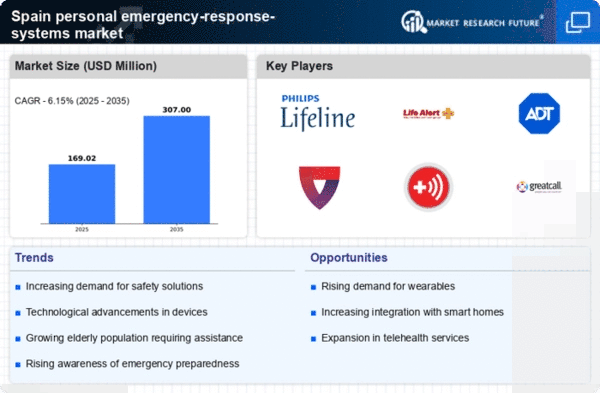
As per Market Research Future analysis, the Spain Personal Emergency Response Systems Market size was estimated at 159.23 USD Million in 2024. The Personal Emergency-response-systems market is projected to grow from 169.02 USD Million in 2025 to 307.0 USD Million by 2035, exhibiting a compound annual growth rate (CAGR) of 6.1% during the forecast period 2025 - 2035

Key Market Trends & Highlights

The Spain personal emergency-response-systems market is experiencing notable growth driven by technological advancements and demographic shifts.

  • Technological advancements are enhancing the functionality and accessibility of personal emergency-response systems.
  • The aging population in Spain is contributing to an increased demand for reliable emergency-response solutions.
  • The largest segment in this market is the home-based emergency-response systems, while the fastest-growing segment is mobile emergency-response applications.
  • Rising health awareness and increased government initiatives are key drivers propelling market expansion.

Market Size & Forecast

2024 Market Size 159.23 (USD Million)
2035 Market Size 307.0 (USD Million)
CAGR (2025 - 2035) 6.15%

Major Players

Philips Lifeline (US), Life Alert (US), ADT Inc. (US), Medical Guardian (US), Bay Alarm Medical (US), GreatCall (US), MobileHelp (US), Vigilant (US)

Our Impact
Enabled $4.3B Revenue Impact for Fortune 500 and Leading Multinationals
Partnering with 2000+ Global Organizations Each Year
30K+ Citations by Top-Tier Firms in the Industry

Spain Personal Emergency Response Systems Market Trends

The Spain Personal Emergency Response Systems Market is experiencing notable growth, driven by an increasing awareness of safety and security among the population. This market encompasses devices and services designed to assist individuals in emergencies, particularly the elderly and those with health concerns. The rise in the aging population in Spain has led to a heightened demand for these systems, as families seek reliable solutions to ensure the well-being of their loved ones. Furthermore, advancements in technology have facilitated the development of more sophisticated and user-friendly devices, which are appealing to a broader audience. In addition to technological innovations, the regulatory environment in Spain appears to be supportive of the personal emergency-response-systems market. Government initiatives aimed at enhancing healthcare services and promoting independent living for seniors contribute to the market's expansion. The integration of mobile applications and wearable technology into emergency-response systems is also noteworthy, as it enhances accessibility and responsiveness. As the market evolves, it is likely to witness further innovations that cater to the specific needs of users, ensuring that personal emergency-response systems remain a vital component of personal safety strategies.

Technological Advancements

The personal emergency-response-systems market is experiencing rapid technological advancements, particularly in the areas of connectivity and user interface. Innovations such as mobile applications and wearable devices are enhancing the functionality of emergency-response systems, making them more accessible and efficient for users. This trend indicates a shift towards more integrated solutions that cater to the needs of a diverse demographic.

Aging Population

The increasing aging population in Spain is significantly influencing the personal emergency-response-systems market. As more individuals seek to maintain independence while ensuring their safety, the demand for reliable emergency-response solutions is likely to rise. This demographic shift suggests a growing market opportunity for providers of these essential services.

Regulatory Support

The regulatory landscape in Spain appears to be increasingly favorable for the personal emergency-response-systems market. Government initiatives aimed at improving healthcare access and promoting safety for vulnerable populations are likely to bolster market growth. This supportive environment may encourage innovation and investment in emergency-response technologies.

Spain Personal Emergency Response Systems Market Drivers

Growing Urbanization

The trend of urbanization in Spain contributes to the expansion of the personal emergency-response-systems market. As more individuals move to urban areas, the need for efficient emergency response solutions becomes increasingly critical. Urban environments often present unique challenges, such as higher population density and increased risk of accidents. Consequently, residents are more inclined to invest in personal emergency-response systems that can provide immediate assistance in case of emergencies. Data suggests that urban areas in Spain have seen a population increase of approximately 5% over the past five years, which correlates with a rising demand for safety solutions. This urban growth is likely to drive innovation and competition within the personal emergency-response-systems market, as companies strive to meet the needs of a more diverse and densely populated consumer base.

Rising Health Awareness

The increasing awareness of health and safety among the Spanish population is driving the personal emergency-response-systems market. As individuals become more conscious of their health, the demand for systems that provide immediate assistance in emergencies is likely to rise. This trend is particularly evident among older adults, who are more susceptible to health issues. According to recent data, approximately 20% of the Spanish population is over 65 years old, a demographic that often seeks reassurance through emergency-response systems. The personal emergency-response-systems market is expected to benefit from this heightened awareness, as families prioritize the safety of their loved ones. Furthermore, educational campaigns about the importance of quick response in emergencies may further stimulate market growth, indicating a shift towards proactive health management.

Rising Insurance Coverage

The expansion of insurance coverage for personal emergency-response systems is emerging as a significant driver in the market. In Spain, insurance companies are increasingly recognizing the value of these systems in reducing emergency response times and improving health outcomes. As a result, many insurers are offering policies that cover the costs associated with purchasing and maintaining personal emergency-response systems. This trend is likely to encourage more consumers to invest in such systems, as they can now do so with financial support from their insurance providers. Recent statistics indicate that approximately 30% of new insurance policies in Spain now include provisions for emergency-response systems, reflecting a growing acknowledgment of their importance. This shift not only enhances market accessibility but also promotes a culture of safety and preparedness among the population.

Technological Integration

The integration of advanced technologies into personal emergency-response-systems drives market growth in Spain. Innovations such as GPS tracking, mobile applications, and wearable devices enhance the functionality of these systems, making them more appealing to consumers. For instance, the incorporation of real-time location tracking allows emergency responders to reach individuals faster, potentially saving lives. The personal emergency-response-systems market is witnessing a surge in demand for devices that can seamlessly connect with smartphones and other smart home technologies. This trend is likely to continue as technology evolves, with an estimated growth rate of 15% in the adoption of smart emergency-response devices over the next five years. As consumers seek more reliable and efficient solutions, the market is poised for significant expansion.

Increased Government Initiatives

Government initiatives aimed at improving public safety and health services are significantly influencing the personal emergency-response-systems market. In Spain, various programs are being implemented to promote the use of emergency-response systems, particularly among vulnerable populations. These initiatives often include subsidies or financial assistance for low-income families, making these systems more accessible. Recent reports indicate that government funding for health and safety programs has increased by 10% in the last year, reflecting a commitment to enhancing emergency response capabilities. This support not only encourages the adoption of personal emergency-response systems but also fosters partnerships between public and private sectors, further driving market growth. As these initiatives continue to evolve, they are likely to create a more favorable environment for the personal emergency-response-systems market.


Market Segment Insights

By Type: Mobile PERS (Largest) vs. Standalone PERS (Fastest-Growing)

In the Spain personal emergency-response-systems market, Mobile PERS represents the largest segment, solidifying its stronghold as the preferred choice among consumers due to its flexibility and ease of use. Standalone PERS, while not as dominant, exhibits significant growth, capturing interest with its user-friendly features and standalone functionalities, gaining traction in the market especially among seniors seeking simplicity. The other segment values like Transmitters and R-cube monitoring systems also play integral roles but have lesser shares in comparison. Growth trends in the Spain personal emergency-response-systems market are heavily influenced by the increasing aging population and a rising awareness of health monitoring systems. Mobile PERS thrives on the demand for portability and connectivity, enabling users to access emergency assistance anytime, anywhere. The burgeoning technology in wearable devices propels Standalone PERS, underlining the shift towards more comprehensive, integrated solutions that promote independent living among seniors. Continuous advancements in communication technology further fuel this growth, making emergency response systems more reliable and efficient.

Mobile PERS (Dominant) vs. Standalone PERS (Emerging)

Mobile PERS dominates the Spain personal emergency-response-systems market due to its high mobility and real-time connectivity features, appealing to users who prioritize an active lifestyle. This segment is characterized by its integration with smartphones and GPS technology, ensuring users have constant access to emergency support. On the other hand, Standalone PERS has emerged as a noteworthy alternative, particularly among those who prefer a straightforward, easy-to-use device without the need for additional technology. This segment is gaining popularity due to its affordable options and straightforward functionality, making it an attractive choice for cost-conscious consumers, especially the elderly who may not be technologically savvy. As both segments evolve, they are likely to complement each other, catering to a wider range of user needs.

By Component: Fall detection sensors (Largest) vs. Bed sensors (Fastest-Growing)

In the Spain personal emergency-response-systems market, the component segment is dominated by fall detection sensors, which command a significant market share. Meanwhile, smoke detectors and pull-cord residential systems also hold noteworthy positions but are outpaced by the growth of bed sensors. The diversity in consumer preferences has led to a varied distribution among these components, with some focusing on immediate alert functionalities while others prioritize ongoing monitoring solutions. The market is witnessing a promising upward trajectory, driven primarily by an aging population that is increasingly adopting fall detection and monitoring technologies. Additionally, technological advancements are making systems more user-friendly and efficient, significantly boosting consumer adoption. The trend towards integrating smart home technologies in emergency response systems further enhances the growth potential of bed sensors, which are becoming a preferred choice among users seeking convenience and reliability.

Smoke detectors (Dominant) vs. Pull-cord residential (Emerging)

Smoke detectors remain a dominant component in the market due to their critical role in ensuring safety and quick response in emergencies. Their widespread acceptance is attributed to regulatory compliance and consumer awareness regarding fire hazards. Conversely, pull-cord residential systems are emerging as a viable option for those seeking a simplified emergency alert mechanism, especially among elderly users. While they offer basic functionality, their simplicity and ease of use make them appealing, leading to a gradual increase in market presence. The growth of pull-cord systems reflects a shift towards more accessible and economically viable emergency solutions, catering to users who prioritize straightforward operation alongside basic safety.

By End-user: Home-based users (Largest) vs. Nursing homes (Fastest-Growing)

In the Spain personal emergency-response-systems market, home-based users hold the largest market share among end-user segments, driven by the increasing preference for independence among seniors living at home. Assisted living facilities and senior living facilities also contribute significantly to the market, yet their shares are smaller compared to the dominant home-based user segment. Nursing homes and hospices represent niche markets but are crucial due to their specialized needs for emergency response systems. Growth trends indicate a shift towards home-based solutions, fueled by advancements in technology that enhance accessibility and ease of use for seniors. As the population ages, there's an increasing demand for personalized, home-centric emergency response systems. Meanwhile, nursing homes are expanding their facilities, embracing fast-tracked technologies, which positions them as the fastest-growing segment. This reflects a broader trend towards integrated care solutions in residential settings.

Home-based users (Dominant) vs. Nursing homes (Emerging)

Home-based users within the Spain personal emergency-response-systems market are characterized by their need for reliable, accessible systems that facilitate independence and peace of mind for seniors living alone. These users prioritize devices that offer emergency alerts and monitoring capabilities without intrusive intervention. In contrast, nursing homes represent an emerging segment, where facilities are increasingly adopting advanced emergency response technologies to ensure the safety of their residents. These institutions focus on integrating comprehensive care services, striving to enhance the quality of life for their residents while accommodating the growing demand for technology-driven health solutions.

Get more detailed insights about Spain Personal Emergency Response Systems Market

Key Players and Competitive Insights

The personal emergency-response-systems market in Spain features a competitive landscape increasingly shaped by technological advancements and evolving consumer preferences. Key growth drivers include an aging population, rising health awareness, and the integration of smart technologies into emergency response systems. Major players such as Philips Lifeline (US), Life Alert (US), and ADT Inc. (US) are strategically positioned to leverage these trends. Philips Lifeline (US) focuses on innovation through the development of advanced wearable devices that enhance user safety, while Life Alert (US) emphasizes its long-standing reputation for reliability and customer service. ADT Inc. (US) is actively pursuing partnerships with healthcare providers to expand its service offerings, thereby enhancing its market presence. Collectively, these strategies contribute to a competitive environment that is both dynamic and multifaceted.In terms of business tactics, companies are increasingly localizing manufacturing and optimizing supply chains to enhance operational efficiency. The market structure appears moderately fragmented, with several key players vying for market share. This fragmentation allows for diverse offerings, yet the influence of major companies remains significant, as they set benchmarks for quality and service standards that smaller firms often strive to meet.
In October Philips Lifeline (US) announced the launch of a new AI-driven monitoring system designed to predict potential health emergencies before they occur. This strategic move is likely to position the company at the forefront of proactive health management, potentially reducing emergency incidents and enhancing user trust. The integration of AI into their systems may also streamline operations and improve response times, thereby reinforcing their competitive edge.
In September Life Alert (US) expanded its service coverage to include rural areas in Spain, addressing a critical gap in emergency response for underserved populations. This expansion not only broadens their customer base but also aligns with the growing demand for accessible emergency services in less populated regions. By enhancing their geographical reach, Life Alert (US) is likely to strengthen its market position and brand loyalty among consumers who prioritize reliability in emergency situations.
In August ADT Inc. (US) entered into a strategic partnership with a leading telehealth provider to integrate remote health monitoring into its emergency response services. This collaboration is expected to enhance the value proposition of ADT's offerings, allowing for a more comprehensive approach to health and safety. By combining emergency response with telehealth capabilities, ADT Inc. (US) may attract a broader demographic, particularly among aging populations who require continuous health monitoring.
As of November the competitive trends in the personal emergency-response-systems market are increasingly defined by digitalization, sustainability, and the integration of AI technologies. Strategic alliances are becoming more prevalent, as companies recognize the value of collaborative innovation in enhancing service delivery. Looking ahead, competitive differentiation is likely to evolve from traditional price-based competition to a focus on technological innovation, service reliability, and supply chain resilience. This shift suggests that companies that prioritize these aspects will be better positioned to thrive in an increasingly complex market.

Key Companies in the Spain Personal Emergency Response Systems Market include

Industry Developments

Recent developments in the Spain Personal Emergency Response Systems Market demonstrate significant growth and innovation. Companies like Connect America, Vital Link, Ada Health, and Philips Lifeline are introducing advanced technologies, including integrated health monitoring systems and wearable devices tailored to the aging population, which represents a key demographic in Spain.

Current trends also show a surge in consumer demand for reliable PERS solutions, particularly amid the increasing concerns over home safety due to the pandemic aftermath. In terms of mergers and acquisitions, there have been notable movements; for example, Tunstall Healthcare has expanded its reach in Spain through partnerships, enhancing its service portfolio in the region during the latter part of 2022.

Additionally, companies like Medical Alert and Alert1 are ramping up their marketing efforts to target senior citizens more effectively.

Over the past couple of years, from 2021 to 2023, the market valuation of key players, including Lifeline Systems and Secure Call, has seen a positive trend, spurred by technological advancements and a growing awareness of personal safety solutions. The Spanish government continues to emphasize support for technology in elder care, further propelling growth in this sector.

Future Outlook

Spain Personal Emergency Response Systems Market Future Outlook

The personal emergency-response-systems market in Spain is projected to grow at a 6.15% CAGR from 2025 to 2035, driven by technological advancements and increasing demand for safety solutions.

New opportunities lie in:

  • Integration of AI-driven analytics for predictive maintenance Development of mobile applications for real-time alerts Expansion into telehealth services for remote monitoring

By 2035, the market is expected to achieve robust growth, reflecting evolving consumer needs and technological innovations.

Market Segmentation

Spain Personal Emergency Response Systems Market Type Outlook

  • Standalone PERS
  • Transmitters
  • R-cube monitoring systems
  • Standalone voice dialers
  • Wandering systems
  • Medical alarm systems
  • Landline PERS
  • Mobile PERS
  • Wireless
  • GPS
  • Cellular

Spain Personal Emergency Response Systems Market End-user Outlook

  • Nursing homes
  • Home-based users
  • Assisted living facilities
  • Hospices
  • Senior living facilities

Spain Personal Emergency Response Systems Market Component Outlook

  • Smoke detectors
  • Bed sensors
  • Pull-cord residential
  • Fall detection sensors
  • Flood detectors

Report Scope

MARKET SIZE 2024 159.23(USD Million)
MARKET SIZE 2025 169.02(USD Million)
MARKET SIZE 2035 307.0(USD Million)
COMPOUND ANNUAL GROWTH RATE (CAGR) 6.15% (2025 - 2035)
REPORT COVERAGE Revenue Forecast, Competitive Landscape, Growth Factors, and Trends
BASE YEAR 2024
Market Forecast Period 2025 - 2035
Historical Data 2019 - 2024
Market Forecast Units USD Million
Key Companies Profiled Philips Lifeline (US), Life Alert (US), ADT Inc. (US), Medical Guardian (US), Bay Alarm Medical (US), GreatCall (US), MobileHelp (US), Vigilant (US)
Segments Covered Type, Component, End-user
Key Market Opportunities Integration of advanced wearable technology enhances user engagement in the personal emergency-response-systems market.
Key Market Dynamics Rising demand for advanced personal emergency-response-systems driven by aging population and regulatory support in Spain.
Countries Covered Spain
Leave a Comment

FAQs

What is the expected market size of the Spain Personal Emergency Response Systems Market in 2024?

The expected market size of the Spain Personal Emergency Response Systems Market in 2024 is 143.28 million USD.

What will be the projected market size by 2035?

The projected market size of the Spain Personal Emergency Response Systems Market by 2035 is 290.00 million USD.

What is the expected CAGR for the Spain Personal Emergency Response Systems Market from 2025 to 2035?

The expected CAGR for the Spain Personal Emergency Response Systems Market from 2025 to 2035 is 6.62%.

What are the key players in the Spain Personal Emergency Response Systems Market?

Key players in the Spain Personal Emergency Response Systems Market include Connect America, Vital Link, Ada Health, Alert1, and Philips Lifeline.

Which type of Personal Emergency Response Systems is expected to have the highest growth by 2035?

By 2035, the Standalone voice dialer segment is expected to reach a market value of 70.0 million USD.

What is the market size for Standalone PERS in 2024?

The market size for Standalone PERS in 2024 is projected at 30.0 million USD.

What is the market value of the Wandering system segment in 2024?

The Wandering system segment is valued at 33.28 million USD in 2024.

What is the expected growth rate for the Transmitter segment from 2024 to 2035?

The Transmitter segment is expected to grow from 25.0 million USD in 2024 to 50.0 million USD by 2035.

What challenges may affect the Spain Personal Emergency Response Systems Market in the coming years?

Challenges such as regulatory hurdles and technological advancements may impact the market growth in the coming years.

How does the Spanish market for Personal Emergency Response Systems compare regionally?

The Spain Personal Emergency Response Systems Market showcases significant growth potential, driven by an aging population and increasing demand for safety solutions.

Download Free Sample

Kindly complete the form below to receive a free sample of this Report

Compare Licence

×
Features License Type
Single User Multiuser License Enterprise User
Price $4,950 $5,950 $7,250
Maximum User Access Limit 1 User Upto 10 Users Unrestricted Access Throughout the Organization
Free Customization
Direct Access to Analyst
Deliverable Format
Platform Access
Discount on Next Purchase 10% 15% 15%
Printable Versions