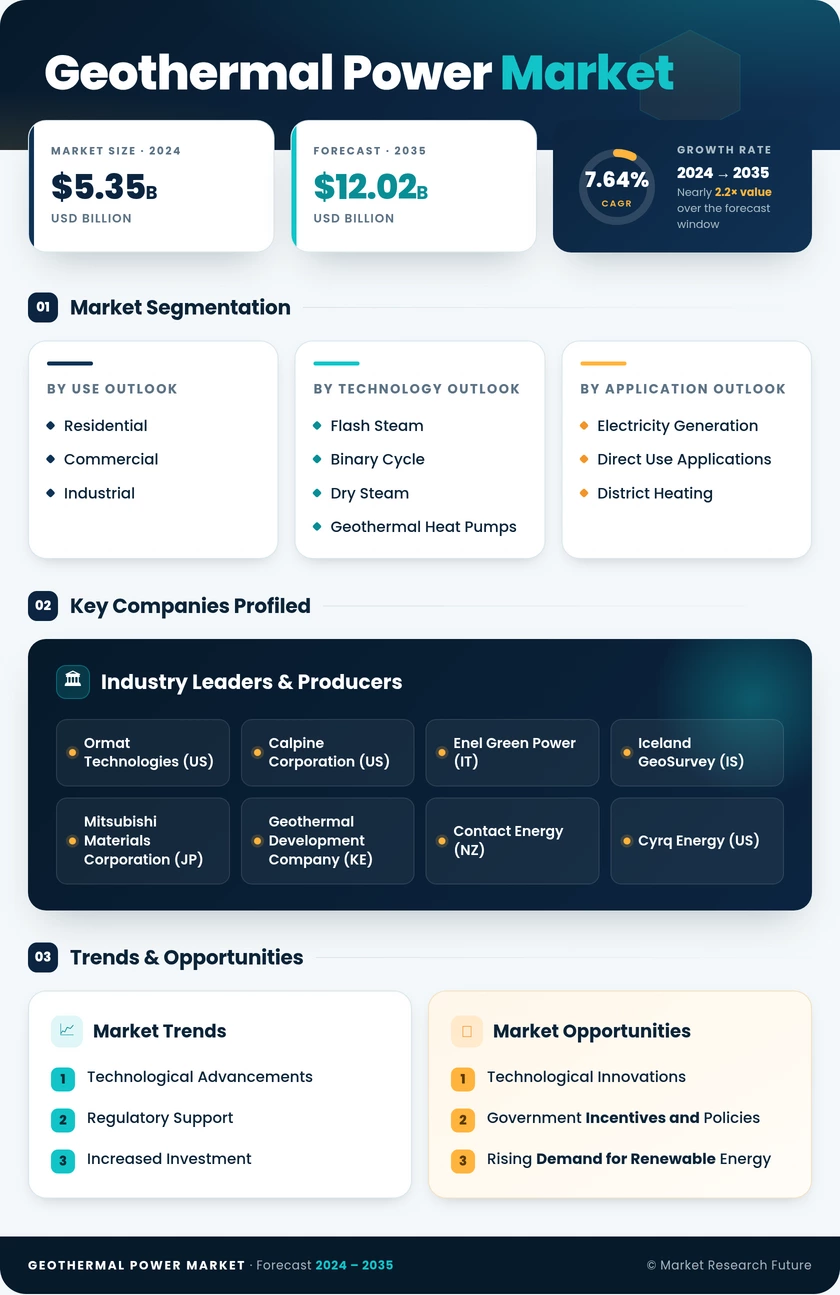
Geothermal Power Market (2026 - 2035)

ID: MRFR/EnP/7259-HCR 200 Pages Chitranshi Jaiswal Last Updated: October 16, 2026
Geothermal Power Market Research Report By Plant Type (Flash Steam, Binary Cycle (ORC), Dry Steam, Enhanced Geothermal Systems (EGS), Hybrid and Other Configurations), By Application (Electricity Generation, District Heating and Cooling, Industrial Process Heat, Greenhouse and Aquaculture, Balneology and Other Direct Use), By End User (Utilities and Independent Power Producers, Industrial Enterprises, Commercial and Institutional Buildings, Municipal and District Network Operators, Residential), By Resource Temperature (High Enthalpy (>180°C), Medium Enthalpy (100–180°C), Low Enthalpy (<100°C)) - Forecast to 2035
Geothermal Power Market
Market Size
Forecast Period2026-2035
CAGR (2026-2035)9.7%
2025 Market SizeUSD 8.42 Billion
2035 Market SizeUSD 21.22 Billion
Key Players
Ormat Technologies
Enel Green Power
Pertamina Geothermal Energy
Contact Energy
Calpine
KenGen
Opportunities
  • Lithium Co-Production from Geothermal Brine
  • Behind-the-Meter Supply for Computing Loads
  • East African Rift Capacity Build-Out
  1. 1 Market Overview | |
    1. 1.1 Study Assumptions & Market Definition | |
    2. 1.2 Scope of the Study | |
    3. 1.3 Research Methodology | |
  2. 2 Market Summary & Key Report Takeaways | |
    1. 2.1 Key Takeaways by Technology | |
    2. 2.2 Key Takeaways by Sector | |
    3. 2.3 Key Takeaways by Geography | |
  3. 3 Global Market Size & Forecast (2021–2035) | |
    1. 3.1 Historical Market Size (2021–2024) | |
    2. 3.2 Base Year Assessment (2025) | |
    3. 3.3 Forecast Market Size (2026–2035) | |
    4. 3.4 Year-over-Year Growth Analysis | |
  4. 4 Market Drivers Analysis | |
    1. 4.1 Clean Firm Power Procurement Mandates | |
    2. 4.2 Drilling Cost Deflation from Shale Technique Transfer | |
    3. 4.3 Feed-in Tariffs and Sovereign De-Risking in Southeast Asia | |
    4. 4.4 Data Center Firm-Power Offtake | |
    5. 4.5 European Heat Decarbonization Directives | |
    6. 4.6 U.S. Exploration Grants and Credit Transferability | |
    7. 4.7 Organic Rankine Efficiency Gains at Low Enthalpy | |
  5. 5 Market Restraints Analysis | |
    1. 5.1 Exploration and Resource Confirmation Risk | |
    2. 5.2 Capital Intensity per Installed Megawatt | |
    3. 5.3 Permitting Duration and Land Access | |
    4. 5.4 Induced Seismicity and Community Resistance | |
    5. 5.5 High-Temperature Equipment Supply Bottlenecks | |
  6. 6 Market Opportunity Analysis | |
    1. 6.1 Lithium Co-Production from Geothermal Brine | |
    2. 6.2 Behind-the-Meter Supply for Computing Loads | |
    3. 6.3 East African Rift Capacity Build-Out | |
    4. 6.4 Repowering Legacy Steam Fields with Bottoming Cycles | |
    5. 6.5 Subsurface Data Monetization and Digital Reservoir Twins | |
    6. 6.6 Industry Value Chain Analysis | |
    7. 6.7 Porter's Five Forces Analysis | |
  7. 7 Regional Market Share & Country-Level Analysis | |
    1. 7.1 North America | | |
      1. 7.1.1 United States | | |
      2. 7.1.2 Canada | | |
      3. 7.1.3 Mexico | |
    2. 7.2 Europe | | |
      1. 7.2.1 Germany | | |
      2. 7.2.2 United Kingdom | | |
      3. 7.2.3 France | | |
      4. 7.2.4 Italy | | |
      5. 7.2.5 Spain | | |
      6. 7.2.6 Nordic Countries | | |
      7. 7.2.7 Russia | | |
      8. 7.2.8 Rest of Europe | |
    3. 7.3 Asia-Pacific | | |
      1. 7.3.1 China | | |
      2. 7.3.2 India | | |
      3. 7.3.3 Japan | | |
      4. 7.3.4 South Korea | | |
      5. 7.3.5 ASEAN | | |
      6. 7.3.6 Rest of Asia-Pacific | |
    4. 7.4 South America | | |
      1. 7.4.1 Brazil | | |
      2. 7.4.2 Argentina | | |
      3. 7.4.3 Rest of South America | |
    5. 7.5 Middle East & Africa | | |
      1. 7.5.1 Saudi Arabia | | |
      2. 7.5.2 United Arab Emirates | | |
      3. 7.5.3 South Africa | | |
      4. 7.5.4 Egypt | | |
      5. 7.5.5 Rest of Middle East & Africa | |
  8. 8 Future Outlook (2026–2035) | |
    1. 8.1 Autonomous Reservoir and Plant Operations | |
    2. 8.2 Repricing of Clean Firm Capacity | |
    3. 8.3 The Heat Electrification and District Energy Wave | |
    4. 8.4 Disclosure Frameworks and Cost of Capital | |
  9. 9 Segmentation Analysis | |
    1. 9.1 By Plant Type | | |
      1. 9.1.1 Flash Steam | | |
      2. 9.1.2 Binary Cycle (ORC) | | |
      3. 9.1.3 Dry Steam | | |
      4. 9.1.4 Enhanced Geothermal Systems (EGS) | | |
      5. 9.1.5 Hybrid and Other Configurations | |
    2. 9.2 By Application | | |
      1. 9.2.1 Electricity Generation | | |
      2. 9.2.2 District Heating and Cooling | | |
      3. 9.2.3 Industrial Process Heat | | |
      4. 9.2.4 Greenhouse and Aquaculture | | |
      5. 9.2.5 Balneology and Other Direct Use | |
    3. 9.3 By End User | | |
      1. 9.3.1 Utilities and Independent Power Producers | | |
      2. 9.3.2 Industrial Enterprises | | |
      3. 9.3.3 Commercial and Institutional Buildings | | |
      4. 9.3.4 Municipal and District Network Operators | | |
      5. 9.3.5 Residential | |
    4. 9.4 By Resource Temperature | | |
      1. 9.4.1 High Enthalpy (>180°C) | | |
      2. 9.4.2 Medium Enthalpy (100–180°C) | | |
      3. 9.4.3 Low Enthalpy (<100°C) | |
  10. 10 Competitive Landscape | |
    1. 10.1 Market Concentration Analysis (2026) | |
    2. 10.2 Competitive Benchmarking Matrix | |
    3. 10.3 Company Profiles | | |
      1. 10.3.1 Ormat Technologies | | |
      2. 10.3.2 Enel Green Power | | |
      3. 10.3.3 Pertamina Geothermal Energy | | |
      4. 10.3.4 Contact Energy | | |
      5. 10.3.5 Calpine | | |
      6. 10.3.6 KenGen | | |
      7. 10.3.7 Mitsubishi Power | | |
      8. 10.3.8 Toshiba Energy Systems & Solutions | | |
      9. 10.3.9 Fuji Electric | | |
      10. 10.3.10 Turboden | | |
      11. 10.3.11 Fervo Energy | | |
      12. 10.3.12 Baker Hughes | |
  11. 11 Recent Developments & News (2023–2025) | |
  12. 12 Report Scope & Methodology | |
    1. 12.1 Study Period & Base Year | |
    2. 12.2 Estimation Framework | |
    3. 12.3 Abbreviations | |
  13. 13 Detailed Sources & Citations | |
  14. 14 Frequently Asked Questions | | LIST OF TABLES | |
  15. TABLE 1 Global Geothermal Power Market Size & Forecast, by Revenue (USD Billion), 2021–2035 | |
  16. TABLE 2 Global Geothermal Power Market — Year-over-Year Growth Analysis, 2021–2035 | |
  17. TABLE 3 Driver Impact Analysis — Contribution to Growth Rate, 2026–2035 | |
  18. TABLE 4 Restraint Impact Analysis — Drag on Growth Rate, 2026–2035 | |
  19. TABLE 5 Global Geothermal Power Market Size, by Region, 2021–2035 (USD Billion) | |
  20. TABLE 6 North America Geothermal Power Market Size, by Country, 2021–2035 (USD Billion) | |
  21. TABLE 7 Europe Geothermal Power Market Size, by Country, 2021–2035 (USD Billion) | |
  22. TABLE 8 Asia-Pacific Geothermal Power Market Size, by Country, 2021–2035 (USD Billion) | |
  23. TABLE 9 South America Geothermal Power Market Size, by Country, 2021–2035 (USD Billion) | |
  24. TABLE 10 Middle East & Africa Geothermal Power Market Size, by Country, 2021–2035 (USD Billion) | |
  25. TABLE 11 Global Geothermal Power Market Size, by Plant Type, 2021–2035 (USD Billion) | |
  26. TABLE 12 Global Geothermal Power Market Size, by Application, 2021–2035 (USD Billion) | |
  27. TABLE 13 Global Geothermal Power Market Size, by End User, 2021–2035 (USD Billion) | |
  28. TABLE 14 Global Geothermal Power Market Size, by Resource Temperature, 2021–2035 (USD Billion) | |
  29. TABLE 15 North America Geothermal Power Market Size, by Plant Type, 2021–2035 (USD Billion) | |
  30. TABLE 16 North America Geothermal Power Market Size, by Application, 2021–2035 (USD Billion) | |
  31. TABLE 17 Europe Geothermal Power Market Size, by Plant Type, 2021–2035 (USD Billion) | |
  32. TABLE 18 Europe Geothermal Power Market Size, by Application, 2021–2035 (USD Billion) | |
  33. TABLE 19 Asia-Pacific Geothermal Power Market Size, by Plant Type, 2021–2035 (USD Billion) | |
  34. TABLE 20 Asia-Pacific Geothermal Power Market Size, by Application, 2021–2035 (USD Billion) | |
  35. TABLE 21 South America Geothermal Power Market Size, by Plant Type, 2021–2035 (USD Billion) | |
  36. TABLE 22 Middle East & Africa Geothermal Power Market Size, by Plant Type, 2021–2035 (USD Billion) | |
  37. TABLE 23 United States Geothermal Power Market Size, by Application, 2021–2035 (USD Billion) | |
  38. TABLE 24 Indonesia and ASEAN Geothermal Power Market Size, by Plant Type, 2021–2035 (USD Billion) | |
  39. TABLE 25 Competitive Benchmarking Matrix — Global Geothermal Power Market, 2026 | |
  40. TABLE 26 Company Profiles — Key Players, Global Geothermal Power Market | |
  41. TABLE 27 Recent Developments & Strategic Announcements, 2023–2025 | |
  42. TABLE 28 Report Scope & Methodology Summary | |
  43. TABLE 29 Detailed Sources & Citations Index | | LIST OF FIGURES | |
  44. FIGURE 1 Global Geothermal Power Market — Market Dynamics Overview (Drivers, Restraints, Opportunities) | |
  45. FIGURE 2 Industry Value Chain Analysis — Exploration to Distribution | |
  46. FIGURE 3 Porter's Five Forces Analysis — Global Geothermal Power Market | |
  47. FIGURE 4 Global Market Size Trend & Forecast, 2021–2035 (USD Billion) | |
  48. FIGURE 5 Year-over-Year Growth Trajectory, 2022–2035 (%) | |
  49. FIGURE 6 Market Share by Plant Type, 2025 vs 2035 (%) | |
  50. FIGURE 7 Market Share by Application, 2025 vs 2035 (%) | |
  51. FIGURE 8 Market Share by End User, 2025 (%) | |
  52. FIGURE 9 Market Share by Resource Temperature, 2025 (%) | |
  53. FIGURE 10 Regional Market Share Distribution, 2025 (%) | |
  54. FIGURE 11 Regional Growth Rate Comparison, 2026–2035 (CAGR %) | |
  55. FIGURE 12 North America Country-Level Share Breakdown, 2025 (%) | |
  56. FIGURE 13 Europe Country-Level Share Breakdown, 2025 (%) | |
  57. FIGURE 14 Asia-Pacific Country-Level Share Breakdown, 2025 (%) | |
  58. FIGURE 15 Competitive Landscape — Estimated Revenue Share Bands, 2026 | |
  59. FIGURE 16 Competitive Positioning Matrix — Capability vs Geographic Reach | |
  60. FIGURE 17 Levelized Cost Trajectory by Plant Type, 2021–2035 | |
  61. FIGURE 18 Investment Flow into Enhanced Geothermal Systems, 2021–2025 (USD Million)

Segmentation Quick Reference

DimensionSub-SegmentsDominant SegmentFastest Growing Segment
By Plant TypeFlash Steam; Binary Cycle (ORC); Dry Steam; Enhanced Geothermal Systems (EGS); Hybrid and Other ConfigurationsFlash SteamEnhanced Geothermal Systems (EGS)
By ApplicationElectricity Generation; District Heating and Cooling; Industrial Process Heat; Greenhouse and Aquaculture; Balneology and Other Direct UseElectricity GenerationDistrict Heating and Cooling
By End UserUtilities and Independent Power Producers; Industrial Enterprises; Commercial and Institutional Buildings; Municipal and District Network Operators; ResidentialUtilities and Independent Power ProducersMunicipal and District Network Operators
By Resource TemperatureHigh Enthalpy (>180°C); Medium Enthalpy (100–180°C); Low Enthalpy (<100°C)High Enthalpy (>180°C)Low Enthalpy (<100°C)
By GeographyNorth America; Europe; Asia-Pacific; South America; Middle East & AfricaAsia-PacificAsia-Pacific


Market Segmentation Overview

By Plant Type

Sub-SegmentKey Trend
Flash SteamSingle- and double-flash units dominate volcanic-arc capacity; repowering focus shifts to separator efficiency
Binary Cycle (ORC)Working-fluid and turbine improvements expand viable resource temperature downward
Dry SteamVapour-dominated fields concentrate in a small number of legacy assets requiring make-up drilling
Enhanced Geothermal Systems (EGS)Horizontal drilling and staged stimulation cut per-well cost sharply across successive iterations
Hybrid and Other ConfigurationsSolar-thermal augmentation and combined heat-and-power schemes raise annual utilization


Plant type selection is dictated almost entirely by reservoir enthalpy rather than by developer preference. High-temperature fields default to flash configurations for capital efficiency, while medium-temperature resources require closed-loop organic Rankine conversion. Enhanced systems sit apart because they create rather than locate a reservoir, which is why their cost curve behaves like a manufacturing learning curve.

By Application

Sub-SegmentKey Trend
Electricity GenerationFirm-capacity accreditation reform improves revenue quality for baseload output
District Heating and CoolingNetwork conversion mandates in Europe drive retrofit of existing distribution assets
Industrial Process HeatSub-150°C process loads align closely with binary-accessible resource temperatures
Greenhouse and AquacultureYear-round controlled-environment production expands in Nordic and Anatolian clusters
Balneology and Other Direct UseTourism and wellness infrastructure sustains stable, low-growth direct thermal demand


Application mix is shifting from a near-exclusive electricity orientation toward a balanced thermal and power portfolio. Heat applications carry lower capital cost per unit of delivered energy and face less competition from variable renewables, though revenue is governed by local tariff regulation rather than wholesale price formation.

By End User

Sub-SegmentKey Trend
Utilities and Independent Power ProducersResource adequacy requirements elevate the planning value of continuous output
Industrial EnterprisesInternal carbon pricing makes firm renewable heat cost-comparable with displaced fuel
Commercial and Institutional BuildingsCampus, hospital and airport thermal retrofits adopt shared ground-loop architectures
Municipal and District Network OperatorsStatutory decarbonization obligations force fossil boiler replacement on fixed timetables
ResidentialCommunity-scale shared loops replace individual installations in dense housing stock


Buyer sophistication varies widely across these groups, which affects contracting norms. Utilities negotiate detailed availability and curtailment terms, industrial buyers prioritize delivered thermal cost stability, and municipal operators optimize for regulatory compliance and network tariff recovery rather than for return on capital.

By Resource Temperature

Sub-SegmentKey Trend
High Enthalpy (>180°C)Conversion efficiency advantage sustains value leadership despite geographic concentration
Medium Enthalpy (100–180°C)Binary generation and industrial heat applications compete for the same resource band
Low Enthalpy (<100°C)Heat pump coupling and shallow drilling make near-ubiquitous resources commercially viable


Temperature banding is the most useful lens for assessing addressable opportunity, because it maps directly onto both technology cost and geographic availability. The commercial frontier is moving downward through the temperature stack as conversion and heat pump equipment improves, which progressively decouples industry growth from proximity to plate boundaries.




Download PDF ×

We do not share your information with anyone. However, we may send you emails based on your report interest from time to time. You may contact us at any time to opt-out.