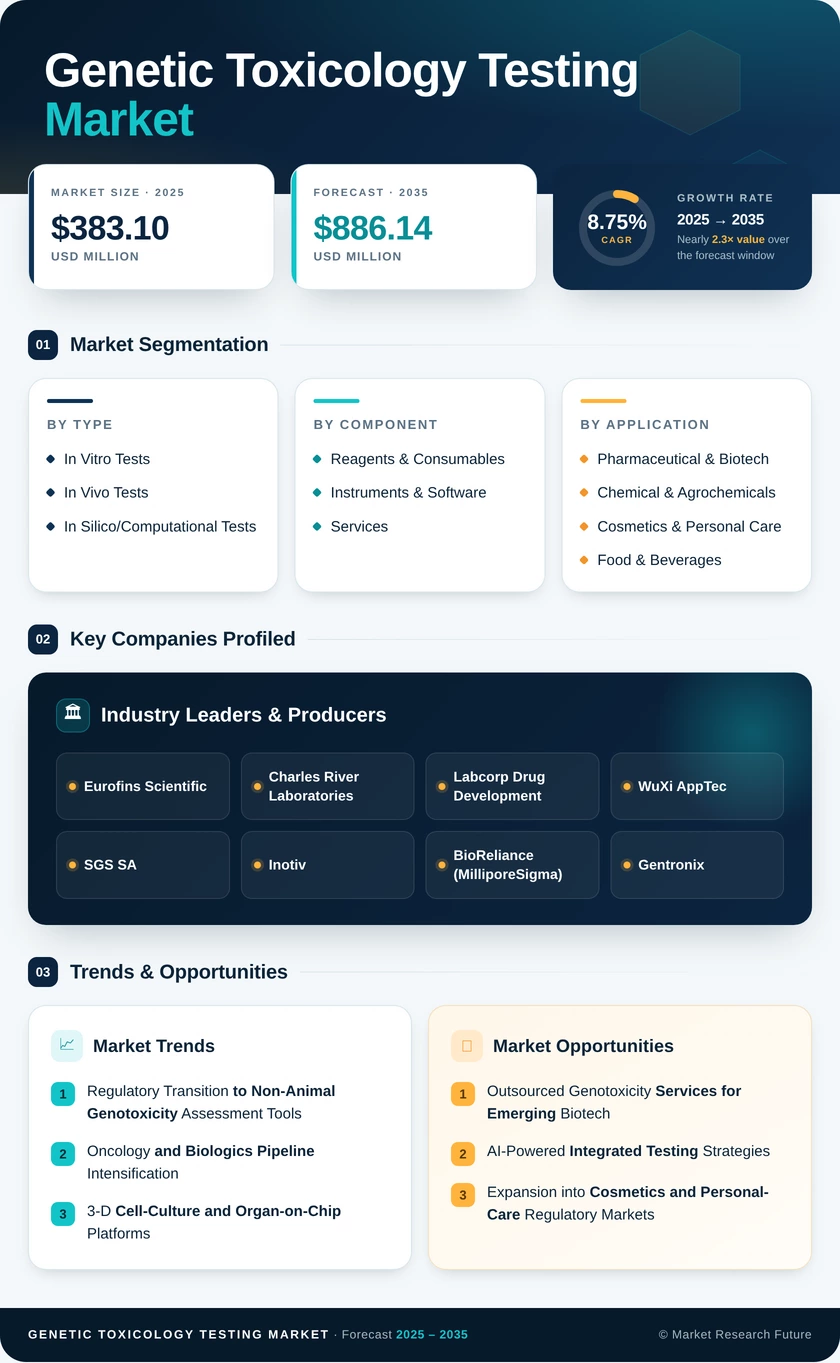
Segmentation Quick Reference
| Dimension | Sub-Segments | Dominant Segment | Fastest Growing Segment |
| Test Type | In Vitro Tests; In Vivo Tests; In Silico/Computational Tests | In Vitro Tests | In Silico/Computational Tests |
| Component | Instruments & Software; Reagents & Consumables; Services | Reagents & Consumables | Services |
| Application | Genetic Toxicology Testing Market & Biotech; Chemical & Agrochemicals; Cosmetics & Personal Care; Food & Beverages | Genetic Toxicology Testing Market & Biotech | Chemical & Agrochemicals |
| Geography | North America; Europe; Asia-Pacific; South America; Middle East & Africa | North America | Asia-Pacific |
Market Segmentation Overview
By Test Type
| Sub-Segment | Key Trend |
| In Vitro Tests | ICH S2(R1) standard battery mandates driving sustained dominance; Ames test and micronucleus assay remain regulatory gold standards |
| In Vivo Tests | Confirmatory role for follow-up assessment under regulatory frameworks; declining share as in vitro predictivity improves |
| In Silico/Computational Tests | ICH M7 impurity assessment and QSAR model maturation driving fastest adoption; deep-learning architectures enhancing predictive accuracy |
In vitro tests continue to anchor global genetic toxicology workflows because regulatory agencies require at least two validated in vitro endpoints — typically bacterial reverse mutation and mammalian cell genotoxicity — before permitting clinical-stage advancement. Computational methods are gaining traction as ICH M7 acceptance broadens and QSAR training databases expand.
By Component
| Sub-Segment | Key Trend |
| Instruments & Software | Capital investment in high-throughput screening platforms and LIMS software for data management |
| Reagents & Consumables | Non-discretionary recurring spend on bacterial strains, S9 fractions, culture media, and staining reagents |
| Services | Outsourcing trend accelerating among small and mid-cap biotech firms lacking in-house GLP capacity |
Reagents and consumables benefit from a replenishment-driven revenue model that delivers predictable demand regardless of macroeconomic cycles. Contract testing services are gaining share as the cost and complexity of maintaining GLP-certified laboratories drive pharmaceutical sponsors toward specialised CRO partners.
By Application
| Sub-Segment | Key Trend |
| Genetic Toxicology Testing Market & Biotech | IND-enabling preclinical packages requiring tiered genotoxicity batteries; biologics-specific assay development |
| Chemical & Agrochemicals | REACH, EPA, and national pesticide re-registration programmes mandating mutagenicity data |
| Cosmetics & Personal Care | EU, India, and South Korea animal-testing bans compelling transition to validated in vitro alternatives |
| Food & Beverages | EFSA and FDA novel-food and food-contact-material regulations requiring genotoxicity dossiers |
Genetic Toxicology Testing Market and biotech end users dominate demand because every investigational new drug must clear genotoxicity screening before entering human trials. The agrochemical segment is expanding as regulatory agencies worldwide tighten pesticide re-registration requirements, mandating updated mutagenicity data for legacy active ingredients.
By Geography
| Sub-Segment | Key Trend |
| North America | Largest market; FDA pipeline throughput and advanced CRO infrastructure |
| Europe | REACH and cosmetics regulation driving comprehensive genotoxicity data requirements |
| Asia-Pacific | Fastest growing; biologics manufacturing expansion in China and India; biosimilar filings |
| South America | ANVISA harmonisation with ICH guidelines; agrochemical sector testing demand |
| Middle East & Africa | Nascent but growing; Vision 2030 and SAHPRA modernisation driving GLP lab investment |
North America maintains its leading position through the sheer volume of IND and NDA submissions processed annually by the FDA, coupled with the continent's dense network of GLP-certified CROs. Asia-Pacific is rapidly closing the gap as China's NMPA accelerates biologics approvals and India's contract testing sector scales to serve global pharmaceutical sponsors.


 Noah Malgeri
Co-Founder
Noah Malgeri
Co-Founder

 Peter Groot koerkamp
Account and Business Manager
Peter Groot koerkamp
Account and Business Manager

 Younghwan Choi
Senior Retail Manager
Younghwan Choi
Senior Retail Manager

 Mark Irwin
Management Consultant
Mark Irwin
Management Consultant

 Akif Moroglu
Strategy & Business Development Director
Akif Moroglu
Strategy & Business Development Director

 Guilherme Gomes Martins
Product Management Director
Guilherme Gomes Martins
Product Management Director

 Joseph Aguayo
Sales Operations & Pricing Manager
Joseph Aguayo
Sales Operations & Pricing Manager

 La Terria Dodd
Program Support Specialist
La Terria Dodd
Program Support Specialist

 Rob Kooiker
Group Product Manager HVAC & Fire Protection GMA
Rob Kooiker
Group Product Manager HVAC & Fire Protection GMA