유전 독성 시험 시장 (2026 - 2035)

Genetic Toxicology Testing Market Research Report: Size, Share, Trend Analysis By Testing Methodology (In Vitro Testing, In Vivo Testing, Computational Toxicology, High-Throughput Screening), By Applications Area (Pharmaceuticals, Cosmetics, Agricultural Chemicals, Biotechnology), By End Users (Pharmaceutical Companies, Research Institutions, Contract Research Organizations (CROs), Government Agencies), By Types of Genetic Toxicology Test (Ames Test, Micronucleus Test, Comet Assay, Chromosomal Aberration Test) and By Regional (North America, Europe, South America, Asia Pacific, Middle East and Africa) - Growth Outlook & Industry Forecast 2026 To 2035
ID: MRFR/LS/30246-HCR 100 Pages Rahul Gotadki, Kinjoll Dey Last Updated: November 07, 2026
Genetic Toxicology Testing Market
Market Size
Forecast Period2026-2035
CAGR (2026-2035)8.75%
2025 Market SizeUSD 383.10 Million
2035 Market SizeUSD 886.14 Million
Key Players
Eurofins Scientific
Charles River Laboratories
Labcorp Drug Development
WuXi AppTec
SGS SA
Inotiv
Opportunities
  • Outsourced Genotoxicity Services for Emerging Biotech
  • AI-Powered Integrated Testing Strategies
  • Expansion into Cosmetics and Personal-Care Regulatory Markets

유전 독성 시험 시장 시장 요약

The Global Genetic Toxicology Testing Market size was valued at USD 383.10 Million in 2025, and the market is projected to grow from USD 416.52 Million in 2026 to USD 886.14 Million by 2035, registering a CAGR of 8.75% during the forecast period 2026–2035. Two catalysts underpin this trajectory: global pharmaceutical R&D expenditure exceeded USD 288 billion in 2024, with oncology and biologics pipelines requiring rigorous mutagenicity testing assays at every preclinical gate [1]; simultaneously, the U.S. FDA Modernization Act 2.0 eliminated statutory language mandating animal studies for new drugs, channeling demand toward validated in vitro and computational genotoxicity assessment tools .

A technology inflection is reshaping how sponsors screen drug candidates for DNA damage. Legacy rodent-based chromosomal aberration testing protocols and conventional Ames test genetic toxicology workflows are giving way to 3-D spheroid cultures, organ-on-chip devices, and transformer-based predictive models that cut study cycle time by up to 40% . The European Union's REACH revision earmarked EUR 45 million for non-animal DNA damage testing services infrastructure between 2024 and 2027, accelerating lab upgrades across contract research organizations .

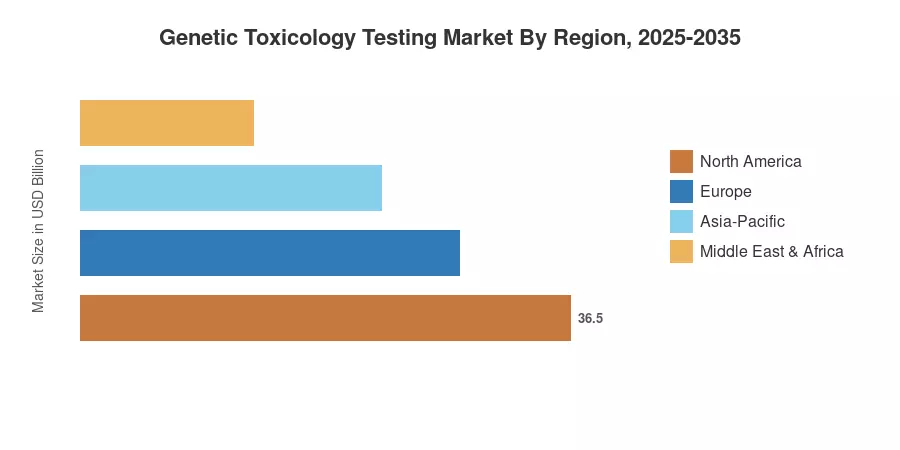
North America commands approximately 39.5% of the genetic toxicology testing market, anchored by the FDA's Center for Drug Evaluation and Research pipeline throughput. Asia-Pacific represents the fastest-growing region, posting an estimated 10.30% CAGR through 2035 as China and India expand biologics manufacturing capacity. Europe, contributing roughly 29.2% of global revenue, continues to drive demand via its regulatory preference for in vitro genotoxicity screening under OECD Test Guidelines [5]. The decade ahead promises accelerated adoption of AI-enabled mutagenicity testing assays and harmonized international standards for DNA damage testing services.

Key Report Takeaways

• By Test Type

  • In vitro tests held approximately 69.0% of the genetic toxicology testing market share in 2025, led by the Ames test genetic toxicology platform and micronucleus assays.
  • In silico/computational tests are forecast to register a 9.45% CAGR during 2026–2035, fueled by AI-driven genotoxicity assessment tools.
  • In vivo testing remains essential for confirmatory chromosomal aberration testing under ICH S2(R1) guidelines.

• By Component

  • Reagents and consumables captured 42.4% of the genetic toxicology testing market in 2025.
  • The services segment is projected to expand at a 9.85% CAGR through 2035 as sponsors outsource DNA damage testing services.

• By Region

  • North America led the genetic toxicology testing market with USD 151.32 million in 2025.
  • Asia-Pacific is growing fastest at 10.30% CAGR, driven by expanding pharmaceutical R&D in China, India, and Japan.

Market Size and Forecast (2026–2035)

Market size estimates integrate bottom-up revenue analysis from over 60 CROs, reagent manufacturers, and software vendors, triangulated against top-down pharmaceutical R&D budget allocation data from OECD and WHO sources [6].
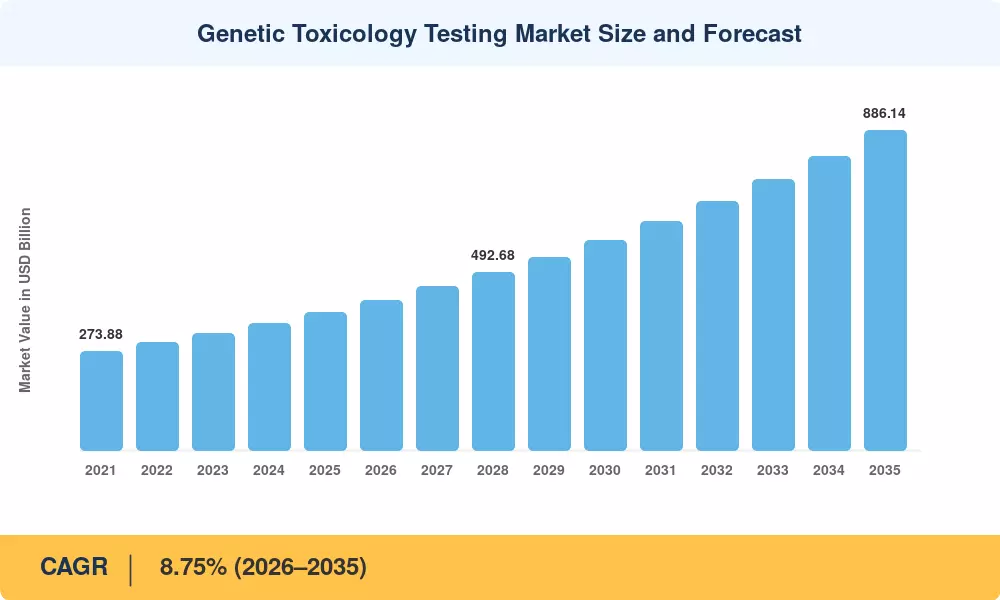
Genetic Toxicology Testing Market Size and Forecast
Our Impact

Enabled $4.3B Revenue Impact for Fortune 500 and Leading Multinationals

Partnering with 2000+ Global Organizations Each Year

30K+ Citations by Top-Tier Firms in the Industry

Driver Impact Analysis

Driver ~% Impact on CAGR Geographic Relevance Impact Timeline
Regulatory push for non-animal (in vitro & in silico) assays +2.3% Global; strongest in EU & North America Medium term (2–4 yr)
Rising R&D spend in oncology & biologics pipelines +1.9% Global; concentrated in North America & Europe Long term (≥ 4 yr)
High-throughput & 3-D cell-culture platform adoption +1.5% North America & EU; expanding to APAC Short term (≤ 2 yr)
AI-enabled predictive genotoxicity analytics +1.3% Global; led by North America & Europe Medium term (2–4 yr)
OECD standardisation of DNA-damage reference materials +0.95% Global; OECD-coordinated Long term (≥ 4 yr)
Expansion of cosmetics animal-testing bans worldwide +0.8% EU, India, South Korea, Brazil Medium term (2–4 yr)
Growth of biosimilar regulatory filings in emerging markets +0.6% APAC & South America Long term (≥ 4 yr)


Regulatory Transition to Non-Animal Genotoxicity Assessment Tools

The FDA Modernization Act 2.0, signed in December 2022, struck mandatory animal-testing language from the Federal Food, Drug, and Cosmetic Act, opening a statutory pathway for sponsors to file INDs supported entirely by in vitro genotoxicity screening and computational evidence . Within 18 months, the agency approved three New Drug Applications that relied on integrated in silico/in vitro mutagenicity testing assays in place of traditional rodent studies, setting a precedent that European regulators are expected to mirror under REACH's 2027 revision .

Oncology and Biologics Pipeline Intensification

Global oncology R&D spending topped USD 68 billion in 2024, with over 6,500 molecules in active clinical development [1]. Each candidate must pass a tiered battery of DNA damage testing services — starting with the Ames test genetic toxicology screen and advancing to chromosomal aberration testing and in vivo comet assays — before receiving first-in-human clearance. Biologics, which now represent 42% of FDA approvals, require specialized genotoxicity assessment tools adapted for complex protein therapeutics, a gap that contract testing labs are racing to fill [7].

3-D Cell-Culture and Organ-on-Chip Platforms

Organ-on-chip devices developed by firms such as Emulate and CN Bio replicate hepatic metabolism with higher fidelity than two-dimensional monocultures, reducing false-positive rates in chromosomal aberration testing by an estimated 25–30% . The NIH's Microphysiological Systems Program allocated USD 140 million between 2017 and 2024 to accelerate qualification of these platforms for regulatory submissions, and ICH's draft Q14 guideline references 3-D models as acceptable mutagenicity testing assays for early-stage hazard identification [12].

AI-Enabled Predictive Toxicology

Transformer-based machine-learning models trained on public Ames test genetic toxicology datasets now achieve area-under-the-curve scores exceeding 0.90 for bacterial mutagenicity prediction [9]. Platforms such as Lhasa Limited's Derek Nexus and Instem's Leadscope pair structural alerts with quantitative dose-response modeling, enabling sponsors to deprioritize compounds with high mutagenic liability before committing to costly GLP-compliant DNA damage testing services [13].

Restraints Impact Analysis

Restraint percentages represent estimated downward pressure on market growth; they do not offset driver impacts on a one-to-one basis.

Restraint ~% Impact on CAGR Geographic Relevance Impact Timeline
High instrument and validation costs for small CROs –1.1% Global; acute in emerging markets Medium term (2–4 yr)
Regulatory lag in accepting in silico data as standalone evidence –0.9% APAC & South America Long term (≥ 4 yr)
Shortage of qualified genetic toxicologists –0.7% Global Long term (≥ 4 yr)
Inconsistent international harmonisation of test guidelines –0.5% Global; OECD vs non-OECD divergence Medium term (2–4 yr)
Data-integrity concerns with AI-generated genotoxicity predictions –0.4% North America & EU Short term (≤ 2 yr)


Capital Barriers for Emerging-Market Laboratories

A fully equipped in vitro genotoxicity screening laboratory — covering flow cytometry for micronucleus detection, automated colony counters for mutagenicity testing assays, and GLP-grade laminar flow cabinets — requires USD 1.2–1.8 million in upfront capital . For mid-tier CROs in India, Brazil, and Southeast Asia, this figure can exceed 18 months of operating revenue, limiting their ability to participate in the growing outsourced DNA damage testing services pipeline.

Regulatory Acceptance Gaps for Computational Methods

While the FDA and EMA have signalled receptivity to in silico genotoxicity assessment tools, many national agencies in Latin America, Africa, and parts of Southeast Asia still mandate conventional in vivo studies as the default confirmatory step [5]. Until OECD Test Guideline 497 — the Integrated Approach to Testing and Assessment for mutagenicity — achieves broader adoption, computational toxicology vendors face fragmented market access and protracted validation timelines.

유전 독성 시험 시장 기회

Outsourced Genotoxicity Services for Emerging Biotech

Small and mid-cap biotech companies, representing 65% of Phase I IND applications in 2024, are seeking to outsource full preclinical safety packages rather than develop internal expertise for chromosomal aberration testing. A CRO offering integrated DNA damage tests from bacterial reverse mutation to in vitro micronucleus and computational screening can generate recurring revenue from multi-compound pipeline agreements.


AI-Powered Integrated Testing Strategies

Regulatory acceptance of ICH M7-compliant in silico mutagenicity prediction opens up a new SaaS business stream for software suppliers. Integrated platforms that marry quantitative structure-activity relationship (QSAR) engines with automated Ames test genetic toxicology read-across are well-positioned to scale across therapeutic domains and can potentially lower sponsor study expenditures by 30–40%.


Expansion into Cosmetics and Personal-Care Regulatory Markets

The EU prohibition of animal testing for cosmetics under Regulation (EC) 1223/2009, a stance echoed by India, South Korea, and numerous ASEAN countries, leaves cosmetic makers with little choice but to rely on approved in vitro genotoxicity screening batteries [10]. This category is smaller than pharmaceuticals but is growing at double-digit rates and represents an addressable potential worth an estimated USD 58 million by 2030.


Standardised Reference-Material Commercialisation

The OECD Mutual Acceptance of Data program is producing approved reference compounds for mutagenicity testing assays, giving reagent makers a regular revenue stream from consumables. Vendors that obtain early supply agreements with national metrology institutes will gain pricing leverage.


Data-Monetisation and Platform Analytics

Testing laboratories generate millions of dose-response data points annually from Ames test genetic toxicology and chromosomal aberration testing campaigns. Anonymised, curated datasets can be licensed to pharmaceutical companies and AI developers building next-generation genotoxicity assessment tools — a data-as-a-service model analogous to clinical-trial data exchanges already operating in the pharmacovigilance space.

유전 독성 시험 시장 향후 전망

AI-Autonomous Genotoxicity Screening Pipelines

By 2030, fully automated screening workflows that integrate robotic liquid handling, high-content imaging, and AI-based mutagenicity prediction are expected to reduce end-to-end study timelines from 8 weeks to under 10 days [9]. These closed-loop systems will redefine throughput economics in the genetic toxicology testing market and lower the per-compound cost of genotoxicity assessment tools by 50–60%.

Platform Convergence and Organ-on-Chip Scale-Up

Organ-on-chip developers are pursuing multi-organ configurations that combine hepatic, renal, and bone-marrow compartments, enabling simultaneous DNA damage testing services and ADME profiling on a single device [12]. The global microphysiological systems sector is forecast to exceed USD 400 million by 2030, with genetic toxicology applications constituting a fast-growing vertical.

ESG-Driven Demand for Non-Animal Testing

Investor and consumer pressure on ESG compliance is pushing pharmaceutical and cosmetics companies to disclose animal-testing metrics in annual sustainability reports [10]. Companies transitioning from in vivo confirmatory studies to validated in vitro genotoxicity screening batteries will benefit from improved ESG scores and reduced regulatory timelines, reinforcing growth in the genetic toxicology testing market.

Harmonised Global Data Portability

OECD's Mutual Acceptance of Data programme, combined with ICH's ongoing revision of the M7 and S2(R1) guidelines, aims to create a single submission-ready mutagenicity testing assay data package accepted across 40+ regulatory jurisdictions by 2032 [5]. This harmonisation will eliminate duplicative studies and expand the addressable market for computational genotoxicity assessment tools globally.

Regional Market Share Analysis

Region Metric Primary Investment Themes
North America 39.5% share (2025) FDA pipeline throughput; in silico regulatory acceptance
Europe 29.2% share (2025) REACH revision; cosmetics testing ban enforcement
Asia-Pacific 10.30% CAGR (2026–2035) Biologics manufacturing expansion; biosimilar filings
South America USD 23.37 Million (2025) Brazil ANVISA harmonisation; agricultural chemicals
Middle East & Africa 4.4% share (2025) Pharma sector diversification; GLP lab certification
**Total** **USD 383.10 Million (2025)** —

The genetic toxicology testing market exhibits distinct regional dynamics shaped by regulatory frameworks, pharma R&D concentration, and CRO infrastructure maturity.


North America

Country Metric Key Driver
United States 81.2% of regional share FDA CDER preclinical submission volume
Canada 10.8% of regional share Health Canada alignment with ICH guidelines
Mexico USD 12.10 Million (2025) COFEPRIS modernisation programme


North America's dominance in the genetic toxicology testing market reflects the United States' unmatched pharmaceutical pipeline — over 4,800 INDs were active in 2024 — and its CRO ecosystem, where Charles River Laboratories and Labcorp Drug Development operate GLP-certified mutagenicity testing assays at scale. Canada's Health Canada adopted ICH S2(R1) without modification, streamlining cross-border DNA damage testing services, while Mexico's COFEPRIS has introduced expedited review pathways for generics that accept foreign genotoxicity data [16].

Europe

Country Metric Key Driver
Germany 7.85% CAGR (2026–2035) BfArM pharmaceutical approvals pipeline
United Kingdom USD 14.50 Million (2025) MHRA independent post-Brexit framework
France 16.8% of regional share ANSM biologics emphasis
Italy 10.4% of regional share Cosmetics industry cluster demand
Spain 6.20% CAGR (2026–2035) Emerging CRO hub positioning
Nordic Countries USD 7.80 Million (2025) Academic-industry translational research
Russia 4.1% of regional share Domestic pharmaceutical self-sufficiency drive
Rest of Europe USD 11.30 Million (2025) OECD mutual acceptance of data


Europe's regulatory architecture, built around REACH and CLP regulations, mandates comprehensive in vitro genotoxicity screening for chemicals, cosmetics, and agrochemical actives. The European Chemicals Agency processed over 22,000 registration dossiers requiring chromosomal aberration testing data by end-2024 . The UK's MHRA has issued distinct guidance on accepting computational genotoxicity assessment tools, creating a divergent regulatory micro-market post-Brexit.

Asia-Pacific

Country Metric Key Driver
China 32.5% of regional share NMPA biologics registration surge
India 11.45% CAGR (2026–2035) Biosimilar pipeline and contract testing exports
Japan USD 12.90 Million (2025) PMDA advanced therapy approvals
South Korea 9.80% CAGR (2026–2035) K-FDA cosmetics animal-testing ban
ASEAN 8.5% of regional share Pharmaceutical manufacturing FDI
Rest of Asia-Pacific USD 5.20 Million (2025) Capacity building initiatives


Asia-Pacific's rapid expansion in the genetic toxicology testing market is propelled by China's NMPA, which approved a record 85 biologics license applications in 2024, each mandating Ames test genetic toxicology data and in vitro micronucleus assessment . India's biosimilar sponsors — responsible for roughly 40% of global biosimilar filings — are increasingly procuring domestic DNA damage testing services to reduce turnaround time and cost versus Western CROs.

South America

Country Metric Key Driver
Brazil 62.0% of regional share ANVISA pharmaceutical regulatory reform
Argentina 8.15% CAGR (2026–2035) Agricultural chemicals testing demand
Rest of South America USD 5.10 Million (2025) Regional CRO network expansion


Brazil dominates the South American genetic toxicology testing market through ANVISA's alignment with ICH genotoxicity guidelines and the country's sizeable agrochemical sector, which requires mutagenicity testing assays for pesticide active ingredients under Resolution RDC 294/2019 [18].

Middle East & Africa

Country Metric Key Driver
Saudi Arabia 28.5% of regional share Vision 2030 pharmaceutical localisation
UAE 7.90% CAGR (2026–2035) Free-zone CRO investment incentives
South Africa USD 3.40 Million (2025) SAHPRA regulatory modernisation
Egypt 14.2% of regional share Generic pharmaceutical production hub
Rest of MEA USD 3.80 Million (2025) Infrastructure development programmes


Saudi Arabia's Vision 2030 has channelled SAR 8 billion into domestic pharmaceutical manufacturing, creating demand for local chromosomal aberration testing and DNA damage testing services laboratories that can support registration dossiers without relying on overseas CROs [19].

Genetic Toxicology Testing Market By Region, 2025-2035

유전 독성 시험 시장 시장 세분화

By Test Type

Segment Metric Primary Demand Driver
In Vitro Tests 69.0% share (2025) ICH S2(R1) standard battery requirement
In Vivo Tests USD 84.28 Million (2025) Confirmatory regulatory mandate
In Silico/Computational Tests 9.45% CAGR (2026–2035) ICH M7 impurity assessment adoption


In vitro tests — led by the Ames test genetic toxicology assay and the in vitro micronucleus test — constitute the backbone of the genetic toxicology testing market because regulatory agencies worldwide require at least two in vitro endpoints before advancing to clinical trials. Reagent and kit innovations, such as Xenotech's S9 metabolic activation fractions and Gentronix's GreenScreen HC reporter assay, are improving sensitivity and reducing false-positive rates, further entrenching in vitro dominance.

In silico/computational tests represent the fastest-expanding segment, driven by ICH M7's endorsement of QSAR-based mutagenicity prediction for pharmaceutical impurities. Platforms incorporating deep-learning architectures trained on curated Ames test genetic toxicology databases are achieving predictive accuracies above 90%, enabling sponsors to triage thousands of impurities computationally before committing to wet-lab DNA damage testing services [9].

By Component

Segment Metric Primary Demand Driver
Reagents & Consumables 42.4% share (2025) Recurring spend on culture media, S9 fractions, staining kits
Instruments & Software USD 103.15 Million (2025) Capital upgrades for high-throughput screening
Services 9.85% CAGR (2026–2035) Outsourcing by small and mid-cap biotechs


Reagents and consumables remain the largest component category owing to their non-discretionary, recurring purchase cycle — each Ames test genetic toxicology study consumes bacterial tester strains, top agar, histidine supplements, and positive-control mutagens that must be replenished per study. The services component is expanding most rapidly as sponsors increasingly outsource chromosomal aberration testing and integrated genotoxicity assessment tools packages to CROs with GLP-certified facilities.

By Application

Segment Metric Primary Demand Driver
Pharmaceutical & Biotech 52.8% share (2025) IND-enabling preclinical safety packages
Chemical & Agrochemicals 8.40% CAGR (2026–2035) REACH and EPA pesticide re-registration
Cosmetics & Personal Care USD 32.70 Million (2025) EU animal-testing ban compliance
Food & Beverages 7.15% CAGR (2026–2035) EFSA novel-food genotoxicity dossier requirements


Pharmaceutical and biotech end users drive the majority of the genetic toxicology testing market revenue, as every IND submission to the FDA, EMA, or PMDA must include results from validated mutagenicity testing assays. The cosmetics and personal-care vertical, though smaller in absolute terms, is experiencing accelerated demand for non-animal DNA damage testing services following legislative bans in the EU, India, and South Korea.

Competitive Benchmarking

The genetic toxicology testing market exhibits medium concentration, with an estimated top-five player share of 35–42% and a Herfindahl-Hirschman Index (HHI) below 1,000. Competition centres on GLP-certified lab capacity, proprietary genotoxicity assessment tools, and global regulatory filing support.

Company Est. Revenue Share Range Key Offerings Strategic Positioning
Eurofins Scientific ~8–11% Full-spectrum GLP mutagenicity testing assays; Ames, MN, comet Global CRO scale: 60+ testing sites
Charles River Laboratories ~7–10% Integrated preclinical safety packages; in vitro and in vivo End-to-end drug development partner
Labcorp Drug Development ~6–9% Chromosomal aberration testing; regulatory consulting Strong FDA submission track record
WuXi AppTec ~5–8% High-throughput in vitro genotoxicity screening; APAC hub Cost-competitive capacity in China
SGS SA ~4–7% Agrochemical and industrial chemical genotoxicity testing Multi-sector regulatory compliance
Inotiv ~3–5% In vivo genetic toxicology studies; transgenic rodent assays Niche preclinical specialist
BioReliance (MilliporeSigma) ~3–5% Cell-bank testing; biologics-focused DNA damage testing services Integrated with Merck KGaA life-science supply chain
Gentronix ~2–4% GreenScreen HC assay; high-throughput reporter systems Proprietary in vitro technology platform
Instem ~2–3% Provantis data management; Leadscope QSAR software Software and data analytics for genotoxicity
Xenotech (Sekisui) ~1–3% S9 metabolic fractions; hepatocyte-based assays Reagent and metabolic competence specialist


Recent News & Developments

  • Charles River Laboratories (September 2022) announced a collaboration with Cure AP-4 for gene therapy production. The Charles River is the first CDMO in North America to acquire EMA approval to commercially manufacture allogeneic cell therapy medicinal products.


자주 묻는 질문

스폰서가 아웃소싱된 유전독성 연구를 위한 CRO 파트너를 평가하는 방법은 무엇인가요?
연간 200건 이상의 Ames 테스트 유전독성 처리량을 입증한 국가 당국의 GLP 인증을 보유한 CRO를 우선시하세요. 계약 전에 그들의 능력 시험 참여 및 데이터 무결성 감사 추적을 감사하세요 .
현재 ICH M7 규제 요구 사항을 충족하는 인 실리코 플랫폼은 무엇인가요?
Derek Nexus와 Leadscope는 제약 불순물 돌연변이성 테스트 분석을 위한 ICH M7 지침에서 명시적으로 언급된 두 개의 QSAR 엔진입니다. 두 플랫폼 모두 보완적인 전문가 검토가 필요합니다 [13].
표준 GLP Ames 테스트의 일반적인 비용 범위는 얼마인가요?
5균주 GLP 준수 박테리아 역돌연변이 연구는 대사 활성화 조건에 따라 15,000–25,000 USD의 비용이 발생합니다. OECD TG 471에 따른 축소 플레이트 프로토콜은 비용을 약 20% 줄일 수 있습니다 [5].
오르간-온-칩 모델은 전통적인 염색체 이상 테스트와 어떻게 비교되나요?
간 칩 장치는 전통적인 2-D 배양보다 25–30% 낮은 위양성률을 보이며 대사 능력을 유지합니다. 독립 사용을 위한 규제 자격은 아직 대기 중입니다 .
유전독성 테스트 시장이 APAC의 신규 진입자를 지원할 수 있나요?
아시아-태평양의 10.30% CAGR과 증가하는 바이오시밀러 제출은 특히 인도와 동남아시아에서 지역 DNA 손상 테스트 서비스의 용량이 수요에 미치지 못하는 상황에서 유효한 진입 조건을 만듭니다 .
니트로사민 불순물 우려가 시장 성장에 어떤 역할을 하나요?
EMA의 니트로사민 행동 계획은 위험한 활성 물질을 포함하는 모든 판매 제품에 대해 돌연변이성 테스트 분석을 의무화합니다. 이 단일 이니셔티브는 2028년까지 4,500만 USD 이상의 추가 테스트 수요를 창출할 수 있습니다 [13].
ESG 보고 기준이 유전독성 평가 도구에 대한 수요에 어떤 영향을 미칠까요?
CSRD 및 SEC 기후 공개 프레임워크는 동물 테스트 지표로 확장되고 있으며, 스폰서를 검증된 인 비트로 유전독성 스크리닝으로 유도하여 지속 가능성 점수를 개선하도록 압박하고 있습니다 [10].
저자
저자 Author Profile Rahul Gotadki LinkedIn Research Manager
He holds an experience of about 9+ years in Market Research and Business Consulting, working under the spectrum of Life Sciences and Healthcare domains. Rahul conceptualizes and implements a scalable business strategy and provides strategic leadership to the clients. His expertise lies in market estimation, competitive intelligence, pipeline analysis, customer assessment, etc.
공동 저자 Co-Author Profile Kinjoll Dey LinkedIn Senior Research Analyst
He is an extremely curious individual currently working in Healthcare and Medical Devices Domain. Kinjoll is comfortably versed in data centric research backed by healthcare educational background. He leverages extensive data mining and analytics tools such as Primary and Secondary Research, Statistical Analysis, Machine Learning, Data Modelling. His key role also involves Technical Sales Support, Client Interaction and Project management within the Healthcare team. Lastly, he showcases extensive affinity towards learning new skills and remain fascinated in implementing them.

Research Approach


Secondary Research

The secondary research process involved comprehensive analysis of regulatory databases, peer-reviewed toxicology journals, clinical publications, and authoritative health and environmental organizations. Key sources included the US Food & Drug Administration (FDA) Center for Drug Evaluation and Research (CDER) and Center for Food Safety and Applied Nutrition (CFSAN), European Medicines Agency (EMA), European Chemicals Agency (ECHA) REACH database, Organisation for Economic Co-operation and Development (OECD) Test Guidelines Programme, International Council for Harmonisation of Technical Requirements for Pharmaceuticals for Human Use (ICH) S2(R1) guidelines, US Environmental Protection Agency (EPA) ToxCast and Tox21 programs, National Toxicology Program (NTP) Interagency Center for the Evaluation of Alternative Toxicological Methods (NICEATM), National Institutes of Health (NIH) National Library of Medicine (NLM) PubChem and PubMed, National Center for Biotechnology Information (NCBI), Centers for Disease Control and Prevention (CDC) National Institute for Occupational Safety and Health (NIOSH), World Health Organization (WHO) International Programme on Chemical Safety (IPCS), Environmental Protection UK, Health Canada, Japan Ministry of Health, Labour and Welfare (MHLW), Pharmaceuticals and Medical Devices Agency (PMDA) Japan, China National Medical Products Administration (NMPA), Central Drugs Standard Control Organization (CDSCO) India, and Brazilian Health Regulatory Agency (ANVISA).

Regulatory testing requirements, genotoxicity study protocols, pharmaceutical and chemical safety assessment data, in vitro and in vivo testing adoption trends, and market landscape analysis for Ames testing, micronucleus assays, chromosomal aberration tests, mouse lymphoma assays, and new high-throughput screening technologies were all gathered from these sources.


Primary Research

In order to gather both qualitative and quantitative insights, supply-side and demand-side stakeholders were interviewed during the primary research process. CEOs, VPs of R&D, heads of regulatory affairs, chief scientific officers, and commercial directors from genetic toxicology testing service providers, contract research organizations (CROs), makers of lab equipment, and suppliers of assay kits were examples of supply-side sources. Chief toxicologists, regulatory scientists, quality assurance directors, and procurement leads from pharmaceutical, biotechnology, cosmetic, chemical, food and beverage, and medical device businesses were examples of demand-side sources. Market segmentation, testing service pipeline expansions, regulatory acceptance patterns, testing package pricing strategies, and outsourcing versus in-house laboratory capabilities were all confirmed by primary research.

Primary Respondent Breakdown:

By Designation C-level Primaries (28%), Director Level (35%), Others (37%)

By Region North America (32%), Europe (29%), Asia-Pacific (34%), Rest of World (5%)


Market Size Estimation

Global market valuation was derived through revenue mapping and testing volume analysis. The methodology included:

Identification of 50+ key testing service providers and CROs across North America, Europe, Asia-Pacific, and Latin America

Service mapping across Ames bacterial mutation tests, in vitro micronucleus assays, chromosomal aberration tests, mouse lymphoma TK assays, in vivo comet assays, and emerging next-generation sequencing-based genotoxicity screening

Analysis of reported and modeled annual revenues specific to genetic toxicology testing portfolios

Coverage of service providers and CROs representing 72-78% of global market share in 2024

Extrapolation using bottom-up (testing volume × average service pricing by country and assay type) and top-down (service provider revenue validation) approaches to derive segment-specific valuations

무료 샘플 다운로드

이 보고서의 무료 샘플을 받으려면 아래 양식을 작성하십시오

Download PDF ×

We do not share your information with anyone. However, we may send you emails based on your report interest from time to time. You may contact us at any time to opt-out.
















