Request Free Sample ×

Kindly complete the form below to receive a free sample of this Report

* Please use a valid business email

Leading companies partner with us for data-driven Insights

clients tt-cursor
Hero Background
English
Chinese
French
Japanese
Korean
German
Spanish

Genetic Testing Market Analysis

ID: MRFR/HC/1477-CR
150 Pages
Satyendra Maurya
February 2021

Genetic Testing Market Research Report: Size, Share, Trend Analysis By Applications (Prenatal Testing, Newborn Screening, Carrier Testing, Diagnostic Testing, Predictive Testing), By Types (Single Gene Tests, Panel Tests, Whole Exome Sequencing, Whole Genome Sequencing, Non-Invasive Prenatal Testing), By Service Type (Laboratory Services, Diagnostic Services, Consultation Services), By End Users (Hospitals, Clinical Laboratories, Research Institutions, Homecare Settings) andBy Regional (North America, Europe, South America, Asia Pacific, Middle East and Africa) - Growth Outlook & Industry Forecast 2025 To 2035

Share:
Download PDF ×

We do not share your information with anyone. However, we may send you emails based on your report interest from time to time. You may contact us at any time to opt-out.

Genetic Testing Market Infographic
Purchase Options

Market Analysis

In-depth Analysis of Genetic Testing Market Industry Landscape

Genetic disorders arise from mutations or changes in a person's genetic composition, leading to abnormal outcomes that significantly impact their life. The prevalence of genetic disorders has experienced substantial growth, attributed to various factors such as shifts in geography and environment, alterations in dietary patterns, pollution, and exposure to harmful radiations or chemicals. These disorders profoundly influence an individual's well-being. Compounding the concern is the hereditary nature of genetic disorders, with the potential for them to be passed down from one generation to the next. To address the challenges posed by genetic disorders, there has been a notable surge in the development of genetic tests designed to diagnose these conditions and formulate appropriate interventions. The current market boasts a repertoire of over 2000 genetic tests, reflecting the industry's commitment to advancing diagnostic capabilities. Notably, companies in the field have placed a significant emphasis on the oncology segment, recognizing the substantial impact of genetic disorders in contributing to this life-threatening disease. This focus stems from the recognition that a large segment of the population is affected by various forms of cancer, prompting the development of genetic tests tailored to address these specific concerns.

Beyond oncology, there is an ongoing effort to expand the scope of genetic testing to encompass a broad array of other genetic disorders. The dynamic landscape of genetic research and technological advancements continually gives rise to new tests targeting different aspects of genetic health. This diversification is driven by the recognition that genetic disorders extend beyond cancer, and addressing a wider range of conditions necessitates a comprehensive approach to testing and diagnostics. The escalating prevalence of genetic disorders serves as a driving force behind the growth of the genetic testing market. The increasing demand for effective diagnostic tools and interventions in the face of rising genetic disorder cases has propelled the industry forward. The development of more genetic tests for various disorders reflects a collective effort to meet the evolving healthcare needs of individuals grappling with genetic challenges. As the understanding of genetic disorders deepens and technological capabilities expand, the genetic testing market is poised for further expansion to meet the growing demand for comprehensive and targeted diagnostic solutions.


Author
Author Profile
Satyendra Maurya
Research Analyst

An accomplished research analyst with high proficiency in market forecasting, data visualization, competitive benchmarking, and others. He holds a pronounced track record in research and consulting projects for sectors such as life sciences, medical devices, and healthcare IT. His capabilities in qualitative and quantitative analysis have resulted in positive client outcomes. Working on niche market trends, opportunities, sales, and forecasted value is part of his skill set.

Leave a Comment

FAQs

What is the current valuation of the Genetic Testing Market as of 2024?

<p>The Genetic Testing Market was valued at 13.3 USD Billion in 2024.</p>

What is the projected market valuation for the Genetic Testing Market in 2035?

<p>The market is projected to reach 88.64 USD Billion by 2035.</p>

What is the expected CAGR for the Genetic Testing Market during the forecast period 2025 - 2035?

<p>The expected CAGR for the Genetic Testing Market during 2025 - 2035 is 18.82%.</p>

Which companies are considered key players in the Genetic Testing Market?

<p>Key players in the market include Illumina, Thermo Fisher Scientific, Roche, Abbott Laboratories, Myriad Genetics, 23andMe, Genomic Health, Fulgent Genetics, and Natera.</p>

What are the main application segments of the Genetic Testing Market?

<p>The main application segments include Prenatal Testing, Newborn Screening, Carrier Testing, Diagnostic Testing, and Predictive Testing.</p>

How does the market size for Diagnostic Testing compare to other application segments?

<p>Diagnostic Testing had a valuation of 3.5 USD Billion in 2024, with a projected growth to 25.0 USD Billion by 2035.</p>

What types of genetic tests are included in the market analysis?

<p>The types of genetic tests include Single Gene Tests, Panel Tests, Whole Exome Sequencing, Whole Genome Sequencing, and Non-Invasive Prenatal Testing.</p>

What is the projected market size for Whole Genome Sequencing by 2035?

<p>Whole Genome Sequencing is projected to grow from 3.0 USD Billion in 2024 to 25.0 USD Billion by 2035.</p>

Which service types are analyzed within the Genetic Testing Market?

<p>Service types analyzed include Laboratory Services, Diagnostic Services, and Consultation Services.</p>

What is the expected growth for Clinical Laboratories as an end user in the Genetic Testing Market?

<p>Clinical Laboratories are expected to grow from 4.0 USD Billion in 2024 to 30.0 USD Billion by 2035.</p>

Market Summary

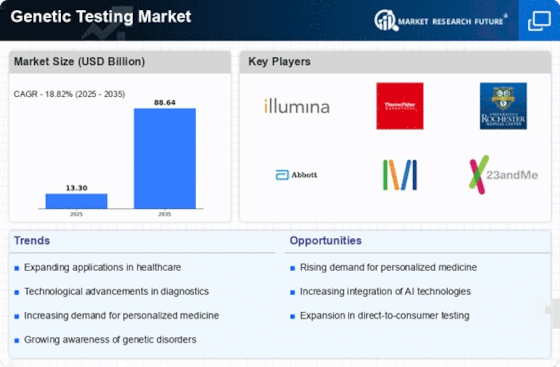
According to MRFR analysis, the Genetic Testing Market Size was valued at USD 13.3 Billion in 2024. The market is projected to grow from USD 15.8 Billion in 2025 to USD 88.64 Billion by 2035, registering a CAGR of 18.82% during the forecast period (2025–2035). North America led the market with over 45.11% share, generating around USD 6 billion in revenue.
 
The Genetic Testing Market is expanding rapidly due to increasing demand for personalized medicine and early disease detection. Key trends include advancements in sequencing technologies, growing adoption of direct-to-consumer genetic tests, and rising applications in cancer screening, prenatal testing, and rare disease diagnosis across healthcare systems.

Key Market Trends & Highlights

The Genetic Testing Market is experiencing robust growth driven by technological advancements and increasing consumer awareness.

  • The demand for preventive healthcare is propelling the Genetic Testing Market forward, particularly in North America. Technological advancements in testing methods are enhancing the accuracy and efficiency of genetic tests, especially in the Asia-Pacific region. Prenatal Testing remains the largest segment, while Whole Genome Sequencing is emerging as the fastest-growing segment in the market. Rising prevalence of genetic disorders and the integration of genetic testing in personalized medicine are key drivers of market expansion.

Market Size & Forecast

2024 Market Size 13.3 (USD Billion)
2035 Market Size 88.64 (USD Billion)
CAGR (2025 - 2035) 18.82%
Largest Regional Market Share in 2024 North America

Major Players

Companies such as Illumina (US), Thermo Fisher Scientific (US), Roche (CH), Abbott Laboratories (US), Myriad Genetics (US), 23andMe (US), Genomic Health (US), Fulgent Genetics (US), Natera (US) are some of the major participants in the global market.

Market Trends

The genetic testing market size expansion is currently experiencing a transformative phase, driven by advancements in technology and an increasing awareness of personalized medicine. As healthcare evolves, genetic testing is becoming integral to disease prevention, diagnosis, and treatment. The rise in chronic diseases and genetic disorders has prompted a greater demand for testing services, which are now more accessible to the general population.

Furthermore, the integration of genetic testing into routine healthcare practices is fostering a shift towards proactive health management, allowing individuals to make informed decisions about their health based on their genetic profiles.

The Genetic Testing Market is witnessing a surge in research and development activities, as companies strive to innovate and enhance testing methodologies. This trend is likely to be bolstered by collaborations between academic institutions and industry players, aiming to explore new applications of genetic testing. 

Regulatory frameworks are also evolving to accommodate the rapid advancements in this field, ensuring that testing services remain safe and reliable. Overall, the market appears poised for substantial growth, with a focus on improving patient outcomes and expanding the scope of genetic insights available to healthcare providers and patients alike.

Increased Demand for Preventive Healthcare

There is a noticeable shift towards preventive healthcare, with individuals seeking genetic testing to identify potential health risks before they manifest. This trend reflects a growing understanding of the importance of early intervention and personalized health strategies.

Technological Advancements in Testing Methods

Genetic testing statistics suggest that innovations in genetic testing technologies are enhancing the accuracy and efficiency of tests. Techniques such as next-generation sequencing are becoming more prevalent, allowing for comprehensive analysis of genetic information and facilitating more precise diagnoses.

Innovations such as next-generation sequencing (NGS) are significantly improving the accuracy and speed of genetic analysis. The National Human Genome Research Institute notes that the cost of sequencing a human genome has dropped from about USD 100 million in 2001 to around USD 1,000 today, greatly expanding the accessibility of genetic testing.

Expansion of Direct-to-Consumer Testing

The rise of direct-to-consumer genetic testing services is reshaping the genetic testing industry. Consumers are increasingly opting for at-home testing kits, which provide insights into ancestry, health risks, and traits, thereby democratizing access to genetic information.

Direct-to-consumer genetic testing services are expanding rapidly, allowing individuals to access genetic insights from home. Companies like 23andMe report that millions of customers have already used at-home genetic testing kits, demonstrating the growing public interest in personal genetic information.

Genetic Testing Market Market Drivers

Rising Prevalence of Genetic Disorders

The increasing incidence of genetic disorders is a primary driver for the Genetic Testing Market. Conditions such as cystic fibrosis, sickle cell anemia, and various hereditary cancers are becoming more prevalent, prompting a greater need for genetic testing.
 
According to recent estimates, approximately 1 in 33 babies is born with a genetic disorder, which underscores the urgency for early detection and intervention. This trend is likely to propel the demand for genetic testing services, as healthcare providers and patients seek to understand genetic risks and make informed decisions. The market is thus positioned to expand significantly as awareness of genetic disorders grows, leading to increased testing and subsequent treatment options.

Advancements in Sequencing Technologies

Technological advancements in sequencing technologies are revolutionizing the Genetic Testing Market. Innovations such as next-generation sequencing (NGS) have dramatically reduced the cost and time required for genetic testing, making it more accessible to a wider population. The cost of sequencing a human genome has plummeted from thousands of dollars to a few hundred, facilitating the growth of genetic testing services.
 
As these technologies continue to evolve, they are likely to enhance the accuracy and efficiency of genetic tests, further driving market expansion. The market stands to gain from these advancements, as healthcare providers increasingly adopt cutting-edge technologies to meet the rising demand for comprehensive genetic testing.

Regulatory Support and Reimbursement Policies

Supportive regulatory frameworks and favorable reimbursement policies are crucial drivers for the Genetic Testing Market. Governments and health organizations are increasingly recognizing the value of genetic testing in preventive healthcare and disease management. As a result, many countries are implementing policies that facilitate access to genetic testing services.
 
Additionally, insurance companies are beginning to cover genetic tests, which alleviates the financial burden on patients. This trend is expected to encourage more individuals to seek genetic testing, thereby expanding the market. The market is likely to experience growth as these supportive measures continue to evolve, promoting wider adoption of genetic testing across various demographics.

Growing Awareness and Acceptance of Genetic Testing

Public awareness and acceptance of genetic testing are on the rise, significantly influencing the Genetic Testing Market. Educational campaigns and media coverage have played a crucial role in demystifying genetic testing, leading to increased consumer interest. Surveys indicate that a substantial percentage of individuals are now more willing to undergo genetic testing for both health and ancestry purposes.
 
This shift in perception is likely to drive market growth, as more people seek out testing services to gain insights into their genetic predispositions. The market is thus expected to benefit from this trend, with a projected increase in the number of tests conducted annually, reflecting a broader societal acceptance of genetic information.

Integration of Genetic Testing in Personalized Medicine

The integration of genetic testing into personalized medicine is transforming the landscape of healthcare, thereby driving the Genetic Testing Market. Personalized medicine tailors treatment plans based on an individual's genetic makeup, enhancing the efficacy of therapies. As healthcare systems increasingly adopt this approach, the demand for genetic testing is expected to rise.
 
For instance, pharmacogenomics, which studies how genes affect a person's response to drugs, is gaining traction. This shift towards personalized treatment strategies is projected to contribute to a market growth rate of over 10% annually in the coming years. Consequently, the market is likely to see a surge in investments and innovations aimed at developing more precise testing methodologies.

Market Segment Insights

By Application: Prenatal Testing (Largest) vs. Newborn Screening (Fastest-Growing)

The market showcases significant distribution among various applications, with Prenatal Testing leading as the largest segment. This application has garnered substantial attention due to rising awareness around maternal health and the importance of genetic information in predicting potential health concerns in fetuses. Conversely, Newborn Screening has emerged rapidly, driven by healthcare policies advocating for thorough screening at birth to ensure early interventions and treatments, thus significantly contributing to the overall market dynamics. Current growth trends indicate a robust demand for genetic testing applications, primarily propelled by advancements in technology and increasing investments in healthcare infrastructure. The need for enhanced diagnostic capabilities and the growing acceptance of genetic testing in preventive healthcare are key drivers. Furthermore, as personalized medicine gains traction, applications like Carrier Testing and Predictive Testing continue to draw interest, indicating a holistic evolution in personal health management and disease prevention strategies.

Prenatal Testing (Dominant) vs. Carrier Testing (Emerging)

The market for testing of genetics report suggests that the Prenatal Testing remains a dominant force within the Genetic Testing Market, characterized by its innovative approaches to assess genetic conditions and congenital anomalies early in pregnancy. Its established protocols and widespread adoption among expectant parents solidify its market foothold. In contrast, Carrier Testing is identified as an emerging segment that plays a crucial role in family planning by identifying individuals who may carry genetic disorders. Its growing relevance is attributed to increasing awareness of inherited conditions and the desire for informed reproductive choices. As healthcare providers emphasize the importance of understanding one's genetic predisposition, the interest in Carrier Testing continues to rise, fostering an environment where informed decision-making becomes integral to personal health.

By Type: Panel Tests (Largest) vs. Whole Genome Sequencing (Fastest-Growing)

The distribution of Genetic Testing Market share among different types of genetic tests reveals that Panel Tests dominate due to their comprehensive nature and ability to screen for multiple conditions simultaneously. Single Gene Tests also hold a significant share, serving specific diagnostic purposes, while Whole Exome Sequencing and Non-Invasive Prenatal Testing follow closely, appealing to different consumer needs. Whole Genome Sequencing, though smaller currently, is emerging as a powerful tool for extensive genetic insights, gaining traction among consumers and healthcare providers alike.

Genetic Testing Type: Panel Tests (Dominant) vs. Whole Genome Sequencing (Emerging)

Panel Tests have established themselves as the dominant player in the market due to their effectiveness in detecting various genetic disorders within a single test. They offer a cost-effective solution for both healthcare providers and patients, allowing for a streamlined approach to genetic testing. In contrast, Whole Genome Sequencing is an emerging technology that promises comprehensive genetic analysis. This method captures all genetic information in a single test, appealing to researchers and clinicians who seek detailed understanding in complex genetic landscapes. As the technology advances, Whole Genome Sequencing is expected to see a surge in adoption rates, making it a significant area of growth in the future.

By Service Type: Laboratory Services (Largest) vs. Consultation Services (Fastest-Growing)

The distribution of market share among service types reveals that Laboratory Services dominate significantly due to their foundational role in the testing process. This segment includes a wide range of testing methodologies, including <a href="https://www.marketresearchfuture.com/reports/dna-sequencing-market-5774" target="_blank" title="dna sequencing">DNA sequencing</a> and genome analysis, which are essential for accurate diagnoses. Diagnostic Services also hold a considerable share but are often integrated with laboratory offerings, while Consultation Services, although smaller in share, are rapidly gaining traction as patients seek personalized guidance and support through the genetic testing journey.

Laboratory Services (Dominant) vs. Consultation Services (Emerging)

Laboratory Services are the dominant force in the Genetic Testing Market, providing essential testing capabilities that form the backbone of genetic diagnostics. These services encompass advanced testing technologies that ensure accuracy and reliability, leading to widespread adoption in clinical and research settings. On the other hand, Consultation Services represent an emerging trend, driven by increasing consumer awareness and demand for tailored genetic insights. This segment enables healthcare professionals to interpret genetic results for patients, aligning with the growing emphasis on personalized medicine. As more individuals seek guidance through complex genetic information, Consultation Services are expected to expand their market presence, influenced by enhanced advocacy for genetic literacy and health management.

By End User: Hospitals (Largest) vs. Clinical Laboratories (Fastest-Growing)

Hospitals hold the largest Genetic Testing Market share among end users, attributed to their comprehensive patient care capabilities and integration of advanced testing technologies. Clinical laboratories follow closely behind, focusing on specific testing solutions that cater to diverse patient needs. Research institutions and homecare settings contribute to the market but remain smaller in comparison, serving niche segments of the population with specialized tests and services.

Hospitals (Dominant) vs. Research Institutions (Emerging)

Hospitals continue to dominate the Genetic Testing Market due to their ability to offer a wide range of tests and facilitate seamless patient care. They utilize cutting-edge technology to provide accurate and timely results to patients, enhancing their treatment options. In contrast, research institutions are emerging as key players, focusing on innovative genetic research and the development of tailored testing solutions. While they currently represent a smaller segment, their role is vital in advancing genetic testing methodologies and driving future innovations in the market.

Get more detailed insights about Genetic Testing Market Research Report - Forecast till 2035

Regional Insights

North America : Leading Innovation and Adoption

North America leads in the Genetic Testing Market Size, accounting for over 45.11% of the global revenue in 2024, driven by advanced healthcare infrastructure, high consumer awareness, and significant investments in research and development. The demand for personalized medicine and preventive healthcare is propelling growth, alongside supportive regulatory frameworks that encourage innovation in genetic testing technologies.

The market for genetic testing USA is the primary contributor, with key players like Illumina, Thermo Fisher Scientific, and Myriad Genetics leading the market. The competitive landscape is characterized by rapid technological advancements and collaborations among companies and research institutions. Canada also plays a significant role, focusing on expanding access to genetic testing services and enhancing public health initiatives.

Europe : Regulatory Frameworks Driving Growth

Europe Genetic Testing Market size was valued at USD 3.99 Billion in 2024, making it the second-largest regional market with a 30% share. The region benefits from stringent regulatory frameworks that ensure the safety and efficacy of genetic tests, alongside increasing public awareness and acceptance of genetic testing.

Countries like Germany and the UK are at the forefront, with supportive policies that promote innovation and accessibility in genetic healthcare. Germany leads the market, followed closely by the UK and France, with a competitive landscape featuring major players like Roche and Abbott Laboratories. The presence of advanced research institutions and a strong focus on personalized medicine are key drivers. Collaborative efforts between public and private sectors are enhancing the development and distribution of genetic testing services across Europe.

Asia-Pacific : Rapid Growth and Adoption

Asia-Pacific is rapidly emerging as a significant player in the genetic testing market, holding around 20% of the global share. The region is driven by increasing healthcare expenditure, rising awareness of genetic disorders, and advancements in technology. Countries like China and India are leading the charge, with government initiatives aimed at enhancing healthcare access and promoting genetic research and testing services.

China is the largest market in the region, supported by a growing population and increasing demand for personalized medicine. India follows closely, with a burgeoning biotechnology sector and a focus on affordable genetic testing solutions. The competitive landscape is evolving, with both local and international players, including Fulgent Genetics and Natera, striving to capture market share through innovative offerings.

Middle East and Africa : Untapped Potential in Healthcare

The Middle East and Africa region is gradually recognizing the potential of genetic testing, currently holding about 5% of the global market share. The growth is driven by increasing healthcare investments, rising awareness of genetic diseases, and a push towards personalized medicine. Countries like South Africa and the UAE are leading the way, with initiatives aimed at improving healthcare infrastructure and access to genetic testing services.

South Africa is the largest market in the region, with a growing number of private and public sector collaborations enhancing the availability of genetic testing. The UAE is also emerging as a hub for genetic research and testing, supported by government initiatives. The competitive landscape is characterized by a mix of local and international players, focusing on expanding their services to meet the growing demand.

Key Players and Competitive Insights

The Genetic Testing Market is currently characterized by a dynamic competitive landscape, driven by rapid technological advancements and increasing consumer demand for personalized healthcare solutions. Key players such as Illumina (US), Thermo Fisher Scientific (US), and Myriad Genetics (US) are at the forefront, each adopting distinct strategies to enhance their market positioning.
 
Illumina (US) focuses on innovation in sequencing technology, aiming to lower costs and improve accessibility, while Thermo Fisher Scientific (US) emphasizes a broad portfolio of genetic testing solutions, catering to both clinical and research applications. Myriad Genetics (US) is strategically positioning itself through partnerships and acquisitions to expand its genetic testing capabilities, particularly in oncology, thereby shaping a competitive environment that is increasingly collaborative and innovation-driven.
 
In terms of business tactics, companies are localizing manufacturing and optimizing supply chains to enhance efficiency and responsiveness to market demands. The Genetic Testing Market appears moderately fragmented, with a mix of established players and emerging companies vying for market share. The collective influence of these key players fosters a competitive structure that encourages innovation and rapid advancements in genetic testing technologies.
 
In August Illumina (US) announced a strategic partnership with a leading healthcare provider to integrate its genomic sequencing technology into routine clinical practice. This collaboration is poised to enhance patient access to advanced genetic testing, thereby reinforcing Illumina's position as a leader in the market. The strategic importance of this partnership lies in its potential to drive adoption of genomic testing in mainstream healthcare, aligning with the growing trend towards personalized medicine.
 
In September Myriad Genetics (US) launched a new genetic test aimed at identifying hereditary cancer risks, which is expected to significantly expand its market reach. This initiative underscores Myriad's commitment to innovation and its focus on oncology, a sector that is increasingly prioritized in genetic testing. The introduction of this test not only enhances Myriad's product offerings but also positions the company to capture a larger share of the growing demand for cancer-related genetic testing.
 
In October Thermo Fisher Scientific (US) unveiled a new digital platform designed to streamline genetic testing workflows for laboratories. This platform integrates advanced analytics and AI capabilities, which could potentially transform laboratory operations and improve turnaround times for test results. The strategic importance of this development lies in its ability to enhance operational efficiency and support laboratories in meeting the increasing demand for genetic testing services.
 
As of October current competitive trends in the Genetic Testing Market are heavily influenced by digitalization, sustainability, and the integration of artificial intelligence. Strategic alliances among key players are shaping the landscape, fostering innovation and collaboration. Looking ahead, competitive differentiation is likely to evolve from traditional price-based competition towards a focus on technological innovation, enhanced service delivery, and supply chain reliability, reflecting the industry's shift towards more sophisticated and personalized healthcare solutions.

Key Companies in the Genetic Testing Market include

Industry Developments

Helix BioPharma Corp.:(June-2025)

Helix BioPharma Corp. Announces CFO Appointment to Support Strategic Growth and Upcoming Milestones: Indicates corporate restructuring and focus on future growth.

Guardant Health: (June-2025)

FDA Grants Breakthrough Device Designation to Guardant Health's Shield MCD Test: This is a significant regulatory milestone, accelerating the review process for their multi-cancer detection blood test.

Invitae: (May -2025)

Labcorp Acquiring Invitae Assets for $239M: This significant development indicates a major restructuring for Invitae, with parts of its business being acquired by Labcorp. This follows Invitae's filing for Chapter 11 bankruptcy protection.

The Global Genetic Testing Market has recently witnessed notable developments, including increased demand for genetic testing services driven by advances in precision medicine and personalized healthcare. In October 2023, Myriad Genetics announced the launch of its new correlative testing platform aimed at enhancing patient care in oncology.

Additionally, in September 2023, Abbott Laboratories expanded its genetic testing portfolio with new tests for hereditary cancer risk, targeting a growing focus on preventative health measures. In terms of mergers and acquisitions, Invitae acquired ArcherDX in September 2020, a significant move aimed at enhancing its molecular diagnostics capabilities.

Similarly, 23andMe announced a partnership with GlaxoSmithKline in July 2023, expanding their collaborative efforts in genetic research to develop new therapies. The market has seen a surge in valuation, with companies like Illumina and Thermo Fisher Scientific reporting robust quarterly earnings due to increased adoption of genetic testing technologies across various healthcare settings.

Over the last couple of years, the market has observed a shift towards home-based genetic testing services, with Color Genomics leveraging digital platforms to reach consumers more effectively. The growing awareness of genetic diseases and advancements in genomic technologies continue to shape the ongoing transformation in this sector.

Future Outlook

Genetic Testing Market Future Outlook

The Genetic Testing Market size is projected to reach USD 88.64 Billion by 2035, growing at a CAGR of 18.82%, driven by technological advancements, increasing consumer awareness, and rising demand for personalized medicine.

New opportunities lie in:

  • <p>Expansion of direct-to-consumer genetic testing services Development of AI-driven genetic analysis platforms Partnerships with healthcare providers for integrated testing solutions</p>

By 2035, the Genetic Testing Market is expected to be a pivotal component of personalized healthcare.

Market Segmentation

Genetic Testing Market Type Outlook

  • Single Gene Tests
  • Panel Tests
  • Whole Exome Sequencing
  • Whole Genome Sequencing
  • Non-Invasive Prenatal Testing

Genetic Testing Market End User Outlook

  • Hospitals
  • Clinical Laboratories
  • Research Institutions
  • Homecare Settings

Genetic Testing Market Application Outlook

  • Prenatal Testing
  • Newborn Screening
  • Carrier Testing
  • Diagnostic Testing
  • Predictive Testing

Genetic Testing Market Service Type Outlook

  • Laboratory Services
  • Diagnostic Services
  • Consultation Services

Report Scope

MARKET SIZE 2024 13.3(USD Billion)
MARKET SIZE 2025 15.8(USD Billion)
MARKET SIZE 2035 88.64(USD Billion)
COMPOUND ANNUAL GROWTH RATE (CAGR) 18.82% (2025 - 2035)
REPORT COVERAGE Revenue Forecast, Competitive Landscape, Growth Factors, and Trends
BASE YEAR 2024
Market Forecast Period 2025 - 2035
Historical Data 2019 - 2024
Market Forecast Units USD Billion
Key Companies Profiled Illumina (US), Thermo Fisher Scientific (US), Roche (CH), Abbott Laboratories (US), Myriad Genetics (US), 23andMe (US), Genomic Health (US), Fulgent Genetics (US), Natera (US)
Segments Covered Applications, Types, Service Type, End Users, Regional
Key Market Opportunities Advancements in personalized medicine drive demand for innovative solutions in the market.
Key Market Dynamics Rising consumer demand for personalized medicine drives innovation and competition in the market.
Countries Covered North America, Europe, APAC, South America, MEA

FAQs

What is the current valuation of the Genetic Testing Market as of 2024?

<p>The Genetic Testing Market was valued at 13.3 USD Billion in 2024.</p>

What is the projected market valuation for the Genetic Testing Market in 2035?

<p>The market is projected to reach 88.64 USD Billion by 2035.</p>

What is the expected CAGR for the Genetic Testing Market during the forecast period 2025 - 2035?

<p>The expected CAGR for the Genetic Testing Market during 2025 - 2035 is 18.82%.</p>

Which companies are considered key players in the Genetic Testing Market?

<p>Key players in the market include Illumina, Thermo Fisher Scientific, Roche, Abbott Laboratories, Myriad Genetics, 23andMe, Genomic Health, Fulgent Genetics, and Natera.</p>

What are the main application segments of the Genetic Testing Market?

<p>The main application segments include Prenatal Testing, Newborn Screening, Carrier Testing, Diagnostic Testing, and Predictive Testing.</p>

How does the market size for Diagnostic Testing compare to other application segments?

<p>Diagnostic Testing had a valuation of 3.5 USD Billion in 2024, with a projected growth to 25.0 USD Billion by 2035.</p>

What types of genetic tests are included in the market analysis?

<p>The types of genetic tests include Single Gene Tests, Panel Tests, Whole Exome Sequencing, Whole Genome Sequencing, and Non-Invasive Prenatal Testing.</p>

What is the projected market size for Whole Genome Sequencing by 2035?

<p>Whole Genome Sequencing is projected to grow from 3.0 USD Billion in 2024 to 25.0 USD Billion by 2035.</p>

Which service types are analyzed within the Genetic Testing Market?

<p>Service types analyzed include Laboratory Services, Diagnostic Services, and Consultation Services.</p>

What is the expected growth for Clinical Laboratories as an end user in the Genetic Testing Market?

<p>Clinical Laboratories are expected to grow from 4.0 USD Billion in 2024 to 30.0 USD Billion by 2035.</p>

  1. SECTION I: EXECUTIVE SUMMARY AND KEY HIGHLIGHTS
    1. | 1.1 EXECUTIVE SUMMARY
    2. | | 1.1.1 Market Overview
    3. | | 1.1.2 Key Findings
    4. | | 1.1.3 Market Segmentation
    5. | | 1.1.4 Competitive Landscape
    6. | | 1.1.5 Challenges and Opportunities
    7. | | 1.1.6 Future Outlook
  2. SECTION II: SCOPING, METHODOLOGY AND MARKET STRUCTURE
    1. | 2.1 MARKET INTRODUCTION
    2. | | 2.1.1 Definition
    3. | | 2.1.2 Scope of the study
    4. | | | 2.1.2.1 Research Objective
    5. | | | 2.1.2.2 Assumption
    6. | | | 2.1.2.3 Limitations
    7. | 2.2 RESEARCH METHODOLOGY
    8. | | 2.2.1 Overview
    9. | | 2.2.2 Data Mining
    10. | | 2.2.3 Secondary Research
    11. | | 2.2.4 Primary Research
    12. | | | 2.2.4.1 Primary Interviews and Information Gathering Process
    13. | | | 2.2.4.2 Breakdown of Primary Respondents
    14. | | 2.2.5 Forecasting Model
    15. | | 2.2.6 Market Size Estimation
    16. | | | 2.2.6.1 Bottom-Up Approach
    17. | | | 2.2.6.2 Top-Down Approach
    18. | | 2.2.7 Data Triangulation
    19. | | 2.2.8 Validation
  3. SECTION III: QUALITATIVE ANALYSIS
    1. | 3.1 MARKET DYNAMICS
    2. | | 3.1.1 Overview
    3. | | 3.1.2 Drivers
    4. | | 3.1.3 Restraints
    5. | | 3.1.4 Opportunities
    6. | 3.2 MARKET FACTOR ANALYSIS
    7. | | 3.2.1 Value chain Analysis
    8. | | 3.2.2 Porter's Five Forces Analysis
    9. | | | 3.2.2.1 Bargaining Power of Suppliers
    10. | | | 3.2.2.2 Bargaining Power of Buyers
    11. | | | 3.2.2.3 Threat of New Entrants
    12. | | | 3.2.2.4 Threat of Substitutes
    13. | | | 3.2.2.5 Intensity of Rivalry
    14. | | 3.2.3 COVID-19 Impact Analysis
    15. | | | 3.2.3.1 Market Impact Analysis
    16. | | | 3.2.3.2 Regional Impact
    17. | | | 3.2.3.3 Opportunity and Threat Analysis
  4. SECTION IV: QUANTITATIVE ANALYSIS
    1. | 4.1 Healthcare, BY Application (USD Billion)
    2. | | 4.1.1 Prenatal Testing
    3. | | 4.1.2 Newborn Screening
    4. | | 4.1.3 Carrier Testing
    5. | | 4.1.4 Diagnostic Testing
    6. | | 4.1.5 Predictive Testing
    7. | 4.2 Healthcare, BY Type (USD Billion)
    8. | | 4.2.1 Single Gene Tests
    9. | | 4.2.2 Panel Tests
    10. | | 4.2.3 Whole Exome Sequencing
    11. | | 4.2.4 Whole Genome Sequencing
    12. | | 4.2.5 Non-Invasive Prenatal Testing
    13. | 4.3 Healthcare, BY Service Type (USD Billion)
    14. | | 4.3.1 Laboratory Services
    15. | | 4.3.2 Diagnostic Services
    16. | | 4.3.3 Consultation Services
    17. | 4.4 Healthcare, BY End User (USD Billion)
    18. | | 4.4.1 Hospitals
    19. | | 4.4.2 Clinical Laboratories
    20. | | 4.4.3 Research Institutions
    21. | | 4.4.4 Homecare Settings
    22. | 4.5 Healthcare, BY Region (USD Billion)
    23. | | 4.5.1 North America
    24. | | | 4.5.1.1 US
    25. | | | 4.5.1.2 Canada
    26. | | 4.5.2 Europe
    27. | | | 4.5.2.1 Germany
    28. | | | 4.5.2.2 UK
    29. | | | 4.5.2.3 France
    30. | | | 4.5.2.4 Russia
    31. | | | 4.5.2.5 Italy
    32. | | | 4.5.2.6 Spain
    33. | | | 4.5.2.7 Rest of Europe
    34. | | 4.5.3 APAC
    35. | | | 4.5.3.1 China
    36. | | | 4.5.3.2 India
    37. | | | 4.5.3.3 Japan
    38. | | | 4.5.3.4 South Korea
    39. | | | 4.5.3.5 Malaysia
    40. | | | 4.5.3.6 Thailand
    41. | | | 4.5.3.7 Indonesia
    42. | | | 4.5.3.8 Rest of APAC
    43. | | 4.5.4 South America
    44. | | | 4.5.4.1 Brazil
    45. | | | 4.5.4.2 Mexico
    46. | | | 4.5.4.3 Argentina
    47. | | | 4.5.4.4 Rest of South America
    48. | | 4.5.5 MEA
    49. | | | 4.5.5.1 GCC Countries
    50. | | | 4.5.5.2 South Africa
    51. | | | 4.5.5.3 Rest of MEA
  5. SECTION V: COMPETITIVE ANALYSIS
    1. | 5.1 Competitive Landscape
    2. | | 5.1.1 Overview
    3. | | 5.1.2 Competitive Analysis
    4. | | 5.1.3 Market share Analysis
    5. | | 5.1.4 Major Growth Strategy in the Healthcare
    6. | | 5.1.5 Competitive Benchmarking
    7. | | 5.1.6 Leading Players in Terms of Number of Developments in the Healthcare
    8. | | 5.1.7 Key developments and growth strategies
    9. | | | 5.1.7.1 New Product Launch/Service Deployment
    10. | | | 5.1.7.2 Merger & Acquisitions
    11. | | | 5.1.7.3 Joint Ventures
    12. | | 5.1.8 Major Players Financial Matrix
    13. | | | 5.1.8.1 Sales and Operating Income
    14. | | | 5.1.8.2 Major Players R&D Expenditure. 2023
    15. | 5.2 Company Profiles
    16. | | 5.2.1 Illumina (US)
    17. | | | 5.2.1.1 Financial Overview
    18. | | | 5.2.1.2 Products Offered
    19. | | | 5.2.1.3 Key Developments
    20. | | | 5.2.1.4 SWOT Analysis
    21. | | | 5.2.1.5 Key Strategies
    22. | | 5.2.2 Thermo Fisher Scientific (US)
    23. | | | 5.2.2.1 Financial Overview
    24. | | | 5.2.2.2 Products Offered
    25. | | | 5.2.2.3 Key Developments
    26. | | | 5.2.2.4 SWOT Analysis
    27. | | | 5.2.2.5 Key Strategies
    28. | | 5.2.3 Roche (CH)
    29. | | | 5.2.3.1 Financial Overview
    30. | | | 5.2.3.2 Products Offered
    31. | | | 5.2.3.3 Key Developments
    32. | | | 5.2.3.4 SWOT Analysis
    33. | | | 5.2.3.5 Key Strategies
    34. | | 5.2.4 Abbott Laboratories (US)
    35. | | | 5.2.4.1 Financial Overview
    36. | | | 5.2.4.2 Products Offered
    37. | | | 5.2.4.3 Key Developments
    38. | | | 5.2.4.4 SWOT Analysis
    39. | | | 5.2.4.5 Key Strategies
    40. | | 5.2.5 Myriad Genetics (US)
    41. | | | 5.2.5.1 Financial Overview
    42. | | | 5.2.5.2 Products Offered
    43. | | | 5.2.5.3 Key Developments
    44. | | | 5.2.5.4 SWOT Analysis
    45. | | | 5.2.5.5 Key Strategies
    46. | | 5.2.6 23andMe (US)
    47. | | | 5.2.6.1 Financial Overview
    48. | | | 5.2.6.2 Products Offered
    49. | | | 5.2.6.3 Key Developments
    50. | | | 5.2.6.4 SWOT Analysis
    51. | | | 5.2.6.5 Key Strategies
    52. | | 5.2.7 Genomic Health (US)
    53. | | | 5.2.7.1 Financial Overview
    54. | | | 5.2.7.2 Products Offered
    55. | | | 5.2.7.3 Key Developments
    56. | | | 5.2.7.4 SWOT Analysis
    57. | | | 5.2.7.5 Key Strategies
    58. | | 5.2.8 Fulgent Genetics (US)
    59. | | | 5.2.8.1 Financial Overview
    60. | | | 5.2.8.2 Products Offered
    61. | | | 5.2.8.3 Key Developments
    62. | | | 5.2.8.4 SWOT Analysis
    63. | | | 5.2.8.5 Key Strategies
    64. | | 5.2.9 Natera (US)
    65. | | | 5.2.9.1 Financial Overview
    66. | | | 5.2.9.2 Products Offered
    67. | | | 5.2.9.3 Key Developments
    68. | | | 5.2.9.4 SWOT Analysis
    69. | | | 5.2.9.5 Key Strategies
    70. | 5.3 Appendix
    71. | | 5.3.1 References
    72. | | 5.3.2 Related Reports
  6. LIST OF FIGURES
    1. | 6.1 MARKET SYNOPSIS
    2. | 6.2 NORTH AMERICA MARKET ANALYSIS
    3. | 6.3 US MARKET ANALYSIS BY APPLICATION
    4. | 6.4 US MARKET ANALYSIS BY TYPE
    5. | 6.5 US MARKET ANALYSIS BY SERVICE TYPE
    6. | 6.6 US MARKET ANALYSIS BY END USER
    7. | 6.7 CANADA MARKET ANALYSIS BY APPLICATION
    8. | 6.8 CANADA MARKET ANALYSIS BY TYPE
    9. | 6.9 CANADA MARKET ANALYSIS BY SERVICE TYPE
    10. | 6.10 CANADA MARKET ANALYSIS BY END USER
    11. | 6.11 EUROPE MARKET ANALYSIS
    12. | 6.12 GERMANY MARKET ANALYSIS BY APPLICATION
    13. | 6.13 GERMANY MARKET ANALYSIS BY TYPE
    14. | 6.14 GERMANY MARKET ANALYSIS BY SERVICE TYPE
    15. | 6.15 GERMANY MARKET ANALYSIS BY END USER
    16. | 6.16 UK MARKET ANALYSIS BY APPLICATION
    17. | 6.17 UK MARKET ANALYSIS BY TYPE
    18. | 6.18 UK MARKET ANALYSIS BY SERVICE TYPE
    19. | 6.19 UK MARKET ANALYSIS BY END USER
    20. | 6.20 FRANCE MARKET ANALYSIS BY APPLICATION
    21. | 6.21 FRANCE MARKET ANALYSIS BY TYPE
    22. | 6.22 FRANCE MARKET ANALYSIS BY SERVICE TYPE
    23. | 6.23 FRANCE MARKET ANALYSIS BY END USER
    24. | 6.24 RUSSIA MARKET ANALYSIS BY APPLICATION
    25. | 6.25 RUSSIA MARKET ANALYSIS BY TYPE
    26. | 6.26 RUSSIA MARKET ANALYSIS BY SERVICE TYPE
    27. | 6.27 RUSSIA MARKET ANALYSIS BY END USER
    28. | 6.28 ITALY MARKET ANALYSIS BY APPLICATION
    29. | 6.29 ITALY MARKET ANALYSIS BY TYPE
    30. | 6.30 ITALY MARKET ANALYSIS BY SERVICE TYPE
    31. | 6.31 ITALY MARKET ANALYSIS BY END USER
    32. | 6.32 SPAIN MARKET ANALYSIS BY APPLICATION
    33. | 6.33 SPAIN MARKET ANALYSIS BY TYPE
    34. | 6.34 SPAIN MARKET ANALYSIS BY SERVICE TYPE
    35. | 6.35 SPAIN MARKET ANALYSIS BY END USER
    36. | 6.36 REST OF EUROPE MARKET ANALYSIS BY APPLICATION
    37. | 6.37 REST OF EUROPE MARKET ANALYSIS BY TYPE
    38. | 6.38 REST OF EUROPE MARKET ANALYSIS BY SERVICE TYPE
    39. | 6.39 REST OF EUROPE MARKET ANALYSIS BY END USER
    40. | 6.40 APAC MARKET ANALYSIS
    41. | 6.41 CHINA MARKET ANALYSIS BY APPLICATION
    42. | 6.42 CHINA MARKET ANALYSIS BY TYPE
    43. | 6.43 CHINA MARKET ANALYSIS BY SERVICE TYPE
    44. | 6.44 CHINA MARKET ANALYSIS BY END USER
    45. | 6.45 INDIA MARKET ANALYSIS BY APPLICATION
    46. | 6.46 INDIA MARKET ANALYSIS BY TYPE
    47. | 6.47 INDIA MARKET ANALYSIS BY SERVICE TYPE
    48. | 6.48 INDIA MARKET ANALYSIS BY END USER
    49. | 6.49 JAPAN MARKET ANALYSIS BY APPLICATION
    50. | 6.50 JAPAN MARKET ANALYSIS BY TYPE
    51. | 6.51 JAPAN MARKET ANALYSIS BY SERVICE TYPE
    52. | 6.52 JAPAN MARKET ANALYSIS BY END USER
    53. | 6.53 SOUTH KOREA MARKET ANALYSIS BY APPLICATION
    54. | 6.54 SOUTH KOREA MARKET ANALYSIS BY TYPE
    55. | 6.55 SOUTH KOREA MARKET ANALYSIS BY SERVICE TYPE
    56. | 6.56 SOUTH KOREA MARKET ANALYSIS BY END USER
    57. | 6.57 MALAYSIA MARKET ANALYSIS BY APPLICATION
    58. | 6.58 MALAYSIA MARKET ANALYSIS BY TYPE
    59. | 6.59 MALAYSIA MARKET ANALYSIS BY SERVICE TYPE
    60. | 6.60 MALAYSIA MARKET ANALYSIS BY END USER
    61. | 6.61 THAILAND MARKET ANALYSIS BY APPLICATION
    62. | 6.62 THAILAND MARKET ANALYSIS BY TYPE
    63. | 6.63 THAILAND MARKET ANALYSIS BY SERVICE TYPE
    64. | 6.64 THAILAND MARKET ANALYSIS BY END USER
    65. | 6.65 INDONESIA MARKET ANALYSIS BY APPLICATION
    66. | 6.66 INDONESIA MARKET ANALYSIS BY TYPE
    67. | 6.67 INDONESIA MARKET ANALYSIS BY SERVICE TYPE
    68. | 6.68 INDONESIA MARKET ANALYSIS BY END USER
    69. | 6.69 REST OF APAC MARKET ANALYSIS BY APPLICATION
    70. | 6.70 REST OF APAC MARKET ANALYSIS BY TYPE
    71. | 6.71 REST OF APAC MARKET ANALYSIS BY SERVICE TYPE
    72. | 6.72 REST OF APAC MARKET ANALYSIS BY END USER
    73. | 6.73 SOUTH AMERICA MARKET ANALYSIS
    74. | 6.74 BRAZIL MARKET ANALYSIS BY APPLICATION
    75. | 6.75 BRAZIL MARKET ANALYSIS BY TYPE
    76. | 6.76 BRAZIL MARKET ANALYSIS BY SERVICE TYPE
    77. | 6.77 BRAZIL MARKET ANALYSIS BY END USER
    78. | 6.78 MEXICO MARKET ANALYSIS BY APPLICATION
    79. | 6.79 MEXICO MARKET ANALYSIS BY TYPE
    80. | 6.80 MEXICO MARKET ANALYSIS BY SERVICE TYPE
    81. | 6.81 MEXICO MARKET ANALYSIS BY END USER
    82. | 6.82 ARGENTINA MARKET ANALYSIS BY APPLICATION
    83. | 6.83 ARGENTINA MARKET ANALYSIS BY TYPE
    84. | 6.84 ARGENTINA MARKET ANALYSIS BY SERVICE TYPE
    85. | 6.85 ARGENTINA MARKET ANALYSIS BY END USER
    86. | 6.86 REST OF SOUTH AMERICA MARKET ANALYSIS BY APPLICATION
    87. | 6.87 REST OF SOUTH AMERICA MARKET ANALYSIS BY TYPE
    88. | 6.88 REST OF SOUTH AMERICA MARKET ANALYSIS BY SERVICE TYPE
    89. | 6.89 REST OF SOUTH AMERICA MARKET ANALYSIS BY END USER
    90. | 6.90 MEA MARKET ANALYSIS
    91. | 6.91 GCC COUNTRIES MARKET ANALYSIS BY APPLICATION
    92. | 6.92 GCC COUNTRIES MARKET ANALYSIS BY TYPE
    93. | 6.93 GCC COUNTRIES MARKET ANALYSIS BY SERVICE TYPE
    94. | 6.94 GCC COUNTRIES MARKET ANALYSIS BY END USER
    95. | 6.95 SOUTH AFRICA MARKET ANALYSIS BY APPLICATION
    96. | 6.96 SOUTH AFRICA MARKET ANALYSIS BY TYPE
    97. | 6.97 SOUTH AFRICA MARKET ANALYSIS BY SERVICE TYPE
    98. | 6.98 SOUTH AFRICA MARKET ANALYSIS BY END USER
    99. | 6.99 REST OF MEA MARKET ANALYSIS BY APPLICATION
    100. | 6.100 REST OF MEA MARKET ANALYSIS BY TYPE
    101. | 6.101 REST OF MEA MARKET ANALYSIS BY SERVICE TYPE
    102. | 6.102 REST OF MEA MARKET ANALYSIS BY END USER
    103. | 6.103 KEY BUYING CRITERIA OF HEALTHCARE
    104. | 6.104 RESEARCH PROCESS OF MRFR
    105. | 6.105 DRO ANALYSIS OF HEALTHCARE
    106. | 6.106 DRIVERS IMPACT ANALYSIS: HEALTHCARE
    107. | 6.107 RESTRAINTS IMPACT ANALYSIS: HEALTHCARE
    108. | 6.108 SUPPLY / VALUE CHAIN: HEALTHCARE
    109. | 6.109 HEALTHCARE, BY APPLICATION, 2024 (% SHARE)
    110. | 6.110 HEALTHCARE, BY APPLICATION, 2024 TO 2035 (USD Billion)
    111. | 6.111 HEALTHCARE, BY TYPE, 2024 (% SHARE)
    112. | 6.112 HEALTHCARE, BY TYPE, 2024 TO 2035 (USD Billion)
    113. | 6.113 HEALTHCARE, BY SERVICE TYPE, 2024 (% SHARE)
    114. | 6.114 HEALTHCARE, BY SERVICE TYPE, 2024 TO 2035 (USD Billion)
    115. | 6.115 HEALTHCARE, BY END USER, 2024 (% SHARE)
    116. | 6.116 HEALTHCARE, BY END USER, 2024 TO 2035 (USD Billion)
    117. | 6.117 BENCHMARKING OF MAJOR COMPETITORS
  7. LIST OF TABLES
    1. | 7.1 LIST OF ASSUMPTIONS
    2. | | 7.1.1
    3. | 7.2 North America MARKET SIZE ESTIMATES; FORECAST
    4. | | 7.2.1 BY APPLICATION, 2025-2035 (USD Billion)
    5. | | 7.2.2 BY TYPE, 2025-2035 (USD Billion)
    6. | | 7.2.3 BY SERVICE TYPE, 2025-2035 (USD Billion)
    7. | | 7.2.4 BY END USER, 2025-2035 (USD Billion)
    8. | 7.3 US MARKET SIZE ESTIMATES; FORECAST
    9. | | 7.3.1 BY APPLICATION, 2025-2035 (USD Billion)
    10. | | 7.3.2 BY TYPE, 2025-2035 (USD Billion)
    11. | | 7.3.3 BY SERVICE TYPE, 2025-2035 (USD Billion)
    12. | | 7.3.4 BY END USER, 2025-2035 (USD Billion)
    13. | 7.4 Canada MARKET SIZE ESTIMATES; FORECAST
    14. | | 7.4.1 BY APPLICATION, 2025-2035 (USD Billion)
    15. | | 7.4.2 BY TYPE, 2025-2035 (USD Billion)
    16. | | 7.4.3 BY SERVICE TYPE, 2025-2035 (USD Billion)
    17. | | 7.4.4 BY END USER, 2025-2035 (USD Billion)
    18. | 7.5 Europe MARKET SIZE ESTIMATES; FORECAST
    19. | | 7.5.1 BY APPLICATION, 2025-2035 (USD Billion)
    20. | | 7.5.2 BY TYPE, 2025-2035 (USD Billion)
    21. | | 7.5.3 BY SERVICE TYPE, 2025-2035 (USD Billion)
    22. | | 7.5.4 BY END USER, 2025-2035 (USD Billion)
    23. | 7.6 Germany MARKET SIZE ESTIMATES; FORECAST
    24. | | 7.6.1 BY APPLICATION, 2025-2035 (USD Billion)
    25. | | 7.6.2 BY TYPE, 2025-2035 (USD Billion)
    26. | | 7.6.3 BY SERVICE TYPE, 2025-2035 (USD Billion)
    27. | | 7.6.4 BY END USER, 2025-2035 (USD Billion)
    28. | 7.7 UK MARKET SIZE ESTIMATES; FORECAST
    29. | | 7.7.1 BY APPLICATION, 2025-2035 (USD Billion)
    30. | | 7.7.2 BY TYPE, 2025-2035 (USD Billion)
    31. | | 7.7.3 BY SERVICE TYPE, 2025-2035 (USD Billion)
    32. | | 7.7.4 BY END USER, 2025-2035 (USD Billion)
    33. | 7.8 France MARKET SIZE ESTIMATES; FORECAST
    34. | | 7.8.1 BY APPLICATION, 2025-2035 (USD Billion)
    35. | | 7.8.2 BY TYPE, 2025-2035 (USD Billion)
    36. | | 7.8.3 BY SERVICE TYPE, 2025-2035 (USD Billion)
    37. | | 7.8.4 BY END USER, 2025-2035 (USD Billion)
    38. | 7.9 Russia MARKET SIZE ESTIMATES; FORECAST
    39. | | 7.9.1 BY APPLICATION, 2025-2035 (USD Billion)
    40. | | 7.9.2 BY TYPE, 2025-2035 (USD Billion)
    41. | | 7.9.3 BY SERVICE TYPE, 2025-2035 (USD Billion)
    42. | | 7.9.4 BY END USER, 2025-2035 (USD Billion)
    43. | 7.10 Italy MARKET SIZE ESTIMATES; FORECAST
    44. | | 7.10.1 BY APPLICATION, 2025-2035 (USD Billion)
    45. | | 7.10.2 BY TYPE, 2025-2035 (USD Billion)
    46. | | 7.10.3 BY SERVICE TYPE, 2025-2035 (USD Billion)
    47. | | 7.10.4 BY END USER, 2025-2035 (USD Billion)
    48. | 7.11 Spain MARKET SIZE ESTIMATES; FORECAST
    49. | | 7.11.1 BY APPLICATION, 2025-2035 (USD Billion)
    50. | | 7.11.2 BY TYPE, 2025-2035 (USD Billion)
    51. | | 7.11.3 BY SERVICE TYPE, 2025-2035 (USD Billion)
    52. | | 7.11.4 BY END USER, 2025-2035 (USD Billion)
    53. | 7.12 Rest of Europe MARKET SIZE ESTIMATES; FORECAST
    54. | | 7.12.1 BY APPLICATION, 2025-2035 (USD Billion)
    55. | | 7.12.2 BY TYPE, 2025-2035 (USD Billion)
    56. | | 7.12.3 BY SERVICE TYPE, 2025-2035 (USD Billion)
    57. | | 7.12.4 BY END USER, 2025-2035 (USD Billion)
    58. | 7.13 APAC MARKET SIZE ESTIMATES; FORECAST
    59. | | 7.13.1 BY APPLICATION, 2025-2035 (USD Billion)
    60. | | 7.13.2 BY TYPE, 2025-2035 (USD Billion)
    61. | | 7.13.3 BY SERVICE TYPE, 2025-2035 (USD Billion)
    62. | | 7.13.4 BY END USER, 2025-2035 (USD Billion)
    63. | 7.14 China MARKET SIZE ESTIMATES; FORECAST
    64. | | 7.14.1 BY APPLICATION, 2025-2035 (USD Billion)
    65. | | 7.14.2 BY TYPE, 2025-2035 (USD Billion)
    66. | | 7.14.3 BY SERVICE TYPE, 2025-2035 (USD Billion)
    67. | | 7.14.4 BY END USER, 2025-2035 (USD Billion)
    68. | 7.15 India MARKET SIZE ESTIMATES; FORECAST
    69. | | 7.15.1 BY APPLICATION, 2025-2035 (USD Billion)
    70. | | 7.15.2 BY TYPE, 2025-2035 (USD Billion)
    71. | | 7.15.3 BY SERVICE TYPE, 2025-2035 (USD Billion)
    72. | | 7.15.4 BY END USER, 2025-2035 (USD Billion)
    73. | 7.16 Japan MARKET SIZE ESTIMATES; FORECAST
    74. | | 7.16.1 BY APPLICATION, 2025-2035 (USD Billion)
    75. | | 7.16.2 BY TYPE, 2025-2035 (USD Billion)
    76. | | 7.16.3 BY SERVICE TYPE, 2025-2035 (USD Billion)
    77. | | 7.16.4 BY END USER, 2025-2035 (USD Billion)
    78. | 7.17 South Korea MARKET SIZE ESTIMATES; FORECAST
    79. | | 7.17.1 BY APPLICATION, 2025-2035 (USD Billion)
    80. | | 7.17.2 BY TYPE, 2025-2035 (USD Billion)
    81. | | 7.17.3 BY SERVICE TYPE, 2025-2035 (USD Billion)
    82. | | 7.17.4 BY END USER, 2025-2035 (USD Billion)
    83. | 7.18 Malaysia MARKET SIZE ESTIMATES; FORECAST
    84. | | 7.18.1 BY APPLICATION, 2025-2035 (USD Billion)
    85. | | 7.18.2 BY TYPE, 2025-2035 (USD Billion)
    86. | | 7.18.3 BY SERVICE TYPE, 2025-2035 (USD Billion)
    87. | | 7.18.4 BY END USER, 2025-2035 (USD Billion)
    88. | 7.19 Thailand MARKET SIZE ESTIMATES; FORECAST
    89. | | 7.19.1 BY APPLICATION, 2025-2035 (USD Billion)
    90. | | 7.19.2 BY TYPE, 2025-2035 (USD Billion)
    91. | | 7.19.3 BY SERVICE TYPE, 2025-2035 (USD Billion)
    92. | | 7.19.4 BY END USER, 2025-2035 (USD Billion)
    93. | 7.20 Indonesia MARKET SIZE ESTIMATES; FORECAST
    94. | | 7.20.1 BY APPLICATION, 2025-2035 (USD Billion)
    95. | | 7.20.2 BY TYPE, 2025-2035 (USD Billion)
    96. | | 7.20.3 BY SERVICE TYPE, 2025-2035 (USD Billion)
    97. | | 7.20.4 BY END USER, 2025-2035 (USD Billion)
    98. | 7.21 Rest of APAC MARKET SIZE ESTIMATES; FORECAST
    99. | | 7.21.1 BY APPLICATION, 2025-2035 (USD Billion)
    100. | | 7.21.2 BY TYPE, 2025-2035 (USD Billion)
    101. | | 7.21.3 BY SERVICE TYPE, 2025-2035 (USD Billion)
    102. | | 7.21.4 BY END USER, 2025-2035 (USD Billion)
    103. | 7.22 South America MARKET SIZE ESTIMATES; FORECAST
    104. | | 7.22.1 BY APPLICATION, 2025-2035 (USD Billion)
    105. | | 7.22.2 BY TYPE, 2025-2035 (USD Billion)
    106. | | 7.22.3 BY SERVICE TYPE, 2025-2035 (USD Billion)
    107. | | 7.22.4 BY END USER, 2025-2035 (USD Billion)
    108. | 7.23 Brazil MARKET SIZE ESTIMATES; FORECAST
    109. | | 7.23.1 BY APPLICATION, 2025-2035 (USD Billion)
    110. | | 7.23.2 BY TYPE, 2025-2035 (USD Billion)
    111. | | 7.23.3 BY SERVICE TYPE, 2025-2035 (USD Billion)
    112. | | 7.23.4 BY END USER, 2025-2035 (USD Billion)
    113. | 7.24 Mexico MARKET SIZE ESTIMATES; FORECAST
    114. | | 7.24.1 BY APPLICATION, 2025-2035 (USD Billion)
    115. | | 7.24.2 BY TYPE, 2025-2035 (USD Billion)
    116. | | 7.24.3 BY SERVICE TYPE, 2025-2035 (USD Billion)
    117. | | 7.24.4 BY END USER, 2025-2035 (USD Billion)
    118. | 7.25 Argentina MARKET SIZE ESTIMATES; FORECAST
    119. | | 7.25.1 BY APPLICATION, 2025-2035 (USD Billion)
    120. | | 7.25.2 BY TYPE, 2025-2035 (USD Billion)
    121. | | 7.25.3 BY SERVICE TYPE, 2025-2035 (USD Billion)
    122. | | 7.25.4 BY END USER, 2025-2035 (USD Billion)
    123. | 7.26 Rest of South America MARKET SIZE ESTIMATES; FORECAST
    124. | | 7.26.1 BY APPLICATION, 2025-2035 (USD Billion)
    125. | | 7.26.2 BY TYPE, 2025-2035 (USD Billion)
    126. | | 7.26.3 BY SERVICE TYPE, 2025-2035 (USD Billion)
    127. | | 7.26.4 BY END USER, 2025-2035 (USD Billion)
    128. | 7.27 MEA MARKET SIZE ESTIMATES; FORECAST
    129. | | 7.27.1 BY APPLICATION, 2025-2035 (USD Billion)
    130. | | 7.27.2 BY TYPE, 2025-2035 (USD Billion)
    131. | | 7.27.3 BY SERVICE TYPE, 2025-2035 (USD Billion)
    132. | | 7.27.4 BY END USER, 2025-2035 (USD Billion)
    133. | 7.28 GCC Countries MARKET SIZE ESTIMATES; FORECAST
    134. | | 7.28.1 BY APPLICATION, 2025-2035 (USD Billion)
    135. | | 7.28.2 BY TYPE, 2025-2035 (USD Billion)
    136. | | 7.28.3 BY SERVICE TYPE, 2025-2035 (USD Billion)
    137. | | 7.28.4 BY END USER, 2025-2035 (USD Billion)
    138. | 7.29 South Africa MARKET SIZE ESTIMATES; FORECAST
    139. | | 7.29.1 BY APPLICATION, 2025-2035 (USD Billion)
    140. | | 7.29.2 BY TYPE, 2025-2035 (USD Billion)
    141. | | 7.29.3 BY SERVICE TYPE, 2025-2035 (USD Billion)
    142. | | 7.29.4 BY END USER, 2025-2035 (USD Billion)
    143. | 7.30 Rest of MEA MARKET SIZE ESTIMATES; FORECAST
    144. | | 7.30.1 BY APPLICATION, 2025-2035 (USD Billion)
    145. | | 7.30.2 BY TYPE, 2025-2035 (USD Billion)
    146. | | 7.30.3 BY SERVICE TYPE, 2025-2035 (USD Billion)
    147. | | 7.30.4 BY END USER, 2025-2035 (USD Billion)
    148. | 7.31 PRODUCT LAUNCH/PRODUCT DEVELOPMENT/APPROVAL
    149. | | 7.31.1
    150. | 7.32 ACQUISITION/PARTNERSHIP
    151. | | 7.32.1

Healthcare Market Segmentation

Healthcare By Application (USD Billion, 2025-2035)

  • Prenatal Testing
  • Newborn Screening
  • Carrier Testing
  • Diagnostic Testing
  • Predictive Testing

Healthcare By Type (USD Billion, 2025-2035)

  • Single Gene Tests
  • Panel Tests
  • Whole Exome Sequencing
  • Whole Genome Sequencing
  • Non-Invasive Prenatal Testing

Healthcare By Service Type (USD Billion, 2025-2035)

  • Laboratory Services
  • Diagnostic Services
  • Consultation Services

Healthcare By End User (USD Billion, 2025-2035)

  • Hospitals
  • Clinical Laboratories
  • Research Institutions
  • Homecare Settings
Infographic

Free Sample Request

Kindly complete the form below to receive a free sample of this Report

Get Free Sample

Customer Strories

Compare Licence

×
Features License Type
Single User Multiuser License Enterprise User
Price $4,950 $5,950 $7,250
Maximum User Access Limit 1 User Upto 10 Users Unrestricted Access Throughout the Organization
Free Customization
Direct Access to Analyst
Deliverable Format
Platform Access
Discount on Next Purchase 10% 15% 15%
Printable Versions