×
Hero Background
English
Chinese
French
Japanese
Korean
German
Spanish

Gasoline Direct Injection Market Share

ID: MRFR/AT/3606-HCR
111 Pages
Sejal Akre
October 2025

Gasoline Direct Injection (GDI) Market Research Report Information By Component (Electronic Controls Units, Fuel Injectors, Fuel Pumps, Sensors), By Vehicle (Passenger Vehicle, Commercial Vehicle), By Support Technology (Gasoline Turbocharger, GPF), And By Region (North America, Europe, Asia-Pacific, And Rest Of The World)-Market Forecast Till 2035

Share:
Download PDF ×

We do not share your information with anyone. However, we may send you emails based on your report interest from time to time. You may contact us at any time to opt-out.

Gasoline Direct Injection Market Infographic
Purchase Options

Market Share

Gasoline Direct Injection Market Share Analysis

In the pretty competitive landscape of the Gasoline Direct Injection (GDI) marketplace, organizations appoint various market percentage positioning strategies to gain a aggressive facet and capture a larger percentage of the market. One normal approach is differentiation, in which companies cognizance on supplying particular features or technology that sets their GDI systems apart from competitors. This should involve improvements in gasoline performance, decreased emissions, or more desirable engine overall performance. By providing a awesome fee proposition, businesses intend to attract a gap phase of clients who prioritize particular blessings. Market segmentation is every other powerful approach, in which agencies tailor their GDI services to cater to unique marketplace segments. This includes knowledge the diverse desires and possibilities of purchasers and developing GDI structures that align with those requirements. For instance, some customers may also prioritize overall performance, at the same time as others might also prioritize fuel performance or environmental sustainability. By segmenting the marketplace and customizing products for this reason, businesses can address various client demands and set up a robust presence in diverse segments. Collaborative partnerships and alliances additionally play a pivotal role in marketplace share positioning inside the GDI industry. Companies may additionally form strategic partnerships with car manufacturers, gas providers, or generation builders to create included solutions that provide a complete package deal to clients. Such collaborations enable organizations to leverage complementary strengths, proportion assets, and penetrate new markets together. By joining forces, businesses can decorate their market presence and competitiveness inside the unexpectedly evolving automobile industry. Strategic advertising and branding tasks are vital components of market proportion positioning techniques. Effective communique of a brand's values, product benefits, and technological improvements enables the construction of client consideration and loyalty. Companies spend money on advertising and marketing campaigns that highlight the specific selling propositions of their GDI systems, growing a wonderful perception in the minds of purchasers. Building a robust emblem presence no longer only draws new customers however additionally keeps existing ones, contributing to sustained market proportion growth. Continuous innovation is a fundamental strategy in the dynamic GDI market. As car technologies evolve, businesses need to live at the vanguard of innovation to stay competitive. This involves making an investment in research and development to introduce modern-day capabilities, enhance performance, and meet emerging environmental requirements. By constantly handing over revolutionary solutions, businesses can function themselves as industry leaders, attracting customers who searching for the today's improvements in GDI era. In end, the Gasoline Direct Injection market is fiercely aggressive, and agencies rent a variety of techniques to position themselves favorably in terms of market share. Whether thru differentiation, value leadership, market segmentation, collaborations, strategic advertising and marketing, or non-stop innovation, a hit corporations apprehend the importance of adapting their technique to fulfill the evolving wishes of purchasers and the enterprise.

Author
Sejal Akre
Senior Research Analyst

She has over 5 years of rich experience, in market research and consulting providing valuable market insights to client. Hands on expertise in management consulting, and extensive knowledge in domain including ICT, Automotive & Transportation and Aerospace & Defense. She is skilled in Go-to market strategy, industry analysis, market sizing, in depth company profiling, competitive intelligence & benchmarking and value chain amongst others.

Leave a Comment

FAQs

How much is the gasoline direct injection (GDI) market?

The gasoline direct injection (GDI) market size was valued at USD 7.73 Billion in 2024.

What is the growth rate of the gasoline direct injection (GDI) market?

The global market is projected to grow at a CAGR of 5.90% during the forecast period, 2024-2034.

Which region held the largest market share in the gasoline direct injection (GDI) market?

North America had the largest share of the global market

Who are the key players in the gasoline direct injection (GDI) market?

The key players in the market are Bosch, Continental, Delphi, Denso, Magneti Marelli, Hitachi, Stanadyne, MSR-Jebsen Technologies, Eaton Corporation, and Mitsubishi Electric Corp.

Which component led the gasoline direct injection (GDI) market?

The Fuel Injectors category dominated the market in 2022.

Which vehicle segment had the largest market share in the gasoline direct injection (GDI) market?

Passenger Vehicles had the largest share of the global market.

Market Summary

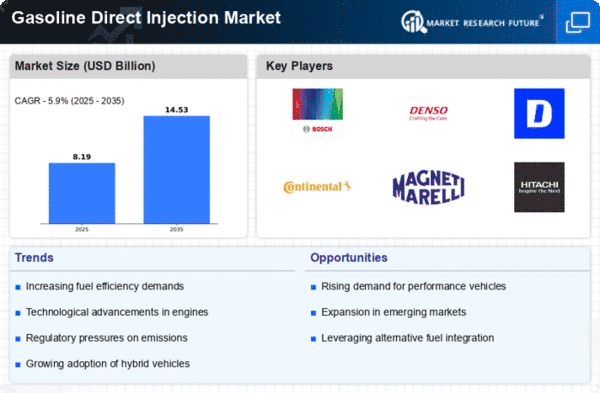
As per MRFR analysis, the Gasoline Direct Injection Market Size was estimated at 7.73 USD Billion in 2024. The Gasoline Direct Injection industry is projected to grow from 8.19 USD Billion in 2025 to 14.53 USD Billion by 2035, exhibiting a compound annual growth rate (CAGR) of 5.9 during the forecast period 2025 - 2035.

Key Market Trends & Highlights

The Gasoline Direct Injection Market is poised for substantial growth driven by technological advancements and evolving consumer preferences.

  • North America remains the largest market for gasoline direct injection technology, reflecting a strong demand for fuel-efficient vehicles. Asia-Pacific is emerging as the fastest-growing region, propelled by increasing automotive production and consumer adoption of advanced engine technologies. The passenger vehicle segment dominates the market, while the commercial vehicle segment is experiencing rapid growth due to rising demand for efficient transport solutions. Key market drivers include rising fuel efficiency standards and a growing consumer preference for performance, which are shaping industry dynamics.

Market Size & Forecast

2024 Market Size 7.73 (USD Billion)
2035 Market Size 14.53 (USD Billion)
CAGR (2025 - 2035) 5.9%
Largest Regional Market Share in 2024 North America

Major Players

<p>Bosch (DE), Denso (JP), Delphi Technologies (GB), Continental (DE), Magneti Marelli (IT), Hitachi Automotive Systems (JP), Valeo (FR), Aisin Seiki (JP), BorgWarner (US)</p>

Market Trends

The Gasoline Direct Injection Market is currently experiencing a transformative phase, driven by advancements in automotive technology and increasing consumer demand for fuel-efficient vehicles. This market segment appears to be gaining traction as manufacturers focus on enhancing engine performance while simultaneously reducing emissions. The integration of gasoline direct injection systems is likely to play a pivotal role in meeting stringent environmental regulations, as these systems are known for their ability to optimize fuel combustion and improve overall efficiency.

Furthermore, the growing trend towards electrification in the automotive sector may also influence the Gasoline Direct Injection Market, as hybrid vehicles often incorporate such technologies to maximize performance and minimize fuel consumption. In addition to technological advancements, consumer preferences are shifting towards vehicles that offer a balance of power and efficiency.

This trend suggests that automakers are increasingly investing in research and development to refine gasoline direct injection systems, ensuring they meet the evolving expectations of environmentally conscious consumers. Moreover, the competitive landscape of the Gasoline Direct Injection Market is likely to intensify as new entrants emerge, bringing innovative solutions to the forefront. As the market continues to evolve, it may witness collaborations between automotive manufacturers and technology firms, further enhancing the capabilities of gasoline direct injection systems and solidifying their position in the future of transportation.

Technological Advancements

The Gasoline Direct Injection Industry is witnessing rapid technological innovations that enhance engine performance and fuel efficiency. Manufacturers are increasingly adopting advanced materials and designs to improve the durability and effectiveness of direct injection systems. This trend indicates a commitment to optimizing combustion processes, which may lead to reduced emissions and better overall vehicle performance.

Consumer Demand for Efficiency

There is a noticeable shift in consumer preferences towards vehicles that offer superior fuel efficiency and lower emissions. This trend suggests that automakers are prioritizing the development of gasoline direct injection systems to meet the growing demand for environmentally friendly options. As consumers become more aware of their carbon footprint, the market is likely to respond with innovative solutions.

Regulatory Pressures

The Gasoline Direct Injection Sector is increasingly influenced by stringent environmental regulations aimed at reducing vehicular emissions. This regulatory landscape compels manufacturers to adopt cleaner technologies, including gasoline direct injection systems, which are known for their ability to enhance fuel efficiency. As regulations evolve, the market may see a surge in the adoption of these systems to comply with new standards.

Gasoline Direct Injection Market Market Drivers

Market Growth Projections

The Global Gasoline Direct Injection Market (GDI) Market is poised for substantial growth, with projections indicating a market value of 7.73 USD Billion in 2024 and an anticipated increase to 14.5 USD Billion by 2035. This growth trajectory suggests a compound annual growth rate (CAGR) of 5.9% from 2025 to 2035. Such figures reflect the increasing adoption of GDI technology across various vehicle segments, driven by consumer demand for fuel efficiency and performance. The market's expansion is likely to be influenced by ongoing technological advancements and regulatory pressures, positioning GDI as a critical component in the future of automotive engineering.

Rising Demand for Fuel Efficiency

The GDI Market is experiencing heightened demand for fuel-efficient vehicles. As consumers become increasingly environmentally conscious, automakers are compelled to innovate and enhance fuel efficiency. GDI technology allows for more precise fuel delivery, resulting in improved combustion and reduced fuel consumption. This trend is underscored by the projected market value of 7.73 USD Billion in 2024, indicating a robust growth trajectory. The shift towards stringent emissions regulations further propels this demand, as GDI systems are known to produce lower CO2 emissions compared to traditional fuel injection systems.

Government Regulations and Incentives

Government regulations and incentives significantly influence the Gasoline Direct Injection System Market. Many countries are implementing stricter emissions standards, compelling manufacturers to adopt cleaner technologies such as GDI. Incentives for consumers purchasing fuel-efficient vehicles further stimulate market growth. For instance, various governments offer tax rebates or subsidies for vehicles equipped with GDI systems, thereby encouraging adoption. This regulatory landscape is expected to drive the market's compound annual growth rate (CAGR) of 5.9% from 2025 to 2035, as manufacturers align their strategies with these evolving policies to meet consumer and regulatory demands.

Increasing Adoption of Hybrid Vehicles

The increasing adoption of hybrid vehicles is a notable driver for the Direct Fuel Injection Market. Hybrid vehicles, which combine internal combustion engines with electric propulsion, often utilize GDI technology to enhance fuel efficiency and reduce emissions. As consumers seek alternatives to traditional gasoline-powered vehicles, the integration of GDI systems in hybrids becomes more prevalent. This trend is supported by the growing awareness of environmental issues and the need for sustainable transportation solutions. Consequently, the market is poised for growth, with projections indicating a rise to 14.5 USD Billion by 2035, reflecting the industry's adaptation to changing consumer preferences.

Technological Advancements in Engine Design

Technological advancements play a pivotal role in shaping the GDI Technology Market. Innovations in engine design, such as turbocharging and variable valve timing, are increasingly integrated with GDI systems to optimize performance and efficiency. These advancements not only enhance power output but also contribute to lower emissions, aligning with global sustainability goals. The continuous evolution of engine technologies suggests a promising future for GDI systems, with a projected market growth to 14.5 USD Billion by 2035. This growth is indicative of the automotive industry's commitment to developing cleaner and more efficient vehicles.

Consumer Preference for Performance Vehicles

Consumer preference for performance-oriented vehicles is a driving force in the Gasoline Direct Injection System Market. GDI technology enhances engine performance by providing better throttle response and increased power output, appealing to enthusiasts and everyday drivers alike. As automotive manufacturers strive to meet this demand, they are increasingly incorporating GDI systems into their performance models. This trend is likely to contribute to the market's expansion, with a projected value of 7.73 USD Billion in 2024. The growing interest in high-performance vehicles suggests that GDI technology will remain a focal point in automotive engineering, aligning performance with efficiency.

Market Segment Insights

By Application: Passenger Vehicle (Largest) vs. Commercial Vehicle (Fastest-Growing)

<p>The Gasoline Direct Injection (GDI) market is primarily dominated by the passenger vehicle segment, which accounts for a significant share due to the increasing demand for fuel-efficient vehicles. This segment benefits from advancements in GDI technology and consumer preferences for performance-oriented engines in personal cars. The commercial vehicle segment, while smaller, is experiencing rapid growth as manufacturers are increasingly adopting GDI systems to meet stringent emission regulations and enhance fuel efficiency in larger vehicles.</p>

<p>Passenger Vehicle (Dominant) vs. Commercial Vehicle (Emerging)</p>

<p>The passenger vehicle segment represents the dominant force in the GDI market, driven by consumer demand for cost-effective and efficient engine technologies that combine performance with lower emissions. This segment has embraced innovations in GDI systems, contributing to enhanced engine responsiveness, fuel economy, and overall driving experience. Conversely, the commercial vehicle segment is emerging, characterized by a growing trend towards integrating GDI technology to produce more efficient engines capable of meeting environmental standards. This shift is encouraged by regulatory pressures and fleet operators' need for operational cost savings, making the commercial segment a key area of focus for future GDI developments.</p>

By Fuel Type: Regular Gasoline (Largest) vs. Premium Gasoline (Fastest-Growing)

<p>In the Gasoline Direct Injection Market, Regular Gasoline holds a dominant position, accounting for a significant portion of fuel consumption due to its affordability and widespread availability. It is favored by a majority of consumers who prioritize cost-effectiveness and reliability. In contrast, Premium Gasoline is gaining traction among high-performance vehicle owners who require enhanced engine performance and efficiency. The shift towards Premium is also being supported by rising awareness of vehicle maintenance and long-term cost benefits.</p>

<p>Regular Gasoline (Dominant) vs. Alternative Fuel (Emerging)</p>

<p>Regular Gasoline remains the cornerstone of the Gasoline Direct Injection Market, appealing to the mass market for its price advantages and accessibility. This segment is characterized by its broad acceptance and extensive distribution network. On the other hand, the Alternative Fuel segment, which includes options such as ethanol blends and natural gas, is emerging due to rising environmental concerns and governmental policies promoting cleaner fuels. Consumers are increasingly interested in sustainable options, driving research and development of alternative fuels, and positioning them as a viable choice for the future automotive landscape.</p>

By Engine Type: Internal Combustion Engine (Largest) vs. Hybrid Engine (Fastest-Growing)

<p>In the Gasoline Direct Injection Market, the distribution of market share among various engine types reveals a strong dominance of Internal Combustion Engines (ICE), which constitute a significant portion of the market. These engines have been the backbone of gasoline vehicles for decades, owing to their efficiency and established technology. Meanwhile, the Hybrid Engine segment is rapidly gaining traction due to increasing consumer demand for fuel-efficient options and stringent environmental regulations. This trend is driving innovation and investment in hybrid technology, leading to its burgeoning market share amidst the shift towards greener alternatives.</p>

<p>Engine Type: Internal Combustion Engine (Dominant) vs. Hybrid Engine (Emerging)</p>

<p>The Internal Combustion Engine has been the dominant force in the Gasoline Direct Injection Market, characterized by its reliability and performance. This traditional engine type, comprising numerous variations like inline and V-configurations, excels in delivering high power output and responsiveness, appealing to consumers seeking performance. On the other hand, the Hybrid Engine represents an emerging force, combining the strengths of conventional engines with electric components to enhance fuel efficiency and reduce emissions. As concerns over environmental impact grow, hybrid engines attract a more environmentally conscious consumer base, making significant advancements in technology and market penetration.</p>

By Technology: Direct Injection (Largest) vs. Multi-Point Injection (Fastest-Growing)

<p>In the Gasoline Direct Injection (GDI) market, 'Direct Injection' holds the largest market share, reflecting its widespread adoption due to enhanced fuel efficiency and performance. Conversely, 'Multi-Point Injection' is witnessing rapid growth, driven by increasing demand for advanced engine technologies that optimize fuel delivery and combustion efficiency. These segments demonstrate a dynamic market landscape where traditional technologies face competition from innovative solutions enhancing overall vehicle performance. The growth trend is notably fueled by a shift towards greener technologies emphasizing fuel efficiency and reduced emissions. As stringent environmental regulations come into play, automakers are increasingly adopting direct injection systems to meet these demands. Additionally, advancements in variable valve timing and electronic control systems are further propelling the expansion of multi-point injection technology, making it an attractive option for manufacturers aiming for performance and sustainability.</p>

<p>Technology: Direct Injection (Dominant) vs. Multi-Point Injection (Emerging)</p>

<p>The Direct Injection technology continues to be dominant in the gasoline direct injection market due to its ability to improve fuel efficiency and reduce emissions effectively. This method directly injects fuel into the combustion chamber, resulting in better atomization and a more powerful combustion process. The key strengths of direct injection include enhanced performance and throttle response, making it preferred among performance-oriented vehicles. In contrast, Multi-Point Injection is emerging rapidly, gaining traction due to its simplicity and adaptability in various engine designs. While less efficient than direct injection, multi-point systems benefit from smoother power delivery and throttle response, which resonates with manufacturers prioritizing consumer comfort and drivability. As the automotive industry evolves, both technologies will be crucial in the ongoing pursuit of performance and environmental sustainability.</p>

By End User: Automotive Manufacturers (Largest) vs. Aftermarket Service Providers (Fastest-Growing)

<p>The end user segment of the Gasoline Direct Injection Market is primarily dominated by Automotive Manufacturers, who are increasingly adopting advanced fuel injection technologies to enhance engine efficiency and performance. This segment holds the largest share, driven by the rising demand for fuel-efficient vehicles. Meanwhile, Aftermarket Service Providers are emerging as a rapidly growing segment, capitalizing on the increasing number of vehicles fitted with gasoline direct injection systems that require ongoing maintenance and upgrades.</p>

<p>Automotive Manufacturers (Dominant) vs. Aftermarket Service Providers (Emerging)</p>

<p>Automotive Manufacturers represent the dominant force within the Gasoline Direct Injection market, leveraging innovations to develop high-performance engines that comply with stringent emission regulations. Their established market presence allows them to invest in cutting-edge technologies to maintain a competitive edge. Conversely, Aftermarket Service Providers are an emerging segment, offering essential services such as repairs and enhancements for gasoline direct injection vehicles. This group is experiencing rapid growth fueled by the expanding vehicle fleet and the increasing consumer preference for advanced automotive technologies. Both segments are crucial to driving technological advancements and ensuring the sustained growth of the market.</p>

Get more detailed insights about Gasoline Direct Injection (GDI) Market Research Report – Global Forecast To 2035

Regional Insights

North America : Market Leader in Innovation

North America is poised to maintain its leadership in the Gasoline Direct Injection (GDI) market, holding a significant share of 3.5 in 2025. The region's growth is driven by increasing consumer demand for fuel-efficient vehicles and stringent emissions regulations. Government initiatives promoting cleaner technologies further catalyze market expansion, making GDI systems a preferred choice for automakers. The competitive landscape is characterized by major players such as Bosch, Denso, and BorgWarner, who are investing heavily in R&D to enhance GDI technology. The U.S. and Canada are the leading countries, with a robust automotive sector that supports innovation and adoption of advanced fuel injection systems. This dynamic environment positions North America as a hub for GDI advancements.

Europe : Emerging Regulatory Frameworks

Europe is witnessing a growing demand for Gasoline Direct Injection (GDI) systems, with a market size of 2.5 in 2025. The region's growth is fueled by stringent EU regulations aimed at reducing CO2 emissions and improving fuel efficiency. The European Commission's Green Deal emphasizes the transition to cleaner vehicles, which is expected to drive GDI adoption significantly. Leading countries like Germany, France, and Italy are at the forefront of this transition, with key players such as Bosch and Valeo actively participating in the market. The competitive landscape is robust, with a focus on innovation and sustainability. The presence of established automotive manufacturers further enhances the region's market dynamics, making Europe a critical player in the GDI sector.

Asia-Pacific : Rapid Growth in Emerging Markets

The Asia-Pacific region is emerging as a significant player in the Gasoline Direct Injection (GDI) market, with a projected size of 1.8 in 2025. The growth is driven by increasing vehicle production and rising consumer awareness regarding fuel efficiency. Countries like China and Japan are leading the charge, supported by government policies that encourage the adoption of advanced fuel injection technologies. China, in particular, is witnessing a surge in GDI adoption due to its vast automotive market and stringent emissions standards. Key players such as Denso and Hitachi Automotive Systems are investing in local manufacturing and R&D to cater to this growing demand. The competitive landscape is evolving, with both domestic and international players vying for market share, making Asia-Pacific a vital region for GDI advancements.

Middle East and Africa : Emerging Market Opportunities

The Middle East and Africa region is gradually recognizing the potential of Gasoline Direct Injection (GDI) systems, with a market size of 0.93 in 2025. The growth is primarily driven by increasing vehicle ownership and a shift towards more fuel-efficient technologies. Governments in the region are beginning to implement regulations aimed at reducing emissions, which is expected to further boost GDI adoption. Countries like South Africa and the UAE are leading the way, with a growing automotive sector that supports the introduction of advanced fuel injection systems. The competitive landscape is still developing, with key players like Delphi Technologies and Magneti Marelli exploring opportunities in this emerging market. As awareness of GDI benefits increases, the region is set to experience significant growth in the coming years.

Key Players and Competitive Insights

The Gasoline Direct Injection Market is currently characterized by a dynamic competitive landscape, driven by technological advancements and increasing demand for fuel-efficient vehicles. Key players such as Bosch (Germany), Denso (Japan), and Delphi Technologies (United Kingdom) are at the forefront, each adopting distinct strategies to enhance their market positioning. Bosch (Germany) emphasizes innovation in fuel injection systems, focusing on integrating advanced technologies to improve engine performance and reduce emissions. Denso (Japan) is strategically investing in partnerships with automotive manufacturers to expand its market reach, while Delphi Technologies (United Kingdom) is concentrating on digital transformation initiatives to streamline operations and enhance product offerings. Collectively, these strategies contribute to a competitive environment that is increasingly focused on technological differentiation and sustainability.

In terms of business tactics, companies are localizing manufacturing to reduce costs and optimize supply chains, which is particularly relevant in the context of fluctuating global trade dynamics. The market structure appears moderately fragmented, with several key players exerting influence over various segments. This fragmentation allows for niche players to emerge, yet the collective strength of major companies like Bosch (Germany) and Denso (Japan) shapes the overall competitive dynamics.

In November 2025, Bosch (Germany) announced the launch of a new line of gasoline direct injection systems designed to enhance fuel efficiency by up to 15%. This strategic move underscores Bosch's commitment to innovation and positions the company to capitalize on the growing demand for environmentally friendly automotive technologies. The introduction of this product line is likely to strengthen Bosch's competitive edge in the market, as it aligns with global trends towards sustainability.

In October 2025, Denso (Japan) entered into a strategic partnership with a leading electric vehicle manufacturer to develop hybrid gasoline direct injection systems. This collaboration is significant as it not only expands Denso's technological capabilities but also positions the company to tap into the burgeoning hybrid vehicle market. The partnership reflects a broader trend of convergence between traditional internal combustion engine technologies and electric vehicle innovations, suggesting a shift in consumer preferences.

In September 2025, Delphi Technologies (United Kingdom) unveiled a new digital platform aimed at optimizing the performance of gasoline direct injection systems through real-time data analytics. This initiative is indicative of the increasing importance of digitalization in the automotive sector, as it allows for enhanced monitoring and predictive maintenance of fuel injection systems. By leveraging data analytics, Delphi Technologies is likely to improve customer satisfaction and operational efficiency, further solidifying its market position.

As of December 2025, the competitive trends in the GDI Market are increasingly defined by digitalization, sustainability, and the integration of artificial intelligence. Strategic alliances are becoming more prevalent, as companies recognize the need to collaborate in order to innovate and meet evolving consumer demands. Looking ahead, competitive differentiation is expected to shift from price-based competition to a focus on technological innovation, reliability in supply chains, and sustainable practices. This evolution suggests that companies that prioritize R&D and strategic partnerships will likely emerge as leaders in the market.

In October 2025, GB Remanufacturing expanded its gasoline direct fuel injection program, adding new remanufactured components for modern engines. The expansion enhances coverage for late-model vehicles and supports aftermarket availability. It reflects growing demand for high-quality, cost-effective replacement fuel systems.

Recently, Hyundai began development of a new 1.2-litre turbocharged petrol engine, designed to deliver stronger performance and better fuel efficiency in compact cars. The engine is expected to support upcoming models and expand Hyundai’s modern turbo powertrain lineup.

Key Companies in the Gasoline Direct Injection Market market include

Industry Developments

DECEMBER 2023: Stanadyne, a global supplier of fuel and air management systems, is looking to expand its performance and specialty product portfolio by introducing new Goliath 350-bar gasoline direct injection (GDI) durability fuel injector, which has been patented. This new injector acts as a system with Stanadyne’s latest Goliath high-flow, 12mm bore, 350-bar performance gasoline direct injection (GDI) fuel pump or can work independently.

The Goliath 350-bar GDI Performance Fuel Injector from Stanadyne is a superior modular solution that addresses the problem posed by stock injectors when trying to increase the power output of GDI engines as they are limited by fuel pressure. It is engineered towards specialist and high-performance engine modifications. This makes fitting safer and easier for professional tuners as well as amateurs because it comes in modules with pre-installed inlet fuel lines fittings.

As compared to OEM injectors, the Goliath injector enables flow increases of around 65-70% and allows for delivery up to 350 on selected Gasoline Direct Injection Market Engines. Stanadyne’s manufacturing principles, including best practices, are applied in the production of their aftermarket products. Their performance injectors meet OE quality standards with laser drilled orifices. They are manufactured entirely using lasers within clean rooms that allow helium mass leak testing making them highly committed to safety while ensuring quality.

The Stanadyne purpose-built high-pressure Goliath GDI performance fuel injector covers a range of horsepower applications for a variety of engine makes, such as Audi, Aston Martin Vantage, BMW, Ferrari, Ford, GM, Infinity, Kia, Lamborghini Mercedes Benz Stellantis Toyota.The product is planned to be available via selected Stanadyne Performance partners starting summer 2024.

Future Outlook

Gasoline Direct Injection Market Future Outlook

<p>The Gasoline Direct Injection Market is projected to grow at a 5.9% CAGR from 2024 to 2035, driven by advancements in fuel efficiency and emissions regulations.</p>

New opportunities lie in:

  • <p>Development of advanced fuel injection systems for electric hybrid vehicles.</p>
  • <p>Expansion into emerging markets with tailored GDI solutions.</p>
  • <p>Partnerships with automotive manufacturers for integrated GDI technologies.</p>

<p>By 2035, the market is expected to solidify its position as a leader in fuel efficiency innovations.</p>

Market Segmentation

Gasoline Direct Injection Market End User Outlook

  • Automotive Manufacturers
  • Aftermarket Service Providers
  • Fleet Operators
  • Research Institutions
  • Government Agencies

Gasoline Direct Injection Market Fuel Type Outlook

  • Regular Gasoline
  • Premium Gasoline
  • Alternative Fuel
  • Ethanol Blends
  • Natural Gas

Gasoline Direct Injection Market Technology Outlook

  • Single Injection
  • Multi-Point Injection
  • Direct Injection
  • Dual Injection
  • Variable Valve Timing

Gasoline Direct Injection Market Application Outlook

  • Passenger Vehicle
  • Commercial Vehicle
  • Motorcycle
  • Small Engine
  • Marine

Gasoline Direct Injection Market Engine Type Outlook

  • Internal Combustion Engine
  • Hybrid Engine
  • Electric Engine
  • Turbocharged Engine
  • Supercharged Engine

Report Scope

MARKET SIZE 2024 7.73(USD Billion)
MARKET SIZE 2025 8.19(USD Billion)
MARKET SIZE 2035 14.53(USD Billion)
COMPOUND ANNUAL GROWTH RATE (CAGR) 5.9% (2024 - 2035)
REPORT COVERAGE Revenue Forecast, Competitive Landscape, Growth Factors, and Trends
BASE YEAR 2024
Market Forecast Period 2025 - 2035
Historical Data 2019 - 2024
Market Forecast Units USD Billion
Key Companies Profiled Bosch (DE), Denso (JP), Delphi Technologies (GB), Continental (DE), Magneti Marelli (IT), Hitachi Automotive Systems (JP), Valeo (FR), Aisin Seiki (JP), BorgWarner (US)
Segments Covered Application, Fuel Type, Engine Type, Technology, End User
Key Market Opportunities Advancements in fuel efficiency regulations drive innovation in the Gasoline Direct Injection Market.
Key Market Dynamics Rising demand for fuel efficiency drives innovation in gasoline direct injection technologies and competitive market dynamics.
Countries Covered North America, Europe, APAC, South America, MEA

FAQs

How much is the gasoline direct injection (GDI) market?

The gasoline direct injection (GDI) market size was valued at USD 7.73 Billion in 2024.

What is the growth rate of the gasoline direct injection (GDI) market?

The global market is projected to grow at a CAGR of 5.90% during the forecast period, 2024-2034.

Which region held the largest market share in the gasoline direct injection (GDI) market?

North America had the largest share of the global market

Who are the key players in the gasoline direct injection (GDI) market?

The key players in the market are Bosch, Continental, Delphi, Denso, Magneti Marelli, Hitachi, Stanadyne, MSR-Jebsen Technologies, Eaton Corporation, and Mitsubishi Electric Corp.

Which component led the gasoline direct injection (GDI) market?

The Fuel Injectors category dominated the market in 2022.

Which vehicle segment had the largest market share in the gasoline direct injection (GDI) market?

Passenger Vehicles had the largest share of the global market.

  1. INTRODUCTION
    1. DEFINITION
    2. SCOPE OF STUDY
    3. RESEARCH OBJECTIVE
    4. ASSUMPTIONS & LIMITATIONS
    5. MARKET STRUCTURE:
  2. RESEARCH METHODOLOGY
    1. RESEARCH PROCESS
    2. PRIMARY RESEARCH
    3. SECONDARY RESEARCH
  3. MARKET DYNAMICS
    1. DRIVERS
    2. RESTRAINTS
    3. OPPORTUNITIES
    4. CHALLENGES
    5. MACROECONOMIC INDICATORS
  4. MARKET FACTOR ANALYSIS
    1. PORTER’S FIVE FORCES MODEL
      1. BARGAINING POWER OF SUPPLIERS
      2. BARGAINING POWER OF CUSTOMER
      3. INTENSITY OF COMPETITOR’S
      4. THREAT OF NEW ENTRANTS
  5. GASOLINE DIRECT INJECTION (GDI), BY VEHICLE TYPE
    1. INTRODUCTION
      1. PASSENGER VEHICLE
      2. COMMERCIAL VEHICLE
  6. GASOLINE DIRECT INJECTION (GDI), BY COMPONENT
    1. INTRODUCTION
      1. ELECTRONIC CONTROL UNITS
      2. FUEL INJECTORS
      3. FUEL PUMPS
      4. SENSORS
  7. GASOLINE DIRECT INJECTION (GDI), BY SUPPORT TECHNOLOGY
    1. INTRODUCTION
      1. GASOLINE TURBOCHARGER
      2. GPF
  8. GASOLINE DIRECT INJECTION (GDI), BY REGION
    1. INTRODUCTION
      1. NORTH AMERICA
      2. EUROPE
      3. ASIA PACIFIC
      4. MIDDLE EAST & AFRICA
  9. COMPANY LANDSCAPE
    1. INTRODUCTION
      1. MERGERS ACQUISITIONS
      2. COLLABORATIONS
      3. RELEASE/NEW PRODUCT LAUNCHES
      4. OTHER (EXPANSION, UPDATES, PARTNERSHIP)
  10. COMPANY PROFILE
    1. BOSCH
      1. COMPANY OVERVIEW
      2. PRODUCT/BUSINESS SEGMENT OVERVIEW
      3. FINANCIALS
      4. KEY DEVELOPMENTS
    2. CONTINENTAL
      1. OVERVIEW
      2. PRODUCT/BUSINESS SEGMENT OVERVIEW
      3. FINANCIALS
      4. KEY DEVELOPMENTS
    3. DELPHI
      1. OVERVIEW
      2. PRODUCT/BUSINESS SEGMENT OVERVIEW
      3. FINANCIALS
      4. KEY DEVELOPMENTS
    4. DENSO
      1. OVERVIEW
      2. PRODUCT/BUSINESS SEGMENT OVERVIEW
      3. FINANCIALS
      4. KEY DEVELOPMENTS
    5. MAGNETI MARELLI
      1. OVERVIEW
      2. PRODUCT/BUSINESS SEGMENT OVERVIEW
      3. FINANCIALS
      4. KEY DEVELOPMENTS
    6. HITACHI
      1. OVERVIEW
      2. PRODUCT/BUSINESS SEGMENT OVERVIEW
      3. FINANCIALS
      4. KEY DEVELOPMENTS
    7. STANADYNE
      1. OVERVIEW
      2. PRODUCT/BUSINESS SEGMENT OVERVIEW
      3. FINANCIALS
      4. KEY DEVELOPMENTS
  11. APPENDIX
  12. LIST OF TABLES
  13. EUROPE GASOLINE DIRECT INJECTION (GDI), BY REGION 2023-2032, ($ MILLION) 19
  14. EUROPE GASOLINE DIRECT INJECTION (GDI) FOR MINING, BY REGION 2023-2032, (MILLION) 19
  15. EUROPE GASOLINE DIRECT INJECTION (GDI) FOR MARINE, BY REGION 2023-2032, (MILLION) 20
  16. EUROPE GASOLINE DIRECT INJECTION (GDI) FOR WATERTREATMENT, BY REGION 2023-2032, (MILLION) 20
  17. EUROPE GASOLINE DIRECT INJECTION (GDI) FOR PHARMACEUTICAL, BY REGION 2023-2032, (MILLION) 20
  18. EUROPE GASOLINE DIRECT INJECTION (GDI) FOR CHEMICAL, BY REGION 2023-2032, (MILLION) 21
  19. EUROPE GASOLINE DIRECT INJECTION (GDI) FOR FOOD & BEVERAGES, BY REGION 2023-2032, (MILLION) 21
  20. EUROPE GASOLINE DIRECT INJECTION (GDI) FOR OIL & GAS, BY REGION 2023-2032, (MILLION) 21
  21. EUROPE GASOLINE DIRECT INJECTION (GDI), BY TYPE 2023-2032, (MILLION) 22
  22. EUROPE GASOLINE DIRECT INJECTION (GDI), BY TYPE 2023-2032, (MILLION) 22
  23. MIDDLE EAST GASOLINE DIRECT INJECTION (GDI), BY TYPE 2023-2032, (MILLION) 23
  24. AFRICA GASOLINE DIRECT INJECTION (GDI), BY TYPE, 2023-2032, (MILLION) 23
  25. EUROPE GASOLINE DIRECT INJECTION (GDI) 2023-2032, ($MILLION) 24
  26. EUROPE GASOLINE DIRECT INJECTION (GDI), BY COUNTRY 2023-2032, ($MILLION) 25
  27. GERMANY GASOLINE DIRECT INJECTION (GDI), BY COMPONENT 2023-2032, ($MILLION) 25
  28. GERMANY GASOLINE DIRECT INJECTION (GDI), BY TYPE 2023-2032, ($MILLION) 26
  29. FRANCE GASOLINE DIRECT INJECTION (GDI), BY COMPONENT 2023-2032, ($MILLION) 26
  30. FRANCE GASOLINE DIRECT INJECTION (GDI), BY TYPE 2023-2032, ($MILLION) 26
  31. ITALY GASOLINE DIRECT INJECTION (GDI), BY COMPONENT 2023-2032, ($MILLION) 27
  32. ITALY GASOLINE DIRECT INJECTION (GDI), BY TYPE 2023-2032, ($MILLION) 27
  33. SPAIN GASOLINE DIRECT INJECTION (GDI), BY COMPONENT 2023-2032, ($MILLION) 28
  34. SPAIN GASOLINE DIRECT INJECTION (GDI), BY TYPE 2023-2032, ($MILLION) 28
  35. U.K. GASOLINE DIRECT INJECTION (GDI), BY COMPONENT 2011-20127, ($MILLION) 29
  36. U.K. GASOLINE DIRECT INJECTION (GDI), BY TYPE 2023-2032, ($MILLION) 29
  37. SCANDINAVIA GASOLINE DIRECT INJECTION (GDI), BY COMPONENT 2023-2032, ($MILLION) 30
  38. SCANDINAVIA GASOLINE DIRECT INJECTION (GDI), BY TYPE 2023-2032, ($MILLION) 30
  39. BENELUX GASOLINE DIRECT INJECTION (GDI), BY COMPONENT 2023-2032, ($MILLION) 31
  40. BENELUX GASOLINE DIRECT INJECTION (GDI), BY TYPE 2023-2032, ($MILLION) 31
  41. REST OF EUROPE GASOLINE DIRECT INJECTION (GDI), BY COMPONENT 2023-2032, ($MILLION) 32
  42. REST OF EUROPE GASOLINE DIRECT INJECTION (GDI), BY TYPE 2023-2032, ($MILLION) 32
  43. MIDDLE EAST GASOLINE DIRECT INJECTION (GDI), BY COUNTRY 2023-2032, ($MILLION) 33
  44. SAUDI ARABIA GASOLINE DIRECT INJECTION (GDI), BY COMPONENT 2023-2032, ($MILLION) 34
  45. SAUDI ARABIA GASOLINE DIRECT INJECTION (GDI), BY TYPE 2023-2032, ($MILLION) 34
  46. UAE GASOLINE DIRECT INJECTION (GDI), BY COMPONENT 2023-2032, ($MILLION) 35
  47. UAE GASOLINE DIRECT INJECTION (GDI), BY TYPE 2023-2032, ($MILLION) 35
  48. KUWAIT GASOLINE DIRECT INJECTION (GDI), BY COMPONENT 2023-2032, ($MILLION) 36
  49. KUWAIT GASOLINE DIRECT INJECTION (GDI), BY SUPORT TECHNOLOGY 2023-2032, ($MILLION) 36
  50. QATAR GASOLINE DIRECT INJECTION (GDI), BY COMPONENT 2023-2032, ($MILLION) 37
  51. QATAR GASOLINE DIRECT INJECTION (GDI), BY SUPORT TECHNOLOGY 2023-2032, ($MILLION) 37
  52. REST OF MIDDLE EAST GASOLINE DIRECT INJECTION (GDI), BY COMPONENT 2023-2032, ($MILLION) 38
  53. REST OF MIDDLE EAST GASOLINE DIRECT INJECTION (GDI), BY SUPORT TECHNOLOGY 2023-2032, ($MILLION) 38
  54. AFRICA GASOLINE DIRECT INJECTION (GDI), BY COUNTRY 2023-2032, ($MILLION) 39
  55. SOUTH AFRICA GASOLINE DIRECT INJECTION (GDI), BY COMPONENT 2023-2032, ($MILLION) 40
  56. SOUTH AFRICA GASOLINE DIRECT INJECTION (GDI), BY SUPORT TECHNOLOGY 2023-2032, ($MILLION) 40
  57. NIGERIA GASOLINE DIRECT INJECTION (GDI), BY COMPONENT 2023-2032, ($MILLION) 41
  58. NIGERIA GASOLINE DIRECT INJECTION (GDI), BY SUPORT TECHNOLOGY 2023-2032, ($MILLION) 41
  59. ALGERIA GASOLINE DIRECT INJECTION (GDI), BY COMPONENT 2023-2032, ($MILLION) 42
  60. ALGERIA GASOLINE DIRECT INJECTION (GDI), BY SUPORT TECHNOLOGY 2023-2032, ($MILLION) 42
  61. REST OF AFRICA GASOLINE DIRECT INJECTION (GDI), BY COMPONENT 2023-2032, ($MILLION) 43
  62. REST OF AFRICA GASOLINE DIRECT INJECTION (GDI), BY SUPORT TECHNOLOGY 2023-2032, ($MILLION) 43
  63. LIST OF FIGURES
  64. SUPPLY CHAIN: AODD PUMPS 16
  65. PORTERS FIVE FORCES 17

Gasoline Direct Injection Market Segmentation

Gasoline Direct Injection (GDI) Component Outlook (USD Billion, 2018-2032)

  • Electronic Control Units
  • Fuel Injectors
  • Fuel Pumps
  • Sensors

Gasoline Direct Injection (GDI) Vehicle Outlook (USD Billion, 2018-2032)

  • Passenger Vehicle
  • Commercial Vehicle

Gasoline Direct Injection (GDI) Support Technology Outlook (USD Billion, 2018-2032)

  • Gasoline Turbocharger
  • GPF

Gasoline Direct Injection (GDI) Regional Outlook (USD Billion, 2018-2032)

  • North America Outlook (USD Billion, 2018-2032)

    • North America Gasoline Direct Injection (GDI) by Component
      • Electronic Control Units
      • Fuel Injectors
      • Fuel Pumps
      • Sensors
    • North America Gasoline Direct Injection (GDI) by Vehicle
      • Passenger Vehicle
      • Commercial Vehicle
    • North America Gasoline Direct Injection (GDI) by Support Technology
      • Gasoline Turbocharger
      • GPF
    • US Outlook (USD Billion, 2018-2032)

    • US Gasoline Direct Injection (GDI) by Component
      • Electronic Control Units
      • Fuel Injectors
      • Fuel Pumps
      • Sensors
    • US Gasoline Direct Injection (GDI) by Vehicle
      • Passenger Vehicle
      • Commercial Vehicle
    • US Gasoline Direct Injection (GDI) by Support Technology
      • Gasoline Turbocharger
      • GPF
    • CANADA Outlook (USD Billion, 2018-2032)

    • CANADA Gasoline Direct Injection (GDI) by Fusion Component
      • Electronic Control Units
      • Fuel Injectors
      • Fuel Pumps
      • Sensors
    • CANADA Gasoline Direct Injection (GDI) by Vehicle
      • Passenger Vehicle
      • Commercial Vehicle
    • CANADA Gasoline Direct Injection (GDI) by Support Technology
      • Gasoline Turbocharger
      • GPF
  • Europe Outlook (GERMANYD Million, 2018-2032)

    • Europe Gasoline Direct Injection (GDI) by Component
      • Electronic Control Units
      • Fuel Injectors
      • Fuel Pumps
      • Sensors
    • Europe Gasoline Direct Injection (GDI) by Vehicle
      • Passenger Vehicle
      • Commercial Vehicle
    • Europe Gasoline Direct Injection (GDI) by Support Technology
      • Gasoline Turbocharger
      • GPF
    • GERMANY Outlook (USD Billion, 2018-2032)

    • GERMANY Gasoline Direct Injection (GDI) by Component
      • Electronic Control Units
      • Fuel Injectors
      • Fuel Pumps
      • Sensors
    • GERMANY Gasoline Direct Injection (GDI) by Vehicle
      • Passenger Vehicle
      • Commercial Vehicle
    • GERMANY Gasoline Direct Injection (GDI) by Support Technology
      • Gasoline Turbocharger
      • GPF
    • FRANCE Outlook (USD Billion, 2018-2032)

    • FRANCE Gasoline Direct Injection (GDI) by Component
      • Electronic Control Units
      • Fuel Injectors
      • Fuel Pumps
      • Sensors
    • FRANCE Gasoline Direct Injection (GDI) by Vehicle
      • Passenger Vehicle
      • Commercial Vehicle
    • FRANCE Gasoline Direct Injection (GDI) by Support Technology
      • Gasoline Turbocharger
      • GPF
    • UK Outlook (USD Billion, 2018-2032)

    • UK Gasoline Direct Injection (GDI) by Component
      • Electronic Control Units
      • Fuel Injectors
      • Fuel Pumps
      • Sensors
    • UK Gasoline Direct Injection (GDI) by Vehicle
      • Passenger Vehicle
      • Commercial Vehicle
    • UK Gasoline Direct Injection (GDI) by Support Technology
      • Gasoline Turbocharger
      • GPF
    • ITALY Outlook (USD Billion, 2018-2032)

    • ITALY Gasoline Direct Injection (GDI) by Component
      • Electronic Control Units
      • Fuel Injectors
      • Fuel Pumps
      • Sensors
    • ITALY Gasoline Direct Injection (GDI) by Vehicle

      • Passenger Vehicle
      • Commercial Vehicle
    • ITALY Gasoline Direct Injection (GDI) by Support Technology

      • Gasoline Turbocharger
      • GPF
    • SPAIN Outlook (USD Billion, 2018-2032)

    • SPAIN Gasoline Direct Injection (GDI) by Fusion Component
      • Electronic Control Units
      • Fuel Injectors
      • Fuel Pumps
      • Sensors
    • SPAIN Gasoline Direct Injection (GDI) by Vehicle
      • Passenger Vehicle
      • Commercial Vehicle
    • SPAIN Gasoline Direct Injection (GDI) by Support Technology
      • Gasoline Turbocharger
      • GPF
    • Rest of Europe Outlook (USD Billion, 2018-2032)

    • Rest of Europe Gasoline Direct Injection (GDI) by Component
      • Electronic Control Units
      • Fuel Injectors
      • Fuel Pumps
      • Sensors
    • Rest of Europe Gasoline Direct Injection (GDI) by Vehicle
      • Passenger Vehicle
      • Commercial Vehicle
    • Rest of Europe Gasoline Direct Injection (GDI) by Support Technology
      • Gasoline Turbocharger
      • GPF
  • Asia Pacific Outlook (USD Billion, 2018-2032)

    • Asia Pacific Gasoline Direct Injection (GDI) by Component
      • Electronic Control Units
      • Fuel Injectors
      • Fuel Pumps
      • Sensors
    • Asia Pacific Gasoline Direct Injection (GDI) by Vehicle
      • Passenger Vehicle
      • Commercial Vehicle
    • Asia Pacific Gasoline Direct Injection (GDI) by Support Technology
      • Gasoline Turbocharger
      • GPF
    • China Outlook (USD Billion, 2018-2032)

    • China Gasoline Direct Injection (GDI) by Component
      • Electronic Control Units
      • Fuel Injectors
      • Fuel Pumps
      • Sensors
    • China Gasoline Direct Injection (GDI) by Vehicle
      • Passenger Vehicle
      • Commercial Vehicle
    • China Gasoline Direct Injection (GDI) by Support Technology
      • Gasoline Turbocharger
      • GPF
    • Japan Outlook (USD Billion, 2018-2032)

    • Japan Gasoline Direct Injection (GDI) by Fusion Component
      • Electronic Control Units
      • Fuel Injectors
      • Fuel Pumps
      • Sensors
    • Japan Gasoline Direct Injection (GDI) by Vehicle
      • Passenger Vehicle
      • Commercial Vehicle
    • Japan Gasoline Direct Injection (GDI) by Support Technology
      • Gasoline Turbocharger
      • GPF
    • India Outlook (USD Billion, 2018-2032)

    • India Gasoline Direct Injection (GDI) by Component
      • Electronic Control Units
      • Fuel Injectors
      • Fuel Pumps
      • Sensors
    • India Gasoline Direct Injection (GDI) by Vehicle
      • Passenger Vehicle
      • Commercial Vehicle
    • India Gasoline Direct Injection (GDI) by Support Technology
      • Gasoline Turbocharger
      • GPF
    • Australia Outlook (USD Billion, 2018-2032)

    • Australia Gasoline Direct Injection (GDI) by Fusion Component
      • Electronic Control Units
      • Fuel Injectors
      • Fuel Pumps
      • Sensors
    • Australia Gasoline Direct Injection (GDI) by Vehicle
      • Passenger Vehicle
      • Commercial Vehicle
    • Australia Gasoline Direct Injection (GDI) by Support Technology
      • Gasoline Turbocharger
      • GPF
    • Rest of Asia Pacific Outlook (USD Billion, 2018-2032)

    • Rest of Asia Pacific Gasoline Direct Injection (GDI) by Component
      • Electronic Control Units
      • Fuel Injectors
      • Fuel Pumps
      • Sensors
    • Rest of Asia Pacific Gasoline Direct Injection (GDI) by Vehicle
      • Passenger Vehicle
      • Commercial Vehicle
    • Rest of Asia Pacific Gasoline Direct Injection (GDI) by Support Technology
      • Gasoline Turbocharger
      • GPF
  • Rest of World Outlook (USD Billion, 2018-2032)

    • Rest of World Gasoline Direct Injection (GDI) by Component
      • Electronic Control Units
      • Fuel Injectors
      • Fuel Pumps
      • Sensors
    • Rest of World Gasoline Direct Injection (GDI) by Vehicle
      • Passenger Vehicle
      • Commercial Vehicle
    • Rest of World Gasoline Direct Injection (GDI) by Support Technology
      • Gasoline Turbocharger
      • GPF
    • Middle East Outlook (USD Billion, 2018-2032)

    • Middle East Gasoline Direct Injection (GDI) by Component
      • Electronic Control Units
      • Fuel Injectors
      • Fuel Pumps
      • Sensors
    • Middle East Gasoline Direct Injection (GDI) by Vehicle
      • Passenger Vehicle
      • Commercial Vehicle
    • Middle East Gasoline Direct Injection (GDI) by Support Technology
      • Gasoline Turbocharger
      • GPF
    • Africa Outlook (USD Billion, 2018-2032)

    • Africa Gasoline Direct Injection (GDI) by Component
      • Electronic Control Units
      • Fuel Injectors
      • Fuel Pumps
      • Sensors
    • Africa Gasoline Direct Injection (GDI) by Vehicle
      • Passenger Vehicle
      • Commercial Vehicle
    • Africa Gasoline Direct Injection (GDI) by Support Technology
      • Gasoline Turbocharger
      • GPF
    • Latin America Outlook (USD Billion, 2018-2032)

    • Latin America Gasoline Direct Injection (GDI) by Component
      • Electronic Control Units
      • Fuel Injectors
      • Fuel Pumps
      • Sensors
    • Latin America Gasoline Direct Injection (GDI) by Vehicle
      • Passenger Vehicle
      • Commercial Vehicle
    • Latin America Gasoline Direct Injection (GDI) by Support Technology
      • Gasoline Turbocharger
      • GPF
Infographic

Free Sample Request

Kindly complete the form below to receive a free sample of this Report

Get Free Sample

Customer Strories

Compare Licence

×
Features License Type
Single User Multiuser License Enterprise User
Price $4,950 $5,950 $7,250
Maximum User Access Limit 1 User Upto 10 Users Unrestricted Access Throughout the Organization
Free Customization
Direct Access to Analyst
Deliverable Format
Platform Access
Discount on Next Purchase 10% 15% 15%
Printable Versions