Request Free Sample ×

Kindly complete the form below to receive a free sample of this Report

* Please use a valid business email

Leading companies partner with us for data-driven Insights

clients tt-cursor
Hero Background
English
Chinese
French
Japanese
Korean
German
Spanish

Gas Detection Equipment Market Share

ID: MRFR/Equip/6251-CR
242 Pages
Snehal Singh
Last Updated: April 16, 2026

Gas Detection Equipment Market Research Report Information By Gas Type (Toxic( carbon Monoxide, Hydrogen Sulfide , Chlorine, and Benzene) combustible (Methane, propane, Butane, Hydrogen), Volatile Organic Compounds) By Technology (Semiconductor, Infrared (IR), Laser-based Detection, Catalytic, Photoionization Detector (PID)), By Product Type (Fixed Gas Detectors, Portable Gas Detectors, Flame Detectors), By Application (Oil & Gas , Mining, Petrochemicals, Construction, Energy & Power, Water Treatment , Industrial, Automotive) and Region (North America, Europe, Asia Pacific, Middle East & Africa, and South America) - Growth & Industry Forecast to 2035

Share:
Download PDF ×

We do not share your information with anyone. However, we may send you emails based on your report interest from time to time. You may contact us at any time to opt-out.

Gas Detection Equipment Market Infographic
Purchase Options

Market Share

Gas Detection Equipment Market Share Analysis

In the hastily evolving realm of the Smart Stadium Market, organizations rent various techniques to secure marketplace percentage and set up themselves as leaders in this burgeoning enterprise. One key approach entails leveraging technological innovation to create specific and superior Smart Stadium answers. Companies focus on growing modern-day features such as excessive-tech fan engagement apps, IoT-linked infrastructure, and AI-pushed analytics to beautify the general stadium revel. Cost management is every other pivotal method inside the Smart Stadium Market. Companies purpose to offer fee-effective answers through optimizing the implementation and protection of Smart Stadium technology. This entails efficient mission control, streamlined operations, and strategic partnerships to minimize standard prices. By offering competitive pricing without compromising great, businesses appeal to a wide variety of sports activities businesses, mainly those with budget constraints. Cost management is frequently complemented by collaborations with generation carriers, ensuring the affordability and accessibility of Smart Stadium answers. Market segmentation performs a vital function in a hit marketplace percentage positioning in the Smart Stadium Market. Companies perceive unique wishes and alternatives within the sports activities enterprise, tailoring their Smart Stadium answers accordingly. For instance, a business enterprise would possibly provide complete fan engagement platforms for major sports leagues, while every other might specialize in scalable and modular structures appropriate for smaller venues. Strategic partnerships and collaborations are instrumental in improving market proportion within the Smart Stadium Market. Companies regularly form alliances with sports activities teams, leagues, or venue operators to integrate their technology seamlessly. These collaborations facilitate the development of custom-designed answers and decorate the general fan experience. Additionally, partnerships with era providers, telecommunications businesses, and infrastructure builders make contributions to the introduction of comprehensive Smart Stadium ecosystems. By aligning with key stakeholders, corporations role themselves to address the multifaceted demands of the Smart Stadium enterprise and make their marketplace attain. Effective advertising marketing and logo positioning are critical components of market percentage techniques in the Smart Stadium Market. Companies invest in marketing campaigns to showcase the benefits of their Smart Stadium answers, emphasizing functions like improved fan engagement, operational efficiency, and revenue generation possibilities. Building a sturdy emblem identification establishes trust and credibility, influencing sports corporations to choose particular Smart Stadium answers.


Author
Author Profile
Snehal Singh
Manager - Research

High acumen in analyzing complex macro & micro markets with more than 6 years of work experience in the field of market research. By implementing her analytical skills in forecasting and estimation into market research reports, she has expertise in Packaging, Construction, and Equipment domains. She handles a team size of 20-25 resources and ensures smooth running of the projects, associated marketing activities, and client servicing.

Leave a Comment

FAQs

What is the current valuation of the Gas Detection Equipment Market in 2025?

<p>The Gas Detection Equipment Market is valued at approximately 5027.2 USD Million in 2024.</p>

What is the projected market valuation for the Gas Detection Equipment Market by 2035?

<p>The market is expected to reach a valuation of around 8688.72 USD Million by 2035.</p>

What is the expected CAGR for the Gas Detection Equipment Market during the forecast period 2025 - 2035?

<p>The anticipated CAGR for the Gas Detection Equipment Market during the forecast period is 5.1%.</p>

Which companies are considered key players in the Gas Detection Equipment Market?

<p>Key players in the market include Honeywell, Drägerwerk AG, MSA Safety, and Industrial Scientific, among others.</p>

What are the main segments of the Gas Detection Equipment Market based on gas type?

The main segments based on gas type include Toxic, Combustible, Volatile Organic Compounds, and Others.

How do the valuations of different gas types compare in the market?

In 2024, the valuation for Combustible gases was between 1500.0 and 2500.0 USD Million, while Toxic gases ranged from 1000.0 to 1800.0 USD Million.

What technologies are utilized in the Gas Detection Equipment Market?

Technologies in the market include Semiconductor, Infrared (IR), Laser-based Detection, and Catalytic, among others.

What is the valuation range for Portable Gas Detectors in the market?

The valuation for Portable Gas Detectors is projected to be between 2000.0 and 3500.0 USD Million.

Which application types are driving demand in the Gas Detection Equipment Market?

Application types driving demand include Oil &amp; Gas, Mining, Petrochemicals, and Construction.

What is the expected growth trajectory for the Gas Detection Equipment Market in the coming years?

The market is likely to experience steady growth, with a projected increase in valuation from 5027.2 USD Million in 2024 to 8688.72 USD Million by 2035.

Market Summary

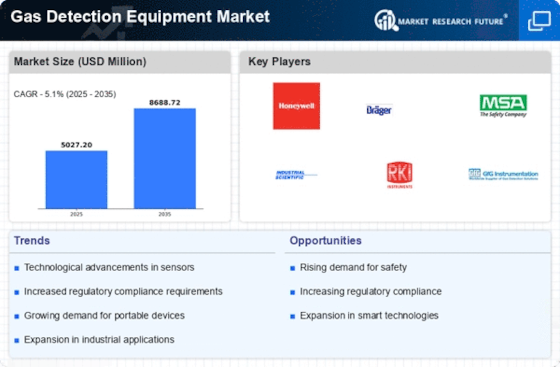
As per Market Research Future analysis, the Gas Detection Equipment Market was estimated at 5027.2 USD Million in 2024. The Gas Detection Equipment industry is projected to grow from 5283.59 USD Million in 2025 to 8688.72 USD Million by 2035, exhibiting a compound annual growth rate (CAGR) of 5.1% during the forecast period 2025 - 2035

Key Market Trends & Highlights

The Gas Detection Equipment Market is poised for growth driven by regulatory compliance and technological advancements.

  • North America remains the largest market for gas detection equipment, driven by stringent safety regulations. The Asia-Pacific region is emerging as the fastest-growing market, fueled by rapid industrialization and urbanization. The toxic gas detection segment holds the largest market share, while the combustible gas detection segment is experiencing the fastest growth. Rising industrial safety standards and growing awareness of environmental hazards are key drivers propelling market expansion.

Market Size & Forecast

2024 Market Size 5027.2 (USD Million)
2035 Market Size 8688.72 (USD Million)
CAGR (2025 - 2035) 5.1%
Largest Regional Market Share in 2024 South America

Major Players

<a href="https://automation.honeywell.com/us/en/products/sensing-solutions/gas-and-flame-detection/portables">Honeywell </a>(US), Drägerwerk AG (DE), MSA Safety (US), Industrial Scientific (US), RKI Instruments (US), GfG Instrumentation (DE), Crowcon Detection Instruments (GB), <a href="https://www.teledynewater.com/gas-detection">Teledyne </a>Technologies (US), Xgard (GB)

Market Trends

The Gas Detection Equipment Market is currently experiencing a notable evolution, driven by increasing safety regulations and a heightened awareness of environmental concerns. Industries such as oil and gas, manufacturing, and mining are prioritizing the implementation of advanced gas detector technologies to mitigate risks associated with hazardous gases. This shift is not merely a response to gas pressure regulator it reflects a broader commitment to ensuring worker safety and environmental protection. As organizations strive to enhance operational efficiency, the demand for sophisticated gas detection solutions is likely to grow, fostering innovation and technological advancements in the sector. 

Moreover, the Gas Detection Equipment Market is witnessing a trend towards the integration of smart technologies. The advent of the Internet of Things (IoT) and artificial intelligence is transforming traditional gas detection systems into intelligent monitoring solutions. These innovations enable real-time data analysis, predictive maintenance, and remote monitoring capabilities, which could significantly improve response times in emergency situations. 

The Gas Detection Equipment Market is experiencing a strategic shift as manufacturers prioritize the development of multi-gas sensors and ultra-low-power wireless units to ensure continuous protection in increasingly complex industrial environments. As industries continue to embrace digital transformation, the Gas Detection Equipment Market is poised for substantial growth, with an emphasis on developing more efficient, reliable, and user-friendly detection systems.

Increased Regulatory Compliance

The Gas Detection Equipment Market is seeing a rise in demand due to stricter safety regulations across various industries. Companies are compelled to adopt advanced detection technologies, including fixed gas detection systems, to comply with these regulations, ensuring the safety of their workforce and minimizing environmental impact.

Integration of Smart Technologies

The incorporation of smart technologies into gas detection systems is becoming prevalent. IoT and AI are enhancing traditional equipment, allowing for real-time monitoring and data analysis, which may lead to improved safety measures and operational efficiency.

Focus on Environmental Sustainability

There is a growing emphasis on environmental sustainability within the Gas Detection Equipment Market. Organizations are increasingly investing in technologies that not only ensure safety but also contribute to reducing their carbon footprint and promoting eco-friendly practices.

Gas Detection Equipment Market Market Drivers

Rising Industrial Safety Standards

The Gas Detection Equipment Market is experiencing a surge in demand due to the increasing emphasis on industrial safety standards. Regulatory bodies are mandating stringent safety protocols across various sectors, including oil and gas, chemicals, and manufacturing. This trend is likely to drive the adoption of advanced gas detection systems, including wireless gas detection systems, as companies seek to comply with regulations and ensure the safety of their workforce. In fact, the market for gas detection equipment is projected to grow at a compound annual growth rate of approximately 7% over the next few years, reflecting the heightened focus on workplace safety. As industries prioritize risk management, the Gas Detection Equipment Market is poised for significant expansion.

Growing Awareness of Environmental Hazards

The Gas Detection Equipment Industry is significantly influenced by the rising awareness of environmental hazards associated with gas emissions. Industries are increasingly recognizing the importance of monitoring and controlling gas leaks to mitigate environmental impact. This awareness is prompting companies to invest in gas detection systems that not only ensure compliance with environmental regulations but also enhance their corporate social responsibility initiatives. The market is expected to see a notable increase in demand for environmentally friendly detection solutions, as organizations strive to minimize their ecological footprint. Consequently, the Gas Detection Equipment is likely to benefit from this shift towards sustainable practices.

Increased Focus on Workplace Safety Culture

The Gas Detection Equipment Market is benefiting from an increased focus on cultivating a workplace safety culture across various sectors. Organizations are recognizing that fostering a safety-oriented environment not only protects employees but also enhances productivity and operational efficiency. This cultural shift is driving the demand for reliable gas detection systems, as companies seek to proactively identify and mitigate risks associated with gas exposure. Training programs and safety drills are becoming commonplace, further emphasizing the importance of gas detection equipment in maintaining a safe workplace. As this trend continues, the Gas Detection Equipment is likely to see sustained growth.

Expansion of Oil and Gas Exploration Activities

The expansion of oil and gas exploration activities is a key driver for the Gas Detection Equipment Market. As energy demands continue to rise, companies are investing heavily in exploration and production, particularly in remote and offshore locations. This trend necessitates the deployment of advanced gas detection systems to ensure safety and compliance in potentially hazardous environments. The market is projected to witness substantial growth as exploration activities increase, with gas detection equipment becoming an integral part of operational safety protocols. The Gas Detection Equipment Market is thus positioned to capitalize on the ongoing expansion in the energy sector.

Technological Advancements in Detection Systems

Technological innovations are transforming the Gas Detection Equipment Market, leading to the development of more sophisticated and efficient detection systems. The integration of smart technologies, such as IoT and AI, enhances the capabilities of gas detectors, allowing for real-time monitoring and data analysis. These advancements not only improve detection accuracy but also facilitate predictive maintenance, reducing downtime and operational costs. The market is witnessing a shift towards portable and multi-gas detectors, which are increasingly favored in various applications. As these technologies evolve, the Gas Detection Equipment is likely to attract investments and drive further growth.

Market Segment Insights

By Gas Type: Toxic (Largest) vs. Combustible (Fastest-Growing)

In the Gas Detection Equipment Market, the 'Gas Type' segment witnesses a diverse distribution among its categories. Toxic gases represent the largest portion of the segment, reflecting a critical demand in industries that prioritize worker safety and regulatory compliance. Following closely are combustible gases, which hold a significant share as well, driven by the necessity for safety in various manufacturing and processing environments.  Other categories include volatile organic compounds and other gases, which cater to niche applications but are gradually gaining traction. Growth trends indicate a robust expansion for the 'Gas Type' segment, propelled by increasing industrialization and a heightened emphasis on safety measures across diverse sectors. Regulatory frameworks advocating for safer work environments are fostering investments in gas detection technologies. The rapid development of smart technologies and IoT applications further contributes to the growth, making combustible gases the fastest-growing category as industries embrace automated detection systems for enhanced safety.

Toxic (Dominant) vs. Combustible (Emerging)

The toxic gas detection segment stands as the dominant player in the Gas Detection Equipment Market, primarily due to stringent safety regulations that mandate monitoring these hazardous substances in workplaces. Toxic gases present significant health risks, leading industries to prioritize detection and mitigation solutions. On the other hand, the combustible gas detection segment has emerged rapidly in response to evolving industrial needs. With various sectors like petrochemical and manufacturing focusing on risk management strategies, the demand for combustible gas detection is on the rise. These segments are characterized by their technological advancements, including sensitivity and reliability enhancements, making them critical to ensuring safety across industries. Overall, both segments reflect the Gas Detection Equipment Market’s commitment to promoting safe operational environments.

By Technology: Infrared (IR) (Largest) vs. Laser-based Detection (Fastest-Growing)

In the Gas Detection Equipment Market, the technology segment is marked by a diverse set of methodologies. Infrared (IR) technology dominates the segment, capturing the largest market share due to its reliability and effectiveness in detecting various gases. Other technologies, including Semiconductor, Catalytic, and Photoionization Detectors (PID), contribute to the market but with substantially smaller shares, indicating a clear preference for IR technology among users in various industries.

Gas Detection Technologies: Infrared (IR) (Dominant) vs. Laser-based Detection (Emerging)

Infrared (IR) technology is established as the dominant force in the Gas Detection Equipment Market due to its sensitive detection capabilities and broad applicability across sectors such as oil and gas, pharmaceutical, and manufacturing. <br>Conversely, Laser-based Detection technology is emerging rapidly, propelled by advancements in laser optics and sensitivity. These detectors offer highly accurate and real-time data, which is increasingly sought-after in safety-sensitive environments. IR technology is primarily praised for its long-term stability and operational simplicity, while Laser-based systems are recognized for their precision and ability to detect gases in low concentrations, making both vital to fulfilling the safety demands of various industrial applications.

By Product Type: Fixed Gas Detectors (Largest) vs. Portable Gas Detectors (Fastest-Growing)

In the Gas Detection Equipment Market, Fixed <a href="https://www.marketresearchfuture.com/reports/gas-detector-market-23069">Gas Detectors</a> currently hold the largest market share, benefiting from widespread adoption in industrial and commercial settings for their reliability and constant monitoring capabilities. Portable Gas Detectors, however, are gaining traction as companies prioritize worker safety and the need for mobility in hazardous environments, leading to a shift in market dynamics. While Fixed Gas Detectors serve as a foundational safety measure, the increasing demand for on-the-go monitoring devices is propelling the growth of Portable Gas Detectors, indicating a notable shift in preference among end-users. Additionally, <a href="https://www.marketresearchfuture.com/reports/gas-leak-detector-market-23162">gas leak detector</a>, flame detectors have established their niche by providing essential detection capabilities in environments where open flames pose a risk. Their growth is supported by regulations and increasing awareness about fire safety, although they remain a smaller segment compared to the others. Market trends indicate that sectors like oil and gas, chemicals, and manufacturing are primarily driving growth in both Fixed and Portable Gas Detectors, highlighting the evolving landscape of gas detection solutions.

Fixed Gas Detectors (Dominant) vs. Portable Gas Detectors (Emerging)

Fixed Gas Detectors are widely recognized as the dominant technology in gas detection due to their ability to provide continuous, non-stop monitoring in various industrial applications, making them indispensable in environments where gas leaks could pose serious risks. They are often integrated into safety systems to ensure real-time alerts and compliance with safety regulations. In contrast, <a href="https://www.marketresearchfuture.com/reports/portable-gas-detector-market-28528">Portable Gas Detectors</a>, while emerging, have quickly gained importance due to their versatility and ease of use. They cater to the growing need for personal safety in areas where workers might be exposed to hazardous gases and require immediate detection and alert systems. Both segments cater to specific safety needs, but the rise in portable technology reflects the market's adaptation to changing workforce demands and safety protocols.

By Application Type: Oil & Gas (Largest) vs. Mining (Fastest-Growing)

The Gas Detection Equipment Market is primarily driven by the Oil &amp; Gas sector, which holds the largest share due to its extensive operational requirements for safety and compliance. Following closely are industries like Petrochemicals and Mining, where gas detection is vital for risk management and regulatory adherence. Other significant contributors include Construction, Energy &amp; Power, and Water Treatment, each facing their unique challenges and opportunities, further diversifying the market landscape. In recent years, the Mining sector has emerged as the fastest-growing segment, fueled by increasing safety regulations, technological advancements, and heightened awareness regarding occupational health. Innovations in gas detection technology are also making it accessible and adaptable for various applications across industrial environments. As more sectors recognize the importance of gas detection, the market is expected to expand, with all application types adapting to evolving safety standards and technological developments.

Oil &amp; Gas: Dominant vs. Mining: Emerging

The Oil &amp; Gas sector stands as the dominant force in the Gas Detection Equipment Market, characterized by rigorous safety protocols and the constant need for advanced monitoring systems to detect hazardous gases. Companies in this sector prioritize the implementation of state-of-the-art gas detection technologies to ensure compliance with safety regulations and to protect their workforce from potential hazards. Conversely, the Mining sector is emerging with rapid growth due to the increased emphasis on workplace safety and the adoption of new technologies in hazardous environments. Despite its smaller current share, the Mining segment is becoming increasingly crucial as safety standards tighten and the demand for advanced detection solutions grows. Both sectors exhibit unique needs that drive innovation and adaptation in gas detection technologies.

Get more detailed insights about Gas Detection Equipment Market Research Report-Forecast till 2035

Regional Insights

North America : Market Leader in Innovation

North America is the largest market for gas detection equipment, holding approximately 40% of the global market share. The region's growth is driven by stringent safety regulations, increasing industrial activities, and a rising focus on workplace safety. The demand for advanced gas detection technologies is further fueled by the oil and gas, manufacturing, and chemical sectors, which are heavily regulated. The United States is the primary contributor to this market, with key players like Honeywell, MSA Safety, and Industrial Scientific leading the charge. The competitive landscape is characterized by continuous innovation and the introduction of smart technologies. Canada also plays a significant role, focusing on enhancing safety standards across various industries, thereby supporting market growth.

Europe : Regulatory-Driven Market Growth

Europe is the second-largest market for gas detection equipment, accounting for around 30% of the global share. The region's growth is significantly influenced by stringent environmental regulations and safety standards set by the European Union. The increasing focus on worker safety and the adoption of advanced technologies in industries such as oil and gas, mining, and manufacturing are key demand drivers. Leading countries in this region include Germany, the UK, and France, where companies like Drägerwerk AG and GfG Instrumentation are prominent. The competitive landscape is marked by a mix of established players and innovative startups, all striving to meet the evolving regulatory requirements. The European market is also witnessing a shift towards integrated solutions that combine gas detection with other safety systems.

Asia-Pacific : Emerging Market with High Potential

Asia-Pacific is an emerging powerhouse in the gas detection equipment market, holding approximately 25% of the global share. The region's rapid industrialization, urbanization, and increasing awareness of safety regulations are key growth drivers. Countries like China and India are witnessing a surge in demand for gas detection solutions, particularly in the manufacturing and construction sectors, where safety is paramount. China is the largest market in this region, supported by government initiatives aimed at enhancing workplace safety. The competitive landscape features both local and international players, including RKI Instruments and Teledyne Technologies. As industries evolve, the demand for advanced and integrated gas detection systems is expected to rise, further propelling market growth in the region.

Middle East and Africa : Resource-Rich Market Dynamics

The Middle East and Africa region is witnessing a growing demand for gas detection equipment, accounting for about 5% of the global market share. The growth is primarily driven by the oil and gas sector, which is heavily regulated and requires stringent safety measures. Additionally, increasing investments in infrastructure and industrial projects are contributing to the rising demand for gas detection solutions. Countries like Saudi Arabia and South Africa are leading the market, with a focus on enhancing safety standards across various industries. The competitive landscape includes both local manufacturers and international players, creating a dynamic market environment. As regulations tighten, the need for reliable gas detection systems is expected to grow, further supporting market expansion in this region.

Key Players and Competitive Insights

The Gas Detection Equipment Market is currently characterized by a dynamic competitive landscape, driven by increasing regulatory requirements and a heightened focus on workplace safety across various industries. Key players such as Honeywell (US), Drägerwerk AG (DE), and MSA Safety (US) are strategically positioned to leverage their technological advancements and extensive product portfolios. Honeywell (US) emphasizes innovation through its development of advanced sensor technologies, while Drägerwerk AG (DE) focuses on expanding its global footprint, particularly in emerging markets. MSA Safety (US) is enhancing its operational focus on digital transformation, integrating IoT capabilities into its gas detection solutions. Collectively, these strategies not only enhance their competitive edge but also contribute to a more robust market environment. In terms of business tactics, companies are increasingly localizing manufacturing to reduce costs and improve supply chain efficiency. The Gas Detection Equipment Market appears moderately fragmented, with a mix of established players and emerging companies vying for market share. The collective influence of these key players shapes the market structure, as they engage in strategic partnerships and collaborations to enhance their product offerings and expand their reach. In August 2025, Honeywell (US) announced the launch of its new line of portable gas detectors, which incorporate advanced AI algorithms for real-time data analysis. This strategic move is significant as it positions Honeywell at the forefront of technological innovation, potentially enhancing user safety and operational efficiency in hazardous environments. The integration of AI into gas detection equipment may redefine industry standards and set a new benchmark for competitors. In September 2025, Drägerwerk AG (DE) unveiled a strategic partnership with a leading software company to develop a cloud-based monitoring system for gas detection. This collaboration is likely to enhance Drägerwerk's product offerings by providing customers with real-time data analytics and remote monitoring capabilities. Such advancements could significantly improve decision-making processes in safety management, thereby reinforcing Drägerwerk's market position. In July 2025, MSA Safety (US) completed the acquisition of a smaller tech firm specializing in IoT solutions for industrial safety applications. This acquisition is pivotal as it allows MSA Safety to integrate cutting-edge IoT technology into its existing product lines, thereby enhancing the functionality and appeal of its gas detection equipment. The move reflects a broader trend of consolidation in the market, as companies seek to bolster their technological capabilities and expand their service offerings. As of October 2025, the Gas Detection Equipment Market is witnessing trends such as digitalization, sustainability, and the integration of AI technologies. Strategic alliances are increasingly shaping the competitive landscape, enabling companies to pool resources and expertise. Looking ahead, competitive differentiation is likely to evolve from traditional price-based competition to a focus on innovation, technological advancements, and supply chain reliability. This shift underscores the importance of adaptability and forward-thinking strategies in maintaining a competitive edge in the market.

Key Companies in the Gas Detection Equipment Market include

Industry Developments

February 2025: Teledyne Gas & Flame Detection (Teledyne GFD) introduced the Spyglass™ Xtend, a triple-infrared flame detector capable of detecting both hydrogen (H₂) and hydrocarbon (HC) fires simultaneously. This enhances industrial safety by identifying fires that H₂-only detectors might miss, preventing potential hydrocarbon fuel-related hazards.

Future Outlook

Gas Detection Equipment Market Future Outlook

The Gas Detection Equipment Market is projected to grow at a 5.1% CAGR from 2025 to 2035, driven by increasing safety regulations, technological advancements, and rising industrial applications. The future outlook for the Gas Detection Equipment Market is defined by the rapid integration of wireless connectivity and sensor miniaturization. As industrial safety standards become more rigorous worldwide, the Gas Detection Equipment Market is set to expand through the adoption of cloud-based monitoring systems that offer real-time hazard alerts and enhanced data analytics for safer work environments.

New opportunities lie in:

  • <p>Development of portable gas detection devices for remote monitoring Integration of IoT technology for real-time data analytics Expansion into emerging markets with tailored solutions</p>

By 2035, the market is expected to be robust, driven by innovation and increased demand.

Market Segmentation

Gas Detection Equipment Market Gas Type Outlook

  • Toxic
  • Combustible
  • Volatile Organic Compounds
  • Others

Gas Detection Equipment Market Technology Outlook

  • Semiconductor
  • Infrared (IR)
  • Laser-based Detection
  • Catalytic
  • Photoionization Detector (PID)
  • Others

Gas Detection Equipment Market Product Type Outlook

  • Fixed Gas Detectors
  • Portable Gas Detectors
  • Flame Detectors

Gas Detection Equipment Market Application Type Outlook

  • Oil & Gas
  • Mining
  • Petrochemicals
  • Construction
  • Energy & Power
  • Water Treatment
  • Industrial
  • Automotive
  • Others

Report Scope

MARKET SIZE 2024 5027.2(USD Million)
MARKET SIZE 2025 5283.59(USD Million)
MARKET SIZE 2035 8688.72(USD Million)
COMPOUND ANNUAL GROWTH RATE (CAGR) 5.1% (2025 - 2035)
REPORT COVERAGE Revenue Forecast, Competitive Landscape, Growth Factors, and Trends
BASE YEAR 2024
Market Forecast Period 2025 - 2035
Historical Data 2019 - 2024
Market Forecast Units USD Million
Key Companies Profiled Honeywell (US), Drägerwerk AG (DE), MSA Safety (US), Industrial Scientific (US), RKI Instruments (US), GfG Instrumentation (DE), Crowcon Detection Instruments (GB), Teledyne Technologies (US), Xgard (GB)
Segments Covered Gas Type, Technology, Product Type, Application
Key Market Opportunities Integration of advanced sensor technologies enhances safety and efficiency in the Gas Detection Equipment Market.
Key Market Dynamics Rising regulatory standards and technological advancements drive demand for innovative gas detection solutions across various industries.
Countries Covered North America, Europe, APAC, South America, MEA

FAQs

What is the current valuation of the Gas Detection Equipment Market in 2025?

<p>The Gas Detection Equipment Market is valued at approximately 5027.2 USD Million in 2024.</p>

What is the projected market valuation for the Gas Detection Equipment Market by 2035?

<p>The market is expected to reach a valuation of around 8688.72 USD Million by 2035.</p>

What is the expected CAGR for the Gas Detection Equipment Market during the forecast period 2025 - 2035?

<p>The anticipated CAGR for the Gas Detection Equipment Market during the forecast period is 5.1%.</p>

Which companies are considered key players in the Gas Detection Equipment Market?

<p>Key players in the market include Honeywell, Drägerwerk AG, MSA Safety, and Industrial Scientific, among others.</p>

What are the main segments of the Gas Detection Equipment Market based on gas type?

The main segments based on gas type include Toxic, Combustible, Volatile Organic Compounds, and Others.

How do the valuations of different gas types compare in the market?

In 2024, the valuation for Combustible gases was between 1500.0 and 2500.0 USD Million, while Toxic gases ranged from 1000.0 to 1800.0 USD Million.

What technologies are utilized in the Gas Detection Equipment Market?

Technologies in the market include Semiconductor, Infrared (IR), Laser-based Detection, and Catalytic, among others.

What is the valuation range for Portable Gas Detectors in the market?

The valuation for Portable Gas Detectors is projected to be between 2000.0 and 3500.0 USD Million.

Which application types are driving demand in the Gas Detection Equipment Market?

Application types driving demand include Oil &amp; Gas, Mining, Petrochemicals, and Construction.

What is the expected growth trajectory for the Gas Detection Equipment Market in the coming years?

The market is likely to experience steady growth, with a projected increase in valuation from 5027.2 USD Million in 2024 to 8688.72 USD Million by 2035.

  1. SECTION I: EXECUTIVE SUMMARY AND KEY HIGHLIGHTS |
    1. EXECUTIVE SUMMARY | |
      1. Market Overview | |
      2. Key Findings | |
      3. Market Segmentation | |
      4. Competitive Landscape | |
      5. Challenges and Opportunities | |
      6. Future Outlook 2
  2. SECTION II: SCOPING, METHODOLOGY AND MARKET STRUCTURE |
    1. MARKET INTRODUCTION | |
      1. Definition | |
      2. Scope of the study | | |
    2. RESEARCH METHODOLOGY | |
      1. Overview | |
      2. Data Mining | |
      3. Secondary Research | |
      4. Primary Research | | |
      5. Forecasting Model | |
      6. Market Size Estimation | | |
      7. Data Triangulation | |
      8. Validation 3
  3. SECTION III: QUALITATIVE ANALYSIS |
    1. MARKET DYNAMICS | |
      1. Overview | |
      2. Drivers | |
      3. Restraints | |
      4. Opportunities |
    2. MARKET FACTOR ANALYSIS | |
      1. Value chain Analysis | |
      2. Porter's Five Forces Analysis | | |
      3. COVID-19 Impact Analysis | | |
  4. SECTION IV: QUANTITATIVE ANALYSIS |
    1. Healthcare, BY Gas Type (USD Million) | |
      1. Toxic | |
      2. Combustible | |
      3. Volatile Organic Compounds | |
      4. Others |
    2. Healthcare, BY Technology (USD Million) | |
      1. Semiconductor | |
      2. Infrared (IR) | |
      3. Laser-based Detection | |
      4. Catalytic | |
      5. Photoionization Detector (PID) | |
      6. Others |
    3. Healthcare, BY Product Type (USD Million) | |
      1. Fixed Gas Detectors | |
      2. Portable Gas Detectors | |
      3. Flame Detectors |
    4. Healthcare, BY Application Type (USD Million) | |
      1. Oil & Gas | |
      2. Mining | |
      3. Petrochemicals | |
      4. Construction | |
      5. Energy & Power | |
      6. Water Treatment | |
      7. Industrial | |
      8. Automotive | |
      9. Others |
    5. Healthcare, BY Region (USD Million) | |
      1. North America | | |
      2. Europe | | |
      3. APAC | | |
      4. South America | | |
      5. MEA | | |
  5. SECTION V: COMPETITIVE ANALYSIS |
    1. Competitive Landscape | |
      1. Overview | |
      2. Competitive Analysis | |
      3. Market share Analysis | |
      4. Major Growth Strategy in the Healthcare | |
      5. Competitive Benchmarking | |
      6. Leading Players in Terms of Number of Developments in the Healthcare | |
      7. Key developments and growth strategies | | |
      8. Major Players Financial Matrix | | |
    2. Company Profiles | |
      1. Honeywell (US) | | |
      2. Drägerwerk AG (DE) | | |
      3. MSA Safety (US) | | |
      4. Industrial Scientific (US) | | |
      5. RKI Instruments (US) | | |
      6. GfG Instrumentation (DE) | | |
      7. Crowcon Detection Instruments (GB) | | |
      8. Teledyne Technologies (US) | | |
      9. Xgard (GB) | | |
    3. Appendix | |
      1. References | |
      2. Related Reports 6 LIST OF FIGURES |
    4. MARKET SYNOPSIS |
    5. NORTH AMERICA MARKET ANALYSIS |
    6. US MARKET ANALYSIS BY GAS TYPE |
    7. US MARKET ANALYSIS BY TECHNOLOGY |
    8. US MARKET ANALYSIS BY PRODUCT TYPE |
    9. US MARKET ANALYSIS BY APPLICATION TYPE |
    10. CANADA MARKET ANALYSIS BY GAS TYPE |
    11. CANADA MARKET ANALYSIS BY TECHNOLOGY |
    12. CANADA MARKET ANALYSIS BY PRODUCT TYPE |
    13. CANADA MARKET ANALYSIS BY APPLICATION TYPE |
    14. EUROPE MARKET ANALYSIS |
    15. GERMANY MARKET ANALYSIS BY GAS TYPE |
    16. GERMANY MARKET ANALYSIS BY TECHNOLOGY |
    17. GERMANY MARKET ANALYSIS BY PRODUCT TYPE |
    18. GERMANY MARKET ANALYSIS BY APPLICATION TYPE |
    19. UK MARKET ANALYSIS BY GAS TYPE |
    20. UK MARKET ANALYSIS BY TECHNOLOGY |
    21. UK MARKET ANALYSIS BY PRODUCT TYPE |
    22. UK MARKET ANALYSIS BY APPLICATION TYPE |
    23. FRANCE MARKET ANALYSIS BY GAS TYPE |
    24. FRANCE MARKET ANALYSIS BY TECHNOLOGY |
    25. FRANCE MARKET ANALYSIS BY PRODUCT TYPE |
    26. FRANCE MARKET ANALYSIS BY APPLICATION TYPE |
    27. RUSSIA MARKET ANALYSIS BY GAS TYPE |
    28. RUSSIA MARKET ANALYSIS BY TECHNOLOGY |
    29. RUSSIA MARKET ANALYSIS BY PRODUCT TYPE |
    30. RUSSIA MARKET ANALYSIS BY APPLICATION TYPE |
    31. ITALY MARKET ANALYSIS BY GAS TYPE |
    32. ITALY MARKET ANALYSIS BY TECHNOLOGY |
    33. ITALY MARKET ANALYSIS BY PRODUCT TYPE |
    34. ITALY MARKET ANALYSIS BY APPLICATION TYPE |
    35. SPAIN MARKET ANALYSIS BY GAS TYPE |
    36. SPAIN MARKET ANALYSIS BY TECHNOLOGY |
    37. SPAIN MARKET ANALYSIS BY PRODUCT TYPE |
    38. SPAIN MARKET ANALYSIS BY APPLICATION TYPE |
    39. REST OF EUROPE MARKET ANALYSIS BY GAS TYPE |
    40. REST OF EUROPE MARKET ANALYSIS BY TECHNOLOGY |
    41. REST OF EUROPE MARKET ANALYSIS BY PRODUCT TYPE |
    42. REST OF EUROPE MARKET ANALYSIS BY APPLICATION TYPE |
    43. APAC MARKET ANALYSIS |
    44. CHINA MARKET ANALYSIS BY GAS TYPE |
    45. CHINA MARKET ANALYSIS BY TECHNOLOGY |
    46. CHINA MARKET ANALYSIS BY PRODUCT TYPE |
    47. CHINA MARKET ANALYSIS BY APPLICATION TYPE |
    48. INDIA MARKET ANALYSIS BY GAS TYPE |
    49. INDIA MARKET ANALYSIS BY TECHNOLOGY |
    50. INDIA MARKET ANALYSIS BY PRODUCT TYPE |
    51. INDIA MARKET ANALYSIS BY APPLICATION TYPE |
    52. JAPAN MARKET ANALYSIS BY GAS TYPE |
    53. JAPAN MARKET ANALYSIS BY TECHNOLOGY |
    54. JAPAN MARKET ANALYSIS BY PRODUCT TYPE |
    55. JAPAN MARKET ANALYSIS BY APPLICATION TYPE |
    56. SOUTH KOREA MARKET ANALYSIS BY GAS TYPE |
    57. SOUTH KOREA MARKET ANALYSIS BY TECHNOLOGY |
    58. SOUTH KOREA MARKET ANALYSIS BY PRODUCT TYPE |
    59. SOUTH KOREA MARKET ANALYSIS BY APPLICATION TYPE |
    60. MALAYSIA MARKET ANALYSIS BY GAS TYPE |
    61. MALAYSIA MARKET ANALYSIS BY TECHNOLOGY |
    62. MALAYSIA MARKET ANALYSIS BY PRODUCT TYPE |
    63. MALAYSIA MARKET ANALYSIS BY APPLICATION TYPE |
    64. THAILAND MARKET ANALYSIS BY GAS TYPE |
    65. THAILAND MARKET ANALYSIS BY TECHNOLOGY |
    66. THAILAND MARKET ANALYSIS BY PRODUCT TYPE |
    67. THAILAND MARKET ANALYSIS BY APPLICATION TYPE |
    68. INDONESIA MARKET ANALYSIS BY GAS TYPE |
    69. INDONESIA MARKET ANALYSIS BY TECHNOLOGY |
    70. INDONESIA MARKET ANALYSIS BY PRODUCT TYPE |
    71. INDONESIA MARKET ANALYSIS BY APPLICATION TYPE |
    72. REST OF APAC MARKET ANALYSIS BY GAS TYPE |
    73. REST OF APAC MARKET ANALYSIS BY TECHNOLOGY |
    74. REST OF APAC MARKET ANALYSIS BY PRODUCT TYPE |
    75. REST OF APAC MARKET ANALYSIS BY APPLICATION TYPE |
    76. SOUTH AMERICA MARKET ANALYSIS |
    77. BRAZIL MARKET ANALYSIS BY GAS TYPE |
    78. BRAZIL MARKET ANALYSIS BY TECHNOLOGY |
    79. BRAZIL MARKET ANALYSIS BY PRODUCT TYPE |
    80. BRAZIL MARKET ANALYSIS BY APPLICATION TYPE |
    81. MEXICO MARKET ANALYSIS BY GAS TYPE |
    82. MEXICO MARKET ANALYSIS BY TECHNOLOGY |
    83. MEXICO MARKET ANALYSIS BY PRODUCT TYPE |
    84. MEXICO MARKET ANALYSIS BY APPLICATION TYPE |
    85. ARGENTINA MARKET ANALYSIS BY GAS TYPE |
    86. ARGENTINA MARKET ANALYSIS BY TECHNOLOGY |
    87. ARGENTINA MARKET ANALYSIS BY PRODUCT TYPE |
    88. ARGENTINA MARKET ANALYSIS BY APPLICATION TYPE |
    89. REST OF SOUTH AMERICA MARKET ANALYSIS BY GAS TYPE |
    90. REST OF SOUTH AMERICA MARKET ANALYSIS BY TECHNOLOGY |
    91. REST OF SOUTH AMERICA MARKET ANALYSIS BY PRODUCT TYPE |
    92. REST OF SOUTH AMERICA MARKET ANALYSIS BY APPLICATION TYPE |
    93. MEA MARKET ANALYSIS |
    94. GCC COUNTRIES MARKET ANALYSIS BY GAS TYPE |
    95. GCC COUNTRIES MARKET ANALYSIS BY TECHNOLOGY |
    96. GCC COUNTRIES MARKET ANALYSIS BY PRODUCT TYPE |
    97. GCC COUNTRIES MARKET ANALYSIS BY APPLICATION TYPE |
    98. SOUTH AFRICA MARKET ANALYSIS BY GAS TYPE |
    99. SOUTH AFRICA MARKET ANALYSIS BY TECHNOLOGY |
    100. SOUTH AFRICA MARKET ANALYSIS BY PRODUCT TYPE |
    101. SOUTH AFRICA MARKET ANALYSIS BY APPLICATION TYPE |
    102. REST OF MEA MARKET ANALYSIS BY GAS TYPE |
    103. REST OF MEA MARKET ANALYSIS BY TECHNOLOGY |
    104. REST OF MEA MARKET ANALYSIS BY PRODUCT TYPE |
    105. REST OF MEA MARKET ANALYSIS BY APPLICATION TYPE |
    106. KEY BUYING CRITERIA OF HEALTHCARE |
    107. RESEARCH PROCESS OF MRFR |
    108. DRO ANALYSIS OF HEALTHCARE |
    109. DRIVERS IMPACT ANALYSIS: HEALTHCARE |
    110. RESTRAINTS IMPACT ANALYSIS: HEALTHCARE |
    111. SUPPLY / VALUE CHAIN: HEALTHCARE |
    112. HEALTHCARE, BY GAS TYPE, 2024 (% SHARE) |
    113. HEALTHCARE, BY GAS TYPE, 2024 TO 2035 (USD Million) |
    114. HEALTHCARE, BY TECHNOLOGY, 2024 (% SHARE) |
    115. HEALTHCARE, BY TECHNOLOGY, 2024 TO 2035 (USD Million) |
    116. HEALTHCARE, BY PRODUCT TYPE, 2024 (% SHARE) |
    117. HEALTHCARE, BY PRODUCT TYPE, 2024 TO 2035 (USD Million) |
    118. HEALTHCARE, BY APPLICATION TYPE, 2024 (% SHARE) |
    119. HEALTHCARE, BY APPLICATION TYPE, 2024 TO 2035 (USD Million) |
    120. BENCHMARKING OF MAJOR COMPETITORS 7 LIST OF TABLES |
    121. LIST OF ASSUMPTIONS | |
      1. |
    122. North America MARKET SIZE ESTIMATES; FORECAST | |
      1. BY GAS TYPE, 2025-2035 (USD Million) | |
      2. BY TECHNOLOGY, 2025-2035 (USD Million) | |
      3. BY PRODUCT TYPE, 2025-2035 (USD Million) | |
      4. BY APPLICATION TYPE, 2025-2035 (USD Million) |
    123. US MARKET SIZE ESTIMATES; FORECAST | |
      1. BY GAS TYPE, 2025-2035 (USD Million) | |
      2. BY TECHNOLOGY, 2025-2035 (USD Million) | |
      3. BY PRODUCT TYPE, 2025-2035 (USD Million) | |
      4. BY APPLICATION TYPE, 2025-2035 (USD Million) |
    124. Canada MARKET SIZE ESTIMATES; FORECAST | |
      1. BY GAS TYPE, 2025-2035 (USD Million) | |
      2. BY TECHNOLOGY, 2025-2035 (USD Million) | |
      3. BY PRODUCT TYPE, 2025-2035 (USD Million) | |
      4. BY APPLICATION TYPE, 2025-2035 (USD Million) |
    125. Europe MARKET SIZE ESTIMATES; FORECAST | |
      1. BY GAS TYPE, 2025-2035 (USD Million) | |
      2. BY TECHNOLOGY, 2025-2035 (USD Million) | |
      3. BY PRODUCT TYPE, 2025-2035 (USD Million) | |
      4. BY APPLICATION TYPE, 2025-2035 (USD Million) |
    126. Germany MARKET SIZE ESTIMATES; FORECAST | |
      1. BY GAS TYPE, 2025-2035 (USD Million) | |
      2. BY TECHNOLOGY, 2025-2035 (USD Million) | |
      3. BY PRODUCT TYPE, 2025-2035 (USD Million) | |
      4. BY APPLICATION TYPE, 2025-2035 (USD Million) |
    127. UK MARKET SIZE ESTIMATES; FORECAST | |
      1. BY GAS TYPE, 2025-2035 (USD Million) | |
      2. BY TECHNOLOGY, 2025-2035 (USD Million) | |
      3. BY PRODUCT TYPE, 2025-2035 (USD Million) | |
      4. BY APPLICATION TYPE, 2025-2035 (USD Million) |
    128. France MARKET SIZE ESTIMATES; FORECAST | |
      1. BY GAS TYPE, 2025-2035 (USD Million) | |
      2. BY TECHNOLOGY, 2025-2035 (USD Million) | |
      3. BY PRODUCT TYPE, 2025-2035 (USD Million) | |
      4. BY APPLICATION TYPE, 2025-2035 (USD Million) |
    129. Russia MARKET SIZE ESTIMATES; FORECAST | |
      1. BY GAS TYPE, 2025-2035 (USD Million) | |
      2. BY TECHNOLOGY, 2025-2035 (USD Million) | |
      3. BY PRODUCT TYPE, 2025-2035 (USD Million) | |
      4. BY APPLICATION TYPE, 2025-2035 (USD Million) |
    130. Italy MARKET SIZE ESTIMATES; FORECAST | |
      1. BY GAS TYPE, 2025-2035 (USD Million) | |
      2. BY TECHNOLOGY, 2025-2035 (USD Million) | |
      3. BY PRODUCT TYPE, 2025-2035 (USD Million) | |
      4. BY APPLICATION TYPE, 2025-2035 (USD Million) |
    131. Spain MARKET SIZE ESTIMATES; FORECAST | |
      1. BY GAS TYPE, 2025-2035 (USD Million) | |
      2. BY TECHNOLOGY, 2025-2035 (USD Million) | |
      3. BY PRODUCT TYPE, 2025-2035 (USD Million) | |
      4. BY APPLICATION TYPE, 2025-2035 (USD Million) |
    132. Rest of Europe MARKET SIZE ESTIMATES; FORECAST | |
      1. BY GAS TYPE, 2025-2035 (USD Million) | |
      2. BY TECHNOLOGY, 2025-2035 (USD Million) | |
      3. BY PRODUCT TYPE, 2025-2035 (USD Million) | |
      4. BY APPLICATION TYPE, 2025-2035 (USD Million) |
    133. APAC MARKET SIZE ESTIMATES; FORECAST | |
      1. BY GAS TYPE, 2025-2035 (USD Million) | |
      2. BY TECHNOLOGY, 2025-2035 (USD Million) | |
      3. BY PRODUCT TYPE, 2025-2035 (USD Million) | |
      4. BY APPLICATION TYPE, 2025-2035 (USD Million) |
    134. China MARKET SIZE ESTIMATES; FORECAST | |
      1. BY GAS TYPE, 2025-2035 (USD Million) | |
      2. BY TECHNOLOGY, 2025-2035 (USD Million) | |
      3. BY PRODUCT TYPE, 2025-2035 (USD Million) | |
      4. BY APPLICATION TYPE, 2025-2035 (USD Million) |
    135. India MARKET SIZE ESTIMATES; FORECAST | |
      1. BY GAS TYPE, 2025-2035 (USD Million) | |
      2. BY TECHNOLOGY, 2025-2035 (USD Million) | |
      3. BY PRODUCT TYPE, 2025-2035 (USD Million) | |
      4. BY APPLICATION TYPE, 2025-2035 (USD Million) |
    136. Japan MARKET SIZE ESTIMATES; FORECAST | |
      1. BY GAS TYPE, 2025-2035 (USD Million) | |
      2. BY TECHNOLOGY, 2025-2035 (USD Million) | |
      3. BY PRODUCT TYPE, 2025-2035 (USD Million) | |
      4. BY APPLICATION TYPE, 2025-2035 (USD Million) |
    137. South Korea MARKET SIZE ESTIMATES; FORECAST | |
      1. BY GAS TYPE, 2025-2035 (USD Million) | |
      2. BY TECHNOLOGY, 2025-2035 (USD Million) | |
      3. BY PRODUCT TYPE, 2025-2035 (USD Million) | |
      4. BY APPLICATION TYPE, 2025-2035 (USD Million) |
    138. Malaysia MARKET SIZE ESTIMATES; FORECAST | |
      1. BY GAS TYPE, 2025-2035 (USD Million) | |
      2. BY TECHNOLOGY, 2025-2035 (USD Million) | |
      3. BY PRODUCT TYPE, 2025-2035 (USD Million) | |
      4. BY APPLICATION TYPE, 2025-2035 (USD Million) |
    139. Thailand MARKET SIZE ESTIMATES; FORECAST | |
      1. BY GAS TYPE, 2025-2035 (USD Million) | |
      2. BY TECHNOLOGY, 2025-2035 (USD Million) | |
      3. BY PRODUCT TYPE, 2025-2035 (USD Million) | |
      4. BY APPLICATION TYPE, 2025-2035 (USD Million) |
    140. Indonesia MARKET SIZE ESTIMATES; FORECAST | |
      1. BY GAS TYPE, 2025-2035 (USD Million) | |
      2. BY TECHNOLOGY, 2025-2035 (USD Million) | |
      3. BY PRODUCT TYPE, 2025-2035 (USD Million) | |
      4. BY APPLICATION TYPE, 2025-2035 (USD Million) |
    141. Rest of APAC MARKET SIZE ESTIMATES; FORECAST | |
      1. BY GAS TYPE, 2025-2035 (USD Million) | |
      2. BY TECHNOLOGY, 2025-2035 (USD Million) | |
      3. BY PRODUCT TYPE, 2025-2035 (USD Million) | |
      4. BY APPLICATION TYPE, 2025-2035 (USD Million) |
    142. South America MARKET SIZE ESTIMATES; FORECAST | |
      1. BY GAS TYPE, 2025-2035 (USD Million) | |
      2. BY TECHNOLOGY, 2025-2035 (USD Million) | |
      3. BY PRODUCT TYPE, 2025-2035 (USD Million) | |
      4. BY APPLICATION TYPE, 2025-2035 (USD Million) |
    143. Brazil MARKET SIZE ESTIMATES; FORECAST | |
      1. BY GAS TYPE, 2025-2035 (USD Million) | |
      2. BY TECHNOLOGY, 2025-2035 (USD Million) | |
      3. BY PRODUCT TYPE, 2025-2035 (USD Million) | |
      4. BY APPLICATION TYPE, 2025-2035 (USD Million) |
    144. Mexico MARKET SIZE ESTIMATES; FORECAST | |
      1. BY GAS TYPE, 2025-2035 (USD Million) | |
      2. BY TECHNOLOGY, 2025-2035 (USD Million) | |
      3. BY PRODUCT TYPE, 2025-2035 (USD Million) | |
      4. BY APPLICATION TYPE, 2025-2035 (USD Million) |
    145. Argentina MARKET SIZE ESTIMATES; FORECAST | |
      1. BY GAS TYPE, 2025-2035 (USD Million) | |
      2. BY TECHNOLOGY, 2025-2035 (USD Million) | |
      3. BY PRODUCT TYPE, 2025-2035 (USD Million) | |
      4. BY APPLICATION TYPE, 2025-2035 (USD Million) |
    146. Rest of South America MARKET SIZE ESTIMATES; FORECAST | |
      1. BY GAS TYPE, 2025-2035 (USD Million) | |
      2. BY TECHNOLOGY, 2025-2035 (USD Million) | |
      3. BY PRODUCT TYPE, 2025-2035 (USD Million) | |
      4. BY APPLICATION TYPE, 2025-2035 (USD Million) |
    147. MEA MARKET SIZE ESTIMATES; FORECAST | |
      1. BY GAS TYPE, 2025-2035 (USD Million) | |
      2. BY TECHNOLOGY, 2025-2035 (USD Million) | |
      3. BY PRODUCT TYPE, 2025-2035 (USD Million) | |
      4. BY APPLICATION TYPE, 2025-2035 (USD Million) |
    148. GCC Countries MARKET SIZE ESTIMATES; FORECAST | |
      1. BY GAS TYPE, 2025-2035 (USD Million) | |
      2. BY TECHNOLOGY, 2025-2035 (USD Million) | |
      3. BY PRODUCT TYPE, 2025-2035 (USD Million) | |
      4. BY APPLICATION TYPE, 2025-2035 (USD Million) |
    149. South Africa MARKET SIZE ESTIMATES; FORECAST | |
      1. BY GAS TYPE, 2025-2035 (USD Million) | |
      2. BY TECHNOLOGY, 2025-2035 (USD Million) | |
      3. BY PRODUCT TYPE, 2025-2035 (USD Million) | |
      4. BY APPLICATION TYPE, 2025-2035 (USD Million) |
    150. Rest of MEA MARKET SIZE ESTIMATES; FORECAST | |
      1. BY GAS TYPE, 2025-2035 (USD Million) | |
      2. BY TECHNOLOGY, 2025-2035 (USD Million) | |
      3. BY PRODUCT TYPE, 2025-2035 (USD Million) | |
      4. BY APPLICATION TYPE, 2025-2035 (USD Million) |
    151. PRODUCT LAUNCH/PRODUCT DEVELOPMENT/APPROVAL | |
      1. |
    152. ACQUISITION/PARTNERSHIP | |

Healthcare Market Segmentation

Healthcare By Gas Type (USD Million, 2025-2035)

  • Toxic
  • Combustible
  • Volatile Organic Compounds
  • Others

Healthcare By Technology (USD Million, 2025-2035)

  • Semiconductor
  • Infrared (IR)
  • Laser-based Detection
  • Catalytic
  • Photoionization Detector (PID)
  • Others

Healthcare By Product Type (USD Million, 2025-2035)

  • Fixed Gas Detectors
  • Portable Gas Detectors
  • Flame Detectors

Healthcare By Application Type (USD Million, 2025-2035)

  • Oil & Gas
  • Mining
  • Petrochemicals
  • Construction
  • Energy & Power
  • Water Treatment
  • Industrial
  • Automotive
  • Others
Infographic

Free Sample Request

Kindly complete the form below to receive a free sample of this Report

Get Free Sample

Customer Strories

Compare Licence

×
Features License Type
Single User Multiuser License Enterprise User
Price $4,950 $5,950 $7,250
Maximum User Access Limit 1 User Upto 10 Users Unrestricted Access Throughout the Organization
Free Customization
Direct Access to Analyst
Deliverable Format
Platform Access
Discount on Next Purchase 10% 15% 15%
Printable Versions