×
Request Free Sample ×

Kindly complete the form below to receive a free sample of this Report

* Please use a valid business email

Leading companies partner with us for data-driven Insights

clients tt-cursor
Hero Background

Robotic Wheelchair Market

ID: MRFR/ICT/8637-HCR
128 Pages
Aarti Dhapte
October 2025

Robotic Wheelchair Market Research Report: By Type (Indoor/Outdoor, Personal, Hospital), By User Group (Elderly, Disabled, Other), By Control Mode (Joystick, Head Array, Voice Control), By Propulsion System (Electric, Hydraulic, Pneumatic), By Application (Healthcare, Education, Industrial) and By Regional (North America, Europe, South America, Asia Pacific, Middle East and Africa) - Forecast to 2035

Share:
Download PDF ×

We do not share your information with anyone. However, we may send you emails based on your report interest from time to time. You may contact us at any time to opt-out.

Robotic Wheelchair Market Infographic
Purchase Options

Robotic Wheelchair Market Summary

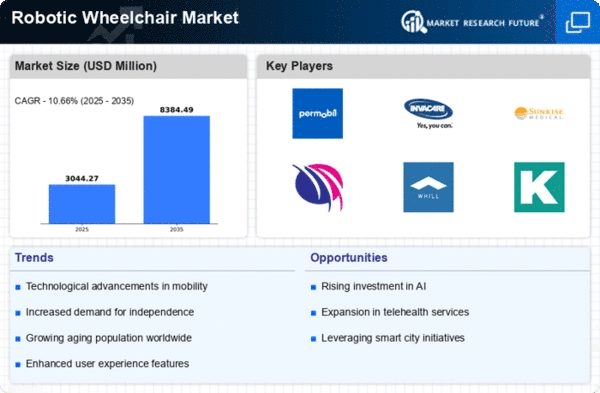
As per MRFR analysis, the Robotic Wheelchair Market Size was estimated at 2751.01 USD Million in 2024. The Robotic Wheelchair industry is projected to grow from 3044.32 in 2025 to 8384.49 by 2035, exhibiting a compound annual growth rate (CAGR) of 10.66 during the forecast period 2025 - 2035.

Key Market Trends & Highlights

The Robotic Wheelchair Market is experiencing robust growth driven by technological advancements and increasing demand for independence.

  • Technological advancements are enhancing the functionality and user experience of robotic wheelchairs.
  • The North American market remains the largest, while the Asia-Pacific region is emerging as the fastest-growing market.
  • The personal mobility segment dominates the market, whereas the healthcare segment is witnessing rapid growth.
  • Key market drivers include technological innovations in robotics and the aging population facing mobility challenges.

Market Size & Forecast

2024 Market Size 2751.01 (USD Million)
2035 Market Size 8384.49 (USD Million)
CAGR (2025 - 2035) 10.66%

Major Players

Permobil (SE), Invacare (US), Sunrise Medical (US), MediTouch (IL), Whill (JP), Karma Medical (TW), Drive Medical (US), Apex Medical (TW), SmartDrive (US)

Robotic Wheelchair Market Trends

The Robotic Wheelchair Market is currently experiencing a transformative phase, characterized by advancements in technology and increasing demand for mobility solutions. As the global population ages, the need for innovative assistive devices becomes more pronounced. This market appears to be evolving rapidly, with manufacturers focusing on enhancing user experience through improved design and functionality. Moreover, the integration of artificial intelligence and smart technologies into robotic wheelchairs is likely to redefine mobility for individuals with disabilities, offering them greater independence and autonomy. In addition, the growing awareness of the benefits associated with robotic wheelchairs is fostering a shift in consumer perception. Stakeholders, including healthcare providers and caregivers, are recognizing the potential of these devices to enhance quality of life. This trend suggests a promising future for the Robotic Wheelchair Market, as ongoing research and development efforts aim to address existing challenges and expand the range of applications. As the market continues to mature, it may witness increased collaboration between technology firms and healthcare organizations, further driving innovation and accessibility in mobility solutions.

Technological Advancements

The Robotic Wheelchair Market is witnessing rapid technological advancements, particularly in the integration of artificial intelligence and machine learning. These innovations are enhancing the functionality and adaptability of wheelchairs, allowing for more intuitive user interactions and improved navigation capabilities.

Increased Demand for Independence

There is a growing demand for solutions that promote independence among individuals with mobility challenges. Robotic wheelchairs are increasingly viewed as tools that empower users, enabling them to navigate their environments with greater ease and confidence.

Focus on Customization

Customization is becoming a key trend within the Robotic Wheelchair Market. Manufacturers are recognizing the importance of tailoring features to meet the specific needs of users, which may include personalized controls, seating arrangements, and mobility options.

Robotic Wheelchair Market Drivers

Aging Population

The aging population is a significant driver of the Global Robotic Wheelchair Market Industry. As the global demographic shifts towards an older population, the demand for mobility solutions increases. Older adults often face mobility challenges due to age-related conditions such as arthritis and neurological disorders. Robotic wheelchairs offer a viable solution, providing independence and improved quality of life. Countries with rapidly aging populations, such as Japan and many European nations, are witnessing a surge in demand for these devices. This trend is expected to contribute substantially to market growth, as more elderly individuals seek advanced mobility aids to maintain their autonomy.

Rising Disability Rates

The increasing rates of disabilities worldwide are influencing the Global Robotic Wheelchair Market Industry significantly. According to estimates, approximately 15% of the global population lives with some form of disability, which includes mobility impairments. Robotic wheelchairs are designed to cater to this demographic, offering enhanced mobility and independence. Governments and healthcare systems are recognizing the need for better mobility solutions, leading to increased funding and support for assistive technologies. This growing awareness and acceptance of robotic wheelchairs as essential mobility aids are likely to drive market expansion, as more individuals with disabilities seek these innovative solutions.

Market Growth Projections

The Global Robotic Wheelchair Market Industry is projected to experience substantial growth over the next decade. With a market value of 2.94 USD Billion in 2024, it is anticipated to reach 8.38 USD Billion by 2035. This growth trajectory indicates a compound annual growth rate (CAGR) of 9.98% from 2025 to 2035. Such projections reflect the increasing demand for advanced mobility solutions driven by technological advancements, an aging population, and rising disability rates. The market's expansion is likely to be supported by ongoing innovations and improvements in robotic wheelchair technology, which will enhance user experience and accessibility.

Technological Advancements

The Global Robotic Wheelchair Market Industry is experiencing rapid technological advancements that enhance the functionality and usability of robotic wheelchairs. Innovations in artificial intelligence, sensor technology, and machine learning are enabling these devices to navigate complex environments autonomously. For instance, advanced obstacle detection systems and real-time mapping capabilities are becoming standard features. These improvements not only increase user safety but also expand the potential user base, particularly among individuals with severe mobility impairments. As a result, the market is projected to grow from 2.94 USD Billion in 2024 to 8.38 USD Billion by 2035, reflecting a robust CAGR of 9.98% for the period from 2025 to 2035.

Increased Awareness and Acceptance

Increased awareness and acceptance of robotic wheelchairs among consumers and healthcare professionals are driving the Global Robotic Wheelchair Market Industry. Educational initiatives and advocacy efforts are helping to dispel misconceptions about these devices, highlighting their benefits and capabilities. As more individuals become informed about the advantages of robotic wheelchairs, including enhanced mobility and independence, the demand is likely to grow. Additionally, healthcare professionals are increasingly recommending these devices as viable mobility solutions, further boosting their acceptance. This shift in perception is expected to contribute to the overall market growth, as more users seek out robotic wheelchairs for their mobility needs.

Healthcare Infrastructure Improvements

Improvements in healthcare infrastructure globally are facilitating the growth of the Global Robotic Wheelchair Market Industry. Enhanced healthcare facilities are increasingly adopting advanced technologies, including robotic wheelchairs, to provide better patient care. Hospitals and rehabilitation centers are integrating these devices into their services, recognizing their potential to improve patient outcomes and reduce caregiver burden. This trend is particularly evident in developed nations, where healthcare systems are investing in cutting-edge assistive technologies. As healthcare infrastructure continues to evolve, the demand for robotic wheelchairs is expected to rise, further propelling market growth.


Market Segment Insights

By Application: Personal Mobility (Largest) vs. Healthcare (Fastest-Growing)

The Robotic Wheelchair Market is witnessing a significant distribution of market share among various application segments. Personal Mobility holds the largest share as individuals seek enhanced independence and mobility solutions. Healthcare, on the other hand, is gaining momentum, driven by increasing demand for advanced wheelchair technologies in medical facilities for patient transport and care. Rehabilitation and Assisted Living follow closely behind, with outdoor use also capturing a niche market.

Healthcare (Dominant) vs. Rehabilitation (Emerging)

In the Robotic Wheelchair Market, the Healthcare segment stands out as a dominant force due to its critical role in enhancing patient mobility and safety in medical environments. This segment benefits from advancements in robotics and artificial intelligence, leading to innovative features tailored for patient care. Meanwhile, Rehabilitation serves as an emerging segment, focusing on therapy and recovery aspects, helping users regain mobility post-injury or surgery. It is characterized by versatile wheelchairs equipped with adaptive technologies that support therapeutic exercises and monitoring, appealing to a growing demographic seeking such solutions.

By End User: Elderly (Largest) vs. Physically Disabled (Fastest-Growing)

The Robotic Wheelchair Market displays a diverse market share distribution among its end-user segments. The elderly segment holds the largest share, driven by an aging population that increasingly seeks mobility solutions to enhance their quality of life. Following closely, physically disabled individuals represent a rapidly expanding segment, reflecting a growing demand for tailored mobility aids. Post-surgery patients, caregivers, and healthcare facilities also contribute to the market but with comparatively smaller shares, emphasizing the varied requirements across these demographics. Growth trends in the Robotic Wheelchair Market are significantly influenced by technological advancements and increased awareness about independent living for the elderly and physically disabled. Factors such as improved battery life, user-friendly interfaces, and advanced navigation systems are driving the adoption of robotic wheelchairs. Additionally, the prevalence of chronic illnesses and surgeries necessitates effective mobility solutions, leading to innovations tailored to post-surgery rehabilitation and support from caregivers in healthcare facilities.

Elderly (Dominant) vs. Physically Disabled (Emerging)

The elderly population represents the dominant segment within the Robotic Wheelchair Market, characterized by a significant demand for mobility assistance as they seek to maintain independence and dignity in their daily lives. This group favors wheelchairs that offer enhanced comfort, easy maneuverability, and safety features. In contrast, physically disabled individuals are emerging as a critical market segment, driven by technological advancements that cater specifically to their diverse needs. These users often require customized solutions that support their unique physical challenges, leading to innovations such as customizable controls and adaptive technologies that enhance user experience. Both segments are crucial to market growth, as they reflect a growing societal shift towards more inclusive mobility solutions.

By Technology: Electric Drive (Largest) vs. Smart Technology (Fastest-Growing)

The Robotic Wheelchair Market is witnessing a significant distribution of market share among its technology segment values. Electric Drive remains the largest segment, driven by its widespread adoption and reliability in providing mobility solutions for users. Hydraulic Drive is also notable but currently has a smaller market share, focusing on heavier applications. Pneumatic Drive is niche, mainly used in specific models, while Smart Technology is rapidly gaining traction among consumers seeking innovative features and enhanced user experiences.

Technology: Electric Drive (Dominant) vs. Smart Technology (Emerging)

Electric Drive technology is dominant in the Robotic Wheelchair Market due to its efficiency, user-friendliness, and extensive manufacturer support. This segment is designed for smooth operation in various terrains, making it ideal for a broad range of users. Conversely, Smart Technology is emerging as a key player, integrating advanced features such as IoT connectivity, health monitoring, and user customization. It appeals particularly to tech-savvy consumers and those looking for a more personalized wheelchair experience. As the demand for innovative solutions continues to grow, these two segments will shape the future landscape of robotic wheelchairs.

By Weight Capacity: Standard (Largest) vs. Heavy Duty (Fastest-Growing)

In the Robotic Wheelchair Market, the distribution of market share among different weight capacities reveals that the Standard segment holds the largest proportion. This segment appeals to a broad user base due to its balance of weight, functionality, and affordability. In contrast, the Heavy Duty segment, designed for users with higher weight requirements, exhibits the fastest growth, catering to an increasing demographic of users who demand robust solutions with higher weight limits. Market trends indicate a rising need for robotic wheelchairs that can support a wider range of weight capacities. Factors driving this segment’s growth include the aging population requiring mobility solutions that prioritize safety, globalization, and enhanced technology resulting in more innovative, adaptable wheelchairs. The Heavy Duty segment is essential for expanding the reach of robotic wheelchairs to users looking for durability and reliability in mobility aids.

Standard (Dominant) vs. Ultra Heavy Duty (Emerging)

The Standard weight capacity robotic wheelchairs dominate the market as they provide a versatile option for most users, balancing comfort, style, and reliability. This segment is favored for its affordability and practical features, which have resonated well with the general mobility aid consumers. Conversely, the Ultra Heavy Duty segment is emerging as a vital player, catering to niche markets that require higher weight thresholds. Users in this category often face unique challenges and demands, leading to a burgeoning interest in customized solutions tailored for enhanced safety and performance. The increasing focus on inclusivity within healthcare and mobility solutions is propelling the emergence of Ultra Heavy Duty robotic wheelchairs, aiming to break barriers for users with specific weight needs.

By Control Mechanism: Joystick Control (Largest) vs. Voice Control (Fastest-Growing)

In the Robotic Wheelchair Market, joystick control holds the largest market share, owing to its established use and familiarity among users. This traditional mechanism offers precision in navigation, making it a favored choice for many wheelchair users. In contrast, voice control is emerging rapidly, capturing the attention of tech-savvy individuals seeking hands-free operation. As accessibility becomes paramount, the market share of these control mechanisms is evolving to cater to diverse user needs.

Joystick Control (Dominant) vs. Voice Control (Emerging)

Joystick control remains the dominant mechanism in the Robotic Wheelchair Market, characterized by its intuitive design and ease of use, appealing to a broad demographic, including elderly individuals and those with mobility impairments. It provides users with a high level of control, offering precision during movement. However, voice control is emerging as a strong competitor, providing a futuristic approach to mobility assistance. This innovative technology allows users to operate their wheelchairs through voice commands, offering unparalleled convenience. As advancements in voice recognition technology improve, this segment is expected to attract more users, particularly younger individuals who embrace tech-driven solutions.

Get more detailed insights about Robotic Wheelchair Market

Regional Insights

North America : Market Leader in Robotics

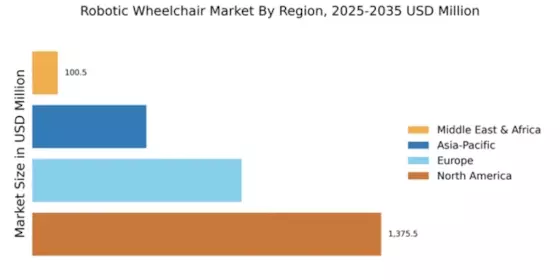
North America is poised to maintain its leadership in the robotic wheelchair market, holding a significant market share of 1375.5 million. The growth is driven by increasing demand for advanced mobility solutions, technological innovations, and supportive regulatory frameworks. The region's aging population and rising prevalence of disabilities further fuel the market's expansion, making it a critical area for investment and development. The competitive landscape in North America is robust, featuring key players such as Invacare, Sunrise Medical, and Drive Medical. These companies are at the forefront of innovation, offering a range of products that cater to diverse consumer needs. The presence of established manufacturers and a strong distribution network enhances market accessibility, ensuring that advanced robotic wheelchairs are available to those in need.

Europe : Emerging Market Potential

Europe is witnessing a burgeoning market for robotic wheelchairs, with a market size of 825.0 million. The growth is propelled by increasing awareness of mobility solutions, government initiatives promoting assistive technologies, and a growing elderly population. Regulatory support, including funding for healthcare innovations, is also a significant catalyst for market expansion, enhancing accessibility to advanced mobility aids. Leading countries in this region include Germany, France, and the UK, where companies like Permobil and Sunrise Medical are making significant strides. The competitive landscape is characterized by a mix of established players and innovative startups, fostering a dynamic environment for product development. The European market is increasingly focused on integrating smart technologies into mobility solutions, enhancing user experience and functionality.

Asia-Pacific : Rapidly Growing Market

The Asia-Pacific region is rapidly emerging as a significant player in the robotic wheelchair market, with a market size of 450.0 million. Factors driving this growth include rising disposable incomes, increasing awareness of assistive technologies, and a growing elderly population. Government initiatives aimed at improving healthcare access and mobility solutions are also contributing to the market's expansion, making it a focal point for future investments. Countries like Japan, China, and Australia are leading the charge, with companies such as Whill and Karma Medical at the forefront. The competitive landscape is evolving, with both local and international players vying for market share. The region's unique challenges, such as varying regulatory environments and cultural attitudes towards disability, are shaping the development of tailored mobility solutions that meet diverse consumer needs.

Middle East and Africa : Untapped Market Opportunities

The Middle East and Africa region represents an untapped market for robotic wheelchairs, with a market size of 100.51 million. The growth potential is driven by increasing healthcare investments, rising awareness of assistive technologies, and a growing demand for mobility solutions among the aging population. Government initiatives aimed at improving healthcare infrastructure are also expected to catalyze market growth, making this region a promising area for future development. Leading countries in this region include South Africa and the UAE, where there is a growing interest in advanced mobility solutions. The competitive landscape is still developing, with opportunities for both local and international players to establish a presence. As awareness of the benefits of robotic wheelchairs increases, the market is likely to see a surge in demand, paving the way for innovative solutions tailored to regional needs.

Key Players and Competitive Insights

The Robotic Wheelchair Market is currently characterized by a dynamic competitive landscape, driven by technological advancements and an increasing demand for mobility solutions among individuals with disabilities. Key players such as Permobil (SE), Invacare (US), and Whill (JP) are strategically positioning themselves through innovation and partnerships, thereby enhancing their operational focus. For instance, Permobil (SE) has been emphasizing the integration of AI and IoT technologies into their products, which not only improves user experience but also sets a benchmark for competitors. Similarly, Invacare (US) has been focusing on expanding its product line to cater to diverse consumer needs, which collectively shapes a competitive environment that is increasingly reliant on technological differentiation and customer-centric solutions.

In terms of business tactics, companies are localizing manufacturing and optimizing supply chains to enhance efficiency and reduce costs. The market structure appears moderately fragmented, with several players vying for market share. However, the collective influence of key players like Drive Medical (US) and Sunrise Medical (US) suggests a trend towards consolidation, as these companies leverage their resources to gain competitive advantages. This fragmentation allows for niche players to thrive, yet the overarching trend indicates a gradual shift towards a more concentrated market.

In November 2025, Whill (JP) announced a strategic partnership with a leading tech firm to develop next-generation robotic wheelchairs equipped with advanced navigation systems. This move is significant as it not only enhances Whill's product offerings but also positions the company at the forefront of technological innovation in the market. The collaboration is expected to yield products that are more intuitive and user-friendly, potentially attracting a broader customer base.

In October 2025, Invacare (US) launched a new line of robotic wheelchairs that incorporate smart mobility features, such as voice control and automated obstacle detection. This strategic action underscores Invacare's commitment to innovation and reflects a growing trend towards integrating smart technologies into mobility solutions. The introduction of these features is likely to enhance user safety and convenience, thereby strengthening Invacare's market position.

In September 2025, Permobil (SE) expanded its operations into emerging markets by establishing a manufacturing facility in Southeast Asia. This strategic expansion is indicative of Permobil's focus on capturing new market segments and responding to the increasing demand for affordable mobility solutions in developing regions. By localizing production, the company aims to reduce costs and improve supply chain efficiency, which could enhance its competitive edge.

As of December 2025, the competitive trends in the Robotic Wheelchair Market are increasingly defined by digitalization, sustainability, and the integration of AI technologies. Strategic alliances are playing a crucial role in shaping the landscape, as companies collaborate to leverage each other's strengths. Looking ahead, it appears that competitive differentiation will evolve from traditional price-based competition to a focus on innovation, technological advancements, and supply chain reliability. This shift suggests that companies that prioritize R&D and customer-centric solutions are likely to emerge as leaders in the market.

Key Companies in the Robotic Wheelchair Market market include

Industry Developments

  • Q2 2024: Honda Unveils Next-Generation UNI-CUB β Robotic Personal Mobility Device Honda announced the launch of its next-generation UNI-CUB β, a robotic personal mobility device designed for indoor use, featuring advanced balance control technology and intuitive operation for users with mobility challenges.
  • Q2 2024: Permobil Launches M Corpus VS Robotic Wheelchair Market with Standing Functionality Permobil introduced the M Corpus VS, a robotic wheelchair that enables users to stand, integrating advanced robotics and ergonomic design to improve mobility and independence for people with disabilities.
  • Q3 2024: WHILL Announces Partnership with Tokyo International Airport for Autonomous Mobility Service WHILL partnered with Tokyo International Airport to deploy its autonomous robotic wheelchairs, providing enhanced mobility services for travelers with disabilities within the airport terminal.
  • Q3 2024: UPnRIDE Robotics Raises $15 Million Series B to Scale Robotic Standing Wheelchair Production UPnRIDE Robotics secured $15 million in Series B funding to expand manufacturing and accelerate commercialization of its robotic standing wheelchair, which offers upright mobility for users with severe disabilities.
  • Q4 2024: Ottobock Acquires Minority Stake in Centaur Robotics to Advance Smart Wheelchair Technology Ottobock acquired a minority stake in Centaur Robotics, aiming to collaborate on the development of next-generation smart robotic wheelchairs with enhanced navigation and safety features.
  • Q4 2024: Karman Healthcare Opens New Robotic Wheelchair Market Manufacturing Facility in Texas Karman Healthcare inaugurated a new state-of-the-art facility in Texas dedicated to the production of robotic wheelchairs, increasing its manufacturing capacity to meet rising demand in North America.
  • Q1 2025: MEYRA Announces Strategic Partnership with Panasonic for AI-Driven Wheelchair Navigation MEYRA entered a strategic partnership with Panasonic to integrate AI-powered navigation systems into its robotic wheelchairs, aiming to enhance user safety and autonomy.
  • Q1 2025: Sunrise Medical Launches Q700-UP M Robotic Wheelchair Market in Europe Sunrise Medical launched the Q700-UP M, a robotic wheelchair featuring advanced drive controls and standing functionality, targeting the European market for high-end mobility solutions.
  • Q2 2025: Invacare Receives CE Mark Approval for AVIVA FX Robotic Power Wheelchair Invacare obtained CE Mark approval for its AVIVA FX robotic power wheelchair, allowing the company to market and sell the device across the European Union.
  • Q2 2025: Airwheel Debuts H3TS+ Robotic Wheelchair Market with Smart Home Integration Airwheel launched the H3TS+, a robotic wheelchair equipped with smart home connectivity, enabling users to control household devices directly from their mobility device.
  • Q3 2025: Tmsuk Secures $20 Million Investment to Expand Robotic Wheelchair Market R&D Tmsuk raised $20 million in new investment to accelerate research and development of its next-generation robotic wheelchairs, focusing on AI and remote monitoring capabilities.
  • Q3 2025: Permobil Announces Acquisition of Robotic Mobility Startup WheelTech Permobil acquired WheelTech, a startup specializing in robotic mobility solutions, to strengthen its portfolio and accelerate innovation in the robotic wheelchair sector.


Future Outlook

Robotic Wheelchair Market Future Outlook

The Robotic Wheelchair Market is poised for growth at 10.66% CAGR from 2024 to 2035, driven by technological advancements, increasing demand for mobility solutions, and an aging population.

New opportunities lie in:

  • Integration of AI for personalized user experiences
  • Development of subscription-based service models
  • Expansion into emerging markets with tailored products

By 2035, the market is expected to achieve substantial growth, solidifying its position as a leader in mobility solutions.

Market Segmentation

Robotic Wheelchair Market End User Outlook

  • Elderly
  • Physically Disabled
  • Post-Surgery Patients
  • Caregivers
  • Healthcare Facilities

Robotic Wheelchair Market Technology Outlook

  • Electric Drive
  • Hydraulic Drive
  • Pneumatic Drive
  • Smart Technology
  • Autonomous Navigation

Robotic Wheelchair Market Application Outlook

  • Personal Mobility
  • Healthcare
  • Rehabilitation
  • Assisted Living
  • Outdoor Use

Robotic Wheelchair Market Weight Capacity Outlook

  • Lightweight
  • Standard
  • Heavy Duty
  • Ultra Heavy Duty

Robotic Wheelchair Market Control Mechanism Outlook

  • Joystick Control
  • Touchscreen Control
  • Voice Control
  • Mobile App Control

Report Scope

MARKET SIZE 20242751.01(USD Million)
MARKET SIZE 20253044.32(USD Million)
MARKET SIZE 20358384.49(USD Million)
COMPOUND ANNUAL GROWTH RATE (CAGR)10.66% (2024 - 2035)
REPORT COVERAGERevenue Forecast, Competitive Landscape, Growth Factors, and Trends
BASE YEAR2024
Market Forecast Period2025 - 2035
Historical Data2019 - 2024
Market Forecast UnitsUSD Million
Key Companies ProfiledPermobil (SE), Invacare (US), Sunrise Medical (US), MediTouch (IL), Whill (JP), Karma Medical (TW), Drive Medical (US), Apex Medical (TW), SmartDrive (US)
Segments CoveredApplication, End User, Technology, Weight Capacity, Control Mechanism
Key Market OpportunitiesIntegration of artificial intelligence enhances user experience in the Robotic Wheelchair Market.
Key Market DynamicsTechnological advancements and increasing consumer demand drive innovation and competition in the robotic wheelchair market.
Countries CoveredNorth America, Europe, APAC, South America, MEA

Leave a Comment

FAQs

What was the market size of the Robotic Wheelchair Market in 2023?

The Robotic Wheelchair Market reached a valuation of 2.75 billion USD in 2024

What is the projected CAGR of the Robotic Wheelchair Market from 2025 to 2034?

The Robotic Wheelchair Market is projected to grow at a CAGR of 10.66% from 2025 to 2034

Which region is expected to hold the largest market share in the Robotic Wheelchair Market in 2034?

North America is expected to hold the largest market share in the Robotic Wheelchair Market in 2034

What are the key factors driving the growth of the Robotic Wheelchair Market?

The increasing prevalence of mobility impairments and the growing demand for assistive technologies are key factors driving the growth of the Robotic Wheelchair Market.

Who are the major players in the Robotic Wheelchair Market?

Major players in the Robotic Wheelchair Market include Permobil, Sunrise Medical, and Ottobock.

What are the key applications of robotic wheelchairs?

Robotic wheelchairs are used for a variety of applications, including indoor and outdoor mobility, rehabilitation, and recreation.

What are the challenges facing the Robotic Wheelchair Market?

Challenges facing the Robotic Wheelchair Market include high cost, regulatory hurdles, and lack of reimbursement.

What are the opportunities in the Robotic Wheelchair Market?

Opportunities in the Robotic Wheelchair Market include technological advancements, increasing demand from emerging markets, and government support.

What are the key trends in the Robotic Wheelchair Market?

Key trends in the Robotic Wheelchair Market include the integration of AI and machine learning, the development of modular and customizable wheelchairs, and the growing adoption of cloud-based services.

What is the expected market size of the Robotic Wheelchair Market in 2032?

The Robotic Wheelchair Market is expected to reach a valuation of 5.6 billion USD in 2032.

Download Free Sample

Kindly complete the form below to receive a free sample of this Report

Compare Licence

×
Features License Type
Single User Multiuser License Enterprise User
Price $4,950 $5,950 $6,250
Maximum User Access Limit 1 User Upto 10 Users Unrestricted Access Throughout the Organization
Free Customization
Direct Access to Analyst
Deliverable Format
Platform Access
Discount on Next Purchase 10% 15% 15%
Printable Versions