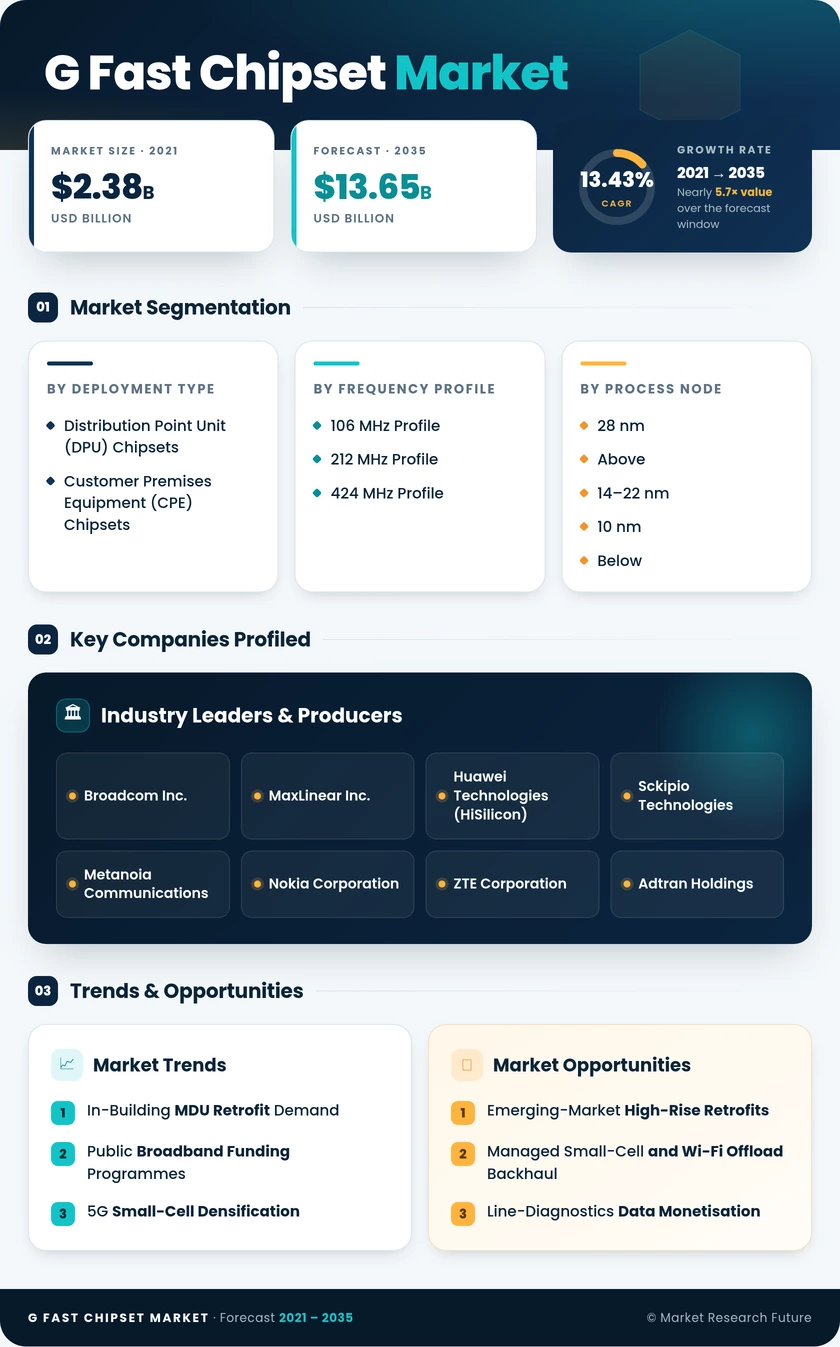
Segmentation Quick Reference
| Dimension | Sub-Segments | Dominant Segment | Fastest Growing Segment |
|---|---|---|---|
| By Deployment Type | Distribution Point Unit (DPU) Chipsets; Customer Premises Equipment (CPE) Chipsets | Distribution Point Unit (DPU) Chipsets — 52.4% share | Customer Premises Equipment (CPE) Chipsets — 14.2% CAGR |
| By Frequency Profile | 106 MHz Profile; 212 MHz Profile; 424 MHz Profile | 212 MHz Profile — 43.5% share | 424 MHz Profile — 13.8% CAGR |
| By Process Node | 28 nm and Above; 14–22 nm; 10 nm and Below | 14–22 nm — 46.9% share | 10 nm and Below — 13.7% CAGR |
| By End-Use Application | Multi-Dwelling Unit Broadband; Single-Family FTTC / FTTB; Small-Cell / Wi-Fi Offload Backhaul; Industrial and Enterprise Connectivity | Multi-Dwelling Unit Broadband — 40.1% share | Small-Cell / Wi-Fi Offload Backhaul — 14.0% CAGR |
| By Region | North America; Europe; Asia-Pacific; South America; Middle East & Africa | Asia-Pacific — 38.5% share | Middle East & Africa — 15.6% CAGR |
Market Segmentation Overview
By Deployment Type
| Sub-Segment | Key Trend |
|---|---|
| Distribution Point Unit (DPU) Chipsets | Reverse-powered curbside nodes with integrated vectoring |
| Customer Premises Equipment (CPE) Chipsets | Modem refresh cycles and profile-upgrade replacements |
Distribution Point Unit (DPU) Chipsets lead this dimension because operators prefer to concentrate vectoring and power-feed intelligence in a single curbside or basement node that software updates can upgrade in place. Customer Premises Equipment (CPE) Chipsets grow fastest, since every subscriber moving off a legacy DSL modem, or onto a higher-frequency profile, needs new premises silicon. Bundling CPE hardware with service contracts, common in Europe and Asia, keeps attachment rates high.
By Frequency Profile
| Sub-Segment | Key Trend |
|---|---|
| 106 MHz Profile | Longer loops and VDSL2 spectrum coexistence |
| 212 MHz Profile | Mature workhorse profile for incumbent operators |
| 424 MHz Profile | Symmetrical multi-gigabit service over short loops |
The 212 MHz Profile dominates because its reach and established diagnostics suit loops of 150–200 metres, while the 106 MHz Profile remains on longer runs that must share spectrum with VDSL2. The 424 MHz Profile grows fastest by doubling usable spectrum, which makes symmetrical gigabit tiers viable in MDUs and small-cell links. Better echo cancellation is steadily extending its usable reach.
By Process Node
| Sub-Segment | Key Trend |
|---|---|
| 28 nm and Above | Cost-led CPE facing mature-line supply pressure |
| 14–22 nm | Balance of performance and wafer cost |
| 10 nm and Below | Single-die integration of processing, security, and AI engines |
14–22 nm holds the largest share because it delivers sufficient vectoring performance at a manageable wafer cost. 10 nm and Below grows fastest, as operators impose power-per-bit thresholds and vendors integrate neural engines and secure boot on one die. 28 nm and Above persists in price-led CPE but faces tightening foundry allocation.
By End-Use Application
| Sub-Segment | Key Trend |
|---|---|
| Multi-Dwelling Unit Broadband | Reuse of in-building copper risers to avoid apartment rewiring |
| Single-Family FTTC / FTTB | Rural and historic districts with civil-works limits |
| Small-Cell / Wi-Fi Offload Backhaul | 5G densification over existing street copper |
| Industrial and Enterprise Connectivity | Hotels, hospitals, and campuses reusing telephone wiring |
Multi-Dwelling Unit Broadband leads because building owners can offer gigabit service without drilling into individual apartments, a decisive advantage in high-rise markets. Small-Cell / Wi-Fi Offload Backhaul grows fastest as 5G densification multiplies the number of sites needing low-latency links that copper already reaches. Single-Family FTTC / FTTB slows as new housing adopts fibre-ready standards, while Industrial and Enterprise Connectivity provides a smaller but high-margin niche.


 Noah Malgeri
Co-Founder

 Peter Groot koerkamp
Account and Business Manager

 Younghwan Choi
Senior Retail Manager

 Mark Irwin
Management Consultant

 Akif Moroglu
Strategy & Business Development Director

 Guilherme Gomes Martins
Product Management Director

 Joseph Aguayo
Sales Operations & Pricing Manager

 La Terria Dodd
Program Support Specialist

 Rob Kooiker
Group Product Manager HVAC & Fire Protection GMA