Request Free Sample ×

Kindly complete the form below to receive a free sample of this Report

* Please use a valid business email

Leading companies partner with us for data-driven Insights

clients tt-cursor
Hero Background
English
Chinese
French
Japanese
Korean
German
Spanish

Fungal Endocarditis Market Share

ID: MRFR/LS/3679-HCR
85 Pages
Vikita Thakur
April 2026

Fungal Endocarditis Market Research Report Information: By Type of Fungus (Candida, Aspergillus), Diagnosis (Blood Test, X-Ray, Echocardiography, Electrocardiogram), Treatment (Antifungal Medication, Surgery, Combined Treatment), End User - Global Forecast till 2035

Share:
Download PDF ×

We do not share your information with anyone. However, we may send you emails based on your report interest from time to time. You may contact us at any time to opt-out.

Fungal Endocarditis Market Infographic
Purchase Options

Market Share

Fungal Endocarditis Market Share Analysis

The Fungal Endocarditis Market tends to a difficult ailment described by fungal contaminations influencing the endocardium. Organizations working in this specialty market utilize different techniques to situate themselves really and capture market share in the finding and treatment of fungal endocarditis. A key procedure includes the usage of cutting-edge indicative strategies. Organizations put resources into cutting edge imaging innovations, blood culture techniques, and molecular diagnostics to improve the exactness and speed of fungal endocarditis determination. Remaining at the very front of analytic abilities adds to market authority. Given the intricacy of treating fungal endocarditis, organizations decisively center around the turn of events and advancement of compelling antifungal treatments. This incorporates the exploration and presentation of novel antifungal specialists and treatment conventions. Offering exhaustive and inventive treatment choices improves market appeal and impacts endorsing choices. Dynamic commitment to instructive projects focusing on the two patients and healthcare experts is indispensable. Giving data about fungal endocarditis, its risk elements, side effects, and available medicines upgrades consciousness. Instructing doctors on the subtleties of diagnosing and overseeing fungal endocarditis adds to expanded reception and market share development. A contemporary procedure includes coordinating fungal endocarditis determination and conferences with telemedicine stages. Organizations foster arrangements that permit remote interviews with irresistible infection trained professionals, empowering patients to get to well-qualified feelings paying attention to geographical constraints. This approach lines up with the developing pattern of telehealth and works on tolerant accessibility. Giving expense proficient antifungal treatment arrangements is an essential thought. Organizations upgrade fabricating processes, haggle with providers, and investigate economies of scale to offer serious valuing. This system draws in healthcare suppliers and establishments searching for solid and practical antifungal treatments for fungal endocarditis.


Author
Author Profile
Vikita Thakur
Senior Research Analyst

She holds an experience of about 5+ years in market research and business consulting projects for sectors such as life sciences, medical devices, and healthcare IT. She possesses a robust background in data analysis, market estimation, competitive intelligence, pipeline analysis market trend identification, and consumer behavior insights. Her expertise lies in technical Sales support, client interaction and project management, designing and implementing market research studies, conducting competitive analysis, and synthesizing complex data into actionable recommendations that drive business growth.

Leave a Comment

FAQs

What is the current market valuation of the Fungal Endocarditis Market?

<p>The Fungal Endocarditis Market was valued at 364.25 USD Million in 2024.</p>

What is the projected market size for the Fungal Endocarditis Market by 2035?

<p>The market is expected to reach 642.97 USD Million by 2035.</p>

What is the expected CAGR for the Fungal Endocarditis Market during the forecast period?

<p>The expected CAGR for the Fungal Endocarditis Market from 2025 to 2035 is 5.26%.</p>

Which companies are the key players in the Fungal Endocarditis Market?

<p>Key players include Pfizer Inc, Merck & Co, Astellas Pharma Inc, and Gilead Sciences Inc.</p>

What are the primary applications in the Fungal Endocarditis Market?

<p>The primary applications include Diagnosis, Treatment, and Prevention, with Treatment valued at 200.0 to 350.0 USD Million.</p>

How is the Fungal Endocarditis Market segmented by end use?

The market is segmented into Hospitals, Clinics, and Home Care, with Hospitals valued at 145.0 to 260.0 USD Million.

What are the leading pathogen types affecting the Fungal Endocarditis Market?

Leading pathogen types include Candida, Aspergillus, and Cryptococcus, with Candida valued at 145.0 to 260.0 USD Million.

What diagnostic methods are utilized in the Fungal Endocarditis Market?

Diagnostic methods include Blood Culture, Serological Tests, and Molecular Techniques, with Blood Culture valued at 145.0 to 250.0 USD Million.

What treatment types are available in the Fungal Endocarditis Market?

Available treatment types include Antifungal Therapy, Surgical Intervention, and Supportive Care, with Antifungal Therapy valued at 145.0 to 260.0 USD Million.

How does the market performance of Fungal Endocarditis compare across different segments?

The market performance varies, with Treatment leading at 200.0 to 350.0 USD Million, while Diagnosis and Prevention also show substantial values.

Market Summary

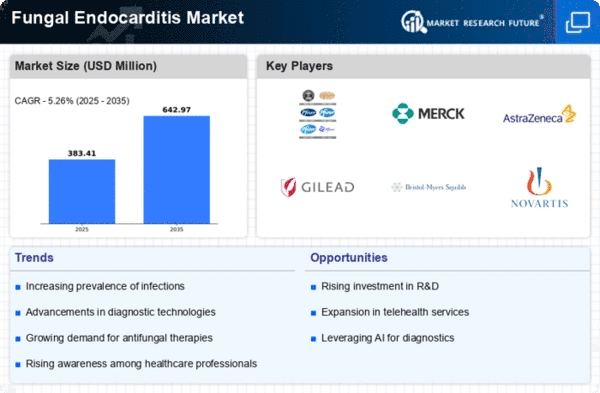
As per MRFR analysis, the Fungal Endocarditis Market Size was estimated at 364.25 USD Million in 2024. The Fungal Endocarditis industry is projected to grow from 387.58 USD Million in 2025 to 642.97 USD Million by 2035, exhibiting a compound annual growth rate (CAGR) of 5.26% during the forecast period 2025 - 2035.

Key Market Trends & Highlights

The Fungal Endocarditis Market is poised for growth driven by rising incidences and advancements in treatment.

  • The market is witnessing a rising incidence of fungal infections, particularly in immunocompromised populations. Advancements in diagnostic technologies are enhancing early detection and management of fungal endocarditis. The treatment segment is experiencing rapid growth due to the development of novel therapeutics and innovative treatment modalities. Key market drivers include increasing awareness of fungal endocarditis and the rising prevalence of immunocompromised patients, particularly in North America and the Asia-Pacific region.

Market Size & Forecast

2024 Market Size 364.25 (USD Million)
2035 Market Size 642.97 (USD Million)
CAGR (2025 - 2035) 5.26%
Largest Regional Market Share in 2024 North America

Major Players

Pfizer Inc (US), Merck &amp; Co Inc (US), AstraZeneca PLC (GB), Gilead Sciences Inc (US), Bristol-Myers Squibb Company (US), Novartis AG (CH), Roche Holding AG (CH), Johnson &amp; Johnson (US), Sanofi SA (FR)

Market Trends

The Fungal Endocarditis Market is currently experiencing a notable evolution, driven by a combination of factors including advancements in diagnostic techniques and an increasing awareness of fungal infections. The rise in immunocompromised patients, due to various underlying health conditions, has led to a heightened incidence of fungal endocarditis. This condition, characterized by the infection of the heart valves, poses significant treatment challenges, necessitating the development of more effective therapeutic options. As healthcare providers become more attuned to the complexities of fungal infections, there is a growing emphasis on early detection and tailored treatment strategies, which could potentially enhance patient outcomes. Moreover, the Fungal Endocarditis Market is likely to benefit from ongoing research initiatives aimed at understanding the pathophysiology of fungal infections. Innovative antifungal agents are being explored, which may offer improved efficacy against resistant strains. The integration of technology in healthcare, such as telemedicine and digital health solutions, appears to facilitate better management of patients with fungal endocarditis. As the market continues to evolve, collaboration among pharmaceutical companies, healthcare providers, and research institutions may play a crucial role in addressing the unmet needs of this patient population, ultimately leading to advancements in treatment protocols and patient care.

Rising Incidence of Fungal Infections

The increasing prevalence of fungal infections, particularly among immunocompromised individuals, is driving demand within the Fungal Endocarditis Market. This trend suggests a need for enhanced awareness and improved diagnostic capabilities to address the growing burden of these infections.

Advancements in Diagnostic Technologies

Innovations in diagnostic methodologies are likely to transform the Fungal Endocarditis Market. Enhanced imaging techniques and molecular diagnostics may facilitate earlier detection, allowing for timely intervention and potentially better patient outcomes.

Development of Novel Therapeutics

The ongoing research into new antifungal agents indicates a promising future for the Fungal Endocarditis Market. These novel therapeutics may provide effective treatment options for resistant fungal strains, addressing a critical gap in current treatment paradigms.

Fungal Endocarditis Market Market Drivers

Rising Incidence of Fungal Infections

The increasing prevalence of fungal infections globally appears to drive the Global Fungal Endocarditis Market Industry. Factors such as immunocompromised patients, including those with diabetes, HIV, and cancer, contribute to this rise. In 2024, the market is projected to reach 0.45 USD Billion, reflecting the urgent need for effective treatment options. As awareness of fungal infections grows, healthcare providers are likely to enhance diagnostic capabilities, further propelling market growth. This trend suggests a potential increase in the number of diagnosed cases, which may lead to a greater demand for antifungal therapies and interventions.

Market Segment Insights

By Application: Diagnosis (Largest) vs. Treatment (Fastest-Growing)

In the Fungal Endocarditis Market, the application segments are distinctly divided into Diagnosis, Treatment, and Prevention. Diagnosis currently holds the largest share of the market, primarily due to its critical role in the early detection and management of fungal infections. The significant investment in diagnostic tools and technologies has bolstered this segment, making it the leading area for market share. On the other hand, Treatment, while smaller, is the fastest-growing segment, fueled by increasing awareness and new therapeutic innovations in antifungal medications and supportive therapies for affected patients.

Treatment: Antifungal Therapy (Dominant) vs. Supportive Care (Emerging)

Within the Treatment segment for fungal endocarditis, Antifungal Therapy is established as the dominant approach, relying on a range of antifungal agents that are key to combating the infection effectively. This therapy sees broad application across various patient demographics and is continually evolving with advances in pharmaceutical research. In contrast, Supportive Care is emerging as a vital component of treatment strategies, focusing on managing symptoms and improving patient quality of life. This dual approach emphasizes a comprehensive strategy in treating fungal endocarditis, combining both aggressive infection control and supportive interventions.

By End Use: Hospitals (Largest) vs. Home Care (Fastest-Growing)

In the Fungal Endocarditis market, the distribution of end-use segments reveals that hospitals hold the largest share, significantly contributing to the overall treatment landscape. Clinics also play a crucial role; however, their market presence is relatively smaller when compared to hospitals. Meanwhile, home care services are gaining traction, marking a shift toward more patient-centric approaches that allow for treatments outside traditional healthcare facilities.

Hospitals (Dominant) vs. Home Care (Emerging)

Hospitals are the dominant players in the Fungal Endocarditis market due to their comprehensive resources and specialized departments equipped to handle complicated cases. They provide a range of advanced diagnostic tools, treatment modalities, and interdisciplinary care, fostering high success rates for fungal endocarditis patients. Conversely, home care services are emerging as a rapid growth segment, driven by the increasing demand for personalized medical support in the comfort of patients' homes. This trend is supported by advancements in telemedicine and home healthcare technologies, which cater to the growing preference for outpatient treatment and management, making healthcare more accessible and convenient.

By Pathogen Type: Candida (Largest) vs. Aspergillus (Fastest-Growing)

The Fungal Endocarditis Market shows a diverse share distribution among the main pathogen types: Candida, Aspergillus, and Cryptococcus. Candida leads the segment due to its higher incidence rates and associated complications, positioning it as the primary pathogen of concern in endocarditis cases. Aspergillus is also noteworthy, experiencing a rapid increase in cases due to rising immunocompromised populations. Cryptococcus, while significant, holds a smaller percentage, indicating diverse epidemiological challenges facing healthcare providers.

Pathogen Type: Candida (Dominant) vs. Aspergillus (Emerging)

Candida is recognized as the dominant pathogen in the Fungal Endocarditis sphere, largely due to its prevalence in patients with underlying health conditions such as diabetes and immunosuppression. Its opportunistic nature enables it to cause severe infections efficiently. In contrast, Aspergillus is rapidly emerging as a significant competitor, largely driven by the increasing number of immunocompromised individuals, including those undergoing chemotherapy and living with HIV/AIDS. This shift towards Aspergillus is indicative of changing patient demographics and highlights the need for effective diagnostic and therapeutic strategies.

By Diagnosis Method: Blood Culture (Largest) vs. Molecular Techniques (Fastest-Growing)

<p>In the Fungal Endocarditis Market, diagnostic methods are pivotal for timely treatment and improved patient outcomes. Blood cultures, being the largest segment, dominate the market due to their established reliability and effectiveness in detecting fungal pathogens. Serological tests hold a smaller share, yet they play a crucial role in supporting diagnosis when blood cultures yield inconclusive results. Meanwhile, molecular techniques are gaining traction and are expected to capture a growing portion of the market, especially as advancements in technology reduce testing times and enhance accuracy.</p>

<p>Blood Culture (Dominant) vs. Molecular Techniques (Emerging)</p>

<p>Blood culture remains the dominant diagnosis method in the Fungal Endocarditis Market, revered for its comprehensive ability to isolate and identify pathogens from patient samples, thereby leading to informed treatment decisions. However, molecular techniques are emerging rapidly, leveraging innovative methods like PCR to detect fungal DNA with high sensitivity and specificity. These techniques are particularly advantageous in cases where traditional cultures fail or are delayed. As healthcare systems increasingly adopt rapid diagnostic tools, molecular techniques' significance is expected to rise, providing healthcare professionals with timely results for effective intervention.</p>

By Treatment Type: Antifungal Therapy (Largest) vs. Surgical Intervention (Fastest-Growing)

In the Fungal Endocarditis Market, Antifungal Therapy dominates the treatment landscape, capturing the largest market share due to its established efficacy and wide usage among healthcare providers. Antifungal treatments are integral in managing fungal infections, making them the preferred choice for clinicians. Surgical Intervention is witnessing rapid growth as an essential complement to antifungal therapy, especially for patients with severe cases or associated complications that require urgent medical action.

Antifungal Therapy (Dominant) vs. Supportive Care (Emerging)

Antifungal Therapy remains the dominant treatment option within the Fungal Endocarditis Market, characterized by a strong portfolio of medications that target a variety of fungal pathogens. It plays a crucial role in eradicating infections and reducing mortality rates. In contrast, Supportive Care, while considered an emerging segment, focuses on adjunctive therapies to enhance patient well-being. This includes managing symptoms and bolstering the immune response, making it increasingly important as part of a comprehensive treatment strategy. As awareness of fungal infections rises, the integration of supportive care alongside antifungal therapy is expected to gain traction, further enhancing patient outcomes in managing fungal endocarditis.

Get more detailed insights about Fungal Endocarditis Market Research Report- Global forecast till 2035

Regional Insights

North America : Market Leader in Fungal Endocarditis

North America is poised to maintain its leadership in the Fungal Endocarditis market, holding a significant market share of 182.12M in 2024. The region's growth is driven by increasing incidences of fungal infections, advancements in diagnostic technologies, and supportive regulatory frameworks. The demand for effective antifungal therapies is further propelled by rising healthcare expenditures and a growing awareness of fungal endocarditis among healthcare professionals. The competitive landscape in North America is characterized by the presence of major pharmaceutical companies such as Pfizer Inc, Merck & Co, and Gilead Sciences. These key players are actively engaged in research and development to innovate new treatment options. The U.S. remains the leading country, supported by a robust healthcare infrastructure and significant investments in medical research, ensuring a steady supply of advanced therapeutic solutions.

Europe : Emerging Market with Growth Potential

Europe is witnessing a growing interest in the Fungal Endocarditis market, with a market size of 95.25M in 2024. The region's growth is fueled by increasing awareness of fungal infections, improved diagnostic capabilities, and a rise in the geriatric population, which is more susceptible to such infections. Regulatory bodies are also enhancing guidelines to facilitate faster approvals for antifungal treatments, thereby boosting market growth. Leading countries in Europe include Germany, France, and the UK, where healthcare systems are increasingly prioritizing fungal infection management. The competitive landscape features key players like AstraZeneca and Roche, who are investing in innovative therapies. The European Medicines Agency (EMA) is actively working to streamline the approval process for new antifungal drugs, which is expected to further enhance market dynamics.

Asia-Pacific : Rapidly Growing Market Segment

The Asia-Pacific region is emerging as a significant player in the Fungal Endocarditis market, with a market size of 70.0M in 2024. The growth is driven by increasing healthcare investments, rising awareness of fungal infections, and a growing population at risk. Countries like India and China are focusing on improving healthcare infrastructure, which is expected to enhance access to antifungal treatments and diagnostics, thereby driving market demand. The competitive landscape in Asia-Pacific is evolving, with local and international players vying for market share. Key companies such as Gilead Sciences and Novartis are expanding their presence in the region. The regulatory environment is gradually improving, with governments emphasizing the need for effective treatment options for fungal infections, which is likely to support market growth.

Middle East and Africa : Emerging Market with Challenges

The Middle East and Africa region is gradually developing its Fungal Endocarditis market, currently valued at 16.88M in 2024. The growth is hindered by limited healthcare infrastructure and awareness of fungal infections. However, increasing investments in healthcare and rising incidences of fungal diseases are expected to drive market growth. Regulatory bodies are beginning to recognize the importance of antifungal treatments, which may lead to improved access and availability in the future. Countries like South Africa and the UAE are leading the way in addressing fungal infections, with initiatives aimed at enhancing healthcare services. The competitive landscape is still nascent, with few key players present. However, as awareness grows, more pharmaceutical companies are likely to enter the market, driven by the potential for growth in this underserved region.

Key Players and Competitive Insights

The Fungal Endocarditis Market is currently characterized by a competitive landscape that is both dynamic and multifaceted. Key growth drivers include the rising incidence of fungal infections, advancements in diagnostic technologies, and an increasing focus on antimicrobial resistance. Major players such as Pfizer Inc (US), Gilead Sciences Inc (US), and Merck & Co Inc (US) are strategically positioned to leverage these trends. Pfizer Inc (US) has been focusing on innovation in antifungal therapies, while Gilead Sciences Inc (US) emphasizes partnerships to enhance its product pipeline. Merck & Co Inc (US) is actively pursuing mergers and acquisitions to bolster its market presence, collectively shaping a competitive environment that is increasingly reliant on innovation and strategic collaborations.In terms of business tactics, companies are localizing manufacturing and optimizing supply chains to enhance efficiency and responsiveness to market demands. The market structure appears moderately fragmented, with a mix of established players and emerging biotech firms. This fragmentation allows for diverse approaches to treatment and innovation, although the collective influence of key players is significant in setting industry standards and driving research initiatives.
In November Gilead Sciences Inc (US) announced a strategic partnership with a leading diagnostic company to develop rapid testing solutions for fungal infections. This collaboration is poised to enhance early detection and treatment options for fungal endocarditis, potentially improving patient outcomes. The strategic importance of this move lies in Gilead's commitment to addressing unmet medical needs through innovative solutions, thereby reinforcing its position in the market.
In October Merck & Co Inc (US) completed the acquisition of a biotech firm specializing in antifungal drug development. This acquisition is expected to expand Merck's portfolio and accelerate the development of novel therapies for fungal endocarditis. The strategic significance of this action is underscored by Merck's focus on enhancing its research capabilities and addressing the growing demand for effective antifungal treatments.
In September Pfizer Inc (US) launched a new antifungal agent that targets resistant strains of fungi. This product introduction is a critical step in Pfizer's strategy to lead in the antifungal market, particularly in light of increasing resistance patterns. The launch not only reflects Pfizer's commitment to innovation but also positions the company to capture a larger market share in a competitive landscape.
As of December current competitive trends are increasingly defined by digitalization, sustainability, and the integration of artificial intelligence in drug development. Strategic alliances are shaping the landscape, enabling companies to pool resources and expertise to tackle complex challenges in fungal endocarditis treatment. Looking ahead, competitive differentiation is likely to evolve from traditional price-based competition to a focus on innovation, technological advancements, and supply chain reliability, suggesting a transformative shift in how companies approach market challenges.

Key Companies in the Fungal Endocarditis Market include

Industry Developments

Future Outlook

Fungal Endocarditis Market Future Outlook

The Fungal Endocarditis Market is projected to grow at a 5.26% CAGR from 2025 to 2035, driven by increasing incidence rates, advancements in diagnostics, and enhanced treatment options.

New opportunities lie in:

  • <p>Development of targeted antifungal therapies for resistant strains. Expansion of <a href="https://www.marketresearchfuture.com/reports/telemedicine-market-2216">telemedicine</a> platforms for remote patient monitoring. Investment in advanced diagnostic tools for early detection and treatment.</p>

By 2035, the market is expected to achieve substantial growth, reflecting evolving healthcare needs.

Market Segmentation

Fungal Endocarditis Market End Use Outlook

  • Hospitals
  • Clinics
  • Home Care

Fungal Endocarditis Market Application Outlook

  • Diagnosis
  • Treatment
  • Prevention

Fungal Endocarditis Market Pathogen Type Outlook

  • Candida
  • Aspergillus
  • Cryptococcus

Fungal Endocarditis Market Treatment Type Outlook

  • Antifungal Therapy
  • Surgical Intervention
  • Supportive Care

Fungal Endocarditis Market Patient Demographics Outlook

  • Adults
  • Pediatrics
  • Geriatrics

Report Scope

MARKET SIZE 2024 364.25(USD Million)
MARKET SIZE 2025 387.58(USD Million)
MARKET SIZE 2035 642.97(USD Million)
COMPOUND ANNUAL GROWTH RATE (CAGR) 5.26% (2025 - 2035)
REPORT COVERAGE Revenue Forecast, Competitive Landscape, Growth Factors, and Trends
BASE YEAR 2024
Market Forecast Period 2025 - 2035
Historical Data 2019 - 2024
Market Forecast Units USD Million
Key Companies Profiled Pfizer Inc (US), Merck & Co Inc (US), AstraZeneca PLC (GB), Gilead Sciences Inc (US), Bristol-Myers Squibb Company (US), Novartis AG (CH), Roche Holding AG (CH), Johnson & Johnson (US), Sanofi SA (FR)
Segments Covered Application, End Use, Pathogen Type, Patient Demographics, Treatment Type
Key Market Opportunities Advancements in antifungal therapies and diagnostics enhance treatment options in the Fungal Endocarditis Market.
Key Market Dynamics Rising prevalence of fungal infections drives demand for innovative treatment options in the Fungal Endocarditis Market.
Countries Covered North America, Europe, APAC, South America, MEA

FAQs

What is the current market valuation of the Fungal Endocarditis Market?

<p>The Fungal Endocarditis Market was valued at 364.25 USD Million in 2024.</p>

What is the projected market size for the Fungal Endocarditis Market by 2035?

<p>The market is expected to reach 642.97 USD Million by 2035.</p>

What is the expected CAGR for the Fungal Endocarditis Market during the forecast period?

<p>The expected CAGR for the Fungal Endocarditis Market from 2025 to 2035 is 5.26%.</p>

Which companies are the key players in the Fungal Endocarditis Market?

<p>Key players include Pfizer Inc, Merck & Co, Astellas Pharma Inc, and Gilead Sciences Inc.</p>

What are the primary applications in the Fungal Endocarditis Market?

<p>The primary applications include Diagnosis, Treatment, and Prevention, with Treatment valued at 200.0 to 350.0 USD Million.</p>

How is the Fungal Endocarditis Market segmented by end use?

The market is segmented into Hospitals, Clinics, and Home Care, with Hospitals valued at 145.0 to 260.0 USD Million.

What are the leading pathogen types affecting the Fungal Endocarditis Market?

Leading pathogen types include Candida, Aspergillus, and Cryptococcus, with Candida valued at 145.0 to 260.0 USD Million.

What diagnostic methods are utilized in the Fungal Endocarditis Market?

Diagnostic methods include Blood Culture, Serological Tests, and Molecular Techniques, with Blood Culture valued at 145.0 to 250.0 USD Million.

What treatment types are available in the Fungal Endocarditis Market?

Available treatment types include Antifungal Therapy, Surgical Intervention, and Supportive Care, with Antifungal Therapy valued at 145.0 to 260.0 USD Million.

How does the market performance of Fungal Endocarditis compare across different segments?

The market performance varies, with Treatment leading at 200.0 to 350.0 USD Million, while Diagnosis and Prevention also show substantial values.

  1. SECTION I: EXECUTIVE SUMMARY AND KEY HIGHLIGHTS
    1. | 1.1 EXECUTIVE SUMMARY
    2. | | 1.1.1 Market Overview
    3. | | 1.1.2 Key Findings
    4. | | 1.1.3 Market Segmentation
    5. | | 1.1.4 Competitive Landscape
    6. | | 1.1.5 Challenges and Opportunities
    7. | | 1.1.6 Future Outlook
  2. SECTION II: SCOPING, METHODOLOGY AND MARKET STRUCTURE
    1. | 2.1 MARKET INTRODUCTION
    2. | | 2.1.1 Definition
    3. | | 2.1.2 Scope of the study
    4. | | | 2.1.2.1 Research Objective
    5. | | | 2.1.2.2 Assumption
    6. | | | 2.1.2.3 Limitations
    7. | 2.2 RESEARCH METHODOLOGY
    8. | | 2.2.1 Overview
    9. | | 2.2.2 Data Mining
    10. | | 2.2.3 Secondary Research
    11. | | 2.2.4 Primary Research
    12. | | | 2.2.4.1 Primary Interviews and Information Gathering Process
    13. | | | 2.2.4.2 Breakdown of Primary Respondents
    14. | | 2.2.5 Forecasting Model
    15. | | 2.2.6 Market Size Estimation
    16. | | | 2.2.6.1 Bottom-Up Approach
    17. | | | 2.2.6.2 Top-Down Approach
    18. | | 2.2.7 Data Triangulation
    19. | | 2.2.8 Validation
  3. SECTION III: QUALITATIVE ANALYSIS
    1. | 3.1 MARKET DYNAMICS
    2. | | 3.1.1 Overview
    3. | | 3.1.2 Drivers
    4. | | 3.1.3 Restraints
    5. | | 3.1.4 Opportunities
    6. | 3.2 MARKET FACTOR ANALYSIS
    7. | | 3.2.1 Value chain Analysis
    8. | | 3.2.2 Porter's Five Forces Analysis
    9. | | | 3.2.2.1 Bargaining Power of Suppliers
    10. | | | 3.2.2.2 Bargaining Power of Buyers
    11. | | | 3.2.2.3 Threat of New Entrants
    12. | | | 3.2.2.4 Threat of Substitutes
    13. | | | 3.2.2.5 Intensity of Rivalry
    14. | | 3.2.3 COVID-19 Impact Analysis
    15. | | | 3.2.3.1 Market Impact Analysis
    16. | | | 3.2.3.2 Regional Impact
    17. | | | 3.2.3.3 Opportunity and Threat Analysis
  4. SECTION IV: QUANTITATIVE ANALYSIS
    1. | 4.1 Healthcare, BY Application (USD Million)
    2. | | 4.1.1 Diagnosis
    3. | | 4.1.2 Treatment
    4. | | 4.1.3 Prevention
    5. | 4.2 Healthcare, BY End Use (USD Million)
    6. | | 4.2.1 Hospitals
    7. | | 4.2.2 Clinics
    8. | | 4.2.3 Home Care
    9. | 4.3 Healthcare, BY Pathogen Type (USD Million)
    10. | | 4.3.1 Candida
    11. | | 4.3.2 Aspergillus
    12. | | 4.3.3 Cryptococcus
    13. | 4.4 Healthcare, BY Diagnosis Method (USD Million)
    14. | | 4.4.1 Blood Culture
    15. | | 4.4.2 Serological Tests
    16. | | 4.4.3 Molecular Techniques
    17. | 4.5 Healthcare, BY Treatment Type (USD Million)
    18. | | 4.5.1 Antifungal Therapy
    19. | | 4.5.2 Surgical Intervention
    20. | | 4.5.3 Supportive Care
    21. | 4.6 Healthcare, BY Region (USD Million)
    22. | | 4.6.1 North America
    23. | | | 4.6.1.1 US
    24. | | | 4.6.1.2 Canada
    25. | | 4.6.2 Europe
    26. | | | 4.6.2.1 Germany
    27. | | | 4.6.2.2 UK
    28. | | | 4.6.2.3 France
    29. | | | 4.6.2.4 Russia
    30. | | | 4.6.2.5 Italy
    31. | | | 4.6.2.6 Spain
    32. | | | 4.6.2.7 Rest of Europe
    33. | | 4.6.3 APAC
    34. | | | 4.6.3.1 China
    35. | | | 4.6.3.2 India
    36. | | | 4.6.3.3 Japan
    37. | | | 4.6.3.4 South Korea
    38. | | | 4.6.3.5 Malaysia
    39. | | | 4.6.3.6 Thailand
    40. | | | 4.6.3.7 Indonesia
    41. | | | 4.6.3.8 Rest of APAC
    42. | | 4.6.4 South America
    43. | | | 4.6.4.1 Brazil
    44. | | | 4.6.4.2 Mexico
    45. | | | 4.6.4.3 Argentina
    46. | | | 4.6.4.4 Rest of South America
    47. | | 4.6.5 MEA
    48. | | | 4.6.5.1 GCC Countries
    49. | | | 4.6.5.2 South Africa
    50. | | | 4.6.5.3 Rest of MEA
  5. SECTION V: COMPETITIVE ANALYSIS
    1. | 5.1 Competitive Landscape
    2. | | 5.1.1 Overview
    3. | | 5.1.2 Competitive Analysis
    4. | | 5.1.3 Market share Analysis
    5. | | 5.1.4 Major Growth Strategy in the Healthcare
    6. | | 5.1.5 Competitive Benchmarking
    7. | | 5.1.6 Leading Players in Terms of Number of Developments in the Healthcare
    8. | | 5.1.7 Key developments and growth strategies
    9. | | | 5.1.7.1 New Product Launch/Service Deployment
    10. | | | 5.1.7.2 Merger & Acquisitions
    11. | | | 5.1.7.3 Joint Ventures
    12. | | 5.1.8 Major Players Financial Matrix
    13. | | | 5.1.8.1 Sales and Operating Income
    14. | | | 5.1.8.2 Major Players R&D Expenditure. 2023
    15. | 5.2 Company Profiles
    16. | | 5.2.1 Pfizer Inc (US)
    17. | | | 5.2.1.1 Financial Overview
    18. | | | 5.2.1.2 Products Offered
    19. | | | 5.2.1.3 Key Developments
    20. | | | 5.2.1.4 SWOT Analysis
    21. | | | 5.2.1.5 Key Strategies
    22. | | 5.2.2 Merck & Co (US)
    23. | | | 5.2.2.1 Financial Overview
    24. | | | 5.2.2.2 Products Offered
    25. | | | 5.2.2.3 Key Developments
    26. | | | 5.2.2.4 SWOT Analysis
    27. | | | 5.2.2.5 Key Strategies
    28. | | 5.2.3 Astellas Pharma Inc (JP)
    29. | | | 5.2.3.1 Financial Overview
    30. | | | 5.2.3.2 Products Offered
    31. | | | 5.2.3.3 Key Developments
    32. | | | 5.2.3.4 SWOT Analysis
    33. | | | 5.2.3.5 Key Strategies
    34. | | 5.2.4 Gilead Sciences Inc (US)
    35. | | | 5.2.4.1 Financial Overview
    36. | | | 5.2.4.2 Products Offered
    37. | | | 5.2.4.3 Key Developments
    38. | | | 5.2.4.4 SWOT Analysis
    39. | | | 5.2.4.5 Key Strategies
    40. | | 5.2.5 Bristol-Myers Squibb Company (US)
    41. | | | 5.2.5.1 Financial Overview
    42. | | | 5.2.5.2 Products Offered
    43. | | | 5.2.5.3 Key Developments
    44. | | | 5.2.5.4 SWOT Analysis
    45. | | | 5.2.5.5 Key Strategies
    46. | | 5.2.6 Novartis AG (CH)
    47. | | | 5.2.6.1 Financial Overview
    48. | | | 5.2.6.2 Products Offered
    49. | | | 5.2.6.3 Key Developments
    50. | | | 5.2.6.4 SWOT Analysis
    51. | | | 5.2.6.5 Key Strategies
    52. | | 5.2.7 Roche Holding AG (CH)
    53. | | | 5.2.7.1 Financial Overview
    54. | | | 5.2.7.2 Products Offered
    55. | | | 5.2.7.3 Key Developments
    56. | | | 5.2.7.4 SWOT Analysis
    57. | | | 5.2.7.5 Key Strategies
    58. | | 5.2.8 AbbVie Inc (US)
    59. | | | 5.2.8.1 Financial Overview
    60. | | | 5.2.8.2 Products Offered
    61. | | | 5.2.8.3 Key Developments
    62. | | | 5.2.8.4 SWOT Analysis
    63. | | | 5.2.8.5 Key Strategies
    64. | | 5.2.9 Johnson & Johnson (US)
    65. | | | 5.2.9.1 Financial Overview
    66. | | | 5.2.9.2 Products Offered
    67. | | | 5.2.9.3 Key Developments
    68. | | | 5.2.9.4 SWOT Analysis
    69. | | | 5.2.9.5 Key Strategies
    70. | 5.3 Appendix
    71. | | 5.3.1 References
    72. | | 5.3.2 Related Reports
  6. LIST OF FIGURES
    1. | 6.1 MARKET SYNOPSIS
    2. | 6.2 NORTH AMERICA MARKET ANALYSIS
    3. | 6.3 US MARKET ANALYSIS BY APPLICATION
    4. | 6.4 US MARKET ANALYSIS BY END USE
    5. | 6.5 US MARKET ANALYSIS BY PATHOGEN TYPE
    6. | 6.6 US MARKET ANALYSIS BY DIAGNOSIS METHOD
    7. | 6.7 US MARKET ANALYSIS BY TREATMENT TYPE
    8. | 6.8 CANADA MARKET ANALYSIS BY APPLICATION
    9. | 6.9 CANADA MARKET ANALYSIS BY END USE
    10. | 6.10 CANADA MARKET ANALYSIS BY PATHOGEN TYPE
    11. | 6.11 CANADA MARKET ANALYSIS BY DIAGNOSIS METHOD
    12. | 6.12 CANADA MARKET ANALYSIS BY TREATMENT TYPE
    13. | 6.13 EUROPE MARKET ANALYSIS
    14. | 6.14 GERMANY MARKET ANALYSIS BY APPLICATION
    15. | 6.15 GERMANY MARKET ANALYSIS BY END USE
    16. | 6.16 GERMANY MARKET ANALYSIS BY PATHOGEN TYPE
    17. | 6.17 GERMANY MARKET ANALYSIS BY DIAGNOSIS METHOD
    18. | 6.18 GERMANY MARKET ANALYSIS BY TREATMENT TYPE
    19. | 6.19 UK MARKET ANALYSIS BY APPLICATION
    20. | 6.20 UK MARKET ANALYSIS BY END USE
    21. | 6.21 UK MARKET ANALYSIS BY PATHOGEN TYPE
    22. | 6.22 UK MARKET ANALYSIS BY DIAGNOSIS METHOD
    23. | 6.23 UK MARKET ANALYSIS BY TREATMENT TYPE
    24. | 6.24 FRANCE MARKET ANALYSIS BY APPLICATION
    25. | 6.25 FRANCE MARKET ANALYSIS BY END USE
    26. | 6.26 FRANCE MARKET ANALYSIS BY PATHOGEN TYPE
    27. | 6.27 FRANCE MARKET ANALYSIS BY DIAGNOSIS METHOD
    28. | 6.28 FRANCE MARKET ANALYSIS BY TREATMENT TYPE
    29. | 6.29 RUSSIA MARKET ANALYSIS BY APPLICATION
    30. | 6.30 RUSSIA MARKET ANALYSIS BY END USE
    31. | 6.31 RUSSIA MARKET ANALYSIS BY PATHOGEN TYPE
    32. | 6.32 RUSSIA MARKET ANALYSIS BY DIAGNOSIS METHOD
    33. | 6.33 RUSSIA MARKET ANALYSIS BY TREATMENT TYPE
    34. | 6.34 ITALY MARKET ANALYSIS BY APPLICATION
    35. | 6.35 ITALY MARKET ANALYSIS BY END USE
    36. | 6.36 ITALY MARKET ANALYSIS BY PATHOGEN TYPE
    37. | 6.37 ITALY MARKET ANALYSIS BY DIAGNOSIS METHOD
    38. | 6.38 ITALY MARKET ANALYSIS BY TREATMENT TYPE
    39. | 6.39 SPAIN MARKET ANALYSIS BY APPLICATION
    40. | 6.40 SPAIN MARKET ANALYSIS BY END USE
    41. | 6.41 SPAIN MARKET ANALYSIS BY PATHOGEN TYPE
    42. | 6.42 SPAIN MARKET ANALYSIS BY DIAGNOSIS METHOD
    43. | 6.43 SPAIN MARKET ANALYSIS BY TREATMENT TYPE
    44. | 6.44 REST OF EUROPE MARKET ANALYSIS BY APPLICATION
    45. | 6.45 REST OF EUROPE MARKET ANALYSIS BY END USE
    46. | 6.46 REST OF EUROPE MARKET ANALYSIS BY PATHOGEN TYPE
    47. | 6.47 REST OF EUROPE MARKET ANALYSIS BY DIAGNOSIS METHOD
    48. | 6.48 REST OF EUROPE MARKET ANALYSIS BY TREATMENT TYPE
    49. | 6.49 APAC MARKET ANALYSIS
    50. | 6.50 CHINA MARKET ANALYSIS BY APPLICATION
    51. | 6.51 CHINA MARKET ANALYSIS BY END USE
    52. | 6.52 CHINA MARKET ANALYSIS BY PATHOGEN TYPE
    53. | 6.53 CHINA MARKET ANALYSIS BY DIAGNOSIS METHOD
    54. | 6.54 CHINA MARKET ANALYSIS BY TREATMENT TYPE
    55. | 6.55 INDIA MARKET ANALYSIS BY APPLICATION
    56. | 6.56 INDIA MARKET ANALYSIS BY END USE
    57. | 6.57 INDIA MARKET ANALYSIS BY PATHOGEN TYPE
    58. | 6.58 INDIA MARKET ANALYSIS BY DIAGNOSIS METHOD
    59. | 6.59 INDIA MARKET ANALYSIS BY TREATMENT TYPE
    60. | 6.60 JAPAN MARKET ANALYSIS BY APPLICATION
    61. | 6.61 JAPAN MARKET ANALYSIS BY END USE
    62. | 6.62 JAPAN MARKET ANALYSIS BY PATHOGEN TYPE
    63. | 6.63 JAPAN MARKET ANALYSIS BY DIAGNOSIS METHOD
    64. | 6.64 JAPAN MARKET ANALYSIS BY TREATMENT TYPE
    65. | 6.65 SOUTH KOREA MARKET ANALYSIS BY APPLICATION
    66. | 6.66 SOUTH KOREA MARKET ANALYSIS BY END USE
    67. | 6.67 SOUTH KOREA MARKET ANALYSIS BY PATHOGEN TYPE
    68. | 6.68 SOUTH KOREA MARKET ANALYSIS BY DIAGNOSIS METHOD
    69. | 6.69 SOUTH KOREA MARKET ANALYSIS BY TREATMENT TYPE
    70. | 6.70 MALAYSIA MARKET ANALYSIS BY APPLICATION
    71. | 6.71 MALAYSIA MARKET ANALYSIS BY END USE
    72. | 6.72 MALAYSIA MARKET ANALYSIS BY PATHOGEN TYPE
    73. | 6.73 MALAYSIA MARKET ANALYSIS BY DIAGNOSIS METHOD
    74. | 6.74 MALAYSIA MARKET ANALYSIS BY TREATMENT TYPE
    75. | 6.75 THAILAND MARKET ANALYSIS BY APPLICATION
    76. | 6.76 THAILAND MARKET ANALYSIS BY END USE
    77. | 6.77 THAILAND MARKET ANALYSIS BY PATHOGEN TYPE
    78. | 6.78 THAILAND MARKET ANALYSIS BY DIAGNOSIS METHOD
    79. | 6.79 THAILAND MARKET ANALYSIS BY TREATMENT TYPE
    80. | 6.80 INDONESIA MARKET ANALYSIS BY APPLICATION
    81. | 6.81 INDONESIA MARKET ANALYSIS BY END USE
    82. | 6.82 INDONESIA MARKET ANALYSIS BY PATHOGEN TYPE
    83. | 6.83 INDONESIA MARKET ANALYSIS BY DIAGNOSIS METHOD
    84. | 6.84 INDONESIA MARKET ANALYSIS BY TREATMENT TYPE
    85. | 6.85 REST OF APAC MARKET ANALYSIS BY APPLICATION
    86. | 6.86 REST OF APAC MARKET ANALYSIS BY END USE
    87. | 6.87 REST OF APAC MARKET ANALYSIS BY PATHOGEN TYPE
    88. | 6.88 REST OF APAC MARKET ANALYSIS BY DIAGNOSIS METHOD
    89. | 6.89 REST OF APAC MARKET ANALYSIS BY TREATMENT TYPE
    90. | 6.90 SOUTH AMERICA MARKET ANALYSIS
    91. | 6.91 BRAZIL MARKET ANALYSIS BY APPLICATION
    92. | 6.92 BRAZIL MARKET ANALYSIS BY END USE
    93. | 6.93 BRAZIL MARKET ANALYSIS BY PATHOGEN TYPE
    94. | 6.94 BRAZIL MARKET ANALYSIS BY DIAGNOSIS METHOD
    95. | 6.95 BRAZIL MARKET ANALYSIS BY TREATMENT TYPE
    96. | 6.96 MEXICO MARKET ANALYSIS BY APPLICATION
    97. | 6.97 MEXICO MARKET ANALYSIS BY END USE
    98. | 6.98 MEXICO MARKET ANALYSIS BY PATHOGEN TYPE
    99. | 6.99 MEXICO MARKET ANALYSIS BY DIAGNOSIS METHOD
    100. | 6.100 MEXICO MARKET ANALYSIS BY TREATMENT TYPE
    101. | 6.101 ARGENTINA MARKET ANALYSIS BY APPLICATION
    102. | 6.102 ARGENTINA MARKET ANALYSIS BY END USE
    103. | 6.103 ARGENTINA MARKET ANALYSIS BY PATHOGEN TYPE
    104. | 6.104 ARGENTINA MARKET ANALYSIS BY DIAGNOSIS METHOD
    105. | 6.105 ARGENTINA MARKET ANALYSIS BY TREATMENT TYPE
    106. | 6.106 REST OF SOUTH AMERICA MARKET ANALYSIS BY APPLICATION
    107. | 6.107 REST OF SOUTH AMERICA MARKET ANALYSIS BY END USE
    108. | 6.108 REST OF SOUTH AMERICA MARKET ANALYSIS BY PATHOGEN TYPE
    109. | 6.109 REST OF SOUTH AMERICA MARKET ANALYSIS BY DIAGNOSIS METHOD
    110. | 6.110 REST OF SOUTH AMERICA MARKET ANALYSIS BY TREATMENT TYPE
    111. | 6.111 MEA MARKET ANALYSIS
    112. | 6.112 GCC COUNTRIES MARKET ANALYSIS BY APPLICATION
    113. | 6.113 GCC COUNTRIES MARKET ANALYSIS BY END USE
    114. | 6.114 GCC COUNTRIES MARKET ANALYSIS BY PATHOGEN TYPE
    115. | 6.115 GCC COUNTRIES MARKET ANALYSIS BY DIAGNOSIS METHOD
    116. | 6.116 GCC COUNTRIES MARKET ANALYSIS BY TREATMENT TYPE
    117. | 6.117 SOUTH AFRICA MARKET ANALYSIS BY APPLICATION
    118. | 6.118 SOUTH AFRICA MARKET ANALYSIS BY END USE
    119. | 6.119 SOUTH AFRICA MARKET ANALYSIS BY PATHOGEN TYPE
    120. | 6.120 SOUTH AFRICA MARKET ANALYSIS BY DIAGNOSIS METHOD
    121. | 6.121 SOUTH AFRICA MARKET ANALYSIS BY TREATMENT TYPE
    122. | 6.122 REST OF MEA MARKET ANALYSIS BY APPLICATION
    123. | 6.123 REST OF MEA MARKET ANALYSIS BY END USE
    124. | 6.124 REST OF MEA MARKET ANALYSIS BY PATHOGEN TYPE
    125. | 6.125 REST OF MEA MARKET ANALYSIS BY DIAGNOSIS METHOD
    126. | 6.126 REST OF MEA MARKET ANALYSIS BY TREATMENT TYPE
    127. | 6.127 KEY BUYING CRITERIA OF HEALTHCARE
    128. | 6.128 RESEARCH PROCESS OF MRFR
    129. | 6.129 DRO ANALYSIS OF HEALTHCARE
    130. | 6.130 DRIVERS IMPACT ANALYSIS: HEALTHCARE
    131. | 6.131 RESTRAINTS IMPACT ANALYSIS: HEALTHCARE
    132. | 6.132 SUPPLY / VALUE CHAIN: HEALTHCARE
    133. | 6.133 HEALTHCARE, BY APPLICATION, 2024 (% SHARE)
    134. | 6.134 HEALTHCARE, BY APPLICATION, 2024 TO 2035 (USD Million)
    135. | 6.135 HEALTHCARE, BY END USE, 2024 (% SHARE)
    136. | 6.136 HEALTHCARE, BY END USE, 2024 TO 2035 (USD Million)
    137. | 6.137 HEALTHCARE, BY PATHOGEN TYPE, 2024 (% SHARE)
    138. | 6.138 HEALTHCARE, BY PATHOGEN TYPE, 2024 TO 2035 (USD Million)
    139. | 6.139 HEALTHCARE, BY DIAGNOSIS METHOD, 2024 (% SHARE)
    140. | 6.140 HEALTHCARE, BY DIAGNOSIS METHOD, 2024 TO 2035 (USD Million)
    141. | 6.141 HEALTHCARE, BY TREATMENT TYPE, 2024 (% SHARE)
    142. | 6.142 HEALTHCARE, BY TREATMENT TYPE, 2024 TO 2035 (USD Million)
    143. | 6.143 BENCHMARKING OF MAJOR COMPETITORS
  7. LIST OF TABLES
    1. | 7.1 LIST OF ASSUMPTIONS
    2. | | 7.1.1
    3. | 7.2 North America MARKET SIZE ESTIMATES; FORECAST
    4. | | 7.2.1 BY APPLICATION, 2025-2035 (USD Million)
    5. | | 7.2.2 BY END USE, 2025-2035 (USD Million)
    6. | | 7.2.3 BY PATHOGEN TYPE, 2025-2035 (USD Million)
    7. | | 7.2.4 BY DIAGNOSIS METHOD, 2025-2035 (USD Million)
    8. | | 7.2.5 BY TREATMENT TYPE, 2025-2035 (USD Million)
    9. | 7.3 US MARKET SIZE ESTIMATES; FORECAST
    10. | | 7.3.1 BY APPLICATION, 2025-2035 (USD Million)
    11. | | 7.3.2 BY END USE, 2025-2035 (USD Million)
    12. | | 7.3.3 BY PATHOGEN TYPE, 2025-2035 (USD Million)
    13. | | 7.3.4 BY DIAGNOSIS METHOD, 2025-2035 (USD Million)
    14. | | 7.3.5 BY TREATMENT TYPE, 2025-2035 (USD Million)
    15. | 7.4 Canada MARKET SIZE ESTIMATES; FORECAST
    16. | | 7.4.1 BY APPLICATION, 2025-2035 (USD Million)
    17. | | 7.4.2 BY END USE, 2025-2035 (USD Million)
    18. | | 7.4.3 BY PATHOGEN TYPE, 2025-2035 (USD Million)
    19. | | 7.4.4 BY DIAGNOSIS METHOD, 2025-2035 (USD Million)
    20. | | 7.4.5 BY TREATMENT TYPE, 2025-2035 (USD Million)
    21. | 7.5 Europe MARKET SIZE ESTIMATES; FORECAST
    22. | | 7.5.1 BY APPLICATION, 2025-2035 (USD Million)
    23. | | 7.5.2 BY END USE, 2025-2035 (USD Million)
    24. | | 7.5.3 BY PATHOGEN TYPE, 2025-2035 (USD Million)
    25. | | 7.5.4 BY DIAGNOSIS METHOD, 2025-2035 (USD Million)
    26. | | 7.5.5 BY TREATMENT TYPE, 2025-2035 (USD Million)
    27. | 7.6 Germany MARKET SIZE ESTIMATES; FORECAST
    28. | | 7.6.1 BY APPLICATION, 2025-2035 (USD Million)
    29. | | 7.6.2 BY END USE, 2025-2035 (USD Million)
    30. | | 7.6.3 BY PATHOGEN TYPE, 2025-2035 (USD Million)
    31. | | 7.6.4 BY DIAGNOSIS METHOD, 2025-2035 (USD Million)
    32. | | 7.6.5 BY TREATMENT TYPE, 2025-2035 (USD Million)
    33. | 7.7 UK MARKET SIZE ESTIMATES; FORECAST
    34. | | 7.7.1 BY APPLICATION, 2025-2035 (USD Million)
    35. | | 7.7.2 BY END USE, 2025-2035 (USD Million)
    36. | | 7.7.3 BY PATHOGEN TYPE, 2025-2035 (USD Million)
    37. | | 7.7.4 BY DIAGNOSIS METHOD, 2025-2035 (USD Million)
    38. | | 7.7.5 BY TREATMENT TYPE, 2025-2035 (USD Million)
    39. | 7.8 France MARKET SIZE ESTIMATES; FORECAST
    40. | | 7.8.1 BY APPLICATION, 2025-2035 (USD Million)
    41. | | 7.8.2 BY END USE, 2025-2035 (USD Million)
    42. | | 7.8.3 BY PATHOGEN TYPE, 2025-2035 (USD Million)
    43. | | 7.8.4 BY DIAGNOSIS METHOD, 2025-2035 (USD Million)
    44. | | 7.8.5 BY TREATMENT TYPE, 2025-2035 (USD Million)
    45. | 7.9 Russia MARKET SIZE ESTIMATES; FORECAST
    46. | | 7.9.1 BY APPLICATION, 2025-2035 (USD Million)
    47. | | 7.9.2 BY END USE, 2025-2035 (USD Million)
    48. | | 7.9.3 BY PATHOGEN TYPE, 2025-2035 (USD Million)
    49. | | 7.9.4 BY DIAGNOSIS METHOD, 2025-2035 (USD Million)
    50. | | 7.9.5 BY TREATMENT TYPE, 2025-2035 (USD Million)
    51. | 7.10 Italy MARKET SIZE ESTIMATES; FORECAST
    52. | | 7.10.1 BY APPLICATION, 2025-2035 (USD Million)
    53. | | 7.10.2 BY END USE, 2025-2035 (USD Million)
    54. | | 7.10.3 BY PATHOGEN TYPE, 2025-2035 (USD Million)
    55. | | 7.10.4 BY DIAGNOSIS METHOD, 2025-2035 (USD Million)
    56. | | 7.10.5 BY TREATMENT TYPE, 2025-2035 (USD Million)
    57. | 7.11 Spain MARKET SIZE ESTIMATES; FORECAST
    58. | | 7.11.1 BY APPLICATION, 2025-2035 (USD Million)
    59. | | 7.11.2 BY END USE, 2025-2035 (USD Million)
    60. | | 7.11.3 BY PATHOGEN TYPE, 2025-2035 (USD Million)
    61. | | 7.11.4 BY DIAGNOSIS METHOD, 2025-2035 (USD Million)
    62. | | 7.11.5 BY TREATMENT TYPE, 2025-2035 (USD Million)
    63. | 7.12 Rest of Europe MARKET SIZE ESTIMATES; FORECAST
    64. | | 7.12.1 BY APPLICATION, 2025-2035 (USD Million)
    65. | | 7.12.2 BY END USE, 2025-2035 (USD Million)
    66. | | 7.12.3 BY PATHOGEN TYPE, 2025-2035 (USD Million)
    67. | | 7.12.4 BY DIAGNOSIS METHOD, 2025-2035 (USD Million)
    68. | | 7.12.5 BY TREATMENT TYPE, 2025-2035 (USD Million)
    69. | 7.13 APAC MARKET SIZE ESTIMATES; FORECAST
    70. | | 7.13.1 BY APPLICATION, 2025-2035 (USD Million)
    71. | | 7.13.2 BY END USE, 2025-2035 (USD Million)
    72. | | 7.13.3 BY PATHOGEN TYPE, 2025-2035 (USD Million)
    73. | | 7.13.4 BY DIAGNOSIS METHOD, 2025-2035 (USD Million)
    74. | | 7.13.5 BY TREATMENT TYPE, 2025-2035 (USD Million)
    75. | 7.14 China MARKET SIZE ESTIMATES; FORECAST
    76. | | 7.14.1 BY APPLICATION, 2025-2035 (USD Million)
    77. | | 7.14.2 BY END USE, 2025-2035 (USD Million)
    78. | | 7.14.3 BY PATHOGEN TYPE, 2025-2035 (USD Million)
    79. | | 7.14.4 BY DIAGNOSIS METHOD, 2025-2035 (USD Million)
    80. | | 7.14.5 BY TREATMENT TYPE, 2025-2035 (USD Million)
    81. | 7.15 India MARKET SIZE ESTIMATES; FORECAST
    82. | | 7.15.1 BY APPLICATION, 2025-2035 (USD Million)
    83. | | 7.15.2 BY END USE, 2025-2035 (USD Million)
    84. | | 7.15.3 BY PATHOGEN TYPE, 2025-2035 (USD Million)
    85. | | 7.15.4 BY DIAGNOSIS METHOD, 2025-2035 (USD Million)
    86. | | 7.15.5 BY TREATMENT TYPE, 2025-2035 (USD Million)
    87. | 7.16 Japan MARKET SIZE ESTIMATES; FORECAST
    88. | | 7.16.1 BY APPLICATION, 2025-2035 (USD Million)
    89. | | 7.16.2 BY END USE, 2025-2035 (USD Million)
    90. | | 7.16.3 BY PATHOGEN TYPE, 2025-2035 (USD Million)
    91. | | 7.16.4 BY DIAGNOSIS METHOD, 2025-2035 (USD Million)
    92. | | 7.16.5 BY TREATMENT TYPE, 2025-2035 (USD Million)
    93. | 7.17 South Korea MARKET SIZE ESTIMATES; FORECAST
    94. | | 7.17.1 BY APPLICATION, 2025-2035 (USD Million)
    95. | | 7.17.2 BY END USE, 2025-2035 (USD Million)
    96. | | 7.17.3 BY PATHOGEN TYPE, 2025-2035 (USD Million)
    97. | | 7.17.4 BY DIAGNOSIS METHOD, 2025-2035 (USD Million)
    98. | | 7.17.5 BY TREATMENT TYPE, 2025-2035 (USD Million)
    99. | 7.18 Malaysia MARKET SIZE ESTIMATES; FORECAST
    100. | | 7.18.1 BY APPLICATION, 2025-2035 (USD Million)
    101. | | 7.18.2 BY END USE, 2025-2035 (USD Million)
    102. | | 7.18.3 BY PATHOGEN TYPE, 2025-2035 (USD Million)
    103. | | 7.18.4 BY DIAGNOSIS METHOD, 2025-2035 (USD Million)
    104. | | 7.18.5 BY TREATMENT TYPE, 2025-2035 (USD Million)
    105. | 7.19 Thailand MARKET SIZE ESTIMATES; FORECAST
    106. | | 7.19.1 BY APPLICATION, 2025-2035 (USD Million)
    107. | | 7.19.2 BY END USE, 2025-2035 (USD Million)
    108. | | 7.19.3 BY PATHOGEN TYPE, 2025-2035 (USD Million)
    109. | | 7.19.4 BY DIAGNOSIS METHOD, 2025-2035 (USD Million)
    110. | | 7.19.5 BY TREATMENT TYPE, 2025-2035 (USD Million)
    111. | 7.20 Indonesia MARKET SIZE ESTIMATES; FORECAST
    112. | | 7.20.1 BY APPLICATION, 2025-2035 (USD Million)
    113. | | 7.20.2 BY END USE, 2025-2035 (USD Million)
    114. | | 7.20.3 BY PATHOGEN TYPE, 2025-2035 (USD Million)
    115. | | 7.20.4 BY DIAGNOSIS METHOD, 2025-2035 (USD Million)
    116. | | 7.20.5 BY TREATMENT TYPE, 2025-2035 (USD Million)
    117. | 7.21 Rest of APAC MARKET SIZE ESTIMATES; FORECAST
    118. | | 7.21.1 BY APPLICATION, 2025-2035 (USD Million)
    119. | | 7.21.2 BY END USE, 2025-2035 (USD Million)
    120. | | 7.21.3 BY PATHOGEN TYPE, 2025-2035 (USD Million)
    121. | | 7.21.4 BY DIAGNOSIS METHOD, 2025-2035 (USD Million)
    122. | | 7.21.5 BY TREATMENT TYPE, 2025-2035 (USD Million)
    123. | 7.22 South America MARKET SIZE ESTIMATES; FORECAST
    124. | | 7.22.1 BY APPLICATION, 2025-2035 (USD Million)
    125. | | 7.22.2 BY END USE, 2025-2035 (USD Million)
    126. | | 7.22.3 BY PATHOGEN TYPE, 2025-2035 (USD Million)
    127. | | 7.22.4 BY DIAGNOSIS METHOD, 2025-2035 (USD Million)
    128. | | 7.22.5 BY TREATMENT TYPE, 2025-2035 (USD Million)
    129. | 7.23 Brazil MARKET SIZE ESTIMATES; FORECAST
    130. | | 7.23.1 BY APPLICATION, 2025-2035 (USD Million)
    131. | | 7.23.2 BY END USE, 2025-2035 (USD Million)
    132. | | 7.23.3 BY PATHOGEN TYPE, 2025-2035 (USD Million)
    133. | | 7.23.4 BY DIAGNOSIS METHOD, 2025-2035 (USD Million)
    134. | | 7.23.5 BY TREATMENT TYPE, 2025-2035 (USD Million)
    135. | 7.24 Mexico MARKET SIZE ESTIMATES; FORECAST
    136. | | 7.24.1 BY APPLICATION, 2025-2035 (USD Million)
    137. | | 7.24.2 BY END USE, 2025-2035 (USD Million)
    138. | | 7.24.3 BY PATHOGEN TYPE, 2025-2035 (USD Million)
    139. | | 7.24.4 BY DIAGNOSIS METHOD, 2025-2035 (USD Million)
    140. | | 7.24.5 BY TREATMENT TYPE, 2025-2035 (USD Million)
    141. | 7.25 Argentina MARKET SIZE ESTIMATES; FORECAST
    142. | | 7.25.1 BY APPLICATION, 2025-2035 (USD Million)
    143. | | 7.25.2 BY END USE, 2025-2035 (USD Million)
    144. | | 7.25.3 BY PATHOGEN TYPE, 2025-2035 (USD Million)
    145. | | 7.25.4 BY DIAGNOSIS METHOD, 2025-2035 (USD Million)
    146. | | 7.25.5 BY TREATMENT TYPE, 2025-2035 (USD Million)
    147. | 7.26 Rest of South America MARKET SIZE ESTIMATES; FORECAST
    148. | | 7.26.1 BY APPLICATION, 2025-2035 (USD Million)
    149. | | 7.26.2 BY END USE, 2025-2035 (USD Million)
    150. | | 7.26.3 BY PATHOGEN TYPE, 2025-2035 (USD Million)
    151. | | 7.26.4 BY DIAGNOSIS METHOD, 2025-2035 (USD Million)
    152. | | 7.26.5 BY TREATMENT TYPE, 2025-2035 (USD Million)
    153. | 7.27 MEA MARKET SIZE ESTIMATES; FORECAST
    154. | | 7.27.1 BY APPLICATION, 2025-2035 (USD Million)
    155. | | 7.27.2 BY END USE, 2025-2035 (USD Million)
    156. | | 7.27.3 BY PATHOGEN TYPE, 2025-2035 (USD Million)
    157. | | 7.27.4 BY DIAGNOSIS METHOD, 2025-2035 (USD Million)
    158. | | 7.27.5 BY TREATMENT TYPE, 2025-2035 (USD Million)
    159. | 7.28 GCC Countries MARKET SIZE ESTIMATES; FORECAST
    160. | | 7.28.1 BY APPLICATION, 2025-2035 (USD Million)
    161. | | 7.28.2 BY END USE, 2025-2035 (USD Million)
    162. | | 7.28.3 BY PATHOGEN TYPE, 2025-2035 (USD Million)
    163. | | 7.28.4 BY DIAGNOSIS METHOD, 2025-2035 (USD Million)
    164. | | 7.28.5 BY TREATMENT TYPE, 2025-2035 (USD Million)
    165. | 7.29 South Africa MARKET SIZE ESTIMATES; FORECAST
    166. | | 7.29.1 BY APPLICATION, 2025-2035 (USD Million)
    167. | | 7.29.2 BY END USE, 2025-2035 (USD Million)
    168. | | 7.29.3 BY PATHOGEN TYPE, 2025-2035 (USD Million)
    169. | | 7.29.4 BY DIAGNOSIS METHOD, 2025-2035 (USD Million)
    170. | | 7.29.5 BY TREATMENT TYPE, 2025-2035 (USD Million)
    171. | 7.30 Rest of MEA MARKET SIZE ESTIMATES; FORECAST
    172. | | 7.30.1 BY APPLICATION, 2025-2035 (USD Million)
    173. | | 7.30.2 BY END USE, 2025-2035 (USD Million)
    174. | | 7.30.3 BY PATHOGEN TYPE, 2025-2035 (USD Million)
    175. | | 7.30.4 BY DIAGNOSIS METHOD, 2025-2035 (USD Million)
    176. | | 7.30.5 BY TREATMENT TYPE, 2025-2035 (USD Million)
    177. | 7.31 PRODUCT LAUNCH/PRODUCT DEVELOPMENT/APPROVAL
    178. | | 7.31.1
    179. | 7.32 ACQUISITION/PARTNERSHIP
    180. | | 7.32.1

Healthcare Market Segmentation

Healthcare By Application (USD Million, 2025-2035)

  • Diagnosis
  • Treatment
  • Prevention

Healthcare By End Use (USD Million, 2025-2035)

  • Hospitals
  • Clinics
  • Home Care

Healthcare By Pathogen Type (USD Million, 2025-2035)

  • Candida
  • Aspergillus
  • Cryptococcus

Healthcare By Diagnosis Method (USD Million, 2025-2035)

  • Blood Culture
  • Serological Tests
  • Molecular Techniques

Healthcare By Treatment Type (USD Million, 2025-2035)

  • Antifungal Therapy
  • Surgical Intervention
  • Supportive Care
Infographic

Free Sample Request

Kindly complete the form below to receive a free sample of this Report

Get Free Sample

Customer Strories

Compare Licence

×
Features License Type
Single User Multiuser License Enterprise User
Price $4,950 $5,950 $7,250
Maximum User Access Limit 1 User Upto 10 Users Unrestricted Access Throughout the Organization
Free Customization
Direct Access to Analyst
Deliverable Format
Platform Access
Discount on Next Purchase 10% 15% 15%
Printable Versions
%>