
×
Request Free Sample ×

Kindly complete the form below to receive a free sample of this Report

* Please use a valid business email

Leading companies partner with us for data-driven Insights

clients tt-cursor
Hero Background
English
Chinese
French
Japanese
Korean
German
Spanish

Fuel Convenience Store POS Market Size

ID: MRFR/ICT/8896-CR
121 Pages
Shubham Munde
December 2021

Fuel and Convenience Store PoS Market Research Report Information By Component (Solutions and Services), By Application (Operations Management, Cash Management, Inventory Management, Reporting & Analytics, and Others), By End-Use (Fuel Station and Convenience Stores), And By Region (North America, Europe, Asia-Pacific, And Rest Of The World) –Market Forecast Till 2035

Share:
Download PDF ×

We do not share your information with anyone. However, we may send you emails based on your report interest from time to time. You may contact us at any time to opt-out.

Fuel Convenience Store POS Market Infographic
Purchase Options

Fuel Convenience Store Pos Size

Fuel Convenience Store POS Market Growth Projections and Opportunities

The market dynamics of the Fuel Convenience Store Point of Sale (POS) market are characterized by a combination of various factors that influence its growth and evolution. As technology continues to advance, the Fuel Convenience Store POS market is experiencing a significant transformation. The increasing demand for streamlined and efficient operations in fuel convenience stores has led to a surge in the adoption of POS systems tailored to meet the unique needs of this sector.

One key driving force behind the market dynamics is the growing emphasis on automation and digitalization within the fuel retail industry. Fuel convenience stores are increasingly recognizing the importance of POS systems that not only handle transactions but also offer inventory management, employee tracking, and real-time reporting capabilities. As a result, there is a rising trend of fuel convenience stores upgrading their traditional cash registers to more sophisticated POS solutions, contributing to market expansion.

Moreover, the integration of contactless payment technologies and mobile POS solutions has become a pivotal factor shaping the market dynamics. With the global shift towards digital and mobile payments, fuel convenience stores are adapting their POS systems to accommodate these preferences. Customers are now seeking faster and more convenient payment options, and POS systems are evolving to meet these expectations. The market is witnessing a surge in the development of POS solutions that seamlessly integrate with mobile payment platforms, enhancing the overall customer experience.

Additionally, regulatory changes and compliance requirements play a crucial role in shaping the market dynamics of the Fuel Convenience Store POS market. Governments and regulatory bodies are increasingly implementing stringent rules and standards related to payment processing, data security, and compliance reporting. Fuel convenience stores need to ensure that their POS systems adhere to these regulations, driving the demand for advanced and compliant POS solutions. As a result, POS vendors are continually innovating to provide systems that not only meet current standards but also anticipate future regulatory changes.

The competitive landscape is another significant aspect of the market dynamics. As more players enter the Fuel Convenience Store POS market, competition intensifies, leading to innovations and improvements in POS technology. Vendors are striving to differentiate their offerings by providing additional features such as loyalty programs, customer relationship management (CRM) capabilities, and analytics tools. This competitive environment fosters a continuous cycle of development, pushing the market towards enhanced functionalities and improved user experiences.

The ongoing digital transformation and the increasing importance of data analytics are also influencing the market dynamics. Fuel convenience stores are leveraging POS systems that offer advanced analytics and reporting capabilities. These tools empower retailers to gather valuable insights into customer behavior, inventory trends, and sales patterns. The ability to make data-driven decisions enhances operational efficiency and helps fuel convenience stores stay competitive in a rapidly evolving market.
Fuel Convenience Store POS Market Size Graph
Author
Shubham Munde
Research Analyst Level II

With a technical background in information technology & semiconductors, Shubham has 4.5+ years of experience in market research and analytics with the tasks of data mining, analysis, and project execution. He is the POC for our clients, for their consulting projects running under the ICT/Semiconductor domain. Shubham holds a Bachelor’s in Information and Technology and a Master of Business Administration (MBA). Shubham has executed over 150 research projects for our clients under the brand name Market Research Future in the last 2 years. His core skill is building the research respondent relation for gathering the primary information from industry and market estimation for niche markets. He is having expertise in conducting secondary & primary research, market estimations, market projections, competitive analysis, analysing current market trends and market dynamics, deep-dive analysis on market scenarios, consumer behaviour, technological impact analysis, consulting, analytics, etc. He has worked on fortune 500 companies' syndicate and consulting projects along with several government projects. He has worked on the projects of top tech brands such as IBM, Google, Microsoft, AWS, Meta, Oracle, Cisco Systems, Samsung, Accenture, VMware, Schneider Electric, Dell, HP, Ericsson, and so many others. He has worked on Metaverse, Web 3.0, Zero-Trust security, cyber-security, blockchain, quantum computing, robotics, 5G technology, High-Performance computing, data centers, AI, automation, IT equipment, sensors, semiconductors, consumer electronics and so many tech domain projects.

Leave a Comment

FAQs

How much is the Fuel and Convenience Store PoS market?

The Fuel and Convenience Store PoS market size was valued at USD 1.10 Billion in 2024.

What is the growth rate of the Fuel and Convenience Store PoS market?

The market is projected to grow at a CAGR of 21.30% during the forecast period, 2025-2034.

Which region held the largest Fuel and Convenience Store PoS market share?

North America had the largest share of the market.

Who are the key players in the Fuel and Convenience Store PoS market?

The key players in the market are Fujitsu Ltd. (Japan), VeriFone Inc. (US), Diebold Nixdorf Incorporated (US), NCR Corporation (US), and LS Retail (Iceland).

Which component led the Fuel and Convenience Store PoS market?

The services category dominated the market in 2023.

Which application had the largest Fuel and Convenience Store PoS market share?

The operations management had the largest share in the market.

Which end-use had the largest Fuel and Convenience Store PoS market share?

The fuel station had the largest share of the market.

Market Summary

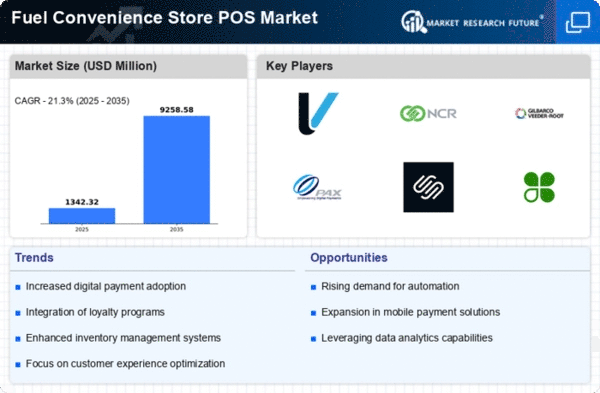
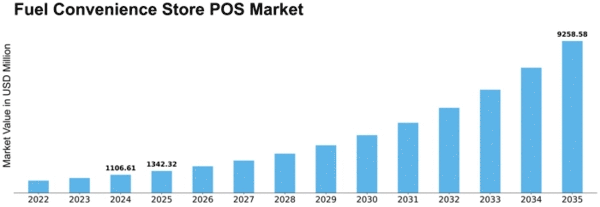
As per MRFR analysis, the Fuel Convenience Store POS Market Size was estimated at 1106.61 USD Million in 2024. The Fuel Convenience Store POS industry is projected to grow from 1342.34 in 2025 to 9258.58 by 2035, exhibiting a compound annual growth rate (CAGR) of 21.3 during the forecast period 2025 - 2035.

Key Market Trends & Highlights

The Fuel Convenience Store POS Market is experiencing a transformative shift towards advanced technological integration and consumer-centric solutions.

  • The integration of contactless payments is becoming increasingly prevalent in North America, enhancing customer convenience.
  • Data-driven decision making is gaining traction, particularly in the fuel management segment, as businesses seek to optimize operations.
  • Cloud-based solutions are being adopted rapidly in the Asia-Pacific region, reflecting a shift towards more flexible and scalable systems.
  • The rise in fuel prices and consumer preference for convenience are driving the growth of POS systems in fuel stations and convenience stores.

Market Size & Forecast

2024 Market Size 1106.61 (USD Million)
2035 Market Size 9258.58 (USD Million)
CAGR (2025 - 2035) 21.3%
Largest Regional Market Share in 2024 North America

Major Players

Verifone (US), NCR Corporation (US), Gilbarco Veeder-Root (US), PAX Technology (CN), Square (US), Clover (US), PayPal (US), Ingenico (FR), SaaS POS (US)

Market Trends

The Fuel Convenience Store POS Market is currently experiencing a transformative phase, driven by advancements in technology and changing consumer preferences. As digital payment methods gain traction, convenience stores are increasingly adopting sophisticated point-of-sale systems that enhance transaction efficiency and customer experience. These systems not only streamline payment processes but also integrate inventory management and customer relationship management features, thereby providing a comprehensive solution for store operators. Furthermore, the growing emphasis on data analytics allows retailers to gain insights into consumer behavior, enabling them to tailor their offerings and marketing strategies more effectively. In addition to technological advancements, the Fuel Convenience Store POS Market is influenced by evolving regulatory frameworks and sustainability initiatives. Retailers are now more focused on compliance with environmental standards, which may lead to the adoption of eco-friendly practices within their operations. This shift could potentially reshape the competitive landscape, as businesses that prioritize sustainability may attract a more environmentally conscious customer base. Overall, the Fuel Convenience Store POS Market appears poised for growth, with innovations and consumer trends likely to drive its evolution in the coming years.

Integration of Contactless Payments

The trend towards contactless payment solutions is gaining momentum within the Fuel Convenience Store POS Market. As consumers increasingly prefer quick and secure transactions, retailers are investing in POS systems that support various contactless payment methods. This shift not only enhances customer satisfaction but also reduces transaction times, thereby improving overall operational efficiency.

Emphasis on Data-Driven Decision Making

There is a growing focus on leveraging data analytics within the Fuel Convenience Store POS Market. Retailers are utilizing advanced analytics tools to gather insights on customer preferences and purchasing patterns. This data-driven approach enables businesses to optimize inventory management, tailor marketing strategies, and enhance customer engagement, ultimately driving sales.

Adoption of Cloud-Based Solutions

The transition towards cloud-based POS systems is becoming increasingly prevalent in the Fuel Convenience Store POS Market. These solutions offer flexibility, scalability, and remote access to critical business data. By adopting cloud technology, retailers can streamline operations, reduce costs, and improve collaboration among staff, positioning themselves for future growth.

Fuel Convenience Store POS Market Market Drivers

Market Growth Projections

The Global Fuel and Convenience Store PoS Market Industry is projected to experience substantial growth over the next decade. With a market valuation of 1.11 USD Billion in 2024, it is anticipated to reach 9.26 USD Billion by 2035. This growth trajectory reflects a compound annual growth rate of 21.28% from 2025 to 2035, indicating a robust demand for advanced PoS solutions. The increasing adoption of technology, coupled with changing consumer preferences, is likely to drive this expansion, positioning the market for significant advancements in the coming years.

Technological Advancements

The Global Fuel and Convenience Store PoS Market Industry is experiencing rapid technological advancements that enhance operational efficiency and customer experience. Innovations such as mobile payment systems, contactless transactions, and integrated inventory management systems are becoming increasingly prevalent. These technologies not only streamline transactions but also provide valuable data analytics for better decision-making. For instance, the adoption of advanced PoS systems is projected to contribute significantly to the market's growth, with a valuation of 1.11 USD Billion in 2024. As retailers embrace these technologies, they can expect improved customer satisfaction and loyalty, further driving market expansion.

Rising Demand for Convenience

Consumer preferences are shifting towards convenience, significantly impacting the Global Fuel and Convenience Store PoS Market Industry. As lifestyles become busier, customers increasingly seek quick and efficient shopping experiences. This trend is reflected in the growing number of convenience stores and fuel stations that offer a wide range of products and services under one roof. The market is expected to grow substantially, with projections indicating a rise to 9.26 USD Billion by 2035. This increasing demand for convenience drives retailers to invest in advanced PoS systems that facilitate faster transactions and enhance customer engagement.

Integration of Loyalty Programs

The integration of loyalty programs within the Global Fuel and Convenience Store PoS Market Industry is becoming a crucial driver of customer retention and sales growth. Retailers are leveraging PoS systems to implement personalized loyalty initiatives that reward frequent customers with discounts and promotions. This strategy not only encourages repeat business but also provides valuable insights into consumer behavior. As a result, the market is likely to witness a compound annual growth rate of 21.28% from 2025 to 2035. By fostering customer loyalty through innovative PoS solutions, retailers can enhance their competitive edge in a crowded marketplace.

E-commerce and Omnichannel Strategies

The rise of e-commerce and omnichannel retailing is reshaping the Global Fuel and Convenience Store PoS Market Industry. Retailers are increasingly adopting integrated PoS systems that facilitate seamless transactions across various channels, including online and in-store purchases. This approach allows businesses to meet the evolving expectations of consumers who seek flexibility and convenience in their shopping experiences. As the market adapts to these changes, it is anticipated that the integration of e-commerce capabilities will drive significant growth, contributing to the overall market expansion and enhancing customer satisfaction.

Regulatory Compliance and Safety Standards

Regulatory compliance and safety standards play a pivotal role in shaping the Global Fuel and Convenience Store PoS Market Industry. As governments worldwide implement stricter regulations regarding payment security and data protection, retailers are compelled to upgrade their PoS systems to ensure compliance. This necessity not only protects consumer data but also fosters trust and credibility in the marketplace. Consequently, the demand for compliant PoS solutions is expected to rise, driving market growth as retailers invest in technologies that meet these evolving regulatory requirements.

Market Segment Insights

By Application: Fuel Management (Largest) vs. Customer Relationship Management (Fastest-Growing)

In the Fuel Convenience Store POS Market, the 'Fuel Management' segment holds the largest market share, driven by the increasing demand for efficient fuel operations and management systems. Following closely are 'Inventory Management' and 'Sales Tracking', which play critical roles in streamlining operations and enhancing service delivery in fuel convenience stores. 'Reporting and Analytics' and 'Customer Relationship Management' are also significant, providing valuable insights and fostering customer connections, respectively. Over recent years, the growth trends in this segment indicate a strong emphasis on digital solutions to enhance operational efficiencies and customer interactions. Fuel Management remains a key focus area for convenience stores as they adopt advanced technologies to optimize fuel distribution. Meanwhile, Customer Relationship Management is rapidly gaining traction as operators recognize the importance of personalized marketing and customer engagement, making it one of the fastest-growing segments in this market.

Fuel Management (Dominant) vs. Customer Relationship Management (Emerging)

Fuel Management stands out as the dominant application in the Fuel Convenience Store POS Market, focusing on the effective monitoring and management of fuel inventories to minimize losses and streamline operations. This application supports various functionalities such as fuel pricing strategies and compliance management, making it essential for efficient fuel sales. In contrast, Customer Relationship Management (CRM) is an emerging segment that is quickly gaining importance. It emphasizes customer engagement through tailored marketing strategies and personalized services. The emergence of digital channels and analytics tools is propelling CRM's growth, allowing fuel convenience stores to build meaningful relationships with customers, increase loyalty, and enhance overall customer satisfaction. As both applications evolve, Fuel Management ensures operational efficiency while CRM fosters customer-centric approaches.

By End Use: Fuel Stations (Largest) vs. Convenience Stores (Fastest-Growing)

In the Fuel Convenience Store POS Market, the 'End Use' segment showcases a diverse distribution among its key players. Fuel Stations hold the largest market share due to their essential role in the fuel distribution chain, integrating advanced POS systems for efficient transactions and customer management. Convenience Stores follow closely, leveraging their strategic locations and diverse product offerings to enhance customer experience and foster loyalty, rapidly increasing their market presence as more consumers opt for quick and easy shopping options.

Retail Formats: Fuel Stations (Dominant) vs. Automated Fuel Dispensing Systems (Emerging)

Fuel Stations represent the dominant force in the Fuel Convenience Store POS Market, utilizing advanced point-of-sale systems to streamline fuel sales and broaden service offerings. These locations are designed to cater to high transaction volumes, instilling operational efficiency and customer satisfaction. Conversely, Automated Fuel Dispensing Systems are emerging as a noteworthy alternative, driven by technological advancements that enable unmanned operations. These systems appeal to a tech-savvy clientele, providing personalized service through mobile payment options and real-time inventory updates. Together, these two formats shape the future of the Fuel Convenience Store POS landscape.

By Deployment Type: Cloud-Based (Largest) vs. Hybrid (Fastest-Growing)

In the Fuel Convenience Store POS Market, the distribution of market share among deployment types reveals a clear preference for Cloud-Based solutions, which have emerged as the largest segment due to their ease of use and lower overall costs. On-Premise solutions, while still holding a significant share, are being gradually overshadowed by the growing adoption of cloud technologies, which allow for better scalability and integration of advanced features. Hybrid deployment models are also gaining traction as retailers seek to leverage the benefits of both on-premise and cloud solutions while maintaining control over their operations. Growth trends within this segment indicate a strong shift toward Cloud-Based POS systems, driven by increasing demand for mobility and real-time data access. Retailers are increasingly drawn to the advantages of cloud solutions, including lower upfront expenses and stronger customer support capabilities. Hybrid systems are rapidly becoming the preferred choice for those businesses needing flexibility and customization options, leading to an exciting expansion of deployment alternatives in the industry.

Cloud-Based (Dominant) vs. Hybrid (Emerging)

Cloud-Based POS systems dominate the Fuel Convenience Store market due to their distinctive advantages, including cost efficiency, accessibility, and seamless integration with other cloud applications. They enable retailers to manage their operations remotely, facilitating real-time data access and decision-making, which is critical for optimizing sales and inventory management. On the other hand, Hybrid POS solutions are emerging as a compelling alternative for operators who require a blend of on-premises control and cloud capabilities. These systems provide flexibility, allowing for necessary business customizations while still offering cloud functionalities, appealing to retailers who may not yet be fully ready to transition entirely to the cloud but recognize its potential benefits. This dynamic poses interesting challenges and opportunities for technology providers in the Fuel Convenience Store sector.

By Payment Method: Credit Card (Largest) vs. Mobile Payment (Fastest-Growing)

The Fuel Convenience Store POS Market showcases a diverse payment landscape where credit cards command the largest share, reflecting consumer preference for convenience and security. Mobile payments, however, are rapidly gaining traction, particularly among younger consumers who value speed and ease of use. Cash remains a viable option, primarily for those who prefer traditional methods, while loyalty programs are increasingly integrated into POS systems to enhance customer engagement and retention.

Credit Card (Dominant) vs. Mobile Payment (Emerging)

Credit cards stand out as the dominant payment method in the Fuel Convenience Store POS Market, favored for their reliability and security in transactions. They offer convenience to consumers and provide stores with faster checkout processes. In contrast, mobile payments are emerging as a strong competitor, driven by technological advancements and a growing preference for digital wallets. As more customers adopt smartphones for everyday transactions, mobile payment platforms are being seamlessly integrated into POS systems, providing faster, more efficient service and appealing to tech-savvy consumers.

By User Type: Medium Enterprises (Largest) vs. Large Enterprises (Fastest-Growing)

In the Fuel Convenience Store POS Market, the distribution of market share among user types showcases Medium Enterprises as the largest segment. This is primarily due to their established presence and ability to leverage POS systems effectively to streamline operations. On the other hand, Large Enterprises, while smaller in overall share compared to Medium Enterprises, are witnessing robust growth, driven by the expansion of fuel convenience stores and advancements in technology that cater to their specific needs.

Medium Enterprises (Dominant) vs. Large Enterprises (Emerging)

Medium Enterprises play a dominant role in the Fuel Convenience Store POS Market, characterized by their adaptability to market trends and a strong focus on customer service. They utilize POS solutions to enhance operational efficiency, offering a range of services tailored to consumer demands. On the other hand, Large Enterprises, categorized as an emerging segment, are rapidly adopting advanced POS technologies. This move is primarily driven by the need for comprehensive data analytics and enhanced inventory management, enabling them to stay competitive in a fast-evolving market. Their growth is also fueled by increasing consumer expectations for seamless transactions and superior service.

Get more detailed insights about Fuel and Convenience Store PoS Market Research Report—Global Forecast till 2035

Regional Insights

North America : Market Leader in POS Solutions

North America is poised to maintain its leadership in the Fuel Convenience Store POS market, holding a significant market share of $600.0M in 2025. The region's growth is driven by increasing fuel sales, technological advancements in payment systems, and a shift towards contactless transactions. Regulatory support for digital payment solutions further enhances market dynamics, fostering innovation and consumer adoption. The competitive landscape is robust, with key players like Verifone, NCR Corporation, and Gilbarco Veeder-Root leading the charge. The U.S. remains the largest market, supported by a high density of fuel stations and convenience stores. The presence of innovative solutions from companies such as Square and Clover is reshaping consumer experiences, making transactions faster and more efficient.

Europe : Emerging Market with Growth Potential

Europe's Fuel Convenience Store POS market is projected to grow, with a market size of $300.0M by 2025. The region benefits from increasing fuel consumption and a growing trend towards integrated payment solutions. Regulatory frameworks promoting digital transactions and sustainability initiatives are key drivers of this growth, encouraging retailers to adopt advanced POS systems that enhance operational efficiency. Leading countries such as Germany, France, and the UK are at the forefront of this market, with a competitive landscape featuring players like Ingenico and PAX Technology. The presence of established retail chains and a focus on customer-centric solutions are pivotal in shaping the market. As the region embraces technological advancements, the demand for innovative POS systems is expected to rise significantly.

Asia-Pacific : Rapidly Growing Market Segment

The Asia-Pacific region is witnessing rapid growth in the Fuel Convenience Store POS market, with a projected size of $150.0M by 2025. Factors such as rising disposable incomes, urbanization, and an increasing number of fuel stations are driving demand. Additionally, government initiatives to promote digital payments are catalyzing the adoption of advanced POS systems, enhancing transaction efficiency and customer satisfaction. Countries like China and India are leading the charge, with a burgeoning number of convenience stores and fuel outlets. The competitive landscape includes key players such as PAX Technology and local innovators. As the region continues to embrace technology, the demand for sophisticated POS solutions is expected to surge, creating opportunities for growth and investment.

Middle East and Africa : Emerging Market with Unique Challenges

The Middle East and Africa region is gradually developing its Fuel Convenience Store POS market, with a size of $56.61M anticipated by 2025. The growth is driven by increasing fuel consumption and a shift towards modern payment solutions. However, challenges such as infrastructure limitations and varying regulatory environments can impact market dynamics. Governments are increasingly recognizing the need for digital payment systems, which is expected to catalyze growth in this sector. Countries like South Africa and the UAE are leading the market, with a growing number of convenience stores adopting advanced POS systems. The competitive landscape is evolving, with both local and international players vying for market share. As the region continues to develop its retail infrastructure, the demand for efficient and reliable POS solutions is set to increase significantly.

Key Players and Competitive Insights

The Fuel Convenience Store POS Market is currently characterized by a dynamic competitive landscape, driven by technological advancements and evolving consumer preferences. Key players such as Verifone (US), NCR Corporation (US), and Gilbarco Veeder-Root (US) are at the forefront, each adopting distinct strategies to enhance their market positioning. Verifone (US) focuses on innovation through the development of integrated payment solutions that streamline transactions, while NCR Corporation (US) emphasizes digital transformation, enhancing customer engagement through advanced analytics and cloud-based services. Gilbarco Veeder-Root (US) appears to be concentrating on regional expansion, particularly in emerging markets, thereby broadening its customer base and increasing market penetration. Collectively, these strategies contribute to a competitive environment that is increasingly reliant on technological integration and customer-centric solutions.In terms of business tactics, companies are localizing manufacturing and optimizing supply chains to enhance operational efficiency. The market structure is moderately fragmented, with several players vying for market share. This fragmentation allows for a diverse range of offerings, yet the influence of major players remains significant, as they set benchmarks for innovation and service quality that smaller competitors strive to meet.

In November NCR Corporation (US) announced a strategic partnership with a leading cloud service provider to enhance its POS solutions with AI capabilities. This move is likely to bolster NCR's offerings by integrating machine learning algorithms that can analyze consumer behavior in real-time, thereby enabling retailers to tailor their services more effectively. Such advancements may position NCR as a leader in the digital transformation of the fuel convenience sector.

In October Verifone (US) launched a new suite of mobile payment solutions designed specifically for fuel retailers. This initiative is significant as it addresses the growing demand for contactless payment options, particularly in a market that is increasingly prioritizing convenience and speed. By enhancing its product line, Verifone is likely to strengthen its competitive edge and attract a broader customer base.

In September Gilbarco Veeder-Root (US) expanded its operations into Southeast Asia, establishing new distribution channels to cater to the region's burgeoning fuel retail market. This strategic move not only diversifies Gilbarco's market presence but also positions the company to capitalize on the increasing demand for advanced POS systems in developing economies. Such expansion efforts may yield substantial returns as the region continues to grow economically.

As of December the competitive trends in the Fuel Convenience Store POS Market are increasingly defined by digitalization, sustainability, and the integration of AI technologies. Strategic alliances are becoming more prevalent, as companies recognize the need to collaborate to enhance their technological capabilities and market reach. Looking ahead, competitive differentiation is expected to evolve, shifting from traditional price-based competition to a focus on innovation, technology, and supply chain reliability. This transition suggests that companies that prioritize these aspects will likely emerge as leaders in the market.

Key Companies in the Fuel Convenience Store POS Market include

Industry Developments

March 2023: Dover Fueling Solutions launched DX PowerTM to incorporate EV Chargers into the Prizma Ecosystem.

October 2022: Posiflex exhibited best-in-class POS hardware and self-service technologies at GITEX 2022, enabling a smarter world of transactions.

Future Outlook

Fuel Convenience Store POS Market Future Outlook

The Fuel Convenience Store POS Market is projected to grow at a 21.3% CAGR from 2025 to 2035, driven by technological advancements, increased consumer demand, and enhanced operational efficiencies.

New opportunities lie in:

  • Integration of mobile payment solutions for enhanced customer convenience.
  • Development of AI-driven inventory management systems to optimize stock levels.
  • Expansion of loyalty programs leveraging data analytics to boost customer retention.

By 2035, the market is expected to be robust, reflecting substantial growth and innovation.

Market Segmentation

Fuel Convenience Store POS Market End Use Outlook

  • Fuel Stations
  • Convenience Stores
  • Supermarkets
  • Automated Fuel Dispensing Systems

Fuel Convenience Store POS Market User Type Outlook

  • Small Enterprises
  • Medium Enterprises
  • Large Enterprises

Fuel Convenience Store POS Market Application Outlook

  • Fuel Management
  • Inventory Management
  • Sales Tracking
  • Customer Relationship Management
  • Reporting and Analytics

Fuel Convenience Store POS Market Payment Method Outlook

  • Credit Card
  • Mobile Payment
  • Cash
  • Loyalty Programs

Fuel Convenience Store POS Market Deployment Type Outlook

  • On-Premise
  • Cloud-Based
  • Hybrid

Report Scope

MARKET SIZE 20241106.61(USD Million)
MARKET SIZE 20251342.34(USD Million)
MARKET SIZE 20359258.58(USD Million)
COMPOUND ANNUAL GROWTH RATE (CAGR)21.3% (2025 - 2035)
REPORT COVERAGERevenue Forecast, Competitive Landscape, Growth Factors, and Trends
BASE YEAR2024
Market Forecast Period2025 - 2035
Historical Data2019 - 2024
Market Forecast UnitsUSD Million
Key Companies ProfiledVerifone (US), NCR Corporation (US), Gilbarco Veeder-Root (US), PAX Technology (CN), Square (US), Clover (US), PayPal (US), Ingenico (FR), SaaS POS (US)
Segments CoveredApplication, End Use, Deployment Type, Payment Method, User Type
Key Market OpportunitiesIntegration of advanced analytics and mobile payment solutions in the Fuel Convenience Store POS Market.
Key Market DynamicsTechnological advancements and evolving consumer preferences drive innovation in Fuel Convenience Store Point of Sale systems.
Countries CoveredNorth America, Europe, APAC, South America, MEA

FAQs

How much is the Fuel and Convenience Store PoS market?

The Fuel and Convenience Store PoS market size was valued at USD 1.10 Billion in 2024.

What is the growth rate of the Fuel and Convenience Store PoS market?

The market is projected to grow at a CAGR of 21.30% during the forecast period, 2025-2034.

Which region held the largest Fuel and Convenience Store PoS market share?

North America had the largest share of the market.

Who are the key players in the Fuel and Convenience Store PoS market?

The key players in the market are Fujitsu Ltd. (Japan), VeriFone Inc. (US), Diebold Nixdorf Incorporated (US), NCR Corporation (US), and LS Retail (Iceland).

Which component led the Fuel and Convenience Store PoS market?

The services category dominated the market in 2023.

Which application had the largest Fuel and Convenience Store PoS market share?

The operations management had the largest share in the market.

Which end-use had the largest Fuel and Convenience Store PoS market share?

The fuel station had the largest share of the market.

  1. SECTION I: EXECUTIVE SUMMARY AND KEY HIGHLIGHTS
    1. | 1.1 EXECUTIVE SUMMARY
    2. | 1.1.1 Market Overview
    3. | 1.1.2 Key Findings
    4. | 1.1.3 Market Segmentation
    5. | 1.1.4 Competitive Landscape
    6. | 1.1.5 Challenges and Opportunities
    7. | 1.1.6 Future Outlook
  2. SECTION II: SCOPING, METHODOLOGY AND MARKET STRUCTURE
    1. | 2.1 MARKET INTRODUCTION
    2. | 2.1.1 Definition
    3. | 2.1.2 Scope of the study
    4. |-- 2.1.2.1 Research Objective
    5. |-- 2.1.2.2 Assumption
    6. |-- 2.1.2.3 Limitations
    7. | 2.2 RESEARCH METHODOLOGY
    8. | 2.2.1 Overview
    9. | 2.2.2 Data Mining
    10. | 2.2.3 Secondary Research
    11. | 2.2.4 Primary Research
    12. |-- 2.2.4.1 Primary Interviews and Information Gathering Process
    13. |-- 2.2.4.2 Breakdown of Primary Respondents
    14. | 2.2.5 Forecasting Model
    15. | 2.2.6 Market Size Estimation
    16. |-- 2.2.6.1 Bottom-Up Approach
    17. |-- 2.2.6.2 Top-Down Approach
    18. | 2.2.7 Data Triangulation
    19. | 2.2.8 Validation
  3. SECTION III: QUALITATIVE ANALYSIS
    1. | 3.1 MARKET DYNAMICS
    2. | 3.1.1 Overview
    3. | 3.1.2 Drivers
    4. | 3.1.3 Restraints
    5. | 3.1.4 Opportunities
    6. | 3.2 MARKET FACTOR ANALYSIS
    7. | 3.2.1 Value chain Analysis
    8. | 3.2.2 Porter's Five Forces Analysis
    9. |-- 3.2.2.1 Bargaining Power of Suppliers
    10. |-- 3.2.2.2 Bargaining Power of Buyers
    11. |-- 3.2.2.3 Threat of New Entrants
    12. |-- 3.2.2.4 Threat of Substitutes
    13. |-- 3.2.2.5 Intensity of Rivalry
    14. | 3.2.3 COVID-19 Impact Analysis
    15. |-- 3.2.3.1 Market Impact Analysis
    16. |-- 3.2.3.2 Regional Impact
    17. |-- 3.2.3.3 Opportunity and Threat Analysis
  4. SECTION IV: QUANTITATIVE ANALYSIS
    1. | 4.1 Information and Communications Technology, BY Application (USD Million)
    2. | 4.1.1 Fuel Management
    3. | 4.1.2 Inventory Management
    4. | 4.1.3 Sales Tracking
    5. | 4.1.4 Customer Relationship Management
    6. | 4.1.5 Reporting and Analytics
    7. | 4.2 Information and Communications Technology, BY End Use (USD Million)
    8. | 4.2.1 Fuel Stations
    9. | 4.2.2 Convenience Stores
    10. | 4.2.3 Supermarkets
    11. | 4.2.4 Automated Fuel Dispensing Systems
    12. | 4.3 Information and Communications Technology, BY Deployment Type (USD Million)
    13. | 4.3.1 On-Premise
    14. | 4.3.2 Cloud-Based
    15. | 4.3.3 Hybrid
    16. | 4.4 Information and Communications Technology, BY Payment Method (USD Million)
    17. | 4.4.1 Credit Card
    18. | 4.4.2 Mobile Payment
    19. | 4.4.3 Cash
    20. | 4.4.4 Loyalty Programs
    21. | 4.5 Information and Communications Technology, BY User Type (USD Million)
    22. | 4.5.1 Small Enterprises
    23. | 4.5.2 Medium Enterprises
    24. | 4.5.3 Large Enterprises
    25. | 4.6 Information and Communications Technology, BY Region (USD Million)
    26. | 4.6.1 North America
    27. |-- 4.6.1.1 US
    28. |-- 4.6.1.2 Canada
    29. | 4.6.2 Europe
    30. |-- 4.6.2.1 Germany
    31. |-- 4.6.2.2 UK
    32. |-- 4.6.2.3 France
    33. |-- 4.6.2.4 Russia
    34. |-- 4.6.2.5 Italy
    35. |-- 4.6.2.6 Spain
    36. |-- 4.6.2.7 Rest of Europe
    37. | 4.6.3 APAC
    38. |-- 4.6.3.1 China
    39. |-- 4.6.3.2 India
    40. |-- 4.6.3.3 Japan
    41. |-- 4.6.3.4 South Korea
    42. |-- 4.6.3.5 Malaysia
    43. |-- 4.6.3.6 Thailand
    44. |-- 4.6.3.7 Indonesia
    45. |-- 4.6.3.8 Rest of APAC
    46. | 4.6.4 South America
    47. |-- 4.6.4.1 Brazil
    48. |-- 4.6.4.2 Mexico
    49. |-- 4.6.4.3 Argentina
    50. |-- 4.6.4.4 Rest of South America
    51. | 4.6.5 MEA
    52. |-- 4.6.5.1 GCC Countries
    53. |-- 4.6.5.2 South Africa
    54. |-- 4.6.5.3 Rest of MEA
  5. SECTION V: COMPETITIVE ANALYSIS
    1. | 5.1 Competitive Landscape
    2. | 5.1.1 Overview
    3. | 5.1.2 Competitive Analysis
    4. | 5.1.3 Market share Analysis
    5. | 5.1.4 Major Growth Strategy in the Information and Communications Technology
    6. | 5.1.5 Competitive Benchmarking
    7. | 5.1.6 Leading Players in Terms of Number of Developments in the Information and Communications Technology
    8. | 5.1.7 Key developments and growth strategies
    9. |-- 5.1.7.1 New Product Launch/Service Deployment
    10. |-- 5.1.7.2 Merger & Acquisitions
    11. |-- 5.1.7.3 Joint Ventures
    12. | 5.1.8 Major Players Financial Matrix
    13. |-- 5.1.8.1 Sales and Operating Income
    14. |-- 5.1.8.2 Major Players R&D Expenditure. 2023
    15. | 5.2 Company Profiles
    16. | 5.2.1 Verifone (US)
    17. |-- 5.2.1.1 Financial Overview
    18. |-- 5.2.1.2 Products Offered
    19. |-- 5.2.1.3 Key Developments
    20. |-- 5.2.1.4 SWOT Analysis
    21. |-- 5.2.1.5 Key Strategies
    22. | 5.2.2 NCR Corporation (US)
    23. |-- 5.2.2.1 Financial Overview
    24. |-- 5.2.2.2 Products Offered
    25. |-- 5.2.2.3 Key Developments
    26. |-- 5.2.2.4 SWOT Analysis
    27. |-- 5.2.2.5 Key Strategies
    28. | 5.2.3 Gilbarco Veeder-Root (US)
    29. |-- 5.2.3.1 Financial Overview
    30. |-- 5.2.3.2 Products Offered
    31. |-- 5.2.3.3 Key Developments
    32. |-- 5.2.3.4 SWOT Analysis
    33. |-- 5.2.3.5 Key Strategies
    34. | 5.2.4 PAX Technology (CN)
    35. |-- 5.2.4.1 Financial Overview
    36. |-- 5.2.4.2 Products Offered
    37. |-- 5.2.4.3 Key Developments
    38. |-- 5.2.4.4 SWOT Analysis
    39. |-- 5.2.4.5 Key Strategies
    40. | 5.2.5 Square (US)
    41. |-- 5.2.5.1 Financial Overview
    42. |-- 5.2.5.2 Products Offered
    43. |-- 5.2.5.3 Key Developments
    44. |-- 5.2.5.4 SWOT Analysis
    45. |-- 5.2.5.5 Key Strategies
    46. | 5.2.6 Clover (US)
    47. |-- 5.2.6.1 Financial Overview
    48. |-- 5.2.6.2 Products Offered
    49. |-- 5.2.6.3 Key Developments
    50. |-- 5.2.6.4 SWOT Analysis
    51. |-- 5.2.6.5 Key Strategies
    52. | 5.2.7 PayPal (US)
    53. |-- 5.2.7.1 Financial Overview
    54. |-- 5.2.7.2 Products Offered
    55. |-- 5.2.7.3 Key Developments
    56. |-- 5.2.7.4 SWOT Analysis
    57. |-- 5.2.7.5 Key Strategies
    58. | 5.2.8 Ingenico (FR)
    59. |-- 5.2.8.1 Financial Overview
    60. |-- 5.2.8.2 Products Offered
    61. |-- 5.2.8.3 Key Developments
    62. |-- 5.2.8.4 SWOT Analysis
    63. |-- 5.2.8.5 Key Strategies
    64. | 5.2.9 SaaS POS (US)
    65. |-- 5.2.9.1 Financial Overview
    66. |-- 5.2.9.2 Products Offered
    67. |-- 5.2.9.3 Key Developments
    68. |-- 5.2.9.4 SWOT Analysis
    69. |-- 5.2.9.5 Key Strategies
    70. | 5.3 Appendix
    71. | 5.3.1 References
    72. | 5.3.2 Related Reports

Information and Communications Technology Market Segmentation

Information and Communications Technology By Application (USD Million, 2025-2035)

  • Fuel Management
  • Inventory Management
  • Sales Tracking
  • Customer Relationship Management
  • Reporting and Analytics

Information and Communications Technology By End Use (USD Million, 2025-2035)

  • Fuel Stations
  • Convenience Stores
  • Supermarkets
  • Automated Fuel Dispensing Systems

Information and Communications Technology By Deployment Type (USD Million, 2025-2035)

  • On-Premise
  • Cloud-Based
  • Hybrid

Information and Communications Technology By Payment Method (USD Million, 2025-2035)

  • Credit Card
  • Mobile Payment
  • Cash
  • Loyalty Programs

Information and Communications Technology By User Type (USD Million, 2025-2035)

  • Small Enterprises
  • Medium Enterprises
  • Large Enterprises
Infographic

Free Sample Request

Kindly complete the form below to receive a free sample of this Report

Get Free Sample

Customer Strories

Compare Licence

×
Features License Type
Single User Multiuser License Enterprise User
Price $4,950 $5,950 $7,250
Maximum User Access Limit 1 User Upto 10 Users Unrestricted Access Throughout the Organization
Free Customization
Direct Access to Analyst
Deliverable Format
Platform Access
Discount on Next Purchase 10% 15% 15%
Printable Versions