×
Request Free Sample ×

Kindly complete the form below to receive a free sample of this Report

* Please use a valid business email

Leading companies partner with us for data-driven Insights

clients tt-cursor
Hero Background
English
Chinese
French
Japanese
Korean
German
Spanish

Fuel Card Market Share

ID: MRFR/SEM/5225-CR
128 Pages
Aarti Dhapte
February 2024

Fuel Card Market Size, Share and Research Report By Card Type (Branded Fuel Cards, Universal Fuel Cards, Merchant Fuel Cards) By Vehicle Type (Heavy Fleet, Light Fleet) By Application (Fuel Refill, Parking, Vehicle Service, Toll Charge, Others), And By Region (North America, Europe, Asia-Pacific, Middle East & Africa, and South America) –Industry Forecast Till 2035

Share:
Download PDF ×

We do not share your information with anyone. However, we may send you emails based on your report interest from time to time. You may contact us at any time to opt-out.

Fuel Card Market Infographic
Purchase Options

Market Share

Fuel Card Market Share Analysis

Fuel card companies often use a system of separation through assistance contributions. Providers anticipate setting themselves apart with compelling features including comprehensive information research, ongoing monitoring, and user-friendly mobile apps. Organizations aim to attract and retain a larger clientele by providing additional benefits, which will ultimately strengthen their position in the market share hierarchy. The overall purpose of dedication initiatives and rewards frameworks is to increase market share and increase client dependability. These loyalty campaigns attract new customers looking for opportunities to save money in addition to encouraging existing customers to stick with a particular gasoline card. Long-term market share security and growth for a provider are enhanced by cultivating a devoted customer base. Contributions that are customized and flexible approach a system to capture various market segments. Fuel card suppliers recognize that different businesses and individuals have unique needs, therefore they design plans that may be tailored to meet specific requirements. This might include defining expenditure caps, disclosing preferences, and integrating with other business executives' frameworks. By providing flexibility, providers may attract a wider audience and establish themselves as accommodating and accommodating in the market. Fuel card providers invest in persuasive and lucid writing to showcase their client-focused highlights, technological innovations, and best-selling advice. Effective marketing initiatives help suppliers solidify their position in the market by attracting new customers and enhancing their reputation. It may be quite effective to attract cost-conscious customers and gain market share by providing budget-friendly plans, clear cost structures, and strict fuel restrictions. Cost positioning necessitates a delicate balance between reasonableness and the perceived value of the services being offered. Market leaders use a special technique called persistent development to maintain and increase their market share. Over time, fuel card providers who adapt to changing customer demands, integrate emerging innovations, and showcase state-of-the-art features will have a greater chance of gaining market share. Extending administrations into new districts or nations permits suppliers to take advantage of beforehand undiscovered markets and broaden their client base. This procedure requires a comprehension of territorial contrasts in fueling practices, guidelines, and buyer inclinations, empowering suppliers to fit their contributions to explicit geographic markets.


Author
Aarti Dhapte
AVP - Research

A consulting professional focused on helping businesses navigate complex markets through structured research and strategic insights. I partner with clients to solve high-impact business problems across market entry strategy, competitive intelligence, and opportunity assessment. Over the course of my experience, I have led and contributed to 100+ market research and consulting engagements, delivering insights across multiple industries and geographies, and supporting strategic decisions linked to $500M+ market opportunities. My core expertise lies in building robust market sizing, forecasting, and commercial models (top-down and bottom-up), alongside deep-dive competitive and industry analysis. I have played a key role in shaping go-to-market strategies, investment cases, and growth roadmaps, enabling clients to make confident, data-backed decisions in dynamic markets.

Leave a Comment

FAQs

What is the current valuation of the Fuel Card Market as of 2024?

<p>The overall market valuation was 9353.05 USD Million in 2024.</p>

What is the projected market size for the Fuel Card Market in 2035?

<p>The projected valuation for 2035 is 21367.79 USD Million.</p>

What is the expected CAGR for the Fuel Card Market during the forecast period 2025 - 2035?

<p>The expected CAGR for the Fuel Card Market during the forecast period 2025 - 2035 is 7.8%.</p>

Which companies are considered key players in the Fuel Card Market?

<p>Key players in the market include WEX Inc., Fleetcor Technologies, Shell Fleet Solutions, BP Fleet Solutions, ExxonMobil, TotalEnergies, Chevron, Aral, and DKV Euro Service.</p>

How do branded fuel cards perform in terms of market valuation?

<p>Branded fuel cards are valued between 4000.0 and 9000.0 USD Million.</p>

What is the market valuation range for universal fuel cards?

Universal fuel cards have a market valuation range of 3000.0 to 7000.0 USD Million.

What is the valuation range for heavy fleet fuel cards?

Heavy fleet fuel cards are valued between 5580.0 and 12600.0 USD Million.

What applications are included in the Fuel Card Market, and what are their valuations?

Applications include fuel refill valued at 3741.22 to 8500.0 USD Million, parking at 1860.0 to 4200.0 USD Million, and vehicle service at 1390.0 to 3200.0 USD Million.

What is the valuation range for merchant fuel cards?

Merchant fuel cards are valued between 2353.05 and 4367.79 USD Million.

How does the light fleet segment compare to the heavy fleet segment in terms of market valuation?

The light fleet segment is valued between 3773.05 and 8767.79 USD Million, which is lower than the heavy fleet segment.

Market Summary

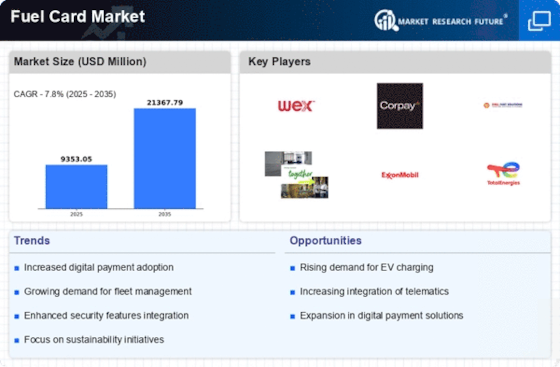
As per Market Research Future analysis, the Fuel Card Market Size was estimated at 9353.05 USD Million in 2024. The Fuel Card industry is projected to grow from USD 10082.59 Million in 2025 to USD 21367.79 Million by 2035, exhibiting a compound annual growth rate (CAGR) of 7.8% during the forecast period 2025 - 2035

Key Market Trends & Highlights

The Fuel Card Market is experiencing a dynamic shift driven by technological advancements and sustainability initiatives.

  • North America remains the largest market for fuel cards, driven by a robust demand for fleet management solutions. Asia-Pacific is emerging as the fastest-growing region, reflecting a rising trend towards digital payment solutions. Branded fuel cards dominate the market, while universal fuel cards are gaining traction due to their flexibility and convenience. Rising fuel prices and a focus on sustainability are key drivers influencing the market's evolution.

Market Size & Forecast

2024 Market Size 9353.05 (USD Million)
2035 Market Size 21367.79 (USD Million)
CAGR (2025 - 2035) 7.8%
Largest Regional Market Share in 2024 North America

Major Players

WEX Inc. (US), Fleetcor Technologies (US), Shell Fleet Solutions (GB), BP Fleet Solutions (GB), ExxonMobil (US), TotalEnergies (FR), Chevron (US), Aral (DE), DKV Euro Service (DE)

Market Trends

The Fuel Card Market is currently experiencing a dynamic evolution, driven by various factors that influence consumer behavior and industry practices. As businesses increasingly seek efficient solutions for managing fuel expenses, the demand for fuel cards appears to be on the rise. The fuel cards market is gaining traction globally as fleet operators increasingly adopt digital payment solutions to improve fuel expense management, transparency, and operational control.  These cards offer a streamlined approach to tracking fuel purchases, enhancing financial oversight, and simplifying administrative tasks. Moreover, the integration of advanced technology into fuel card systems suggests a shift towards more sophisticated solutions, potentially improving user experience and operational efficiency. In addition, the growing emphasis on sustainability and environmental responsibility is likely to shape the Fuel Card Market in the coming years. Companies are becoming more aware of their carbon footprints and are seeking ways to reduce emissions associated with transportation. This trend may lead to the development of fuel cards that incentivize the use of alternative fuels or promote eco-friendly driving practices. Overall, the Fuel Card Market appears poised for growth, with innovations and changing consumer preferences driving its trajectory.

Technological Advancements

The Fuel Card Market is witnessing a surge in technological innovations that enhance functionality and user experience. Digital platforms and mobile applications are becoming integral, allowing users to manage transactions and monitor fuel consumption in real-time. This trend indicates a shift towards more user-friendly solutions that cater to the needs of modern businesses.

Sustainability Initiatives

There is a growing focus on sustainability within the Fuel Card Market, as companies strive to minimize their environmental impact. Fuel cards that promote the use of alternative fuels or provide incentives for eco-friendly driving practices are gaining traction. This trend reflects a broader commitment to corporate social responsibility and environmental stewardship.

Increased Market Competition

The Fuel Card Market is becoming increasingly competitive, with numerous players vying for market share. This competition is likely to drive innovation and improve service offerings, as companies seek to differentiate themselves. Enhanced customer service and tailored solutions may emerge as key strategies for success in this evolving landscape.

Fuel Card Market Market Drivers

Rising Fuel Prices

The Fuel Card Market is experiencing a notable surge in demand due to rising fuel prices. As fuel costs continue to escalate, businesses are increasingly seeking ways to manage their fuel expenditures effectively. Fuel cards provide a streamlined solution for tracking fuel purchases, thereby enhancing cost control. In recent years, the average price of fuel has shown a consistent upward trend, prompting companies to adopt fuel cards as a means of mitigating financial strain. This trend is particularly evident in sectors such as transportation and logistics, where fuel expenses constitute a significant portion of operational costs. Consequently, the Fuel Card Market is likely to witness sustained growth as organizations prioritize efficient fuel management strategies.

Enhanced Fleet Management Solutions

The Fuel Card Market is significantly influenced by the growing need for enhanced fleet management solutions. Companies are increasingly recognizing the importance of optimizing their fleet operations to improve efficiency and reduce costs. Fuel cards offer integrated solutions that allow businesses to monitor fuel consumption, track vehicle performance, and analyze spending patterns. This data-driven approach enables organizations to make informed decisions regarding fleet management. According to recent statistics, businesses utilizing fuel cards report a reduction in fuel expenses by up to 15%. As a result, the demand for fuel cards is expected to rise as companies seek to leverage technology for better fleet management.

Regulatory Compliance and Reporting

The Fuel Card Market is also shaped by the increasing emphasis on regulatory compliance and reporting requirements. Governments are implementing stricter regulations regarding fuel usage and emissions, compelling businesses to adopt solutions that facilitate compliance. Fuel cards provide detailed transaction records, which are essential for meeting regulatory standards. This capability not only aids in compliance but also enhances transparency in fuel expenditures. As organizations strive to adhere to these regulations, the demand for fuel cards is likely to grow. Furthermore, the ability to generate comprehensive reports simplifies the auditing process, making fuel cards an attractive option for businesses aiming to maintain compliance in a complex regulatory landscape.

Shift Towards Digital Payment Solutions

The Fuel Card Market is witnessing a shift towards digital payment solutions, driven by the increasing adoption of technology in financial transactions. Businesses are increasingly favoring cashless transactions for their convenience and security. Fuel cards, which often incorporate digital payment features, align with this trend by offering a secure and efficient method for fuel purchases. The rise of mobile payment applications and contactless transactions further supports this shift, as consumers and businesses alike seek faster and more reliable payment options. As the trend towards digitalization continues, the Fuel Card Market is expected to expand, catering to the evolving preferences of consumers and businesses.

Focus on Sustainability and Environmental Responsibility

The Fuel Card Market is increasingly influenced by the focus on sustainability and environmental responsibility. As organizations strive to reduce their carbon footprint, there is a growing demand for solutions that promote eco-friendly practices. Fuel cards can play a pivotal role in this transition by providing insights into fuel consumption patterns and encouraging the use of more efficient vehicles. Companies that utilize fuel cards often report a decrease in fuel consumption, contributing to their sustainability goals. This alignment with environmental initiatives is likely to drive the adoption of fuel cards, as businesses seek to enhance their corporate social responsibility efforts while managing fuel costs effectively.

Market Segment Insights

By Type: Branded Fuel Cards (Largest) vs. Universal Fuel Cards (Fastest-Growing)

<p>In the Fuel Card Market, Branded Fuel Cards hold the largest market share due to their affiliation with specific fuel brands which often translates to consumer loyalty and preference. Their established market presence and partnerships with various fuel stations give them significant advantages in terms of accessibility and reward programs. In contrast, Universal Fuel Cards, while currently trailing in market share, are gaining traction as businesses seek flexibility and reduced restrictions on fuel purchases across a wide network of stations.</p>

<p>Branded Fuel Cards (Dominant) vs. Merchant Fuel Cards (Emerging)</p>

<p>Branded Fuel Cards represent the dominant segment in the Fuel Card Market, primarily due to their strong brand identity and targeted offerings that appeal to specific consumer bases. These cards provide benefits such as discounts and loyalty points tied to particular fuel brands, enhancing their attractiveness. Merchant Fuel Cards, on the other hand, are emerging as a compelling alternative as they offer more extensive acceptance at multiple locations and cater to businesses looking to simplify their fuel procurement. This growing preference is driven by the rise of fleet vehicles and the need for cost-effective fueling solutions.</p>

By Vehicle Type: Heavy Fleet (Largest) vs. Light Fleet (Fastest-Growing)

<p>In the Fuel Card Market, the vehicle type segment is primarily divided into Heavy Fleet and Light Fleet. Heavy Fleet dominates the market, owing to the significant utilization of fuel cards by logistics and transportation companies operating large commercial vehicles. This segment's extensive presence is facilitated by the operational efficiency and cost management benefits provided by fuel cards, which are essential for larger fleets engaged in long-haul transportation. On the other hand, the Light Fleet segment, while smaller in share, is experiencing a rapid growth trajectory as more companies adopt fuel cards to streamline their fuel management processes for smaller vehicles. This surge is indicative of the evolving preferences of fleet operators.</p>

<p>Vehicle Type: Heavy Fleet (Dominant) vs. Light Fleet (Emerging)</p>

<p>The Heavy Fleet segment is marked by its substantial reliance on fuel cards to efficiently manage fuel expenses and streamline operations across extensive fleets, often used in long-distance logistics. Companies operating in this segment leverage fuel cards to gain insights into their fuel consumption patterns, enhance accountability, and optimize routing, further solidifying their market position. In contrast, the Light Fleet segment, although emerging, is rapidly gaining traction, driven by the adoption of technology and increased emphasis on cost efficiency. Light Fleet users typically consist of businesses using smaller commercial vehicles, and the push for convenience, digital integration, and management efficiencies through fuel cards is leading to its growth. This segment's expansion is supported by the need for improved fuel expense tracking and enhanced operational management.</p>

By Application: Fuel Refill (Largest) vs. Vehicle Service (Fastest-Growing)

<p>In the Fuel Card Market, the application segment showcases a diverse range of services with varying market shares. Fuel Refill emerges as the largest segment, accounting for a significant portion of the market, primarily driven by the growing number of fuel stations accepting fuel cards. Other applications like Parking, Vehicle Service, and Toll Charges follow, each contributing to the overall demand as companies look to streamline expenses.</p>

<p>Fuel Refill (Dominant) vs. Vehicle Service (Emerging)</p>

<p>Fuel Refill is the dominant application in the Fuel Card Market, capturing the attention of businesses seeking to optimize fuel expenses. Its widespread acceptance and integration into fleet management solutions make it a go-to choice for companies. Conversely, Vehicle Service represents an emerging segment, showcasing rapid growth as companies recognize the convenience of using fuel cards for maintenance services. This shift is fueled by a growing emphasis on operational efficiency and the need for consolidated spending mechanisms within fleet operations.</p>

Get more detailed insights about Fuel Card Market Research Report—Global Forecast till 2035

Regional Insights

North America : Market Leader in Fuel Cards

North America is the largest market for fuel cards, accounting for approximately 45% of the global market share. The growth is driven by the increasing number of commercial fleets and the rising demand for efficient fuel management solutions. Regulatory support for fleet management and environmental sustainability initiatives further catalyze market expansion. The U.S. and Canada are the primary contributors to this growth, with a strong emphasis on technological advancements in fuel card systems. The competitive landscape in North America is characterized by major players such as WEX Inc., Fleetcor Technologies, and ExxonMobil. These companies are continuously innovating to enhance their service offerings, focusing on integrated solutions that provide real-time data analytics and cost management. The presence of established fuel networks and partnerships with various fuel providers strengthens their market position, ensuring a robust competitive environment.

Europe : Emerging Market Dynamics

Europe is witnessing significant growth in the fuel card market, holding approximately 30% of the global share. The increasing focus on fleet efficiency and the adoption of digital payment solutions are key drivers of this growth. Growth in the Europe fuel card market is supported by stringent fleet cost optimization requirements, widespread adoption of cashless payments, and increasing cross-border transportation activity. The France fuel cards market is driven by rising demand from commercial fleets seeking enhanced reporting capabilities, tax recovery solutions, and centralized fuel purchasing systems. Expansion of the Greece fuel cards market is supported by increasing fleet digitization, growth in tourism-related transportation, and gradual modernization of fuel payment infrastructure. The Italy fuel cards market is characterized by steady adoption across small and large fleet operators, driven by regulatory compliance requirements and the need for improved fuel cost tracking.

Asia-Pacific : Rapid Growth Potential

Asia-Pacific is emerging as a significant player in the fuel card market, accounting for about 20% of the global market share. The rapid growth of the logistics and transportation sectors, coupled with increasing fuel prices, is driving demand for fuel management solutions. Countries like China and India are at the forefront of this growth, supported by government initiatives aimed at improving transportation efficiency and reducing operational costs. The competitive landscape in this region is evolving, with local players and international companies vying for market share. Key players such as TotalEnergies and Chevron are expanding their presence through strategic partnerships and innovative service offerings. The increasing adoption of technology in fleet management, including telematics and mobile applications, is further enhancing the market's growth potential, making Asia-Pacific a region to watch in the fuel card industry.

Middle East and Africa : Emerging Market Opportunities

The Middle East and Africa region is gradually developing its fuel card market, currently holding about 5% of the global share. The growth is primarily driven by the increasing number of commercial vehicles and the need for efficient fuel management solutions. Regulatory initiatives aimed at improving transportation infrastructure and reducing fuel fraud are also contributing to market expansion. Countries like South Africa and the UAE are leading this growth, supported by investments in logistics and transportation sectors. The competitive landscape in this region is characterized by a mix of local and international players. Companies such as Aral and TotalEnergies are establishing their presence through strategic partnerships and tailored solutions for local markets. The increasing focus on digital payment solutions and fleet management technologies is expected to drive further growth, making the Middle East and Africa a region with emerging opportunities in the fuel card market.

Key Players and Competitive Insights

The Fuel Card Market is currently characterized by a dynamic competitive landscape, driven by the increasing demand for efficient fleet management solutions and the growing emphasis on sustainability. Major players such as WEX Inc. (US), Fleetcor Technologies (US), and Shell Fleet Solutions (GB) are strategically positioning themselves through innovation and digital transformation. WEX Inc. (US) focuses on enhancing its digital platforms to provide comprehensive fleet management services, while Fleetcor Technologies (US) emphasizes partnerships with technology firms to integrate advanced analytics into its offerings. Shell Fleet Solutions (GB) is also investing in sustainable fuel options, which reflects a broader industry trend towards eco-friendly solutions. Collectively, these strategies are reshaping the competitive environment, fostering a shift towards more integrated and sustainable fuel management solutions.In terms of business tactics, companies are increasingly localizing their operations and optimizing supply chains to enhance service delivery. The Fuel Card Market appears moderately fragmented, with several key players exerting considerable influence. This structure allows for a diverse range of offerings, catering to various customer needs while also fostering competition among established and emerging players.
In August WEX Inc. (US) announced a partnership with a leading telematics provider to enhance its fleet management capabilities. This strategic move is likely to bolster WEX's position in the market by integrating real-time data analytics into its fuel card services, thereby providing customers with actionable insights to optimize fuel consumption and reduce operational costs. Such innovations may significantly enhance customer loyalty and retention in a competitive landscape.
In September Fleetcor Technologies (US) launched a new mobile application designed to streamline fuel card management for fleet operators. This application not only simplifies transaction tracking but also incorporates features for expense management and reporting. The introduction of this app indicates Fleetcor's commitment to leveraging technology to improve user experience, which could potentially attract a broader customer base seeking efficiency and convenience in fuel management.
In July Shell Fleet Solutions (GB) expanded its portfolio by introducing a new line of sustainable fuel cards aimed at promoting the use of renewable energy sources among fleet operators. This initiative aligns with global sustainability goals and positions Shell as a leader in the transition towards greener fuel options. The strategic importance of this move lies in its potential to capture environmentally conscious customers, thereby enhancing Shell's competitive edge in a market increasingly focused on sustainability.
As of October the Fuel Card Market is witnessing significant trends such as digitalization, sustainability, and the integration of artificial intelligence into service offerings. Strategic alliances among key players are shaping the current landscape, enabling companies to pool resources and expertise to innovate more effectively. Looking ahead, competitive differentiation is likely to evolve from traditional price-based competition towards a focus on innovation, technology integration, and supply chain reliability. This shift underscores the importance of adapting to changing market demands and customer expectations in a rapidly evolving industry.

Key Companies in the Fuel Card Market include

Industry Developments

  • In August 2021, U.S. Bank has collaborated with Mastercard to introduce the U.S. Bank Voyager Mastercard, expanding its fleet card services. This card allows users to pay for various fleet-related expenses at existing Voyager merchant locations and anywhere Mastercard is accepted. Fleet managers can tailor spend controls for drivers and vehicles, overseeing an array of purchases beyond fuel and maintenance. The card covers tolls, emergency repairs, international fuel purchases, and more. The global fuel card market continues to expand as logistics companies, corporate fleets, and transportation providers prioritize efficient fuel monitoring and fraud prevention mechanisms.
  • In November 2023, Radius, the largest UK fuel card supplier, enhances its offering by allowing users to pay and pre-book HGV parking and washing at truck stops nationwide. In partnership with TRAVIS Road Services, this service aims to address the challenge of inadequate parking for HGVs, offering convenience and safety for drivers. Users can manage fuel and services through the online portal, Radius Velocity. The initial rollout covers the UK, with expansion to the Republic of Ireland and Europe in 2024.

Future Outlook

Fuel Card Market Future Outlook

The Fuel Card Market is projected to grow at a 7.8% CAGR from 2025 to 2035, driven by increasing fleet management needs and digital payment solutions.

New opportunities lie in:

  • <p>Integration of telematics with fuel card systems</p>
  • <p> </p>
  • <p>Expansion into electric vehicle charging solutions</p>
  • <p>Development of mobile applications for real-time fuel tracking</p>

By 2035, the Fuel Card Market is expected to be robust, reflecting substantial growth and innovation.

Market Segmentation

Fuel Card Market Type Outlook

  • Branded Fuel Cards
  • Universal Fuel Cards
  • Merchant Fuel Cards

Fuel Card Market Application Outlook

  • Fuel Refill
  • Parking
  • Vehicle Service
  • Toll Charges
  • Others

Fuel Card Market Vehicle Type Outlook

  • Heavy Fleet
  • Light Fleet

Report Scope

MARKET SIZE 2024 9353.05(USD Million)
MARKET SIZE 2025 10082.59(USD Million)
MARKET SIZE 2035 21367.79(USD Million)
COMPOUND ANNUAL GROWTH RATE (CAGR) 7.8% (2025 - 2035)
REPORT COVERAGE Revenue Forecast, Competitive Landscape, Growth Factors, and Trends
BASE YEAR 2024
Market Forecast Period 2025 - 2035
Historical Data 2019 - 2024
Market Forecast Units USD Million
Key Companies Profiled WEX Inc. (US), Fleetcor Technologies (US), Shell Fleet Solutions (GB), BP Fleet Solutions (GB), ExxonMobil (US), TotalEnergies (FR), Chevron (US), Aral (DE), DKV Euro Service (DE)
Segments Covered Card Type, Vehicle Type, Application, Region
Key Market Opportunities Integration of digital payment solutions enhances efficiency in the Fuel Card Market.
Key Market Dynamics Rising demand for fuel efficiency drives innovation in fuel card technology and competitive market consolidation.
Countries Covered North America, Europe, APAC, South America, MEA

FAQs

What is the current valuation of the Fuel Card Market as of 2024?

<p>The overall market valuation was 9353.05 USD Million in 2024.</p>

What is the projected market size for the Fuel Card Market in 2035?

<p>The projected valuation for 2035 is 21367.79 USD Million.</p>

What is the expected CAGR for the Fuel Card Market during the forecast period 2025 - 2035?

<p>The expected CAGR for the Fuel Card Market during the forecast period 2025 - 2035 is 7.8%.</p>

Which companies are considered key players in the Fuel Card Market?

<p>Key players in the market include WEX Inc., Fleetcor Technologies, Shell Fleet Solutions, BP Fleet Solutions, ExxonMobil, TotalEnergies, Chevron, Aral, and DKV Euro Service.</p>

How do branded fuel cards perform in terms of market valuation?

<p>Branded fuel cards are valued between 4000.0 and 9000.0 USD Million.</p>

What is the market valuation range for universal fuel cards?

Universal fuel cards have a market valuation range of 3000.0 to 7000.0 USD Million.

What is the valuation range for heavy fleet fuel cards?

Heavy fleet fuel cards are valued between 5580.0 and 12600.0 USD Million.

What applications are included in the Fuel Card Market, and what are their valuations?

Applications include fuel refill valued at 3741.22 to 8500.0 USD Million, parking at 1860.0 to 4200.0 USD Million, and vehicle service at 1390.0 to 3200.0 USD Million.

What is the valuation range for merchant fuel cards?

Merchant fuel cards are valued between 2353.05 and 4367.79 USD Million.

How does the light fleet segment compare to the heavy fleet segment in terms of market valuation?

The light fleet segment is valued between 3773.05 and 8767.79 USD Million, which is lower than the heavy fleet segment.

  1. SECTION I: EXECUTIVE SUMMARY AND KEY HIGHLIGHTS
    1. | 1.1 EXECUTIVE SUMMARY
    2. | | 1.1.1 Market Overview
    3. | | 1.1.2 Key Findings
    4. | | 1.1.3 Market Segmentation
    5. | | 1.1.4 Competitive Landscape
    6. | | 1.1.5 Challenges and Opportunities
    7. | | 1.1.6 Future Outlook
  2. SECTION II: SCOPING, METHODOLOGY AND MARKET STRUCTURE
    1. | 2.1 MARKET INTRODUCTION
    2. | | 2.1.1 Definition
    3. | | 2.1.2 Scope of the study
    4. | | | 2.1.2.1 Research Objective
    5. | | | 2.1.2.2 Assumption
    6. | | | 2.1.2.3 Limitations
    7. | 2.2 RESEARCH METHODOLOGY
    8. | | 2.2.1 Overview
    9. | | 2.2.2 Data Mining
    10. | | 2.2.3 Secondary Research
    11. | | 2.2.4 Primary Research
    12. | | | 2.2.4.1 Primary Interviews and Information Gathering Process
    13. | | | 2.2.4.2 Breakdown of Primary Respondents
    14. | | 2.2.5 Forecasting Model
    15. | | 2.2.6 Market Size Estimation
    16. | | | 2.2.6.1 Bottom-Up Approach
    17. | | | 2.2.6.2 Top-Down Approach
    18. | | 2.2.7 Data Triangulation
    19. | | 2.2.8 Validation
  3. SECTION III: QUALITATIVE ANALYSIS
    1. | 3.1 MARKET DYNAMICS
    2. | | 3.1.1 Overview
    3. | | 3.1.2 Drivers
    4. | | 3.1.3 Restraints
    5. | | 3.1.4 Opportunities
    6. | 3.2 MARKET FACTOR ANALYSIS
    7. | | 3.2.1 Value chain Analysis
    8. | | 3.2.2 Porter's Five Forces Analysis
    9. | | | 3.2.2.1 Bargaining Power of Suppliers
    10. | | | 3.2.2.2 Bargaining Power of Buyers
    11. | | | 3.2.2.3 Threat of New Entrants
    12. | | | 3.2.2.4 Threat of Substitutes
    13. | | | 3.2.2.5 Intensity of Rivalry
    14. | | 3.2.3 COVID-19 Impact Analysis
    15. | | | 3.2.3.1 Market Impact Analysis
    16. | | | 3.2.3.2 Regional Impact
    17. | | | 3.2.3.3 Opportunity and Threat Analysis
  4. SECTION IV: QUANTITATIVE ANALYSIS
    1. | 4.1 Semiconductor & Electronics, BY Type (USD Million)
    2. | | 4.1.1 Branded Fuel Cards
    3. | | 4.1.2 Universal Fuel Cards
    4. | | 4.1.3 Merchant Fuel Cards
    5. | 4.2 Semiconductor & Electronics, BY Vehicle Type (USD Million)
    6. | | 4.2.1 Heavy Fleet
    7. | | 4.2.2 Light Fleet
    8. | 4.3 Semiconductor & Electronics, BY Application (USD Million)
    9. | | 4.3.1 Fuel Refill
    10. | | 4.3.2 Parking
    11. | | 4.3.3 Vehicle Service
    12. | | 4.3.4 Toll Charges
    13. | | 4.3.5 Others
    14. | 4.4 Semiconductor & Electronics, BY Region (USD Million)
    15. | | 4.4.1 North America
    16. | | | 4.4.1.1 US
    17. | | | 4.4.1.2 Canada
    18. | | 4.4.2 Europe
    19. | | | 4.4.2.1 Germany
    20. | | | 4.4.2.2 UK
    21. | | | 4.4.2.3 France
    22. | | | 4.4.2.4 Russia
    23. | | | 4.4.2.5 Italy
    24. | | | 4.4.2.6 Spain
    25. | | | 4.4.2.7 Rest of Europe
    26. | | 4.4.3 APAC
    27. | | | 4.4.3.1 China
    28. | | | 4.4.3.2 India
    29. | | | 4.4.3.3 Japan
    30. | | | 4.4.3.4 South Korea
    31. | | | 4.4.3.5 Malaysia
    32. | | | 4.4.3.6 Thailand
    33. | | | 4.4.3.7 Indonesia
    34. | | | 4.4.3.8 Rest of APAC
    35. | | 4.4.4 South America
    36. | | | 4.4.4.1 Brazil
    37. | | | 4.4.4.2 Mexico
    38. | | | 4.4.4.3 Argentina
    39. | | | 4.4.4.4 Rest of South America
    40. | | 4.4.5 MEA
    41. | | | 4.4.5.1 GCC Countries
    42. | | | 4.4.5.2 South Africa
    43. | | | 4.4.5.3 Rest of MEA
  5. SECTION V: COMPETITIVE ANALYSIS
    1. | 5.1 Competitive Landscape
    2. | | 5.1.1 Overview
    3. | | 5.1.2 Competitive Analysis
    4. | | 5.1.3 Market share Analysis
    5. | | 5.1.4 Major Growth Strategy in the Semiconductor & Electronics
    6. | | 5.1.5 Competitive Benchmarking
    7. | | 5.1.6 Leading Players in Terms of Number of Developments in the Semiconductor & Electronics
    8. | | 5.1.7 Key developments and growth strategies
    9. | | | 5.1.7.1 New Product Launch/Service Deployment
    10. | | | 5.1.7.2 Merger & Acquisitions
    11. | | | 5.1.7.3 Joint Ventures
    12. | | 5.1.8 Major Players Financial Matrix
    13. | | | 5.1.8.1 Sales and Operating Income
    14. | | | 5.1.8.2 Major Players R&D Expenditure. 2023
    15. | 5.2 Company Profiles
    16. | | 5.2.1 WEX Inc. (US)
    17. | | | 5.2.1.1 Financial Overview
    18. | | | 5.2.1.2 Products Offered
    19. | | | 5.2.1.3 Key Developments
    20. | | | 5.2.1.4 SWOT Analysis
    21. | | | 5.2.1.5 Key Strategies
    22. | | 5.2.2 Fleetcor Technologies (US)
    23. | | | 5.2.2.1 Financial Overview
    24. | | | 5.2.2.2 Products Offered
    25. | | | 5.2.2.3 Key Developments
    26. | | | 5.2.2.4 SWOT Analysis
    27. | | | 5.2.2.5 Key Strategies
    28. | | 5.2.3 Shell Fleet Solutions (GB)
    29. | | | 5.2.3.1 Financial Overview
    30. | | | 5.2.3.2 Products Offered
    31. | | | 5.2.3.3 Key Developments
    32. | | | 5.2.3.4 SWOT Analysis
    33. | | | 5.2.3.5 Key Strategies
    34. | | 5.2.4 BP Fleet Solutions (GB)
    35. | | | 5.2.4.1 Financial Overview
    36. | | | 5.2.4.2 Products Offered
    37. | | | 5.2.4.3 Key Developments
    38. | | | 5.2.4.4 SWOT Analysis
    39. | | | 5.2.4.5 Key Strategies
    40. | | 5.2.5 ExxonMobil (US)
    41. | | | 5.2.5.1 Financial Overview
    42. | | | 5.2.5.2 Products Offered
    43. | | | 5.2.5.3 Key Developments
    44. | | | 5.2.5.4 SWOT Analysis
    45. | | | 5.2.5.5 Key Strategies
    46. | | 5.2.6 TotalEnergies (FR)
    47. | | | 5.2.6.1 Financial Overview
    48. | | | 5.2.6.2 Products Offered
    49. | | | 5.2.6.3 Key Developments
    50. | | | 5.2.6.4 SWOT Analysis
    51. | | | 5.2.6.5 Key Strategies
    52. | | 5.2.7 Chevron (US)
    53. | | | 5.2.7.1 Financial Overview
    54. | | | 5.2.7.2 Products Offered
    55. | | | 5.2.7.3 Key Developments
    56. | | | 5.2.7.4 SWOT Analysis
    57. | | | 5.2.7.5 Key Strategies
    58. | | 5.2.8 Aral (DE)
    59. | | | 5.2.8.1 Financial Overview
    60. | | | 5.2.8.2 Products Offered
    61. | | | 5.2.8.3 Key Developments
    62. | | | 5.2.8.4 SWOT Analysis
    63. | | | 5.2.8.5 Key Strategies
    64. | | 5.2.9 DKV Euro Service (DE)
    65. | | | 5.2.9.1 Financial Overview
    66. | | | 5.2.9.2 Products Offered
    67. | | | 5.2.9.3 Key Developments
    68. | | | 5.2.9.4 SWOT Analysis
    69. | | | 5.2.9.5 Key Strategies
    70. | 5.3 Appendix
    71. | | 5.3.1 References
    72. | | 5.3.2 Related Reports
  6. LIST OF FIGURES
    1. | 6.1 MARKET SYNOPSIS
    2. | 6.2 NORTH AMERICA MARKET ANALYSIS
    3. | 6.3 US MARKET ANALYSIS BY TYPE
    4. | 6.4 US MARKET ANALYSIS BY VEHICLE TYPE
    5. | 6.5 US MARKET ANALYSIS BY APPLICATION
    6. | 6.6 CANADA MARKET ANALYSIS BY TYPE
    7. | 6.7 CANADA MARKET ANALYSIS BY VEHICLE TYPE
    8. | 6.8 CANADA MARKET ANALYSIS BY APPLICATION
    9. | 6.9 EUROPE MARKET ANALYSIS
    10. | 6.10 GERMANY MARKET ANALYSIS BY TYPE
    11. | 6.11 GERMANY MARKET ANALYSIS BY VEHICLE TYPE
    12. | 6.12 GERMANY MARKET ANALYSIS BY APPLICATION
    13. | 6.13 UK MARKET ANALYSIS BY TYPE
    14. | 6.14 UK MARKET ANALYSIS BY VEHICLE TYPE
    15. | 6.15 UK MARKET ANALYSIS BY APPLICATION
    16. | 6.16 FRANCE MARKET ANALYSIS BY TYPE
    17. | 6.17 FRANCE MARKET ANALYSIS BY VEHICLE TYPE
    18. | 6.18 FRANCE MARKET ANALYSIS BY APPLICATION
    19. | 6.19 RUSSIA MARKET ANALYSIS BY TYPE
    20. | 6.20 RUSSIA MARKET ANALYSIS BY VEHICLE TYPE
    21. | 6.21 RUSSIA MARKET ANALYSIS BY APPLICATION
    22. | 6.22 ITALY MARKET ANALYSIS BY TYPE
    23. | 6.23 ITALY MARKET ANALYSIS BY VEHICLE TYPE
    24. | 6.24 ITALY MARKET ANALYSIS BY APPLICATION
    25. | 6.25 SPAIN MARKET ANALYSIS BY TYPE
    26. | 6.26 SPAIN MARKET ANALYSIS BY VEHICLE TYPE
    27. | 6.27 SPAIN MARKET ANALYSIS BY APPLICATION
    28. | 6.28 REST OF EUROPE MARKET ANALYSIS BY TYPE
    29. | 6.29 REST OF EUROPE MARKET ANALYSIS BY VEHICLE TYPE
    30. | 6.30 REST OF EUROPE MARKET ANALYSIS BY APPLICATION
    31. | 6.31 APAC MARKET ANALYSIS
    32. | 6.32 CHINA MARKET ANALYSIS BY TYPE
    33. | 6.33 CHINA MARKET ANALYSIS BY VEHICLE TYPE
    34. | 6.34 CHINA MARKET ANALYSIS BY APPLICATION
    35. | 6.35 INDIA MARKET ANALYSIS BY TYPE
    36. | 6.36 INDIA MARKET ANALYSIS BY VEHICLE TYPE
    37. | 6.37 INDIA MARKET ANALYSIS BY APPLICATION
    38. | 6.38 JAPAN MARKET ANALYSIS BY TYPE
    39. | 6.39 JAPAN MARKET ANALYSIS BY VEHICLE TYPE
    40. | 6.40 JAPAN MARKET ANALYSIS BY APPLICATION
    41. | 6.41 SOUTH KOREA MARKET ANALYSIS BY TYPE
    42. | 6.42 SOUTH KOREA MARKET ANALYSIS BY VEHICLE TYPE
    43. | 6.43 SOUTH KOREA MARKET ANALYSIS BY APPLICATION
    44. | 6.44 MALAYSIA MARKET ANALYSIS BY TYPE
    45. | 6.45 MALAYSIA MARKET ANALYSIS BY VEHICLE TYPE
    46. | 6.46 MALAYSIA MARKET ANALYSIS BY APPLICATION
    47. | 6.47 THAILAND MARKET ANALYSIS BY TYPE
    48. | 6.48 THAILAND MARKET ANALYSIS BY VEHICLE TYPE
    49. | 6.49 THAILAND MARKET ANALYSIS BY APPLICATION
    50. | 6.50 INDONESIA MARKET ANALYSIS BY TYPE
    51. | 6.51 INDONESIA MARKET ANALYSIS BY VEHICLE TYPE
    52. | 6.52 INDONESIA MARKET ANALYSIS BY APPLICATION
    53. | 6.53 REST OF APAC MARKET ANALYSIS BY TYPE
    54. | 6.54 REST OF APAC MARKET ANALYSIS BY VEHICLE TYPE
    55. | 6.55 REST OF APAC MARKET ANALYSIS BY APPLICATION
    56. | 6.56 SOUTH AMERICA MARKET ANALYSIS
    57. | 6.57 BRAZIL MARKET ANALYSIS BY TYPE
    58. | 6.58 BRAZIL MARKET ANALYSIS BY VEHICLE TYPE
    59. | 6.59 BRAZIL MARKET ANALYSIS BY APPLICATION
    60. | 6.60 MEXICO MARKET ANALYSIS BY TYPE
    61. | 6.61 MEXICO MARKET ANALYSIS BY VEHICLE TYPE
    62. | 6.62 MEXICO MARKET ANALYSIS BY APPLICATION
    63. | 6.63 ARGENTINA MARKET ANALYSIS BY TYPE
    64. | 6.64 ARGENTINA MARKET ANALYSIS BY VEHICLE TYPE
    65. | 6.65 ARGENTINA MARKET ANALYSIS BY APPLICATION
    66. | 6.66 REST OF SOUTH AMERICA MARKET ANALYSIS BY TYPE
    67. | 6.67 REST OF SOUTH AMERICA MARKET ANALYSIS BY VEHICLE TYPE
    68. | 6.68 REST OF SOUTH AMERICA MARKET ANALYSIS BY APPLICATION
    69. | 6.69 MEA MARKET ANALYSIS
    70. | 6.70 GCC COUNTRIES MARKET ANALYSIS BY TYPE
    71. | 6.71 GCC COUNTRIES MARKET ANALYSIS BY VEHICLE TYPE
    72. | 6.72 GCC COUNTRIES MARKET ANALYSIS BY APPLICATION
    73. | 6.73 SOUTH AFRICA MARKET ANALYSIS BY TYPE
    74. | 6.74 SOUTH AFRICA MARKET ANALYSIS BY VEHICLE TYPE
    75. | 6.75 SOUTH AFRICA MARKET ANALYSIS BY APPLICATION
    76. | 6.76 REST OF MEA MARKET ANALYSIS BY TYPE
    77. | 6.77 REST OF MEA MARKET ANALYSIS BY VEHICLE TYPE
    78. | 6.78 REST OF MEA MARKET ANALYSIS BY APPLICATION
    79. | 6.79 KEY BUYING CRITERIA OF SEMICONDUCTOR & ELECTRONICS
    80. | 6.80 RESEARCH PROCESS OF MRFR
    81. | 6.81 DRO ANALYSIS OF SEMICONDUCTOR & ELECTRONICS
    82. | 6.82 DRIVERS IMPACT ANALYSIS: SEMICONDUCTOR & ELECTRONICS
    83. | 6.83 RESTRAINTS IMPACT ANALYSIS: SEMICONDUCTOR & ELECTRONICS
    84. | 6.84 SUPPLY / VALUE CHAIN: SEMICONDUCTOR & ELECTRONICS
    85. | 6.85 SEMICONDUCTOR & ELECTRONICS, BY TYPE, 2024 (% SHARE)
    86. | 6.86 SEMICONDUCTOR & ELECTRONICS, BY TYPE, 2024 TO 2035 (USD Million)
    87. | 6.87 SEMICONDUCTOR & ELECTRONICS, BY VEHICLE TYPE, 2024 (% SHARE)
    88. | 6.88 SEMICONDUCTOR & ELECTRONICS, BY VEHICLE TYPE, 2024 TO 2035 (USD Million)
    89. | 6.89 SEMICONDUCTOR & ELECTRONICS, BY APPLICATION, 2024 (% SHARE)
    90. | 6.90 SEMICONDUCTOR & ELECTRONICS, BY APPLICATION, 2024 TO 2035 (USD Million)
    91. | 6.91 BENCHMARKING OF MAJOR COMPETITORS
  7. LIST OF TABLES
    1. | 7.1 LIST OF ASSUMPTIONS
    2. | | 7.1.1
    3. | 7.2 North America MARKET SIZE ESTIMATES; FORECAST
    4. | | 7.2.1 BY TYPE, 2025-2035 (USD Million)
    5. | | 7.2.2 BY VEHICLE TYPE, 2025-2035 (USD Million)
    6. | | 7.2.3 BY APPLICATION, 2025-2035 (USD Million)
    7. | 7.3 US MARKET SIZE ESTIMATES; FORECAST
    8. | | 7.3.1 BY TYPE, 2025-2035 (USD Million)
    9. | | 7.3.2 BY VEHICLE TYPE, 2025-2035 (USD Million)
    10. | | 7.3.3 BY APPLICATION, 2025-2035 (USD Million)
    11. | 7.4 Canada MARKET SIZE ESTIMATES; FORECAST
    12. | | 7.4.1 BY TYPE, 2025-2035 (USD Million)
    13. | | 7.4.2 BY VEHICLE TYPE, 2025-2035 (USD Million)
    14. | | 7.4.3 BY APPLICATION, 2025-2035 (USD Million)
    15. | 7.5 Europe MARKET SIZE ESTIMATES; FORECAST
    16. | | 7.5.1 BY TYPE, 2025-2035 (USD Million)
    17. | | 7.5.2 BY VEHICLE TYPE, 2025-2035 (USD Million)
    18. | | 7.5.3 BY APPLICATION, 2025-2035 (USD Million)
    19. | 7.6 Germany MARKET SIZE ESTIMATES; FORECAST
    20. | | 7.6.1 BY TYPE, 2025-2035 (USD Million)
    21. | | 7.6.2 BY VEHICLE TYPE, 2025-2035 (USD Million)
    22. | | 7.6.3 BY APPLICATION, 2025-2035 (USD Million)
    23. | 7.7 UK MARKET SIZE ESTIMATES; FORECAST
    24. | | 7.7.1 BY TYPE, 2025-2035 (USD Million)
    25. | | 7.7.2 BY VEHICLE TYPE, 2025-2035 (USD Million)
    26. | | 7.7.3 BY APPLICATION, 2025-2035 (USD Million)
    27. | 7.8 France MARKET SIZE ESTIMATES; FORECAST
    28. | | 7.8.1 BY TYPE, 2025-2035 (USD Million)
    29. | | 7.8.2 BY VEHICLE TYPE, 2025-2035 (USD Million)
    30. | | 7.8.3 BY APPLICATION, 2025-2035 (USD Million)
    31. | 7.9 Russia MARKET SIZE ESTIMATES; FORECAST
    32. | | 7.9.1 BY TYPE, 2025-2035 (USD Million)
    33. | | 7.9.2 BY VEHICLE TYPE, 2025-2035 (USD Million)
    34. | | 7.9.3 BY APPLICATION, 2025-2035 (USD Million)
    35. | 7.10 Italy MARKET SIZE ESTIMATES; FORECAST
    36. | | 7.10.1 BY TYPE, 2025-2035 (USD Million)
    37. | | 7.10.2 BY VEHICLE TYPE, 2025-2035 (USD Million)
    38. | | 7.10.3 BY APPLICATION, 2025-2035 (USD Million)
    39. | 7.11 Spain MARKET SIZE ESTIMATES; FORECAST
    40. | | 7.11.1 BY TYPE, 2025-2035 (USD Million)
    41. | | 7.11.2 BY VEHICLE TYPE, 2025-2035 (USD Million)
    42. | | 7.11.3 BY APPLICATION, 2025-2035 (USD Million)
    43. | 7.12 Rest of Europe MARKET SIZE ESTIMATES; FORECAST
    44. | | 7.12.1 BY TYPE, 2025-2035 (USD Million)
    45. | | 7.12.2 BY VEHICLE TYPE, 2025-2035 (USD Million)
    46. | | 7.12.3 BY APPLICATION, 2025-2035 (USD Million)
    47. | 7.13 APAC MARKET SIZE ESTIMATES; FORECAST
    48. | | 7.13.1 BY TYPE, 2025-2035 (USD Million)
    49. | | 7.13.2 BY VEHICLE TYPE, 2025-2035 (USD Million)
    50. | | 7.13.3 BY APPLICATION, 2025-2035 (USD Million)
    51. | 7.14 China MARKET SIZE ESTIMATES; FORECAST
    52. | | 7.14.1 BY TYPE, 2025-2035 (USD Million)
    53. | | 7.14.2 BY VEHICLE TYPE, 2025-2035 (USD Million)
    54. | | 7.14.3 BY APPLICATION, 2025-2035 (USD Million)
    55. | 7.15 India MARKET SIZE ESTIMATES; FORECAST
    56. | | 7.15.1 BY TYPE, 2025-2035 (USD Million)
    57. | | 7.15.2 BY VEHICLE TYPE, 2025-2035 (USD Million)
    58. | | 7.15.3 BY APPLICATION, 2025-2035 (USD Million)
    59. | 7.16 Japan MARKET SIZE ESTIMATES; FORECAST
    60. | | 7.16.1 BY TYPE, 2025-2035 (USD Million)
    61. | | 7.16.2 BY VEHICLE TYPE, 2025-2035 (USD Million)
    62. | | 7.16.3 BY APPLICATION, 2025-2035 (USD Million)
    63. | 7.17 South Korea MARKET SIZE ESTIMATES; FORECAST
    64. | | 7.17.1 BY TYPE, 2025-2035 (USD Million)
    65. | | 7.17.2 BY VEHICLE TYPE, 2025-2035 (USD Million)
    66. | | 7.17.3 BY APPLICATION, 2025-2035 (USD Million)
    67. | 7.18 Malaysia MARKET SIZE ESTIMATES; FORECAST
    68. | | 7.18.1 BY TYPE, 2025-2035 (USD Million)
    69. | | 7.18.2 BY VEHICLE TYPE, 2025-2035 (USD Million)
    70. | | 7.18.3 BY APPLICATION, 2025-2035 (USD Million)
    71. | 7.19 Thailand MARKET SIZE ESTIMATES; FORECAST
    72. | | 7.19.1 BY TYPE, 2025-2035 (USD Million)
    73. | | 7.19.2 BY VEHICLE TYPE, 2025-2035 (USD Million)
    74. | | 7.19.3 BY APPLICATION, 2025-2035 (USD Million)
    75. | 7.20 Indonesia MARKET SIZE ESTIMATES; FORECAST
    76. | | 7.20.1 BY TYPE, 2025-2035 (USD Million)
    77. | | 7.20.2 BY VEHICLE TYPE, 2025-2035 (USD Million)
    78. | | 7.20.3 BY APPLICATION, 2025-2035 (USD Million)
    79. | 7.21 Rest of APAC MARKET SIZE ESTIMATES; FORECAST
    80. | | 7.21.1 BY TYPE, 2025-2035 (USD Million)
    81. | | 7.21.2 BY VEHICLE TYPE, 2025-2035 (USD Million)
    82. | | 7.21.3 BY APPLICATION, 2025-2035 (USD Million)
    83. | 7.22 South America MARKET SIZE ESTIMATES; FORECAST
    84. | | 7.22.1 BY TYPE, 2025-2035 (USD Million)
    85. | | 7.22.2 BY VEHICLE TYPE, 2025-2035 (USD Million)
    86. | | 7.22.3 BY APPLICATION, 2025-2035 (USD Million)
    87. | 7.23 Brazil MARKET SIZE ESTIMATES; FORECAST
    88. | | 7.23.1 BY TYPE, 2025-2035 (USD Million)
    89. | | 7.23.2 BY VEHICLE TYPE, 2025-2035 (USD Million)
    90. | | 7.23.3 BY APPLICATION, 2025-2035 (USD Million)
    91. | 7.24 Mexico MARKET SIZE ESTIMATES; FORECAST
    92. | | 7.24.1 BY TYPE, 2025-2035 (USD Million)
    93. | | 7.24.2 BY VEHICLE TYPE, 2025-2035 (USD Million)
    94. | | 7.24.3 BY APPLICATION, 2025-2035 (USD Million)
    95. | 7.25 Argentina MARKET SIZE ESTIMATES; FORECAST
    96. | | 7.25.1 BY TYPE, 2025-2035 (USD Million)
    97. | | 7.25.2 BY VEHICLE TYPE, 2025-2035 (USD Million)
    98. | | 7.25.3 BY APPLICATION, 2025-2035 (USD Million)
    99. | 7.26 Rest of South America MARKET SIZE ESTIMATES; FORECAST
    100. | | 7.26.1 BY TYPE, 2025-2035 (USD Million)
    101. | | 7.26.2 BY VEHICLE TYPE, 2025-2035 (USD Million)
    102. | | 7.26.3 BY APPLICATION, 2025-2035 (USD Million)
    103. | 7.27 MEA MARKET SIZE ESTIMATES; FORECAST
    104. | | 7.27.1 BY TYPE, 2025-2035 (USD Million)
    105. | | 7.27.2 BY VEHICLE TYPE, 2025-2035 (USD Million)
    106. | | 7.27.3 BY APPLICATION, 2025-2035 (USD Million)
    107. | 7.28 GCC Countries MARKET SIZE ESTIMATES; FORECAST
    108. | | 7.28.1 BY TYPE, 2025-2035 (USD Million)
    109. | | 7.28.2 BY VEHICLE TYPE, 2025-2035 (USD Million)
    110. | | 7.28.3 BY APPLICATION, 2025-2035 (USD Million)
    111. | 7.29 South Africa MARKET SIZE ESTIMATES; FORECAST
    112. | | 7.29.1 BY TYPE, 2025-2035 (USD Million)
    113. | | 7.29.2 BY VEHICLE TYPE, 2025-2035 (USD Million)
    114. | | 7.29.3 BY APPLICATION, 2025-2035 (USD Million)
    115. | 7.30 Rest of MEA MARKET SIZE ESTIMATES; FORECAST
    116. | | 7.30.1 BY TYPE, 2025-2035 (USD Million)
    117. | | 7.30.2 BY VEHICLE TYPE, 2025-2035 (USD Million)
    118. | | 7.30.3 BY APPLICATION, 2025-2035 (USD Million)
    119. | 7.31 PRODUCT LAUNCH/PRODUCT DEVELOPMENT/APPROVAL
    120. | | 7.31.1
    121. | 7.32 ACQUISITION/PARTNERSHIP
    122. | | 7.32.1

Semiconductor & Electronics Market Segmentation

Semiconductor & Electronics By Type (USD Million, 2025-2035)

  • Branded Fuel Cards
  • Universal Fuel Cards
  • Merchant Fuel Cards

Semiconductor & Electronics By Vehicle Type (USD Million, 2025-2035)

  • Heavy Fleet
  • Light Fleet

Semiconductor & Electronics By Application (USD Million, 2025-2035)

  • Fuel Refill
  • Parking
  • Vehicle Service
  • Toll Charges
  • Others
Infographic

Free Sample Request

Kindly complete the form below to receive a free sample of this Report

Get Free Sample

Customer Strories

Compare Licence

×
Features License Type
Single User Multiuser License Enterprise User
Price $4,950 $5,950 $7,250
Maximum User Access Limit 1 User Upto 10 Users Unrestricted Access Throughout the Organization
Free Customization
Direct Access to Analyst
Deliverable Format
Platform Access
Discount on Next Purchase 10% 15% 15%
Printable Versions