
Request Free Sample ×

Kindly complete the form below to receive a free sample of this Report

* Please use a valid business email

Leading companies partner with us for data-driven Insights

clients tt-cursor
Hero Background
English
Chinese
French
Japanese
Korean
German
Spanish

Frozen Fruits Market Trends

ID: MRFR/FnB/1219-HCR
128 Pages
Sakshi Gupta
April 2026

Global Frozen Fruits Market Size, Share, Industry Trend & Analysis Research Report By Product Type (Berries, Tropical Fruits, Stone Fruits, Citrus Fruits, Bananas), By Form (Whole Fruits, Sliced Fruits, Puree, Diced Fruits), By End Use (Food Processing, Smoothie Preparation, Baking, Snacking), By Distribution Channel (Online Retail, Supermarkets, Convenience Stores, Specialty Stores) andBy Regional (North America, Europe, South America, Asia Pacific, Middle East and Africa)- Forecast to 2035

Share:
Download PDF ×

We do not share your information with anyone. However, we may send you emails based on your report interest from time to time. You may contact us at any time to opt-out.

Frozen Fruits Market Infographic
Purchase Options

Market Trends

Key Emerging Trends in the Frozen Fruits Market

The frozen fruits marketplace is experiencing big trends driven by shifting customer options, health consciousness, and comfort. One distinguished fashion is the increasing demand for healthful and convenient food options, main purchasers to choose frozen fruits as a nutritious and time-saving opportunity. Frozen fruits maintain their nutrients and minerals, making them a famous desire for smoothies, cakes, and snacks. This trend is fueled by a busy life, in which customers are looking for convenient yet nutritious alternatives without compromising on the finer points of their food. The easy-label motion is influencing the frozen fruits market, with purchasers seeking products with minimum additives, preservatives, and artificial substances. Frozen fruits are valued for their herbal sweetness and flavors, and brands are responding by offering merchandise with simple and transparent factor lists. This clean-label trend aligns with the wider client preference for more healthy and greater natural meal alternatives. The COVID-19 pandemic has impacted the frozen fruits marketplace, with clients turning to frozen meals, including results, for their longer shelf lifestyles and comfort for the duration of lockdowns and regulations. The pandemic multiplied the adoption of online grocery purchasing, contributing to the elevated income of frozen fruits through e-commerce structures. This shift has caused agencies to beautify their virtual presence and optimize their delivery chains to meet the growing demand for frozen fruits inside the online retail space. In conclusion, the frozen fruits market is evolving to satisfy the demands of fitness-conscious purchasers looking for handy, sustainable, and diverse food alternatives. From a focal point on plant-based totally diets to progressive product services and sustainability considerations, the frozen fruits enterprise is adapting to a changing landscape. As clients prioritize fitness and comfort, organizations inside the frozen fruits sector have to live attuned to those traits, fostering innovation and sustainability to cater to the evolving wishes of a discerning and various client base. The destiny of the frozen fruit market holds promising possibilities for folks who can navigate and capitalize on these emerging traits.


Author
Author Profile
Sakshi Gupta
Team Lead - Research

Currently a Team Lead in consumer goods, FMCG, and F&B, she translates rigorous research into decisive strategy. She develops GTM roadmaps, pricing architectures, and competitive benchmarks for companies across Europe, the US, and APAC. She synthesize insights, align cross-functional teams, and drive execution from brief to measurable outcomes. She leads end-to-end engagements with crisp analysis, compelling storytelling, and a strong command of Power BI, Tableau, SQL, and advanced research platforms.

Leave a Comment

FAQs

What is the projected market valuation of The Global Frozen Fruits by 2035?

<p>The projected market valuation of The Global Frozen Fruits is expected to reach 12.0 USD Billion by 2035.</p>

What was the market valuation of The Global Frozen Fruits in 2024?

<p>The overall market valuation of The Global Frozen Fruits was 6.48 USD Billion in 2024.</p>

What is the expected CAGR for The Global Frozen Fruits during the forecast period 2025 - 2035?

<p>The expected CAGR for The Global Frozen Fruits during the forecast period 2025 - 2035 is 5.76%.</p>

Which segment of frozen fruits is projected to have the highest valuation by 2035?

<p>Berries are projected to have the highest valuation, increasing from 1.94 USD Billion in 2024 to 3.6 USD Billion by 2035.</p>

How do the valuations of sliced fruits compare to whole fruits in 2035?

<p>By 2035, sliced fruits are expected to reach 3.0 USD Billion, while whole fruits are projected to double to 4.0 USD Billion.</p>

What are the key distribution channels for frozen fruits?

<p>Key distribution channels for frozen fruits include supermarkets, which are expected to grow from 2.59 USD Billion in 2024 to 5.0 USD Billion by 2035.</p>

Which company is a leading player in The Global Frozen Fruits?

<p>Dole Food Company is recognized as a leading player in The Global Frozen Fruits.</p>

What is the projected growth for the smoothie preparation segment by 2035?

<p>The smoothie preparation segment is projected to grow from 1.29 USD Billion in 2024 to 2.28 USD Billion by 2035.</p>

How does the market for tropical fruits compare to stone fruits in 2035?

<p>Tropical fruits are expected to grow to 2.4 USD Billion by 2035, whereas stone fruits are projected to reach 1.5 USD Billion.</p>

What is the expected valuation for online retail in The Global Frozen Fruits by 2035?

<p>The expected valuation for online retail in The Global Frozen Fruits is projected to reach 2.0 USD Billion by 2035.</p>

Market Summary

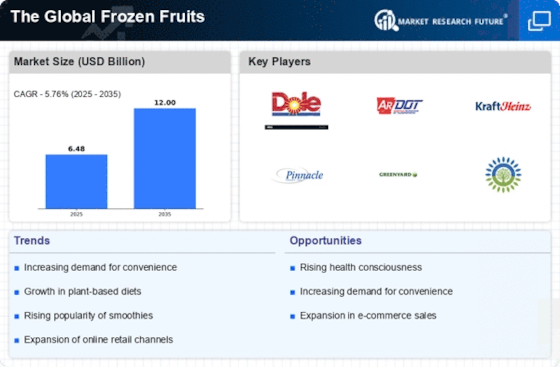
As per Market Research Future analysis, The Global Frozen Fruits Market Size was estimated at 6.48 USD Billion in 2024. The frozen fruits industry is projected to grow from 6.853 USD Billion in 2025 to 12.0 USD Billion by 2035, exhibiting a compound annual growth rate (CAGR) of 5.76% during the forecast period 2025 - 2035

Key Market Trends & Highlights

The Global Frozen Fruits Market is experiencing robust growth driven by health trends and innovative product offerings.

  • Health-conscious consumption continues to drive demand for frozen fruits, particularly in North America, the largest market.
  • Berries represent the largest segment within the frozen fruits category, while tropical fruits are emerging as the fastest-growing segment.
  • E-commerce growth is reshaping distribution channels, particularly in the Asia-Pacific region, which is the fastest-growing market.
  • Key market drivers include rising demand for convenience foods and sustainability initiatives, influencing product development strategies.

Market Size & Forecast

2024 Market Size 6.48 (USD Billion)
2035 Market Size 12.0 (USD Billion)
CAGR (2025 - 2035) 5.76%
Largest Regional Market Share in 2024 North America

Major Players

Dole Food Company (US), Ardo (BE), Kraft Heinz Company (US), Pinnacle Foods (US), Greenyard (BE), SunOpta (CA), Euroberry (ES), Fruttivendolo (IT), Berrifine (DE)

Market Trends

The Global Frozen Fruits Market is currently experiencing a dynamic evolution, driven by shifting consumer preferences towards healthier food options and the convenience of ready-to-eat products. As individuals increasingly prioritize nutrition, the demand for frozen fruits has surged, reflecting a broader trend towards plant-based diets. This market appears to be influenced by various factors, including the growing awareness of the benefits of frozen produce, which retains essential nutrients and flavors. Additionally, the expansion of distribution channels, such as online grocery shopping, has made frozen fruits more accessible to a wider audience, further propelling market growth. Moreover, The Global Frozen Fruits Market seems to be adapting to the rising trend of sustainability. Consumers are becoming more conscious of their environmental impact, leading to a preference for products that are sourced responsibly. This shift may encourage manufacturers to adopt eco-friendly practices in their supply chains, potentially enhancing their appeal to environmentally aware consumers. As the market continues to evolve, it is likely that innovation in product offerings and packaging will play a crucial role in meeting the diverse needs of consumers, ensuring that The Global Frozen Fruits Market remains competitive and relevant in the years to come.

Health-Conscious Consumption

There is a noticeable trend towards health-conscious eating habits, with consumers increasingly opting for frozen fruits as a nutritious alternative to processed snacks. This shift reflects a broader movement towards wellness and balanced diets.

Sustainability Initiatives

The market is witnessing a growing emphasis on sustainability, as consumers demand products that are environmentally friendly. This trend may lead to more brands adopting sustainable sourcing and packaging practices.

E-commerce Growth

The rise of e-commerce platforms is transforming the way consumers purchase frozen fruits. Online shopping offers convenience and a wider selection, making it easier for consumers to access these products.

Frozen Fruits Market Market Drivers

E-commerce Growth

The rapid growth of e-commerce is significantly impacting The Global Frozen Fruits Industry. With the increasing penetration of the internet and mobile devices, consumers are turning to online platforms for their grocery shopping needs. This shift is particularly evident in the frozen fruits segment, where convenience and accessibility are paramount. Recent data shows that online grocery sales have surged, with frozen fruits being one of the top-selling categories. The ease of purchasing frozen fruits online, coupled with the ability to compare prices and read reviews, enhances consumer confidence. As a result, many traditional retailers are expanding their online presence to capture this growing market segment. This trend indicates that e-commerce will continue to be a vital channel for the distribution of frozen fruits, potentially leading to increased sales and market expansion.

Sustainability Initiatives

Sustainability initiatives are becoming increasingly influential in shaping The Global Frozen Fruits Industry. As consumers become more environmentally conscious, there is a growing demand for products that are sourced and packaged sustainably. This shift is prompting companies to adopt eco-friendly practices, such as using biodegradable packaging and sourcing fruits from sustainable farms. Recent statistics indicate that brands that emphasize sustainability in their marketing strategies experience a 20% increase in consumer preference. Furthermore, the implementation of sustainable practices not only appeals to eco-conscious consumers but also enhances brand loyalty. As the market evolves, companies that prioritize sustainability are likely to gain a competitive edge, thereby driving growth in the frozen fruits sector. This trend suggests that sustainability will play a crucial role in the future landscape of the industry.

Health-Conscious Consumption

The rising trend of health-conscious consumption is a pivotal driver for The Global Frozen Fruits Industry. Consumers are increasingly prioritizing nutritious food options, leading to a surge in demand for frozen fruits, which retain essential vitamins and minerals. According to recent data, the frozen fruit segment is projected to grow at a compound annual growth rate of approximately 5.5% over the next five years. This growth is attributed to the increasing awareness of the health benefits associated with fruits, such as antioxidants and dietary fiber. As more individuals seek convenient yet healthy meal options, the appeal of frozen fruits as a versatile ingredient in smoothies, desserts, and snacks becomes more pronounced. Consequently, this trend is likely to bolster the market, as manufacturers respond by expanding their product lines to include a wider variety of frozen fruit offerings.

Innovative Product Development

Innovative product development is a key driver in The Global Frozen Fruits Industry. As consumer preferences evolve, manufacturers are increasingly focusing on creating new and unique frozen fruit products. This includes the introduction of exotic fruit blends, organic options, and ready-to-eat frozen fruit snacks. Recent market analysis suggests that innovative products can lead to a 15% increase in sales for companies that successfully tap into emerging trends. Additionally, the incorporation of superfoods and functional ingredients into frozen fruit offerings is gaining traction, appealing to health-conscious consumers. This emphasis on innovation not only attracts new customers but also encourages repeat purchases, thereby fostering brand loyalty. As the market continues to evolve, the ability to innovate will likely be a determining factor for success in the frozen fruits sector.

Rising Demand for Convenience Foods

The rising demand for convenience foods is a significant driver of The Global Frozen Fruits Industry. As lifestyles become busier, consumers are increasingly seeking quick and easy meal solutions. Frozen fruits offer a convenient option for those looking to prepare healthy meals without the time-consuming process of washing, peeling, and chopping fresh fruits. Recent surveys indicate that nearly 60% of consumers prefer frozen fruits for their ease of use in meal preparation. This trend is particularly pronounced among working professionals and families, who value the time-saving aspect of frozen fruits. Consequently, manufacturers are responding by enhancing their product offerings, such as pre-packaged fruit mixes and single-serving portions. This focus on convenience is likely to continue driving growth in the frozen fruits market, as more consumers prioritize efficiency in their food choices.

Market Segment Insights

By Type: Berries (Largest) vs. Tropical Fruits (Fastest-Growing)

In The Global Frozen Fruits Market, Berries dominate the segment with the largest market share, owing to their popularity in both consumer and industrial applications. The demand for mixed berry products for smoothies and desserts is particularly high, contributing to their significant market presence. Tropical Fruits, on the other hand, are witnessing rapid growth as health trends shift towards the incorporation of exotic fruit flavors in various food items. With increasing health awareness among consumers, Tropical Fruits are gaining traction, making them a key focus in market analysis. The growth trends in the Frozen Fruits Market indicate that while Berries are already established as a preferred choice, Tropical Fruits are emerging as a strong contender. The expansion of distribution channels and the favorable positioning of Tropical Fruits in health-focused product lines are vital growth drivers. Moreover, the increase in ready-to-eat snacks that utilize Frozen Tropical Fruits signifies a lucrative opportunity for manufacturers and retailers, indicating a promising trajectory for this segment.

Berries (Dominant) vs. Tropical Fruits (Emerging)

Berries, including strawberries, blueberries, and raspberries, have become household favorites due to their versatility and health benefits. This dominance stems from their extensive use in smoothies, desserts, and <a href="https://www.marketresearchfuture.com/reports/breakfast-products-market-40500" target="_blank">breakfast products</a>, appealing to a wide demographic. Their vibrant colors and flavor profiles make them an ideal choice for both retail and food service applications. In contrast, Tropical Fruits such as mangoes and pineapples are recognized for their exotic appeal and growing popularity in diverse culinary applications. As consumers increasingly seek adventurous flavors, Frozen Tropical Fruits have positioned themselves as an emerging segment, benefiting from trends such as health-conscious eating and the rise of global cuisines. These fruits are particularly favored in salads, smoothies, and <a href="https://www.marketresearchfuture.com/reports/alcoholic-beverages-market-3190" target="_blank">alcoholic beverages</a>, showcasing their adaptability in modern gastronomy.

By Form: Whole Fruits (Largest) vs. Sliced Fruits (Fastest-Growing)

In The Global Frozen Fruits Market, the segment of Whole Fruits holds the largest market share, catering to consumers seeking convenience without compromising on quality. This segment's robust demand is driven by the increasing preference for natural and minimally processed frozen foods, as well as a growing trend towards healthy eating. In contrast, Sliced Fruits, while smaller in share, is witnessing rapid growth, popular among consumers for their ease of use in meal preparation and snacking. The growth trends within this segment are largely fuelled by consumers' busy lifestyles and the rising popularity of healthy snacking options. As awareness of the nutritional benefits of frozen fruits increases, more people are incorporating these products into their diets. Market players are innovating in packaging and product offerings, making sliced fruits more accessible, which in turn supports the segment's fastest growth trajectory.

Whole Fruits: Dominant vs. Sliced Fruits: Emerging

Whole fruits represent the dominant force in The Global Frozen Fruits Market, primarily due to their versatility and strong consumer recognition. They are often perceived as a healthier option, preserving more nutrients during the freezing process. This segment caters to a wide range of applications, from smoothies to desserts, appealing to health-conscious consumers. Meanwhile, sliced fruits are emerging rapidly, with their convenience appealing to time-strapped customers and busy families. The easy-to-use format makes them ideal for quick snacks or as recipe ingredients. As innovation in frozen snack formats continues, sliced fruits are likely to capture a greater market share, especially among younger consumers seeking healthy, on-the-go options.

By End Use: Food Processing (Largest) vs. Smoothie Preparation (Fastest-Growing)

In The Global Frozen Fruits Market, the end use of Food Processing captures a significant portion of market share, driven by the continuous demand for convenience food and ready-to-eat products. This segment includes the use of frozen fruits in a variety of applications such as sauces, desserts, and other food formulations. Smoothie Preparation is also witnessing a surge in popularity, particularly among health-conscious consumers, emphasizing the increasing trend towards nutrition and quick meal options. The growth trends within these segments highlight a shifting consumer preference toward healthier diets and convenient meal solutions. The Food Processing segment is bolstered by the evolving landscape of food manufacturing, while Smoothie Preparation is rapidly gaining traction, driven by the rise of smoothie bars and health-oriented cafes. Moreover, promotional activities and the advent of new product innovations further propel growth in these areas as consumers seek varied and wholesome choices.

Food Processing (Dominant) vs. Snacking (Emerging)

Food Processing represents the dominant segment in The Global Frozen Fruits Market, characterized by its wide application in various culinary uses including jams, jellies, and baked goods. This segment benefits from industrial demand as manufacturers seek high-quality fruit ingredients that offer long shelf life without compromising on flavor or nutritional value. In contrast, Snacking is an emerging segment, driven by the increasing trend of on-the-go consumption. Consumers are gravitating towards easy-to-eat options, and frozen fruits cater perfectly to this need, providing nutritious snacking alternatives that align with health-conscious lifestyles. While Food Processing maintains its stronghold, Snacking is poised for rapid expansion as it capitalizes on modern eating habits.

By Distribution Channel: Supermarkets (Largest) vs. Online Retail (Fastest-Growing)

The Global Frozen Fruits Market showcases a varied distribution among different channels, with Supermarkets holding the largest share. This dominance can be attributed to their wide reach and convenience for consumers. Meanwhile, Online Retail is rapidly transforming the market landscape as more consumers turn to e-commerce for their grocery needs, particularly in the convenience-oriented post-pandemic environment.

Supermarkets: Dominant vs. Online Retail: Emerging

Supermarkets have established themselves as the dominant distribution channel for frozen fruits, leveraging their vast networks and physical presence to drive sales. These establishments often offers a wide range of frozen fruit products, catering to diverse consumer preferences. On the other hand, Online Retail is emerging as a compelling alternative, attracting a younger demographic that prefers the convenience of home delivery. The increasing penetration of technology and changing consumer behaviors towards shopping are propelling this channel's rapid growth, positioning it as a significant part of the market's future.

Get more detailed insights about Frozen Fruits Market Research Report - Forecast till 2035

Regional Insights

The Regional segment of the Global Frozen Fruits Market is positioned for significant growth, with total revenue reaching 6.48 USD Billion in 2024 and anticipated to grow further. Among the regions, North America leads with a dominant valuation of 2.3 USD Billion in 2024, projected to expand to 4.2 USD Billion by 2035, driven by increasing consumer demand for convenient and healthy food options.

Europe follows closely, expanding to 3.2 USD Billion by 2035, reflecting robust market growth due to the rising popularity of frozen fruits in various culinary applications.The APAC region, valued at 1.5 USD Billion in 2024, is expected to see growth to 2.7 USD Billion, indicating a surge in demand stemming from changing dietary patterns and the growing urban population. South America, with a valuation of 0.65 USD Billion in 2024 and an anticipated rise to 1.1 USD Billion, highlights increasing access to frozen fruit products, aligning with global health trends.

Lastly, the Middle East and Africa (MEA) is expected to grow from 0.23 USD Billion in 2024 to 0.8 USD Billion by 2035, showcasing emerging market opportunities in the food industry.

Overall, the Global Frozen Fruits Market segmentation by region showcases varying growth dynamics driven by consumer behavior, health awareness, and increasing availability of frozen fruit products across different regions, reflecting significant opportunities for the industry.

 Source: Primary Research, Secondary Research, Market Research Future Database and Analyst Review

Key Players and Competitive Insights

The Global Frozen Fruits Market has been experiencing robust growth over the past few years, driven by an increasing demand for processed foods, health-conscious consumer trends, and the convenience of frozen products. As the market expands, companies are vying for dominance through innovative products, strategic partnerships, and extensive distribution networks. This competitive landscape is characterized by a mix of established brands and emerging players, all striving to capture consumer interest with quality offerings such as berries, tropical fruits, and mixed fruit blends.As frozen fruits become a staple in households and food service establishments alike, understanding the strengths and market strategies of key players becomes crucial.Haitai Confectionery has made a notable presence within the Global Frozen Fruits Market, primarily focusing on producing high-quality frozen fruit products that cater to diverse consumer needs. The company leverages its strong brand recognition and understanding of regional preferences to deliver products that resonate well with health-conscious consumers looking for nutritious snack options. With a robust supply chain and distribution network, Haitai Confectionery ensures that its frozen fruits are widely available across various retail channels, allowing for increased visibility and competitive advantage in the market. The company's commitment to maintaining high standards of quality throughout its production processes further solidifies its position as a reliable and trusted name in the realm of frozen fruits.Ocean Spray has established itself as a significant contender in the Global Frozen Fruits Market with a diverse product portfolio that includes frozen cranberries, blueberries, and a variety of berry blends, appealing to both retail consumers and food service operators. The cooperative emphasizes the benefits of its products, such as high nutritional value and versatility in culinary applications, further bolstering its appeal in the frozen sector.With a strong market presence, Ocean Spray continually invests in marketing and product development to enhance brand loyalty and consumer awareness. The company has pursued strategic mergers and acquisitions to expand its offerings and distribution capabilities, allowing it to adapt to changing market dynamics effectively and ensure sustained growth in the competitive landscape.

Key Companies in the Frozen Fruits Market include

Industry Developments

Recent developments in the Global Frozen Fruits Market indicate increased demand driven by evolving consumer preferences for healthy and convenient food options. Companies such as Dole Food Company and Cargill are focusing on expanding their product lines to cater to this trend. In September 2023, Ocean Spray announced a strategic partnership with a major retailer to expand the distribution of its frozen cranberry products, enhancing market reach. Furthermore, Nabati Foods has made significant strides in plant-based frozen products, aligning with sustainability trends.

In terms of mergers and acquisitions, McCain Foods completed its acquisition of a regional player in Europe in August 2023, bolstering its presence in the frozen sector. 

Additionally, Greenyard reported a 15% growth in market valuation in early 2023, attributed to increased demand for frozen fruits amidst rising health awareness. Over the past few years, the global market has witnessed heightened activity, with stakeholders investing in Research and Development to innovate and enhance product quality. The combination of these factors highlights the dynamic nature of the Global Frozen Fruits Market as it aims to meet changing consumer demands while also addressing sustainability concerns.

Future Outlook

Frozen Fruits Market Future Outlook

The Global Frozen Fruits Market is projected to grow at a 5.76% CAGR from 2025 to 2035, driven by increasing health consciousness, convenience, and demand for year-round availability.

New opportunities lie in:

  • Expansion of e-commerce platforms for frozen fruit sales.
  • Development of innovative packaging solutions to enhance shelf life.
  • Partnerships with food service providers for bulk supply agreements.

By 2035, the market is expected to achieve robust growth, reflecting evolving consumer preferences and strategic innovations.

Market Segmentation

Frozen Fruits Market Form Outlook

  • Whole Fruits
  • Sliced Fruits
  • Puree
  • Diced Fruits

Frozen Fruits Market Type Outlook

  • Berries
  • Tropical Fruits
  • Stone Fruits
  • Citrus Fruits
  • Bananas

Frozen Fruits Market End Use Outlook

  • Food Processing
  • Smoothie Preparation
  • Baking
  • Snacking

Frozen Fruits Market Distribution Channel Outlook

  • Online Retail
  • Supermarkets
  • Convenience Stores
  • Specialty Stores

Report Scope

MARKET SIZE 2024 6.48(USD Billion)
MARKET SIZE 2025 6.853(USD Billion)
MARKET SIZE 2035 12.0(USD Billion)
COMPOUND ANNUAL GROWTH RATE (CAGR) 5.76% (2025 - 2035)
REPORT COVERAGE Revenue Forecast, Competitive Landscape, Growth Factors, and Trends
BASE YEAR 2024
Market Forecast Period 2025 - 2035
Historical Data 2019 - 2024
Market Forecast Units USD Billion
Key Companies Profiled Dole Food Company (US), Ardo (BE), Kraft Heinz Company (US), Pinnacle Foods (US), Greenyard (BE), SunOpta (CA), Euroberry (ES), Fruttivendolo (IT), Berrifine (DE)
Segments Covered Product Type, Form, End Use, Distribution Channel, Regional
Key Market Opportunities Rising consumer demand for healthy snacks drives innovation in The Global Frozen Fruits.
Key Market Dynamics Rising consumer demand for healthy snacks drives innovation and competition in the frozen fruits sector.
Countries Covered North America, Europe, APAC, South America, MEA

FAQs

What is the projected market valuation of The Global Frozen Fruits by 2035?

<p>The projected market valuation of The Global Frozen Fruits is expected to reach 12.0 USD Billion by 2035.</p>

What was the market valuation of The Global Frozen Fruits in 2024?

<p>The overall market valuation of The Global Frozen Fruits was 6.48 USD Billion in 2024.</p>

What is the expected CAGR for The Global Frozen Fruits during the forecast period 2025 - 2035?

<p>The expected CAGR for The Global Frozen Fruits during the forecast period 2025 - 2035 is 5.76%.</p>

Which segment of frozen fruits is projected to have the highest valuation by 2035?

<p>Berries are projected to have the highest valuation, increasing from 1.94 USD Billion in 2024 to 3.6 USD Billion by 2035.</p>

How do the valuations of sliced fruits compare to whole fruits in 2035?

<p>By 2035, sliced fruits are expected to reach 3.0 USD Billion, while whole fruits are projected to double to 4.0 USD Billion.</p>

What are the key distribution channels for frozen fruits?

<p>Key distribution channels for frozen fruits include supermarkets, which are expected to grow from 2.59 USD Billion in 2024 to 5.0 USD Billion by 2035.</p>

Which company is a leading player in The Global Frozen Fruits?

<p>Dole Food Company is recognized as a leading player in The Global Frozen Fruits.</p>

What is the projected growth for the smoothie preparation segment by 2035?

<p>The smoothie preparation segment is projected to grow from 1.29 USD Billion in 2024 to 2.28 USD Billion by 2035.</p>

How does the market for tropical fruits compare to stone fruits in 2035?

<p>Tropical fruits are expected to grow to 2.4 USD Billion by 2035, whereas stone fruits are projected to reach 1.5 USD Billion.</p>

What is the expected valuation for online retail in The Global Frozen Fruits by 2035?

<p>The expected valuation for online retail in The Global Frozen Fruits is projected to reach 2.0 USD Billion by 2035.</p>

  1. SECTION I: EXECUTIVE SUMMARY AND KEY HIGHLIGHTS
    1. | 1.1 EXECUTIVE SUMMARY
    2. | | 1.1.1 Market Overview
    3. | | 1.1.2 Key Findings
    4. | | 1.1.3 Market Segmentation
    5. | | 1.1.4 Competitive Landscape
    6. | | 1.1.5 Challenges and Opportunities
    7. | | 1.1.6 Future Outlook
  2. SECTION II: SCOPING, METHODOLOGY AND MARKET STRUCTURE
    1. | 2.1 MARKET INTRODUCTION
    2. | | 2.1.1 Definition
    3. | | 2.1.2 Scope of the study
    4. | | | 2.1.2.1 Research Objective
    5. | | | 2.1.2.2 Assumption
    6. | | | 2.1.2.3 Limitations
    7. | 2.2 RESEARCH METHODOLOGY
    8. | | 2.2.1 Overview
    9. | | 2.2.2 Data Mining
    10. | | 2.2.3 Secondary Research
    11. | | 2.2.4 Primary Research
    12. | | | 2.2.4.1 Primary Interviews and Information Gathering Process
    13. | | | 2.2.4.2 Breakdown of Primary Respondents
    14. | | 2.2.5 Forecasting Model
    15. | | 2.2.6 Market Size Estimation
    16. | | | 2.2.6.1 Bottom-Up Approach
    17. | | | 2.2.6.2 Top-Down Approach
    18. | | 2.2.7 Data Triangulation
    19. | | 2.2.8 Validation
  3. SECTION III: QUALITATIVE ANALYSIS
    1. | 3.1 MARKET DYNAMICS
    2. | | 3.1.1 Overview
    3. | | 3.1.2 Drivers
    4. | | 3.1.3 Restraints
    5. | | 3.1.4 Opportunities
    6. | 3.2 MARKET FACTOR ANALYSIS
    7. | | 3.2.1 Value chain Analysis
    8. | | 3.2.2 Porter's Five Forces Analysis
    9. | | | 3.2.2.1 Bargaining Power of Suppliers
    10. | | | 3.2.2.2 Bargaining Power of Buyers
    11. | | | 3.2.2.3 Threat of New Entrants
    12. | | | 3.2.2.4 Threat of Substitutes
    13. | | | 3.2.2.5 Intensity of Rivalry
    14. | | 3.2.3 COVID-19 Impact Analysis
    15. | | | 3.2.3.1 Market Impact Analysis
    16. | | | 3.2.3.2 Regional Impact
    17. | | | 3.2.3.3 Opportunity and Threat Analysis
  4. SECTION IV: QUANTITATIVE ANALYSIS
    1. | 4.1 Food, Beverages & Nutrition, BY Type (USD Billion)
    2. | | 4.1.1 Berries
    3. | | 4.1.2 Tropical Fruits
    4. | | 4.1.3 Stone Fruits
    5. | | 4.1.4 Citrus Fruits
    6. | | 4.1.5 Bananas
    7. | 4.2 Food, Beverages & Nutrition, BY Form (USD Billion)
    8. | | 4.2.1 Whole Fruits
    9. | | 4.2.2 Sliced Fruits
    10. | | 4.2.3 Puree
    11. | | 4.2.4 Diced Fruits
    12. | 4.3 Food, Beverages & Nutrition, BY End Use (USD Billion)
    13. | | 4.3.1 Food Processing
    14. | | 4.3.2 Smoothie Preparation
    15. | | 4.3.3 Baking
    16. | | 4.3.4 Snacking
    17. | 4.4 Food, Beverages & Nutrition, BY Distribution Channel (USD Billion)
    18. | | 4.4.1 Online Retail
    19. | | 4.4.2 Supermarkets
    20. | | 4.4.3 Convenience Stores
    21. | | 4.4.4 Specialty Stores
    22. | 4.5 Food, Beverages & Nutrition, BY Region (USD Billion)
    23. | | 4.5.1 North America
    24. | | | 4.5.1.1 US
    25. | | | 4.5.1.2 Canada
    26. | | 4.5.2 Europe
    27. | | | 4.5.2.1 Germany
    28. | | | 4.5.2.2 UK
    29. | | | 4.5.2.3 France
    30. | | | 4.5.2.4 Russia
    31. | | | 4.5.2.5 Italy
    32. | | | 4.5.2.6 Spain
    33. | | | 4.5.2.7 Rest of Europe
    34. | | 4.5.3 APAC
    35. | | | 4.5.3.1 China
    36. | | | 4.5.3.2 India
    37. | | | 4.5.3.3 Japan
    38. | | | 4.5.3.4 South Korea
    39. | | | 4.5.3.5 Malaysia
    40. | | | 4.5.3.6 Thailand
    41. | | | 4.5.3.7 Indonesia
    42. | | | 4.5.3.8 Rest of APAC
    43. | | 4.5.4 South America
    44. | | | 4.5.4.1 Brazil
    45. | | | 4.5.4.2 Mexico
    46. | | | 4.5.4.3 Argentina
    47. | | | 4.5.4.4 Rest of South America
    48. | | 4.5.5 MEA
    49. | | | 4.5.5.1 GCC Countries
    50. | | | 4.5.5.2 South Africa
    51. | | | 4.5.5.3 Rest of MEA
  5. SECTION V: COMPETITIVE ANALYSIS
    1. | 5.1 Competitive Landscape
    2. | | 5.1.1 Overview
    3. | | 5.1.2 Competitive Analysis
    4. | | 5.1.3 Market share Analysis
    5. | | 5.1.4 Major Growth Strategy in the Food, Beverages & Nutrition
    6. | | 5.1.5 Competitive Benchmarking
    7. | | 5.1.6 Leading Players in Terms of Number of Developments in the Food, Beverages & Nutrition
    8. | | 5.1.7 Key developments and growth strategies
    9. | | | 5.1.7.1 New Product Launch/Service Deployment
    10. | | | 5.1.7.2 Merger & Acquisitions
    11. | | | 5.1.7.3 Joint Ventures
    12. | | 5.1.8 Major Players Financial Matrix
    13. | | | 5.1.8.1 Sales and Operating Income
    14. | | | 5.1.8.2 Major Players R&D Expenditure. 2023
    15. | 5.2 Company Profiles
    16. | | 5.2.1 Dole Food Company (US)
    17. | | | 5.2.1.1 Financial Overview
    18. | | | 5.2.1.2 Products Offered
    19. | | | 5.2.1.3 Key Developments
    20. | | | 5.2.1.4 SWOT Analysis
    21. | | | 5.2.1.5 Key Strategies
    22. | | 5.2.2 Ardo (BE)
    23. | | | 5.2.2.1 Financial Overview
    24. | | | 5.2.2.2 Products Offered
    25. | | | 5.2.2.3 Key Developments
    26. | | | 5.2.2.4 SWOT Analysis
    27. | | | 5.2.2.5 Key Strategies
    28. | | 5.2.3 Kraft Heinz Company (US)
    29. | | | 5.2.3.1 Financial Overview
    30. | | | 5.2.3.2 Products Offered
    31. | | | 5.2.3.3 Key Developments
    32. | | | 5.2.3.4 SWOT Analysis
    33. | | | 5.2.3.5 Key Strategies
    34. | | 5.2.4 Pinnacle Foods (US)
    35. | | | 5.2.4.1 Financial Overview
    36. | | | 5.2.4.2 Products Offered
    37. | | | 5.2.4.3 Key Developments
    38. | | | 5.2.4.4 SWOT Analysis
    39. | | | 5.2.4.5 Key Strategies
    40. | | 5.2.5 Greenyard (BE)
    41. | | | 5.2.5.1 Financial Overview
    42. | | | 5.2.5.2 Products Offered
    43. | | | 5.2.5.3 Key Developments
    44. | | | 5.2.5.4 SWOT Analysis
    45. | | | 5.2.5.5 Key Strategies
    46. | | 5.2.6 SunOpta (CA)
    47. | | | 5.2.6.1 Financial Overview
    48. | | | 5.2.6.2 Products Offered
    49. | | | 5.2.6.3 Key Developments
    50. | | | 5.2.6.4 SWOT Analysis
    51. | | | 5.2.6.5 Key Strategies
    52. | | 5.2.7 Euroberry (ES)
    53. | | | 5.2.7.1 Financial Overview
    54. | | | 5.2.7.2 Products Offered
    55. | | | 5.2.7.3 Key Developments
    56. | | | 5.2.7.4 SWOT Analysis
    57. | | | 5.2.7.5 Key Strategies
    58. | | 5.2.8 Fruttivendolo (IT)
    59. | | | 5.2.8.1 Financial Overview
    60. | | | 5.2.8.2 Products Offered
    61. | | | 5.2.8.3 Key Developments
    62. | | | 5.2.8.4 SWOT Analysis
    63. | | | 5.2.8.5 Key Strategies
    64. | | 5.2.9 Berrifine (DE)
    65. | | | 5.2.9.1 Financial Overview
    66. | | | 5.2.9.2 Products Offered
    67. | | | 5.2.9.3 Key Developments
    68. | | | 5.2.9.4 SWOT Analysis
    69. | | | 5.2.9.5 Key Strategies
    70. | 5.3 Appendix
    71. | | 5.3.1 References
    72. | | 5.3.2 Related Reports
  6. LIST OF FIGURES
    1. | 6.1 MARKET SYNOPSIS
    2. | 6.2 NORTH AMERICA MARKET ANALYSIS
    3. | 6.3 US MARKET ANALYSIS BY TYPE
    4. | 6.4 US MARKET ANALYSIS BY FORM
    5. | 6.5 US MARKET ANALYSIS BY END USE
    6. | 6.6 US MARKET ANALYSIS BY DISTRIBUTION CHANNEL
    7. | 6.7 CANADA MARKET ANALYSIS BY TYPE
    8. | 6.8 CANADA MARKET ANALYSIS BY FORM
    9. | 6.9 CANADA MARKET ANALYSIS BY END USE
    10. | 6.10 CANADA MARKET ANALYSIS BY DISTRIBUTION CHANNEL
    11. | 6.11 EUROPE MARKET ANALYSIS
    12. | 6.12 GERMANY MARKET ANALYSIS BY TYPE
    13. | 6.13 GERMANY MARKET ANALYSIS BY FORM
    14. | 6.14 GERMANY MARKET ANALYSIS BY END USE
    15. | 6.15 GERMANY MARKET ANALYSIS BY DISTRIBUTION CHANNEL
    16. | 6.16 UK MARKET ANALYSIS BY TYPE
    17. | 6.17 UK MARKET ANALYSIS BY FORM
    18. | 6.18 UK MARKET ANALYSIS BY END USE
    19. | 6.19 UK MARKET ANALYSIS BY DISTRIBUTION CHANNEL
    20. | 6.20 FRANCE MARKET ANALYSIS BY TYPE
    21. | 6.21 FRANCE MARKET ANALYSIS BY FORM
    22. | 6.22 FRANCE MARKET ANALYSIS BY END USE
    23. | 6.23 FRANCE MARKET ANALYSIS BY DISTRIBUTION CHANNEL
    24. | 6.24 RUSSIA MARKET ANALYSIS BY TYPE
    25. | 6.25 RUSSIA MARKET ANALYSIS BY FORM
    26. | 6.26 RUSSIA MARKET ANALYSIS BY END USE
    27. | 6.27 RUSSIA MARKET ANALYSIS BY DISTRIBUTION CHANNEL
    28. | 6.28 ITALY MARKET ANALYSIS BY TYPE
    29. | 6.29 ITALY MARKET ANALYSIS BY FORM
    30. | 6.30 ITALY MARKET ANALYSIS BY END USE
    31. | 6.31 ITALY MARKET ANALYSIS BY DISTRIBUTION CHANNEL
    32. | 6.32 SPAIN MARKET ANALYSIS BY TYPE
    33. | 6.33 SPAIN MARKET ANALYSIS BY FORM
    34. | 6.34 SPAIN MARKET ANALYSIS BY END USE
    35. | 6.35 SPAIN MARKET ANALYSIS BY DISTRIBUTION CHANNEL
    36. | 6.36 REST OF EUROPE MARKET ANALYSIS BY TYPE
    37. | 6.37 REST OF EUROPE MARKET ANALYSIS BY FORM
    38. | 6.38 REST OF EUROPE MARKET ANALYSIS BY END USE
    39. | 6.39 REST OF EUROPE MARKET ANALYSIS BY DISTRIBUTION CHANNEL
    40. | 6.40 APAC MARKET ANALYSIS
    41. | 6.41 CHINA MARKET ANALYSIS BY TYPE
    42. | 6.42 CHINA MARKET ANALYSIS BY FORM
    43. | 6.43 CHINA MARKET ANALYSIS BY END USE
    44. | 6.44 CHINA MARKET ANALYSIS BY DISTRIBUTION CHANNEL
    45. | 6.45 INDIA MARKET ANALYSIS BY TYPE
    46. | 6.46 INDIA MARKET ANALYSIS BY FORM
    47. | 6.47 INDIA MARKET ANALYSIS BY END USE
    48. | 6.48 INDIA MARKET ANALYSIS BY DISTRIBUTION CHANNEL
    49. | 6.49 JAPAN MARKET ANALYSIS BY TYPE
    50. | 6.50 JAPAN MARKET ANALYSIS BY FORM
    51. | 6.51 JAPAN MARKET ANALYSIS BY END USE
    52. | 6.52 JAPAN MARKET ANALYSIS BY DISTRIBUTION CHANNEL
    53. | 6.53 SOUTH KOREA MARKET ANALYSIS BY TYPE
    54. | 6.54 SOUTH KOREA MARKET ANALYSIS BY FORM
    55. | 6.55 SOUTH KOREA MARKET ANALYSIS BY END USE
    56. | 6.56 SOUTH KOREA MARKET ANALYSIS BY DISTRIBUTION CHANNEL
    57. | 6.57 MALAYSIA MARKET ANALYSIS BY TYPE
    58. | 6.58 MALAYSIA MARKET ANALYSIS BY FORM
    59. | 6.59 MALAYSIA MARKET ANALYSIS BY END USE
    60. | 6.60 MALAYSIA MARKET ANALYSIS BY DISTRIBUTION CHANNEL
    61. | 6.61 THAILAND MARKET ANALYSIS BY TYPE
    62. | 6.62 THAILAND MARKET ANALYSIS BY FORM
    63. | 6.63 THAILAND MARKET ANALYSIS BY END USE
    64. | 6.64 THAILAND MARKET ANALYSIS BY DISTRIBUTION CHANNEL
    65. | 6.65 INDONESIA MARKET ANALYSIS BY TYPE
    66. | 6.66 INDONESIA MARKET ANALYSIS BY FORM
    67. | 6.67 INDONESIA MARKET ANALYSIS BY END USE
    68. | 6.68 INDONESIA MARKET ANALYSIS BY DISTRIBUTION CHANNEL
    69. | 6.69 REST OF APAC MARKET ANALYSIS BY TYPE
    70. | 6.70 REST OF APAC MARKET ANALYSIS BY FORM
    71. | 6.71 REST OF APAC MARKET ANALYSIS BY END USE
    72. | 6.72 REST OF APAC MARKET ANALYSIS BY DISTRIBUTION CHANNEL
    73. | 6.73 SOUTH AMERICA MARKET ANALYSIS
    74. | 6.74 BRAZIL MARKET ANALYSIS BY TYPE
    75. | 6.75 BRAZIL MARKET ANALYSIS BY FORM
    76. | 6.76 BRAZIL MARKET ANALYSIS BY END USE
    77. | 6.77 BRAZIL MARKET ANALYSIS BY DISTRIBUTION CHANNEL
    78. | 6.78 MEXICO MARKET ANALYSIS BY TYPE
    79. | 6.79 MEXICO MARKET ANALYSIS BY FORM
    80. | 6.80 MEXICO MARKET ANALYSIS BY END USE
    81. | 6.81 MEXICO MARKET ANALYSIS BY DISTRIBUTION CHANNEL
    82. | 6.82 ARGENTINA MARKET ANALYSIS BY TYPE
    83. | 6.83 ARGENTINA MARKET ANALYSIS BY FORM
    84. | 6.84 ARGENTINA MARKET ANALYSIS BY END USE
    85. | 6.85 ARGENTINA MARKET ANALYSIS BY DISTRIBUTION CHANNEL
    86. | 6.86 REST OF SOUTH AMERICA MARKET ANALYSIS BY TYPE
    87. | 6.87 REST OF SOUTH AMERICA MARKET ANALYSIS BY FORM
    88. | 6.88 REST OF SOUTH AMERICA MARKET ANALYSIS BY END USE
    89. | 6.89 REST OF SOUTH AMERICA MARKET ANALYSIS BY DISTRIBUTION CHANNEL
    90. | 6.90 MEA MARKET ANALYSIS
    91. | 6.91 GCC COUNTRIES MARKET ANALYSIS BY TYPE
    92. | 6.92 GCC COUNTRIES MARKET ANALYSIS BY FORM
    93. | 6.93 GCC COUNTRIES MARKET ANALYSIS BY END USE
    94. | 6.94 GCC COUNTRIES MARKET ANALYSIS BY DISTRIBUTION CHANNEL
    95. | 6.95 SOUTH AFRICA MARKET ANALYSIS BY TYPE
    96. | 6.96 SOUTH AFRICA MARKET ANALYSIS BY FORM
    97. | 6.97 SOUTH AFRICA MARKET ANALYSIS BY END USE
    98. | 6.98 SOUTH AFRICA MARKET ANALYSIS BY DISTRIBUTION CHANNEL
    99. | 6.99 REST OF MEA MARKET ANALYSIS BY TYPE
    100. | 6.100 REST OF MEA MARKET ANALYSIS BY FORM
    101. | 6.101 REST OF MEA MARKET ANALYSIS BY END USE
    102. | 6.102 REST OF MEA MARKET ANALYSIS BY DISTRIBUTION CHANNEL
    103. | 6.103 KEY BUYING CRITERIA OF FOOD, BEVERAGES & NUTRITION
    104. | 6.104 RESEARCH PROCESS OF MRFR
    105. | 6.105 DRO ANALYSIS OF FOOD, BEVERAGES & NUTRITION
    106. | 6.106 DRIVERS IMPACT ANALYSIS: FOOD, BEVERAGES & NUTRITION
    107. | 6.107 RESTRAINTS IMPACT ANALYSIS: FOOD, BEVERAGES & NUTRITION
    108. | 6.108 SUPPLY / VALUE CHAIN: FOOD, BEVERAGES & NUTRITION
    109. | 6.109 FOOD, BEVERAGES & NUTRITION, BY TYPE, 2024 (% SHARE)
    110. | 6.110 FOOD, BEVERAGES & NUTRITION, BY TYPE, 2024 TO 2035 (USD Billion)
    111. | 6.111 FOOD, BEVERAGES & NUTRITION, BY FORM, 2024 (% SHARE)
    112. | 6.112 FOOD, BEVERAGES & NUTRITION, BY FORM, 2024 TO 2035 (USD Billion)
    113. | 6.113 FOOD, BEVERAGES & NUTRITION, BY END USE, 2024 (% SHARE)
    114. | 6.114 FOOD, BEVERAGES & NUTRITION, BY END USE, 2024 TO 2035 (USD Billion)
    115. | 6.115 FOOD, BEVERAGES & NUTRITION, BY DISTRIBUTION CHANNEL, 2024 (% SHARE)
    116. | 6.116 FOOD, BEVERAGES & NUTRITION, BY DISTRIBUTION CHANNEL, 2024 TO 2035 (USD Billion)
    117. | 6.117 BENCHMARKING OF MAJOR COMPETITORS
  7. LIST OF TABLES
    1. | 7.1 LIST OF ASSUMPTIONS
    2. | | 7.1.1
    3. | 7.2 North America MARKET SIZE ESTIMATES; FORECAST
    4. | | 7.2.1 BY TYPE, 2025-2035 (USD Billion)
    5. | | 7.2.2 BY FORM, 2025-2035 (USD Billion)
    6. | | 7.2.3 BY END USE, 2025-2035 (USD Billion)
    7. | | 7.2.4 BY DISTRIBUTION CHANNEL, 2025-2035 (USD Billion)
    8. | 7.3 US MARKET SIZE ESTIMATES; FORECAST
    9. | | 7.3.1 BY TYPE, 2025-2035 (USD Billion)
    10. | | 7.3.2 BY FORM, 2025-2035 (USD Billion)
    11. | | 7.3.3 BY END USE, 2025-2035 (USD Billion)
    12. | | 7.3.4 BY DISTRIBUTION CHANNEL, 2025-2035 (USD Billion)
    13. | 7.4 Canada MARKET SIZE ESTIMATES; FORECAST
    14. | | 7.4.1 BY TYPE, 2025-2035 (USD Billion)
    15. | | 7.4.2 BY FORM, 2025-2035 (USD Billion)
    16. | | 7.4.3 BY END USE, 2025-2035 (USD Billion)
    17. | | 7.4.4 BY DISTRIBUTION CHANNEL, 2025-2035 (USD Billion)
    18. | 7.5 Europe MARKET SIZE ESTIMATES; FORECAST
    19. | | 7.5.1 BY TYPE, 2025-2035 (USD Billion)
    20. | | 7.5.2 BY FORM, 2025-2035 (USD Billion)
    21. | | 7.5.3 BY END USE, 2025-2035 (USD Billion)
    22. | | 7.5.4 BY DISTRIBUTION CHANNEL, 2025-2035 (USD Billion)
    23. | 7.6 Germany MARKET SIZE ESTIMATES; FORECAST
    24. | | 7.6.1 BY TYPE, 2025-2035 (USD Billion)
    25. | | 7.6.2 BY FORM, 2025-2035 (USD Billion)
    26. | | 7.6.3 BY END USE, 2025-2035 (USD Billion)
    27. | | 7.6.4 BY DISTRIBUTION CHANNEL, 2025-2035 (USD Billion)
    28. | 7.7 UK MARKET SIZE ESTIMATES; FORECAST
    29. | | 7.7.1 BY TYPE, 2025-2035 (USD Billion)
    30. | | 7.7.2 BY FORM, 2025-2035 (USD Billion)
    31. | | 7.7.3 BY END USE, 2025-2035 (USD Billion)
    32. | | 7.7.4 BY DISTRIBUTION CHANNEL, 2025-2035 (USD Billion)
    33. | 7.8 France MARKET SIZE ESTIMATES; FORECAST
    34. | | 7.8.1 BY TYPE, 2025-2035 (USD Billion)
    35. | | 7.8.2 BY FORM, 2025-2035 (USD Billion)
    36. | | 7.8.3 BY END USE, 2025-2035 (USD Billion)
    37. | | 7.8.4 BY DISTRIBUTION CHANNEL, 2025-2035 (USD Billion)
    38. | 7.9 Russia MARKET SIZE ESTIMATES; FORECAST
    39. | | 7.9.1 BY TYPE, 2025-2035 (USD Billion)
    40. | | 7.9.2 BY FORM, 2025-2035 (USD Billion)
    41. | | 7.9.3 BY END USE, 2025-2035 (USD Billion)
    42. | | 7.9.4 BY DISTRIBUTION CHANNEL, 2025-2035 (USD Billion)
    43. | 7.10 Italy MARKET SIZE ESTIMATES; FORECAST
    44. | | 7.10.1 BY TYPE, 2025-2035 (USD Billion)
    45. | | 7.10.2 BY FORM, 2025-2035 (USD Billion)
    46. | | 7.10.3 BY END USE, 2025-2035 (USD Billion)
    47. | | 7.10.4 BY DISTRIBUTION CHANNEL, 2025-2035 (USD Billion)
    48. | 7.11 Spain MARKET SIZE ESTIMATES; FORECAST
    49. | | 7.11.1 BY TYPE, 2025-2035 (USD Billion)
    50. | | 7.11.2 BY FORM, 2025-2035 (USD Billion)
    51. | | 7.11.3 BY END USE, 2025-2035 (USD Billion)
    52. | | 7.11.4 BY DISTRIBUTION CHANNEL, 2025-2035 (USD Billion)
    53. | 7.12 Rest of Europe MARKET SIZE ESTIMATES; FORECAST
    54. | | 7.12.1 BY TYPE, 2025-2035 (USD Billion)
    55. | | 7.12.2 BY FORM, 2025-2035 (USD Billion)
    56. | | 7.12.3 BY END USE, 2025-2035 (USD Billion)
    57. | | 7.12.4 BY DISTRIBUTION CHANNEL, 2025-2035 (USD Billion)
    58. | 7.13 APAC MARKET SIZE ESTIMATES; FORECAST
    59. | | 7.13.1 BY TYPE, 2025-2035 (USD Billion)
    60. | | 7.13.2 BY FORM, 2025-2035 (USD Billion)
    61. | | 7.13.3 BY END USE, 2025-2035 (USD Billion)
    62. | | 7.13.4 BY DISTRIBUTION CHANNEL, 2025-2035 (USD Billion)
    63. | 7.14 China MARKET SIZE ESTIMATES; FORECAST
    64. | | 7.14.1 BY TYPE, 2025-2035 (USD Billion)
    65. | | 7.14.2 BY FORM, 2025-2035 (USD Billion)
    66. | | 7.14.3 BY END USE, 2025-2035 (USD Billion)
    67. | | 7.14.4 BY DISTRIBUTION CHANNEL, 2025-2035 (USD Billion)
    68. | 7.15 India MARKET SIZE ESTIMATES; FORECAST
    69. | | 7.15.1 BY TYPE, 2025-2035 (USD Billion)
    70. | | 7.15.2 BY FORM, 2025-2035 (USD Billion)
    71. | | 7.15.3 BY END USE, 2025-2035 (USD Billion)
    72. | | 7.15.4 BY DISTRIBUTION CHANNEL, 2025-2035 (USD Billion)
    73. | 7.16 Japan MARKET SIZE ESTIMATES; FORECAST
    74. | | 7.16.1 BY TYPE, 2025-2035 (USD Billion)
    75. | | 7.16.2 BY FORM, 2025-2035 (USD Billion)
    76. | | 7.16.3 BY END USE, 2025-2035 (USD Billion)
    77. | | 7.16.4 BY DISTRIBUTION CHANNEL, 2025-2035 (USD Billion)
    78. | 7.17 South Korea MARKET SIZE ESTIMATES; FORECAST
    79. | | 7.17.1 BY TYPE, 2025-2035 (USD Billion)
    80. | | 7.17.2 BY FORM, 2025-2035 (USD Billion)
    81. | | 7.17.3 BY END USE, 2025-2035 (USD Billion)
    82. | | 7.17.4 BY DISTRIBUTION CHANNEL, 2025-2035 (USD Billion)
    83. | 7.18 Malaysia MARKET SIZE ESTIMATES; FORECAST
    84. | | 7.18.1 BY TYPE, 2025-2035 (USD Billion)
    85. | | 7.18.2 BY FORM, 2025-2035 (USD Billion)
    86. | | 7.18.3 BY END USE, 2025-2035 (USD Billion)
    87. | | 7.18.4 BY DISTRIBUTION CHANNEL, 2025-2035 (USD Billion)
    88. | 7.19 Thailand MARKET SIZE ESTIMATES; FORECAST
    89. | | 7.19.1 BY TYPE, 2025-2035 (USD Billion)
    90. | | 7.19.2 BY FORM, 2025-2035 (USD Billion)
    91. | | 7.19.3 BY END USE, 2025-2035 (USD Billion)
    92. | | 7.19.4 BY DISTRIBUTION CHANNEL, 2025-2035 (USD Billion)
    93. | 7.20 Indonesia MARKET SIZE ESTIMATES; FORECAST
    94. | | 7.20.1 BY TYPE, 2025-2035 (USD Billion)
    95. | | 7.20.2 BY FORM, 2025-2035 (USD Billion)
    96. | | 7.20.3 BY END USE, 2025-2035 (USD Billion)
    97. | | 7.20.4 BY DISTRIBUTION CHANNEL, 2025-2035 (USD Billion)
    98. | 7.21 Rest of APAC MARKET SIZE ESTIMATES; FORECAST
    99. | | 7.21.1 BY TYPE, 2025-2035 (USD Billion)
    100. | | 7.21.2 BY FORM, 2025-2035 (USD Billion)
    101. | | 7.21.3 BY END USE, 2025-2035 (USD Billion)
    102. | | 7.21.4 BY DISTRIBUTION CHANNEL, 2025-2035 (USD Billion)
    103. | 7.22 South America MARKET SIZE ESTIMATES; FORECAST
    104. | | 7.22.1 BY TYPE, 2025-2035 (USD Billion)
    105. | | 7.22.2 BY FORM, 2025-2035 (USD Billion)
    106. | | 7.22.3 BY END USE, 2025-2035 (USD Billion)
    107. | | 7.22.4 BY DISTRIBUTION CHANNEL, 2025-2035 (USD Billion)
    108. | 7.23 Brazil MARKET SIZE ESTIMATES; FORECAST
    109. | | 7.23.1 BY TYPE, 2025-2035 (USD Billion)
    110. | | 7.23.2 BY FORM, 2025-2035 (USD Billion)
    111. | | 7.23.3 BY END USE, 2025-2035 (USD Billion)
    112. | | 7.23.4 BY DISTRIBUTION CHANNEL, 2025-2035 (USD Billion)
    113. | 7.24 Mexico MARKET SIZE ESTIMATES; FORECAST
    114. | | 7.24.1 BY TYPE, 2025-2035 (USD Billion)
    115. | | 7.24.2 BY FORM, 2025-2035 (USD Billion)
    116. | | 7.24.3 BY END USE, 2025-2035 (USD Billion)
    117. | | 7.24.4 BY DISTRIBUTION CHANNEL, 2025-2035 (USD Billion)
    118. | 7.25 Argentina MARKET SIZE ESTIMATES; FORECAST
    119. | | 7.25.1 BY TYPE, 2025-2035 (USD Billion)
    120. | | 7.25.2 BY FORM, 2025-2035 (USD Billion)
    121. | | 7.25.3 BY END USE, 2025-2035 (USD Billion)
    122. | | 7.25.4 BY DISTRIBUTION CHANNEL, 2025-2035 (USD Billion)
    123. | 7.26 Rest of South America MARKET SIZE ESTIMATES; FORECAST
    124. | | 7.26.1 BY TYPE, 2025-2035 (USD Billion)
    125. | | 7.26.2 BY FORM, 2025-2035 (USD Billion)
    126. | | 7.26.3 BY END USE, 2025-2035 (USD Billion)
    127. | | 7.26.4 BY DISTRIBUTION CHANNEL, 2025-2035 (USD Billion)
    128. | 7.27 MEA MARKET SIZE ESTIMATES; FORECAST
    129. | | 7.27.1 BY TYPE, 2025-2035 (USD Billion)
    130. | | 7.27.2 BY FORM, 2025-2035 (USD Billion)
    131. | | 7.27.3 BY END USE, 2025-2035 (USD Billion)
    132. | | 7.27.4 BY DISTRIBUTION CHANNEL, 2025-2035 (USD Billion)
    133. | 7.28 GCC Countries MARKET SIZE ESTIMATES; FORECAST
    134. | | 7.28.1 BY TYPE, 2025-2035 (USD Billion)
    135. | | 7.28.2 BY FORM, 2025-2035 (USD Billion)
    136. | | 7.28.3 BY END USE, 2025-2035 (USD Billion)
    137. | | 7.28.4 BY DISTRIBUTION CHANNEL, 2025-2035 (USD Billion)
    138. | 7.29 South Africa MARKET SIZE ESTIMATES; FORECAST
    139. | | 7.29.1 BY TYPE, 2025-2035 (USD Billion)
    140. | | 7.29.2 BY FORM, 2025-2035 (USD Billion)
    141. | | 7.29.3 BY END USE, 2025-2035 (USD Billion)
    142. | | 7.29.4 BY DISTRIBUTION CHANNEL, 2025-2035 (USD Billion)
    143. | 7.30 Rest of MEA MARKET SIZE ESTIMATES; FORECAST
    144. | | 7.30.1 BY TYPE, 2025-2035 (USD Billion)
    145. | | 7.30.2 BY FORM, 2025-2035 (USD Billion)
    146. | | 7.30.3 BY END USE, 2025-2035 (USD Billion)
    147. | | 7.30.4 BY DISTRIBUTION CHANNEL, 2025-2035 (USD Billion)
    148. | 7.31 PRODUCT LAUNCH/PRODUCT DEVELOPMENT/APPROVAL
    149. | | 7.31.1
    150. | 7.32 ACQUISITION/PARTNERSHIP
    151. | | 7.32.1

Food, Beverages & Nutrition Market Segmentation

Food, Beverages & Nutrition By Type (USD Billion, 2025-2035)

  • Berries
  • Tropical Fruits
  • Stone Fruits
  • Citrus Fruits
  • Bananas

Food, Beverages & Nutrition By Form (USD Billion, 2025-2035)

  • Whole Fruits
  • Sliced Fruits
  • Puree
  • Diced Fruits

Food, Beverages & Nutrition By End Use (USD Billion, 2025-2035)

  • Food Processing
  • Smoothie Preparation
  • Baking
  • Snacking

Food, Beverages & Nutrition By Distribution Channel (USD Billion, 2025-2035)

  • Online Retail
  • Supermarkets
  • Convenience Stores
  • Specialty Stores
Infographic

Free Sample Request

Kindly complete the form below to receive a free sample of this Report

Get Free Sample

Customer Strories

Compare Licence

×
Features License Type
Single User Multiuser License Enterprise User
Price $4,950 $5,950 $7,250
Maximum User Access Limit 1 User Upto 10 Users Unrestricted Access Throughout the Organization
Free Customization
Direct Access to Analyst
Deliverable Format
Platform Access
Discount on Next Purchase 10% 15% 15%
Printable Versions