
Request Free Sample ×

Kindly complete the form below to receive a free sample of this Report

* Please use a valid business email

Leading companies partner with us for data-driven Insights

clients tt-cursor
Hero Background
English
Chinese
French
Japanese
Korean
German
Spanish

Freshwater Fish Market Trends

ID: MRFR/FnB/10155-HCR
200 Pages
Harshita Gorde
Last Updated: April 06, 2026

Freshwater Fish Market Size, Share, Industry Trend & Analysis Research Report By Species (Tilapia, Catfish, Trout, Carp, Bass), By Sales Channel (Supermarkets, Online Retail, Fish Markets, Wholesale), By End Use (Food Service, Retail, Processing), By Form (Live, Fresh, Frozen, Canned) and By Regional (North America, Europe, South America, Asia Pacific, Middle East and Africa)- Forecast to 2035

Share:
Download PDF ×

We do not share your information with anyone. However, we may send you emails based on your report interest from time to time. You may contact us at any time to opt-out.

Freshwater Fish Market Infographic
Purchase Options

Market Trends

Key Emerging Trends in the Freshwater Fish Market

The freshwater fish market is experiencing significant shifts in trends due to various factors influencing consumer preferences, environmental concerns, and technological advancements. One noticeable trend is the increasing demand for sustainably sourced freshwater fish. With growing awareness about the importance of preserving aquatic ecosystems, consumers are seeking out fish that are harvested or farmed using environmentally friendly methods. This has led to a rise in the popularity of certifications such as Aquaculture Stewardship Council (ASC) and Marine Stewardship Council (MSC), which assure consumers that the fish they are purchasing has been sourced responsibly.

Another prominent trend in the freshwater fish market is the growing interest in exotic and specialty species. As consumers become more adventurous with their culinary choices, there is a rising demand for unique freshwater fish varieties that offer distinct flavors and textures. Fish such as tilapia, catfish, and trout continue to be staples in the market, but there is also an increasing appetite for lesser-known species like barramundi, arapaima, and pangasius.

Advancements in aquaculture technology have also had a significant impact on market trends. Fish farming techniques have become more sophisticated, leading to increased production efficiency and higher yields. This has helped to meet the rising demand for freshwater fish while also driving down prices in some cases. Additionally, innovations such as recirculating aquaculture systems (RAS) and integrated multitrophic aquaculture (IMTA) are gaining traction as sustainable alternatives to traditional fish farming methods.

The rise of e-commerce and online grocery platforms has further reshaped the freshwater fish market. Consumers now have greater access to a wider variety of fish species from around the world, regardless of their geographical location. This has opened up new opportunities for fish suppliers and producers to reach customers directly, bypassing traditional retail channels. However, it has also intensified competition in the market, as consumers can easily compare prices and quality across different vendors.

Health and wellness considerations are also influencing market trends in the freshwater fish industry. Fish is widely regarded as a healthy protein source, rich in essential nutrients such as omega-3 fatty acids. As a result, there is a growing demand for freshwater fish products that are marketed as being low in fat, high in protein, and free from harmful contaminants such as mercury and PCBs. This has led to an increase in the popularity of wild-caught and organic freshwater fish options among health-conscious consumers.


Author
Author Profile
Harshita Gorde
Research Analyst

Harshita Post graduate MBA in Business Administration from Welingkar Institute, Mumbai and 5 years of experience in the field of product market research. As a Research Analyst, I have cross-domain experience in packaging, and industrial Automation & Equipment. I am currently looking after the research process of packaging, logistics & transportation, and industrial automation & equipment at Market Research Future Reports. My responsibilities at the organization involve handling syndicate and custom reports as well as responding to client inquiries, and organize, co-ordinate with a group of 5 to 6 persons to manage all workflows.

Leave a Comment

FAQs

What is the current valuation of the Freshwater Fish Market?

<p>The Freshwater Fish Market was valued at 241.47 USD Billion in 2024.</p>

What is the projected market size for the Freshwater Fish Market by 2035?

The market is projected to reach 352.62 USD Billion by 2035.

What is the expected CAGR for the Freshwater Fish Market during the forecast period?

The expected CAGR for the Freshwater Fish Market from 2025 to 2035 is 3.5%.

Which species of freshwater fish are leading in market valuation?

Tilapia, Catfish, and Carp are among the leading species, with valuations of 48.29, 36.11, and 40.0 USD Billion respectively.

How do sales channels impact the Freshwater Fish Market?

Supermarkets dominate the sales channels, with a valuation of 96.59 USD Billion, followed by Fish Markets at 60.74 USD Billion.

What are the key end-use segments in the Freshwater Fish Market?

The key end-use segments include Retail, Processing, and Food Service, with valuations of 90.0, 91.47, and 60.0 USD Billion respectively.

Who are the major players in the Freshwater Fish Market?

Key players include Thai Union Group, Maruha Nichiro Corporation, and Dongwon Industries, among others.

What forms of freshwater fish are available in the market?

The market offers various forms, including Fresh, Frozen, and Canned, with valuations of 80.0, 70.0, and 61.47 USD Billion respectively.

How does the Freshwater Fish Market compare to other seafood markets?

While specific comparisons are not provided, the Freshwater Fish Market's growth trajectory appears robust, with a projected increase in valuation.

What trends are influencing the Freshwater Fish Market in 2025?

Trends such as increased online retail and demand for fresh products are likely shaping the market dynamics in 2025.

Market Summary

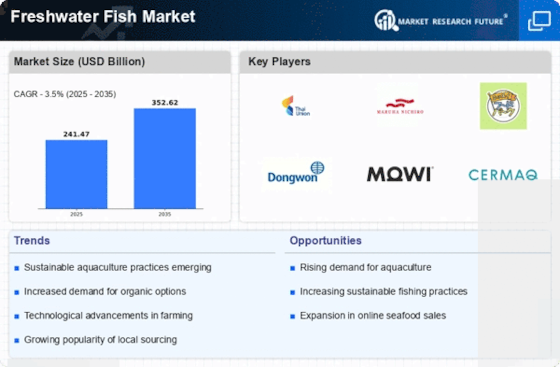
As per Market Research Future analysis, the Freshwater Fish Market Size was estimated at 241.47 USD Billion in 2024. The Freshwater Fish industry is projected to grow from 249.93 USD Billion in 2025 to 352.62 USD Billion by 2035, exhibiting a compound annual growth rate (CAGR) of 3.5% during the forecast period 2025 - 2035

Key Market Trends & Highlights

The Freshwater Fish Market is experiencing robust growth driven by health trends and sustainability.

  • Health consciousness is significantly driving demand for freshwater fish, particularly in North America. Sustainable aquaculture practices are becoming increasingly vital in the Asia-Pacific region, reflecting a global shift towards eco-friendly sourcing. Tilapia remains the largest segment in the market, while catfish is emerging as the fastest-growing option among consumers. Rising consumer demand for freshwater fish and technological advancements in aquaculture are key drivers propelling market expansion.

Market Size & Forecast

2024 Market Size 241.47 (USD Billion)
2035 Market Size 352.62 (USD Billion)
CAGR (2025 - 2035) 3.5%
Largest Regional Market Share in 2024 Asia Pacific

Major Players

Thai Union Group (TH), Maruha Nichiro Corporation (JP), Nissui (JP), Dongwon Industries (KR), Mowi ASA (NO), Cermaq Group AS (NO), Grieg Seafood ASA (NO), SalMar ASA (NO), Blue Star Group (IL)

Market Trends

The Freshwater Fish Market is currently experiencing a dynamic evolution, driven by various factors that influence consumer preferences and industry practices. Increasing awareness regarding health benefits associated with freshwater fish consumption appears to be a primary driver, as more individuals seek nutritious dietary options. Additionally, the rise in aquaculture practices has contributed to a more stable supply chain, allowing for consistent availability of various species. This shift towards sustainable farming methods may also reflect a growing consumer demand for environmentally friendly products, which could further shape market dynamics and influence freshwater fish marketing strategies globally.

Moreover, the Freshwater Fish Market seems to be adapting to changing culinary trends, with an increasing emphasis on diverse preparation methods and flavors. As global cuisines continue to merge, the incorporation of freshwater fish into various dishes is likely to expand. This trend may be bolstered by the influence of social media, where food presentation and innovative recipes gain traction. Overall, the Freshwater Fish Market is poised for growth, with evolving consumer preferences and sustainable practices at the forefront of its development, as highlighted by ongoing freshwater fish market analysis.

Health Consciousness Driving Demand

The rising awareness of health benefits associated with freshwater fish consumption is influencing market dynamics. Consumers are increasingly seeking nutritious options, which may lead to higher demand for various fish species and positively impact the overall freshwater fish market size.

Sustainable Aquaculture Practices

The shift towards sustainable aquaculture is reshaping the Freshwater Fish Market. This trend indicates a commitment to environmentally friendly practices, potentially enhancing supply chain stability and product availability while strengthening global freshwater fish market share.

Culinary Innovation and Diversity

The Freshwater Fish Market is witnessing a surge in culinary innovation, as diverse preparation methods and global flavors gain popularity. This trend suggests that freshwater fish is becoming a versatile ingredient in various cuisines, creating new opportunities for freshwater fish marketing.

Freshwater Fish Market Market Drivers

Increased Focus on Sustainability

Sustainability is becoming a central theme within the Freshwater Fish Market, as consumers and producers alike prioritize environmentally responsible practices. The demand for sustainably sourced fish is on the rise, with consumers increasingly seeking certifications that indicate responsible farming practices. This trend is reflected in market data, which shows that sales of certified sustainable seafood have grown by approximately 25% in the last three years. Producers are responding by adopting practices that minimize environmental impact, such as integrated multi-trophic aquaculture, which promotes biodiversity and resource efficiency. This increased focus on sustainability is likely to shape the future of the Freshwater Fish Market, as it aligns with consumer values and regulatory expectations.

Expansion of Distribution Channels

The Freshwater Fish Market is witnessing an expansion of distribution channels, which is facilitating greater access to freshwater fish products. Retailers are increasingly diversifying their offerings by including fresh, frozen, and processed fish in their inventory. E-commerce platforms are also emerging as significant players, allowing consumers to purchase fish directly from producers. This shift is supported by market data indicating that online sales of seafood have surged by over 20% in recent years. As distribution channels continue to evolve, they are likely to enhance the visibility and availability of freshwater fish, thereby stimulating demand and contributing to the overall growth of the Freshwater Fish Market.

Technological Advancements in Aquaculture

Technological innovations are playing a pivotal role in shaping the Freshwater Fish Market. Advances in aquaculture technology, such as recirculating aquaculture systems and automated feeding systems, are enhancing production efficiency and sustainability. These technologies not only improve fish growth rates but also reduce the environmental impact of fish farming. For instance, the implementation of biofloc technology has been shown to increase yields by up to 30% while minimizing water usage. As these technologies become more widely adopted, they are expected to drive growth in the Freshwater Fish Market, enabling producers to meet the increasing demand for high-quality fish products while maintaining ecological balance.

Rising Consumer Demand for Freshwater Fish

The Freshwater Fish Market is experiencing a notable increase in consumer demand, driven by a growing awareness of the health benefits associated with fish consumption. As consumers become more health-conscious, they are increasingly seeking protein sources that are low in fat and high in omega-3 fatty acids. This trend is reflected in market data, which indicates that the consumption of freshwater fish has risen by approximately 15% over the past five years. Additionally, the shift towards more sustainable and environmentally friendly food sources is influencing purchasing decisions, as consumers prefer fish that are sourced from responsible aquaculture practices. This rising demand is likely to propel the Freshwater Fish Market forward, as producers adapt to meet the evolving preferences of health-oriented consumers.

Culinary Trends Influencing Freshwater Fish Consumption

Culinary trends are significantly influencing the Freshwater Fish Market, as chefs and home cooks alike explore diverse ways to prepare and present fish dishes. The rise of global cuisine has led to an increased interest in various freshwater fish species, which are being incorporated into traditional and contemporary recipes. Market data suggests that the popularity of freshwater fish in gourmet cooking has contributed to a 10% increase in sales over the past year. Additionally, the growing trend of plant-based diets is prompting chefs to create innovative dishes that feature freshwater fish as a complement to plant-based ingredients. This culinary evolution is likely to enhance the appeal of freshwater fish, driving further growth in the Freshwater Fish Market.

Market Segment Insights

By Species: Tilapia (Largest) vs. Catfish (Fastest-Growing)

In the Freshwater Fish Market, the species segment showcases a diverse range of fish, with Tilapia holding the largest market share. This species is favored for its mild flavor and adaptability in various environmental conditions, which contributes to its widespread popularity among consumers and retailers. Catfish follows closely in preference, noted for its firm flesh and ability to thrive in different farming systems, making it a key player as well. Other species, like Trout, Carp, and Bass, have niche markets that cater to specific consumer tastes and regional preferences, yet they do not achieve the same scale as Tilapia and Catfish. The growth trends in this segment are influenced by increasing consumer awareness regarding the health benefits of consuming fish, particularly those rich in omega-3 fatty acids. Additionally, sustainable aquaculture practices and advancements in fish farming technology are driving the rise of fast-growing species like Catfish. As more consumers seek local sourcing for their seafood, the demand for freshwater fish is expected to grow, positioning Tilapia as a steady leader while empowering emerging segments like Catfish to capture an expanding market share.

Tilapia (Dominant) vs. Catfish (Emerging)

Tilapia is recognized as the dominant species in the Freshwater Fish Market, celebrated for its versatility, rapid growth rates, and the ability to thrive in various farming conditions. Its mild taste appeals to a broad audience, making it a staple in both home kitchens and commercial settings. Meanwhile, Catfish is considered an emerging species that is rapidly gaining market traction due to its distinct flavor and desirable texture. Farmed extensively in regions with suitable wetland environments, Catfish is becoming increasingly popular with health-conscious consumers. It has also benefited from improved farming technologies and sustainable practices, further enhancing its position. Together, these two species illustrate the dynamic nature of the freshwater fish industry, combining established dominance with fresh opportunities for growth.

By Sales Channel: Supermarkets (Largest) vs. Online Retail (Fastest-Growing)

In the Freshwater Fish Market, the sales channel distribution reveals that supermarkets hold the largest market share, prominently serving consumers looking for convenience and freshness. They offer a wide variety of freshwater fish, attracting a significant number of shoppers. In contrast, online retail is witnessing a rapid emergence, catering to a tech-savvy consumer base that favors the convenience of home delivery and the ability to compare products easily. This shift is slowly transforming traditional shopping behaviors.

Supermarkets: Dominant vs. Online Retail: Emerging

Supermarkets represent the dominant sales channel in the Freshwater Fish Market, benefiting from established logistics and a strong physical presence. They are characterized by significant foot traffic, offering fresher products and a broad selection that appeals to families and bulk buyers. Conversely, online retail is becoming an emerging channel, with innovative platforms enhancing user experience through seamless browsing and delivery options. The online segment's growth is driven by consumer demand for convenience, increased comfort in online shopping, and promotional offers that attract new customers. As the digital shopping landscape expands, online retail is positioning itself to compete aggressively against traditional supermarkets.

By End Use: Food Service (Largest) vs. Retail (Fastest-Growing)

In the Freshwater Fish Market, the distribution of market share among the end-use segments reveals that the food service sector holds a significant portion of the total market. This segment includes restaurants, hotels, and <a href="https://www.marketresearchfuture.com/reports/catering-services-market-23311" target="_blank" rel="noopener">catering services</a>, which collectively account for a major part of the demand for freshwater fish. Retail, while smaller in share, is rapidly increasing as consumers become more interested in cooking and consuming fish at home, leading to a noteworthy rise in the market share for this segment. The growth trends within the freshwater fish market's end-use segments are heavily influenced by changing consumer preferences and dietary habits. The food service sector is benefiting from a rise in demand for sustainable and high-quality seafood offerings, while the retail segment is experiencing a surge due to increased health consciousness among consumers. Retail outlets are adapting to meet this demand with more fresh fish options and convenient packaging, thus driving the overall growth of this segment.

Food Service (Dominant) vs. Processing (Emerging)

In the Freshwater Fish Market, the food service segment is currently the dominant player, characterized by its stable demand and strong relationships with suppliers. This segment benefits from a consistent customer base in restaurants and <a href="https://www.marketresearchfuture.com/reports/catering-services-market-23311" target="_blank" rel="noopener">catering services</a>, which prioritize quality and variety in freshwater fish. On the other hand, the processing segment is emerging as a key player due to growing innovations in fish processing techniques and increasing consumer demand for value-added fish products. The shift towards processed fish products is driven by convenience and longer shelf life, appealing to both retailers and consumers. As these two segments interact, food service continues to shape trends, while processing adapts to provide products that meet contemporary demands.

By Form: Live (Largest) vs. Frozen (Fastest-Growing)

In the Freshwater Fish Market, the 'Form' segment is crucial, with various product types playing significant roles. Currently, 'Live fish' dominate this segment, representing a substantial portion of consumer preferences due to their freshness and perceived quality. Alongside this, 'Frozen fish' are emerging as an important alternative, appealing to consumers looking for convenience and longer shelf life, which contributes to their growing market share.

Live (Dominant) vs. Frozen (Emerging)

The 'Live' freshwater fish segment is characterized by its strong connection to freshness and quality, appealing to consumers who prioritize taste and nutritional value. This segment thrives in markets where live fish can be easily sourced, such as local fisheries and markets. Conversely, the 'Frozen' segment is gaining traction, providing consumers with a practical option that retains flavor and nutrition while offering extended usability. The convenience of frozen fish aligns with the modern consumer's busy lifestyle, allowing for quick meal preparations without compromising on quality. This growing preference indicates a shift in consumer behavior, with frozen fish increasingly viewed as a staple in households.

Get more detailed insights about Freshwater Fish Market Research Report – Forecast till 2035

Regional Insights

North America : Market Leader in Consumption

North America is the largest market for freshwater fish, accounting for approximately 40% of global consumption. The region's growth is driven by increasing health consciousness among consumers, leading to higher demand for protein-rich diets. Regulatory support for sustainable fishing practices and aquaculture is also a significant catalyst for market expansion. The U.S. and Canada are the primary contributors to this market, with a growing trend towards locally sourced fish products. The competitive landscape in North America features key players such as Thai Union Group and Dongwon Industries, alongside local producers. The presence of advanced aquaculture technologies and stringent quality standards enhances the market's appeal. Additionally, the rise of e-commerce platforms for seafood distribution is reshaping consumer purchasing behaviors, further solidifying North America's position in the freshwater fish market.

Europe : Sustainable Practices in Focus

Europe is the second-largest market for freshwater fish, holding approximately 30% of the global share. The region's growth is propelled by a strong emphasis on sustainability and environmental regulations, which encourage responsible fishing and aquaculture practices. The European Union's Common Fisheries Policy plays a crucial role in shaping market dynamics, ensuring the long-term viability of fish stocks and ecosystems. Consumer preferences are shifting towards sustainably sourced products, driving demand. Leading countries in this market include Norway, Sweden, and the Netherlands, with significant contributions from local aquaculture. Key players such as Mowi ASA and Cermaq Group are at the forefront of sustainable practices, enhancing their competitive edge. The market is characterized by innovation in fish farming techniques and a growing focus on traceability, ensuring consumers are informed about the origins of their seafood products.

Asia-Pacific : Emerging Market with High Potential

Asia-Pacific is an emerging powerhouse in the freshwater fish market, accounting for approximately 25% of global consumption. The region's growth is driven by rising disposable incomes, urbanization, and a growing population that demands affordable protein sources. Countries like China and India are leading this trend, with significant investments in aquaculture and fish farming technologies. Regulatory frameworks are evolving to support sustainable practices, further enhancing market potential. China is the largest producer and consumer of freshwater fish, followed by India and Indonesia. The competitive landscape is marked by both large-scale aquaculture operations and small-scale fish farms. Key players such as Nissui and Maruha Nichiro Corporation are expanding their presence in the region, capitalizing on the increasing demand for freshwater fish products. The market is also witnessing a rise in exports, driven by the growing global appetite for Asian seafood products.

Middle East and Africa : Untapped Market Opportunities

The Middle East and Africa represent a resource-rich frontier for the freshwater fish market, holding approximately 5% of global consumption. The region's growth is fueled by increasing investments in aquaculture and a rising demand for fish as a protein source. Countries like Egypt and South Africa are leading the charge, with government initiatives aimed at boosting local fish production and reducing reliance on imports. Regulatory frameworks are gradually improving to support sustainable practices in aquaculture. The competitive landscape is characterized by a mix of local and international players, with opportunities for growth in both production and distribution. Key players such as Blue Star Group are making strides in the market, focusing on innovative farming techniques and sustainable practices. The region's diverse ecosystems offer significant potential for expanding freshwater fish farming, catering to both local and export markets.

Key Players and Competitive Insights

The Freshwater Fish Market is currently characterized by a dynamic competitive landscape, driven by increasing consumer demand for sustainable and high-quality seafood products. Key players are actively engaging in various strategies to enhance their market positioning, including innovation in aquaculture practices, regional expansion, and digital transformation initiatives. Companies such as Thai Union Group (TH), Maruha Nichiro Corporation (JP), and Mowi ASA (NO) are at the forefront of these efforts, each leveraging their unique strengths to shape the competitive environment. Thai Union Group (TH) focuses on sustainability and product innovation, while Maruha Nichiro Corporation (JP) emphasizes strategic partnerships to enhance its supply chain capabilities. Mowi ASA (NO) is investing heavily in technology to optimize production processes, which collectively influences the market dynamics by fostering a more competitive and responsive industry.The Freshwater Fish Market exhibits a moderately fragmented structure, with several key players vying for market share. Companies are increasingly localizing manufacturing and optimizing supply chains to meet regional demands and reduce operational costs. This competitive structure allows for a diverse range of products and services, catering to varying consumer preferences. The collective influence of these major players is significant, as they not only drive innovation but also set industry standards that smaller competitors often follow.
In August Mowi ASA (NO) announced the launch of a new aquaculture technology aimed at enhancing fish health and growth rates. This strategic move is pivotal as it positions Mowi as a leader in sustainable aquaculture practices, potentially increasing its market share and reinforcing its commitment to environmental stewardship. The introduction of such technology may also serve to attract environmentally conscious consumers, thereby aligning with current market trends.
In September Maruha Nichiro Corporation (JP) entered into a strategic partnership with a leading technology firm to develop AI-driven supply chain solutions. This collaboration is likely to enhance operational efficiency and reduce waste, which is crucial in the highly competitive seafood market. By integrating advanced technology into its supply chain, Maruha Nichiro aims to improve product traceability and quality assurance, which are increasingly important to consumers.
In July Thai Union Group (TH) expanded its operations in Southeast Asia by acquiring a local aquaculture company. This acquisition is strategically significant as it allows Thai Union to strengthen its foothold in a rapidly growing market, while also diversifying its product offerings. The move reflects a broader trend of consolidation within the industry, as companies seek to enhance their competitive edge through strategic acquisitions.
As of October the Freshwater Fish Market is witnessing a shift towards digitalization, sustainability, and the integration of AI technologies. These trends are reshaping the competitive landscape, as companies increasingly prioritize innovation over traditional price-based competition. Strategic alliances are becoming more prevalent, enabling firms to leverage shared resources and expertise. Looking ahead, competitive differentiation will likely evolve, with a greater emphasis on technological advancements and supply chain reliability, positioning companies to better meet the demands of a discerning consumer base.

Key Companies in the Freshwater Fish Market include

Industry Developments

Recent developments in the Global Freshwater Fish Market indicate significant activity driven by increased demand for sustainable seafood options and environmental concerns. Companies like Thai Union Group and Mowi ASA have been focusing on improving their aquaculture practices to enhance sustainability. The market has also seen a surge in investments in technology, with AquaBounty Technologies innovating in genetically modified organisms to increase yield efficiency.

In terms of mergers and acquisitions, Maruha Nichiro Corporation acquired a smaller seafood company in February 2023 to broaden its product portfolio, while Royal Greenland's partnership with Pacific Seafood in March 2023 aims to strengthen its market position in North America. The market valuation has been influenced positively by rising consumer preferences for high-quality, locally sourced fish, especially during the pandemic recovery phase in 2021. This increasing valuation reflects substantial growth as major players like Trident Seafoods and Dongwon Industries expand their production capacities.

As sustainability and traceability become paramount in consumer buying decisions, the Global Freshwater Fish Market is responding with innovative practices and strategic alliances targeting both operational efficiency and environmental responsibility.


Future Outlook

Freshwater Fish Market Future Outlook

The Freshwater Fish Market is projected to grow at a 3.5% CAGR from 2025 to 2035, driven by increasing consumer demand and sustainable aquaculture practices.

New opportunities lie in:

  • <p>Expansion of online seafood retail platforms Investment in aquaculture technology for efficiency Development of value-added freshwater fish products</p>

By 2035, the market is expected to achieve robust growth, reflecting evolving consumer preferences and sustainable practices.

Market Segmentation

Freshwater Fish Market Form Outlook

  • Live
  • Fresh
  • Frozen
  • Canned

Freshwater Fish Market End Use Outlook

  • Food Service
  • Retail
  • Processing

Freshwater Fish Market Species Outlook

  • Tilapia
  • Catfish
  • Trout
  • Carp
  • Bass

Freshwater Fish Market Sales Channel Outlook

  • Supermarkets
  • Online Retail
  • Fish Markets
  • Wholesale

Report Scope

MARKET SIZE 2024 241.47(USD Billion)
MARKET SIZE 2025 249.93(USD Billion)
MARKET SIZE 2035 352.62(USD Billion)
COMPOUND ANNUAL GROWTH RATE (CAGR) 3.5% (2025 - 2035)
REPORT COVERAGE Revenue Forecast, Competitive Landscape, Growth Factors, and Trends
BASE YEAR 2024
Market Forecast Period 2025 - 2035
Historical Data 2019 - 2024
Market Forecast Units USD Billion
Key Companies Profiled Thai Union Group (TH), Maruha Nichiro Corporation (JP), Nissui (JP), Dongwon Industries (KR), Mowi ASA (NO), Cermaq Group AS (NO), Grieg Seafood ASA (NO), SalMar ASA (NO), Blue Star Group (IL)
Segments Covered Species, Sales Channel, End Use, Form, Regional
Key Market Opportunities Growing consumer demand for sustainable aquaculture practices in the Freshwater Fish Market.
Key Market Dynamics Rising consumer preference for sustainable sourcing drives innovation and competition in the freshwater fish market.
Countries Covered North America, Europe, APAC, South America, MEA

FAQs

What is the current valuation of the Freshwater Fish Market?

<p>The Freshwater Fish Market was valued at 241.47 USD Billion in 2024.</p>

What is the projected market size for the Freshwater Fish Market by 2035?

The market is projected to reach 352.62 USD Billion by 2035.

What is the expected CAGR for the Freshwater Fish Market during the forecast period?

The expected CAGR for the Freshwater Fish Market from 2025 to 2035 is 3.5%.

Which species of freshwater fish are leading in market valuation?

Tilapia, Catfish, and Carp are among the leading species, with valuations of 48.29, 36.11, and 40.0 USD Billion respectively.

How do sales channels impact the Freshwater Fish Market?

Supermarkets dominate the sales channels, with a valuation of 96.59 USD Billion, followed by Fish Markets at 60.74 USD Billion.

What are the key end-use segments in the Freshwater Fish Market?

The key end-use segments include Retail, Processing, and Food Service, with valuations of 90.0, 91.47, and 60.0 USD Billion respectively.

Who are the major players in the Freshwater Fish Market?

Key players include Thai Union Group, Maruha Nichiro Corporation, and Dongwon Industries, among others.

What forms of freshwater fish are available in the market?

The market offers various forms, including Fresh, Frozen, and Canned, with valuations of 80.0, 70.0, and 61.47 USD Billion respectively.

How does the Freshwater Fish Market compare to other seafood markets?

While specific comparisons are not provided, the Freshwater Fish Market's growth trajectory appears robust, with a projected increase in valuation.

What trends are influencing the Freshwater Fish Market in 2025?

Trends such as increased online retail and demand for fresh products are likely shaping the market dynamics in 2025.

  1. SECTION I: EXECUTIVE SUMMARY AND KEY HIGHLIGHTS |
    1. EXECUTIVE SUMMARY | |
      1. Market Overview | |
      2. Key Findings | |
      3. Market Segmentation | |
      4. Competitive Landscape | |
      5. Challenges and Opportunities | |
      6. Future Outlook 2
  2. SECTION II: SCOPING, METHODOLOGY AND MARKET STRUCTURE |
    1. MARKET INTRODUCTION | |
      1. Definition | |
      2. Scope of the study | | |
    2. RESEARCH METHODOLOGY | |
      1. Overview | |
      2. Data Mining | |
      3. Secondary Research | |
      4. Primary Research | | |
      5. Forecasting Model | |
      6. Market Size Estimation | | |
      7. Data Triangulation | |
      8. Validation 3
  3. SECTION III: QUALITATIVE ANALYSIS |
    1. MARKET DYNAMICS | |
      1. Overview | |
      2. Drivers | |
      3. Restraints | |
      4. Opportunities |
    2. MARKET FACTOR ANALYSIS | |
      1. Value chain Analysis | |
      2. Porter's Five Forces Analysis | | |
      3. COVID-19 Impact Analysis | | |
  4. SECTION IV: QUANTITATIVE ANALYSIS |
    1. Food, Beverages & Nutrition, BY Species (USD Billion) | |
      1. Tilapia | |
      2. Catfish | |
      3. Trout | |
      4. Carp | |
      5. Bass |
    2. Food, Beverages & Nutrition, BY Sales Channel (USD Billion) | |
      1. Supermarkets | |
      2. Online Retail | |
      3. Fish Markets | |
      4. Wholesale |
    3. Food, Beverages & Nutrition, BY End Use (USD Billion) | |
      1. Food Service | |
      2. Retail | |
      3. Processing |
    4. Food, Beverages & Nutrition, BY Form (USD Billion) | |
      1. Live | |
      2. Fresh | |
      3. Frozen | |
      4. Canned |
    5. Food, Beverages & Nutrition, BY Region (USD Billion) | |
      1. North America | | |
      2. Europe | | |
      3. APAC | | |
      4. South America | | |
      5. MEA | | |
  5. SECTION V: COMPETITIVE ANALYSIS |
    1. Competitive Landscape | |
      1. Overview | |
      2. Competitive Analysis | |
      3. Market share Analysis | |
      4. Major Growth Strategy in the Food, Beverages & Nutrition | |
      5. Competitive Benchmarking | |
      6. Leading Players in Terms of Number of Developments in the Food, Beverages & Nutrition | |
      7. Key developments and growth strategies | | |
      8. Major Players Financial Matrix | | |
    2. Company Profiles | |
      1. Thai Union Group (TH) | | |
      2. Maruha Nichiro Corporation (JP) | | |
      3. Nissui (JP) | | |
      4. Dongwon Industries (KR) | | |
      5. Mowi ASA (NO) | | |
      6. Cermaq Group AS (NO) | | |
      7. Grieg Seafood ASA (NO) | | |
      8. SalMar ASA (NO) | | |
      9. Blue Star Group (IL) | | |
    3. Appendix | |
      1. References | |
      2. Related Reports 6 LIST OF FIGURES |
    4. MARKET SYNOPSIS |
    5. NORTH AMERICA MARKET ANALYSIS |
    6. US MARKET ANALYSIS BY SPECIES |
    7. US MARKET ANALYSIS BY SALES CHANNEL |
    8. US MARKET ANALYSIS BY END USE |
    9. US MARKET ANALYSIS BY FORM |
    10. CANADA MARKET ANALYSIS BY SPECIES |
    11. CANADA MARKET ANALYSIS BY SALES CHANNEL |
    12. CANADA MARKET ANALYSIS BY END USE |
    13. CANADA MARKET ANALYSIS BY FORM |
    14. EUROPE MARKET ANALYSIS |
    15. GERMANY MARKET ANALYSIS BY SPECIES |
    16. GERMANY MARKET ANALYSIS BY SALES CHANNEL |
    17. GERMANY MARKET ANALYSIS BY END USE |
    18. GERMANY MARKET ANALYSIS BY FORM |
    19. UK MARKET ANALYSIS BY SPECIES |
    20. UK MARKET ANALYSIS BY SALES CHANNEL |
    21. UK MARKET ANALYSIS BY END USE |
    22. UK MARKET ANALYSIS BY FORM |
    23. FRANCE MARKET ANALYSIS BY SPECIES |
    24. FRANCE MARKET ANALYSIS BY SALES CHANNEL |
    25. FRANCE MARKET ANALYSIS BY END USE |
    26. FRANCE MARKET ANALYSIS BY FORM |
    27. RUSSIA MARKET ANALYSIS BY SPECIES |
    28. RUSSIA MARKET ANALYSIS BY SALES CHANNEL |
    29. RUSSIA MARKET ANALYSIS BY END USE |
    30. RUSSIA MARKET ANALYSIS BY FORM |
    31. ITALY MARKET ANALYSIS BY SPECIES |
    32. ITALY MARKET ANALYSIS BY SALES CHANNEL |
    33. ITALY MARKET ANALYSIS BY END USE |
    34. ITALY MARKET ANALYSIS BY FORM |
    35. SPAIN MARKET ANALYSIS BY SPECIES |
    36. SPAIN MARKET ANALYSIS BY SALES CHANNEL |
    37. SPAIN MARKET ANALYSIS BY END USE |
    38. SPAIN MARKET ANALYSIS BY FORM |
    39. REST OF EUROPE MARKET ANALYSIS BY SPECIES |
    40. REST OF EUROPE MARKET ANALYSIS BY SALES CHANNEL |
    41. REST OF EUROPE MARKET ANALYSIS BY END USE |
    42. REST OF EUROPE MARKET ANALYSIS BY FORM |
    43. APAC MARKET ANALYSIS |
    44. CHINA MARKET ANALYSIS BY SPECIES |
    45. CHINA MARKET ANALYSIS BY SALES CHANNEL |
    46. CHINA MARKET ANALYSIS BY END USE |
    47. CHINA MARKET ANALYSIS BY FORM |
    48. INDIA MARKET ANALYSIS BY SPECIES |
    49. INDIA MARKET ANALYSIS BY SALES CHANNEL |
    50. INDIA MARKET ANALYSIS BY END USE |
    51. INDIA MARKET ANALYSIS BY FORM |
    52. JAPAN MARKET ANALYSIS BY SPECIES |
    53. JAPAN MARKET ANALYSIS BY SALES CHANNEL |
    54. JAPAN MARKET ANALYSIS BY END USE |
    55. JAPAN MARKET ANALYSIS BY FORM |
    56. SOUTH KOREA MARKET ANALYSIS BY SPECIES |
    57. SOUTH KOREA MARKET ANALYSIS BY SALES CHANNEL |
    58. SOUTH KOREA MARKET ANALYSIS BY END USE |
    59. SOUTH KOREA MARKET ANALYSIS BY FORM |
    60. MALAYSIA MARKET ANALYSIS BY SPECIES |
    61. MALAYSIA MARKET ANALYSIS BY SALES CHANNEL |
    62. MALAYSIA MARKET ANALYSIS BY END USE |
    63. MALAYSIA MARKET ANALYSIS BY FORM |
    64. THAILAND MARKET ANALYSIS BY SPECIES |
    65. THAILAND MARKET ANALYSIS BY SALES CHANNEL |
    66. THAILAND MARKET ANALYSIS BY END USE |
    67. THAILAND MARKET ANALYSIS BY FORM |
    68. INDONESIA MARKET ANALYSIS BY SPECIES |
    69. INDONESIA MARKET ANALYSIS BY SALES CHANNEL |
    70. INDONESIA MARKET ANALYSIS BY END USE |
    71. INDONESIA MARKET ANALYSIS BY FORM |
    72. REST OF APAC MARKET ANALYSIS BY SPECIES |
    73. REST OF APAC MARKET ANALYSIS BY SALES CHANNEL |
    74. REST OF APAC MARKET ANALYSIS BY END USE |
    75. REST OF APAC MARKET ANALYSIS BY FORM |
    76. SOUTH AMERICA MARKET ANALYSIS |
    77. BRAZIL MARKET ANALYSIS BY SPECIES |
    78. BRAZIL MARKET ANALYSIS BY SALES CHANNEL |
    79. BRAZIL MARKET ANALYSIS BY END USE |
    80. BRAZIL MARKET ANALYSIS BY FORM |
    81. MEXICO MARKET ANALYSIS BY SPECIES |
    82. MEXICO MARKET ANALYSIS BY SALES CHANNEL |
    83. MEXICO MARKET ANALYSIS BY END USE |
    84. MEXICO MARKET ANALYSIS BY FORM |
    85. ARGENTINA MARKET ANALYSIS BY SPECIES |
    86. ARGENTINA MARKET ANALYSIS BY SALES CHANNEL |
    87. ARGENTINA MARKET ANALYSIS BY END USE |
    88. ARGENTINA MARKET ANALYSIS BY FORM |
    89. REST OF SOUTH AMERICA MARKET ANALYSIS BY SPECIES |
    90. REST OF SOUTH AMERICA MARKET ANALYSIS BY SALES CHANNEL |
    91. REST OF SOUTH AMERICA MARKET ANALYSIS BY END USE |
    92. REST OF SOUTH AMERICA MARKET ANALYSIS BY FORM |
    93. MEA MARKET ANALYSIS |
    94. GCC COUNTRIES MARKET ANALYSIS BY SPECIES |
    95. GCC COUNTRIES MARKET ANALYSIS BY SALES CHANNEL |
    96. GCC COUNTRIES MARKET ANALYSIS BY END USE |
    97. GCC COUNTRIES MARKET ANALYSIS BY FORM |
    98. SOUTH AFRICA MARKET ANALYSIS BY SPECIES |
    99. SOUTH AFRICA MARKET ANALYSIS BY SALES CHANNEL |
    100. SOUTH AFRICA MARKET ANALYSIS BY END USE |
    101. SOUTH AFRICA MARKET ANALYSIS BY FORM |
    102. REST OF MEA MARKET ANALYSIS BY SPECIES |
    103. REST OF MEA MARKET ANALYSIS BY SALES CHANNEL |
    104. REST OF MEA MARKET ANALYSIS BY END USE |
    105. REST OF MEA MARKET ANALYSIS BY FORM |
    106. KEY BUYING CRITERIA OF FOOD, BEVERAGES & NUTRITION |
    107. RESEARCH PROCESS OF MRFR |
    108. DRO ANALYSIS OF FOOD, BEVERAGES & NUTRITION |
    109. DRIVERS IMPACT ANALYSIS: FOOD, BEVERAGES & NUTRITION |
    110. RESTRAINTS IMPACT ANALYSIS: FOOD, BEVERAGES & NUTRITION |
    111. SUPPLY / VALUE CHAIN: FOOD, BEVERAGES & NUTRITION |
    112. FOOD, BEVERAGES & NUTRITION, BY SPECIES, 2024 (% SHARE) |
    113. FOOD, BEVERAGES & NUTRITION, BY SPECIES, 2024 TO 2035 (USD Billion) |
    114. FOOD, BEVERAGES & NUTRITION, BY SALES CHANNEL, 2024 (% SHARE) |
    115. FOOD, BEVERAGES & NUTRITION, BY SALES CHANNEL, 2024 TO 2035 (USD Billion) |
    116. FOOD, BEVERAGES & NUTRITION, BY END USE, 2024 (% SHARE) |
    117. FOOD, BEVERAGES & NUTRITION, BY END USE, 2024 TO 2035 (USD Billion) |
    118. FOOD, BEVERAGES & NUTRITION, BY FORM, 2024 (% SHARE) |
    119. FOOD, BEVERAGES & NUTRITION, BY FORM, 2024 TO 2035 (USD Billion) |
    120. BENCHMARKING OF MAJOR COMPETITORS 7 LIST OF TABLES |
    121. LIST OF ASSUMPTIONS | |
      1. |
    122. North America MARKET SIZE ESTIMATES; FORECAST | |
      1. BY SPECIES, 2025-2035 (USD Billion) | |
      2. BY SALES CHANNEL, 2025-2035 (USD Billion) | |
      3. BY END USE, 2025-2035 (USD Billion) | |
      4. BY FORM, 2025-2035 (USD Billion) |
    123. US MARKET SIZE ESTIMATES; FORECAST | |
      1. BY SPECIES, 2025-2035 (USD Billion) | |
      2. BY SALES CHANNEL, 2025-2035 (USD Billion) | |
      3. BY END USE, 2025-2035 (USD Billion) | |
      4. BY FORM, 2025-2035 (USD Billion) |
    124. Canada MARKET SIZE ESTIMATES; FORECAST | |
      1. BY SPECIES, 2025-2035 (USD Billion) | |
      2. BY SALES CHANNEL, 2025-2035 (USD Billion) | |
      3. BY END USE, 2025-2035 (USD Billion) | |
      4. BY FORM, 2025-2035 (USD Billion) |
    125. Europe MARKET SIZE ESTIMATES; FORECAST | |
      1. BY SPECIES, 2025-2035 (USD Billion) | |
      2. BY SALES CHANNEL, 2025-2035 (USD Billion) | |
      3. BY END USE, 2025-2035 (USD Billion) | |
      4. BY FORM, 2025-2035 (USD Billion) |
    126. Germany MARKET SIZE ESTIMATES; FORECAST | |
      1. BY SPECIES, 2025-2035 (USD Billion) | |
      2. BY SALES CHANNEL, 2025-2035 (USD Billion) | |
      3. BY END USE, 2025-2035 (USD Billion) | |
      4. BY FORM, 2025-2035 (USD Billion) |
    127. UK MARKET SIZE ESTIMATES; FORECAST | |
      1. BY SPECIES, 2025-2035 (USD Billion) | |
      2. BY SALES CHANNEL, 2025-2035 (USD Billion) | |
      3. BY END USE, 2025-2035 (USD Billion) | |
      4. BY FORM, 2025-2035 (USD Billion) |
    128. France MARKET SIZE ESTIMATES; FORECAST | |
      1. BY SPECIES, 2025-2035 (USD Billion) | |
      2. BY SALES CHANNEL, 2025-2035 (USD Billion) | |
      3. BY END USE, 2025-2035 (USD Billion) | |
      4. BY FORM, 2025-2035 (USD Billion) |
    129. Russia MARKET SIZE ESTIMATES; FORECAST | |
      1. BY SPECIES, 2025-2035 (USD Billion) | |
      2. BY SALES CHANNEL, 2025-2035 (USD Billion) | |
      3. BY END USE, 2025-2035 (USD Billion) | |
      4. BY FORM, 2025-2035 (USD Billion) |
    130. Italy MARKET SIZE ESTIMATES; FORECAST | |
      1. BY SPECIES, 2025-2035 (USD Billion) | |
      2. BY SALES CHANNEL, 2025-2035 (USD Billion) | |
      3. BY END USE, 2025-2035 (USD Billion) | |
      4. BY FORM, 2025-2035 (USD Billion) |
    131. Spain MARKET SIZE ESTIMATES; FORECAST | |
      1. BY SPECIES, 2025-2035 (USD Billion) | |
      2. BY SALES CHANNEL, 2025-2035 (USD Billion) | |
      3. BY END USE, 2025-2035 (USD Billion) | |
      4. BY FORM, 2025-2035 (USD Billion) |
    132. Rest of Europe MARKET SIZE ESTIMATES; FORECAST | |
      1. BY SPECIES, 2025-2035 (USD Billion) | |
      2. BY SALES CHANNEL, 2025-2035 (USD Billion) | |
      3. BY END USE, 2025-2035 (USD Billion) | |
      4. BY FORM, 2025-2035 (USD Billion) |
    133. APAC MARKET SIZE ESTIMATES; FORECAST | |
      1. BY SPECIES, 2025-2035 (USD Billion) | |
      2. BY SALES CHANNEL, 2025-2035 (USD Billion) | |
      3. BY END USE, 2025-2035 (USD Billion) | |
      4. BY FORM, 2025-2035 (USD Billion) |
    134. China MARKET SIZE ESTIMATES; FORECAST | |
      1. BY SPECIES, 2025-2035 (USD Billion) | |
      2. BY SALES CHANNEL, 2025-2035 (USD Billion) | |
      3. BY END USE, 2025-2035 (USD Billion) | |
      4. BY FORM, 2025-2035 (USD Billion) |
    135. India MARKET SIZE ESTIMATES; FORECAST | |
      1. BY SPECIES, 2025-2035 (USD Billion) | |
      2. BY SALES CHANNEL, 2025-2035 (USD Billion) | |
      3. BY END USE, 2025-2035 (USD Billion) | |
      4. BY FORM, 2025-2035 (USD Billion) |
    136. Japan MARKET SIZE ESTIMATES; FORECAST | |
      1. BY SPECIES, 2025-2035 (USD Billion) | |
      2. BY SALES CHANNEL, 2025-2035 (USD Billion) | |
      3. BY END USE, 2025-2035 (USD Billion) | |
      4. BY FORM, 2025-2035 (USD Billion) |
    137. South Korea MARKET SIZE ESTIMATES; FORECAST | |
      1. BY SPECIES, 2025-2035 (USD Billion) | |
      2. BY SALES CHANNEL, 2025-2035 (USD Billion) | |
      3. BY END USE, 2025-2035 (USD Billion) | |
      4. BY FORM, 2025-2035 (USD Billion) |
    138. Malaysia MARKET SIZE ESTIMATES; FORECAST | |
      1. BY SPECIES, 2025-2035 (USD Billion) | |
      2. BY SALES CHANNEL, 2025-2035 (USD Billion) | |
      3. BY END USE, 2025-2035 (USD Billion) | |
      4. BY FORM, 2025-2035 (USD Billion) |
    139. Thailand MARKET SIZE ESTIMATES; FORECAST | |
      1. BY SPECIES, 2025-2035 (USD Billion) | |
      2. BY SALES CHANNEL, 2025-2035 (USD Billion) | |
      3. BY END USE, 2025-2035 (USD Billion) | |
      4. BY FORM, 2025-2035 (USD Billion) |
    140. Indonesia MARKET SIZE ESTIMATES; FORECAST | |
      1. BY SPECIES, 2025-2035 (USD Billion) | |
      2. BY SALES CHANNEL, 2025-2035 (USD Billion) | |
      3. BY END USE, 2025-2035 (USD Billion) | |
      4. BY FORM, 2025-2035 (USD Billion) |
    141. Rest of APAC MARKET SIZE ESTIMATES; FORECAST | |
      1. BY SPECIES, 2025-2035 (USD Billion) | |
      2. BY SALES CHANNEL, 2025-2035 (USD Billion) | |
      3. BY END USE, 2025-2035 (USD Billion) | |
      4. BY FORM, 2025-2035 (USD Billion) |
    142. South America MARKET SIZE ESTIMATES; FORECAST | |
      1. BY SPECIES, 2025-2035 (USD Billion) | |
      2. BY SALES CHANNEL, 2025-2035 (USD Billion) | |
      3. BY END USE, 2025-2035 (USD Billion) | |
      4. BY FORM, 2025-2035 (USD Billion) |
    143. Brazil MARKET SIZE ESTIMATES; FORECAST | |
      1. BY SPECIES, 2025-2035 (USD Billion) | |
      2. BY SALES CHANNEL, 2025-2035 (USD Billion) | |
      3. BY END USE, 2025-2035 (USD Billion) | |
      4. BY FORM, 2025-2035 (USD Billion) |
    144. Mexico MARKET SIZE ESTIMATES; FORECAST | |
      1. BY SPECIES, 2025-2035 (USD Billion) | |
      2. BY SALES CHANNEL, 2025-2035 (USD Billion) | |
      3. BY END USE, 2025-2035 (USD Billion) | |
      4. BY FORM, 2025-2035 (USD Billion) |
    145. Argentina MARKET SIZE ESTIMATES; FORECAST | |
      1. BY SPECIES, 2025-2035 (USD Billion) | |
      2. BY SALES CHANNEL, 2025-2035 (USD Billion) | |
      3. BY END USE, 2025-2035 (USD Billion) | |
      4. BY FORM, 2025-2035 (USD Billion) |
    146. Rest of South America MARKET SIZE ESTIMATES; FORECAST | |
      1. BY SPECIES, 2025-2035 (USD Billion) | |
      2. BY SALES CHANNEL, 2025-2035 (USD Billion) | |
      3. BY END USE, 2025-2035 (USD Billion) | |
      4. BY FORM, 2025-2035 (USD Billion) |
    147. MEA MARKET SIZE ESTIMATES; FORECAST | |
      1. BY SPECIES, 2025-2035 (USD Billion) | |
      2. BY SALES CHANNEL, 2025-2035 (USD Billion) | |
      3. BY END USE, 2025-2035 (USD Billion) | |
      4. BY FORM, 2025-2035 (USD Billion) |
    148. GCC Countries MARKET SIZE ESTIMATES; FORECAST | |
      1. BY SPECIES, 2025-2035 (USD Billion) | |
      2. BY SALES CHANNEL, 2025-2035 (USD Billion) | |
      3. BY END USE, 2025-2035 (USD Billion) | |
      4. BY FORM, 2025-2035 (USD Billion) |
    149. South Africa MARKET SIZE ESTIMATES; FORECAST | |
      1. BY SPECIES, 2025-2035 (USD Billion) | |
      2. BY SALES CHANNEL, 2025-2035 (USD Billion) | |
      3. BY END USE, 2025-2035 (USD Billion) | |
      4. BY FORM, 2025-2035 (USD Billion) |
    150. Rest of MEA MARKET SIZE ESTIMATES; FORECAST | |
      1. BY SPECIES, 2025-2035 (USD Billion) | |
      2. BY SALES CHANNEL, 2025-2035 (USD Billion) | |
      3. BY END USE, 2025-2035 (USD Billion) | |
      4. BY FORM, 2025-2035 (USD Billion) |
    151. PRODUCT LAUNCH/PRODUCT DEVELOPMENT/APPROVAL | |
      1. |
    152. ACQUISITION/PARTNERSHIP | |

Food, Beverages & Nutrition Market Segmentation

Food, Beverages & Nutrition By Species (USD Billion, 2025-2035)

  • Tilapia
  • Catfish
  • Trout
  • Carp
  • Bass

Food, Beverages & Nutrition By Sales Channel (USD Billion, 2025-2035)

  • Supermarkets
  • Online Retail
  • Fish Markets
  • Wholesale

Food, Beverages & Nutrition By End Use (USD Billion, 2025-2035)

  • Food Service
  • Retail
  • Processing

Food, Beverages & Nutrition By Form (USD Billion, 2025-2035)

  • Live
  • Fresh
  • Frozen
  • Canned
Infographic

Free Sample Request

Kindly complete the form below to receive a free sample of this Report

Get Free Sample

Customer Strories

Compare Licence

×
Features License Type
Single User Multiuser License Enterprise User
Price $4,950 $5,950 $7,250
Maximum User Access Limit 1 User Upto 10 Users Unrestricted Access Throughout the Organization
Free Customization
Direct Access to Analyst
Deliverable Format
Platform Access
Discount on Next Purchase 10% 15% 15%
Printable Versions