×
Request Free Sample ×

Kindly complete the form below to receive a free sample of this Report

* Please use a valid business email

Leading companies partner with us for data-driven Insights

clients tt-cursor
Hero Background
English
Chinese
French
Japanese
Korean
German
Spanish

Food Colorants Market Trends

ID: MRFR/FnB/7340-CR
128 Pages
Snehal Singh
April 2025

Food Colorants Market Size, Share, Industry Trend & Analysis Research Report By Type (Natural Colorants, Synthetic Colorants, Organic Colorants), By Application (Food Beverages, Cosmetics, Pharmaceuticals, Textiles), By Form (Liquid, Powder, Gel), By End Use (Bakery Products, Dairy Products, Confectionery, Meat Products) and By Regional (North America, Europe, South America, Asia Pacific, Middle East and Africa)- Forecast to 2035

Share:
Download PDF ×

We do not share your information with anyone. However, we may send you emails based on your report interest from time to time. You may contact us at any time to opt-out.

Food Colorants Market Infographic
Purchase Options

Market Trends

Key Emerging Trends in the Food Colorants Market

The food colorants market is a dynamic and multifaceted sector influenced by a variety of market dynamics. One of the primary drivers shaping this market is the growing emphasis on visual appeal in the food industry. As consumers increasingly prioritize the aesthetic aspects of food products, food colorants play a pivotal role in enhancing the visual appeal of various items. This demand is not limited to processed foods but extends to a wide range of products, including beverages, confectionery, and baked goods. The vibrant and attractive appearance achieved through the use of food colorants often translates to increased consumer interest and purchasing decisions.

Consumer preferences and trends significantly impact the food colorants market dynamics. In recent years, there has been a noticeable shift towards natural and clean-label products. As a result, there is a growing demand for food colorants derived from natural sources such as fruits, vegetables, and spices. This trend is driven by consumer concerns about synthetic additives and a desire for more transparent and health-conscious food choices. Food manufacturers are responding to these preferences by reformulating their products with natural colorants, influencing the overall landscape of the market.

Regulatory factors also play a crucial role in shaping the dynamics of the food colorants market. Stringent regulations and guidelines govern the use of color additives in food products to ensure consumer safety and prevent misleading representations. Compliance with these regulations requires food manufacturers to stay abreast of the latest developments in food safety standards and adjust their formulations accordingly. Additionally, regulatory changes and updates can impact the approval status of certain colorants, influencing their availability and usage in the market.

Global economic conditions contribute to the market dynamics of food colorants. Economic growth, fluctuations in currency exchange rates, and changes in consumer spending patterns all influence the purchasing power of consumers and, consequently, the demand for food products, including those incorporating colorants. Economic downturns may lead consumers to prioritize essential purchases over discretionary items, affecting the market dynamics of non-essential food colorants.

Technological advancements also play a role in shaping the food colorants market. Innovations in food processing and manufacturing technologies enable the development of stable and vibrant colorants with improved performance characteristics. This drives the adoption of advanced colorant solutions by food manufacturers looking to enhance the visual appeal of their products while maintaining stability and quality throughout the production process.

Competitive forces within the food colorants market contribute to its dynamic nature. The presence of both established and emerging players, each with its unique product portfolios and market strategies, creates a competitive environment. Companies often engage in research and development activities to introduce novel colorants with improved properties, fostering innovation in the market. Mergers, acquisitions, and collaborations are common strategies employed by industry participants to strengthen their market positions and expand their product offerings.

Environmental and sustainability considerations are increasingly influencing the food colorants market dynamics. As consumers become more environmentally conscious, there is a growing demand for sustainable and eco-friendly colorant options. This has led to the development of colorants derived from renewable sources and the implementation of eco-friendly manufacturing processes, aligning with the broader global trend towards sustainability.

Author
Snehal Singh
Assistant Manager - Research

High acumen in analyzing complex macro & micro markets with more than 6 years of work experience in the field of market research. By implementing her analytical skills in forecasting and estimation into market research reports, she has expertise in Packaging, Construction, and Equipment domains. She handles a team size of 20-25 resources and ensures smooth running of the projects, associated marketing activities, and client servicing.

Leave a Comment

FAQs

What is the expected market size of the Global Food Colorants Market in 2024?

The Global Food Colorants Market is expected to be valued at 4.03 billion USD in 2024.

What will be the valuation of the Global Food Colorants Market by 2035?

By 2035, the Global Food Colorants Market is expected to reach a valuation of 5.5 billion USD.

What is the projected CAGR for the Global Food Colorants Market from 2025 to 2035?

The expected CAGR for the Global Food Colorants Market from 2025 to 2035 is 2.87 percent.

Which region is projected to have the largest market share in the Global Food Colorants Market by 2035?

North America is projected to have the largest market share in the Global Food Colorants Market with a value of 1.383 billion USD by 2035.

What is the expected market size for Natural Colorants in 2024?

The market size for Natural Colorants is expected to be 1.2 billion USD in 2024.

What are the key players in the Global Food Colorants Market?

Key players in the Global Food Colorants Market include Kerry Group, McCormick and Company, and Naturex among others.

What is the market size for Synthetic Colorants in 2035?

The market size for Synthetic Colorants is expected to be 2.8 billion USD by 2035.

How much is the market for Organic Colorants valued in 2024?

The market for Organic Colorants is valued at 0.73 billion USD in 2024.

What is the expected market size for Europe in the Global Food Colorants Market by 2035?

Europe's market size is expected to grow to 1.179 billion USD by 2035.

What challenges are faced by the Global Food Colorants Market?

The Global Food Colorants Market faces challenges such as regulatory constraints and shifts in consumer preferences.

Market Summary

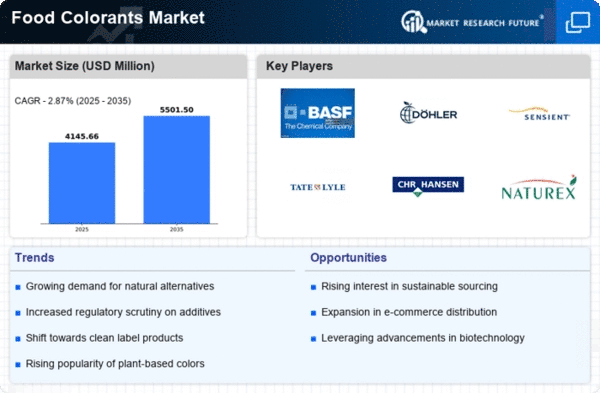
As per MRFR analysis, the Food Colorants Market Size was estimated at 4030.0 USD Million in 2024. The Food Colorants industry is projected to grow from 4145.66 USD Million in 2025 to 5501.5 USD Million by 2035, exhibiting a compound annual growth rate (CAGR) of 2.87 during the forecast period 2025 - 2035.

Key Market Trends & Highlights

The Food Colorants Market is experiencing a notable shift towards natural ingredients and innovative production techniques.

  • The demand for natural colorants is rising, particularly in North America, as consumers increasingly prefer clean label products.
  • Asia-Pacific is emerging as the fastest-growing region, driven by a burgeoning food and beverage sector.
  • The food and beverage segment remains the largest market for colorants, while the cosmetics segment is witnessing rapid growth.
  • Key market drivers include the increasing demand for clean label products and rising awareness of health benefits.

Market Size & Forecast

2024 Market Size 4030.0 (USD Million)
2035 Market Size 5501.5 (USD Million)
CAGR (2025 - 2035) 2.87%
Largest Regional Market Share in 2024 North America

Major Players

BASF SE (DE), Döhler GmbH (DE), Sensient Technologies Corporation (US), Tate & Lyle PLC (GB), Chr. Hansen Holding A/S (DK), Naturex S.A. (FR), Kalsec Inc. (US), FMC Corporation (US), Givaudan SA (CH), Roha Dyechem Pvt. Ltd. (IN)

Market Trends

The Food Colorants Market is currently experiencing a dynamic evolution, driven by a confluence of consumer preferences and regulatory developments. As individuals increasingly seek natural and clean-label products, the demand for plant-based colorants appears to be on the rise. This shift is likely influenced by a growing awareness of health and wellness, prompting manufacturers to reformulate their offerings. Additionally, the market is witnessing innovations in extraction and processing techniques, which may enhance the quality and stability of natural colorants. Furthermore, the expansion of the food and beverage sector, particularly in emerging economies, could provide new opportunities for growth in this market. Moreover, the Food Colorants Market is also shaped by regulatory frameworks that govern the use of synthetic versus natural colorants. As governments and health organizations continue to scrutinize food additives, there seems to be a trend towards stricter regulations, which may compel companies to adapt their product lines accordingly. This regulatory landscape, combined with evolving consumer expectations, suggests that the market will continue to transform, with a potential emphasis on transparency and sustainability. Overall, the Food Colorants Market is poised for significant changes, reflecting broader trends in the food industry and consumer behavior.

Rise of Natural Colorants

There is a noticeable shift towards natural colorants as consumers increasingly prefer products that are perceived as healthier and more environmentally friendly. This trend is likely driven by a growing awareness of the potential health risks associated with synthetic additives.

Regulatory Influence

The Food Colorants Market is significantly impacted by evolving regulations that govern the use of colorants in food products. Stricter guidelines may lead manufacturers to reformulate their offerings, favoring natural alternatives over synthetic options.

Innovation in Extraction Techniques

Advancements in extraction and processing technologies are enhancing the quality and stability of natural colorants. These innovations may enable manufacturers to produce more vibrant and longer-lasting colorants, thereby meeting consumer demands.

Food Colorants Market Market Drivers

Regulatory Support for Food Safety

Regulatory frameworks play a crucial role in shaping the Global Food Colorants Market Industry. Governments worldwide are implementing stringent regulations to ensure food safety and consumer protection. For instance, the European Food Safety Authority (EFSA) and the U.S. Food and Drug Administration (FDA) continuously evaluate food additives, including colorants, to ensure their safety. This regulatory support fosters consumer confidence and encourages manufacturers to invest in compliant colorant solutions. As a result, the industry is likely to witness sustained growth, with projections indicating a market value of 5.5 USD Billion by 2035, reflecting the positive impact of regulatory measures on market dynamics.

Rising Demand for Natural Colorants

The Global Food Colorants Market Industry experiences a notable shift towards natural colorants, driven by consumer preferences for clean-label products. As health-conscious consumers increasingly scrutinize ingredient lists, the demand for natural alternatives to synthetic dyes rises. This trend is reflected in the market's projected growth, with the industry expected to reach 4.03 USD Billion in 2024. Companies are responding by innovating with plant-based colorants derived from sources like beetroot and turmeric, which not only meet consumer expectations but also align with sustainability goals. This transition towards natural colorants is likely to shape the industry's landscape significantly.

Growing Popularity of Functional Foods

The rising trend of functional foods is reshaping the Global Food Colorants Market Industry. Consumers are increasingly seeking foods that offer health benefits beyond basic nutrition, leading to a surge in demand for colorants that also serve functional purposes. For example, colorants derived from superfoods like spirulina not only enhance visual appeal but also provide nutritional benefits. This dual functionality aligns with consumer preferences for health-oriented products, thereby driving market growth. As the industry adapts to these trends, it is likely to see an increase in product offerings that cater to this evolving consumer demand.

Expansion of the Food and Beverage Sector

The continuous expansion of the global food and beverage sector significantly impacts the Global Food Colorants Market Industry. As urbanization and changing lifestyles drive increased consumption of processed foods, the demand for food colorants rises correspondingly. This trend is particularly evident in emerging markets, where a growing middle class seeks diverse and visually appealing food options. The industry's growth is projected to align with this expansion, with estimates suggesting a market value of 4.03 USD Billion in 2024. This correlation highlights the interdependence between food sector growth and the demand for innovative colorant solutions.

Innovations in Food Processing Techniques

Advancements in food processing technologies are significantly influencing the Global Food Colorants Market Industry. Techniques such as microencapsulation and nanotechnology enable the effective use of colorants while enhancing their stability and shelf life. These innovations allow manufacturers to create vibrant and appealing food products without compromising quality. As the industry evolves, the integration of these technologies is expected to drive growth, with a compound annual growth rate (CAGR) of 2.87% projected from 2025 to 2035. This growth trajectory indicates a robust market response to the increasing demand for visually appealing food products.

Market Segment Insights

By Application: Food and Beverage (Largest) vs. Cosmetics (Fastest-Growing)

In the Food Colorants Market, the distribution of application segments shows that Food and Beverage holds the largest share, reflecting a substantial demand for natural and artificial colorants that enhance the aesthetic appeal of food products. This segment benefits from increasing consumer trends towards vibrant food presentation, with colorants being widely used in snacks, beverages, and frozen foods. Following closely, Cosmetics emerge as the fastest-growing segment as beauty and personal care brands increasingly utilize bold and innovative colors to appeal to diverse consumer preferences and trends.

Food and Beverage: Dominant vs. Cosmetics: Emerging

The Food and Beverage segment is characterized by its extensive usage of food colorants to enhance visual appeal and consumer acceptance. It dominates the market as manufacturers favor colors that resonate with health and natural ingredients. In contrast, the Cosmetics segment is emerging rapidly, leveraging trends towards personalized beauty solutions and innovative color application, making it a focal point for research and development. As regulations evolve, both segments are focusing on natural color solutions, driving their respective positions in the market.

By Type: Natural Colorants (Largest) vs. Synthetic Colorants (Fastest-Growing)

The Food Colorants Market is primarily characterized by its division into Natural Colorants, Synthetic Colorants, Lake Colorants, Food Dyes, and Color Additives. Natural Colorants maintain a significant share of the market due to the rising consumer preference for clean labels and health-conscious products. Meanwhile, Synthetic Colorants are also pivotal, appealing to manufacturers looking for cost-effective solutions and stability in varying food applications. As consumers become more aware of ingredient sourcing, the demand for natural options continues to rise alongside the established presence of synthetic alternatives. Recent trends indicate that while Natural Colorants hold a strong market position, Synthetic Colorants are projected to grow rapidly in the coming years. This growth is primarily driven by innovations in food technology and the ability of manufacturers to create vibrant and stable colors that meet diverse consumer needs. Additionally, emerging trends such as customization in food products and a shift towards plant-based diets are likely to impact the market dynamics in favor of specific colorant types.

Natural Colorants (Dominant) vs. Synthetic Colorants (Emerging)

Natural Colorants emerged as the dominant segment within the Food Colorants Market, largely driven by a significant rise in demand for organic and clean-label products. These colorants are derived from natural sources such as plants and minerals, appealing to health-conscious consumers looking for safer alternatives to synthetic additives. On the other hand, Synthetic Colorants are an emerging segment characterized by their ability to provide consistent coloration and extended shelf life. They are favored by manufacturers for their cost-effectiveness and ability to deliver vibrant shades in various food products. Both segments play crucial roles in shaping consumer preferences and are responding to market demands through innovation and sustainability efforts.

By Form: Liquid (Largest) vs. Gel (Fastest-Growing)

In the Food Colorants Market, the 'By Form' segment illustrates a diverse distribution among various types, with liquid colorants leading the market due to their versatility and ease of use. Liquid colorants are favored by manufacturers for their convenience in food processing, allowing for precise color adjustments without impacting texture. In contrast, gel colorants are capturing attention as the fastest-growing segment, appealing to culinary professionals and home cooks who seek vivid, long-lasting colors in desserts and confections.

Liquid (Dominant) vs. Gel (Emerging)

Liquid food colorants dominate the market due to their wide-ranging applications across different food products. Their compatibility with various formulations and straightforward incorporation process make them highly preferred among food manufacturers. On the other hand, gel food colorants are emerging as a popular choice, thanks to their concentrated formula, which requires less product to achieve vibrant colors. This chemical innovation and shift toward clean labeling have spurred gel colorants' growth, particularly in artisanal and specialty food sectors, catering to consumer demand for high-quality, visually appealing products.

By Source: Plant-Based (Largest) vs. Synthetic (Fastest-Growing)

In the Food Colorants Market, the distribution of market share among various sources reveals a clear preference for plant-based colorants, which capture a significant portion of the segment. Plant-based sources are favored for their natural appeal and consumer demand for clean-label products. Meanwhile, synthetic food colorants, although less favored overall, have been gaining traction due to their cost-effectiveness and vibrant hues, appealing to a different segment of manufacturers seeking stability and long shelf-life for their products.

Plant-Based (Dominant) vs. Synthetic (Emerging)

Plant-based food colorants dominate the market, thanks to growing health consciousness and the 'natural' trend among consumers. These colorants, derived from fruits, vegetables, and herbs, offer a wide range of hues and are perceived as safer and healthier alternatives. Conversely, synthetic colorants are emerging as a viable option for certain applications due to their affordability and consistency in color performance. While synthetic options may face scrutiny on health grounds, advancements in technology are driving innovation, making them more appealing to manufacturers who value efficiency and cost without compromising on quality.

Get more detailed insights about Food Colorants Market Research Report - Forecast till 2035

Regional Insights

Europe : Regulatory Focus on Safety

Europe's food colorants market, valued at 1200.0 million, is shaped by stringent regulations and a growing preference for natural ingredients. The European Food Safety Authority (EFSA) plays a crucial role in ensuring that food colorants meet safety standards, which drives innovation and compliance among manufacturers. The increasing demand for clean-label products is also a significant growth driver, as consumers become more aware of ingredient transparency. Leading countries in this region include Germany, France, and the UK, where major players like BASF and Chr. Hansen operate. The competitive landscape is marked by a focus on sustainability and innovation, with companies investing in research to develop new, safer colorants. The presence of a robust regulatory framework ensures that only high-quality products reach the market, fostering consumer trust and brand loyalty.

Asia-Pacific : Emerging Market Potential

The Asia-Pacific region, with a market size of 700.0 million, is witnessing rapid growth in the food colorants sector. This growth is driven by increasing urbanization, rising disposable incomes, and a shift towards processed foods. Additionally, the region's diverse culinary traditions create a demand for a variety of colorants, both synthetic and natural, catering to local tastes and preferences. Regulatory bodies are gradually implementing standards to ensure product safety, further boosting market confidence. Countries like China and India are at the forefront of this growth, with a burgeoning food and beverage industry. Key players such as Naturex and Kalsec are expanding their operations to tap into this potential. The competitive landscape is evolving, with both local and international companies striving to innovate and meet the diverse needs of consumers in this dynamic market.

Middle East and Africa : Untapped Market Opportunities

The Middle East and Africa region, valued at 115.0 million, presents significant growth potential in the food colorants market. The increasing demand for processed and packaged foods, driven by a growing population and urbanization, is a key growth driver. Additionally, the region's diverse culinary practices create a unique demand for various colorants, both natural and synthetic. Regulatory frameworks are gradually evolving to ensure product safety and quality, which is essential for market growth. Leading countries in this region include South Africa and the UAE, where the food and beverage industry is expanding rapidly. The competitive landscape features both local and international players, with companies like Tate & Lyle and FMC Corporation looking to establish a stronger presence. As consumer awareness regarding food quality increases, the demand for safe and appealing food colorants is expected to rise significantly.

Key Players and Competitive Insights

The Food Colorants Market is currently characterized by a dynamic competitive landscape, driven by increasing consumer demand for natural and clean-label products. Key players are actively engaging in innovation and strategic partnerships to enhance their market presence. For instance, BASF SE (DE) has been focusing on expanding its portfolio of natural colorants, aligning with the growing trend towards sustainability. Similarly, Chr. Hansen Holding A/S (DK) emphasizes its commitment to natural solutions, leveraging its expertise in fermentation technology to develop innovative colorants that meet consumer preferences for health-conscious products. These strategies collectively shape a competitive environment that is increasingly focused on sustainability and innovation.In terms of business tactics, companies are localizing manufacturing and optimizing supply chains to enhance efficiency and responsiveness to market demands. The competitive structure of the Food Colorants Market appears moderately fragmented, with several key players exerting influence. This fragmentation allows for niche players to thrive, while larger companies leverage their scale to drive innovation and expand their market share.

In November Sensient Technologies Corporation (US) announced the launch of a new line of plant-based colorants aimed at the beverage industry. This strategic move is significant as it not only addresses the rising consumer preference for natural ingredients but also positions Sensient as a leader in the rapidly evolving beverage sector. The introduction of these colorants is likely to enhance their competitive edge and attract new customers seeking clean-label options.

In October Tate & Lyle PLC (GB) entered into a partnership with a leading food manufacturer to co-develop innovative color solutions that enhance product appeal while maintaining clean-label standards. This collaboration underscores Tate & Lyle's strategy to integrate sustainability into its product offerings, potentially increasing its market share in the food sector. Such partnerships are indicative of a broader trend where companies are aligning with manufacturers to create tailored solutions that meet specific consumer demands.

In December Givaudan SA (CH) announced its investment in advanced AI technologies to streamline its colorant development processes. This initiative reflects a growing trend towards digitalization within the industry, as companies seek to enhance efficiency and reduce time-to-market for new products. The integration of AI is likely to provide Givaudan with a competitive advantage, enabling it to respond more swiftly to market changes and consumer preferences.

As of December the Food Colorants Market is witnessing trends such as digitalization, sustainability, and the integration of AI technologies. Strategic alliances are increasingly shaping the competitive landscape, allowing companies to pool resources and expertise to innovate more effectively. Looking ahead, competitive differentiation is expected to evolve, with a shift from price-based competition towards innovation, technology, and supply chain reliability. This transition may redefine how companies position themselves in the market, emphasizing the importance of sustainable practices and advanced technologies in meeting consumer expectations.

Key Companies in the Food Colorants Market include

Industry Developments

Recent developments in the Food Colorants Market indicate a heightened focus on natural and organic colorants, reflecting consumer demand for healthier food options. Companies such as Kerry Group and Givaudan are increasingly investing in Research and Development to innovate products that meet these demands. In terms of mergers and acquisitions, October 2023 saw Naturex acquiring a smaller competitor to enhance its portfolio in natural colorants, supported by multiple industry sources. The market has exhibited significant growth, with Sensient Technologies reporting a 15% increase in revenue in Q2 2023, driven by demand for vibrant food colors. 

Additionally, the trend toward plant-based diets is influencing major players like McCormick and Company to expand their natural color offerings, thereby impacting market valuation positively. Moreover, Chr. Hansen is enhancing its sustainable colorants through strategic collaborations, further emphasizing the industry's shift towards eco-friendly practices. 

In the last two to three years, numerous companies have adapted to regulations on synthetic dyes, setting the stage for increased adoption of natural alternatives aligning with global shifts towards sustainability in food production.

Future Outlook

Food Colorants Market Future Outlook

The Food Colorants Market is projected to grow at a 2.87% CAGR from 2025 to 2035, driven by increasing consumer demand for natural ingredients and regulatory support for clean-label products.

New opportunities lie in:

  • Development of innovative plant-based colorants for health-conscious consumers.
  • Expansion into emerging markets with tailored product offerings.
  • Investment in sustainable production technologies to enhance brand reputation.

By 2035, the Food Colorants Market is expected to achieve robust growth, reflecting evolving consumer preferences.

Market Segmentation

Food Colorants Market Form Outlook

  • Liquid
  • Powder
  • Gel
  • Paste
  • Granular

Food Colorants Market Type Outlook

  • Natural Colorants
  • Synthetic Colorants
  • Lake Colorants
  • Food Dyes
  • Color Additives

Food Colorants Market Source Outlook

  • Plant-Based
  • Animal-Based
  • Mineral-Based
  • Synthetic
  • Microbial

Food Colorants Market Application Outlook

  • Food and Beverage
  • Cosmetics
  • Pharmaceuticals
  • Textiles
  • Plastics

Report Scope

MARKET SIZE 20244030.0(USD Million)
MARKET SIZE 20254145.66(USD Million)
MARKET SIZE 20355501.5(USD Million)
COMPOUND ANNUAL GROWTH RATE (CAGR)2.87% (2025 - 2035)
REPORT COVERAGERevenue Forecast, Competitive Landscape, Growth Factors, and Trends
BASE YEAR2024
Market Forecast Period2025 - 2035
Historical Data2019 - 2024
Market Forecast UnitsUSD Million
Key Companies ProfiledBASF SE (DE), Döhler GmbH (DE), Sensient Technologies Corporation (US), Tate & Lyle PLC (GB), Chr. Hansen Holding A/S (DK), Naturex S.A. (FR), Kalsec Inc. (US), FMC Corporation (US), Givaudan SA (CH), Roha Dyechem Pvt. Ltd. (IN)
Segments CoveredApplication, Type, Form, Source
Key Market OpportunitiesGrowing demand for natural food colorants driven by health-conscious consumer preferences and regulatory support.
Key Market DynamicsRising consumer demand for natural food colorants drives innovation and regulatory scrutiny in the food colorants market.
Countries CoveredNorth America, Europe, APAC, South America, MEA

FAQs

What is the expected market size of the Global Food Colorants Market in 2024?

The Global Food Colorants Market is expected to be valued at 4.03 billion USD in 2024.

What will be the valuation of the Global Food Colorants Market by 2035?

By 2035, the Global Food Colorants Market is expected to reach a valuation of 5.5 billion USD.

What is the projected CAGR for the Global Food Colorants Market from 2025 to 2035?

The expected CAGR for the Global Food Colorants Market from 2025 to 2035 is 2.87 percent.

Which region is projected to have the largest market share in the Global Food Colorants Market by 2035?

North America is projected to have the largest market share in the Global Food Colorants Market with a value of 1.383 billion USD by 2035.

What is the expected market size for Natural Colorants in 2024?

The market size for Natural Colorants is expected to be 1.2 billion USD in 2024.

What are the key players in the Global Food Colorants Market?

Key players in the Global Food Colorants Market include Kerry Group, McCormick and Company, and Naturex among others.

What is the market size for Synthetic Colorants in 2035?

The market size for Synthetic Colorants is expected to be 2.8 billion USD by 2035.

How much is the market for Organic Colorants valued in 2024?

The market for Organic Colorants is valued at 0.73 billion USD in 2024.

What is the expected market size for Europe in the Global Food Colorants Market by 2035?

Europe's market size is expected to grow to 1.179 billion USD by 2035.

What challenges are faced by the Global Food Colorants Market?

The Global Food Colorants Market faces challenges such as regulatory constraints and shifts in consumer preferences.

  1. SECTION I: EXECUTIVE SUMMARY AND KEY HIGHLIGHTS
    1. | 1.1 EXECUTIVE SUMMARY
    2. | 1.1.1 Market Overview
    3. | 1.1.2 Key Findings
    4. | 1.1.3 Market Segmentation
    5. | 1.1.4 Competitive Landscape
    6. | 1.1.5 Challenges and Opportunities
    7. | 1.1.6 Future Outlook
  2. SECTION II: SCOPING, METHODOLOGY AND MARKET STRUCTURE
    1. | 2.1 MARKET INTRODUCTION
    2. | 2.1.1 Definition
    3. | 2.1.2 Scope of the study
    4. |-- 2.1.2.1 Research Objective
    5. |-- 2.1.2.2 Assumption
    6. |-- 2.1.2.3 Limitations
    7. | 2.2 RESEARCH METHODOLOGY
    8. | 2.2.1 Overview
    9. | 2.2.2 Data Mining
    10. | 2.2.3 Secondary Research
    11. | 2.2.4 Primary Research
    12. |-- 2.2.4.1 Primary Interviews and Information Gathering Process
    13. |-- 2.2.4.2 Breakdown of Primary Respondents
    14. | 2.2.5 Forecasting Model
    15. | 2.2.6 Market Size Estimation
    16. |-- 2.2.6.1 Bottom-Up Approach
    17. |-- 2.2.6.2 Top-Down Approach
    18. | 2.2.7 Data Triangulation
    19. | 2.2.8 Validation
  3. SECTION III: QUALITATIVE ANALYSIS
    1. | 3.1 MARKET DYNAMICS
    2. | 3.1.1 Overview
    3. | 3.1.2 Drivers
    4. | 3.1.3 Restraints
    5. | 3.1.4 Opportunities
    6. | 3.2 MARKET FACTOR ANALYSIS
    7. | 3.2.1 Value chain Analysis
    8. | 3.2.2 Porter's Five Forces Analysis
    9. |-- 3.2.2.1 Bargaining Power of Suppliers
    10. |-- 3.2.2.2 Bargaining Power of Buyers
    11. |-- 3.2.2.3 Threat of New Entrants
    12. |-- 3.2.2.4 Threat of Substitutes
    13. |-- 3.2.2.5 Intensity of Rivalry
    14. | 3.2.3 COVID-19 Impact Analysis
    15. |-- 3.2.3.1 Market Impact Analysis
    16. |-- 3.2.3.2 Regional Impact
    17. |-- 3.2.3.3 Opportunity and Threat Analysis
  4. SECTION IV: QUANTITATIVE ANALYSIS
    1. | 4.1 Food, Beverages & Nutrition, BY Application (USD Million)
    2. | 4.1.1 Food and Beverage
    3. | 4.1.2 Cosmetics
    4. | 4.1.3 Pharmaceuticals
    5. | 4.1.4 Textiles
    6. | 4.1.5 Plastics
    7. | 4.2 Food, Beverages & Nutrition, BY Type (USD Million)
    8. | 4.2.1 Natural Colorants
    9. | 4.2.2 Synthetic Colorants
    10. | 4.2.3 Lake Colorants
    11. | 4.2.4 Food Dyes
    12. | 4.2.5 Color Additives
    13. | 4.3 Food, Beverages & Nutrition, BY Form (USD Million)
    14. | 4.3.1 Liquid
    15. | 4.3.2 Powder
    16. | 4.3.3 Gel
    17. | 4.3.4 Paste
    18. | 4.3.5 Granular
    19. | 4.4 Food, Beverages & Nutrition, BY Source (USD Million)
    20. | 4.4.1 Plant-Based
    21. | 4.4.2 Animal-Based
    22. | 4.4.3 Mineral-Based
    23. | 4.4.4 Synthetic
    24. | 4.4.5 Microbial
    25. | 4.5 Food, Beverages & Nutrition, BY Region (USD Million)
    26. | 4.5.1 North America
    27. |-- 4.5.1.1 US
    28. |-- 4.5.1.2 Canada
    29. | 4.5.2 Europe
    30. |-- 4.5.2.1 Germany
    31. |-- 4.5.2.2 UK
    32. |-- 4.5.2.3 France
    33. |-- 4.5.2.4 Russia
    34. |-- 4.5.2.5 Italy
    35. |-- 4.5.2.6 Spain
    36. |-- 4.5.2.7 Rest of Europe
    37. | 4.5.3 APAC
    38. |-- 4.5.3.1 China
    39. |-- 4.5.3.2 India
    40. |-- 4.5.3.3 Japan
    41. |-- 4.5.3.4 South Korea
    42. |-- 4.5.3.5 Malaysia
    43. |-- 4.5.3.6 Thailand
    44. |-- 4.5.3.7 Indonesia
    45. |-- 4.5.3.8 Rest of APAC
    46. | 4.5.4 South America
    47. |-- 4.5.4.1 Brazil
    48. |-- 4.5.4.2 Mexico
    49. |-- 4.5.4.3 Argentina
    50. |-- 4.5.4.4 Rest of South America
    51. | 4.5.5 MEA
    52. |-- 4.5.5.1 GCC Countries
    53. |-- 4.5.5.2 South Africa
    54. |-- 4.5.5.3 Rest of MEA
  5. SECTION V: COMPETITIVE ANALYSIS
    1. | 5.1 Competitive Landscape
    2. | 5.1.1 Overview
    3. | 5.1.2 Competitive Analysis
    4. | 5.1.3 Market share Analysis
    5. | 5.1.4 Major Growth Strategy in the Food, Beverages & Nutrition
    6. | 5.1.5 Competitive Benchmarking
    7. | 5.1.6 Leading Players in Terms of Number of Developments in the Food, Beverages & Nutrition
    8. | 5.1.7 Key developments and growth strategies
    9. |-- 5.1.7.1 New Product Launch/Service Deployment
    10. |-- 5.1.7.2 Merger & Acquisitions
    11. |-- 5.1.7.3 Joint Ventures
    12. | 5.1.8 Major Players Financial Matrix
    13. |-- 5.1.8.1 Sales and Operating Income
    14. |-- 5.1.8.2 Major Players R&D Expenditure. 2023
    15. | 5.2 Company Profiles
    16. | 5.2.1 BASF SE (DE)
    17. |-- 5.2.1.1 Financial Overview
    18. |-- 5.2.1.2 Products Offered
    19. |-- 5.2.1.3 Key Developments
    20. |-- 5.2.1.4 SWOT Analysis
    21. |-- 5.2.1.5 Key Strategies
    22. | 5.2.2 Döhler GmbH (DE)
    23. |-- 5.2.2.1 Financial Overview
    24. |-- 5.2.2.2 Products Offered
    25. |-- 5.2.2.3 Key Developments
    26. |-- 5.2.2.4 SWOT Analysis
    27. |-- 5.2.2.5 Key Strategies
    28. | 5.2.3 Sensient Technologies Corporation (US)
    29. |-- 5.2.3.1 Financial Overview
    30. |-- 5.2.3.2 Products Offered
    31. |-- 5.2.3.3 Key Developments
    32. |-- 5.2.3.4 SWOT Analysis
    33. |-- 5.2.3.5 Key Strategies
    34. | 5.2.4 Tate & Lyle PLC (GB)
    35. |-- 5.2.4.1 Financial Overview
    36. |-- 5.2.4.2 Products Offered
    37. |-- 5.2.4.3 Key Developments
    38. |-- 5.2.4.4 SWOT Analysis
    39. |-- 5.2.4.5 Key Strategies
    40. | 5.2.5 Chr. Hansen Holding A/S (DK)
    41. |-- 5.2.5.1 Financial Overview
    42. |-- 5.2.5.2 Products Offered
    43. |-- 5.2.5.3 Key Developments
    44. |-- 5.2.5.4 SWOT Analysis
    45. |-- 5.2.5.5 Key Strategies
    46. | 5.2.6 Naturex S.A. (FR)
    47. |-- 5.2.6.1 Financial Overview
    48. |-- 5.2.6.2 Products Offered
    49. |-- 5.2.6.3 Key Developments
    50. |-- 5.2.6.4 SWOT Analysis
    51. |-- 5.2.6.5 Key Strategies
    52. | 5.2.7 Kalsec Inc. (US)
    53. |-- 5.2.7.1 Financial Overview
    54. |-- 5.2.7.2 Products Offered
    55. |-- 5.2.7.3 Key Developments
    56. |-- 5.2.7.4 SWOT Analysis
    57. |-- 5.2.7.5 Key Strategies
    58. | 5.2.8 FMC Corporation (US)
    59. |-- 5.2.8.1 Financial Overview
    60. |-- 5.2.8.2 Products Offered
    61. |-- 5.2.8.3 Key Developments
    62. |-- 5.2.8.4 SWOT Analysis
    63. |-- 5.2.8.5 Key Strategies
    64. | 5.2.9 Givaudan SA (CH)
    65. |-- 5.2.9.1 Financial Overview
    66. |-- 5.2.9.2 Products Offered
    67. |-- 5.2.9.3 Key Developments
    68. |-- 5.2.9.4 SWOT Analysis
    69. |-- 5.2.9.5 Key Strategies
    70. | 5.2.10 Roha Dyechem Pvt. Ltd. (IN)
    71. |-- 5.2.10.1 Financial Overview
    72. |-- 5.2.10.2 Products Offered
    73. |-- 5.2.10.3 Key Developments
    74. |-- 5.2.10.4 SWOT Analysis
    75. |-- 5.2.10.5 Key Strategies
    76. | 5.3 Appendix
    77. | 5.3.1 References
    78. | 5.3.2 Related Reports

Food, Beverages & Nutrition Market Segmentation

Food, Beverages & Nutrition By Application (USD Million, 2025-2035)

  • Food and Beverage
  • Cosmetics
  • Pharmaceuticals
  • Textiles
  • Plastics

Food, Beverages & Nutrition By Type (USD Million, 2025-2035)

  • Natural Colorants
  • Synthetic Colorants
  • Lake Colorants
  • Food Dyes
  • Color Additives

Food, Beverages & Nutrition By Form (USD Million, 2025-2035)

  • Liquid
  • Powder
  • Gel
  • Paste
  • Granular

Food, Beverages & Nutrition By Source (USD Million, 2025-2035)

  • Plant-Based
  • Animal-Based
  • Mineral-Based
  • Synthetic
  • Microbial
Infographic

Free Sample Request

Kindly complete the form below to receive a free sample of this Report

Get Free Sample

Customer Strories

Compare Licence

×
Features License Type
Single User Multiuser License Enterprise User
Price $4,950 $5,950 $7,250
Maximum User Access Limit 1 User Upto 10 Users Unrestricted Access Throughout the Organization
Free Customization
Direct Access to Analyst
Deliverable Format
Platform Access
Discount on Next Purchase 10% 15% 15%
Printable Versions