Food Cold Chain Market (2026 - 2035)

ID: MRFR/FnB/22969-HCR 111 Pages Pradeep Nandi Last Updated: October 27, 2026
Food Cold Chain Market Size, Share, Industry Trend & Analysis Research Report: By Type (Cold-Chain Storage, Cold-Chain Transport, Cold Chain Monitoring Components), By Temperature Range (Chilled, Frozen, Deep Frozen), By Transport Mode (Road, Sea, Air Cargo, Rail, Intermodal), By Application (Meat and Seafood, Fruits and Vegetables, Dairy and Eggs, Ready-to-Eat Meals, Bakery and Confectionery, Others), By Technology (RFID and Basic Real-Time Monitoring, IoT-Enabled Telematics, Blockchain-Based Traceability, AI/ML-Driven Analytics, Others) - Forecast to 2035
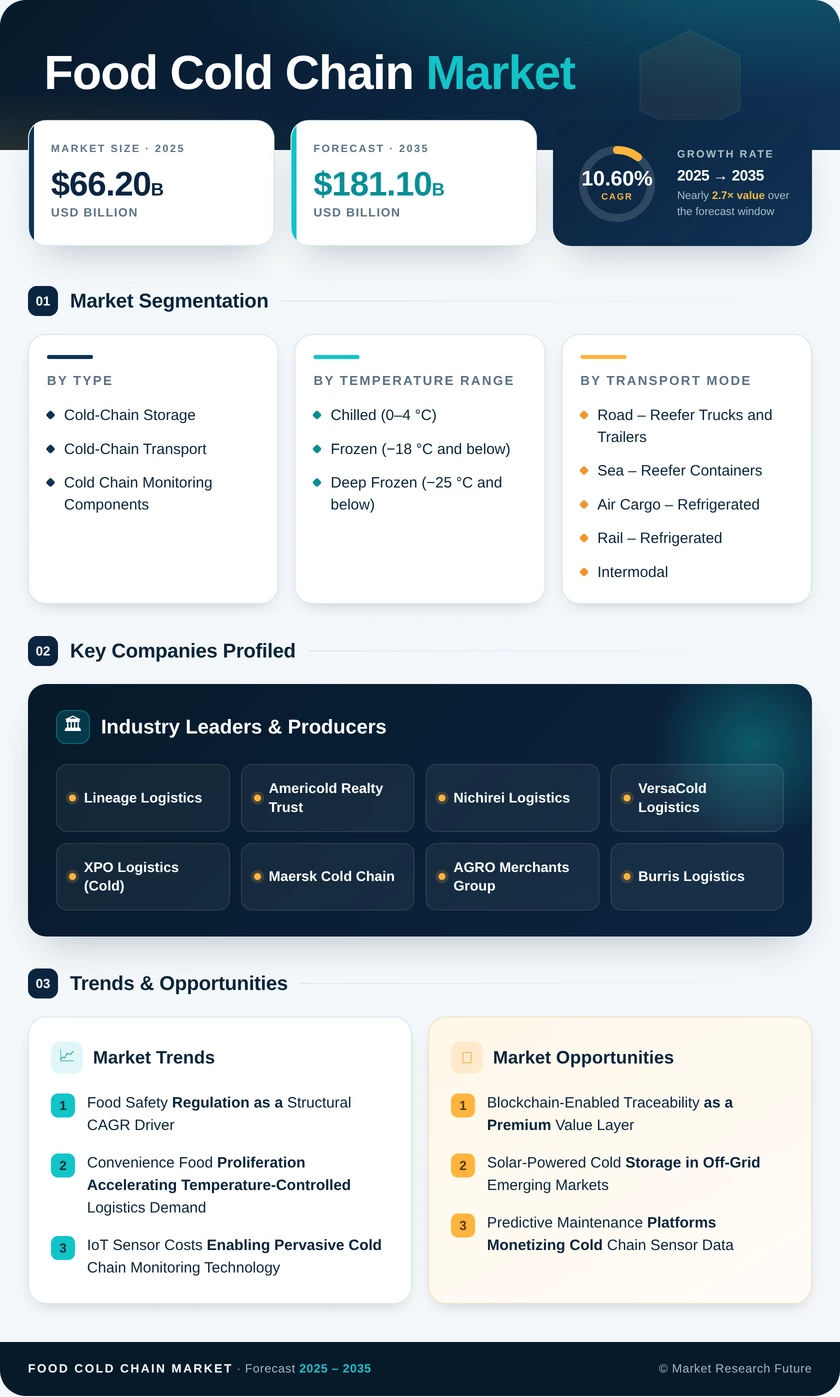
Food Cold Chain Market
Market Size
Forecast Period2026-2035
CAGR (2026-2035)10.60%
2025 Market SizeUSD 66.20 Billion
2035 Market SizeUSD 181.10 Billion
Key Players
Lineage Logistics
Americold Realty Trust
Nichirei Logistics
VersaCold Logistics
XPO Logistics
Maersk Cold Chain
Opportunities
  • Blockchain-Enabled Traceability as a Premium Value Layer
  • Solar-Powered Cold Storage in Off-Grid Emerging Markets
  • Predictive Maintenance Platforms Monetizing Cold Chain Sensor Data
  1. 1 Market Overview |
    1. 1.1 Study Assumptions and Market Definition |
    2. 1.2 Scope of the Study |
    3. 1.3 Research Methodology
  2. 2 Market Summary and Key Takeaways |
    1. 2.1 By Type |
    2. 2.2 By Application |
    3. 2.3 By Geography
  3. 3 Market Dynamics |
    1. 3.1 Market Drivers Analysis | |
      1. 3.1.1 FSMA 204 and Global Food Safety Regulatory Mandates | |
      2. 3.1.2 Convenience Food Proliferation and Ready-to-Eat Meal Demand | |
      3. 3.1.3 IoT and Cold Chain Monitoring Technology Cost Deflation | |
      4. 3.1.4 E-Commerce Grocery and Last-Mile Cold Chain Investment | |
      5. 3.1.5 Emerging-Market Cold Storage Infrastructure Development | |
      6. 3.1.6 International Perishable Goods Trade Expansion | |
      7. 3.1.7 Fleet Electrification and Sustainable Refrigerated Transport |
    2. 3.2 Market Restraints Analysis | |
      1. 3.2.1 High Capital and Operating Costs in Emerging Markets | |
      2. 3.2.2 Energy Price Volatility and Refrigeration Operating Margins | |
      3. 3.2.3 Skilled Technician Shortage for IoT Cold Chain Systems | |
      4. 3.2.4 Fragmented Regulatory Standards Across Trade Corridors | |
      5. 3.2.5 Last-Mile Cold Chain Gaps in Rural and Tier-3 Markets |
    3. 3.3 Market Opportunity Analysis | |
      1. 3.3.1 Blockchain-Enabled Traceability as a Premium Value Layer | |
      2. 3.3.2 Solar-Powered Cold Storage in Off-Grid Emerging Markets | |
      3. 3.3.3 Autonomous Electric Refrigerated Vehicles for Urban Last-Mile | |
      4. 3.3.4 Predictive Maintenance Platforms Monetizing Cold Chain Sensor Data | |
      5. 3.3.5 Pharmaceutical Cold Chain Cross-Selling into Premium Food Networks |
    4. 3.4 Industry Value Chain Analysis |
    5. 3.5 Porter's Five Forces Analysis
  4. 4 Global Food Cold Chain Market Size and Forecast (2021–2035) |
    1. 4.1 Historical Market Size (2021–2025) |
    2. 4.2 Current and Forecast Market Size (2026–2035) |
    3. 4.3 Market Size by Revenue (USD Billion) |
    4. 4.4 Year-over-Year Growth Analysis
  5. 5 Market Segmentation Analysis |
    1. 5.1 By Type | |
      1. 5.1.1 Cold-Chain Storage | |
      2. 5.1.2 Cold-Chain Transport | |
      3. 5.1.3 Cold Chain Monitoring Components |
    2. 5.2 By Temperature Range | |
      1. 5.2.1 Chilled (0–4 °C) | |
      2. 5.2.2 Frozen (−18 °C and below) | |
      3. 5.2.3 Deep Frozen (−25 °C and below) |
    3. 5.3 By Transport Mode | |
      1. 5.3.1 Road – Reefer Trucks and Trailers | |
      2. 5.3.2 Sea–Reefer Containers | |
      3. 5.3.3 Air Cargo – Refrigerated | |
      4. 5.3.4 Rail – Refrigerated | |
      5. 5.3.5 Intermodal |
    4. 5.4 By Application | |
      1. 5.4.1 Meat and Seafood | |
      2. 5.4.2 Fruits and Vegetables | |
      3. 5.4.3 Dairy and Eggs | |
      4. 5.4.4 Ready-to-Eat Meals | |
      5. 5.4.5 Bakery and Confectionery | |
      6. 5.4.6 Others |
    5. 5.5 By Technology | |
      1. 5.5.1 RFID and Basic Real-Time Monitoring | |
      2. 5.5.2 IoT-Enabled Telematics | |
      3. 5.5.3 Blockchain-Based Traceability | |
      4. 5.5.4 AI/ML-Driven Analytics | |
      5. 5.5.5 Others
  6. 6 Regional Analysis |
    1. 6.1 North America | |
      1. 6.1.1 United States | |
      2. 6.1.2 Canada | |
      3. 6.1.3 Mexico |
    2. 6.2 Europe | |
      1. 6.2.1 Germany | |
      2. 6.2.2 United Kingdom | |
      3. 6.2.3 France | |
      4. 6.2.4 Italy | |
      5. 6.2.5 Spain | |
      6. 6.2.6 Nordic Countries | |
      7. 6.2.7 Russia | |
      8. 6.2.8 Rest of Europe |
    3. 6.3 Asia-Pacific | |
      1. 6.3.1 China | |
      2. 6.3.2 India | |
      3. 6.3.3 Japan | |
      4. 6.3.4 South Korea | |
      5. 6.3.5 ASEAN | |
      6. 6.3.6 Rest of Asia-Pacific |
    4. 6.4 South America | |
      1. 6.4.1 Brazil | |
      2. 6.4.2 Argentina | |
      3. 6.4.3 Rest of South America |
    5. 6.5 Middle East and Africa | |
      1. 6.5.1 Saudi Arabia | |
      2. 6.5.2 UAE | |
      3. 6.5.3 South Africa | |
      4. 6.5.4 Egypt | |
      5. 6.5.5 Rest of Middle East and Africa
  7. 7 Competitive Landscape |
    1. 7.1 Market Concentration and Share Analysis (2025) |
    2. 7.2 Competitive Benchmarking Matrix |
    3. 7.3 Company Profiles | |
      1. 7.3.1 Lineage Logistics | |
      2. 7.3.2 Americold Realty Trust | |
      3. 7.3.3 Nichirei Logistics | |
      4. 7.3.4 VersaCold Logistics | |
      5. 7.3.5 XPO Logistics (Cold) | |
      6. 7.3.6 Maersk Cold Chain | |
      7. 7.3.7 AGRO Merchants Group | |
      8. 7.3.8 Burris Logistics | |
      9. 7.3.9 DAIKIN Industries | |
      10. 7.3.10 Sensitech (Carrier Global) | |
      11. 7.3.11 Emerson Electric (Cold Chain)
  8. 8 Future Outlook and Strategic Recommendations (2026–2035) |
    1. 8.1 AI and Autonomous Optimization in Temperature-Controlled Logistics |
    2. 8.2 Platform Economics and Cold Chain Data Monetization |
    3. 8.3 Electrification and Sustainability Mandates Reshaping Refrigerated Transport |
    4. 8.4 ESG Reporting and Scope 3 Emissions Driving Cold Chain Transparency
  9. 9 Recent News and Developments (2023–2025)
  10. 10 Frequently Asked Questions (FAQs)
  11. 11 Report Scope and Methodology |
    1. 11.1 Study Period and Base Year |
    2. 11.2 Data Sources and Citations |
    3. 11.3 Abbreviations
  12. 1 LIST OF TABLES
  13. 2 LIST OF FIGURES

Segmentation Quick Reference

DimensionSub-SegmentsDominant SegmentFastest Growing Segment
By TypeCold-Chain Storage; Cold-Chain Transport; Cold Chain Monitoring ComponentsCold-Chain Storage (54.8% share)Cold Chain Monitoring Components (13.5% CAGR)
By Temperature RangeChilled (0–4 °C); Frozen (−18 °C); Deep Frozen (−25 °C)Chilled (0–4 °C)Frozen (−18 °C and below) (14.4% CAGR)
By Transport ModeRoad – Reefer Trucks and Trailers; Sea – Reefer Containers; Air Cargo; Rail; IntermodalRoad – Reefer Trucks and Trailers (59.4% share)Air Cargo – Refrigerated
By ApplicationMeat and Seafood; Fruits and Vegetables; Dairy and Eggs; Ready-to-Eat Meals; Bakery and Confectionery; OthersMeat and Seafood (25.3% share)Ready-to-Eat Meals (15.4% CAGR)
By Food Cold Chain MarketRFID and Basic Real-Time Monitoring; IoT-Enabled Telematics; Blockchain-Based Traceability; AI/ML-Driven Analytics; OthersRFID and Basic Real-Time Monitoring (40.8% share)IoT-Enabled Telematics (14.7% CAGR)


Market Segmentation Overview

By Type

Sub-SegmentKey Trend
Cold-Chain StorageAutomated warehouse robotics; FSMA-compliant digital logging retrofits
Cold-Chain TransportElectric reefer vehicle adoption; last-mile cold delivery expansion
Cold Chain Monitoring ComponentsIoT sensor cost deflation enabling pallet-level tracking.


Cold-chain storage dominates by revenue, but monitoring components are growing fastest as digital compliance mandates drive retrofit investment across legacy warehouse networks globally.

By Temperature Range

Sub-SegmentKey Trend
Chilled (0–4 °C)Fresh produce safety standards; dairy and prepared meal distribution
Frozen (−18 °C and below)Convenience food growth; quick-commerce micro-fulfillment
Deep Frozen (−25 °C and below)Premium seafood; cell-cultured meat; pharmaceutical cross-utilization


The frozen segment is experiencing a structural demand shift driven by convenience food penetration in urban Asia and the rapid-commerce sector's requirement for frozen SKU availability within 10–15 minute delivery windows.

By Transport Mode

Sub-SegmentKey Trend
Road – Reefer Trucks and TrailersFleet electrification mandates; route optimization AI
Sea – Reefer ContainersGlobal protein trade expansion; port cold hub investment
Air Cargo – RefrigeratedPremium perishables; live seafood; high-value produce
Rail – RefrigeratedChina-Europe cold corridors; India rail cold wagon expansion
IntermodalPort-to-inland cold chain integration; US West Coast corridors


Road remains dominant by volume share, but the intermodal cold chain is gaining traction as operators seek cost efficiencies for long-haul perishable goods distribution between major agricultural production zones and urban consumption centers.

By Application

Sub-SegmentKey Trend
Meat and SeafoodPathogen-control mandates; premium seafood air freight
Fruits and VegetablesFSMA produces rules; organic fresh market growth
Dairy and EggsE-grocery penetration; chilled supply chain density
Ready-to-Eat MealsConvenience trend: QSR and dark-kitchen cold supply chain
Bakery and ConfectioneryPremium chocolate; artisan products; temperature-sensitive gifting
OthersNutraceuticals; beverages; specialty ingredients


Ready-to-eat meals are the application segment most transforming the food cold chain market's infrastructure requirements, as consumer demand for premium convenience foods compresses delivery windows and raises temperature accuracy expectations across the entire perishable goods distribution network.

By Food Cold Chain Market

Sub-SegmentKey Trend
RFID and Basic Real-Time MonitoringCompliance baseline: cost-effective for Tier-2 operators
IoT-Enabled TelematicsPredictive analytics; multi-point wireless sensing
Blockchain-Based TraceabilityRetailer traceability mandates; FSMA 204 compliance.
AI/ML-Driven AnalyticsDemand sensing; spoilage reduction; ESG emissions reporting
OthersSatellite tracking; edge computing; 5G-connected sensors


IoT-enabled telematics is the technology sub-segment most fundamentally changing cold chain operating economics, enabling the transition from reactive temperature management to predictive equipment maintenance and real-time route optimization for refrigerated storage and transport fleets.


 

Download PDF ×

We do not share your information with anyone. However, we may send you emails based on your report interest from time to time. You may contact us at any time to opt-out.