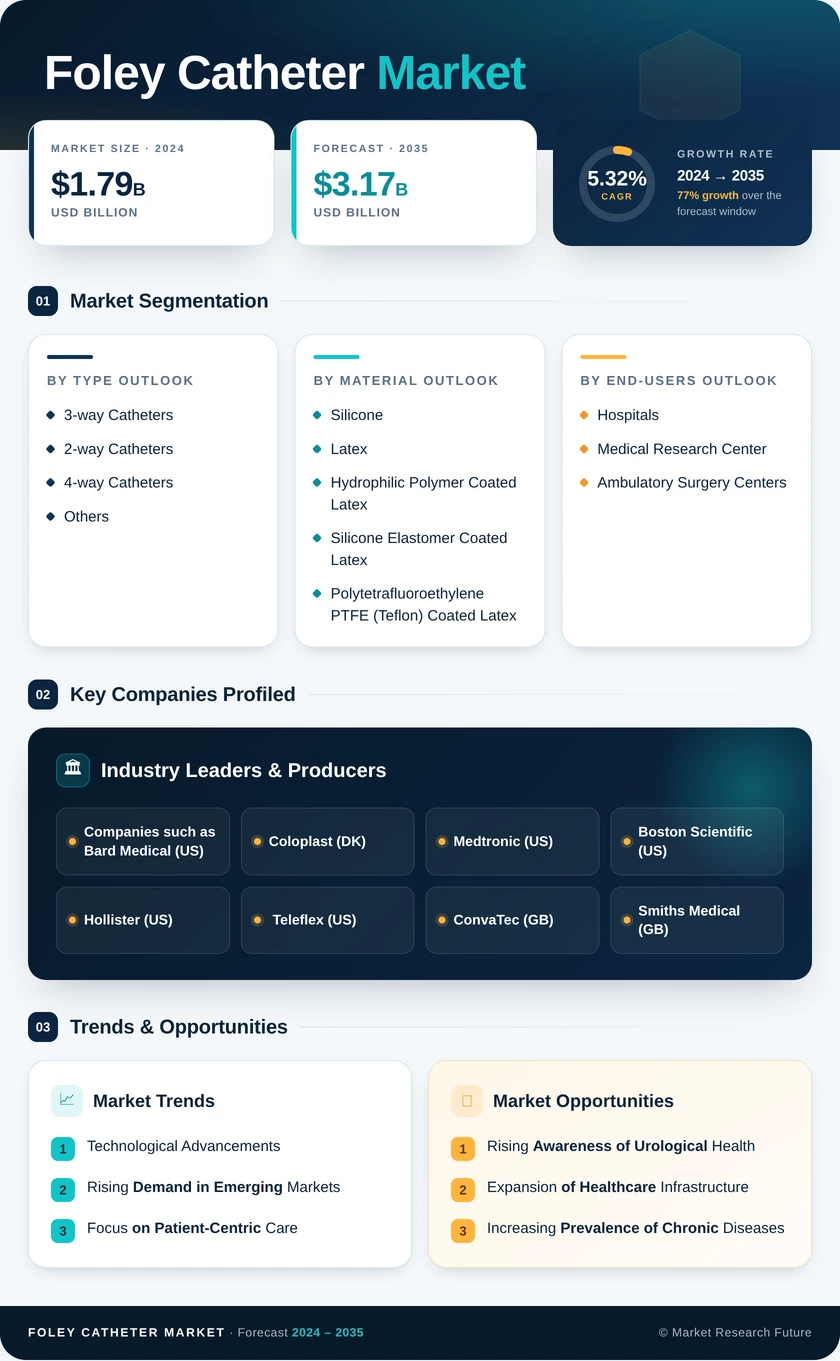
Segmentation Quick Reference
| Dimension | Sub-Segments | Dominant Segment | Fastest Growing Segment |
|---|
| By Material Type | latex; silicone; hydrophilic polymer-coated latex; silicone elastomer-coated latex; PTFE-coated latex | silicone — 36.6% share | silicone elastomer-coated latex — 7.2% CAGR |
| By Region | North America; Europe; Asia-Pacific; South America; Middle East & Africa | North America — 38.4% share | Asia-Pacific — 6.9% CAGR |
Market Segmentation Overview
| Sub-Segment | Key Trend |
|---|
| latex | Holds volume in public tenders but loses share to coated and silicone alternatives |
| silicone | Preferred for long-dwell, pediatric, and latex-free protocols |
| hydrophilic polymer-coated latex | Gaining use where insertion comfort and lower urethral trauma matter |
| Silicone elastomer-coated latex | Mid-tier hospitals adopt it as a bridge between latex and full silicone. |
| PTFE-coated latex | Serves buyers seeking reduced adhesion and encrustation at moderate cost |
Silicone leads the material dimension because long indwelling use, lower encrustation risk, and latex-free policies in pediatric and immunocompromised care make it the clinical default where budgets allow. Silicone elastomer-coated latex grows fastest, as it gives cost-constrained hospitals much of silicone's tolerance without full conversion cost. Latex retains significant tender volume, while hydrophilic polymer-coated latex and PTFE-coated latex fill niches defined by insertion comfort and adhesion resistance.


 Noah Malgeri
Co-Founder

 Peter Groot koerkamp
Account and Business Manager

 Younghwan Choi
Senior Retail Manager

 Mark Irwin
Management Consultant

 Akif Moroglu
Strategy & Business Development Director

 Guilherme Gomes Martins
Product Management Director

 Joseph Aguayo
Sales Operations & Pricing Manager

 La Terria Dodd
Program Support Specialist

 Rob Kooiker
Group Product Manager HVAC & Fire Protection GMA