
×
Request Free Sample ×

Kindly complete the form below to receive a free sample of this Report

* Please use a valid business email

Leading companies partner with us for data-driven Insights

clients tt-cursor
Hero Background
English
Chinese
French
Japanese
Korean
German
Spanish

Folding Furniture Market Trends

ID: MRFR/PCM/3395-HCR
100 Pages
Snehal Singh
October 2025

Folding Furniture Market Research Report Information By Product Type (Chairs, Tables, Sofas, Beds, Other), By Application (Residential, Non-residential), And By Region (North America, Europe, Asia-Pacific, And Rest Of The World) – Market Forecast Till 2035

Share:
Download PDF ×

We do not share your information with anyone. However, we may send you emails based on your report interest from time to time. You may contact us at any time to opt-out.

Folding Furniture Market Infographic
×
Folding Furniture Market Infographic Full View
Purchase Options

Market Trends

Key Emerging Trends in the Folding Furniture Market

Due to increasing population growth and public interest in its benefits, the Folding Furniture Market has grown. Even foldable furniture can beautify a room due to its polish.

Folding furniture has changed significantly in recent years due to consumer tastes and lifestyle changes. Urban living areas are demanding more space-efficient solutions, which is driving this market. Consumers want foldable furniture as apartments and compact residences become more common. The urge to maximize space use and provide more adaptable living situations drives this trend. Folding furniture industry trends are driven by sustainability and space efficiency. As environmental awareness rises, consumers prefer eco friendly items.

Folding furniture with technology is another trend. Smart and versatile features are increasing for tech-savvy consumers. Folding furniture with USB connections, wireless charging, or smart home connectivity is popular. This combination of technology and furniture improves functionality and fits the modern lifestyle of convenience and communication.

The COVID-19 pandemic has also changed market trends and how individuals use their homes. As remote work and virtual learning became more common, flexible furniture for home offices and virtual classrooms was in demand. Folding desks, seats, and tables became popular because they could be used to create work or study places and then stored away, keeping the surroundings tidy.

Folding furniture market trends are also affected by global economic considerations. Consumer spending is affected by economic uncertainty and disposable income. The market has responded by producing folding furniture at various price points, helping it appeal to more consumers. Folding furniture remains appealing even during economic downturns thanks to affordable, fashionable designs.

Folding furniture market trends have accelerated due to e-commerce. Online platforms let people shop for folding furniture from home. Manufacturers can now reach worldwide customers.

The foldable furniture market is changing because to urbanization, sustainability, technology integration, the COVID-19 epidemic, economic issues, and e-commerce. As consumer preferences change, firms in this industry must modify their offers to meet the needs of a wide and dynamic customer base. Folding furniture is primed for further innovation and expansion, whether it's about efficient living spaces, sustainability, or smart features.


Author
Snehal Singh
Assistant Manager - Research

High acumen in analyzing complex macro & micro markets with more than 6 years of work experience in the field of market research. By implementing her analytical skills in forecasting and estimation into market research reports, she has expertise in Packaging, Construction, and Equipment domains. She handles a team size of 20-25 resources and ensures smooth running of the projects, associated marketing activities, and client servicing.

Leave a Comment

FAQs

How much is the Folding Furniture market?

Folding Furniture Market size was valued at USD 11713.50 Billion in 2024

What is the growth rate of the Folding Furniture market?

Folding Furniture Market is projected to grow at a CAGR of 4.97% during the forecast period, 2025-2035

Which region held the largest market share in the Folding Furniture market?

Asia Pacific had the largest share of the Folding Furniture market

Who are the key players in the Folding Furniture market?

The key players in the market are IKEA, Ashley furniture industries inc, Leggett and Platt Inc, Dorel Industries Inc, Haworth Inc, Expand furniture, Murphy wall beds hardware Inc, Flexsteel industries Inc, Maxchief Europe, and Hussy seating company

Which Product Type led the market of Folding Furniture?

The Sofas category dominated the market in 2024

Which Application had the largest market share in the market?

Residential had the largest share in the market for Folding Furniture

Market Summary

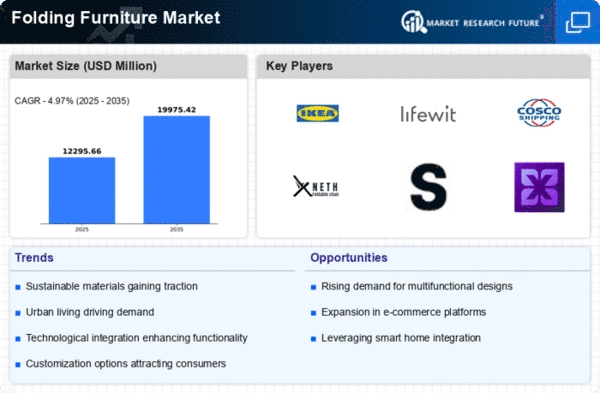
As per MRFR analysis, the Folding Furniture Market Size was estimated at 11713.5 USD Million in 2024. The Folding Furniture industry is projected to grow from 12295.9 USD Million in 2025 to 19975.42 USD Million by 2035, exhibiting a compound annual growth rate (CAGR) of 4.97 during the forecast period 2025 - 2035.

Key Market Trends & Highlights

The Folding Furniture Market is experiencing dynamic growth driven by innovative designs and changing consumer preferences.

  • The market is witnessing a rise in multifunctional designs that cater to diverse consumer needs.
  • Sustainability and eco-friendly materials are becoming increasingly important in product offerings.
  • North America remains the largest market, while Asia-Pacific is recognized as the fastest-growing region in folding furniture.
  • Urbanization and space constraints are major drivers, alongside a growing demand for outdoor furniture, particularly in the residential and commercial segments.

Market Size & Forecast

2024 Market Size 11713.5 (USD Million)
2035 Market Size 19975.42 (USD Million)
CAGR (2025 - 2035) 4.97%
Largest Regional Market Share in 2024 North America

Major Players

IKEA (SE), Lifewit (CN), Cosco (US), Foldable Furniture (US), Simplicity (US), Meco (US), DHP (US), Zinus (KR), Mainstays (US)

Market Trends

The Folding Furniture Market is currently experiencing a notable transformation, driven by evolving consumer preferences and lifestyle changes. As urbanization continues to rise, the demand for space-efficient solutions has surged, prompting manufacturers to innovate and diversify their offerings. This market appears to be characterized by a growing inclination towards multifunctional designs that cater to the needs of modern living. Consumers increasingly seek furniture that not only serves a practical purpose but also enhances aesthetic appeal, suggesting a shift towards stylish yet functional pieces. Moreover, sustainability has emerged as a pivotal factor influencing purchasing decisions within the Folding Furniture Market. Eco-conscious consumers are gravitating towards products made from sustainable materials, reflecting a broader trend towards environmental responsibility. This shift indicates that manufacturers may need to adapt their sourcing and production processes to align with consumer expectations. As the market evolves, it seems likely that the integration of technology, such as smart furniture solutions, will further redefine the landscape, offering enhanced convenience and functionality for users.

Rise of Multifunctional Designs

The Folding Furniture Market is witnessing a surge in demand for multifunctional designs. Consumers are increasingly favoring products that serve multiple purposes, such as sofas that convert into beds or tables that can be expanded for gatherings. This trend reflects a broader desire for versatility in living spaces, particularly in urban environments where space is often limited.

Sustainability and Eco-Friendly Materials

Sustainability has become a crucial consideration for consumers in the Folding Furniture Market. There is a growing preference for furniture made from eco-friendly materials, as buyers seek to minimize their environmental impact. This trend suggests that manufacturers may need to prioritize sustainable sourcing and production methods to meet the expectations of environmentally conscious consumers.

Integration of Technology

The integration of technology into folding furniture is emerging as a notable trend. Smart furniture solutions that incorporate features such as charging ports or adjustable settings are gaining traction. This development indicates a shift towards convenience and enhanced functionality, appealing to tech-savvy consumers who value innovation in their living spaces.

Folding Furniture Market Market Drivers

Rising Urbanization

The Global Folding Furniture Market Industry is experiencing growth driven by rising urbanization. As more people migrate to urban areas, the demand for space-efficient furniture increases. Urban living often comes with limited space, making folding furniture an attractive option for consumers seeking functionality without sacrificing style. In densely populated cities, such as Tokyo and New York, the need for versatile furniture solutions is paramount. This trend is likely to contribute to the market's projected value of 11.7 USD Billion in 2024, as urban dwellers prioritize adaptable living environments.

Growth of E-commerce

The rise of e-commerce platforms is significantly impacting the Global Folding Furniture Market Industry. Online shopping provides consumers with access to a broader range of folding furniture options, often at competitive prices. This convenience allows consumers to compare products and read reviews, enhancing their purchasing experience. Major retailers are increasingly investing in their online presence, which facilitates the growth of the folding furniture segment. As e-commerce continues to expand, it is likely to contribute to the market's anticipated CAGR of 4.97% from 2025 to 2035, reflecting a shift in consumer buying behavior.

Market Growth Projections

The Global Folding Furniture Market Industry is poised for substantial growth, with projections indicating a rise from 11.7 USD Billion in 2024 to 20.0 USD Billion by 2035. This growth reflects a compound annual growth rate (CAGR) of 4.97% from 2025 to 2035. Such projections suggest a robust demand for folding furniture driven by urbanization, sustainability, and evolving consumer preferences. The anticipated growth trajectory highlights the industry's potential to adapt to changing market dynamics and consumer needs.

Increasing Disposable Income

Rising disposable income levels globally are positively influencing the Global Folding Furniture Market Industry. As consumers have more financial freedom, they are more inclined to invest in quality furniture that enhances their living spaces. This trend is particularly evident in emerging markets, where a growing middle class is seeking stylish and functional furniture solutions. The increase in disposable income is likely to drive demand for folding furniture, as consumers prioritize both aesthetics and practicality. This trend may support the market's growth trajectory, aligning with the projected increase to 20.0 USD Billion by 2035.

Increased Focus on Sustainability

Sustainability is becoming a critical consideration in the Global Folding Furniture Market Industry. Consumers are increasingly seeking eco-friendly products, which has led manufacturers to innovate with sustainable materials and production methods. For instance, brands are utilizing recycled materials and sustainable wood sources to create folding furniture that minimizes environmental impact. This shift aligns with global sustainability goals and consumer preferences, potentially enhancing market growth. As the market evolves, the emphasis on sustainability may drive the industry towards a projected value of 20.0 USD Billion by 2035.

Versatility and Multi-functionality

The versatility of folding furniture is a key driver in the Global Folding Furniture Market Industry. Consumers are drawn to products that serve multiple purposes, particularly in smaller living spaces. For example, a folding table can function as a dining surface, a workspace, or even a decorative element when not in use. This adaptability appeals to a wide range of consumers, from students to families. As lifestyles evolve, the demand for multi-functional furniture is expected to grow, further solidifying the market's position and contributing to its projected growth.

Market Segment Insights

By Application: Residential (Largest) vs. Commercial (Fastest-Growing)

The Folding Furniture Market is primarily divided into five applications: Residential, Commercial, Outdoor, Event, and Storage. Among these segments, Residential holds the largest market share due to the increasing popularity of space-saving furniture among urban households. The convenience and multifunctionality of folding furniture make it a preferred choice for home furnishing, especially in smaller living spaces. Meanwhile, the Commercial segment is rapidly growing, driven by the increasing adoption of flexible workspaces and collaborative office designs.

Residential (Dominant) vs. Commercial (Emerging)

The Residential segment is characterized by a strong demand for folding furniture designed for home use, emphasizing style, functionality, and ease of storage. Products in this segment cater to a variety of consumer needs, including limited space solutions for apartments and townhouses. In contrast, the Commercial segment, which includes offices, cafes, and schools, is emerging rapidly as businesses seek versatility in furniture arrangements. This segment is evolving with innovative designs that enhance functionality in workspaces, reflecting the growing trend of flexibility in commercial environments.

By Material: Wood (Largest) vs. Metal (Fastest-Growing)

In the Folding Furniture Market, wood dominates the material segment, representing the largest share due to its durability, aesthetic appeal, and traditional craftsmanship. Wood folding furniture is highly sought after for both residential and commercial use, often regarded as a premium choice. Metal, on the other hand, is the fastest-growing segment driven by its modern design and lightweight properties, making it suitable for various applications, including outdoor use and smaller spaces.

Wood (Dominant) vs. Metal (Emerging)

Wood folding furniture stands out for its classic charm and robust structural integrity, making it a preferred choice among consumers seeking longevity and style. The versatility of wood allows it to be crafted into various designs, accommodating various aesthetics from rustic to contemporary. Conversely, metal folding furniture is gaining traction, especially among younger demographics who appreciate minimalist designs and easy portability. The rise in urban living and small-space solutions has fueled the demand for lightweight, stackable metal alternatives, highlighting a shift in consumer preference towards modern, functional furniture.

By Design Type: Modern (Largest) vs. Multi-functional (Fastest-Growing)

The Folding Furniture Market is characterized by a diverse array of design types, with Modern design currently holding the largest share. This design appeals to a broad demographic because of its sleek aesthetics and functionality. Traditional furniture continues to attract those who prefer classic styles but has gradually slipped in overall market relevance. Meanwhile, Space-saving and Minimalist designs are witnessing growth as urban living spaces shrink, making efficient storage a priority for consumers.

Modern (Dominant) vs. Multi-functional (Emerging)

Modern design in the folding furniture market appeals to contemporary consumers who value style without sacrificing utility. This design type often embraces clean lines and innovative materials, appealing to design-savvy buyers. In contrast, Multi-functional designs are emerging rapidly as they provide versatility and adaptability for multi-purpose spaces. These pieces often incorporate storage solutions within their structure, thus catering to consumers' desire for both space-saving solutions and functionality. As urbanization continues and living spaces become compact, the demand for Multi-functional folding furniture grows, making it the fastest-growing segment in the market.

By End Use: Home (Largest) vs. Office (Fastest-Growing)

The Folding Furniture Market showcases a varied distribution among its end-use segments including Home, Office, Hospitality, Education, and Recreation. The home segment stands out as the largest, appealing to consumers who appreciate flexibility and space-saving solutions. On the other hand, the office segment is rapidly gaining traction as the fastest-growing area, driven by an increasing trend towards remote work and the need for adaptable workspaces.

Home (Dominant) vs. Office (Emerging)

Home folding furniture dominates the market due to its widespread acceptance in residential settings, where space management is a critical concern. Homeowners are increasingly adopting versatile folding solutions that allow for multi-purpose utilization, enhancing both functionality and style. Conversely, the office folding furniture segment is emerging significantly, thanks to the rise in hybrid work models. Companies are opting for folding desks and chairs that can be easily configured or rearranged, optimizing space while catering to diverse work styles. This combination of flexibility and modern design is propelling the office segment's growth in the market.

By Size: Large (Largest) vs. Expandable (Fastest-Growing)

In the Folding Furniture Market, the size segment is diversified into various categories namely small, medium, large, custom, and expandable. Among these, the large-sized folding furniture holds the largest market share, reflecting a strong preference for spacious and versatile designs. Concurrently, the medium and small sizes also cater to specific consumer demands, particularly in urban areas where space is limited. Custom and expandable options provide tailored solutions that are increasingly appealing due to their adaptability and functionality.

Folding Furniture Size: Large (Dominant) vs. Expandable (Emerging)

The large folding furniture segment is renowned for providing ample space and comfort, making it a popular choice for both commercial and residential settings. Its dominance in the market stems from the increasing consumer demand for high-capacity furniture, which can accommodate larger gatherings without compromising on style. In contrast, the expandable folding furniture segment is emerging rapidly, favored for its unique ability to adjust size based on user needs. This flexibility resonates with modern consumers who prioritize multifunctionality in their furnishings. Both segments are essential in propelling the folding furniture market forward, as they address varying preferences and requirements.

Get more detailed insights about Folding Furniture Market Research Report- Forecast 2035

Regional Insights

North America : Market Leader in Folding Furniture

North America leads the folding furniture market with a share of 5000.0. The growth is driven by increasing urbanization, a rise in small living spaces, and a growing trend towards multifunctional furniture. Regulatory support for sustainable materials is also a catalyst for market expansion. The demand for space-saving solutions is expected to continue driving growth in this region. The competitive landscape is robust, with key players like IKEA, Cosco, and DHP dominating the market. The U.S. is the largest contributor, benefiting from a strong retail infrastructure and consumer preference for innovative designs. Companies are focusing on product diversification and sustainability to capture a larger market share, ensuring a dynamic and competitive environment.

Europe : Emerging Market with Growth Potential

Europe's folding furniture market is valued at 3500.0, showing significant growth potential. Factors such as increasing demand for compact living solutions and a focus on sustainability are driving this market. Regulatory frameworks promoting eco-friendly materials are also enhancing market dynamics. The trend towards minimalism and efficient use of space is expected to further boost demand in the coming years. Leading countries include Germany, France, and the UK, where consumer preferences are shifting towards stylish yet functional furniture. Key players like IKEA and Lifewit are well-positioned to capitalize on this trend. The competitive landscape is characterized by innovation and a focus on quality, with companies investing in R&D to meet evolving consumer needs. The market is expected to grow as more consumers seek versatile furniture solutions.

Asia-Pacific : Rapidly Growing Market Segment

The Asia-Pacific folding furniture market, valued at 2500.0, is experiencing rapid growth driven by urbanization and a rising middle class. The demand for space-efficient solutions is increasing, particularly in densely populated urban areas. Regulatory initiatives promoting sustainable practices are also influencing market dynamics, encouraging manufacturers to adopt eco-friendly materials and production methods. Countries like China, Japan, and India are leading the market, with a growing number of local and international players. Companies such as Zinus and Lifewit are expanding their presence, focusing on innovative designs and affordability. The competitive landscape is evolving, with a mix of traditional craftsmanship and modern manufacturing techniques, catering to diverse consumer preferences and driving market growth.

Middle East and Africa : Untapped Market with Opportunities

The Middle East and Africa folding furniture market is valued at 713.5, representing an untapped opportunity for growth. Factors such as increasing urbanization, a rise in disposable income, and a growing trend towards compact living are driving demand. Regulatory support for sustainable practices is also emerging, encouraging manufacturers to innovate and adapt to market needs. Leading countries include South Africa and the UAE, where the demand for versatile furniture is on the rise. The competitive landscape is characterized by a mix of local and international players, with companies focusing on affordability and functionality. As the market matures, there is potential for significant growth, particularly in urban centers where space is at a premium.

Key Players and Competitive Insights

The Folding Furniture Market is currently characterized by a dynamic competitive landscape, driven by evolving consumer preferences for space-saving solutions and multifunctional designs. Key players such as IKEA (SE), Lifewit (CN), and Cosco (US) are at the forefront, each adopting distinct strategies to enhance their market presence. IKEA (SE) continues to leverage its strong brand identity and extensive product range, focusing on innovation and sustainability in its offerings. Meanwhile, Lifewit (CN) emphasizes affordability and practicality, catering to a growing segment of budget-conscious consumers. Cosco (US) positions itself as a leader in outdoor folding furniture, capitalizing on the increasing demand for versatile outdoor living solutions. Collectively, these strategies contribute to a moderately fragmented market structure, where competition is intensifying as companies seek to differentiate themselves through unique value propositions.In terms of business tactics, companies are increasingly localizing manufacturing to reduce lead times and enhance supply chain efficiency. This approach not only mitigates risks associated with global supply chain disruptions but also allows for quicker responses to changing consumer demands. The market's competitive structure remains moderately fragmented, with several players vying for market share. The collective influence of these key players shapes the competitive dynamics, as they continuously innovate and adapt to market trends.

In November IKEA (SE) announced the launch of a new line of eco-friendly folding furniture made from recycled materials. This strategic move underscores the company's commitment to sustainability and aligns with the growing consumer preference for environmentally responsible products. By integrating sustainability into its core offerings, IKEA (SE) not only enhances its brand image but also positions itself favorably in a market increasingly driven by eco-conscious consumers.

In October Lifewit (CN) expanded its product line to include a series of compact, multifunctional folding tables designed for urban living. This expansion reflects the company's strategic focus on addressing the needs of consumers living in smaller spaces, thereby tapping into a lucrative market segment. The introduction of these products is likely to strengthen Lifewit's market position and appeal to a demographic that prioritizes functionality and space efficiency.

In September Cosco (US) entered into a partnership with a leading outdoor lifestyle brand to co-develop a range of premium folding furniture for outdoor enthusiasts. This collaboration not only enhances Cosco's product offerings but also allows the company to leverage the partner's brand equity and customer base. Such strategic alliances are indicative of a broader trend in the market, where companies are seeking synergies to enhance their competitive edge and expand their reach.

As of December the Folding Furniture Market is witnessing significant trends such as digitalization, sustainability, and the integration of AI technologies in product design and customer engagement. Strategic alliances are increasingly shaping the competitive landscape, enabling companies to pool resources and expertise. Looking ahead, competitive differentiation is likely to evolve from traditional price-based competition to a focus on innovation, technology integration, and supply chain reliability. This shift suggests that companies that prioritize these aspects will be better positioned to thrive in an increasingly competitive environment.

Key Companies in the Folding Furniture Market include

Industry Developments

Apr 2022: Dorel Home, a segment of Dorel Industries Inc., reopened its 9th-floor C&D Building showroom at the High Point Market to showcase both new products and its growing portfolio of high-profile licensed brands.

Feb 2022: Ashley Furniture HomeStore in Guadalajara, Mexico, opened the new 15,000 sq. ft. showroom located on Avenida Patria #120, in Guadalajara, Jalisco, Mexico. The Guadalajara store is significant for the expansion of the Ashley brand in Mexico.

Future Outlook

Folding Furniture Market Future Outlook

The Folding Furniture Market is projected to grow at a 4.97% CAGR from 2025 to 2035, driven by urbanization, space optimization, and evolving consumer preferences.

New opportunities lie in:

  • Expansion into e-commerce platforms for direct-to-consumer sales.
  • Development of eco-friendly materials for sustainable folding furniture.
  • Collaboration with interior designers for customized folding solutions.

By 2035, the Folding Furniture Market is expected to achieve robust growth and increased market penetration.

Market Segmentation

Folding Furniture Market Size Outlook

  • Small
  • Medium
  • Large
  • Custom
  • Expandable

Folding Furniture Market End Use Outlook

  • Home
  • Office
  • Hospitality
  • Education
  • Recreation

Folding Furniture Market Material Outlook

  • Wood
  • Metal
  • Plastic
  • Fabric
  • Composite

Folding Furniture Market Application Outlook

  • Residential
  • Commercial
  • Outdoor
  • Event
  • Storage

Folding Furniture Market Design Type Outlook

  • Traditional
  • Modern
  • Minimalist
  • Multi-functional
  • Space-saving

Report Scope

MARKET SIZE 202411713.5(USD Million)
MARKET SIZE 202512295.9(USD Million)
MARKET SIZE 203519975.42(USD Million)
COMPOUND ANNUAL GROWTH RATE (CAGR)4.97% (2025 - 2035)
REPORT COVERAGERevenue Forecast, Competitive Landscape, Growth Factors, and Trends
BASE YEAR2024
Market Forecast Period2025 - 2035
Historical Data2019 - 2024
Market Forecast UnitsUSD Million
Key Companies ProfiledIKEA (SE), Lifewit (CN), Cosco (US), Foldable Furniture (US), Simplicity (US), Meco (US), DHP (US), Zinus (KR), Mainstays (US)
Segments CoveredApplication, Material, Design Type, End Use, Size
Key Market OpportunitiesGrowing demand for space-saving solutions drives innovation in the Folding Furniture Market.
Key Market DynamicsRising consumer preference for multifunctional and space-saving solutions drives innovation in the folding furniture market.
Countries CoveredNorth America, Europe, APAC, South America, MEA

FAQs

How much is the Folding Furniture market?

Folding Furniture Market size was valued at USD 11713.50 Billion in 2024

What is the growth rate of the Folding Furniture market?

Folding Furniture Market is projected to grow at a CAGR of 4.97% during the forecast period, 2025-2035

Which region held the largest market share in the Folding Furniture market?

Asia Pacific had the largest share of the Folding Furniture market

Who are the key players in the Folding Furniture market?

The key players in the market are IKEA, Ashley furniture industries inc, Leggett and Platt Inc, Dorel Industries Inc, Haworth Inc, Expand furniture, Murphy wall beds hardware Inc, Flexsteel industries Inc, Maxchief Europe, and Hussy seating company

Which Product Type led the market of Folding Furniture?

The Sofas category dominated the market in 2024

Which Application had the largest market share in the market?

Residential had the largest share in the market for Folding Furniture

  1. SECTION I: EXECUTIVE SUMMARY AND KEY HIGHLIGHTS
    1. | 1.1 EXECUTIVE SUMMARY
    2. | 1.1.1 Market Overview
    3. | 1.1.2 Key Findings
    4. | 1.1.3 Market Segmentation
    5. | 1.1.4 Competitive Landscape
    6. | 1.1.5 Challenges and Opportunities
    7. | 1.1.6 Future Outlook
  2. SECTION II: SCOPING, METHODOLOGY AND MARKET STRUCTURE
    1. | 2.1 MARKET INTRODUCTION
    2. | 2.1.1 Definition
    3. | 2.1.2 Scope of the study
    4. |-- 2.1.2.1 Research Objective
    5. |-- 2.1.2.2 Assumption
    6. |-- 2.1.2.3 Limitations
    7. | 2.2 RESEARCH METHODOLOGY
    8. | 2.2.1 Overview
    9. | 2.2.2 Data Mining
    10. | 2.2.3 Secondary Research
    11. | 2.2.4 Primary Research
    12. |-- 2.2.4.1 Primary Interviews and Information Gathering Process
    13. |-- 2.2.4.2 Breakdown of Primary Respondents
    14. | 2.2.5 Forecasting Model
    15. | 2.2.6 Market Size Estimation
    16. |-- 2.2.6.1 Bottom-Up Approach
    17. |-- 2.2.6.2 Top-Down Approach
    18. | 2.2.7 Data Triangulation
    19. | 2.2.8 Validation
  3. SECTION III: QUALITATIVE ANALYSIS
    1. | 3.1 MARKET DYNAMICS
    2. | 3.1.1 Overview
    3. | 3.1.2 Drivers
    4. | 3.1.3 Restraints
    5. | 3.1.4 Opportunities
    6. | 3.2 MARKET FACTOR ANALYSIS
    7. | 3.2.1 Value chain Analysis
    8. | 3.2.2 Porter's Five Forces Analysis
    9. |-- 3.2.2.1 Bargaining Power of Suppliers
    10. |-- 3.2.2.2 Bargaining Power of Buyers
    11. |-- 3.2.2.3 Threat of New Entrants
    12. |-- 3.2.2.4 Threat of Substitutes
    13. |-- 3.2.2.5 Intensity of Rivalry
    14. | 3.2.3 COVID-19 Impact Analysis
    15. |-- 3.2.3.1 Market Impact Analysis
    16. |-- 3.2.3.2 Regional Impact
    17. |-- 3.2.3.3 Opportunity and Threat Analysis
  4. SECTION IV: QUANTITATIVE ANALYSIS
    1. | 4.1 Packaging & Transport, BY Application (USD Million)
    2. | 4.1.1 Residential
    3. | 4.1.2 Commercial
    4. | 4.1.3 Outdoor
    5. | 4.1.4 Event
    6. | 4.1.5 Storage
    7. | 4.2 Packaging & Transport, BY Material (USD Million)
    8. | 4.2.1 Wood
    9. | 4.2.2 Metal
    10. | 4.2.3 Plastic
    11. | 4.2.4 Fabric
    12. | 4.2.5 Composite
    13. | 4.3 Packaging & Transport, BY Design Type (USD Million)
    14. | 4.3.1 Traditional
    15. | 4.3.2 Modern
    16. | 4.3.3 Minimalist
    17. | 4.3.4 Multi-functional
    18. | 4.3.5 Space-saving
    19. | 4.4 Packaging & Transport, BY End Use (USD Million)
    20. | 4.4.1 Home
    21. | 4.4.2 Office
    22. | 4.4.3 Hospitality
    23. | 4.4.4 Education
    24. | 4.4.5 Recreation
    25. | 4.5 Packaging & Transport, BY Size (USD Million)
    26. | 4.5.1 Small
    27. | 4.5.2 Medium
    28. | 4.5.3 Large
    29. | 4.5.4 Custom
    30. | 4.5.5 Expandable
    31. | 4.6 Packaging & Transport, BY Region (USD Million)
    32. | 4.6.1 North America
    33. |-- 4.6.1.1 US
    34. |-- 4.6.1.2 Canada
    35. | 4.6.2 Europe
    36. |-- 4.6.2.1 Germany
    37. |-- 4.6.2.2 UK
    38. |-- 4.6.2.3 France
    39. |-- 4.6.2.4 Russia
    40. |-- 4.6.2.5 Italy
    41. |-- 4.6.2.6 Spain
    42. |-- 4.6.2.7 Rest of Europe
    43. | 4.6.3 APAC
    44. |-- 4.6.3.1 China
    45. |-- 4.6.3.2 India
    46. |-- 4.6.3.3 Japan
    47. |-- 4.6.3.4 South Korea
    48. |-- 4.6.3.5 Malaysia
    49. |-- 4.6.3.6 Thailand
    50. |-- 4.6.3.7 Indonesia
    51. |-- 4.6.3.8 Rest of APAC
    52. | 4.6.4 South America
    53. |-- 4.6.4.1 Brazil
    54. |-- 4.6.4.2 Mexico
    55. |-- 4.6.4.3 Argentina
    56. |-- 4.6.4.4 Rest of South America
    57. | 4.6.5 MEA
    58. |-- 4.6.5.1 GCC Countries
    59. |-- 4.6.5.2 South Africa
    60. |-- 4.6.5.3 Rest of MEA
  5. SECTION V: COMPETITIVE ANALYSIS
    1. | 5.1 Competitive Landscape
    2. | 5.1.1 Overview
    3. | 5.1.2 Competitive Analysis
    4. | 5.1.3 Market share Analysis
    5. | 5.1.4 Major Growth Strategy in the Packaging & Transport
    6. | 5.1.5 Competitive Benchmarking
    7. | 5.1.6 Leading Players in Terms of Number of Developments in the Packaging & Transport
    8. | 5.1.7 Key developments and growth strategies
    9. |-- 5.1.7.1 New Product Launch/Service Deployment
    10. |-- 5.1.7.2 Merger & Acquisitions
    11. |-- 5.1.7.3 Joint Ventures
    12. | 5.1.8 Major Players Financial Matrix
    13. |-- 5.1.8.1 Sales and Operating Income
    14. |-- 5.1.8.2 Major Players R&D Expenditure. 2023
    15. | 5.2 Company Profiles
    16. | 5.2.1 IKEA (SE)
    17. |-- 5.2.1.1 Financial Overview
    18. |-- 5.2.1.2 Products Offered
    19. |-- 5.2.1.3 Key Developments
    20. |-- 5.2.1.4 SWOT Analysis
    21. |-- 5.2.1.5 Key Strategies
    22. | 5.2.2 Lifewit (CN)
    23. |-- 5.2.2.1 Financial Overview
    24. |-- 5.2.2.2 Products Offered
    25. |-- 5.2.2.3 Key Developments
    26. |-- 5.2.2.4 SWOT Analysis
    27. |-- 5.2.2.5 Key Strategies
    28. | 5.2.3 Cosco (US)
    29. |-- 5.2.3.1 Financial Overview
    30. |-- 5.2.3.2 Products Offered
    31. |-- 5.2.3.3 Key Developments
    32. |-- 5.2.3.4 SWOT Analysis
    33. |-- 5.2.3.5 Key Strategies
    34. | 5.2.4 Foldable Furniture (US)
    35. |-- 5.2.4.1 Financial Overview
    36. |-- 5.2.4.2 Products Offered
    37. |-- 5.2.4.3 Key Developments
    38. |-- 5.2.4.4 SWOT Analysis
    39. |-- 5.2.4.5 Key Strategies
    40. | 5.2.5 Simplicity (US)
    41. |-- 5.2.5.1 Financial Overview
    42. |-- 5.2.5.2 Products Offered
    43. |-- 5.2.5.3 Key Developments
    44. |-- 5.2.5.4 SWOT Analysis
    45. |-- 5.2.5.5 Key Strategies
    46. | 5.2.6 Meco (US)
    47. |-- 5.2.6.1 Financial Overview
    48. |-- 5.2.6.2 Products Offered
    49. |-- 5.2.6.3 Key Developments
    50. |-- 5.2.6.4 SWOT Analysis
    51. |-- 5.2.6.5 Key Strategies
    52. | 5.2.7 DHP (US)
    53. |-- 5.2.7.1 Financial Overview
    54. |-- 5.2.7.2 Products Offered
    55. |-- 5.2.7.3 Key Developments
    56. |-- 5.2.7.4 SWOT Analysis
    57. |-- 5.2.7.5 Key Strategies
    58. | 5.2.8 Zinus (KR)
    59. |-- 5.2.8.1 Financial Overview
    60. |-- 5.2.8.2 Products Offered
    61. |-- 5.2.8.3 Key Developments
    62. |-- 5.2.8.4 SWOT Analysis
    63. |-- 5.2.8.5 Key Strategies
    64. | 5.2.9 Mainstays (US)
    65. |-- 5.2.9.1 Financial Overview
    66. |-- 5.2.9.2 Products Offered
    67. |-- 5.2.9.3 Key Developments
    68. |-- 5.2.9.4 SWOT Analysis
    69. |-- 5.2.9.5 Key Strategies
    70. | 5.3 Appendix
    71. | 5.3.1 References
    72. | 5.3.2 Related Reports

Packaging & Transport Market Segmentation

Packaging & Transport By Application (USD Million, 2025-2035)

  • Residential
  • Commercial
  • Outdoor
  • Event
  • Storage

Packaging & Transport By Material (USD Million, 2025-2035)

  • Wood
  • Metal
  • Plastic
  • Fabric
  • Composite

Packaging & Transport By Design Type (USD Million, 2025-2035)

  • Traditional
  • Modern
  • Minimalist
  • Multi-functional
  • Space-saving

Packaging & Transport By End Use (USD Million, 2025-2035)

  • Home
  • Office
  • Hospitality
  • Education
  • Recreation

Packaging & Transport By Size (USD Million, 2025-2035)

  • Small
  • Medium
  • Large
  • Custom
  • Expandable
Infographic

Free Sample Request

Kindly complete the form below to receive a free sample of this Report

Get Free Sample

Customer Strories

Compare Licence

×
Features License Type
Single User Multiuser License Enterprise User
Price $4,950 $5,950 $7,250
Maximum User Access Limit 1 User Upto 10 Users Unrestricted Access Throughout the Organization
Free Customization
Direct Access to Analyst
Deliverable Format
Platform Access
Discount on Next Purchase 10% 15% 15%
Printable Versions