×
Request Free Sample ×

Kindly complete the form below to receive a free sample of this Report

* Please use a valid business email

Leading companies partner with us for data-driven Insights

clients tt-cursor
Hero Background
English
Chinese
French
Japanese
Korean
German
Spanish

Fluorosilicone Rubber Market Analysis

ID: MRFR/CnM/7007-HCR
150 Pages
Anshula Mandaokar
October 2025

Fluorosilicone (FVMQ) Rubber Market Research Report Information: By Processing Technology (Compression Molding, Extrusion, Liquid Injection Molding, Calendaring, 3D Printing), By End-Use (Automotive, Aerospace & Defense, Oil & Gas, Electronics & Semiconductors, Others) - Forecast to 2035

Share:
Download PDF ×

We do not share your information with anyone. However, we may send you emails based on your report interest from time to time. You may contact us at any time to opt-out.

Fluorosilicone Rubber Market Infographic
×
Fluorosilicone Rubber Market Infographic Full View
Purchase Options

Market Analysis

In-depth Analysis of Fluorosilicone Rubber Market Industry Landscape

The market dynamics of Fluorosilicone (FVMQ) rubber are influenced by various factors that collectively shape its supply, demand, and pricing trends. FVMQ rubber, a specialized elastomer known for its excellent resistance to extreme temperatures, chemicals, and fuels, experiences fluctuations driven by market forces and industry dynamics. One significant factor impacting the FVMQ rubber market is the demand from end-user industries. Sectors such as automotive, aerospace, electronics, and oil & gas rely on FVMQ rubber for its unique properties, including resistance to harsh environments and stability over a wide temperature range. Consequently, fluctuations in the demand for products within these sectors directly affect the consumption of FVMQ rubber, thereby impacting its market dynamics.

The availability and pricing of raw materials play a crucial role in shaping the FVMQ rubber market dynamics. Raw materials such as fluorosilicone polymers, reinforcing fillers, and curing agents contribute to the production cost of FVMQ rubber. Factors such as the cost and availability of these materials, as well as fluctuations in energy prices, impact the overall manufacturing cost of FVMQ rubber, subsequently influencing its market dynamics. Moreover, the accessibility of alternative raw materials and their cost competitiveness further impact the dynamics of the FVMQ rubber market.

Market competition is another significant driver of FVMQ rubber market dynamics. The presence of key players in the industry, their technological capabilities, production capacities, and geographical reach contribute to market competitiveness. Companies compete on factors such as product quality, innovation, and pricing strategies, thereby influencing market dynamics through competitive forces.

Regulatory policies and standards also play a crucial role in shaping the dynamics of the FVMQ rubber market. Compliance with regulations regarding product safety, environmental protection, and workplace safety impacts the production processes and operational costs of FVMQ rubber manufacturers. Changes in regulations or the introduction of new standards can affect market dynamics by influencing production practices and costs.

Global economic conditions and geopolitical factors also influence the FVMQ rubber market dynamics. Economic growth rates, trade policies, currency exchange rates, and geopolitical tensions can impact market sentiment, investment decisions, and overall demand for FVMQ rubber products. Uncertainties in global markets can lead to fluctuations in demand and pricing, thereby affecting the dynamics of the FVMQ rubber market.

Technological advancements and innovation drive changes in the FVMQ rubber market dynamics. Developments in polymer synthesis, compounding techniques, and manufacturing processes can impact product quality, performance, and cost. Companies investing in research and development to enhance product properties, improve processing methods, and reduce production costs contribute to the evolving dynamics of the FVMQ rubber market. The use of 3D printing process for fluorosilicone rubber is still in the nascent stage. However, it is expected to gain popularity in the near future.

Supply chain dynamics also play a significant role in influencing the FVMQ rubber market. Factors such as transportation costs, logistics efficiency, inventory management, and supply chain disruptions can impact the availability and pricing of FVMQ rubber products. Additionally, shifting customer preferences towards environmentally friendly and sustainable materials drive changes in the FVMQ rubber market dynamics, prompting manufacturers to adapt their strategies to meet these evolving demands.

Author
Anshula Mandaokar
Team Lead - Research

Anshula Mandaokar holds an academic degree in Chemical Engineering and has been contributing to the field for more than 5 years. She has expertise in Market Research and Business Consulting and serves as a Team Lead for a reputed Market Research firm under the Chemicals and Materials domain spectrum. She has worked on multiple projects, generating explicit results in a quick turnaround time. Her understanding of data interpretation justifies her role as a leader.

Leave a Comment

FAQs

What is the valuation of the market?

The global fluorosilicone rubber market was valued at over USD 120 million in 2018.

What is the CAGR of the market?

The market is expected to exhibit a strong 5.51% CAGR over the forecast period from 2019 to 2025.

What is the major driver for the market?

Growing demand in automotive and aircraft manufacturing is the major driver for the fluorosilicone rubber market.

Which is the leading regional market?

Asia Pacific accounts for a share of more than 50% in the global fluorosilicone rubber market.

What are the leading market players?

Leading players in the fluorosilicone rubber market include Dow, Wacker Chemie, and Momentive, among others.

Market Summary

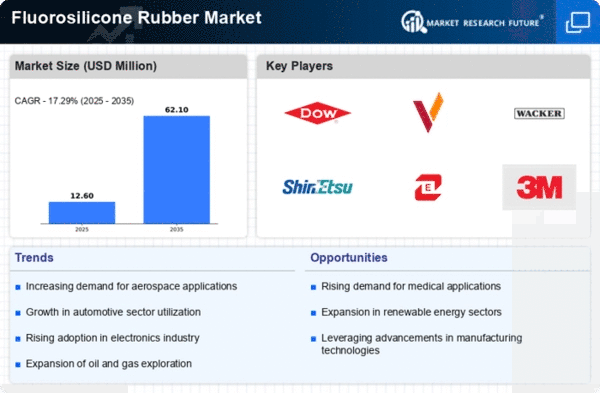
As per MRFR analysis, the Fluorosilicone Rubber Market Size was estimated at 10.74 USD Million in 2024. The Fluorosilicone Rubber industry is projected to grow from 12.6 in 2025 to 62.1 by 2035, exhibiting a compound annual growth rate (CAGR) of 17.29 during the forecast period 2025 - 2035.

Key Market Trends & Highlights

The Fluorosilicone Rubber Market is poised for robust growth driven by diverse applications and technological advancements.

  • The aerospace sector continues to drive the largest demand for fluorosilicone rubber, particularly in North America.
  • Asia-Pacific emerges as the fastest-growing region, fueled by increasing industrialization and demand for high-performance materials.
  • In the seals segment, fluorosilicone rubber remains the largest application, while the gaskets segment is witnessing rapid growth.
  • Key market drivers include the rising demand for high-performance materials and increasing applications in the automotive industry.

Market Size & Forecast

2024 Market Size 10.74 (USD Million)
2035 Market Size 62.1 (USD Million)
CAGR (2025 - 2035) 17.29%
Largest Regional Market Share in 2024 North America

Major Players

<p>Dow (US), Momentive (US), Wacker Chemie (DE), Shin-Etsu Chemical (JP), Elkem (NO), 3M (US), Kraton Corporation (US), Huntsman Corporation (US), Silicone Engineering (GB)</p>

Market Trends

The Fluorosilicone Rubber Market is currently experiencing a notable evolution, driven by its unique properties that combine the advantages of silicone and fluorocarbon materials. This hybrid material exhibits exceptional resistance to extreme temperatures, chemicals, and fuels, making it particularly valuable in industries such as aerospace, automotive, and oil and gas. As manufacturers increasingly seek materials that can withstand harsh environments while maintaining performance, the demand for fluorosilicone rubber appears to be on the rise. Furthermore, the growing emphasis on sustainability and eco-friendly materials may also influence the market dynamics, as companies strive to reduce their environmental footprint while ensuring product reliability. In addition to the industrial applications, the Fluorosilicone Rubber Market is likely to benefit from advancements in technology and manufacturing processes. Innovations in production techniques may enhance the material's properties, leading to broader applications across various sectors. The increasing focus on research and development could further stimulate market growth, as new formulations and blends are explored to meet specific industry requirements. Overall, the Fluorosilicone Rubber Market seems poised for continued expansion, driven by both technological advancements and evolving consumer preferences for high-performance materials.

Rising Demand in Aerospace Sector

The aerospace industry is increasingly adopting fluorosilicone rubber due to its superior resistance to extreme temperatures and harsh chemicals. This trend indicates a shift towards materials that can ensure safety and reliability in critical applications, such as fuel systems and seals.

Focus on Sustainable Solutions

There is a growing emphasis on sustainability within the Fluorosilicone Rubber Market. Manufacturers are exploring eco-friendly alternatives and production methods that minimize environmental impact, reflecting a broader industry trend towards responsible sourcing and material usage.

Technological Advancements in Production

Innovations in manufacturing processes are likely to enhance the properties of fluorosilicone rubber, expanding its applications. These advancements may lead to improved performance characteristics, making the material more appealing across various sectors.

Fluorosilicone Rubber Market Market Drivers

Market Growth Projections

The Global Fluorosilicone (FVMQ) Rubber Market Industry is poised for substantial growth, with projections indicating a market value of 135.7 USD Million in 2024 and an anticipated increase to 244.7 USD Million by 2035. This growth trajectory suggests a compound annual growth rate of 5.51% from 2025 to 2035. Various factors, including rising demand in aerospace and automotive applications, technological advancements, and increasing regulatory standards, contribute to this positive outlook. The market's expansion reflects the growing recognition of FVMQ rubber's unique properties and its suitability for diverse applications across multiple industries.

Increasing Regulatory Standards

The Global Fluorosilicone (FVMQ) Rubber Market Industry is influenced by the rising regulatory standards concerning material safety and environmental impact. Governments and regulatory bodies worldwide are implementing stricter guidelines for materials used in critical applications, particularly in aerospace and automotive sectors. Fluorosilicone rubber, known for its low toxicity and environmental compatibility, positions itself favorably in this context. As industries strive to comply with these regulations, the demand for FVMQ rubber is likely to increase, thereby supporting the market's growth. The anticipated market value of 135.7 USD Million in 2024 and 244.7 USD Million by 2035 underscores the potential for expansion driven by regulatory compliance.

Growth in Automotive Applications

The automotive sector significantly contributes to the Global Fluorosilicone (FVMQ) Rubber Market Industry, as manufacturers increasingly adopt FVMQ rubber for its superior performance in harsh environments. This material is utilized in various automotive components, including seals, gaskets, and hoses, which require high resistance to oils, fuels, and extreme temperatures. The ongoing transition towards electric vehicles, which demand advanced materials for battery and thermal management systems, further propels the demand for FVMQ rubber. As the automotive industry evolves, the market for FVMQ rubber is anticipated to grow, aligning with the overall market value projections of 135.7 USD Million in 2024 and 244.7 USD Million by 2035.

Rising Demand in Aerospace Sector

The Global Fluorosilicone (FVMQ) Rubber Market Industry experiences a notable surge in demand driven by the aerospace sector. Fluorosilicone rubber's exceptional resistance to extreme temperatures and fuel exposure makes it a preferred choice for seals and gaskets in aircraft engines and fuel systems. As the aerospace industry expands, with projected growth rates indicating an increase in aircraft production, the demand for FVMQ rubber is expected to rise. This trend is further supported by the industry's projected market value of 135.7 USD Million in 2024, with expectations to reach 244.7 USD Million by 2035, reflecting a compound annual growth rate of 5.51% from 2025 to 2035.

Expanding Applications in Electronics

The Global Fluorosilicone (FVMQ) Rubber Market Industry is witnessing an expansion in applications within the electronics sector. FVMQ rubber's excellent dielectric properties and resistance to heat and chemicals make it an ideal choice for insulating materials and components in electronic devices. As the electronics industry continues to grow, driven by advancements in technology and increasing consumer demand for high-performance devices, the need for reliable insulating materials is paramount. This trend is expected to bolster the market for FVMQ rubber, contributing to the projected growth from 135.7 USD Million in 2024 to 244.7 USD Million by 2035.

Technological Advancements in Material Science

Innovations in material science play a crucial role in shaping the Global Fluorosilicone (FVMQ) Rubber Market Industry. Ongoing research and development efforts are focused on enhancing the properties of FVMQ rubber, such as improving its thermal stability, chemical resistance, and mechanical strength. These advancements enable the production of more efficient and durable products, which are increasingly sought after in various industries, including aerospace, automotive, and electronics. As manufacturers adopt these new formulations, the market is likely to witness a steady growth trajectory, contributing to the projected increase in market value from 135.7 USD Million in 2024 to 244.7 USD Million by 2035.

Market Segment Insights

By Application: Aerospace (Largest) vs. Medical (Fastest-Growing)

<p>The Fluorosilicone Rubber Market showcases distinct distribution patterns among its applications, with the aerospace sector holding the largest share. This segment benefits significantly from the increasing demand for advanced materials that can withstand extreme environmental conditions. The automotive and industrial applications follow closely, driven by the need for durable and resilient components in various machinery. The medical sector is currently witnessing a rapid rise, fueled by the push for bio-compatible materials in healthcare equipment. Growth trends in this market are prominently influenced by technological advancements and stringent regulations favoring high-performance elastomers. The aerospace sector's dominance is supported by ongoing innovations in aircraft designs, while the medical application is emerging rapidly, driven by heightened healthcare standards and the need for reliable and safe materials in medical devices.</p>

<p>Aerospace (Dominant) vs. Medical (Emerging)</p>

<p>The aerospace application of fluorosilicone rubber is characterized by its exceptional resistance to temperature and chemical exposure, positioning it as a dominant force in the market. Aerospace components require materials that can maintain integrity under extreme conditions, making fluorosilicone rubber ideal for seals, gaskets, and fluid handling systems. In contrast, the medical application is categorized as emerging, driven by the increasing demand for innovative and safe medical devices. As the healthcare industry evolves, the focus on biocompatible and sterilizable materials is on the rise. This has accelerated the adoption of fluorosilicone rubber in medical applications, where it is used for tubing, seals, and other critical components, highlighting its versatility and the burgeoning opportunities within this sector.</p>

By End Use: Seals (Largest) vs. Gaskets (Fastest-Growing)

<p>The end use segment of the Fluorosilicone Rubber Market is primarily dominated by seals, which capture the largest share due to their critical role in various industrial applications. Seals are essential for ensuring leak-proof operations in sectors such as aerospace, automotive, and chemical processing, leading to their widespread adoption. Meanwhile, gaskets are experiencing rapid growth as an emerging segment, driven by increasing demand in automotive and HVAC systems, where leakage prevention and temperature resistance are paramount.</p>

<p>Seals (Dominant) vs. Gaskets (Emerging)</p>

<p>In the Fluorosilicone Rubber Market, seals are regarded as the dominant segment, owing to their unparalleled performance in harsh environments. Their unique properties, including resistance to extreme temperatures and aggressive chemicals, make them indispensable in applications that require reliability and durability. Gaskets, on the other hand, represent an emerging segment that is rapidly gaining traction; their versatility in various sealing applications and compatibility with multiple media is driving innovation and adoption in newer industries. Both segments play pivotal roles in maintaining operational efficiency and safety in their respective applications.</p>

By Type: Fluorosilicone Elastomer (Largest) vs. Fluorosilicone Foam (Fastest-Growing)

<p>The Fluorosilicone Rubber Market exhibits a diverse range of segments, with Fluorosilicone Elastomer holding the largest market share due to its remarkable versatility and performance in high-temperature environments. Following closely behind is Fluorosilicone Foam, which is rapidly gaining traction in various applications, thanks to its lightweight properties and excellent thermal insulation capabilities. This distribution signifies the critical role each type plays in different industrial applications, highlighting their unique strengths and market preferences.</p>

<p>Fluorosilicone Elastomer (Dominant) vs. Fluorosilicone Sealant (Emerging)</p>

<p>Fluorosilicone Elastomer is recognized as the dominant player in the Fluorosilicone Rubber Market due to its exceptional resistance to extreme temperatures, chemicals, and fuel, making it ideal for aerospace and automotive applications. In contrast, Fluorosilicone Sealant is emerging as a significant contender, primarily driven by an increasing demand for effective sealing solutions in construction and manufacturing. As industries seek materials that provide reliable performance under challenging conditions, these segment values reflect a landscape where established products meet evolving market needs, positioning both Fluorosilicone Elastomer and Sealants for sustained growth.</p>

By Form: Sheet (Largest) vs. Liquid (Fastest-Growing)

<p>In the Fluorosilicone Rubber Market, the 'Form' segment showcases a diverse distribution with Sheet being the largest contributor. This segment's allocation reflects the growing demand for durable and flexible materials in various industrial applications. Liquid forms are gaining traction, primarily due to their versatile adaptability, making them increasingly relevant in specialty applications where traditional forms may fall short.</p>

<p>Sheet (Dominant) vs. Liquid (Emerging)</p>

<p>The Sheet form of fluorosilicone rubber is characterized by its robustness and resistance to extreme temperatures and chemical exposure, making it the preferred choice for industries like aerospace and automotive. It dominates the market due to its established applications and reliability. In contrast, the Liquid form is emerging rapidly, distinguished by its ease of application and ability to fill intricate shapes, which broadens its utility in custom solutions and coatings. This versatility is driving interest in the Liquid segment, setting up a competitive edge against more traditional forms.</p>

By Temperature Resistance: High Temperature (Largest) vs. Extreme Temperature (Fastest-Growing)

<p>In the Fluorosilicone Rubber Market, the temperature resistance segment showcases considerable variation in market share distribution. The high temperature category possesses the largest market share due to its extensive application in automotive and aerospace sectors, which demand materials that can withstand elevated temperatures without degrading. In contrast, the extreme temperature segment, while smaller in share, is gaining traction, driven by industries requiring materials that perform under both high and low temperature extremes, making it a compelling area of growth.</p>

<p>High Temperature vs. Extreme Temperature: High Temperature (Dominant) vs. Extreme Temperature (Emerging)</p>

<p>The high temperature segment of the Fluorosilicone Rubber Market is characterized by its robust performance in demanding applications, providing exceptional heat resistance and stability. This makes it a dominant choice for automotive gaskets, seals, and aerospace components. Meanwhile, the extreme temperature segment is emerging as an innovative solution for industries facing diverse temperature challenges. With growing adoption in HVAC systems and specialized equipment, this segment is expected to expand rapidly, offering unique properties that enhance durability and reliability under severe conditions. The continuous innovation in formulations and applications positions extreme temperature solutions as a vital contender in the evolving marketplace.</p>

Get more detailed insights about Fluorosilicone (FVMQ) Rubber Market Research Report - Global Forecast till 2035

Regional Insights

North America : Market Leader in Fluorosilicone

North America is poised to maintain its leadership in the Fluorosilicone Rubber Market, holding a significant market share of 5.5 in 2024. The region's growth is driven by increasing demand in aerospace, automotive, and industrial applications, alongside stringent regulations promoting high-performance materials. The presence of major manufacturers and a robust supply chain further catalyze market expansion, ensuring compliance with environmental standards and enhancing product innovation. The United States stands out as the leading country in this sector, with key players like Dow, Momentive, and 3M driving innovation and market penetration. The competitive landscape is characterized by strategic partnerships and technological advancements, enabling companies to meet diverse customer needs. As the market evolves, investments in R&D and sustainable practices will be crucial for maintaining competitive advantage and addressing regulatory challenges.

Europe : Emerging Market with Growth Potential

Europe's Fluorosilicone Rubber Market is on an upward trajectory, with a market size of 3.0 in 2024. The region benefits from a strong automotive sector and increasing adoption of high-performance materials in various industries. Regulatory frameworks aimed at reducing environmental impact are driving demand for sustainable alternatives, positioning fluorosilicone rubber as a preferred choice for manufacturers seeking compliance and performance. Germany and France are the leading countries in this market, with companies like Wacker Chemie and Shin-Etsu Chemical playing pivotal roles. The competitive landscape is marked by innovation and collaboration among key players, focusing on enhancing product quality and expanding applications. As the market matures, the emphasis on sustainability and regulatory compliance will shape future growth trajectories.

Asia-Pacific : Rapid Growth in Emerging Economies

The Asia-Pacific region is witnessing rapid growth in the Fluorosilicone Rubber Market, with a market size of 2.0 in 2024. This growth is fueled by increasing industrialization, particularly in countries like China and India, where demand for high-performance materials is surging. The region's regulatory environment is gradually evolving, encouraging the adoption of advanced materials that meet international standards, thus driving market expansion. China is the dominant player in this market, supported by local manufacturers and international companies looking to capitalize on the growing demand. The competitive landscape is characterized by a mix of established players and emerging companies, all vying for market share. As the region continues to develop, investments in technology and innovation will be essential for sustaining growth and meeting the diverse needs of various industries.

Middle East and Africa : Niche Market with Growth Opportunities

The Middle East and Africa region represents a niche market for Fluorosilicone Rubber, with a market size of 0.24 in 2024. The growth in this region is primarily driven by increasing industrial activities and a rising demand for high-performance materials in sectors such as oil and gas, automotive, and construction. Regulatory initiatives aimed at enhancing product quality and safety are also contributing to market development, albeit at a slower pace compared to other regions. Countries like South Africa and the UAE are emerging as key players in this market, with local and international companies exploring opportunities for growth. The competitive landscape is still developing, with a focus on establishing supply chains and enhancing product offerings. As the region matures, the emphasis on quality and compliance will be crucial for attracting investment and fostering market growth.

Key Players and Competitive Insights

The Fluorosilicone Rubber Market is currently characterized by a dynamic competitive landscape, driven by increasing demand across various industries such as aerospace, automotive, and electronics. Key players are actively pursuing strategies that emphasize innovation, regional expansion, and sustainability. For instance, Dow (US) has positioned itself as a leader in developing high-performance materials, focusing on enhancing product durability and chemical resistance. Similarly, Shin-Etsu Chemical (JP) is leveraging its extensive research capabilities to innovate in fluorosilicone formulations, thereby enhancing its competitive edge in the market.

In terms of business tactics, companies are increasingly localizing manufacturing to reduce lead times and optimize supply chains. The market appears moderately fragmented, with several players vying for market share. However, the collective influence of major companies like Momentive (US) and Wacker Chemie (DE) is notable, as they continue to shape market dynamics through strategic partnerships and technological advancements.

In November 2025, Momentive (US) announced a strategic partnership with a leading automotive manufacturer to develop advanced fluorosilicone rubber components aimed at improving vehicle performance and sustainability. This collaboration is expected to enhance Momentive's market presence while addressing the growing demand for eco-friendly materials in the automotive sector. The strategic importance of this partnership lies in its potential to drive innovation and meet evolving customer needs.

In October 2025, Wacker Chemie (DE) unveiled a new production facility dedicated to fluorosilicone rubber in Asia, aimed at catering to the growing demand in the region. This expansion not only signifies Wacker's commitment to regional growth but also enhances its ability to serve local markets more effectively. The establishment of this facility is likely to bolster Wacker's competitive position by improving supply chain efficiency and reducing operational costs.

In September 2025, 3M (US) launched a new line of fluorosilicone rubber products designed for high-temperature applications, targeting the aerospace and defense sectors. This product line is significant as it reflects 3M's focus on innovation and its ability to meet the stringent requirements of high-performance industries. The introduction of these products is expected to strengthen 3M's foothold in the market and attract new customers seeking advanced materials.

As of December 2025, the competitive trends in the Fluorosilicone Rubber Market are increasingly influenced by digitalization, sustainability initiatives, and the integration of AI technologies. Strategic alliances are becoming more prevalent, as companies recognize the need to collaborate to enhance innovation and address market challenges. Looking ahead, competitive differentiation is likely to evolve from traditional price-based competition to a focus on technological advancements, product innovation, and supply chain reliability, reflecting a broader shift in industry priorities.

Key Companies in the Fluorosilicone Rubber Market include

Industry Developments

Future Outlook

Fluorosilicone Rubber Market Future Outlook

<p>The Fluorosilicone Rubber Market is projected to grow at a 17.29% CAGR from 2024 to 2035, driven by increasing demand in aerospace, automotive, and chemical processing industries.</p>

New opportunities lie in:

  • <p>Development of high-performance fluorosilicone compounds for aerospace applications.</p>
  • <p>Expansion into emerging markets with tailored product offerings.</p>
  • <p>Investment in sustainable manufacturing processes to attract eco-conscious clients.</p>

<p>By 2035, the Fluorosilicone Rubber Market is expected to achieve substantial growth and innovation.</p>

Market Segmentation

Fluorosilicone Rubber Market Form Outlook

  • Sheet
  • Roll
  • Liquid
  • Molded

Fluorosilicone Rubber Market Type Outlook

  • Fluorosilicone Elastomer
  • Fluorosilicone Foam
  • Fluorosilicone Adhesive
  • Fluorosilicone Sealant

Fluorosilicone Rubber Market End Use Outlook

  • Seals
  • Gaskets
  • Hoses
  • O-Rings
  • Coatings

Fluorosilicone Rubber Market Application Outlook

  • Aerospace
  • Automotive
  • Industrial
  • Medical
  • Electronics

Fluorosilicone Rubber Market Temperature Resistance Outlook

  • Low Temperature
  • High Temperature
  • Extreme Temperature

Report Scope

MARKET SIZE 202410.74(USD Million)
MARKET SIZE 202512.6(USD Million)
MARKET SIZE 203562.1(USD Million)
COMPOUND ANNUAL GROWTH RATE (CAGR)17.29% (2024 - 2035)
REPORT COVERAGERevenue Forecast, Competitive Landscape, Growth Factors, and Trends
BASE YEAR2024
Market Forecast Period2025 - 2035
Historical Data2019 - 2024
Market Forecast UnitsUSD Million
Key Companies ProfiledDow (US), Momentive (US), Wacker Chemie (DE), Shin-Etsu Chemical (JP), Elkem (NO), 3M (US), Kraton Corporation (US), Huntsman Corporation (US), Silicone Engineering (GB)
Segments CoveredApplication, End Use, Type, Form, Temperature Resistance
Key Market OpportunitiesGrowing demand for high-performance materials in aerospace and automotive sectors drives Fluorosilicone Rubber Market opportunities.
Key Market DynamicsRising demand for high-performance materials drives innovation and competition in the fluorosilicone rubber market.
Countries CoveredNorth America, Europe, APAC, South America, MEA

FAQs

What is the valuation of the market?

The global fluorosilicone rubber market was valued at over USD 120 million in 2018.

What is the CAGR of the market?

The market is expected to exhibit a strong 5.51% CAGR over the forecast period from 2019 to 2025.

What is the major driver for the market?

Growing demand in automotive and aircraft manufacturing is the major driver for the fluorosilicone rubber market.

Which is the leading regional market?

Asia Pacific accounts for a share of more than 50% in the global fluorosilicone rubber market.

What are the leading market players?

Leading players in the fluorosilicone rubber market include Dow, Wacker Chemie, and Momentive, among others.

  1. SECTION I: EXECUTIVE SUMMARY AND KEY HIGHLIGHTS
    1. | 1.1 EXECUTIVE SUMMARY
  2. SECTION II: SCOPING, METHODOLOGY AND MARKET STRUCTURE
    1. | 2.1 MARKET INTRODUCTION
    2. | 2.2 RESEARCH METHODOLOGY
  3. SECTION III: QUALITATIVE ANALYSIS
    1. | 3.1 MARKET DYNAMICS
    2. | 3.2 MARKET FACTOR ANALYSIS
  4. SECTION IV: QUANTITATIVE ANALYSIS
    1. | 4.1 Chemicals and Materials, BY Application (USD Million)
    2. | 4.2 Chemicals and Materials, BY End Use (USD Million)
    3. | 4.3 Chemicals and Materials, BY Type (USD Million)
    4. | 4.4 Chemicals and Materials, BY Form (USD Million)
    5. | 4.5 Chemicals and Materials, BY Temperature Resistance (USD Million)
    6. | 4.6 Chemicals and Materials, BY Region (USD Million)
  5. SECTION V: COMPETITIVE ANALYSIS
    1. | 5.1 Competitive Landscape
    2. | 5.2 Company Profiles
    3. | 5.3 Appendix

Fluorosilicone (FVMQ) Rubber Market Segmentation

Market Segmentation Overview

  • Detailed segmentation data will be available in the full report
  • Comprehensive analysis by multiple parameters
  • Regional and country-level breakdowns
  • Market size forecasts by segment
Infographic

Free Sample Request

Kindly complete the form below to receive a free sample of this Report

Get Free Sample

Customer Strories

Compare Licence

×
Features License Type
Single User Multiuser License Enterprise User
Price $4,950 $5,950 $7,250
Maximum User Access Limit 1 User Upto 10 Users Unrestricted Access Throughout the Organization
Free Customization
Direct Access to Analyst
Deliverable Format
Platform Access
Discount on Next Purchase 10% 15% 15%
Printable Versions