Request Free Sample ×

Kindly complete the form below to receive a free sample of this Report

* Please use a valid business email

Leading companies partner with us for data-driven Insights

clients tt-cursor
Hero Background
English
Chinese
French
Japanese
Korean
German
Spanish

Flow Battery Market Share

ID: MRFR/EnP/5157-HCR
111 Pages
Snehal Singh
March 2026

Flow Battery Market Size, Share & Growth Analysis Report By Product Type (Redox, Hybrid), By Material Type (Vanadium, Zinc-Bromine), By Storage Type (Compact, Large Scale), By Application (Industrial & Commercial, Defense, Utilities And Others) And By Region (North America, Europe, Asia-Pacific, And Rest Of The World) – Trends & Industry Forecast to 2035

Share:
Download PDF ×

We do not share your information with anyone. However, we may send you emails based on your report interest from time to time. You may contact us at any time to opt-out.

Flow Battery Market Infographic
Purchase Options

Market Share

Introduction: Navigating the Competitive Landscape of Flow Battery Innovation

The recombinant redox flow battery market is evolving and is being shaped by the fast adoption of the technology, the strict regulations and the increasing demand for sustainable energy solutions. The major players, including system suppliers, IT system integrators and grid operators, are striving for market leadership by deploying new technology, such as AI-based data analytics and IoT integration, to improve the efficiency and energy management of the flow batteries. However, a new generation of challengers, especially greentech start-ups and automation companies, are challenging the status quo and driving innovation and differentiation. North America and Asia-Pacific offer the most growth potential for energy storage, with a strategic trend towards the deployment of large-scale storage systems in support of the integration of renewables. Strategic knowledge of the market is important for C-level executives and strategic planners who want to take advantage of the transformative potential of flow batteries.

Competitive Positioning

Full-Suite Integrators

These vendors offer comprehensive solutions encompassing design, manufacturing, and integration of flow battery systems.

Vendor Competitive Edge Solution Focus Regional Focus
Sumitomo Electric Industries, Ltd. Established global presence and expertise Large-scale energy storage solutions Japan, Asia-Pacific
ESS Inc. Long-duration energy storage technology Sustainable energy storage systems North America

Specialized Technology Vendors

These companies focus on innovative technologies and unique solutions within the flow battery sector.

Vendor Competitive Edge Solution Focus Regional Focus
ViZn Energy Systems Modular and scalable energy storage Zinc-based flow batteries United States
Primus Power Cost-effective energy storage solutions Grid-scale energy storage United States
Elestor Innovative hydrogen bromine technology Flow battery technology Europe

Infrastructure & Equipment Providers

These vendors supply essential components and infrastructure for flow battery systems.

Vendor Competitive Edge Solution Focus Regional Focus
Schmid Expertise in battery manufacturing equipment Production technology for batteries Germany
Gildemeister Energy Solutions Integrated energy storage solutions Energy management systems Austria
Redflow Limited Zinc-bromine flow battery technology Residential and commercial energy storage Australia
Redt Energy Plc Advanced flow battery systems Energy storage for renewable integration United Kingdom
EnSync Energy Systems Focus on renewable energy integration Energy management and storage solutions United States

Emerging Players & Regional Champions

  • Energy Storage Systems (USA): specializes in the production of large-scale flow batteries for the integration of renewable energies. Recently a 50 MW contract with a large electricity company was signed, and the company is challenging the established suppliers by offering a cheaper solution with a higher efficiency.
  • Redflow (Australia): Flow zinc-bromine batteries for residential and commercial applications, recently installed a pilot project in a remote community, complements established suppliers by targeting niche markets with specific energy storage needs.
  • Vionx Energy, USA: developing vanadium-flow batteries for long-duration storage, it has teamed up with a developer of renewable energy to build a 20 MWh project. It is a competitor to the established suppliers, with a focus on long-term and life-cycle costs.
  • Invinity Energy (UK): Provides a scalable, vanadium flow battery for commercial and industrial applications. Has recently completed a large-scale project with a solar farm. Complements established suppliers by providing a scalable solution for securing energy supplies.

Regional Trends: The flow battery market is growing in regions with a high penetration of renewable energies, such as North America and Europe. There is a growing trend towards specialization, with companies focusing on certain chemistries such as vanadium or zinc bromine to meet different energy storage needs. Government support for energy storage is driving investment and bringing in new players.

Collaborations & M&A Movements

  • The ESS and Siemens-Gamesa have agreed to develop together flow batteries, which will improve the storage of electricity from the sun, and so increase their share in the market.
  • Redflow Limited acquired the intellectual property of Australian battery technology firm, ZCell, to expand its product offerings and improve market share in the flow battery sector amidst increasing demand for sustainable energy solutions.
  • Vionx Energy and Duke Energy formed a collaboration to pilot a large-scale flow battery project, aiming to demonstrate the viability of long-duration energy storage and enhance their market presence in the renewable energy landscape.

Competitive Summary Table

Capability Leading Players Remarks
Energy Density Flow Battery Technologies, RedT Energy High-energy density flow batteries from Flow Battery Technologies are designed to operate over long periods of time, which makes them suitable for supplying energy to the grid. The unique design of the RedT Energy vanadium flow batteries enables them to be used at all sizes, as shown by their deployment in various projects involving the storage of renewable energy.
Cost Efficiency ESS Inc., Primus Power E. S. S. focuses on reducing costs through the use of new materials and manufacturing processes. The result is a significant reduction in the levelized cost of storage. EnergyPod is now able to compete in commercial applications. This makes it easier for it to be adopted in different areas.
Sustainability VanadiumCorp Resource Inc., Energy Storage Systems In its batteries VanadiumCorp aims for the use of vanadium from sustainable sources. Energy Storage Systems has developed a flow battery that is completely re-usable, a sign of its commitment to sustainable development and one that will attract customers who are interested in this.
Scalability Gildemeister, Aquion Energy In the energy storage solutions developed by Gildemeister, the easy scalability of the system enables the company to supply both small and large scale applications. The Aquion Energy salt water battery is designed for scalability, which makes it suitable for a wide variety of energy requirements.
Integration with Renewable Energy Sonnen, Flow Power Sonnen has successfully integrated flow batteries with solar energy systems, enhancing energy independence for users. Flow Power's solutions are tailored for wind and solar integration, demonstrating effective use in hybrid energy systems.

Conclusion: Navigating the Flow Battery Landscape

Approaching 2025, the flow battery market is characterized by a high degree of competition and a high degree of fragmentation, with the market share being divided between the old and the new players. The regional development shows a growing emphasis on energy efficiency and energy security, especially in regions with high penetration of renewable energy. Strategic positioning is based on a combination of advanced capabilities such as artificial intelligence for predictive maintenance, automation for operational efficiency and flexible product offerings to meet the widest range of customer needs. Achieving sustainable practices in the company's operations will be decisive for leadership as the value of the company's impact on the environment is increasingly appreciated by the various stakeholders. Those who succeed in developing these capabilities will not only increase their competitiveness but also meet the changing requirements of the energy system.


Author
Author Profile
Snehal Singh
Manager - Research

High acumen in analyzing complex macro & micro markets with more than 6 years of work experience in the field of market research. By implementing her analytical skills in forecasting and estimation into market research reports, she has expertise in Packaging, Construction, and Equipment domains. She handles a team size of 20-25 resources and ensures smooth running of the projects, associated marketing activities, and client servicing.

Leave a Comment

FAQs

What is the current valuation of the Flow Battery Market as of 2024?

<p>The Flow Battery Market was valued at 446.35 USD Million in 2024.</p>

What is the projected market valuation for the Flow Battery Market in 2035?

<p>The market is projected to reach 8473.29 USD Million by 2035.</p>

What is the expected CAGR for the Flow Battery Market during the forecast period 2025 - 2035?

<p>The expected CAGR for the Flow Battery Market during 2025 - 2035 is 30.68%.</p>

Which application segment had the highest valuation in 2024?

<p>The Renewable Energy Integration segment had the highest valuation at 2450.0 USD Million in 2024.</p>

What are the key players in the Flow Battery Market?

<p>Key players include Redflow, Vionx Energy, ESS Inc., and Gildemeister, among others.</p>

Which technology type is projected to dominate the Flow Battery Market by 2035?

<p>The Vanadium Flow Battery technology type is projected to dominate with a valuation of 2465.0 USD Million by 2035.</p>

What is the valuation of the Residential end-use segment in 2024?

The Residential end-use segment was valued at 146.35 USD Million in 2024.

How does the valuation of the Medium Duration storage compare to Long Duration storage in 2024?

In 2024, the Medium Duration storage was valued at 3360.0 USD Million, significantly higher than the Long Duration storage at 178.54 USD Million.

What is the projected valuation for the Commercial end-use segment by 2035?

The Commercial end-use segment is projected to reach 2500.0 USD Million by 2035.

Which power rating segment had the highest valuation in 2024?

The High Power rating segment had the highest valuation at 4473.29 USD Million in 2024.

Market Summary

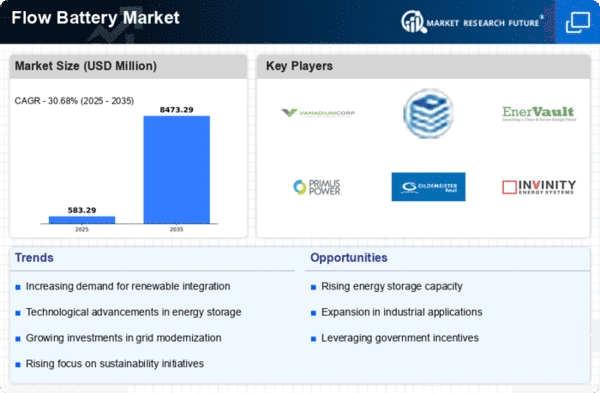
As per MRFR analysis, the Flow Battery Market Size was estimated at 446.35 USD Million in 2024. The Flow Battery industry is projected to grow from 583.3 USD Million in 2025 to 8473.29 USD Million by 2035, exhibiting a compound annual growth rate (CAGR) of 30.68% during the forecast period 2025 - 2035.

Key Market Trends & Highlights

The Flow Battery Market is poised for substantial growth driven by technological advancements and a focus on sustainability.

  • North America remains the largest market for flow batteries, driven by increasing investments in renewable energy storage solutions. Asia-Pacific is emerging as the fastest-growing region, reflecting a rising demand for innovative energy storage technologies. The Grid Energy Storage segment continues to dominate the market, while the Uninterruptible Power Supply segment is witnessing rapid growth. Key market drivers include the increasing demand for renewable energy storage and supportive government incentives and policies.

Market Size & Forecast

2024 Market Size 446.35 (USD Million)
2035 Market Size 8473.29 (USD Million)
CAGR (2025 - 2035) 30.68%
Largest Regional Market Share in 2024 North America

Major Players

VanadiumCorp Resource Inc (CA), Redflow Limited (AU), EnerVault Corporation (US), <a href="https://primuspower.com/press-release/flow-batteries-are-ready-for-prime-time/">Primus Power</a> (US), Gildemeister (DE), Invinity Energy Systems (GB), Sungrow Power Supply Co., Ltd. (CN), Flow Battery Systems (US), <a href="https://essinc.com/go-flow-comes-long-duration-storage/">ESS Inc.</a> (US)

Market Trends

The Flow Battery Market is currently experiencing a notable transformation, driven by the increasing demand for energy storage solutions. This shift is largely attributed to the growing emphasis on renewable energy sources, which necessitate efficient storage systems to manage intermittent supply. Their scalability and flexibility make them particularly appealing for large-scale applications, such as grid storage and renewable integration. The primary advantage of flow batteries in utility settings is their ability to deliver sustained power over long durations, making them ideal for stabilizing grids reliant on intermittent wind and solar energy.

As the world moves towards a more sustainable energy future, the Flow Battery Market is poised for substantial growth, reflecting a broader trend towards decarbonization and energy resilience. In addition to the push for renewable energy, advancements in flow battery technology are enhancing performance and reducing costs. Innovations in materials and design are likely to improve energy density and cycle life, making these systems more competitive against lithium-ion batteries. Furthermore, the increasing interest from various sectors, including commercial, industrial, and utility-scale applications, suggests a diversification of the market. As stakeholders recognize the potential of flow batteries to support energy transition goals, investment and research in this area are expected to intensify, further solidifying the Flow Battery Market's position in the energy landscape.

Technological Advancements

Recent innovations in flow battery technology are enhancing performance and efficiency. Research initiatives are focused on improving energy density and reducing manufacturing costs, which may lead to wider adoption in various applications.

Sustainability Focus

The increasing global emphasis on sustainability is driving interest in flow batteries. Their ability to support renewable energy integration aligns with environmental goals, making them a preferred choice for energy storage solutions.

Market Diversification

The Flow Battery Market is witnessing diversification in applications, ranging from grid energy storage to electric vehicles. This trend suggests a growing recognition of flow batteries' versatility and potential across multiple sectors.

Growing Use in High-Temperature 

The thermal stability of flow batteries (also known as Redox Batteries) allows them to operate in high-temperature environments without the need for the complex and energy-intensive cooling systems required by other chemistries. Companies are competing for Flow Battery Market share by developing standardized, containerized units that allow for rapid deployment and lower installation costs for commercial clients.

Flow Battery Market Market Drivers

Market Charts and Projections

The Flow Battery Market is characterized by dynamic growth projections and evolving trends. The market is expected to expand from a valuation of 0.45 USD Billion in 2024 to an impressive 8.47 USD Billion by 2035. This growth trajectory indicates a robust compound annual growth rate (CAGR) of 30.58% from 2025 to 2035. The charts illustrate the anticipated market expansion, highlighting key drivers such as technological advancements, government policies, and increasing demand for renewable energy storage. These visual representations provide a comprehensive overview of the market's potential, underscoring the importance of flow batteries in the global energy landscape.

Government Incentives and Policies

Government initiatives and policies significantly influence the Flow Battery Market, as many countries implement supportive measures to promote energy storage technologies. Incentives such as tax credits, grants, and subsidies encourage the adoption of flow batteries, particularly in renewable energy projects. For example, various governments are establishing frameworks that prioritize energy storage solutions to enhance grid stability and reliability. These policies not only stimulate market growth but also foster innovation within the industry. As governments recognize the importance of energy storage in achieving climate goals, the flow battery market is likely to benefit from increased funding and support, further driving its expansion.

Growing Applications in Electric Vehicles

The Flow Battery Industry is witnessing a notable increase in applications within the electric vehicle sector. Flow batteries offer several advantages, including longer cycle life and faster charging capabilities, making them an attractive option for electric vehicle manufacturers. As the demand for electric vehicles continues to rise, driven by environmental concerns and regulatory pressures, flow batteries are positioned to play a significant role in this market. Their scalability and ability to provide high energy output align well with the needs of electric vehicle technology. This trend suggests a promising future for flow batteries, potentially contributing to the market's growth trajectory through 2035.

Increasing Demand for Renewable Energy Storage

The Flow Battery Market experiences a surge in demand for energy storage solutions, driven by the global transition towards renewable energy sources. As countries aim to reduce carbon emissions, the need for efficient energy storage systems becomes paramount. Flow batteries, with their ability to store large amounts of energy for extended periods, are well-suited for this purpose. In 2024, the market is valued at 0.45 USD Billion, indicating a growing recognition of flow batteries as a viable option for integrating renewable energy into the grid. This trend is expected to continue, with projections suggesting a market growth to 8.47 USD Billion by 2035.

Technological Advancements in Flow Battery Systems

Technological innovations play a crucial role in the Flow Battery Market, enhancing the efficiency and performance of flow battery systems. Recent advancements in materials and designs have led to improved energy density and cycle life, making flow batteries more competitive against traditional energy storage technologies. For instance, developments in vanadium redox flow batteries have demonstrated increased efficiency and lower costs. These innovations not only attract investments but also expand the application range of flow batteries in various sectors, including grid storage and electric vehicles. As technology continues to evolve, the market is poised for significant growth, with a projected CAGR of 30.58% from 2025 to 2035.

Market Segment Insights

By Application: Grid Energy Storage (Largest) vs. Uninterruptible Power Supply (Fastest-Growing)

The Flow Battery Market is characterized by a diverse range of applications. Among these, Grid Energy Storage holds the largest share, serving as a critical solution for energy management and stability in <a href="https://www.marketresearchfuture.com/reports/power-grid-market-11459">power grids</a>. This segment has become increasingly important as the demand for reliable energy storage solutions rises due to more widespread adoption of renewable energy sources. On the other hand, Uninterruptible Power Supply (UPS) emerges as the fastest-growing application, catering to the increasing need for continuous power supply in various sectors, including healthcare and data centers.

Microgrid Systems (Dominant) vs. Electric Vehicle Charging (Emerging)

Microgrid Systems are becoming a dominant force in the Flow Battery Market, primarily due to their ability to operate independently and integrate various energy sources, thus enhancing energy security and resilience. These systems are particularly beneficial in remote or isolated areas where traditional grid connectivity is challenging. Conversely, Electric Vehicle Charging represents an emerging segment, fueled by the rising demand for EV infrastructure as more consumers and governments push towards sustainable transportation. While still developing, the flow battery's potential to deliver fast charging times and durability positions it favorably within this growing market. Both segments demonstrate a shift towards more innovative and sustainable energy solutions.

By End Use: Utility (Largest) vs. Commercial (Fastest-Growing)

In the Flow Battery Market, the end use segment is largely dominated by the utility sector, which encompasses a significant share due to its critical role in energy storage solutions that support grid stability and renewable integration. Following closely are the commercial and industrial segments, which leverage flow batteries for energy management and cost reduction. Residential applications also contribute to the market, albeit on a smaller scale, seeking efficient energy storage for home solar systems.

Utility: Dominant vs. Commercial: Emerging

The utility segment stands as a dominant force in the Flow Battery Market, primarily due to the increasing demand for energy storage solutions that assist in more sustainable and reliable electricity supply systems. Utility companies are opting for flow batteries for their ability to store large volumes of energy, particularly from renewable sources like wind and solar. In contrast, the commercial segment is emerging rapidly, with businesses recognizing the advantages of flow batteries for peak load shaving and energy cost savings. This segment is increasingly appealing due to the need for energy resilience and the pressure to reduce operational costs.

By Technology Type: Vanadium Flow Battery (Largest) vs. Zinc-Bromine Flow Battery (Fastest-Growing)

The Flow Battery Market is segmented into various technology types, with the Vanadium Flow Battery holding the largest market share. Its popularity stems from its durability, long cycle life, and capacity for large-scale energy storage applications. In contrast, the Zinc-Bromine Flow Battery is emerging rapidly due to its lower costs and higher energy density, appealing to both commercial and residential applications. The market is witnessing a diverse distribution of interests as different technologies cater to specific energy storage needs. As the demand for energy storage solutions grows, these technologies are experiencing significant interest from investors and end-users. The Vanadium Flow Battery continues to lead the market due to its sustainable attributes and reliable performance. Meanwhile, the Zinc-Bromine variant is benefiting from advancements in efficiency and cost reduction, making it a favored choice for emerging markets. This dynamic growth in technology types illustrates a broader trend towards innovative energy storage solutions within the renewable energy sector.

Vanadium Flow Battery (Dominant) vs. Zinc-Bromine Flow Battery (Emerging)

The Vanadium Flow Battery is considered the dominant technology in the flow battery market, recognized for its robustness and long-lasting performance. It offers a unique advantage in large-scale applications, such as grid energy storage, where high efficiency and longevity are paramount. Its strength lies in maintaining performance over numerous charge-discharge cycles without degradation, making it ideal for industrial use. On the other hand, the Zinc-Bromine Flow Battery is emerging as a competitive option, especially in smaller applications. It provides cost advantages and is perceived as a more environmentally friendly option due to the availability of its raw materials. The rapid advancements in the efficiency and effectiveness of Zinc-Bromine systems position them well for increased adoption in the energy storage market.

By Storage Duration: Medium Duration (Largest) vs. Long Duration (Fastest-Growing)

In the Flow Battery Market, the storage duration segment is predominantly characterized by the medium duration systems, which hold the largest market share. These systems are favored for their balance between cost and performance, making them a widely accepted choice for various applications. Short duration systems, though they hold a smaller share, serve niche markets that require rapid discharge capabilities, while long duration systems are emerging as an attractive option for grid stabilization and renewable integration. As the market expands, growth trends indicate a significant shift towards long duration flow batteries, driven by the increasing demand for energy storage solutions that can support intermittent renewable energy sources. Key drivers include technological advancements, policy support for clean energy initiatives, and the need for enhanced grid reliability. As such, long duration flow batteries are positioned to become a crucial component in the transition to sustainable energy systems.

Storage Duration: Medium Duration (Dominant) vs. Short Duration (Emerging)

Medium duration flow batteries remain the dominant storage choice in the market primarily due to their versatility and the ability to cater to various applications such as renewable energy integration and peak load management. These systems typically offer a discharge duration ranging from 4 to 10 hours, optimizing performance while minimizing costs. Conversely, short duration flow batteries, characterized by their quick discharge capabilities, are emerging as a critical solution for applications requiring immediate energy delivery. Although they make up a smaller portion of the market, their rapid response times make them ideal for frequency regulation and ancillary services in the grid. As energy systems evolve, the importance of both medium and short duration systems will be paramount.

By Power Rating: Medium Power (Largest) vs. High Power (Fastest-Growing)

<p>The Flow Battery Market showcases distinct segments across power ratings, with Medium Power batteries commanding the largest share due to their versatile applications in renewable energy systems and grid stabilization. Low Power batteries are also present, primarily catering to smaller-scale applications, while High Power batteries are gaining attention for their rapid deployment in large-scale energy storage projects. As the demand for efficient energy storage solutions grows, these segments continue to evolve, with Medium Power leading the market.</p>

<p>Medium Power: Dominant vs. High Power: Emerging</p>

<p>Medium Power flow batteries are currently dominating the Flow Battery Market, largely attributed to their adaptability in various settings, including industrial and commercial energy management. This segment supports a wide range of applications, enabling it to effectively meet increasing energy demands. In contrast, High Power flow batteries are emerging as a key player, driven by their ability to deliver rapid energy delivery, making them ideal for applications that require quick bursts of power. The rapid advancements in technology are fostering innovations in the High Power segment, positioning it for significant growth as energy storage needs diversify, especially in grid management and stabilization.</p>

Get more detailed insights about Flow Battery Market Research Report-Global Forecast till 2035

Regional Insights

North America : Market Leader in Flow Batteries

North America is poised to maintain its leadership in the flow battery market, holding a significant share of 223.18 million in 2024. The region's growth is driven by increasing investments in renewable energy and supportive government policies aimed at enhancing energy storage solutions. Regulatory frameworks are evolving to promote sustainable technologies, further boosting demand for flow batteries as a reliable energy storage option. The competitive landscape in North America is robust, featuring key players such as EnerVault Corporation and Primus Power. The U.S. leads the market, supported by technological advancements and a strong focus on energy resilience. Companies are innovating to enhance efficiency and reduce costs, positioning themselves favorably in a rapidly growing market. The presence of established firms and startups alike fosters a dynamic environment for growth and collaboration.

Europe : Emerging Market with Strong Potential

Europe is witnessing a surge in the flow battery market, with a market size of 120.0 million. The region's growth is fueled by stringent environmental regulations and a strong commitment to renewable energy sources. Governments are implementing policies that encourage the adoption of energy storage technologies, making flow batteries an attractive option for grid stability and energy management. Leading countries in this market include Germany and the UK, where companies like Gildemeister and Invinity Energy Systems are making significant strides. The competitive landscape is characterized by innovation and collaboration among industry players, enhancing the region's position in the global market. As Europe transitions to a low-carbon economy, the demand for efficient energy storage solutions is expected to rise, further driving market growth.

Asia-Pacific : Rapidly Growing Energy Storage Hub

The Asia-Pacific region is emerging as a key player in the flow battery market, with a market size of 85.0 million. The growth is driven by increasing energy demands and a shift towards renewable energy sources. Governments are investing in energy storage technologies to enhance grid reliability and support the integration of intermittent renewable energy, creating a favorable environment for flow battery adoption. Countries like China and Australia are at the forefront, with companies such as Sungrow Power Supply Co., Ltd. and Redflow Limited leading the charge. The competitive landscape is evolving, with both established firms and new entrants vying for market share. As the region continues to prioritize energy security and sustainability, the flow battery market is expected to experience significant growth in the coming years.

Middle East and Africa : Emerging Frontier for Energy Solutions

The Middle East and Africa (MEA) region is gradually emerging in the flow battery market, with a market size of 18.17 million. The growth is primarily driven by the increasing need for reliable energy storage solutions in remote areas and the rising investments in renewable energy projects. Governments are recognizing the importance of energy storage in enhancing energy security and are beginning to implement supportive policies. Countries like South Africa and the UAE are leading the charge, with a focus on diversifying their energy portfolios. The competitive landscape is still developing, with opportunities for both local and international players to enter the market. As the region continues to invest in infrastructure and renewable energy, the flow battery market is expected to grow, providing new avenues for innovation and investment.

Key Players and Competitive Insights

The Flow Battery Market is currently characterized by a dynamic competitive landscape, driven by the increasing demand for energy storage solutions and the transition towards renewable energy sources. Key players are actively engaging in strategic initiatives to enhance their market positioning. For instance, in November 2025, Invinity Energy Systems (GB) announced a partnership with a leading renewable energy provider to develop large-scale energy storage projects, indicating a focus on innovation and collaboration to meet growing energy demands. Similarly, Redflow Limited (AU) has been concentrating on regional expansion, having secured a contract in October 2025 to supply its flow batteries for a significant solar project in Australia, thereby reinforcing its operational focus on sustainable energy solutions. The business tactics employed by these companies reflect a trend towards localizing manufacturing and optimizing supply chains to enhance efficiency and reduce costs. The market structure appears moderately fragmented, with several players vying for market share, yet the collective influence of major companies is shaping competitive dynamics. This fragmentation allows for niche players to emerge, while larger firms leverage their resources to establish a more substantial presence. In October 2025, EnerVault Corporation (US) unveiled a new flow battery technology that reportedly increases energy density by 30%, a move that could potentially redefine performance standards in the industry. This innovation not only positions EnerVault as a leader in technological advancement but also highlights the importance of R&D in maintaining competitive advantage. Furthermore, in September 2025, Primus Power (US) secured a $10 million investment to scale up production capabilities, which suggests a strategic focus on meeting the rising demand for energy storage solutions in commercial applications. Additionally, in August 2025, ESS Inc. (US) announced the launch of a new product line aimed at enhancing the sustainability of its flow battery systems. This initiative aligns with the growing emphasis on environmentally friendly technologies and positions ESS as a forward-thinking player in the market. Such strategic actions reflect a broader trend towards sustainability and innovation, which are becoming critical differentiators in the competitive landscape. As of December 2025, current trends indicate a significant shift towards digitalization, sustainability, and the integration of AI technologies within the Flow Battery Market. Strategic alliances are increasingly shaping the landscape, enabling companies to pool resources and expertise to drive innovation. The competitive differentiation is likely to evolve from traditional price-based competition to a focus on technological advancements, reliability of supply chains, and sustainable practices. This transition underscores the necessity for companies to adapt and innovate continuously to maintain relevance in an ever-evolving market.

Key Companies in the Flow Battery Market include

Industry Developments

  • Q2 2024: Sumitomo Electric launches world's largest vanadium flow battery in China Sumitomo Electric Industries announced the commissioning of a 100MW/400MWh vanadium redox flow battery system in Dalian, China, marking the world's largest operational flow battery installation for grid-scale energy storage.
  • Q2 2024: Invinity Energy Systems secures $20M contract for flow battery deployment in California Invinity Energy Systems signed a $20 million contract to supply vanadium flow batteries for a major renewable energy project in California, supporting long-duration energy storage for solar and wind integration.
  • Q3 2024: VFlow Tech raises $15M Series B to expand flow battery manufacturing in Singapore Singapore-based VFlow Tech completed a $15 million Series B funding round to scale up its flow battery production capacity and accelerate commercialization in Southeast Asia.
  • Q3 2024: Redflow wins contract to supply flow batteries for Australian government microgrid project Redflow Ltd. announced it will provide zinc-bromine flow batteries for a government-backed microgrid initiative in Queensland, Australia, aimed at improving energy resilience in remote communities.
  • Q4 2024: Lockheed Martin partners with Nel ASA for flow battery pilot in Norway Lockheed Martin and Nel ASA entered a strategic partnership to deploy a pilot flow battery system in Norway, targeting renewable energy storage and grid balancing applications.
  • Q4 2024: Invinity Energy Systems opens new flow battery manufacturing facility in Scotland Invinity Energy Systems inaugurated a new manufacturing plant in Scotland dedicated to producing vanadium flow batteries for European energy storage markets.
  • Q1 2025: Elestor BV secures €12M grant from Dutch government for flow battery R&D Elestor BV received a €12 million grant from the Netherlands government to advance research and development of hydrogen-bromine flow battery technology for grid-scale storage.
  • Q1 2025: Primus Power announces executive appointment to lead global expansion Primus Power appointed a new Chief Commercial Officer to spearhead its international growth strategy for flow battery deployments in emerging markets.
  • Q1 2025: Sumitomo Electric signs MoU with Indian utility for flow battery pilot project Sumitomo Electric Industries signed a Memorandum of Understanding with a major Indian utility to launch a pilot vanadium flow battery project supporting renewable energy integration.
  • Q2 2025: VoltStorage GmbH announces new iron-salt flow battery product launch VoltStorage GmbH unveiled its latest iron-salt flow battery product, targeting commercial and industrial energy storage applications with improved cost efficiency and sustainability.
  • Q2 2025: Redflow opens new assembly facility in South Africa for zinc-bromine flow batteries Redflow Ltd. launched a new assembly plant in South Africa to meet growing demand for zinc-bromine flow batteries in the African energy storage market.
  • Q2 2025: StorEn Technologies secures $10M Series A funding for US flow battery commercialization StorEn Technologies completed a $10 million Series A funding round to accelerate commercialization of its vanadium flow battery systems in the United States.

Future Outlook

Flow Battery Market Future Outlook

The Flow Battery Market is projected to grow at a 30.68% CAGR from 2025 to 2035, driven by increasing demand for renewable energy storage and grid stability solutions. The overall Flow Battery Market size is influenced by the rising global demand for grid-resiliency assets that can survive for decades with negligible performance loss.

New opportunities lie in:

  • <p>Development of modular flow battery systems for residential applications. Integration of flow batteries with renewable energy sources for enhanced efficiency. Expansion into emerging markets with tailored energy storage solutions.</p>

By 2035, the Flow Battery Market is expected to achieve substantial growth, positioning itself as a leader in energy storage solutions.

Market Segmentation

Flow Battery Market End Use Outlook

  • Utility
  • Commercial
  • Industrial
  • Residential

Flow Battery Market Application Outlook

  • Grid Energy Storage
  • Renewable Energy Integration
  • Uninterruptible Power Supply
  • Electric Vehicle Charging
  • Microgrid Systems

Flow Battery Market Power Rating Outlook

  • Low Power
  • Medium Power
  • High Power

Flow Battery Market Technology Type Outlook

  • Vanadium Flow Battery
  • Zinc-Bromine Flow Battery
  • Iron-Chromium Flow Battery
  • Organic Flow Battery

Flow Battery Market Storage Duration Outlook

  • Short Duration
  • Medium Duration
  • Long Duration

Report Scope

MARKET SIZE 2024 446.35(USD Million)
MARKET SIZE 2025 583.3(USD Million)
MARKET SIZE 2035 8473.29(USD Million)
COMPOUND ANNUAL GROWTH RATE (CAGR) 30.68% (2025 - 2035)
REPORT COVERAGE Revenue Forecast, Competitive Landscape, Growth Factors, and Trends
BASE YEAR 2024
Market Forecast Period 2025 - 2035
Historical Data 2019 - 2024
Market Forecast Units USD Million
Key Companies Profiled VanadiumCorp Resource Inc (CA), Redflow Limited (AU), EnerVault Corporation (US), Primus Power (US), Gildemeister (DE), Invinity Energy Systems (GB), Sungrow Power Supply Co., Ltd. (CN), Flow Battery Systems (US), ESS Inc. (US)
Segments Covered Application, End Use, Technology Type, Storage Duration, Power Rating
Key Market Opportunities Growing demand for renewable energy storage solutions drives innovation in the Flow Battery Market.
Key Market Dynamics Rising demand for renewable energy storage drives innovation and competition in the flow battery market.
Countries Covered North America, Europe, APAC, South America, MEA

FAQs

What is the current valuation of the Flow Battery Market as of 2024?

<p>The Flow Battery Market was valued at 446.35 USD Million in 2024.</p>

What is the projected market valuation for the Flow Battery Market in 2035?

<p>The market is projected to reach 8473.29 USD Million by 2035.</p>

What is the expected CAGR for the Flow Battery Market during the forecast period 2025 - 2035?

<p>The expected CAGR for the Flow Battery Market during 2025 - 2035 is 30.68%.</p>

Which application segment had the highest valuation in 2024?

<p>The Renewable Energy Integration segment had the highest valuation at 2450.0 USD Million in 2024.</p>

What are the key players in the Flow Battery Market?

<p>Key players include Redflow, Vionx Energy, ESS Inc., and Gildemeister, among others.</p>

Which technology type is projected to dominate the Flow Battery Market by 2035?

<p>The Vanadium Flow Battery technology type is projected to dominate with a valuation of 2465.0 USD Million by 2035.</p>

What is the valuation of the Residential end-use segment in 2024?

The Residential end-use segment was valued at 146.35 USD Million in 2024.

How does the valuation of the Medium Duration storage compare to Long Duration storage in 2024?

In 2024, the Medium Duration storage was valued at 3360.0 USD Million, significantly higher than the Long Duration storage at 178.54 USD Million.

What is the projected valuation for the Commercial end-use segment by 2035?

The Commercial end-use segment is projected to reach 2500.0 USD Million by 2035.

Which power rating segment had the highest valuation in 2024?

The High Power rating segment had the highest valuation at 4473.29 USD Million in 2024.

  1. SECTION I: EXECUTIVE SUMMARY AND KEY HIGHLIGHTS
    1. | 1.1 EXECUTIVE SUMMARY
    2. | | 1.1.1 Market Overview
    3. | | 1.1.2 Key Findings
    4. | | 1.1.3 Market Segmentation
    5. | | 1.1.4 Competitive Landscape
    6. | | 1.1.5 Challenges and Opportunities
    7. | | 1.1.6 Future Outlook
  2. SECTION II: SCOPING, METHODOLOGY AND MARKET STRUCTURE
    1. | 2.1 MARKET INTRODUCTION
    2. | | 2.1.1 Definition
    3. | | 2.1.2 Scope of the study
    4. | | | 2.1.2.1 Research Objective
    5. | | | 2.1.2.2 Assumption
    6. | | | 2.1.2.3 Limitations
    7. | 2.2 RESEARCH METHODOLOGY
    8. | | 2.2.1 Overview
    9. | | 2.2.2 Data Mining
    10. | | 2.2.3 Secondary Research
    11. | | 2.2.4 Primary Research
    12. | | | 2.2.4.1 Primary Interviews and Information Gathering Process
    13. | | | 2.2.4.2 Breakdown of Primary Respondents
    14. | | 2.2.5 Forecasting Model
    15. | | 2.2.6 Market Size Estimation
    16. | | | 2.2.6.1 Bottom-Up Approach
    17. | | | 2.2.6.2 Top-Down Approach
    18. | | 2.2.7 Data Triangulation
    19. | | 2.2.8 Validation
  3. SECTION III: QUALITATIVE ANALYSIS
    1. | 3.1 MARKET DYNAMICS
    2. | | 3.1.1 Overview
    3. | | 3.1.2 Drivers
    4. | | 3.1.3 Restraints
    5. | | 3.1.4 Opportunities
    6. | 3.2 MARKET FACTOR ANALYSIS
    7. | | 3.2.1 Value chain Analysis
    8. | | 3.2.2 Porter's Five Forces Analysis
    9. | | | 3.2.2.1 Bargaining Power of Suppliers
    10. | | | 3.2.2.2 Bargaining Power of Buyers
    11. | | | 3.2.2.3 Threat of New Entrants
    12. | | | 3.2.2.4 Threat of Substitutes
    13. | | | 3.2.2.5 Intensity of Rivalry
    14. | | 3.2.3 COVID-19 Impact Analysis
    15. | | | 3.2.3.1 Market Impact Analysis
    16. | | | 3.2.3.2 Regional Impact
    17. | | | 3.2.3.3 Opportunity and Threat Analysis
  4. SECTION IV: QUANTITATIVE ANALYSIS
    1. | 4.1 Energy & Power, BY Application (USD Million)
    2. | | 4.1.1 Grid Energy Storage
    3. | | 4.1.2 Renewable Energy Integration
    4. | | 4.1.3 Uninterruptible Power Supply
    5. | | 4.1.4 Electric Vehicle Charging
    6. | | 4.1.5 Microgrid Systems
    7. | 4.2 Energy & Power, BY End Use (USD Million)
    8. | | 4.2.1 Utility
    9. | | 4.2.2 Commercial
    10. | | 4.2.3 Industrial
    11. | | 4.2.4 Residential
    12. | 4.3 Energy & Power, BY Technology Type (USD Million)
    13. | | 4.3.1 Vanadium Flow Battery
    14. | | 4.3.2 Zinc-Bromine Flow Battery
    15. | | 4.3.3 Iron-Chromium Flow Battery
    16. | | 4.3.4 Organic Flow Battery
    17. | 4.4 Energy & Power, BY Storage Duration (USD Million)
    18. | | 4.4.1 Short Duration
    19. | | 4.4.2 Medium Duration
    20. | | 4.4.3 Long Duration
    21. | 4.5 Energy & Power, BY Power Rating (USD Million)
    22. | | 4.5.1 Low Power
    23. | | 4.5.2 Medium Power
    24. | | 4.5.3 High Power
    25. | 4.6 Energy & Power, BY Region (USD Million)
    26. | | 4.6.1 North America
    27. | | | 4.6.1.1 US
    28. | | | 4.6.1.2 Canada
    29. | | 4.6.2 Europe
    30. | | | 4.6.2.1 Germany
    31. | | | 4.6.2.2 UK
    32. | | | 4.6.2.3 France
    33. | | | 4.6.2.4 Russia
    34. | | | 4.6.2.5 Italy
    35. | | | 4.6.2.6 Spain
    36. | | | 4.6.2.7 Rest of Europe
    37. | | 4.6.3 APAC
    38. | | | 4.6.3.1 China
    39. | | | 4.6.3.2 India
    40. | | | 4.6.3.3 Japan
    41. | | | 4.6.3.4 South Korea
    42. | | | 4.6.3.5 Malaysia
    43. | | | 4.6.3.6 Thailand
    44. | | | 4.6.3.7 Indonesia
    45. | | | 4.6.3.8 Rest of APAC
    46. | | 4.6.4 South America
    47. | | | 4.6.4.1 Brazil
    48. | | | 4.6.4.2 Mexico
    49. | | | 4.6.4.3 Argentina
    50. | | | 4.6.4.4 Rest of South America
    51. | | 4.6.5 MEA
    52. | | | 4.6.5.1 GCC Countries
    53. | | | 4.6.5.2 South Africa
    54. | | | 4.6.5.3 Rest of MEA
  5. SECTION V: COMPETITIVE ANALYSIS
    1. | 5.1 Competitive Landscape
    2. | | 5.1.1 Overview
    3. | | 5.1.2 Competitive Analysis
    4. | | 5.1.3 Market share Analysis
    5. | | 5.1.4 Major Growth Strategy in the Energy & Power
    6. | | 5.1.5 Competitive Benchmarking
    7. | | 5.1.6 Leading Players in Terms of Number of Developments in the Energy & Power
    8. | | 5.1.7 Key developments and growth strategies
    9. | | | 5.1.7.1 New Product Launch/Service Deployment
    10. | | | 5.1.7.2 Merger & Acquisitions
    11. | | | 5.1.7.3 Joint Ventures
    12. | | 5.1.8 Major Players Financial Matrix
    13. | | | 5.1.8.1 Sales and Operating Income
    14. | | | 5.1.8.2 Major Players R&D Expenditure. 2023
    15. | 5.2 Company Profiles
    16. | | 5.2.1 Redflow (AU)
    17. | | | 5.2.1.1 Financial Overview
    18. | | | 5.2.1.2 Products Offered
    19. | | | 5.2.1.3 Key Developments
    20. | | | 5.2.1.4 SWOT Analysis
    21. | | | 5.2.1.5 Key Strategies
    22. | | 5.2.2 Vionx Energy (US)
    23. | | | 5.2.2.1 Financial Overview
    24. | | | 5.2.2.2 Products Offered
    25. | | | 5.2.2.3 Key Developments
    26. | | | 5.2.2.4 SWOT Analysis
    27. | | | 5.2.2.5 Key Strategies
    28. | | 5.2.3 ESS Inc. (US)
    29. | | | 5.2.3.1 Financial Overview
    30. | | | 5.2.3.2 Products Offered
    31. | | | 5.2.3.3 Key Developments
    32. | | | 5.2.3.4 SWOT Analysis
    33. | | | 5.2.3.5 Key Strategies
    34. | | 5.2.4 Gildemeister (DE)
    35. | | | 5.2.4.1 Financial Overview
    36. | | | 5.2.4.2 Products Offered
    37. | | | 5.2.4.3 Key Developments
    38. | | | 5.2.4.4 SWOT Analysis
    39. | | | 5.2.4.5 Key Strategies
    40. | | 5.2.5 Sungrow Power Supply Co. (CN)
    41. | | | 5.2.5.1 Financial Overview
    42. | | | 5.2.5.2 Products Offered
    43. | | | 5.2.5.3 Key Developments
    44. | | | 5.2.5.4 SWOT Analysis
    45. | | | 5.2.5.5 Key Strategies
    46. | | 5.2.6 Primus Power (US)
    47. | | | 5.2.6.1 Financial Overview
    48. | | | 5.2.6.2 Products Offered
    49. | | | 5.2.6.3 Key Developments
    50. | | | 5.2.6.4 SWOT Analysis
    51. | | | 5.2.6.5 Key Strategies
    52. | | 5.2.7 Invinity Energy Systems (GB)
    53. | | | 5.2.7.1 Financial Overview
    54. | | | 5.2.7.2 Products Offered
    55. | | | 5.2.7.3 Key Developments
    56. | | | 5.2.7.4 SWOT Analysis
    57. | | | 5.2.7.5 Key Strategies
    58. | | 5.2.8 Flow Battery Systems (US)
    59. | | | 5.2.8.1 Financial Overview
    60. | | | 5.2.8.2 Products Offered
    61. | | | 5.2.8.3 Key Developments
    62. | | | 5.2.8.4 SWOT Analysis
    63. | | | 5.2.8.5 Key Strategies
    64. | | 5.2.9 Ceres Media (US)
    65. | | | 5.2.9.1 Financial Overview
    66. | | | 5.2.9.2 Products Offered
    67. | | | 5.2.9.3 Key Developments
    68. | | | 5.2.9.4 SWOT Analysis
    69. | | | 5.2.9.5 Key Strategies
    70. | 5.3 Appendix
    71. | | 5.3.1 References
    72. | | 5.3.2 Related Reports
  6. LIST OF FIGURES
    1. | 6.1 MARKET SYNOPSIS
    2. | 6.2 NORTH AMERICA MARKET ANALYSIS
    3. | 6.3 US MARKET ANALYSIS BY APPLICATION
    4. | 6.4 US MARKET ANALYSIS BY END USE
    5. | 6.5 US MARKET ANALYSIS BY TECHNOLOGY TYPE
    6. | 6.6 US MARKET ANALYSIS BY STORAGE DURATION
    7. | 6.7 US MARKET ANALYSIS BY POWER RATING
    8. | 6.8 CANADA MARKET ANALYSIS BY APPLICATION
    9. | 6.9 CANADA MARKET ANALYSIS BY END USE
    10. | 6.10 CANADA MARKET ANALYSIS BY TECHNOLOGY TYPE
    11. | 6.11 CANADA MARKET ANALYSIS BY STORAGE DURATION
    12. | 6.12 CANADA MARKET ANALYSIS BY POWER RATING
    13. | 6.13 EUROPE MARKET ANALYSIS
    14. | 6.14 GERMANY MARKET ANALYSIS BY APPLICATION
    15. | 6.15 GERMANY MARKET ANALYSIS BY END USE
    16. | 6.16 GERMANY MARKET ANALYSIS BY TECHNOLOGY TYPE
    17. | 6.17 GERMANY MARKET ANALYSIS BY STORAGE DURATION
    18. | 6.18 GERMANY MARKET ANALYSIS BY POWER RATING
    19. | 6.19 UK MARKET ANALYSIS BY APPLICATION
    20. | 6.20 UK MARKET ANALYSIS BY END USE
    21. | 6.21 UK MARKET ANALYSIS BY TECHNOLOGY TYPE
    22. | 6.22 UK MARKET ANALYSIS BY STORAGE DURATION
    23. | 6.23 UK MARKET ANALYSIS BY POWER RATING
    24. | 6.24 FRANCE MARKET ANALYSIS BY APPLICATION
    25. | 6.25 FRANCE MARKET ANALYSIS BY END USE
    26. | 6.26 FRANCE MARKET ANALYSIS BY TECHNOLOGY TYPE
    27. | 6.27 FRANCE MARKET ANALYSIS BY STORAGE DURATION
    28. | 6.28 FRANCE MARKET ANALYSIS BY POWER RATING
    29. | 6.29 RUSSIA MARKET ANALYSIS BY APPLICATION
    30. | 6.30 RUSSIA MARKET ANALYSIS BY END USE
    31. | 6.31 RUSSIA MARKET ANALYSIS BY TECHNOLOGY TYPE
    32. | 6.32 RUSSIA MARKET ANALYSIS BY STORAGE DURATION
    33. | 6.33 RUSSIA MARKET ANALYSIS BY POWER RATING
    34. | 6.34 ITALY MARKET ANALYSIS BY APPLICATION
    35. | 6.35 ITALY MARKET ANALYSIS BY END USE
    36. | 6.36 ITALY MARKET ANALYSIS BY TECHNOLOGY TYPE
    37. | 6.37 ITALY MARKET ANALYSIS BY STORAGE DURATION
    38. | 6.38 ITALY MARKET ANALYSIS BY POWER RATING
    39. | 6.39 SPAIN MARKET ANALYSIS BY APPLICATION
    40. | 6.40 SPAIN MARKET ANALYSIS BY END USE
    41. | 6.41 SPAIN MARKET ANALYSIS BY TECHNOLOGY TYPE
    42. | 6.42 SPAIN MARKET ANALYSIS BY STORAGE DURATION
    43. | 6.43 SPAIN MARKET ANALYSIS BY POWER RATING
    44. | 6.44 REST OF EUROPE MARKET ANALYSIS BY APPLICATION
    45. | 6.45 REST OF EUROPE MARKET ANALYSIS BY END USE
    46. | 6.46 REST OF EUROPE MARKET ANALYSIS BY TECHNOLOGY TYPE
    47. | 6.47 REST OF EUROPE MARKET ANALYSIS BY STORAGE DURATION
    48. | 6.48 REST OF EUROPE MARKET ANALYSIS BY POWER RATING
    49. | 6.49 APAC MARKET ANALYSIS
    50. | 6.50 CHINA MARKET ANALYSIS BY APPLICATION
    51. | 6.51 CHINA MARKET ANALYSIS BY END USE
    52. | 6.52 CHINA MARKET ANALYSIS BY TECHNOLOGY TYPE
    53. | 6.53 CHINA MARKET ANALYSIS BY STORAGE DURATION
    54. | 6.54 CHINA MARKET ANALYSIS BY POWER RATING
    55. | 6.55 INDIA MARKET ANALYSIS BY APPLICATION
    56. | 6.56 INDIA MARKET ANALYSIS BY END USE
    57. | 6.57 INDIA MARKET ANALYSIS BY TECHNOLOGY TYPE
    58. | 6.58 INDIA MARKET ANALYSIS BY STORAGE DURATION
    59. | 6.59 INDIA MARKET ANALYSIS BY POWER RATING
    60. | 6.60 JAPAN MARKET ANALYSIS BY APPLICATION
    61. | 6.61 JAPAN MARKET ANALYSIS BY END USE
    62. | 6.62 JAPAN MARKET ANALYSIS BY TECHNOLOGY TYPE
    63. | 6.63 JAPAN MARKET ANALYSIS BY STORAGE DURATION
    64. | 6.64 JAPAN MARKET ANALYSIS BY POWER RATING
    65. | 6.65 SOUTH KOREA MARKET ANALYSIS BY APPLICATION
    66. | 6.66 SOUTH KOREA MARKET ANALYSIS BY END USE
    67. | 6.67 SOUTH KOREA MARKET ANALYSIS BY TECHNOLOGY TYPE
    68. | 6.68 SOUTH KOREA MARKET ANALYSIS BY STORAGE DURATION
    69. | 6.69 SOUTH KOREA MARKET ANALYSIS BY POWER RATING
    70. | 6.70 MALAYSIA MARKET ANALYSIS BY APPLICATION
    71. | 6.71 MALAYSIA MARKET ANALYSIS BY END USE
    72. | 6.72 MALAYSIA MARKET ANALYSIS BY TECHNOLOGY TYPE
    73. | 6.73 MALAYSIA MARKET ANALYSIS BY STORAGE DURATION
    74. | 6.74 MALAYSIA MARKET ANALYSIS BY POWER RATING
    75. | 6.75 THAILAND MARKET ANALYSIS BY APPLICATION
    76. | 6.76 THAILAND MARKET ANALYSIS BY END USE
    77. | 6.77 THAILAND MARKET ANALYSIS BY TECHNOLOGY TYPE
    78. | 6.78 THAILAND MARKET ANALYSIS BY STORAGE DURATION
    79. | 6.79 THAILAND MARKET ANALYSIS BY POWER RATING
    80. | 6.80 INDONESIA MARKET ANALYSIS BY APPLICATION
    81. | 6.81 INDONESIA MARKET ANALYSIS BY END USE
    82. | 6.82 INDONESIA MARKET ANALYSIS BY TECHNOLOGY TYPE
    83. | 6.83 INDONESIA MARKET ANALYSIS BY STORAGE DURATION
    84. | 6.84 INDONESIA MARKET ANALYSIS BY POWER RATING
    85. | 6.85 REST OF APAC MARKET ANALYSIS BY APPLICATION
    86. | 6.86 REST OF APAC MARKET ANALYSIS BY END USE
    87. | 6.87 REST OF APAC MARKET ANALYSIS BY TECHNOLOGY TYPE
    88. | 6.88 REST OF APAC MARKET ANALYSIS BY STORAGE DURATION
    89. | 6.89 REST OF APAC MARKET ANALYSIS BY POWER RATING
    90. | 6.90 SOUTH AMERICA MARKET ANALYSIS
    91. | 6.91 BRAZIL MARKET ANALYSIS BY APPLICATION
    92. | 6.92 BRAZIL MARKET ANALYSIS BY END USE
    93. | 6.93 BRAZIL MARKET ANALYSIS BY TECHNOLOGY TYPE
    94. | 6.94 BRAZIL MARKET ANALYSIS BY STORAGE DURATION
    95. | 6.95 BRAZIL MARKET ANALYSIS BY POWER RATING
    96. | 6.96 MEXICO MARKET ANALYSIS BY APPLICATION
    97. | 6.97 MEXICO MARKET ANALYSIS BY END USE
    98. | 6.98 MEXICO MARKET ANALYSIS BY TECHNOLOGY TYPE
    99. | 6.99 MEXICO MARKET ANALYSIS BY STORAGE DURATION
    100. | 6.100 MEXICO MARKET ANALYSIS BY POWER RATING
    101. | 6.101 ARGENTINA MARKET ANALYSIS BY APPLICATION
    102. | 6.102 ARGENTINA MARKET ANALYSIS BY END USE
    103. | 6.103 ARGENTINA MARKET ANALYSIS BY TECHNOLOGY TYPE
    104. | 6.104 ARGENTINA MARKET ANALYSIS BY STORAGE DURATION
    105. | 6.105 ARGENTINA MARKET ANALYSIS BY POWER RATING
    106. | 6.106 REST OF SOUTH AMERICA MARKET ANALYSIS BY APPLICATION
    107. | 6.107 REST OF SOUTH AMERICA MARKET ANALYSIS BY END USE
    108. | 6.108 REST OF SOUTH AMERICA MARKET ANALYSIS BY TECHNOLOGY TYPE
    109. | 6.109 REST OF SOUTH AMERICA MARKET ANALYSIS BY STORAGE DURATION
    110. | 6.110 REST OF SOUTH AMERICA MARKET ANALYSIS BY POWER RATING
    111. | 6.111 MEA MARKET ANALYSIS
    112. | 6.112 GCC COUNTRIES MARKET ANALYSIS BY APPLICATION
    113. | 6.113 GCC COUNTRIES MARKET ANALYSIS BY END USE
    114. | 6.114 GCC COUNTRIES MARKET ANALYSIS BY TECHNOLOGY TYPE
    115. | 6.115 GCC COUNTRIES MARKET ANALYSIS BY STORAGE DURATION
    116. | 6.116 GCC COUNTRIES MARKET ANALYSIS BY POWER RATING
    117. | 6.117 SOUTH AFRICA MARKET ANALYSIS BY APPLICATION
    118. | 6.118 SOUTH AFRICA MARKET ANALYSIS BY END USE
    119. | 6.119 SOUTH AFRICA MARKET ANALYSIS BY TECHNOLOGY TYPE
    120. | 6.120 SOUTH AFRICA MARKET ANALYSIS BY STORAGE DURATION
    121. | 6.121 SOUTH AFRICA MARKET ANALYSIS BY POWER RATING
    122. | 6.122 REST OF MEA MARKET ANALYSIS BY APPLICATION
    123. | 6.123 REST OF MEA MARKET ANALYSIS BY END USE
    124. | 6.124 REST OF MEA MARKET ANALYSIS BY TECHNOLOGY TYPE
    125. | 6.125 REST OF MEA MARKET ANALYSIS BY STORAGE DURATION
    126. | 6.126 REST OF MEA MARKET ANALYSIS BY POWER RATING
    127. | 6.127 KEY BUYING CRITERIA OF ENERGY & POWER
    128. | 6.128 RESEARCH PROCESS OF MRFR
    129. | 6.129 DRO ANALYSIS OF ENERGY & POWER
    130. | 6.130 DRIVERS IMPACT ANALYSIS: ENERGY & POWER
    131. | 6.131 RESTRAINTS IMPACT ANALYSIS: ENERGY & POWER
    132. | 6.132 SUPPLY / VALUE CHAIN: ENERGY & POWER
    133. | 6.133 ENERGY & POWER, BY APPLICATION, 2024 (% SHARE)
    134. | 6.134 ENERGY & POWER, BY APPLICATION, 2024 TO 2035 (USD Million)
    135. | 6.135 ENERGY & POWER, BY END USE, 2024 (% SHARE)
    136. | 6.136 ENERGY & POWER, BY END USE, 2024 TO 2035 (USD Million)
    137. | 6.137 ENERGY & POWER, BY TECHNOLOGY TYPE, 2024 (% SHARE)
    138. | 6.138 ENERGY & POWER, BY TECHNOLOGY TYPE, 2024 TO 2035 (USD Million)
    139. | 6.139 ENERGY & POWER, BY STORAGE DURATION, 2024 (% SHARE)
    140. | 6.140 ENERGY & POWER, BY STORAGE DURATION, 2024 TO 2035 (USD Million)
    141. | 6.141 ENERGY & POWER, BY POWER RATING, 2024 (% SHARE)
    142. | 6.142 ENERGY & POWER, BY POWER RATING, 2024 TO 2035 (USD Million)
    143. | 6.143 BENCHMARKING OF MAJOR COMPETITORS
  7. LIST OF TABLES
    1. | 7.1 LIST OF ASSUMPTIONS
    2. | | 7.1.1
    3. | 7.2 North America MARKET SIZE ESTIMATES; FORECAST
    4. | | 7.2.1 BY APPLICATION, 2025-2035 (USD Million)
    5. | | 7.2.2 BY END USE, 2025-2035 (USD Million)
    6. | | 7.2.3 BY TECHNOLOGY TYPE, 2025-2035 (USD Million)
    7. | | 7.2.4 BY STORAGE DURATION, 2025-2035 (USD Million)
    8. | | 7.2.5 BY POWER RATING, 2025-2035 (USD Million)
    9. | 7.3 US MARKET SIZE ESTIMATES; FORECAST
    10. | | 7.3.1 BY APPLICATION, 2025-2035 (USD Million)
    11. | | 7.3.2 BY END USE, 2025-2035 (USD Million)
    12. | | 7.3.3 BY TECHNOLOGY TYPE, 2025-2035 (USD Million)
    13. | | 7.3.4 BY STORAGE DURATION, 2025-2035 (USD Million)
    14. | | 7.3.5 BY POWER RATING, 2025-2035 (USD Million)
    15. | 7.4 Canada MARKET SIZE ESTIMATES; FORECAST
    16. | | 7.4.1 BY APPLICATION, 2025-2035 (USD Million)
    17. | | 7.4.2 BY END USE, 2025-2035 (USD Million)
    18. | | 7.4.3 BY TECHNOLOGY TYPE, 2025-2035 (USD Million)
    19. | | 7.4.4 BY STORAGE DURATION, 2025-2035 (USD Million)
    20. | | 7.4.5 BY POWER RATING, 2025-2035 (USD Million)
    21. | 7.5 Europe MARKET SIZE ESTIMATES; FORECAST
    22. | | 7.5.1 BY APPLICATION, 2025-2035 (USD Million)
    23. | | 7.5.2 BY END USE, 2025-2035 (USD Million)
    24. | | 7.5.3 BY TECHNOLOGY TYPE, 2025-2035 (USD Million)
    25. | | 7.5.4 BY STORAGE DURATION, 2025-2035 (USD Million)
    26. | | 7.5.5 BY POWER RATING, 2025-2035 (USD Million)
    27. | 7.6 Germany MARKET SIZE ESTIMATES; FORECAST
    28. | | 7.6.1 BY APPLICATION, 2025-2035 (USD Million)
    29. | | 7.6.2 BY END USE, 2025-2035 (USD Million)
    30. | | 7.6.3 BY TECHNOLOGY TYPE, 2025-2035 (USD Million)
    31. | | 7.6.4 BY STORAGE DURATION, 2025-2035 (USD Million)
    32. | | 7.6.5 BY POWER RATING, 2025-2035 (USD Million)
    33. | 7.7 UK MARKET SIZE ESTIMATES; FORECAST
    34. | | 7.7.1 BY APPLICATION, 2025-2035 (USD Million)
    35. | | 7.7.2 BY END USE, 2025-2035 (USD Million)
    36. | | 7.7.3 BY TECHNOLOGY TYPE, 2025-2035 (USD Million)
    37. | | 7.7.4 BY STORAGE DURATION, 2025-2035 (USD Million)
    38. | | 7.7.5 BY POWER RATING, 2025-2035 (USD Million)
    39. | 7.8 France MARKET SIZE ESTIMATES; FORECAST
    40. | | 7.8.1 BY APPLICATION, 2025-2035 (USD Million)
    41. | | 7.8.2 BY END USE, 2025-2035 (USD Million)
    42. | | 7.8.3 BY TECHNOLOGY TYPE, 2025-2035 (USD Million)
    43. | | 7.8.4 BY STORAGE DURATION, 2025-2035 (USD Million)
    44. | | 7.8.5 BY POWER RATING, 2025-2035 (USD Million)
    45. | 7.9 Russia MARKET SIZE ESTIMATES; FORECAST
    46. | | 7.9.1 BY APPLICATION, 2025-2035 (USD Million)
    47. | | 7.9.2 BY END USE, 2025-2035 (USD Million)
    48. | | 7.9.3 BY TECHNOLOGY TYPE, 2025-2035 (USD Million)
    49. | | 7.9.4 BY STORAGE DURATION, 2025-2035 (USD Million)
    50. | | 7.9.5 BY POWER RATING, 2025-2035 (USD Million)
    51. | 7.10 Italy MARKET SIZE ESTIMATES; FORECAST
    52. | | 7.10.1 BY APPLICATION, 2025-2035 (USD Million)
    53. | | 7.10.2 BY END USE, 2025-2035 (USD Million)
    54. | | 7.10.3 BY TECHNOLOGY TYPE, 2025-2035 (USD Million)
    55. | | 7.10.4 BY STORAGE DURATION, 2025-2035 (USD Million)
    56. | | 7.10.5 BY POWER RATING, 2025-2035 (USD Million)
    57. | 7.11 Spain MARKET SIZE ESTIMATES; FORECAST
    58. | | 7.11.1 BY APPLICATION, 2025-2035 (USD Million)
    59. | | 7.11.2 BY END USE, 2025-2035 (USD Million)
    60. | | 7.11.3 BY TECHNOLOGY TYPE, 2025-2035 (USD Million)
    61. | | 7.11.4 BY STORAGE DURATION, 2025-2035 (USD Million)
    62. | | 7.11.5 BY POWER RATING, 2025-2035 (USD Million)
    63. | 7.12 Rest of Europe MARKET SIZE ESTIMATES; FORECAST
    64. | | 7.12.1 BY APPLICATION, 2025-2035 (USD Million)
    65. | | 7.12.2 BY END USE, 2025-2035 (USD Million)
    66. | | 7.12.3 BY TECHNOLOGY TYPE, 2025-2035 (USD Million)
    67. | | 7.12.4 BY STORAGE DURATION, 2025-2035 (USD Million)
    68. | | 7.12.5 BY POWER RATING, 2025-2035 (USD Million)
    69. | 7.13 APAC MARKET SIZE ESTIMATES; FORECAST
    70. | | 7.13.1 BY APPLICATION, 2025-2035 (USD Million)
    71. | | 7.13.2 BY END USE, 2025-2035 (USD Million)
    72. | | 7.13.3 BY TECHNOLOGY TYPE, 2025-2035 (USD Million)
    73. | | 7.13.4 BY STORAGE DURATION, 2025-2035 (USD Million)
    74. | | 7.13.5 BY POWER RATING, 2025-2035 (USD Million)
    75. | 7.14 China MARKET SIZE ESTIMATES; FORECAST
    76. | | 7.14.1 BY APPLICATION, 2025-2035 (USD Million)
    77. | | 7.14.2 BY END USE, 2025-2035 (USD Million)
    78. | | 7.14.3 BY TECHNOLOGY TYPE, 2025-2035 (USD Million)
    79. | | 7.14.4 BY STORAGE DURATION, 2025-2035 (USD Million)
    80. | | 7.14.5 BY POWER RATING, 2025-2035 (USD Million)
    81. | 7.15 India MARKET SIZE ESTIMATES; FORECAST
    82. | | 7.15.1 BY APPLICATION, 2025-2035 (USD Million)
    83. | | 7.15.2 BY END USE, 2025-2035 (USD Million)
    84. | | 7.15.3 BY TECHNOLOGY TYPE, 2025-2035 (USD Million)
    85. | | 7.15.4 BY STORAGE DURATION, 2025-2035 (USD Million)
    86. | | 7.15.5 BY POWER RATING, 2025-2035 (USD Million)
    87. | 7.16 Japan MARKET SIZE ESTIMATES; FORECAST
    88. | | 7.16.1 BY APPLICATION, 2025-2035 (USD Million)
    89. | | 7.16.2 BY END USE, 2025-2035 (USD Million)
    90. | | 7.16.3 BY TECHNOLOGY TYPE, 2025-2035 (USD Million)
    91. | | 7.16.4 BY STORAGE DURATION, 2025-2035 (USD Million)
    92. | | 7.16.5 BY POWER RATING, 2025-2035 (USD Million)
    93. | 7.17 South Korea MARKET SIZE ESTIMATES; FORECAST
    94. | | 7.17.1 BY APPLICATION, 2025-2035 (USD Million)
    95. | | 7.17.2 BY END USE, 2025-2035 (USD Million)
    96. | | 7.17.3 BY TECHNOLOGY TYPE, 2025-2035 (USD Million)
    97. | | 7.17.4 BY STORAGE DURATION, 2025-2035 (USD Million)
    98. | | 7.17.5 BY POWER RATING, 2025-2035 (USD Million)
    99. | 7.18 Malaysia MARKET SIZE ESTIMATES; FORECAST
    100. | | 7.18.1 BY APPLICATION, 2025-2035 (USD Million)
    101. | | 7.18.2 BY END USE, 2025-2035 (USD Million)
    102. | | 7.18.3 BY TECHNOLOGY TYPE, 2025-2035 (USD Million)
    103. | | 7.18.4 BY STORAGE DURATION, 2025-2035 (USD Million)
    104. | | 7.18.5 BY POWER RATING, 2025-2035 (USD Million)
    105. | 7.19 Thailand MARKET SIZE ESTIMATES; FORECAST
    106. | | 7.19.1 BY APPLICATION, 2025-2035 (USD Million)
    107. | | 7.19.2 BY END USE, 2025-2035 (USD Million)
    108. | | 7.19.3 BY TECHNOLOGY TYPE, 2025-2035 (USD Million)
    109. | | 7.19.4 BY STORAGE DURATION, 2025-2035 (USD Million)
    110. | | 7.19.5 BY POWER RATING, 2025-2035 (USD Million)
    111. | 7.20 Indonesia MARKET SIZE ESTIMATES; FORECAST
    112. | | 7.20.1 BY APPLICATION, 2025-2035 (USD Million)
    113. | | 7.20.2 BY END USE, 2025-2035 (USD Million)
    114. | | 7.20.3 BY TECHNOLOGY TYPE, 2025-2035 (USD Million)
    115. | | 7.20.4 BY STORAGE DURATION, 2025-2035 (USD Million)
    116. | | 7.20.5 BY POWER RATING, 2025-2035 (USD Million)
    117. | 7.21 Rest of APAC MARKET SIZE ESTIMATES; FORECAST
    118. | | 7.21.1 BY APPLICATION, 2025-2035 (USD Million)
    119. | | 7.21.2 BY END USE, 2025-2035 (USD Million)
    120. | | 7.21.3 BY TECHNOLOGY TYPE, 2025-2035 (USD Million)
    121. | | 7.21.4 BY STORAGE DURATION, 2025-2035 (USD Million)
    122. | | 7.21.5 BY POWER RATING, 2025-2035 (USD Million)
    123. | 7.22 South America MARKET SIZE ESTIMATES; FORECAST
    124. | | 7.22.1 BY APPLICATION, 2025-2035 (USD Million)
    125. | | 7.22.2 BY END USE, 2025-2035 (USD Million)
    126. | | 7.22.3 BY TECHNOLOGY TYPE, 2025-2035 (USD Million)
    127. | | 7.22.4 BY STORAGE DURATION, 2025-2035 (USD Million)
    128. | | 7.22.5 BY POWER RATING, 2025-2035 (USD Million)
    129. | 7.23 Brazil MARKET SIZE ESTIMATES; FORECAST
    130. | | 7.23.1 BY APPLICATION, 2025-2035 (USD Million)
    131. | | 7.23.2 BY END USE, 2025-2035 (USD Million)
    132. | | 7.23.3 BY TECHNOLOGY TYPE, 2025-2035 (USD Million)
    133. | | 7.23.4 BY STORAGE DURATION, 2025-2035 (USD Million)
    134. | | 7.23.5 BY POWER RATING, 2025-2035 (USD Million)
    135. | 7.24 Mexico MARKET SIZE ESTIMATES; FORECAST
    136. | | 7.24.1 BY APPLICATION, 2025-2035 (USD Million)
    137. | | 7.24.2 BY END USE, 2025-2035 (USD Million)
    138. | | 7.24.3 BY TECHNOLOGY TYPE, 2025-2035 (USD Million)
    139. | | 7.24.4 BY STORAGE DURATION, 2025-2035 (USD Million)
    140. | | 7.24.5 BY POWER RATING, 2025-2035 (USD Million)
    141. | 7.25 Argentina MARKET SIZE ESTIMATES; FORECAST
    142. | | 7.25.1 BY APPLICATION, 2025-2035 (USD Million)
    143. | | 7.25.2 BY END USE, 2025-2035 (USD Million)
    144. | | 7.25.3 BY TECHNOLOGY TYPE, 2025-2035 (USD Million)
    145. | | 7.25.4 BY STORAGE DURATION, 2025-2035 (USD Million)
    146. | | 7.25.5 BY POWER RATING, 2025-2035 (USD Million)
    147. | 7.26 Rest of South America MARKET SIZE ESTIMATES; FORECAST
    148. | | 7.26.1 BY APPLICATION, 2025-2035 (USD Million)
    149. | | 7.26.2 BY END USE, 2025-2035 (USD Million)
    150. | | 7.26.3 BY TECHNOLOGY TYPE, 2025-2035 (USD Million)
    151. | | 7.26.4 BY STORAGE DURATION, 2025-2035 (USD Million)
    152. | | 7.26.5 BY POWER RATING, 2025-2035 (USD Million)
    153. | 7.27 MEA MARKET SIZE ESTIMATES; FORECAST
    154. | | 7.27.1 BY APPLICATION, 2025-2035 (USD Million)
    155. | | 7.27.2 BY END USE, 2025-2035 (USD Million)
    156. | | 7.27.3 BY TECHNOLOGY TYPE, 2025-2035 (USD Million)
    157. | | 7.27.4 BY STORAGE DURATION, 2025-2035 (USD Million)
    158. | | 7.27.5 BY POWER RATING, 2025-2035 (USD Million)
    159. | 7.28 GCC Countries MARKET SIZE ESTIMATES; FORECAST
    160. | | 7.28.1 BY APPLICATION, 2025-2035 (USD Million)
    161. | | 7.28.2 BY END USE, 2025-2035 (USD Million)
    162. | | 7.28.3 BY TECHNOLOGY TYPE, 2025-2035 (USD Million)
    163. | | 7.28.4 BY STORAGE DURATION, 2025-2035 (USD Million)
    164. | | 7.28.5 BY POWER RATING, 2025-2035 (USD Million)
    165. | 7.29 South Africa MARKET SIZE ESTIMATES; FORECAST
    166. | | 7.29.1 BY APPLICATION, 2025-2035 (USD Million)
    167. | | 7.29.2 BY END USE, 2025-2035 (USD Million)
    168. | | 7.29.3 BY TECHNOLOGY TYPE, 2025-2035 (USD Million)
    169. | | 7.29.4 BY STORAGE DURATION, 2025-2035 (USD Million)
    170. | | 7.29.5 BY POWER RATING, 2025-2035 (USD Million)
    171. | 7.30 Rest of MEA MARKET SIZE ESTIMATES; FORECAST
    172. | | 7.30.1 BY APPLICATION, 2025-2035 (USD Million)
    173. | | 7.30.2 BY END USE, 2025-2035 (USD Million)
    174. | | 7.30.3 BY TECHNOLOGY TYPE, 2025-2035 (USD Million)
    175. | | 7.30.4 BY STORAGE DURATION, 2025-2035 (USD Million)
    176. | | 7.30.5 BY POWER RATING, 2025-2035 (USD Million)
    177. | 7.31 PRODUCT LAUNCH/PRODUCT DEVELOPMENT/APPROVAL
    178. | | 7.31.1
    179. | 7.32 ACQUISITION/PARTNERSHIP
    180. | | 7.32.1

Energy & Power Market Segmentation

Energy & Power By Application (USD Million, 2025-2035)

  • Grid Energy Storage
  • Renewable Energy Integration
  • Uninterruptible Power Supply
  • Electric Vehicle Charging
  • Microgrid Systems

Energy & Power By End Use (USD Million, 2025-2035)

  • Utility
  • Commercial
  • Industrial
  • Residential

Energy & Power By Technology Type (USD Million, 2025-2035)

  • Vanadium Flow Battery
  • Zinc-Bromine Flow Battery
  • Iron-Chromium Flow Battery
  • Organic Flow Battery

Energy & Power By Storage Duration (USD Million, 2025-2035)

  • Short Duration
  • Medium Duration
  • Long Duration

Energy & Power By Power Rating (USD Million, 2025-2035)

  • Low Power
  • Medium Power
  • High Power
Infographic

Free Sample Request

Kindly complete the form below to receive a free sample of this Report

Get Free Sample

Customer Strories

Compare Licence

×
Features License Type
Single User Multiuser License Enterprise User
Price $4,950 $5,950 $7,250
Maximum User Access Limit 1 User Upto 10 Users Unrestricted Access Throughout the Organization
Free Customization
Direct Access to Analyst
Deliverable Format
Platform Access
Discount on Next Purchase 10% 15% 15%
Printable Versions