Floating Solar Panel Market (2026 - 2035)

ID: MRFR/EnP/5102-HCR 100 Pages Anshula Mandaokar Last Updated: October 31, 2026
Floating Solar Panel Market Research Report By Product Type (Stationary Systems, Tracking Systems, Hybrid Stationary-Tracking), By Technology (Poly-Crystalline, Mono-Crystalline, Thin-Film / Bifacial), By Capacity Segment (Below 5 MW, 5 to 50 MW, Above 50 MW), By Installation Environment (Reservoirs / Lakes, Canals and Waterways, Offshore / Near-Shore) and By Regional (North America, Europe, South America, Asia Pacific, Middle East and Africa) - Growth & Industry Forecast to 2035
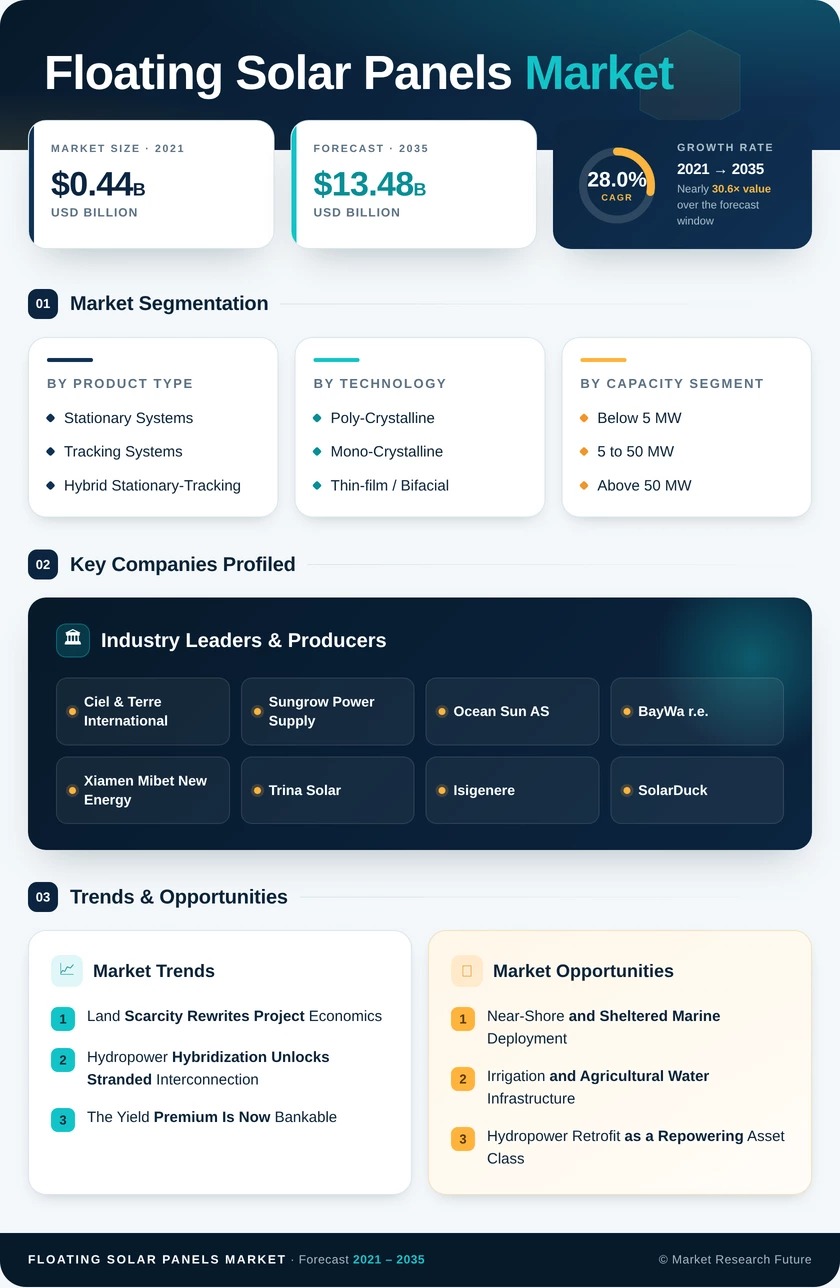
Floating Solar Panel Market
Market Size
Forecast Period2026-2035
CAGR (2026-2035)28.0%
2025 Market SizeUSD 1.14 Billion
2035 Market SizeUSD 13.48 Billion
Key Players
Ciel & Terre International
Sungrow Power Supply
Ocean Sun AS
BayWa r.e.
Xiamen Mibet New Energy
Trina Solar
Opportunities
  • Near-Shore and Sheltered Marine Deployment
  • Irrigation and Agricultural Water Infrastructure
  • Hydropower Retrofit as a Repowering Asset Class
  1. 1 Market Summary |
    1. 1.1 Study Assumptions & Market Definition |
    2. 1.2 Scope of the Study |
    3. 1.3 Research Methodology
  2. 2 Key Report Takeaways |
    1. 2.1 By Technology |
    2. 2.2 By Sector |
    3. 2.3 By Geography
  3. 3 Market Size & Forecast (2021–2035) |
    1. 3.1 Historical Market Size (2021–2025) |
    2. 3.2 Current & Forecast Market Size (2026–2035) |
    3. 3.3 Market Size by Revenue (USD Billion) |
    4. 3.4 Year-over-Year Growth Analysis
  4. 4 Driver Impact Analysis |
    1. 4.1 Land Scarcity Rewrites Project Economics |
    2. 4.2 Hydropower Hybridization Unlocks Stranded Interconnection |
    3. 4.3 The Yield Premium Is Now Bankable |
    4. 4.4 Cost Deflation Reaches the Float Itself
  5. 5 Restraints Impact Analysis |
    1. 5.1 The Cost Premium Has Not Closed |
    2. 5.2 Anchoring Is the Unsolved Engineering Problem |
    3. 5.3 Permitting Moves Slower Than Capital
  6. 6 Opportunities |
    1. 6.1 Near-Shore and Sheltered Marine Deployment |
    2. 6.2 Irrigation and Agricultural Water Infrastructure |
    3. 6.3 Hydropower Retrofit as a Repowering Asset Class |
    4. 6.4 Performance Data and Asset-Management Monetization |
    5. 6.5 Emerging-Market Island and Off-Grid Systems
  7. 7 Regional Market Share & Country-Level Analysis |
    1. 7.1 North America | |
      1. 7.1.1 US | |
      2. 7.1.2 Canada | |
      3. 7.1.3 Mexico |
    2. 7.2 Europe | |
      1. 7.2.1 Germany | |
      2. 7.2.2 UK | |
      3. 7.2.3 France | |
      4. 7.2.4 Italy | |
      5. 7.2.5 Spain | |
      6. 7.2.6 Nordic Countries | |
      7. 7.2.7 Russia | |
      8. 7.2.8 Rest of Europe |
    3. 7.3 Asia-Pacific | |
      1. 7.3.1 China | |
      2. 7.3.2 India | |
      3. 7.3.3 Japan | |
      4. 7.3.4 South Korea | |
      5. 7.3.5 ASEAN | |
      6. 7.3.6 Rest of Asia-Pacific |
    4. 7.4 South America | |
      1. 7.4.1 Brazil | |
      2. 7.4.2 Argentina | |
      3. 7.4.3 Rest of South America |
    5. 7.5 Middle East & Africa | |
      1. 7.5.1 Saudi Arabia | |
      2. 7.5.2 UAE | |
      3. 7.5.3 South Africa | |
      4. 7.5.4 Egypt | |
      5. 7.5.5 Rest of Middle East & Africa
  8. 8 Future Outlook (2026–2035) |
    1. 8.1 Autonomous Inspection and Predictive Mooring Analytics |
    2. 8.2 Standardization Compresses the Cost Premium |
    3. 8.3 Hybrid Dispatch and Storage Integration |
    4. 8.4 Water Stewardship Enters Corporate Reporting
  9. 9 Market Segmentation Analysis |
    1. 9.1 By Product Type | |
      1. 9.1.1 Stationary Systems | |
      2. 9.1.2 Tracking Systems | |
      3. 9.1.3 Hybrid Stationary-Tracking |
    2. 9.2 By Technology | |
      1. 9.2.1 Poly-Crystalline | |
      2. 9.2.2 Mono-Crystalline | |
      3. 9.2.3 Thin-film / Bifacial |
    3. 9.3 By Capacity Segment | |
      1. 9.3.1 Below 5 MW | |
      2. 9.3.2 5 to 50 MW | |
      3. 9.3.3 Above 50 MW |
    4. 9.4 By Installation Environment | |
      1. 9.4.1 Reservoirs / Lakes | |
      2. 9.4.2 Canals and Waterways | |
      3. 9.4.3 Offshore / Near-shore
  10. 10 Competitive Landscape |
    1. 10.1 Market Share Analysis (2026) |
    2. 10.2 Competitive Benchmarking Matrix |
    3. 10.3 Company Profiles | |
      1. 10.3.1 Ciel & Terre International | |
      2. 10.3.2 Sungrow Power Supply | |
      3. 10.3.3 Ocean Sun AS | |
      4. 10.3.4 BayWa r.e. | |
      5. 10.3.5 Xiamen Mibet New Energy | |
      6. 10.3.6 Trina Solar | |
      7. 10.3.7 Isigenere | |
      8. 10.3.8 SolarDuck | |
      9. 10.3.9 Tata Power Solar Systems | |
      10. 10.3.10 Swimsol
  11. 11 Recent News & Developments
  12. 12 Report Scope & Methodology |
    1. 12.1 Study Period & Base Year |
    2. 12.2 Data Sources & Citations |
    3. 12.3 Abbreviations
  13. 13 Detailed Sources and Citations
  14. 14 Frequently Asked Questions (FAQs)
  15. 15 LIST OF TABLES
  16. 16 LIST OF FIGURES

Segmentation Quick Reference

DimensionSub-SegmentsDominant SegmentFastest Growing Segment
By Product TypeStationary Systems; Tracking Systems; Hybrid Stationary-TrackingStationary SystemsTracking Systems
By TechnologyPoly-Crystalline; Mono-Crystalline; Thin-film / BifacialPoly-CrystallineMono-Crystalline
By Capacity SegmentBelow 5 MW; 5 to 50 MW; Above 50 MW5 to 50 MWAbove 50 MW
By Installation EnvironmentReservoirs / Lakes; Canals and Waterways; Offshore / Near-shoreReservoirs / LakesOffshore / Near-shore
By GeographyNorth America; Europe; Asia-Pacific; South America; Middle East & AfricaAsia-PacificAsia-Pacific


Market Segmentation Overview

By Product Type

Sub-SegmentKey Trend
Stationary SystemsModular HDPE platforms standardizing toward interchangeable float geometries
Tracking SystemsCentral-pivot azimuth rotation gaining lender acceptance on sheltered water.
Hybrid Stationary-TrackingPartial-array rotation deployed on sites with mixed wind and depth conditions


Architecture choice follows site conditions more than supplier preference. Calm inland reservoirs justify rotation; anything with meaningful fetch defaults to fixed platforms.

By Technology

Sub-SegmentKey Trend
Poly-CrystallineRetained on cost-led projects where float count dominates capex
Mono-CrystallineTOPCon and heterojunction cells cutting floats required per megawatt
Thin-film / BifacialRear-side albedo capture from water surfaces improving specific yield


Efficiency gains matter disproportionately here because every additional watt per module removes structural cost, not just area.

By Capacity Segment

Sub-SegmentKey Trend
Below 5 MWIndustrial self-consumption and irrigation pump-load matching
5 to 50 MWMunicipal reservoir tenders forming the volume backbone.
Above 50 MWHydro-hybrid mega-projects redefining achievable project scale


Scale is constrained by surface area and coverage limits rather than by demand, which is why hydro reservoirs command such attention.

By Installation Environment

Sub-SegmentKey Trend
Reservoirs / LakesClear ownership and existing interconnection sustaining dominance
Canals and WaterwaysLinear siting programs replicating the Gujarat canal-top model
Offshore / Near-shoreWave-rated platforms moving from pilot to bankable commercial scale.


Water type determines nearly every engineering decision downstream — mooring design, corrosion specification, insurance pricing and O&M logistics all follow from it.




Download PDF ×

We do not share your information with anyone. However, we may send you emails based on your report interest from time to time. You may contact us at any time to opt-out.