
×
Request Free Sample ×

Kindly complete the form below to receive a free sample of this Report

* Please use a valid business email

Leading companies partner with us for data-driven Insights

clients tt-cursor
Hero Background
English
Chinese
French
Japanese
Korean
German
Spanish

Flight Navigation System Market Share

ID: MRFR/AD/1102-HCR
103 Pages
Swapnil Palwe
October 2025

Global Flight Navigation System Market Size, Share, Industry Trend & Analysis Research Report Information by Flight Instrument (Altimeter, Gyroscope, Autopilot, Sensors, and Magnetic Compass), Product (Flight Control System, and Flight Management System), Application (Fixed-Wing and Rotary-Wing) and Region (North America, Europe, Asia-Pacific, Middle East & Africa, and Latin America) Forecast till 2032

Share:
Download PDF ×

We do not share your information with anyone. However, we may send you emails based on your report interest from time to time. You may contact us at any time to opt-out.

Flight Navigation System Market Infographic
Purchase Options

Market Share

Flight Navigation System Market Share Analysis

Flight Navigation Systems are essential to the aviation industry, guiding and controlling planes. Companies use market share positioning methods to identify their strengths in this important sector. One important method is mechanical separation, where companies invest in cutting-edge navigation systems with high precision, quality, and utility. Satellite-based navigation systems, upgraded GPS, and computerized flight control systems help companies stand out and attract airlines and airplane manufacturers searching for cutting-edge navigation.

Cost authority is another important Flight Navigation System market share positioning approach. Organizations may try to become financially savvy navigation service providers, delivering competitive pricing without compromising performance or security. To provide a steady stock of parts at optimal prices, cost initiative requires efficient production processes, economies of scale, and key organizations with providers. Economical airlines and administrators seeking reliable airplane navigation systems would like this method.

Flight instruments including altimeter, autopilot, sensors, and appealing compass organize the global market. Due to the growing need for improved accuracy and passenger safety, altimeters dominated the market in 2018.

Flight Navigation System market share depends on key organizations and coordinated efforts. Navigation system companies often cooperate with aircraft manufacturers, flight providers, and innovation groups to develop their products and expand their markets. Collaboration can integrate navigation systems with other flying elements to meet the aviation industry's growing needs. These organizations collaborate on creative projects to share resources and expertise to enhance navigation.

Development is crucial for Flight Navigation System companies' market share. Companies invest much on innovation to meet changing business needs. Computerized reasoning, AI computations, and flexible navigation systems that adapt to changing flying circumstances may be developed. Navigation system vendors can meet expanding air traveler demands for efficiency, safety, and adaptability by staying ahead of mechanical trends.

Geographical focus is very important for Flight Navigation System market share. Companies can tailor their products and marketing to local aeronautics markets. Adjusting navigation systems to the unique airspace laws and requirements of different nations or districts allows vendors to identify major markets and form partnerships with local aviation partners.


Author
Swapnil Palwe
Team Lead - Research

With a technical background as Bachelor's in Mechanical Engineering, with MBA in Operations Management , Swapnil has 6+ years of experience in market research, consulting and analytics with the tasks of data mining, analysis, and project execution. He is the POC for our clients, for their consulting projects running under the Automotive/A&D domain. Swapnil has worked on major projects in verticals such as Aerospace & Defense, Automotive and many other domain projects. He has worked on projects for fortune 500 companies' syndicate and consulting projects along with several government projects.

Leave a Comment

FAQs

What is the estimated market value of the global flight navigation system market?

global flight navigation system market is estimated to procure a significant market value during the forecast period from 2024 to 2032.

How flight navigation system market is Growing ?

global flight navigation system market is anticipated to expand at a CAGR of 7.0% during the forecast period from 2024 to 2032.

Which segment in the flight segment likely to acquire the maximum market share during the forecast period?

The altimeter segment is anticipated to acquire the largest market share along with the highest CAGR during the forecast period from 2024 to 2032

What is the factor obstructing the global flight navigation system market?

Stringent government regulations for flight navigation systems can hamper market growth during the forecast period from 2024 to 20232.

Who are the key players in the global flight navigation system market?

Collins Aerospace (U.S.), Northrop Grumman Corporation (U.S.), and Honeywell International Inc (U.S.) are some of the key players in the global flight navigation system market.

Market Summary

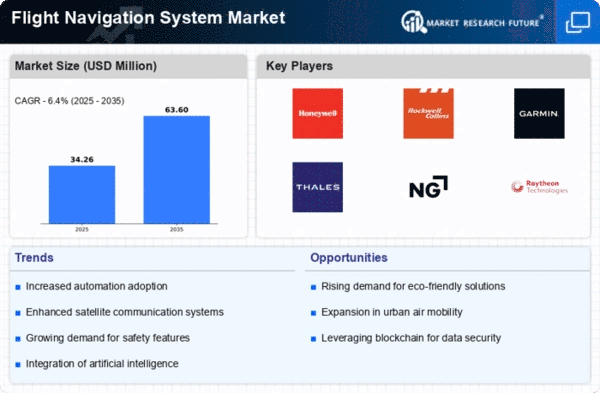
As per MRFR analysis, the Flight Navigation System Market Size was estimated at 32.2 USD Million in 2024. The Flight Navigation System industry is projected to grow from 34.2 in 2025 to 63.6 by 2035, exhibiting a compound annual growth rate (CAGR) of 6.4 during the forecast period 2025 - 2035.

Key Market Trends & Highlights

The Flight Navigation System Market is poised for substantial growth driven by technological advancements and increasing demand for air travel.

  • Technological advancements are enhancing the capabilities of flight navigation systems, particularly in North America, which remains the largest market.
  • Sustainability initiatives are gaining traction, influencing the development of eco-friendly navigation solutions in the Asia-Pacific region, the fastest-growing market.
  • Increased automation in flight navigation systems is becoming prevalent, especially within the commercial aviation segment, which is the largest.
  • Rising demand for air travel and regulatory compliance are key drivers propelling the growth of unmanned aerial vehicles, the fastest-growing segment.

Market Size & Forecast

2024 Market Size 32.2 (USD Million)
2035 Market Size 63.6 (USD Million)
CAGR (2025 - 2035) 6.4%
Largest Regional Market Share in 2024 North America

Major Players

Honeywell (US), Rockwell Collins (US), Garmin (US), Thales Group (FR), Northrop Grumman (US), Raytheon Technologies (US), L3Harris Technologies (US), General Dynamics (US), Boeing (US)

Market Trends

The Flight Navigation System Market is currently experiencing a transformative phase, driven by advancements in technology and increasing demand for enhanced safety and efficiency in aviation. The integration of satellite-based navigation systems, such as GNSS, has revolutionized traditional navigation methods, allowing for more precise and reliable flight operations. Furthermore, the growing emphasis on automation and digitalization within the aviation sector is propelling the adoption of sophisticated navigation systems that can seamlessly interface with other aircraft systems. This trend is likely to enhance operational efficiency and reduce human error, thereby improving overall flight safety. In addition, the Flight Navigation System Market is witnessing a shift towards environmentally sustainable practices. As the aviation industry faces mounting pressure to reduce its carbon footprint, there is a rising interest in navigation systems that optimize flight paths for fuel efficiency. This not only contributes to cost savings for airlines but also aligns with global efforts to promote greener aviation solutions. The convergence of these technological advancements and sustainability initiatives suggests a dynamic future for the Flight Navigation System Market, characterized by innovation and a commitment to safety and environmental responsibility.

Technological Advancements

The Flight Navigation System Market is increasingly influenced by rapid technological innovations. Enhanced satellite navigation systems, improved data processing capabilities, and the integration of artificial intelligence are reshaping how navigation is conducted. These advancements facilitate more accurate positioning and real-time data analysis, which are crucial for modern aviation.

Sustainability Initiatives

There is a growing focus on sustainability within the Flight Navigation System Market. As environmental concerns gain prominence, navigation systems that promote fuel efficiency and reduce emissions are becoming more desirable. This trend reflects a broader commitment within the aviation industry to adopt greener practices and minimize ecological impact.

Increased Automation

The trend towards automation is significantly impacting the Flight Navigation System Market. With the rise of automated flight systems, there is a greater reliance on advanced navigation technologies that enhance operational efficiency. This shift not only streamlines flight operations but also aims to reduce the potential for human error, thereby improving safety outcomes.

Flight Navigation System Market Market Drivers

Emerging Markets

Emerging markets are becoming increasingly relevant in the Global Flight Navigation System Industry. Countries in Asia-Pacific and Latin America are witnessing rapid growth in their aviation sectors, leading to a heightened demand for advanced navigation systems. The expansion of low-cost carriers and increased investment in airport infrastructure contribute to this trend. As these regions develop their aviation capabilities, the need for reliable and efficient flight navigation systems becomes paramount, presenting significant opportunities for market players to capitalize on.

Regulatory Compliance

Regulatory compliance plays a crucial role in shaping the Global Flight Navigation System Industry. Governments and aviation authorities worldwide are implementing stringent regulations to enhance air safety and operational efficiency. For example, the Federal Aviation Administration (FAA) in the United States mandates the adoption of advanced navigation technologies for commercial aviation. This regulatory environment drives the demand for innovative flight navigation systems that meet compliance standards, thereby fostering market growth and encouraging manufacturers to invest in research and development.

Increasing Air Traffic

The Global Flight Navigation System Industry is significantly influenced by the rising volume of air traffic worldwide. As more individuals and goods are transported via air, the demand for efficient navigation systems escalates. According to projections, the market is expected to grow at a CAGR of 6.72% from 2025 to 2035, potentially reaching 16.7 USD Billion by 2035. This growth necessitates the development of advanced navigation systems that can handle increased traffic while ensuring safety and compliance with international regulations.

Technological Advancements

The Global Flight Navigation System Industry is experiencing rapid technological advancements, particularly in satellite navigation and communication systems. Innovations such as the integration of artificial intelligence and machine learning into navigation systems enhance accuracy and efficiency. For instance, the implementation of advanced GPS technology allows for real-time data processing, which is crucial for flight safety and operational efficiency. As a result, the market is projected to reach 8.16 USD Billion in 2024, reflecting the growing demand for sophisticated navigation solutions that improve flight operations and reduce delays.

Focus on Safety and Efficiency

The emphasis on safety and operational efficiency is a driving force in the Global Flight Navigation System Industry. Airlines and aviation operators are prioritizing technologies that enhance safety protocols and streamline operations. For instance, systems that provide real-time weather updates and traffic alerts can significantly reduce the risk of accidents. This focus on safety not only meets regulatory requirements but also boosts consumer confidence in air travel. Consequently, the market is likely to see increased investment in navigation systems that prioritize these aspects, further propelling growth.

Market Segment Insights

By Application: Commercial Aviation (Largest) vs. Unmanned Aerial Vehicles (Fastest-Growing)

The Flight Navigation System Market exhibits a diversified application landscape, with Commercial Aviation dominating the sector. It captures a significant share due to the increasing air travel demands and the growing fleet size of commercial aircraft. Military Aviation also holds a substantial portion, driven by advancements in defense technologies and the need for enhanced operational efficiencies. General Aviation, while smaller, remains relevant, providing versatile navigation solutions for private and leisure flying activities. Meanwhile, Unmanned Aerial Vehicles are emerging rapidly, attracting investments and innovations, paving the way for their future prominence in the market.

Unmanned Aerial Vehicles: Emerging vs. Commercial Aviation: Dominant

Unmanned Aerial Vehicles (UAVs) are rapidly emerging in the Flight Navigation System Market, driven by innovations in drone technology and regulatory advancements facilitating their use across various sectors. Their applications extend beyond traditional uses into areas such as agriculture, logistics, and surveillance, attracting significant interest. In contrast, Commercial Aviation remains the dominant segment, characterized by its well-established infrastructure and consistent demand for advanced navigation systems to enhance safety and efficiency. This stability ensures continued investment, although UAVs are quickly capturing attention due to their flexibility and lower operational costs, creating a competitive dynamic between these two application sectors.

By Technology: Global Navigation Satellite System (Largest) vs. Inertial Navigation System (Fastest-Growing)

The Flight Navigation System Market is witnessing a significant distribution of market share among various technologies. The Global Navigation Satellite System (GNSS) holds the largest share due to its widespread adoption in commercial aviation, enabling precise positioning and navigation. In contrast, the Inertial Navigation System (INS) is rapidly gaining traction as an alternative technology, particularly in applications requiring high reliability and autonomy, which contributes to its fast growth in the sector. Ground-Based Navigation System and Hybrid Navigation System also play vital roles, although they have smaller market shares compared to GNSS and INS.

Technology: GNSS (Dominant) vs. INS (Emerging)

The Flight Navigation System, offering superior accuracy and global coverage that supports diverse aviation needs. It is heavily relied upon for regular flight operations and compliance with international standards. Conversely, the Inertial Navigation System (INS) is emerging rapidly due to its advantages in environments where satellite signals are obstructed. INS technology is increasingly integrated with GNSS to enhance navigation reliability and performance. This synergy of technologies is expected to further propel the adoption and capability of aviation navigation systems in the coming years.

By End Use: Airlines (Largest) vs. Defense Forces (Fastest-Growing)

The Flight Navigation System Market is predominantly led by the Airlines segment, which commands the largest share due to the increasing number of commercial flights and the ongoing fleet modernization initiatives. Airlines invest significantly in advanced navigation systems to enhance safety, efficiency, and customer satisfaction. In contrast, the Defense Forces segment is experiencing rapid growth, driven by rising geopolitical tensions and the urgent need for enhanced situational awareness in military operations. This dual trend showcases a complex interplay of priorities in the aviation sector.

Airlines (Dominant) vs. Defense Forces (Emerging)

The Airlines segment remains a dominant player in the Flight Navigation System Market, characterized by a strong focus on technological advancements and passenger safety. Major airlines are increasingly adopting sophisticated navigation systems that offer real-time data, thereby optimizing flight paths and reducing fuel consumption. Meanwhile, the Defense Forces segment is emerging as a significant contributor to market growth, propelled by advancements in military technology and increased defense budgets worldwide. The unique requirements of military operations generate a demand for customized navigation solutions that ensure precision and reliability in challenging environments. As such, both segments play a crucial role in shaping the future dynamics of flight navigation systems.

Get more detailed insights about Flight Navigation System Market Research Report - Global Forecast till 2032

Regional Insights

air traffic management

Key Players and Competitive Insights

The Flight Navigation System Market is characterized by a dynamic competitive landscape, driven by technological advancements and increasing demand for enhanced safety and efficiency in aviation. Key players such as Honeywell (US), Rockwell Collins (US), and Garmin (US) are at the forefront, each adopting distinct strategies to solidify their market positions. Honeywell (US) focuses on innovation, particularly in integrating artificial intelligence (AI) into navigation systems, which enhances predictive analytics and operational efficiency. Meanwhile, Rockwell Collins (US) emphasizes strategic partnerships, collaborating with various airlines to tailor solutions that meet specific operational needs, thereby enhancing customer loyalty and market penetration. Garmin (US) is leveraging its expertise in consumer electronics to expand its offerings in the aviation sector, indicating a trend towards more user-friendly navigation systems that appeal to a broader audience.The business tactics employed by these companies reflect a concerted effort to optimize supply chains and localize manufacturing processes. The market structure appears moderately fragmented, with several players vying for market share, yet the influence of major companies remains substantial. This competitive environment fosters innovation, as companies strive to differentiate their products and services in a crowded marketplace.

In November Honeywell (US) announced the launch of its latest navigation system, which incorporates advanced AI algorithms designed to improve flight path optimization. This strategic move is significant as it positions Honeywell (US) as a leader in the integration of cutting-edge technology into flight navigation, potentially setting new industry standards for efficiency and safety. The emphasis on AI not only enhances operational capabilities but also aligns with the growing trend towards digital transformation in aviation.

In October Rockwell Collins (US) entered into a partnership with a major airline to develop customized navigation solutions that cater to the airline's specific operational challenges. This collaboration underscores the importance of tailored solutions in the current market, as airlines increasingly seek systems that can adapt to their unique requirements. Such partnerships are likely to enhance Rockwell Collins' (US) competitive edge by fostering deeper customer relationships and driving innovation.

In September Garmin (US) expanded its product line by introducing a new series of portable navigation devices aimed at general aviation pilots. This strategic expansion reflects Garmin's (US) commitment to diversifying its offerings and tapping into the growing segment of private and recreational flying. By catering to this niche market, Garmin (US) not only broadens its customer base but also reinforces its position as a versatile player in the flight navigation sector.

As of December the competitive trends in the Flight Navigation System Market are increasingly defined by digitalization, sustainability, and the integration of AI technologies. Strategic alliances are becoming more prevalent, as companies recognize the value of collaboration in driving innovation and enhancing product offerings. Looking ahead, competitive differentiation is likely to evolve, shifting from traditional price-based competition to a focus on technological innovation, reliability in supply chains, and the ability to deliver customized solutions that meet the diverse needs of the aviation industry.

Key Companies in the Flight Navigation System Market include

Industry Developments

Future Outlook

Flight Navigation System Market Future Outlook

The Flight Navigation System Market is projected to grow at a 6.4% CAGR from 2025 to 2035, driven by technological advancements, increased <a href="https://www.marketresearchfuture.com/reports/air-traffic-market-33794" target="_blank">air traffic</a>, and regulatory support.

New opportunities lie in:

  • Integration of AI-driven predictive analytics for route optimization.
  • Development of advanced navigation systems for unmanned aerial vehicles.
  • Expansion of cloud-based navigation solutions for real-time data access.

By 2035, the market is expected to be robust, reflecting substantial growth and innovation.

Market Segmentation

Flight Navigation System Market End Use Outlook

  • Airlines
  • Defense Forces
  • Private Pilots
  • Aerospace Manufacturers

Flight Navigation System Market Technology Outlook

  • Global Navigation Satellite System
  • Inertial Navigation System
  • Ground-Based Navigation System
  • Hybrid Navigation System

Flight Navigation System Market Application Outlook

  • Commercial Aviation
  • Military Aviation
  • General Aviation
  • Unmanned Aerial Vehicles
  • Space Exploration

Report Scope

MARKET SIZE 202432.2(USD Million)
MARKET SIZE 202534.2(USD Million)
MARKET SIZE 203563.6(USD Million)
COMPOUND ANNUAL GROWTH RATE (CAGR)6.4% (2025 - 2035)
REPORT COVERAGERevenue Forecast, Competitive Landscape, Growth Factors, and Trends
BASE YEAR2024
Market Forecast Period2025 - 2035
Historical Data2019 - 2024
Market Forecast UnitsUSD Million
Key Companies ProfiledHoneywell (US), Rockwell Collins (US), Garmin (US), Thales Group (FR), Northrop Grumman (US), Raytheon Technologies (US), L3Harris Technologies (US), General Dynamics (US), Boeing (US)
Segments CoveredApplication, Technology, End Use
Key Market OpportunitiesIntegration of artificial intelligence in Flight Navigation System Market enhances operational efficiency and safety.
Key Market DynamicsTechnological advancements and regulatory changes drive innovation and competition in the Flight Navigation System market.
Countries CoveredNorth America, Europe, APAC, South America, MEA

FAQs

What is the estimated market value of the global flight navigation system market?

global flight navigation system market is estimated to procure a significant market value during the forecast period from 2024 to 2032.

How flight navigation system market is Growing ?

global flight navigation system market is anticipated to expand at a CAGR of 7.0% during the forecast period from 2024 to 2032.

Which segment in the flight segment likely to acquire the maximum market share during the forecast period?

The altimeter segment is anticipated to acquire the largest market share along with the highest CAGR during the forecast period from 2024 to 2032

What is the factor obstructing the global flight navigation system market?

Stringent government regulations for flight navigation systems can hamper market growth during the forecast period from 2024 to 20232.

Who are the key players in the global flight navigation system market?

Collins Aerospace (U.S.), Northrop Grumman Corporation (U.S.), and Honeywell International Inc (U.S.) are some of the key players in the global flight navigation system market.

  1. SECTION I: EXECUTIVE SUMMARY AND KEY HIGHLIGHTS
    1. | 1.1 EXECUTIVE SUMMARY
    2. | 1.1.1 Market Overview
    3. | 1.1.2 Key Findings
    4. | 1.1.3 Market Segmentation
    5. | 1.1.4 Competitive Landscape
    6. | 1.1.5 Challenges and Opportunities
    7. | 1.1.6 Future Outlook
  2. SECTION II: SCOPING, METHODOLOGY AND MARKET STRUCTURE
    1. | 2.1 MARKET INTRODUCTION
    2. | 2.1.1 Definition
    3. | 2.1.2 Scope of the study
    4. |-- 2.1.2.1 Research Objective
    5. |-- 2.1.2.2 Assumption
    6. |-- 2.1.2.3 Limitations
    7. | 2.2 RESEARCH METHODOLOGY
    8. | 2.2.1 Overview
    9. | 2.2.2 Data Mining
    10. | 2.2.3 Secondary Research
    11. | 2.2.4 Primary Research
    12. |-- 2.2.4.1 Primary Interviews and Information Gathering Process
    13. |-- 2.2.4.2 Breakdown of Primary Respondents
    14. | 2.2.5 Forecasting Model
    15. | 2.2.6 Market Size Estimation
    16. |-- 2.2.6.1 Bottom-Up Approach
    17. |-- 2.2.6.2 Top-Down Approach
    18. | 2.2.7 Data Triangulation
    19. | 2.2.8 Validation
  3. SECTION III: QUALITATIVE ANALYSIS
    1. | 3.1 MARKET DYNAMICS
    2. | 3.1.1 Overview
    3. | 3.1.2 Drivers
    4. | 3.1.3 Restraints
    5. | 3.1.4 Opportunities
    6. | 3.2 MARKET FACTOR ANALYSIS
    7. | 3.2.1 Value chain Analysis
    8. | 3.2.2 Porter's Five Forces Analysis
    9. |-- 3.2.2.1 Bargaining Power of Suppliers
    10. |-- 3.2.2.2 Bargaining Power of Buyers
    11. |-- 3.2.2.3 Threat of New Entrants
    12. |-- 3.2.2.4 Threat of Substitutes
    13. |-- 3.2.2.5 Intensity of Rivalry
    14. | 3.2.3 COVID-19 Impact Analysis
    15. |-- 3.2.3.1 Market Impact Analysis
    16. |-- 3.2.3.2 Regional Impact
    17. |-- 3.2.3.3 Opportunity and Threat Analysis
  4. SECTION IV: QUANTITATIVE ANALYSIS
    1. | 4.1 Aerospace & Defense, BY Application (USD Million)
    2. | 4.1.1 Commercial Aviation
    3. | 4.1.2 Military Aviation
    4. | 4.1.3 General Aviation
    5. | 4.1.4 Unmanned Aerial Vehicles
    6. | 4.1.5 Space Exploration
    7. | 4.2 Aerospace & Defense, BY Technology (USD Million)
    8. | 4.2.1 Global Navigation Satellite System
    9. | 4.2.2 Inertial Navigation System
    10. | 4.2.3 Ground-Based Navigation System
    11. | 4.2.4 Hybrid Navigation System
    12. | 4.3 Aerospace & Defense, BY End Use (USD Million)
    13. | 4.3.1 Airlines
    14. | 4.3.2 Defense Forces
    15. | 4.3.3 Private Pilots
    16. | 4.3.4 Aerospace Manufacturers
    17. | 4.4 Aerospace & Defense, BY Region (USD Million)
    18. | 4.4.1 North America
    19. |-- 4.4.1.1 US
    20. |-- 4.4.1.2 Canada
    21. | 4.4.2 Europe
    22. |-- 4.4.2.1 Germany
    23. |-- 4.4.2.2 UK
    24. |-- 4.4.2.3 France
    25. |-- 4.4.2.4 Russia
    26. |-- 4.4.2.5 Italy
    27. |-- 4.4.2.6 Spain
    28. |-- 4.4.2.7 Rest of Europe
    29. | 4.4.3 APAC
    30. |-- 4.4.3.1 China
    31. |-- 4.4.3.2 India
    32. |-- 4.4.3.3 Japan
    33. |-- 4.4.3.4 South Korea
    34. |-- 4.4.3.5 Malaysia
    35. |-- 4.4.3.6 Thailand
    36. |-- 4.4.3.7 Indonesia
    37. |-- 4.4.3.8 Rest of APAC
    38. | 4.4.4 South America
    39. |-- 4.4.4.1 Brazil
    40. |-- 4.4.4.2 Mexico
    41. |-- 4.4.4.3 Argentina
    42. |-- 4.4.4.4 Rest of South America
    43. | 4.4.5 MEA
    44. |-- 4.4.5.1 GCC Countries
    45. |-- 4.4.5.2 South Africa
    46. |-- 4.4.5.3 Rest of MEA
  5. SECTION V: COMPETITIVE ANALYSIS
    1. | 5.1 Competitive Landscape
    2. | 5.1.1 Overview
    3. | 5.1.2 Competitive Analysis
    4. | 5.1.3 Market share Analysis
    5. | 5.1.4 Major Growth Strategy in the Aerospace & Defense
    6. | 5.1.5 Competitive Benchmarking
    7. | 5.1.6 Leading Players in Terms of Number of Developments in the Aerospace & Defense
    8. | 5.1.7 Key developments and growth strategies
    9. |-- 5.1.7.1 New Product Launch/Service Deployment
    10. |-- 5.1.7.2 Merger & Acquisitions
    11. |-- 5.1.7.3 Joint Ventures
    12. | 5.1.8 Major Players Financial Matrix
    13. |-- 5.1.8.1 Sales and Operating Income
    14. |-- 5.1.8.2 Major Players R&D Expenditure. 2023
    15. | 5.2 Company Profiles
    16. | 5.2.1 Honeywell (US)
    17. |-- 5.2.1.1 Financial Overview
    18. |-- 5.2.1.2 Products Offered
    19. |-- 5.2.1.3 Key Developments
    20. |-- 5.2.1.4 SWOT Analysis
    21. |-- 5.2.1.5 Key Strategies
    22. | 5.2.2 Rockwell Collins (US)
    23. |-- 5.2.2.1 Financial Overview
    24. |-- 5.2.2.2 Products Offered
    25. |-- 5.2.2.3 Key Developments
    26. |-- 5.2.2.4 SWOT Analysis
    27. |-- 5.2.2.5 Key Strategies
    28. | 5.2.3 Garmin (US)
    29. |-- 5.2.3.1 Financial Overview
    30. |-- 5.2.3.2 Products Offered
    31. |-- 5.2.3.3 Key Developments
    32. |-- 5.2.3.4 SWOT Analysis
    33. |-- 5.2.3.5 Key Strategies
    34. | 5.2.4 Thales Group (FR)
    35. |-- 5.2.4.1 Financial Overview
    36. |-- 5.2.4.2 Products Offered
    37. |-- 5.2.4.3 Key Developments
    38. |-- 5.2.4.4 SWOT Analysis
    39. |-- 5.2.4.5 Key Strategies
    40. | 5.2.5 Northrop Grumman (US)
    41. |-- 5.2.5.1 Financial Overview
    42. |-- 5.2.5.2 Products Offered
    43. |-- 5.2.5.3 Key Developments
    44. |-- 5.2.5.4 SWOT Analysis
    45. |-- 5.2.5.5 Key Strategies
    46. | 5.2.6 Raytheon Technologies (US)
    47. |-- 5.2.6.1 Financial Overview
    48. |-- 5.2.6.2 Products Offered
    49. |-- 5.2.6.3 Key Developments
    50. |-- 5.2.6.4 SWOT Analysis
    51. |-- 5.2.6.5 Key Strategies
    52. | 5.2.7 L3Harris Technologies (US)
    53. |-- 5.2.7.1 Financial Overview
    54. |-- 5.2.7.2 Products Offered
    55. |-- 5.2.7.3 Key Developments
    56. |-- 5.2.7.4 SWOT Analysis
    57. |-- 5.2.7.5 Key Strategies
    58. | 5.2.8 General Dynamics (US)
    59. |-- 5.2.8.1 Financial Overview
    60. |-- 5.2.8.2 Products Offered
    61. |-- 5.2.8.3 Key Developments
    62. |-- 5.2.8.4 SWOT Analysis
    63. |-- 5.2.8.5 Key Strategies
    64. | 5.2.9 Boeing (US)
    65. |-- 5.2.9.1 Financial Overview
    66. |-- 5.2.9.2 Products Offered
    67. |-- 5.2.9.3 Key Developments
    68. |-- 5.2.9.4 SWOT Analysis
    69. |-- 5.2.9.5 Key Strategies
    70. | 5.3 Appendix
    71. | 5.3.1 References
    72. | 5.3.2 Related Reports

Aerospace & Defense Market Segmentation

Aerospace & Defense By Application (USD Million, 2025-2035)

  • Commercial Aviation
  • Military Aviation
  • General Aviation
  • Unmanned Aerial Vehicles
  • Space Exploration

Aerospace & Defense By Technology (USD Million, 2025-2035)

  • Global Navigation Satellite System
  • Inertial Navigation System
  • Ground-Based Navigation System
  • Hybrid Navigation System

Aerospace & Defense By End Use (USD Million, 2025-2035)

  • Airlines
  • Defense Forces
  • Private Pilots
  • Aerospace Manufacturers
Infographic

Free Sample Request

Kindly complete the form below to receive a free sample of this Report

Get Free Sample

Customer Strories

Compare Licence

×
Features License Type
Single User Multiuser License Enterprise User
Price $4,950 $5,950 $7,250
Maximum User Access Limit 1 User Upto 10 Users Unrestricted Access Throughout the Organization
Free Customization
Direct Access to Analyst
Deliverable Format
Platform Access
Discount on Next Purchase 10% 15% 15%
Printable Versions