
Request Free Sample ×

Kindly complete the form below to receive a free sample of this Report

* Please use a valid business email

Leading companies partner with us for data-driven Insights

clients tt-cursor
Hero Background
English
Chinese
French
Japanese
Korean
German
Spanish

Flexible Heater Market Size

ID: MRFR/SEM/6066-HCR
100 Pages
Ankit Gupta
Last Updated: April 06, 2026

Flexible Heater Market Size, Share and Research Report By Application (Automotive, Aerospace, Medical Devices, Consumer Electronics, Industrial Equipment), By Technology (Silicone Flexible Heaters, Kapton Flexible Heaters, Polyimide Flexible Heaters, Carbon Fiber Flexible Heaters), By End Use (Heating Elements, Surface Heating, Temperature Maintenance), By Material (Metal, Silicone, Polyimide, Carbon) and By Regional (North America, Europe, South America, Asia Pacific, Middle East and Africa) - Industry Forecast Till 2035

Share:
Download PDF ×

We do not share your information with anyone. However, we may send you emails based on your report interest from time to time. You may contact us at any time to opt-out.

Flexible Heater Market Infographic
Purchase Options

Flexible Heater Size

Flexible Heater Market Growth Projections and Opportunities

As progressions in materials science and engineering keep on unfolding, the market observers a surge in imaginative flexible warming solutions. These mechanical forward leaps upgrade the productivity of flexible heaters as well as add to the development of new applications, expanding the market's true capacity. Also, the demand for flexible heaters is unpredictably connected to the broader monetary circumstances. Enterprises, for example, auto, hardware, and medical care, among others, essentially influence the market's development. For example, in the auto area, the rising reception of electric vehicles (EVs) and the mix of flexible heaters in different car applications add to market development. Additionally, the hardware business' dependence on flexible heaters for warm management in electronic devices fills the market's development as mechanical devices become pervasive. As the worldwide spotlight on sustainability and energy effectiveness intensifies, the demand for energy-proficient warming solutions rises. Flexible heaters, with their capacity to provide exact and confined warming, line up with the sustainability objectives of numerous ventures. heaters, making a positive effect on market elements. Worldwide inventory network elements and unrefined substance availability are fundamental parts influencing the Flexible Heater Market. Changes in the costs of unrefined components, like polymers and conductive components, can affect fabricating costs and, thusly, item pricing. Also, disturbances in the production network, as seen as of late because of worldwide occasions, can prompt deficiencies and influence the general market stability. Customer inclinations and changing purchasing conduct are fundamental considerations for organizations in the Flexible Heater Market. Understanding the advancing necessities of end-clients and taking care of explicit industry prerequisites are basic for market players to remain competitive. The capacity to offer adaptable and application-explicit solutions turns into a key differentiator, impacting buying decisions and market share.
Flexible Heater Market Size Graph
Author
Author Profile
Ankit Gupta
Team Lead - Research

Ankit Gupta is a seasoned market intelligence and strategic research professional with over six plus years of experience in the ICT and Semiconductor industries. With academic roots in Telecom, Marketing, and Electronics, he blends technical insight with business strategy. Ankit has led 200+ projects, including work for Fortune 500 clients like Microsoft and Rio Tinto, covering market sizing, tech forecasting, and go-to-market strategies. Known for bridging engineering and enterprise decision-making, his insights support growth, innovation, and investment planning across diverse technology markets.

Leave a Comment

FAQs

What is the projected market valuation of the Flexible Heater Market by 2035?

<p>The Flexible Heater Market is projected to reach a valuation of 5.907 USD Billion by 2035.</p>

What was the market valuation of the Flexible Heater Market in 2024?

<p>In 2024, the overall market valuation of the Flexible Heater Market was 3.809 USD Billion.</p>

What is the expected CAGR for the Flexible Heater Market during the forecast period 2025 - 2035?

<p>The expected CAGR for the Flexible Heater Market during the forecast period 2025 - 2035 is 4.07%.</p>

Which companies are considered key players in the Flexible Heater Market?

<p>Key players in the Flexible Heater Market include 3M, Honeywell, Friedrich, Watlow, ThermoFlex, BriskHeat, Tempco Electric Heater Corporation, and Chromalox.</p>

What are the projected values for the Automotive segment in the Flexible Heater Market by 2035?

<p>The Automotive segment is projected to grow from 0.95 USD Billion to 1.45 USD Billion by 2035.</p>

How do Silicone Flexible Heaters perform in terms of market valuation?

<p>Silicone Flexible Heaters are expected to increase from 1.142 USD Billion to 1.748 USD Billion by 2035.</p>

What is the anticipated growth for the Industrial Equipment segment in the Flexible Heater Market?

<p>The Industrial Equipment segment is projected to grow from 1.759 USD Billion to 2.357 USD Billion by 2035.</p>

What are the projected values for the Carbon Fiber Flexible Heaters segment by 2035?

<p>Carbon Fiber Flexible Heaters are expected to grow from 0.572 USD Billion to 0.942 USD Billion by 2035.</p>

What is the expected market performance for Heating Elements in the Flexible Heater Market?

<p>Heating Elements are projected to increase from 1.5 USD Billion to 2.3 USD Billion by 2035.</p>

What materials are expected to dominate the Flexible Heater Market by 2035?

<p>Materials such as Metal and Silicone are expected to dominate, with valuations projected to reach 2.3 USD Billion and 1.8 USD Billion, respectively, by 2035.</p>

Market Summary

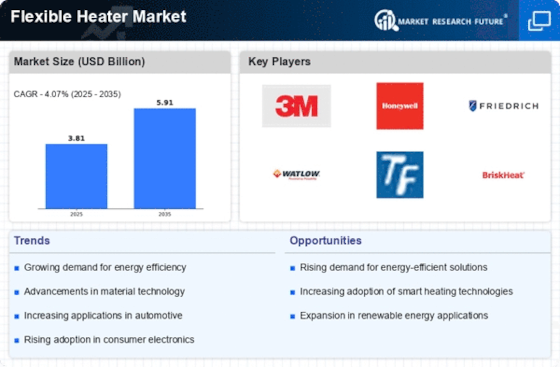
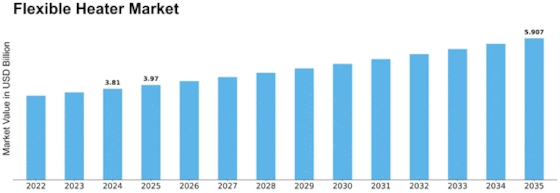
As per Market Research Future analysis, the Flexible Heater Market was estimated at 3.809 USD Billion in 2024. The Flexible Heater industry is projected to grow from 3.964 USD Billion in 2025 to 5.907 USD Billion by 2035, exhibiting a compound annual growth rate (CAGR) of 4.07% during the forecast period 2025 - 2035

Key Market Trends & Highlights

The Flexible Heater Market is experiencing robust growth driven by technological advancements and increasing demand across various sectors.

  • Technological advancements are enhancing the efficiency and performance of flexible heaters, particularly in North America. Customization and personalization are becoming increasingly important, allowing manufacturers to cater to specific consumer needs in the automotive sector. The integration of smart technologies is gaining traction, especially in the medical devices segment, which is witnessing rapid growth. Rising demand in industrial applications and advancements in material technology are key drivers propelling the market forward.

Market Size & Forecast

2024 Market Size 3.809 (USD Billion)
2035 Market Size 5.907 (USD Billion)
CAGR (2025 - 2035) 4.07%
Largest Regional Market Share in 2024 North America

Major Players

3M (US), Honeywell (US), Friedrich (US), Watlow (US), ThermoFlex (US), BriskHeat (US), Tempco Electric Heater Corporation (US), Chromalox (US)

Market Trends

The flexible heater market is currently experiencing a notable transformation, driven by advancements in technology and increasing demand across various sectors. This market encompasses a wide range of flexible heating solutions that are adaptable and efficient, catering to applications in industries such as automotive, aerospace, and consumer electronics. The growing emphasis on energy efficiency and sustainability appears to be influencing product development, as manufacturers strive to create innovative solutions that meet the evolving needs of consumers. Furthermore, the integration of smart technologies into flexible heating systems suggests a shift towards more automated and user-friendly options, enhancing overall functionality and convenience. In addition, the flexible heater market seems to be benefiting from the rising trend of customization, where products are tailored to specific applications and user requirements. This trend indicates a move away from one-size-fits-all solutions, allowing for greater flexibility and performance in diverse environments. As industries continue to seek ways to optimize their operations, the demand for specialized heating solutions is likely to grow, positioning the Flexible Heater Market for sustained expansion in the coming years.

Technological Advancements

Recent innovations in materials and manufacturing processes are reshaping the flexible heater market. Enhanced thermal efficiency and durability are becoming key attributes, as companies invest in research and development to create superior products. This trend indicates a commitment to improving performance while reducing energy consumption.

Customization and Personalization

The demand for tailored heating solutions is on the rise, as consumers and industries seek products that meet specific needs. This trend reflects a broader shift towards personalization, where flexible heaters are designed to fit unique applications, enhancing their effectiveness and user satisfaction.

Integration of Smart Technologies

The incorporation of smart features into flexible heating systems is gaining traction. This trend suggests a movement towards automation and connectivity, allowing users to control and monitor heating solutions remotely. Such advancements may lead to improved energy management and user convenience.

Flexible Heater Market Market Drivers

Growth in Consumer Electronics

The Flexible Heater Market is significantly influenced by the burgeoning consumer electronics sector. With the proliferation of smart devices, there is an increasing requirement for compact and efficient heating solutions. Flexible heaters are utilized in various consumer electronics, including smartphones, tablets, and wearable technology, to ensure optimal performance and user comfort. Market data indicates that the consumer electronics segment is expected to witness a growth rate of around 7% over the next few years. This growth is indicative of the rising consumer expectations for advanced technology, which in turn drives the demand for innovative heating solutions within the Flexible Heater Market.

Advancements in Material Technology

The Flexible Heater Market benefits from ongoing advancements in material technology, which enhance the performance and versatility of flexible heaters. Innovations in materials such as silicone, polyimide, and other flexible substrates allow for improved thermal conductivity and durability. These advancements enable manufacturers to produce heaters that can withstand extreme conditions while maintaining efficiency. Market analysis indicates that the introduction of new materials is likely to drive product innovation, leading to a projected increase in market share for flexible heaters. This evolution in material technology is crucial for the continued growth of the Flexible Heater Market.

Increased Adoption in Medical Devices

The Flexible Heater Market is witnessing a rise in adoption within the medical device sector. Flexible heaters are increasingly utilized in applications such as patient warming systems, surgical instruments, and diagnostic equipment. The ability to provide precise temperature control is essential in medical settings, where patient safety and comfort are paramount. Market data reveals that the medical device segment is expected to grow at a rate of approximately 5% annually, reflecting the increasing reliance on advanced heating solutions. This trend underscores the importance of flexible heaters in enhancing the functionality and reliability of medical devices, thereby driving growth in the Flexible Heater Market.

Rising Demand in Industrial Applications

The Flexible Heater Market experiences a notable surge in demand driven by various industrial applications. Industries such as automotive, aerospace, and manufacturing increasingly rely on flexible heaters for efficient temperature control and process optimization. The ability of flexible heaters to conform to irregular surfaces and provide uniform heating makes them particularly appealing in these sectors. According to recent data, the industrial segment accounts for a substantial share of the market, with projections indicating a growth rate of approximately 6% annually. This trend suggests that as industries continue to innovate and expand, the need for reliable heating solutions will likely propel the Flexible Heater Market further.

Energy Efficiency and Sustainability Trends

The Flexible Heater Market is increasingly shaped by the global emphasis on energy efficiency and sustainability. As industries and consumers alike seek to reduce energy consumption and minimize environmental impact, flexible heaters offer a viable solution. These heaters are designed to provide targeted heating, which can lead to significant energy savings compared to traditional heating methods. Recent studies suggest that the adoption of energy-efficient heating solutions could reduce energy costs by up to 30%. This trend aligns with the broader movement towards sustainable practices, thereby enhancing the appeal of the Flexible Heater Market in various applications.

Market Segment Insights

By Application: Automotive (Largest) vs. Medical Devices (Fastest-Growing)

In the Flexible Heater Market, the application segment reveals a diverse range of sectors contributing to its overall dynamics, supported by continuous innovation from leading flexible heater manufacturers serving automotive, aerospace, medical, and industrial applications. The automotive sector stands out as the largest due to the increasing adoption of advanced heating solutions for electric vehicles and driver comfort systems, claiming a significant market share. Following closely, other applications such as aerospace, consumer electronics, and industrial equipment also play essential roles, albeit at a smaller scale than automotive, thereby shaping the competitive landscape of flexible heaters.

Automotive: Dominant vs. Medical Devices: Emerging

The automotive sector leads in the Flexible Heater Market, characterized by its focus on innovative heating technologies that enhance passenger comfort and safety. This segment primarily utilizes flexible heaters for defrosting windows and heating seats, reflecting a trend towards increased efficiency in vehicular heating systems. In contrast, the medical devices segment is emerging rapidly, driven by the demand for precise and flexible heating solutions to maintain optimal temperatures in various medical applications. Innovations in biocompatible materials and the growing use of flexible heaters in surgical and therapeutic devices indicate a promising future, positioning medical devices as a noteworthy area of expansion alongside established automotive applications.

By Technology: Silicone Flexible Heaters (Largest) vs. Carbon Fiber Flexible Heaters (Fastest-Growing)

In the flexible heater market, Silicone Flexible Heaters hold a significant share, dominating due to their versatile applications across various industries such as aerospace, automotive, and medical devices. Their ability to conform to complex shapes and maintain efficiency at high temperatures has led to a steady demand. In contrast, Carbon Fiber Flexible Heaters are quickly gaining traction, thanks to their light weight and high thermal conductivity, appealing particularly to sectors that prioritize energy efficiency and advanced materials.

Technology: Silicone Flexible Heaters (Dominant) vs. Carbon Fiber Flexible Heaters (Emerging)

Silicone Flexible Heaters are recognized for their durability, flexibility, and capability to operate in extreme environments, making them the preferred choice in sectors requiring reliable heating solutions. Their proven track record in heavy-duty applications ensures they remain a dominant player in the market. On the other hand, Carbon Fiber Flexible Heaters are emerging as a popular choice among manufacturers looking to enhance efficiency without compromising on weight. With an increasing focus on sustainability and performance, carbon fiber's lightweight nature and exceptional thermal properties position it as a promising alternative, attracting interest from industries focused on innovation and adaptability.

By End Use: Heating Elements (Largest) vs. Surface Heating (Fastest-Growing)

In the flexible heater market, the 'Heating Elements' segment dominates the overall market share, representing a considerable portion of the applications. This dominance is largely due to its versatility and wide acceptance across various industries, including automotive and consumer electronics. The 'Surface Heating' segment, while smaller in comparison, is rapidly gaining traction due to increasing demand for energy-efficient solutions in residential and commercial applications. As industries seek innovative heating solutions, both segments play critical roles in the market landscape.

Heating Elements (Dominant) vs. Surface Heating (Emerging)

The 'Heating Elements' segment is characterized by its vast array of applications, providing essential heating solutions across multiple industries such as automotive, aerospace, and healthcare. These elements are preferred for their reliability and efficiency, making them a staple in many heating applications. On the other hand, 'Surface Heating' is emerging as a significant trend driven by the growing need for energy-efficient and uniform heating solutions. This segment is particularly attractive in markets that prioritize sustainability and innovative design. Consumers and businesses alike are increasingly adopting surface heating technologies for their ability to offer consistent temperatures while reducing energy consumption, positioning this segment for rapid growth.

By Material: Silicone (Largest) vs. Polyimide (Fastest-Growing)

In the Flexible Heater Market, material segmentation reveals distinct preferences, with silicone heaters commanding the largest market share. These heaters are highly favored due to their superior flexibility, durability, and excellent thermal conductivity. Following closely are polyimide heaters, which have seen a substantial rise in demand owing to their lightweight and high-performance attributes. Metal and carbon materials, while present, cater to specific applications and thus occupy a smaller portion of the market overall. Growth trends for this segment are primarily driven by advancements in technology and increasing applications across various industries. The rising demand for automation and temperature control in sectors like automotive, aerospace, and medical are propelling the adoption of silicone heaters. Conversely, the fast-paced growth of polyimide heaters is attributed to their efficiency in thin-film applications, making them invaluable in electronics and flexible device manufacturing.

Silicone (Dominant) vs. Carbon (Emerging)

Silicone heaters stand out as the dominant material in the Flexible Heater Market, prized for their resilience and adaptability to a broad range of applications. They are particularly appreciated for their ability to maintain consistent heat distribution, making them ideal for industrial processes and consumer products alike. In contrast, carbon heaters represent an emerging segment, gaining traction due to their innovative heating solutions that promise quick warm-up times and energy efficiency. While silicone dominates due to its established reputation and wide applicability, carbon is positioned for growth, particularly in niche markets focused on lightweight and compact design. This dynamic showcases the evolving landscape of the industry, where traditional materials compete with innovative alternatives.

Get more detailed insights about Flexible Heater Market Research Report – Forecast till 2035

Regional Insights

The Flexible Heater Market is encountering significant growth across various regional segments, with an overall valuation expected to reach 3.66 USD Billion in 2023 and advancing to 5.24 USD Billion by 2032. North America leads the market with a valuation of 1.2 USD Billion in 2023 and is projected to reach 1.7 USD Billion in 2032, showcasing a majority holding in the regional landscape due to high demand across various industries.

Europe follows closely with a market valuation of 1.0 USD Billion in 2023, expected to grow to 1.4 USD Billion, reflecting the region's robust manufacturing base.The APAC region also holds a significant position, valued at 1.0 USD Billion in 2023 and anticipated at 1.5 USD Billion in 2032, driven by rapid industrialization and rising consumer electronics demand.

South America, with a smaller market share at 0.3 USD Billion in 2023, is poised for modest growth, reaching 0.4 USD Billion by 2032, while MEA shows the least contribution with a valuation of 0.16 USD Billion in 2023 and is projected to increase to 0.24 USD Billion. This illustrates varying market dynamics, with North America and Europe dominating due to established infrastructure and technology, while APAC showcases rapid development potential.

Key Players and Competitive Insights

The Flexible Heater Market has experienced significant growth, shaped by technological advancements and increasing application needs across various industries. As businesses aim to optimize operational efficiencies and energy consumption, flexible heaters have emerged as a versatile solution, catering to diverse requirements such as temperature regulation and process heating. In this competitive landscape, companies are vying for market share through innovation, product differentiation, and strategic partnerships. The ongoing trends toward customization and lightweight designs have further intensified competition, attracting new entrants and incumbent firms to leverage their unique selling propositions.Manufacturers are also focusing on sustainability, incorporating eco-friendly materials and energy-efficient technologies to gain a competitive edge in this evolving market. Minco boasts a strong presence in the Flexible Heater Market, recognized for its commitment to quality and innovation. The company has developed a range of advanced heating solutions that cater to various industries, including medical, aerospace, and electronics. Its ability to customize heaters according to specific requirements sets Minco apart from its competitors and enhances its appeal among customers seeking tailored solutions.Moreover, Minco's reputation for reliability and durability strengthens its position in the market, as clients are drawn to products that can withstand demanding applications. The company continually invests in research and development, ensuring it remains at the forefront of technological advancements. Its strategic partnerships in the industry further bolster its market presence, enabling Minco to expand its reach and offer cutting-edge products.Mitsubishi Electric is another prominent player in the Flexible Heater Market, leveraging its extensive experience and technological expertise to deliver efficient heating solutions.The company's range of flexible heaters is designed to meet the rigorous demands of various sectors, including automotive, industrial, and consumer electronics. Mitsubishi Electric is well-regarded for its commitment to innovation, consistently introducing new products that incorporate advanced materials and energy-efficient designs. The company's established reputation for quality assurance and exceptional customer service has further solidified its market position. Moreover, Mitsubishi Electric actively participates in global markets, allowing it to adapt to regional needs and seize opportunities for growth.Its investment in sustainable practices and eco-friendly solutions aligns with the growing consumer demand for environmentally responsible products, giving Mitsubishi Electric a competitive advantage in the industry.

Key Companies in the Flexible Heater Market include

Industry Developments

  • Q2 2024: Watlow Announces Opening of New Manufacturing Facility in Singapore Watlow, a global leader in industrial heating technology, announced the opening of a new manufacturing facility in Singapore to expand its production capacity for flexible heaters and thermal solutions, targeting growth in the Asia-Pacific region.
  • Q2 2024: All Flex Solutions Launches New Line of Polyimide Flexible Heaters for Medical Devices All Flex Solutions introduced a new range of polyimide flexible heaters designed specifically for medical device applications, aiming to meet increasing demand for compact and energy-efficient heating elements in healthcare equipment.
  • Q3 2024: Honeywell Partners with Panasonic to Develop Flexible Heating Solutions for Electric Vehicles Honeywell and Panasonic announced a strategic partnership to co-develop advanced flexible heating systems for electric vehicle battery thermal management, leveraging both companies’ expertise in electronics and thermal engineering.
  • Q3 2024: Chromalox Wins Major Contract to Supply Flexible Heaters for European Aerospace Manufacturer Chromalox secured a significant contract to provide custom flexible heaters for a leading European aerospace manufacturer, supporting precision thermal management in next-generation aircraft systems.
  • Q4 2024: Minco Appoints New CEO to Drive Growth in Flexible Heater Market Segment Minco Products, Inc. announced the appointment of a new Chief Executive Officer, with a mandate to accelerate innovation and market expansion in the flexible heater business.
  • Q4 2024: Omega Engineering Unveils IoT-Enabled Flexible Heater Market Platform Omega Engineering launched a new IoT-enabled flexible heater platform, offering real-time temperature monitoring and remote control capabilities for industrial and medical applications.
  • Q1 2025: Birk Manufacturing Expands Connecticut Facility to Increase Flexible Heater Market Production Birk Manufacturing announced the expansion of its Connecticut facility to boost production capacity for flexible heaters, responding to rising demand from medical and electronics sectors.
  • Q1 2025: Therm-x Secures Funding to Accelerate Development of Ultra-Thin Flexible Heaters Therm-x received new funding to support research and development of ultra-thin flexible heater technologies, targeting applications in semiconductor manufacturing and wearable devices.
  • Q2 2025: Flexitech Acquires HeaterTech to Expand Flexible Heater Market Portfolio Flexitech completed the acquisition of HeaterTech, enhancing its product portfolio and manufacturing capabilities in the flexible heater market.
  • Q2 2025: Durex Industries Wins Contract to Supply Flexible Heaters for Medical Diagnostic Equipment Durex Industries announced a contract win to supply custom flexible heaters for integration into advanced medical diagnostic equipment, supporting precision temperature control.
  • Q3 2025: Rogers Corporation Launches New Silicone-Based Flexible Heater Market for Aerospace Applications Rogers Corporation introduced a new silicone-based flexible heater designed for aerospace applications, offering improved durability and thermal performance for critical systems.
  • Q3 2025: Advanced Thermal Solutions Announces Partnership with Medtronic for Flexible Heater Market Integration Advanced Thermal Solutions entered into a partnership with Medtronic to integrate flexible heater technology into next-generation medical devices, aiming to enhance patient care and device reliability.

Future Outlook

Flexible Heater Market Future Outlook

The Flexible Heater Market is projected to grow at a 4.07% CAGR from 2025 to 2035, driven by technological advancements, increasing demand in various industries, and energy efficiency needs.

New opportunities lie in:

  • <p>Development of smart flexible heating solutions for IoT integration.</p>
  • <p> </p>
  • <p>Expansion into renewable energy applications for sustainable heating.</p>
  • <p>Customized flexible heater designs for niche industrial sectors.</p>

By 2035, the Flexible Heater Market is expected to achieve robust growth, reflecting evolving industry demands and technological innovations.

Market Segmentation

Flexible Heater Market End Use Outlook

  • Heating Elements
  • Surface Heating
  • Temperature Maintenance

Flexible Heater Market Material Outlook

  • Metal
  • Silicone
  • Polyimide
  • Carbon

Flexible Heater Market Technology Outlook

  • Silicone Flexible Heaters
  • Kapton Flexible Heaters
  • Polyimide Flexible Heaters
  • Carbon Fiber Flexible Heaters

Flexible Heater Market Application Outlook

  • Automotive
  • Aerospace
  • Medical Devices
  • Consumer Electronics
  • Industrial Equipment

Report Scope

MARKET SIZE 2024 3.809(USD Billion)
MARKET SIZE 2025 3.964(USD Billion)
MARKET SIZE 2035 5.907(USD Billion)
COMPOUND ANNUAL GROWTH RATE (CAGR) 4.07% (2025 - 2035)
REPORT COVERAGE Revenue Forecast, Competitive Landscape, Growth Factors, and Trends
BASE YEAR 2024
Market Forecast Period 2025 - 2035
Historical Data 2019 - 2024
Market Forecast Units USD Billion
Key Companies Profiled 3M (US), Honeywell (US), Friedrich (US), Watlow (US), ThermoFlex (US), BriskHeat (US), Tempco Electric Heater Corporation (US), Chromalox (US)
Segments Covered Application, Technology, End Use, Material, Regional
Key Market Opportunities Integration of advanced materials enhances efficiency in the Flexible Heater Market.
Key Market Dynamics Rising demand for energy-efficient solutions drives innovation and competition in the flexible heater market.
Countries Covered North America, Europe, APAC, South America, MEA

FAQs

What is the projected market valuation of the Flexible Heater Market by 2035?

<p>The Flexible Heater Market is projected to reach a valuation of 5.907 USD Billion by 2035.</p>

What was the market valuation of the Flexible Heater Market in 2024?

<p>In 2024, the overall market valuation of the Flexible Heater Market was 3.809 USD Billion.</p>

What is the expected CAGR for the Flexible Heater Market during the forecast period 2025 - 2035?

<p>The expected CAGR for the Flexible Heater Market during the forecast period 2025 - 2035 is 4.07%.</p>

Which companies are considered key players in the Flexible Heater Market?

<p>Key players in the Flexible Heater Market include 3M, Honeywell, Friedrich, Watlow, ThermoFlex, BriskHeat, Tempco Electric Heater Corporation, and Chromalox.</p>

What are the projected values for the Automotive segment in the Flexible Heater Market by 2035?

<p>The Automotive segment is projected to grow from 0.95 USD Billion to 1.45 USD Billion by 2035.</p>

How do Silicone Flexible Heaters perform in terms of market valuation?

<p>Silicone Flexible Heaters are expected to increase from 1.142 USD Billion to 1.748 USD Billion by 2035.</p>

What is the anticipated growth for the Industrial Equipment segment in the Flexible Heater Market?

<p>The Industrial Equipment segment is projected to grow from 1.759 USD Billion to 2.357 USD Billion by 2035.</p>

What are the projected values for the Carbon Fiber Flexible Heaters segment by 2035?

<p>Carbon Fiber Flexible Heaters are expected to grow from 0.572 USD Billion to 0.942 USD Billion by 2035.</p>

What is the expected market performance for Heating Elements in the Flexible Heater Market?

<p>Heating Elements are projected to increase from 1.5 USD Billion to 2.3 USD Billion by 2035.</p>

What materials are expected to dominate the Flexible Heater Market by 2035?

<p>Materials such as Metal and Silicone are expected to dominate, with valuations projected to reach 2.3 USD Billion and 1.8 USD Billion, respectively, by 2035.</p>

  1. SECTION I: EXECUTIVE SUMMARY AND KEY HIGHLIGHTS
    1. | 1.1 EXECUTIVE SUMMARY
    2. | | 1.1.1 Market Overview
    3. | | 1.1.2 Key Findings
    4. | | 1.1.3 Market Segmentation
    5. | | 1.1.4 Competitive Landscape
    6. | | 1.1.5 Challenges and Opportunities
    7. | | 1.1.6 Future Outlook
  2. SECTION II: SCOPING, METHODOLOGY AND MARKET STRUCTURE
    1. | 2.1 MARKET INTRODUCTION
    2. | | 2.1.1 Definition
    3. | | 2.1.2 Scope of the study
    4. | | | 2.1.2.1 Research Objective
    5. | | | 2.1.2.2 Assumption
    6. | | | 2.1.2.3 Limitations
    7. | 2.2 RESEARCH METHODOLOGY
    8. | | 2.2.1 Overview
    9. | | 2.2.2 Data Mining
    10. | | 2.2.3 Secondary Research
    11. | | 2.2.4 Primary Research
    12. | | | 2.2.4.1 Primary Interviews and Information Gathering Process
    13. | | | 2.2.4.2 Breakdown of Primary Respondents
    14. | | 2.2.5 Forecasting Model
    15. | | 2.2.6 Market Size Estimation
    16. | | | 2.2.6.1 Bottom-Up Approach
    17. | | | 2.2.6.2 Top-Down Approach
    18. | | 2.2.7 Data Triangulation
    19. | | 2.2.8 Validation
  3. SECTION III: QUALITATIVE ANALYSIS
    1. | 3.1 MARKET DYNAMICS
    2. | | 3.1.1 Overview
    3. | | 3.1.2 Drivers
    4. | | 3.1.3 Restraints
    5. | | 3.1.4 Opportunities
    6. | 3.2 MARKET FACTOR ANALYSIS
    7. | | 3.2.1 Value chain Analysis
    8. | | 3.2.2 Porter's Five Forces Analysis
    9. | | | 3.2.2.1 Bargaining Power of Suppliers
    10. | | | 3.2.2.2 Bargaining Power of Buyers
    11. | | | 3.2.2.3 Threat of New Entrants
    12. | | | 3.2.2.4 Threat of Substitutes
    13. | | | 3.2.2.5 Intensity of Rivalry
    14. | | 3.2.3 COVID-19 Impact Analysis
    15. | | | 3.2.3.1 Market Impact Analysis
    16. | | | 3.2.3.2 Regional Impact
    17. | | | 3.2.3.3 Opportunity and Threat Analysis
  4. SECTION IV: QUANTITATIVE ANALYSIS
    1. | 4.1 Semiconductor & Electronics, BY Application (USD Billion)
    2. | | 4.1.1 Automotive
    3. | | 4.1.2 Aerospace
    4. | | 4.1.3 Medical Devices
    5. | | 4.1.4 Consumer Electronics
    6. | | 4.1.5 Industrial Equipment
    7. | 4.2 Semiconductor & Electronics, BY Technology (USD Billion)
    8. | | 4.2.1 Silicone Flexible Heaters
    9. | | 4.2.2 Kapton Flexible Heaters
    10. | | 4.2.3 Polyimide Flexible Heaters
    11. | | 4.2.4 Carbon Fiber Flexible Heaters
    12. | 4.3 Semiconductor & Electronics, BY End Use (USD Billion)
    13. | | 4.3.1 Heating Elements
    14. | | 4.3.2 Surface Heating
    15. | | 4.3.3 Temperature Maintenance
    16. | 4.4 Semiconductor & Electronics, BY Material (USD Billion)
    17. | | 4.4.1 Metal
    18. | | 4.4.2 Silicone
    19. | | 4.4.3 Polyimide
    20. | | 4.4.4 Carbon
    21. | 4.5 Semiconductor & Electronics, BY Region (USD Billion)
    22. | | 4.5.1 North America
    23. | | | 4.5.1.1 US
    24. | | | 4.5.1.2 Canada
    25. | | 4.5.2 Europe
    26. | | | 4.5.2.1 Germany
    27. | | | 4.5.2.2 UK
    28. | | | 4.5.2.3 France
    29. | | | 4.5.2.4 Russia
    30. | | | 4.5.2.5 Italy
    31. | | | 4.5.2.6 Spain
    32. | | | 4.5.2.7 Rest of Europe
    33. | | 4.5.3 APAC
    34. | | | 4.5.3.1 China
    35. | | | 4.5.3.2 India
    36. | | | 4.5.3.3 Japan
    37. | | | 4.5.3.4 South Korea
    38. | | | 4.5.3.5 Malaysia
    39. | | | 4.5.3.6 Thailand
    40. | | | 4.5.3.7 Indonesia
    41. | | | 4.5.3.8 Rest of APAC
    42. | | 4.5.4 South America
    43. | | | 4.5.4.1 Brazil
    44. | | | 4.5.4.2 Mexico
    45. | | | 4.5.4.3 Argentina
    46. | | | 4.5.4.4 Rest of South America
    47. | | 4.5.5 MEA
    48. | | | 4.5.5.1 GCC Countries
    49. | | | 4.5.5.2 South Africa
    50. | | | 4.5.5.3 Rest of MEA
  5. SECTION V: COMPETITIVE ANALYSIS
    1. | 5.1 Competitive Landscape
    2. | | 5.1.1 Overview
    3. | | 5.1.2 Competitive Analysis
    4. | | 5.1.3 Market share Analysis
    5. | | 5.1.4 Major Growth Strategy in the Semiconductor & Electronics
    6. | | 5.1.5 Competitive Benchmarking
    7. | | 5.1.6 Leading Players in Terms of Number of Developments in the Semiconductor & Electronics
    8. | | 5.1.7 Key developments and growth strategies
    9. | | | 5.1.7.1 New Product Launch/Service Deployment
    10. | | | 5.1.7.2 Merger & Acquisitions
    11. | | | 5.1.7.3 Joint Ventures
    12. | | 5.1.8 Major Players Financial Matrix
    13. | | | 5.1.8.1 Sales and Operating Income
    14. | | | 5.1.8.2 Major Players R&D Expenditure. 2023
    15. | 5.2 Company Profiles
    16. | | 5.2.1 3M (US)
    17. | | | 5.2.1.1 Financial Overview
    18. | | | 5.2.1.2 Products Offered
    19. | | | 5.2.1.3 Key Developments
    20. | | | 5.2.1.4 SWOT Analysis
    21. | | | 5.2.1.5 Key Strategies
    22. | | 5.2.2 Honeywell (US)
    23. | | | 5.2.2.1 Financial Overview
    24. | | | 5.2.2.2 Products Offered
    25. | | | 5.2.2.3 Key Developments
    26. | | | 5.2.2.4 SWOT Analysis
    27. | | | 5.2.2.5 Key Strategies
    28. | | 5.2.3 Friedrich (US)
    29. | | | 5.2.3.1 Financial Overview
    30. | | | 5.2.3.2 Products Offered
    31. | | | 5.2.3.3 Key Developments
    32. | | | 5.2.3.4 SWOT Analysis
    33. | | | 5.2.3.5 Key Strategies
    34. | | 5.2.4 Watlow (US)
    35. | | | 5.2.4.1 Financial Overview
    36. | | | 5.2.4.2 Products Offered
    37. | | | 5.2.4.3 Key Developments
    38. | | | 5.2.4.4 SWOT Analysis
    39. | | | 5.2.4.5 Key Strategies
    40. | | 5.2.5 ThermoFlex (US)
    41. | | | 5.2.5.1 Financial Overview
    42. | | | 5.2.5.2 Products Offered
    43. | | | 5.2.5.3 Key Developments
    44. | | | 5.2.5.4 SWOT Analysis
    45. | | | 5.2.5.5 Key Strategies
    46. | | 5.2.6 BriskHeat (US)
    47. | | | 5.2.6.1 Financial Overview
    48. | | | 5.2.6.2 Products Offered
    49. | | | 5.2.6.3 Key Developments
    50. | | | 5.2.6.4 SWOT Analysis
    51. | | | 5.2.6.5 Key Strategies
    52. | | 5.2.7 Tempco Electric Heater Corporation (US)
    53. | | | 5.2.7.1 Financial Overview
    54. | | | 5.2.7.2 Products Offered
    55. | | | 5.2.7.3 Key Developments
    56. | | | 5.2.7.4 SWOT Analysis
    57. | | | 5.2.7.5 Key Strategies
    58. | | 5.2.8 Chromalox (US)
    59. | | | 5.2.8.1 Financial Overview
    60. | | | 5.2.8.2 Products Offered
    61. | | | 5.2.8.3 Key Developments
    62. | | | 5.2.8.4 SWOT Analysis
    63. | | | 5.2.8.5 Key Strategies
    64. | 5.3 Appendix
    65. | | 5.3.1 References
    66. | | 5.3.2 Related Reports
  6. LIST OF FIGURES
    1. | 6.1 MARKET SYNOPSIS
    2. | 6.2 NORTH AMERICA MARKET ANALYSIS
    3. | 6.3 US MARKET ANALYSIS BY APPLICATION
    4. | 6.4 US MARKET ANALYSIS BY TECHNOLOGY
    5. | 6.5 US MARKET ANALYSIS BY END USE
    6. | 6.6 US MARKET ANALYSIS BY MATERIAL
    7. | 6.7 CANADA MARKET ANALYSIS BY APPLICATION
    8. | 6.8 CANADA MARKET ANALYSIS BY TECHNOLOGY
    9. | 6.9 CANADA MARKET ANALYSIS BY END USE
    10. | 6.10 CANADA MARKET ANALYSIS BY MATERIAL
    11. | 6.11 EUROPE MARKET ANALYSIS
    12. | 6.12 GERMANY MARKET ANALYSIS BY APPLICATION
    13. | 6.13 GERMANY MARKET ANALYSIS BY TECHNOLOGY
    14. | 6.14 GERMANY MARKET ANALYSIS BY END USE
    15. | 6.15 GERMANY MARKET ANALYSIS BY MATERIAL
    16. | 6.16 UK MARKET ANALYSIS BY APPLICATION
    17. | 6.17 UK MARKET ANALYSIS BY TECHNOLOGY
    18. | 6.18 UK MARKET ANALYSIS BY END USE
    19. | 6.19 UK MARKET ANALYSIS BY MATERIAL
    20. | 6.20 FRANCE MARKET ANALYSIS BY APPLICATION
    21. | 6.21 FRANCE MARKET ANALYSIS BY TECHNOLOGY
    22. | 6.22 FRANCE MARKET ANALYSIS BY END USE
    23. | 6.23 FRANCE MARKET ANALYSIS BY MATERIAL
    24. | 6.24 RUSSIA MARKET ANALYSIS BY APPLICATION
    25. | 6.25 RUSSIA MARKET ANALYSIS BY TECHNOLOGY
    26. | 6.26 RUSSIA MARKET ANALYSIS BY END USE
    27. | 6.27 RUSSIA MARKET ANALYSIS BY MATERIAL
    28. | 6.28 ITALY MARKET ANALYSIS BY APPLICATION
    29. | 6.29 ITALY MARKET ANALYSIS BY TECHNOLOGY
    30. | 6.30 ITALY MARKET ANALYSIS BY END USE
    31. | 6.31 ITALY MARKET ANALYSIS BY MATERIAL
    32. | 6.32 SPAIN MARKET ANALYSIS BY APPLICATION
    33. | 6.33 SPAIN MARKET ANALYSIS BY TECHNOLOGY
    34. | 6.34 SPAIN MARKET ANALYSIS BY END USE
    35. | 6.35 SPAIN MARKET ANALYSIS BY MATERIAL
    36. | 6.36 REST OF EUROPE MARKET ANALYSIS BY APPLICATION
    37. | 6.37 REST OF EUROPE MARKET ANALYSIS BY TECHNOLOGY
    38. | 6.38 REST OF EUROPE MARKET ANALYSIS BY END USE
    39. | 6.39 REST OF EUROPE MARKET ANALYSIS BY MATERIAL
    40. | 6.40 APAC MARKET ANALYSIS
    41. | 6.41 CHINA MARKET ANALYSIS BY APPLICATION
    42. | 6.42 CHINA MARKET ANALYSIS BY TECHNOLOGY
    43. | 6.43 CHINA MARKET ANALYSIS BY END USE
    44. | 6.44 CHINA MARKET ANALYSIS BY MATERIAL
    45. | 6.45 INDIA MARKET ANALYSIS BY APPLICATION
    46. | 6.46 INDIA MARKET ANALYSIS BY TECHNOLOGY
    47. | 6.47 INDIA MARKET ANALYSIS BY END USE
    48. | 6.48 INDIA MARKET ANALYSIS BY MATERIAL
    49. | 6.49 JAPAN MARKET ANALYSIS BY APPLICATION
    50. | 6.50 JAPAN MARKET ANALYSIS BY TECHNOLOGY
    51. | 6.51 JAPAN MARKET ANALYSIS BY END USE
    52. | 6.52 JAPAN MARKET ANALYSIS BY MATERIAL
    53. | 6.53 SOUTH KOREA MARKET ANALYSIS BY APPLICATION
    54. | 6.54 SOUTH KOREA MARKET ANALYSIS BY TECHNOLOGY
    55. | 6.55 SOUTH KOREA MARKET ANALYSIS BY END USE
    56. | 6.56 SOUTH KOREA MARKET ANALYSIS BY MATERIAL
    57. | 6.57 MALAYSIA MARKET ANALYSIS BY APPLICATION
    58. | 6.58 MALAYSIA MARKET ANALYSIS BY TECHNOLOGY
    59. | 6.59 MALAYSIA MARKET ANALYSIS BY END USE
    60. | 6.60 MALAYSIA MARKET ANALYSIS BY MATERIAL
    61. | 6.61 THAILAND MARKET ANALYSIS BY APPLICATION
    62. | 6.62 THAILAND MARKET ANALYSIS BY TECHNOLOGY
    63. | 6.63 THAILAND MARKET ANALYSIS BY END USE
    64. | 6.64 THAILAND MARKET ANALYSIS BY MATERIAL
    65. | 6.65 INDONESIA MARKET ANALYSIS BY APPLICATION
    66. | 6.66 INDONESIA MARKET ANALYSIS BY TECHNOLOGY
    67. | 6.67 INDONESIA MARKET ANALYSIS BY END USE
    68. | 6.68 INDONESIA MARKET ANALYSIS BY MATERIAL
    69. | 6.69 REST OF APAC MARKET ANALYSIS BY APPLICATION
    70. | 6.70 REST OF APAC MARKET ANALYSIS BY TECHNOLOGY
    71. | 6.71 REST OF APAC MARKET ANALYSIS BY END USE
    72. | 6.72 REST OF APAC MARKET ANALYSIS BY MATERIAL
    73. | 6.73 SOUTH AMERICA MARKET ANALYSIS
    74. | 6.74 BRAZIL MARKET ANALYSIS BY APPLICATION
    75. | 6.75 BRAZIL MARKET ANALYSIS BY TECHNOLOGY
    76. | 6.76 BRAZIL MARKET ANALYSIS BY END USE
    77. | 6.77 BRAZIL MARKET ANALYSIS BY MATERIAL
    78. | 6.78 MEXICO MARKET ANALYSIS BY APPLICATION
    79. | 6.79 MEXICO MARKET ANALYSIS BY TECHNOLOGY
    80. | 6.80 MEXICO MARKET ANALYSIS BY END USE
    81. | 6.81 MEXICO MARKET ANALYSIS BY MATERIAL
    82. | 6.82 ARGENTINA MARKET ANALYSIS BY APPLICATION
    83. | 6.83 ARGENTINA MARKET ANALYSIS BY TECHNOLOGY
    84. | 6.84 ARGENTINA MARKET ANALYSIS BY END USE
    85. | 6.85 ARGENTINA MARKET ANALYSIS BY MATERIAL
    86. | 6.86 REST OF SOUTH AMERICA MARKET ANALYSIS BY APPLICATION
    87. | 6.87 REST OF SOUTH AMERICA MARKET ANALYSIS BY TECHNOLOGY
    88. | 6.88 REST OF SOUTH AMERICA MARKET ANALYSIS BY END USE
    89. | 6.89 REST OF SOUTH AMERICA MARKET ANALYSIS BY MATERIAL
    90. | 6.90 MEA MARKET ANALYSIS
    91. | 6.91 GCC COUNTRIES MARKET ANALYSIS BY APPLICATION
    92. | 6.92 GCC COUNTRIES MARKET ANALYSIS BY TECHNOLOGY
    93. | 6.93 GCC COUNTRIES MARKET ANALYSIS BY END USE
    94. | 6.94 GCC COUNTRIES MARKET ANALYSIS BY MATERIAL
    95. | 6.95 SOUTH AFRICA MARKET ANALYSIS BY APPLICATION
    96. | 6.96 SOUTH AFRICA MARKET ANALYSIS BY TECHNOLOGY
    97. | 6.97 SOUTH AFRICA MARKET ANALYSIS BY END USE
    98. | 6.98 SOUTH AFRICA MARKET ANALYSIS BY MATERIAL
    99. | 6.99 REST OF MEA MARKET ANALYSIS BY APPLICATION
    100. | 6.100 REST OF MEA MARKET ANALYSIS BY TECHNOLOGY
    101. | 6.101 REST OF MEA MARKET ANALYSIS BY END USE
    102. | 6.102 REST OF MEA MARKET ANALYSIS BY MATERIAL
    103. | 6.103 KEY BUYING CRITERIA OF SEMICONDUCTOR & ELECTRONICS
    104. | 6.104 RESEARCH PROCESS OF MRFR
    105. | 6.105 DRO ANALYSIS OF SEMICONDUCTOR & ELECTRONICS
    106. | 6.106 DRIVERS IMPACT ANALYSIS: SEMICONDUCTOR & ELECTRONICS
    107. | 6.107 RESTRAINTS IMPACT ANALYSIS: SEMICONDUCTOR & ELECTRONICS
    108. | 6.108 SUPPLY / VALUE CHAIN: SEMICONDUCTOR & ELECTRONICS
    109. | 6.109 SEMICONDUCTOR & ELECTRONICS, BY APPLICATION, 2024 (% SHARE)
    110. | 6.110 SEMICONDUCTOR & ELECTRONICS, BY APPLICATION, 2024 TO 2035 (USD Billion)
    111. | 6.111 SEMICONDUCTOR & ELECTRONICS, BY TECHNOLOGY, 2024 (% SHARE)
    112. | 6.112 SEMICONDUCTOR & ELECTRONICS, BY TECHNOLOGY, 2024 TO 2035 (USD Billion)
    113. | 6.113 SEMICONDUCTOR & ELECTRONICS, BY END USE, 2024 (% SHARE)
    114. | 6.114 SEMICONDUCTOR & ELECTRONICS, BY END USE, 2024 TO 2035 (USD Billion)
    115. | 6.115 SEMICONDUCTOR & ELECTRONICS, BY MATERIAL, 2024 (% SHARE)
    116. | 6.116 SEMICONDUCTOR & ELECTRONICS, BY MATERIAL, 2024 TO 2035 (USD Billion)
    117. | 6.117 BENCHMARKING OF MAJOR COMPETITORS
  7. LIST OF TABLES
    1. | 7.1 LIST OF ASSUMPTIONS
    2. | | 7.1.1
    3. | 7.2 North America MARKET SIZE ESTIMATES; FORECAST
    4. | | 7.2.1 BY APPLICATION, 2025-2035 (USD Billion)
    5. | | 7.2.2 BY TECHNOLOGY, 2025-2035 (USD Billion)
    6. | | 7.2.3 BY END USE, 2025-2035 (USD Billion)
    7. | | 7.2.4 BY MATERIAL, 2025-2035 (USD Billion)
    8. | 7.3 US MARKET SIZE ESTIMATES; FORECAST
    9. | | 7.3.1 BY APPLICATION, 2025-2035 (USD Billion)
    10. | | 7.3.2 BY TECHNOLOGY, 2025-2035 (USD Billion)
    11. | | 7.3.3 BY END USE, 2025-2035 (USD Billion)
    12. | | 7.3.4 BY MATERIAL, 2025-2035 (USD Billion)
    13. | 7.4 Canada MARKET SIZE ESTIMATES; FORECAST
    14. | | 7.4.1 BY APPLICATION, 2025-2035 (USD Billion)
    15. | | 7.4.2 BY TECHNOLOGY, 2025-2035 (USD Billion)
    16. | | 7.4.3 BY END USE, 2025-2035 (USD Billion)
    17. | | 7.4.4 BY MATERIAL, 2025-2035 (USD Billion)
    18. | 7.5 Europe MARKET SIZE ESTIMATES; FORECAST
    19. | | 7.5.1 BY APPLICATION, 2025-2035 (USD Billion)
    20. | | 7.5.2 BY TECHNOLOGY, 2025-2035 (USD Billion)
    21. | | 7.5.3 BY END USE, 2025-2035 (USD Billion)
    22. | | 7.5.4 BY MATERIAL, 2025-2035 (USD Billion)
    23. | 7.6 Germany MARKET SIZE ESTIMATES; FORECAST
    24. | | 7.6.1 BY APPLICATION, 2025-2035 (USD Billion)
    25. | | 7.6.2 BY TECHNOLOGY, 2025-2035 (USD Billion)
    26. | | 7.6.3 BY END USE, 2025-2035 (USD Billion)
    27. | | 7.6.4 BY MATERIAL, 2025-2035 (USD Billion)
    28. | 7.7 UK MARKET SIZE ESTIMATES; FORECAST
    29. | | 7.7.1 BY APPLICATION, 2025-2035 (USD Billion)
    30. | | 7.7.2 BY TECHNOLOGY, 2025-2035 (USD Billion)
    31. | | 7.7.3 BY END USE, 2025-2035 (USD Billion)
    32. | | 7.7.4 BY MATERIAL, 2025-2035 (USD Billion)
    33. | 7.8 France MARKET SIZE ESTIMATES; FORECAST
    34. | | 7.8.1 BY APPLICATION, 2025-2035 (USD Billion)
    35. | | 7.8.2 BY TECHNOLOGY, 2025-2035 (USD Billion)
    36. | | 7.8.3 BY END USE, 2025-2035 (USD Billion)
    37. | | 7.8.4 BY MATERIAL, 2025-2035 (USD Billion)
    38. | 7.9 Russia MARKET SIZE ESTIMATES; FORECAST
    39. | | 7.9.1 BY APPLICATION, 2025-2035 (USD Billion)
    40. | | 7.9.2 BY TECHNOLOGY, 2025-2035 (USD Billion)
    41. | | 7.9.3 BY END USE, 2025-2035 (USD Billion)
    42. | | 7.9.4 BY MATERIAL, 2025-2035 (USD Billion)
    43. | 7.10 Italy MARKET SIZE ESTIMATES; FORECAST
    44. | | 7.10.1 BY APPLICATION, 2025-2035 (USD Billion)
    45. | | 7.10.2 BY TECHNOLOGY, 2025-2035 (USD Billion)
    46. | | 7.10.3 BY END USE, 2025-2035 (USD Billion)
    47. | | 7.10.4 BY MATERIAL, 2025-2035 (USD Billion)
    48. | 7.11 Spain MARKET SIZE ESTIMATES; FORECAST
    49. | | 7.11.1 BY APPLICATION, 2025-2035 (USD Billion)
    50. | | 7.11.2 BY TECHNOLOGY, 2025-2035 (USD Billion)
    51. | | 7.11.3 BY END USE, 2025-2035 (USD Billion)
    52. | | 7.11.4 BY MATERIAL, 2025-2035 (USD Billion)
    53. | 7.12 Rest of Europe MARKET SIZE ESTIMATES; FORECAST
    54. | | 7.12.1 BY APPLICATION, 2025-2035 (USD Billion)
    55. | | 7.12.2 BY TECHNOLOGY, 2025-2035 (USD Billion)
    56. | | 7.12.3 BY END USE, 2025-2035 (USD Billion)
    57. | | 7.12.4 BY MATERIAL, 2025-2035 (USD Billion)
    58. | 7.13 APAC MARKET SIZE ESTIMATES; FORECAST
    59. | | 7.13.1 BY APPLICATION, 2025-2035 (USD Billion)
    60. | | 7.13.2 BY TECHNOLOGY, 2025-2035 (USD Billion)
    61. | | 7.13.3 BY END USE, 2025-2035 (USD Billion)
    62. | | 7.13.4 BY MATERIAL, 2025-2035 (USD Billion)
    63. | 7.14 China MARKET SIZE ESTIMATES; FORECAST
    64. | | 7.14.1 BY APPLICATION, 2025-2035 (USD Billion)
    65. | | 7.14.2 BY TECHNOLOGY, 2025-2035 (USD Billion)
    66. | | 7.14.3 BY END USE, 2025-2035 (USD Billion)
    67. | | 7.14.4 BY MATERIAL, 2025-2035 (USD Billion)
    68. | 7.15 India MARKET SIZE ESTIMATES; FORECAST
    69. | | 7.15.1 BY APPLICATION, 2025-2035 (USD Billion)
    70. | | 7.15.2 BY TECHNOLOGY, 2025-2035 (USD Billion)
    71. | | 7.15.3 BY END USE, 2025-2035 (USD Billion)
    72. | | 7.15.4 BY MATERIAL, 2025-2035 (USD Billion)
    73. | 7.16 Japan MARKET SIZE ESTIMATES; FORECAST
    74. | | 7.16.1 BY APPLICATION, 2025-2035 (USD Billion)
    75. | | 7.16.2 BY TECHNOLOGY, 2025-2035 (USD Billion)
    76. | | 7.16.3 BY END USE, 2025-2035 (USD Billion)
    77. | | 7.16.4 BY MATERIAL, 2025-2035 (USD Billion)
    78. | 7.17 South Korea MARKET SIZE ESTIMATES; FORECAST
    79. | | 7.17.1 BY APPLICATION, 2025-2035 (USD Billion)
    80. | | 7.17.2 BY TECHNOLOGY, 2025-2035 (USD Billion)
    81. | | 7.17.3 BY END USE, 2025-2035 (USD Billion)
    82. | | 7.17.4 BY MATERIAL, 2025-2035 (USD Billion)
    83. | 7.18 Malaysia MARKET SIZE ESTIMATES; FORECAST
    84. | | 7.18.1 BY APPLICATION, 2025-2035 (USD Billion)
    85. | | 7.18.2 BY TECHNOLOGY, 2025-2035 (USD Billion)
    86. | | 7.18.3 BY END USE, 2025-2035 (USD Billion)
    87. | | 7.18.4 BY MATERIAL, 2025-2035 (USD Billion)
    88. | 7.19 Thailand MARKET SIZE ESTIMATES; FORECAST
    89. | | 7.19.1 BY APPLICATION, 2025-2035 (USD Billion)
    90. | | 7.19.2 BY TECHNOLOGY, 2025-2035 (USD Billion)
    91. | | 7.19.3 BY END USE, 2025-2035 (USD Billion)
    92. | | 7.19.4 BY MATERIAL, 2025-2035 (USD Billion)
    93. | 7.20 Indonesia MARKET SIZE ESTIMATES; FORECAST
    94. | | 7.20.1 BY APPLICATION, 2025-2035 (USD Billion)
    95. | | 7.20.2 BY TECHNOLOGY, 2025-2035 (USD Billion)
    96. | | 7.20.3 BY END USE, 2025-2035 (USD Billion)
    97. | | 7.20.4 BY MATERIAL, 2025-2035 (USD Billion)
    98. | 7.21 Rest of APAC MARKET SIZE ESTIMATES; FORECAST
    99. | | 7.21.1 BY APPLICATION, 2025-2035 (USD Billion)
    100. | | 7.21.2 BY TECHNOLOGY, 2025-2035 (USD Billion)
    101. | | 7.21.3 BY END USE, 2025-2035 (USD Billion)
    102. | | 7.21.4 BY MATERIAL, 2025-2035 (USD Billion)
    103. | 7.22 South America MARKET SIZE ESTIMATES; FORECAST
    104. | | 7.22.1 BY APPLICATION, 2025-2035 (USD Billion)
    105. | | 7.22.2 BY TECHNOLOGY, 2025-2035 (USD Billion)
    106. | | 7.22.3 BY END USE, 2025-2035 (USD Billion)
    107. | | 7.22.4 BY MATERIAL, 2025-2035 (USD Billion)
    108. | 7.23 Brazil MARKET SIZE ESTIMATES; FORECAST
    109. | | 7.23.1 BY APPLICATION, 2025-2035 (USD Billion)
    110. | | 7.23.2 BY TECHNOLOGY, 2025-2035 (USD Billion)
    111. | | 7.23.3 BY END USE, 2025-2035 (USD Billion)
    112. | | 7.23.4 BY MATERIAL, 2025-2035 (USD Billion)
    113. | 7.24 Mexico MARKET SIZE ESTIMATES; FORECAST
    114. | | 7.24.1 BY APPLICATION, 2025-2035 (USD Billion)
    115. | | 7.24.2 BY TECHNOLOGY, 2025-2035 (USD Billion)
    116. | | 7.24.3 BY END USE, 2025-2035 (USD Billion)
    117. | | 7.24.4 BY MATERIAL, 2025-2035 (USD Billion)
    118. | 7.25 Argentina MARKET SIZE ESTIMATES; FORECAST
    119. | | 7.25.1 BY APPLICATION, 2025-2035 (USD Billion)
    120. | | 7.25.2 BY TECHNOLOGY, 2025-2035 (USD Billion)
    121. | | 7.25.3 BY END USE, 2025-2035 (USD Billion)
    122. | | 7.25.4 BY MATERIAL, 2025-2035 (USD Billion)
    123. | 7.26 Rest of South America MARKET SIZE ESTIMATES; FORECAST
    124. | | 7.26.1 BY APPLICATION, 2025-2035 (USD Billion)
    125. | | 7.26.2 BY TECHNOLOGY, 2025-2035 (USD Billion)
    126. | | 7.26.3 BY END USE, 2025-2035 (USD Billion)
    127. | | 7.26.4 BY MATERIAL, 2025-2035 (USD Billion)
    128. | 7.27 MEA MARKET SIZE ESTIMATES; FORECAST
    129. | | 7.27.1 BY APPLICATION, 2025-2035 (USD Billion)
    130. | | 7.27.2 BY TECHNOLOGY, 2025-2035 (USD Billion)
    131. | | 7.27.3 BY END USE, 2025-2035 (USD Billion)
    132. | | 7.27.4 BY MATERIAL, 2025-2035 (USD Billion)
    133. | 7.28 GCC Countries MARKET SIZE ESTIMATES; FORECAST
    134. | | 7.28.1 BY APPLICATION, 2025-2035 (USD Billion)
    135. | | 7.28.2 BY TECHNOLOGY, 2025-2035 (USD Billion)
    136. | | 7.28.3 BY END USE, 2025-2035 (USD Billion)
    137. | | 7.28.4 BY MATERIAL, 2025-2035 (USD Billion)
    138. | 7.29 South Africa MARKET SIZE ESTIMATES; FORECAST
    139. | | 7.29.1 BY APPLICATION, 2025-2035 (USD Billion)
    140. | | 7.29.2 BY TECHNOLOGY, 2025-2035 (USD Billion)
    141. | | 7.29.3 BY END USE, 2025-2035 (USD Billion)
    142. | | 7.29.4 BY MATERIAL, 2025-2035 (USD Billion)
    143. | 7.30 Rest of MEA MARKET SIZE ESTIMATES; FORECAST
    144. | | 7.30.1 BY APPLICATION, 2025-2035 (USD Billion)
    145. | | 7.30.2 BY TECHNOLOGY, 2025-2035 (USD Billion)
    146. | | 7.30.3 BY END USE, 2025-2035 (USD Billion)
    147. | | 7.30.4 BY MATERIAL, 2025-2035 (USD Billion)
    148. | 7.31 PRODUCT LAUNCH/PRODUCT DEVELOPMENT/APPROVAL
    149. | | 7.31.1
    150. | 7.32 ACQUISITION/PARTNERSHIP
    151. | | 7.32.1

Semiconductor & Electronics Market Segmentation

Semiconductor & Electronics By Application (USD Billion, 2025-2035)

  • Automotive
  • Aerospace
  • Medical Devices
  • Consumer Electronics
  • Industrial Equipment

Semiconductor & Electronics By Technology (USD Billion, 2025-2035)

  • Silicone Flexible Heaters
  • Kapton Flexible Heaters
  • Polyimide Flexible Heaters
  • Carbon Fiber Flexible Heaters

Semiconductor & Electronics By End Use (USD Billion, 2025-2035)

  • Heating Elements
  • Surface Heating
  • Temperature Maintenance

Semiconductor & Electronics By Material (USD Billion, 2025-2035)

  • Metal
  • Silicone
  • Polyimide
  • Carbon
Infographic

Free Sample Request

Kindly complete the form below to receive a free sample of this Report

Get Free Sample

Customer Strories

Compare Licence

×
Features License Type
Single User Multiuser License Enterprise User
Price $4,950 $5,950 $7,250
Maximum User Access Limit 1 User Upto 10 Users Unrestricted Access Throughout the Organization
Free Customization
Direct Access to Analyst
Deliverable Format
Platform Access
Discount on Next Purchase 10% 15% 15%
Printable Versions