×
Hero Background
English
Chinese
French
Japanese
Korean
German
Spanish

Fire Resistant Fabrics Market Share

ID: MRFR/CnM/4002-HCR
111 Pages
Chitranshi Jaiswal
October 2025

Fire-Resistant Fabrics Market Research Report Information by Material (Cotton, Nylon, Aramid, Polyesters, and Others), By Application Type (Protective Wear, Upholstery, Tents and Coverings, Curtains and Drapes, and Others), By Processing Method (Woven, Non-woven, Knitted), And By Region (North America, Europe, Asia-Pacific, And Rest Of The World) – Market Forecast Till 2035

Share:
Download PDF ×

We do not share your information with anyone. However, we may send you emails based on your report interest from time to time. You may contact us at any time to opt-out.

Fire Resistant Fabrics Market Infographic
Purchase Options

Market Share

Fire Resistant Fabrics Market Share Analysis

In the competitive landscape of the Fire Resistant Fabrics Market, companies employ various market share positioning strategies to carve out their niche and gain a competitive edge. One prevalent strategy is differentiation, where companies focus on unique features or benefits of their fire-resistant fabrics to stand out. This could involve offering fabrics with superior fire resistance, durability, comfort, or environmental sustainability compared to competitors. By highlighting these distinctive qualities, companies attract customers who prioritize specific attributes in their purchase decisions.

The development of environment-friendly fire resistant fabrics, with low toxicity, and smoke, is anticipated to be the major opportunity to investment over the forecast years.

Another key strategy is cost leadership, wherein companies strive to offer fire-resistant fabrics at lower prices compared to competitors while maintaining acceptable quality standards. This approach appeals to price-sensitive customers and allows companies to capture a larger market share by catering to budget-conscious segments. Implementing efficient production processes, optimizing supply chains, and leveraging economies of scale are common tactics to achieve cost leadership and remain profitable in the market.

Companies also focus on market segmentation to target specific customer segments effectively. This involves dividing the market based on factors such as industry verticals, application requirements, or geographic regions and tailoring their marketing efforts and product offerings accordingly. By understanding the distinct needs and preferences of different segments, companies can better position their fire-resistant fabrics to meet specific customer demands, thereby enhancing their market share within targeted segments.

Furthermore, partnerships and collaborations play a crucial role in market share positioning strategies. Companies often form strategic alliances with suppliers, distributors, or industry associations to expand their reach and access new markets. Collaborating with complementary businesses can also lead to the development of innovative products or solutions that address evolving customer needs more effectively. By leveraging the expertise and resources of partners, companies can strengthen their market position and gain a competitive advantage.

In addition to these strategies, continuous innovation is essential for maintaining market share in the fire-resistant fabrics market. Companies invest in research and development to improve existing products, develop new technologies, or explore alternative materials that enhance the performance or functionality of fire-resistant fabrics. By staying ahead of technological advancements and industry trends, companies can differentiate their offerings and retain customer loyalty, thereby safeguarding their market share against competitors.

Moreover, effective marketing and branding are vital for establishing a strong market presence and influencing customer perceptions. Companies invest in building brand awareness, positioning their fire-resistant fabrics as premium or value-oriented solutions, and communicating their unique selling propositions through various channels such as advertising, public relations, and digital marketing. A compelling brand image helps companies differentiate themselves from competitors and create emotional connections with customers, driving preference and loyalty in the market.

Finally, customer service and support play a crucial role in sustaining market share. Companies strive to provide exceptional pre-sales and post-sales support, including technical assistance, customization options, and prompt resolution of customer inquiries or concerns. By delivering a superior customer experience, companies can foster long-term relationships with clients, encourage repeat purchases, and generate positive word-of-mouth referrals, ultimately strengthening their market position in the fire-resistant fabrics industry.


Author
Chitranshi Jaiswal
Research Analyst Level I

In her 3 years of experience in the market research field, she has handled critical cross-domain projects. She has an in-depth knowledge of market estimation & analysis, problem-solving, primary as well as secondary research, and team management.She holds an engineering degree and is an MBA professional from a well-known university, capable of evaluating the market and competitive conditions. An exceptional strategist with excellent communication skills and a passion for delivering cutting-edge & practical insights for the market. Proficient in multi-tasking, and can successfully deal with competing demands, while maintaining complete confidentiality. Generated business through active client and project development, networking, and high-quality responses. Her knowledge and skills have helped in making solid business decisions, securing funding from investors, and avoiding business failures.

Leave a Comment

FAQs

How much is the Fire-Resistant Fabrics market?

The Fire-Resistant Fabrics market size was valued at USD 4.42 Billion in 2024.

What is the growth rate of the Fire-Resistant Fabrics market?

Fire Resistant Fabrics Market is expected to grow with a CAGR of 8.12% in the period 2025-2035

Which region held the largest market share in the Fire-Resistant Fabrics market?

Asia Pacific had the largest share of the Fire-Resistant Fabrics market.

Who are the key players in the Fire-Resistant Fabrics market?

The key players in the Fire-Resistant Fabrics market are E.I. DuPont De Nemours and Company (U.S.), Kaneka Corporation (Japan), PBI Performance Products Inc. (U.S.), Royal TenCate N.V. (Netherlands), Teijin Ltd. (Japan), Westex Milliken (U.S.), Gun EI Chemical Industry Co., Ltd. (Japan), Huntsman Corporation (U.S.), Lenzing AG (Austria), Solvay S.A. (Belgium), W. L. Gore Associates Inc. (U.S.), and others.

Which Material led the Fire-Resistant Fabrics market?

The nylon categories dominated the Fire-Resistant Fabrics market in 2024.

Which Application type led the Fire-Resistant Fabrics market?

Protective wear had the largest share in the market for Fire Resistant Fabrics.

Market Summary

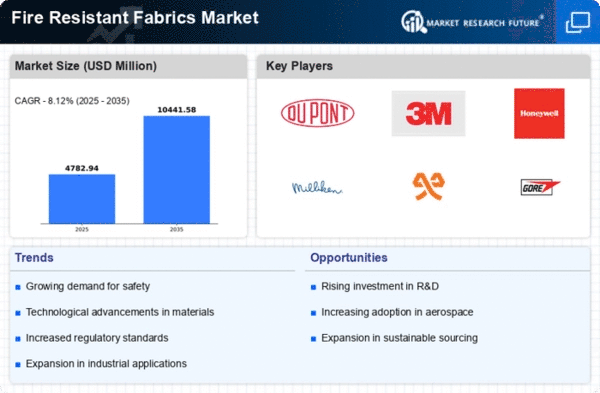
As per MRFR analysis, the Fire Resistant Fabrics Market Size was estimated at 4423.73 USD Million in 2024. The Fire Resistant Fabrics industry is projected to grow from 4782.95 USD Million in 2025 to 10441.58 USD Million by 2035, exhibiting a compound annual growth rate (CAGR) of 8.12 during the forecast period 2025 - 2035.

Key Market Trends & Highlights

The Fire Resistant Fabrics Market is poised for substantial growth driven by technological advancements and increasing safety regulations.

  • Technological advancements in fabric production are enhancing the performance and durability of fire resistant materials.
  • Sustainability and eco-friendly materials are becoming increasingly important in the development of fire resistant fabrics, particularly in North America.
  • The firefighting segment remains the largest market, while the industrial safety segment is experiencing rapid growth in the Asia-Pacific region.
  • Rising awareness of fire safety and regulatory compliance are key drivers propelling demand across various sectors.

Market Size & Forecast

2024 Market Size 4423.73 (USD Million)
2035 Market Size 10441.58 (USD Million)
CAGR (2025 - 2035) 8.12%
Largest Regional Market Share in 2024 North America

Major Players

<p>DuPont (US), 3M (US), Honeywell (US), Milliken & Company (US), Teijin Limited (JP), W. L. Gore & Associates (US), Lenzing AG (AT), BASF SE (DE), Solvay SA (BE)</p>

Market Trends

The Fire Resistant Fabrics Market is currently experiencing a notable transformation, driven by increasing awareness regarding safety standards across various industries. This heightened focus on protective clothing and materials is largely influenced by stringent regulations and the growing demand for enhanced safety measures in sectors such as construction, manufacturing, and firefighting. As a result, manufacturers are innovating and developing advanced materials that not only provide fire resistance but also offer comfort and durability. The integration of technology in fabric production is also becoming more prevalent, leading to the emergence of smart textiles that can monitor environmental conditions and provide real-time data to users. Moreover, the Fire Resistant Fabrics Market is witnessing a shift towards sustainable practices, with companies exploring eco-friendly materials and production methods. This trend aligns with the global push for sustainability and environmental responsibility, as consumers increasingly prefer products that minimize ecological impact. The market appears poised for growth, as advancements in material science and a commitment to safety continue to shape the landscape of fire-resistant textiles. As industries evolve, the demand for innovative solutions that meet both safety and environmental standards is likely to drive further developments in this sector.

Technological Advancements in Fabric Production

The Fire Resistant Fabrics Market is seeing a surge in technological innovations, particularly in the development of smart textiles. These fabrics are designed to respond to environmental stimuli, enhancing user safety and comfort. Manufacturers are investing in research to create materials that not only resist flames but also incorporate features such as moisture-wicking and temperature regulation.

Sustainability and Eco-Friendly Materials

A growing trend within the Fire Resistant Fabrics Market is the emphasis on sustainability. Companies are increasingly adopting eco-friendly materials and production processes to meet consumer demand for environmentally responsible products. This shift not only addresses ecological concerns but also aligns with regulatory pressures for sustainable practices in various industries.

Regulatory Compliance and Safety Standards

The Fire Resistant Fabrics Market is heavily influenced by stringent safety regulations across multiple sectors. As industries prioritize worker safety, compliance with these regulations becomes paramount. This trend drives manufacturers to innovate and enhance their product offerings, ensuring that their fabrics meet or exceed established safety standards.

Fire Resistant Fabrics Market Market Drivers

Market Growth Projections

The Global Fire-Resistant Fabrics Market Industry is projected to experience substantial growth over the next decade. With an anticipated market value of 4.42 USD Billion in 2024, the industry is expected to expand significantly, reaching approximately 10.4 USD Billion by 2035. This growth trajectory suggests a robust compound annual growth rate (CAGR) of 8.13% from 2025 to 2035. The increasing adoption of fire-resistant materials across various sectors, coupled with advancements in technology and heightened safety regulations, is likely to contribute to this positive outlook. The market's expansion reflects the growing recognition of the importance of fire safety in diverse applications.

Increasing Safety Regulations

The Global Fire-Resistant Fabrics Market Industry is experiencing growth driven by stringent safety regulations across various sectors, including construction, automotive, and aerospace. Governments worldwide are implementing more rigorous standards to protect workers and consumers from fire hazards. For instance, the National Fire Protection Association has established codes that necessitate the use of fire-resistant materials in buildings. This regulatory environment is expected to propel the market, as companies seek compliance to avoid penalties and enhance safety. As a result, the market is projected to reach 4.42 USD Billion in 2024, reflecting the increasing emphasis on safety and risk management.

Growing Awareness of Fire Safety

There is a notable increase in awareness regarding fire safety among consumers and industries, which is positively impacting the Global Fire-Resistant Fabrics Market Industry. Educational campaigns and training programs are being implemented to inform individuals and organizations about the importance of fire-resistant materials in preventing fire-related incidents. This heightened awareness is leading to greater investments in fire safety measures, including the procurement of fire-resistant clothing and materials. As a result, industries such as construction and manufacturing are prioritizing fire safety, which is expected to drive demand for fire-resistant fabrics in the coming years.

Expansion of the Aerospace Sector

The aerospace sector is another critical driver for the Global Fire-Resistant Fabrics Market Industry. With the increasing production of aircraft and the rising focus on passenger safety, the demand for fire-resistant materials in aircraft interiors and protective gear for crew members is surging. Regulatory bodies, such as the Federal Aviation Administration, mandate the use of fire-resistant materials in aircraft design and manufacturing. This requirement ensures that materials used in cabins and cockpit areas can withstand high temperatures and prevent fire spread. As the aerospace industry continues to grow, the demand for specialized fire-resistant fabrics is likely to increase, further bolstering the market.

Rising Demand from the Oil and Gas Sector

The oil and gas industry is a significant driver of the Global Fire-Resistant Fabrics Market Industry, as workers in this sector face high risks of fire and explosion. The need for protective clothing made from fire-resistant fabrics is paramount to ensure worker safety. Companies are increasingly investing in high-quality fire-resistant gear to comply with safety regulations and protect their workforce. This trend is evident in the growing adoption of flame-resistant uniforms and protective gear, which are essential for operations in hazardous environments. As the industry continues to expand, the demand for fire-resistant fabrics is expected to rise, further contributing to market growth.

Technological Advancements in Fabric Production

Innovations in textile technology are significantly influencing the Global Fire-Resistant Fabrics Market Industry. Advanced manufacturing processes, such as the development of new fiber blends and treatments, enhance the performance of fire-resistant fabrics. For example, the introduction of nanotechnology in fabric treatment has improved the durability and effectiveness of fire-resistant materials. These advancements not only increase the market appeal but also meet the growing demand for high-performance textiles in industries like oil and gas, where exposure to fire hazards is prevalent. Consequently, the market is anticipated to grow at a CAGR of 8.13% from 2025 to 2035, reaching an estimated 10.4 USD Billion by 2035.

Market Segment Insights

By Application: Firefighting (Largest) vs. Industrial Safety (Fastest-Growing)

<p>In the Fire Resistant Fabrics Market, the application segment is primarily dominated by Firefighting, which holds a significant share due to widespread demand from fire departments and emergency response units. This segment leverages advanced technology and materials to ensure the safety of personnel during hazardous situations. Following closely, Industrial Safety is emerging as a critical area, spurred by an increasing number of workplace regulations and the growing emphasis on employee safety across various industries.</p>

<p>Firefighting (Dominant) vs. Industrial Safety (Emerging)</p>

<p>Firefighting represents the dominant application of fire-resistant fabrics, critical in protecting firefighters from extreme heat and flames. These fabrics incorporate advanced thermal protection technologies, ensuring safety and comfort during intense operations. In contrast, Industrial Safety is viewed as an emerging segment, driven by stringent workplace safety regulations and a rising need for protective gear in factories and manufacturing plants. This application is gaining traction as industries recognize the importance of safeguarding their workforce, leading to innovations in the design and functionality of fire-resistant materials.</p>

By End Use: Aerospace (Largest) vs. Automotive (Fastest-Growing)

<p>The Fire Resistant Fabrics Market is witnessing significant market share distribution among various end-use segments. Currently, the aerospace sector holds the largest portion due to stringent safety regulations and high-performance requirements. Notably, automotive fabrics are rapidly gaining traction as the industry shifts towards safer and more reliable materials to meet enhancing safety standards.</p>

<p>Aerospace: Dominant vs. Automotive: Emerging</p>

<p>The aerospace segment is characterized by its stringent safety standards and the need for high-performance materials that provide superior heat resistance and safety features. Aerospace engineers prioritize lightweight and durable fabrics that can withstand extreme temperatures, making fire-resistant fabrics crucial in this field. On the other hand, the automotive segment is emerging swiftly, driven by increasing regulations concerning vehicle safety and performance. Manufacturers are actively integrating fire-resistant materials into vehicle interiors and components, which reflects a growing demand for innovative and safer fabric solutions. This evolution underscores a shift in consumer preferences towards enhanced safety in vehicles.</p>

By Material Type: Aramid (Largest) vs. Cotton (Fastest-Growing)

<p>In the Fire Resistant Fabrics Market, Aramid fabric stands out as the largest material type, holding a significant market share due to its superior thermal stability and high performance in extreme conditions. Cotton, on the other hand, is recognized for its rapid growth, attracting attention from manufacturers and consumers alike for its comfort and natural properties, which cater to emerging market preferences for eco-friendly durable products.</p>

<p>Aramid (Dominant) vs. Cotton (Emerging)</p>

<p>Aramid fabrics are renowned for their exceptional heat and flame resistance, making them a dominant choice in industries like aviation, military, and firefighting gear. Their lightweight nature combined with high strength attributes enhances the overall safety and performance of protective clothing. Conversely, Cotton has emerged as a preferred choice for lighter, comfortable, and breathable fire-resistant apparel. Over recent years, improvements in cotton treatment technologies have significantly enhanced its fire resistance capabilities, making it a competitive alternative, particularly in sectors focusing on comfort and versatility.</p>

By Product Type: Coated Fabrics (Largest) vs. Non-Coated Fabrics (Fastest-Growing)

<p>In the Fire Resistant Fabrics Market, Coated Fabrics lead the segment with the highest market share, offering enhanced durability and protection against fire hazards. This type of fabric is widely adopted in various industries including construction, aerospace, and automotive due to its reliable performance. Non-Coated Fabrics, while currently holding a smaller share, are witnessing rapid growth due to increasing demand for lightweight and breathable fire-resistant materials that cater to comfort while ensuring safety.</p>

<p>Coated Fabrics (Dominant) vs. Non-Coated Fabrics (Emerging)</p>

<p>Coated Fabrics are recognized for their superior resistance to heat and flames, making them the preferred choice for industries requiring stringent safety measures. Their versatility in applications such as industrial garments and protective wear contributes to their dominant market position. In contrast, Non-Coated Fabrics are emerging as a popular alternative, especially in sectors where comfort and breathability are prioritized alongside fire resistance. This segment is gaining traction as manufacturers innovate to enhance the fire-resistant properties of lightweight textiles, ensuring they meet both safety standards and consumer preferences.</p>

Get more detailed insights about Fire Resistant Fabrics Market Research Report - Forecast till 2035

Regional Insights

North America : Market Leader in Innovation

North America is poised to maintain its leadership in the Fire Resistant Fabrics market, holding a significant share of $2214.0M in 2024. The region's growth is driven by stringent safety regulations and increasing demand from industries such as construction, automotive, and aerospace. The adoption of advanced materials and technologies further fuels this growth, as companies seek to enhance safety standards and product performance. The competitive landscape in North America is robust, featuring key players like DuPont, 3M, and Honeywell. These companies are at the forefront of innovation, investing heavily in R&D to develop new fire-resistant solutions. The presence of established manufacturing facilities and a strong distribution network also contribute to the region's market dominance, ensuring a steady supply of high-quality fabrics to meet growing demand.

Europe : Emerging Regulatory Frameworks

Europe is witnessing a growing demand for Fire Resistant Fabrics, with a market size of $1106.0M in 2024. The region's growth is significantly influenced by stringent safety regulations and a heightened focus on fire safety across various sectors, including construction and textiles. The European Union's commitment to enhancing safety standards is a key driver, pushing manufacturers to innovate and comply with new regulations. Leading countries such as Germany, France, and the UK are at the forefront of this market, supported by a strong presence of key players like BASF and Solvay. The competitive landscape is characterized by a mix of established companies and emerging startups, all striving to meet the increasing demand for high-performance fire-resistant materials. This dynamic environment fosters innovation and collaboration, further propelling market growth.

Asia-Pacific : Rapidly Growing Market Potential

Asia-Pacific is rapidly emerging as a significant player in the Fire Resistant Fabrics market, with a market size of $825.0M in 2024. The region's growth is driven by increasing industrialization, urbanization, and rising safety awareness among consumers. Countries like China and India are witnessing a surge in demand for fire-resistant materials, particularly in construction and manufacturing sectors, as they strive to meet international safety standards. The competitive landscape in Asia-Pacific is evolving, with key players such as Teijin Limited and W. L. Gore & Associates leading the charge. The presence of a growing number of local manufacturers is also enhancing competition, driving innovation and cost-effectiveness. As the region continues to develop, the demand for high-quality fire-resistant fabrics is expected to rise, further solidifying its market position.

Middle East and Africa : Untapped Market Opportunities

The Middle East and Africa region is gradually emerging in the Fire Resistant Fabrics market, with a market size of $278.73M in 2024. The growth is primarily driven by increasing industrial activities and a rising focus on safety regulations in sectors such as oil and gas, construction, and manufacturing. Governments in the region are beginning to implement stricter safety standards, which is expected to boost demand for fire-resistant materials in the coming years. Countries like South Africa and the UAE are leading the way in adopting fire safety measures, supported by a growing number of local and international players entering the market. The competitive landscape is characterized by a mix of established companies and new entrants, all vying to capture market share. As awareness of fire safety continues to grow, the demand for fire-resistant fabrics is anticipated to increase significantly.

Key Players and Competitive Insights

The Fire Resistant Fabrics Market is currently characterized by a dynamic competitive landscape, driven by increasing demand across various sectors such as construction, automotive, and personal protective equipment. Key players are actively engaging in strategies that emphasize innovation, sustainability, and regional expansion. For instance, DuPont (US) has been focusing on enhancing its product portfolio through advanced research and development, particularly in the area of high-performance fibers. Similarly, 3M (US) is leveraging its technological expertise to develop new fire-resistant materials that cater to evolving safety standards, thereby reinforcing its market position. These strategic initiatives collectively contribute to a competitive environment that is increasingly centered around technological advancement and product differentiation.

In terms of business tactics, companies are localizing manufacturing to reduce lead times and optimize supply chains, which is particularly crucial in a market that is moderately fragmented. This approach not only enhances operational efficiency but also allows for better responsiveness to regional market demands. The competitive structure is shaped by the collective influence of major players, which, while diverse, tends to favor those who can innovate rapidly and maintain robust supply chains.

In November 2025, Honeywell (US) announced a strategic partnership with a leading aerospace manufacturer to develop next-generation fire-resistant fabrics specifically designed for aircraft interiors. This collaboration is significant as it not only expands Honeywell's footprint in the aerospace sector but also aligns with the growing emphasis on safety and compliance in aviation. The partnership is expected to enhance product offerings and drive revenue growth in a niche market segment.

In October 2025, Milliken & Company (US) launched a new line of eco-friendly fire-resistant fabrics made from recycled materials. This initiative reflects a broader trend towards sustainability within the industry, appealing to environmentally conscious consumers and businesses. By integrating sustainability into its product development, Milliken is likely to strengthen its competitive edge and attract a new customer base that prioritizes eco-friendly solutions.

In September 2025, Teijin Limited (JP) expanded its manufacturing capabilities in Southeast Asia, aiming to meet the rising demand for fire-resistant textiles in the region. This strategic move not only enhances Teijin's production capacity but also positions the company to better serve local markets, thereby increasing its competitiveness in a rapidly growing area. The expansion is indicative of a trend where companies are investing in regional capabilities to capitalize on emerging market opportunities.

As of December 2025, the Fire Resistant Fabrics Market is witnessing trends that emphasize digitalization, sustainability, and the integration of AI technologies. Strategic alliances are becoming increasingly prevalent, as companies recognize the value of collaboration in enhancing innovation and market reach. The competitive differentiation is likely to evolve from traditional price-based competition towards a focus on technological advancements, product innovation, and supply chain reliability. This shift suggests that companies that can effectively leverage these trends will be better positioned to thrive in the future.

Key Companies in the Fire Resistant Fabrics Market market include

Industry Developments

In April 2020, DuPont has begun a program named TyvekTogether where they presented a new particular Tyvek texture for the medical services laborers. This program was begun to help the world battle what is going on by giving defensive articles of clothing.

August 2021, As a component of the organization's obligation to create items that satisfy the most elevated defensive guidelines, Carrington Textiles has been conceded RU status for six of its fire-resistant textures in the classification of "fire-safe dress for the security of modern staff against brief term warm openings from fire." Having UL endorsement for these fabulous heatproof textures empowers us to focus on the North American market with items that give outstanding well-being to the wearer for which Carrington Textiles is prestigious.

Future Outlook

Fire Resistant Fabrics Market Future Outlook

<p>The Fire Resistant Fabrics Market is projected to grow at 8.12% CAGR from 2024 to 2035, driven by increasing safety regulations and demand across various industries.</p>

New opportunities lie in:

  • <p>Expansion into emerging markets with tailored fire-resistant solutions.</p>
  • <p>Development of innovative, lightweight fabrics for enhanced comfort and protection.</p>
  • <p>Strategic partnerships with safety equipment manufacturers for integrated product offerings.</p>

<p>By 2035, the market is expected to solidify its position as a leader in safety and innovation.</p>

Market Segmentation

Fire Resistant Fabrics Market End Use Outlook

  • Aerospace
  • Automotive
  • Oil and Gas
  • Manufacturing
  • Electrical

Fire Resistant Fabrics Market Application Outlook

  • Firefighting
  • Industrial Safety
  • Military
  • Transportation
  • Construction

Fire Resistant Fabrics Market Product Type Outlook

  • Coated Fabrics
  • Non-Coated Fabrics
  • Blended Fabrics
  • Laminated Fabrics

Fire Resistant Fabrics Market Material Type Outlook

  • Aramid
  • Cotton
  • Polyester
  • Wool
  • Fiberglass

Report Scope

MARKET SIZE 20244423.73(USD Million)
MARKET SIZE 20254782.95(USD Million)
MARKET SIZE 203510441.58(USD Million)
COMPOUND ANNUAL GROWTH RATE (CAGR)8.12% (2024 - 2035)
REPORT COVERAGERevenue Forecast, Competitive Landscape, Growth Factors, and Trends
BASE YEAR2024
Market Forecast Period2025 - 2035
Historical Data2019 - 2024
Market Forecast UnitsUSD Million
Key Companies ProfiledDuPont (US), 3M (US), Honeywell (US), Milliken & Company (US), Teijin Limited (JP), W. L. Gore & Associates (US), Lenzing AG (AT), BASF SE (DE), Solvay SA (BE)
Segments CoveredApplication, End Use, Material Type, Product Type
Key Market OpportunitiesGrowing demand for sustainable and innovative materials in the Fire Resistant Fabrics Market presents significant opportunities.
Key Market DynamicsRising demand for fire safety in various industries drives innovation and competition in fire resistant fabrics.
Countries CoveredNorth America, Europe, APAC, South America, MEA

FAQs

How much is the Fire-Resistant Fabrics market?

The Fire-Resistant Fabrics market size was valued at USD 4.42 Billion in 2024.

What is the growth rate of the Fire-Resistant Fabrics market?

Fire Resistant Fabrics Market is expected to grow with a CAGR of 8.12% in the period 2025-2035

Which region held the largest market share in the Fire-Resistant Fabrics market?

Asia Pacific had the largest share of the Fire-Resistant Fabrics market.

Who are the key players in the Fire-Resistant Fabrics market?

The key players in the Fire-Resistant Fabrics market are E.I. DuPont De Nemours and Company (U.S.), Kaneka Corporation (Japan), PBI Performance Products Inc. (U.S.), Royal TenCate N.V. (Netherlands), Teijin Ltd. (Japan), Westex Milliken (U.S.), Gun EI Chemical Industry Co., Ltd. (Japan), Huntsman Corporation (U.S.), Lenzing AG (Austria), Solvay S.A. (Belgium), W. L. Gore Associates Inc. (U.S.), and others.

Which Material led the Fire-Resistant Fabrics market?

The nylon categories dominated the Fire-Resistant Fabrics market in 2024.

Which Application type led the Fire-Resistant Fabrics market?

Protective wear had the largest share in the market for Fire Resistant Fabrics.

  1. Executive Summary
  2. Scope of the Report
    1. Market Definition
    2. Scope of the Study
      1. Research
      2. Assumptions & Limitations
    3. Objectives
    4. Markets Structure
  3. Market Research Methodology
    1. Research Type
    2. Secondary Research
    3. Primary Research
    4. Forecast Model
  4. Market Landscape
    1. Porter’s
      1. Threat of New Entrants
      2. Threat of substitutes
      3. Segment rivalry
    2. Five Forces Analysis
    3. Bargaining power of buyers
    4. Value Chain/Supply
    5. Chain of Global Fire Resistant Fabrics Market
  5. Industry
    1. Overview of Global Fire Resistant Fabrics Market
    2. Introduction
    3. Growth Drivers
    4. Impact analysis
    5. Market Challenges
  6. Market Trends
    1. Introduction
    2. Growth Trends
    3. Impact analysis
  7. Global Fire Resistant Fabrics
    1. Market by Application
    2. Introduction
      1. Market Estimates & Forecast,
      2. Market Estimates & Forecast by Region, 2023-2030
      3. Market Estimates & Forecast,
      4. Market Estimates & Forecast by Region, 2023-2030
    3. Apparel Fire Resistant Fabrics
    4. Non-Apparel Fire Resistant Fabrics
    5. Global Fire Resistant Fabrics Market by Type
    6. Introduction
    7. Treated Fire Resistant Fabrics
      1. Market Estimates
      2. Market Estimates & Forecast by Region,
    8. & Forecast, 2023-2030
    9. Inherent Fire Resistant Fabrics
      1. Market Estimates & Forecast
    10. Market Estimates & Forecast, 2023-2030
    11. by Region, 2023-2030
  8. Global Fire Resistant Fabrics Market by End-use
    1. Industry
    2. Introduction
    3. Oil
      1. Market Estimates & Forecast, 2023-2030
      2. Market
    4. & gas
    5. Estimates & Forecast by Region, 2023-2030
    6. Building
      1. Market Estimates & Forecast, 2023-2030
    7. and Construction
    8. Market Estimates & Forecast by Region, 2023-2030
    9. Defense
      1. Market Estimates & Forecast, 2023-2030
      2. Market Estimates & Forecast by Region, 2023-2030
      3. Market Estimates & Forecast, 2023-2030
      4. Market Estimates & Forecast by Region, 2023-2030
      5. Market Estimates & Forecast, 2023-2030
    10. and Public Safety
    11. Transportation
    12. Others
    13. Market Estimates & Forecast by Region, 2023-2030
  9. Global
    1. Fire Resistant Fabrics Market by Region
    2. Introduction
    3. North America
      1. Market Estimates & Forecast,
      2. Market Estimates & Forecast by Application, 2023-2030
      3. Market Estimates & Forecast by Type, 2023-2030
      4. Market Estimates
      5. U.S.
      6. Mexico
    4. & Forecast by End use Industry, 2023-2030
    5. & Forecast by Application, 2023-2030
    6. by Type, 2023-2030
    7. Forecast, 2023-2030
    8. Market Estimates & Forecast by End Use Industry, 2023-2030
    9. Canada
    10. Market Estimates & Forecast by Application, 2023-2030
    11. & Forecast by Type, 2023-2030
    12. by End Use Industry, 2023-2030
    13. Europe
      1. Market
      2. Market Estimates & Forecast
      3. Market Estimates & Forecast by Type, 2023-2030
      4. Market Estimates & Forecast by End Use Industry, 2023-2030
      5. France
      6. Italy
      7. U.K
      8. Rest of Europe
      9. Market Estimates & Forecast, 2023-2030
      10. Market Estimates
      11. Market Estimates & Forecast by
      12. China
      13. India
      14. Australia
      15. New Zealand
    14. Estimates & Forecast, 2023-2030
    15. by Application, 2023-2030
    16. Germany
    17. Market Estimates & Forecast by Application, 2023-2030
    18. & Forecast by Type, 2023-2030
    19. by End Use Industry, 2023-2030
    20. Market Estimates & Forecast, 2023-2030
    21. Forecast by Application, 2023-2030
    22. by Type, 2023-2030
    23. Forecast, 2023-2030
    24. Spain
    25. Market Estimates & Forecast by Application, 2023-2030
    26. & Forecast by Type, 2023-2030
    27. by End Use Industry, 2023-2030
    28. Estimates & Forecast, 2023-2030
    29. by Application, 2023-2030
    30. Forecast, 2023-2030
    31. Market Estimates & Forecast by End Use Industry, 2023-2030
    32. Asia Pacific
    33. Market Estimates & Forecast by Application, 2023-2030
    34. & Forecast by Type, 2023-2030
    35. End Use Industry, 2023-2030
    36. Estimates & Forecast, 2023-2030
    37. by Application, 2023-2030
    38. Estimates & Forecast by End Use Industry, 2023-2030
    39. Japan
    40. Market Estimates & Forecast by Application, 2023-2030
    41. & Forecast by Type, 2023-2030
    42. by End Use Industry, 2023-2030
    43. Market Estimates & Forecast, 2023-2030
    44. Forecast by Application, 2023-2030
    45. by Type, 2023-2030
    46. & Forecast, 2023-2030
    47. Market Estimates & Forecast by End Use Industry, 2023-2030
    48. Rest of Asia Pacific
    49. Market Estimates & Forecast by Type, 2023-2030
    50. & Forecast by End Use Industry, 2023-2030
    51. The Middle
      1. Market Estimates & Forecast, 2023-2030
      2. Market Estimates & Forecast by Application, 2023-2030
      3. Market
      4. Market Estimates & Forecast
      5. Turkey
      6. Israel
      7. North Africa
      8. GCC
      9. Rest of the Middle East & Africa
    52. East & Africa
    53. Estimates & Forecast by Type, 2023-2030
    54. by End Use Industry, 2023-2030
    55. & Forecast, 2023-2030
    56. Market Estimates & Forecast by End Use Industry, 2023-2030
    57. & Forecast by Application, 2023-2030
    58. by Type, 2023-2030
    59. Estimates & Forecast by End Use Industry, 2023-2030
    60. Market Estimates & Forecast, 2023-2030
    61. Forecast by Application, 2023-2030
    62. by Type, 2023-2030
    63. Estimates & Forecast, 2023-2030
    64. by Application, 2023-2030
    65. Latin America
      1. Market Estimates & Forecast,
      2. Market Estimates & Forecast by Application, 2023-2030
      3. Market Estimates & Forecast by Type, 2023-2030
      4. Market Estimates
      5. Brazil
      6. Argentina
      7. Rest of Latin
    66. & Forecast by End Use Industry, 2023-2030
    67. Market Estimates & Forecast, 2023-2030
    68. Forecast by Application, 2023-2030
    69. by Type, 2023-2030
    70. Estimates & Forecast by End Use Industry, 2023-2030
    71. America
    72. Market Estimates & Forecast by Application, 2023-2030
    73. & Forecast by Type, 2023-2030
    74. by End Use Industry, 2023-2030
  10. Company Landscape
  11. Company Profiles
    1. E.I. DuPont De Nemours and Company
      1. Application/Business Segment
      2. Financial Updates
    2. Company Overview
    3. Overview
    4. Key Developments
    5. Kaneka Corporation
      1. Application/Business Segment
      2. Financial Updates
    6. Company Overview
    7. Overview
    8. Key Developments
    9. PBI Performance Products Inc
      1. Company Overview
      2. Application/Business
      3. Financial Updates
    10. Segment Overview
    11. Key Developments
    12. Royal TenCate N.V
      1. Application/Business Segment
      2. Financial Updates
    13. Company Overview
    14. Overview
    15. Key Developments
    16. Teijin Ltd
      1. Application/Business Segment
      2. Financial Updates
    17. Company Overview
    18. Overview
    19. Key Developments
    20. Westex By Milliken
      1. Application/Business Segment
      2. Financial Updates
    21. Company Overview
    22. Overview
    23. Key Developments
    24. Gun EI Chemical Industry Co.,
      1. Company Overview
      2. Application/Business
      3. Financial Updates
    25. Ltd
    26. Segment Overview
    27. Key Developments
    28. W. L. Gore & Associates,
      1. Company Overview
      2. Application/Business
      3. Financial Updates
    29. Inc
    30. Segment Overview
    31. Key Developments
    32. Huntsman Corporation
      1. Application/Business Segment
      2. Financial Updates
    33. Company Overview
    34. Overview
    35. Key Developments
    36. Lenzing AG
      1. Application/Business Segment
      2. Financial Updates
    37. Company Overview
    38. Overview
    39. Key Developments
    40. Solvay S.A
      1. Application/Business Segment
      2. Financial Updates
    41. Company Overview
    42. Overview
    43. Key Developments
  12. Conclusion
    1. LIST
  13. OF TABLES
  14. World Population by Major Regions
    1. (2020 To 2027)
  15. Global Fire Resistant Fabrics
    1. Market: By Region, 2023-2030
  16. North America
    1. Fire Resistant Fabrics Market: By Country, 2023-2030
    2. Table 4
    3. Europe Fire Resistant Fabrics Market: By Country, 2023-2030
    4. Table
  17. Asia-Pacific Fire Resistant Fabrics Market: By Country, 2023-2030
  18. Middle East & Africa Fire Resistant Fabrics
    1. Market: By Country, 2023-2030
  19. Latin America
    1. Fire Resistant Fabrics Market: By Country, 2023-2030
    2. Table 8
    3. Global Fire Resistant Fabrics by Application Market: By Regions, 2023-2030
  20. North America Fire Resistant Fabrics by Application
    1. Market: By Country, 2023-2030
    2. Table10 Europe
    3. Fire Resistant Fabrics by Application Market: By Country, 2023-2030
    4. Table11
    5. Asia-Pacific Fire Resistant Fabrics by Application Market: By Country, 2023-2030
    6. Table12 Middle East & Africa Fire Resistant Fabrics
    7. by Application Market: By Country, 2023-2030
    8. Table13 Latin
    9. America Fire Resistant Fabrics by Application Market: By Country, 2023-2030
    10. Table14 Global Fire Resistant Fabrics by Type Market: By Regions,
    11. Table15 North America Fire Resistant Fabrics
    12. by Type Market: By Country, 2023-2030
    13. Table16 Europe
    14. Fire Resistant Fabrics by Type Market: By Country, 2023-2030
    15. Table17
    16. Asia-Pacific Fire Resistant Fabrics by Type Market: By Country, 2023-2030
    17. Table18 Middle East & Africa Fire Resistant Fabrics
    18. by Type Market: By Country, 2023-2030
    19. Table19 Latin
    20. America Fire Resistant Fabrics by Type Market: By Country, 2023-2030
    21. Table20
    22. Global Fire Resistant Fabrics by Type Market: By Regions, 2023-2030
    23. Table21 North America Fire Resistant Fabrics for Type Market:
    24. By Country, 2023-2030
    25. Table22 Europe Fire Resistant
    26. Fabrics for Type Market: By Country, 2023-2030
    27. Table23 Asia-Pacific
    28. Fire Resistant Fabrics for Type Market: By Country, 2023-2030
    29. Table24
    30. Middle East & Africa Fire Resistant Fabrics for Type Market: By Country,
    31. Table25 Latin America Fire Resistant Fabrics
    32. for Type Market: By Country, 2023-2030
    33. Table26 Global
    34. Application Market: By Region, 2023-2030
    35. Table27 Global
    36. Type Market: By Region, 2023-2030
    37. Table28 Global
    38. Type Market: By Region, 2023-2030
    39. Table29 North America
  21. Fire Resistant Fabrics Market, By Country
    1. Table30 North
  22. America Fire Resistant Fabrics Market, By Application
    1. Table31 North
  23. America Fire Resistant Fabrics Market, By Type
    1. Table32 North
  24. America Fire Resistant Fabrics Market, By Type
    1. Table33 Europe:
  25. Fire Resistant Fabrics Market, By Country
    1. Table34 Europe:
  26. Fire Resistant Fabrics Market, By Application
    1. Table35 Europe:
  27. Fire Resistant Fabrics Market, By Type
    1. Table36 Europe: Fire
  28. Resistant Fabrics Market, By Type
    1. Table37 Asia-Pacific: Fire
  29. Resistant Fabrics Market, By Country
    1. Table38 Asia-Pacific:
  30. Fire Resistant Fabrics Market, By Application
    1. Table39 Asia-Pacific:
  31. Fire Resistant Fabrics Market, By Type
    1. Table40 Asia-Pacific:
  32. Fire Resistant Fabrics Market, By Type
    1. Table41 Middle East
  33. & Africa: Fire Resistant Fabrics Market, By Country
    1. Table42
  34. Middle East & Africa Fire Resistant Fabrics Market, By Application
    1. Table43 Middle East & Africa Fire Resistant Fabrics Market,
    2. By Type
    3. Table44 Middle East & Africa: Fire Resistant
  35. Fabrics Market, By Type
    1. Table45 Latin America: Fire Resistant
  36. Fabrics Market, By Country
    1. Table46 Latin America Fire
  37. Resistant Fabrics Market, By Application
    1. Table47 Latin America
  38. Fire Resistant Fabrics Market, By Type
    1. Table48 Latin America:
  39. Fire Resistant Fabrics Market, By Type
  40. LIST OF FIGURES
  41. Global Fire Resistant Fabrics market segmentation
  42. Forecast Methodology
  43. Five Forces Analysis of
    1. Global Fire Resistant Fabrics Market
  44. Value Chain of Global Fire
    1. Resistant Fabrics Market
  45. Share of Global Fire Resistant Fabrics
  46. Market in 2020, by country (in %)
  47. Global Fire Resistant Fabrics
    1. Market, 2023-2030,
  48. Sub segments of Application
    1. FIGURE
  49. Global Fire Resistant Fabrics Market size by Application, 2020
    1. FIGURE
  50. Share of Global Fire Resistant Fabrics Market by Application, 2023-2030
  51. Global Fire Resistant Fabrics Market size by Type, 2020
    1. FIGURE
  52. Share of Global Fire Resistant Fabrics Market by Type, 2023-2030
    1. FIGURE
  53. Global Fire Resistant Fabrics Market size by Type, 2020
    1. FIGURE 13
    2. Share of Global Fire Resistant Fabrics Market by Type, 2023-2030

Fire Resistant Fabrics Material Outlook (USD Billion, 2025 - 2034)

  • Cotton
  • Nylon
  • Aramid
  • Polyesters
  • Others

Fire Resistant Fabrics Application Type Outlook (USD Billion, 2025 - 2034)

  • PROTECTIVE WEAR
  • Upholstery
  • Tents and Coverings
  • Others

Fire Resistant Fabrics Processing Method Outlook (USD Billion, 2025 - 2034)

  • Woven
  • Non-woven
  • Knitted

Fire Resistant Fabrics Regional Outlook (USD Billion, 2025 - 2034)

  • North America Outlook (USD Billion, 2025 - 2034)
    • North America Fire Resistant Fabrics by Material
      • Cotton
      • Nylon
      • Aramid
      • Polyesters
      • Others
    • North America Fire Resistant Fabrics by Application Type
      • PROTECTIVE WEAR
      • Upholstery
      • Tents and Coverings
      • Others
    • North America Fire Resistant Fabrics by Processing Method
      • Woven
      • Non-woven
      • Knitted
    • US Outlook (USD Billion, 2025 - 2034)
    • US Fire Resistant Fabrics by Material
      • Cotton
      • Nylon
      • Aramid
      • Polyesters
      • Others
    • US Fire Resistant Fabrics by Application Type
      • PROTECTIVE WEAR
      • Upholstery
      • Tents and Coverings
      • Others
    • US Fire Resistant Fabrics by Processing Method
      • Woven
      • Non-woven
      • Knitted
    • CANADA Outlook (USD Billion, 2025 - 2034)
    • CANADA Fire Resistant Fabrics by Material
      • Cotton
      • Nylon
      • Aramid
      • Polyesters
      • Others
    • CANADA Fire Resistant Fabrics by Application Type
      • PROTECTIVE WEAR
      • Upholstery
      • Tents and Coverings
      • Others
    • CANADA Fire Resistant Fabrics by Processing Method
      • Woven
      • Non-woven
      • Knitted
  • Europe Outlook (USD Billion, 2025 - 2034)
    • Europe Fire Resistant Fabrics by Material
      • Cotton
      • Nylon
      • Aramid
      • Polyesters
      • Others
    • Europe Fire Resistant Fabrics by Application Type
      • PROTECTIVE WEAR
      • Upholstery
      • Tents and Coverings
      • Others
    • Europe Fire Resistant Fabrics by Processing Method
      • Woven
      • Non-woven
      • Knitted
    • Germany Outlook (USD Billion, 2025 - 2034)
    • Germany Fire Resistant Fabrics by Material
      • Cotton
      • Nylon
      • Aramid
      • Polyesters
      • Others
    • Germany Fire Resistant Fabrics by Application Type
      • PROTECTIVE WEAR
      • Upholstery
      • Tents and Coverings
      • Others
    • Germany Fire Resistant Fabrics by Processing Method
      • Woven
      • Non-woven
      • Knitted
    • France Outlook (USD Billion, 2025 - 2034)
    • France Fire Resistant Fabrics by Material
      • Cotton
      • Nylon
      • Aramid
      • Polyesters
      • Others
    • France Fire Resistant Fabrics by Application Type
      • PROTECTIVE WEAR
      • Upholstery
      • Tents and Coverings
      • Others
    • France Fire Resistant Fabrics by Processing Method
    •  
      • Woven
      • Non-woven
      • Knitted
  •  
    • UK Outlook (USD Billion, 2025 - 2034)
    • UK Fire Resistant Fabrics by Material
      • Cotton
      • Nylon
      • Aramid
      • Polyesters
      • Others
    • UK Fire Resistant Fabrics by Application Type
      • PROTECTIVE WEAR
      • Upholstery
      • Tents and Coverings
      • Others
    • UK Fire Resistant Fabrics by Processing Method
      • Woven
      • Non-woven
      • Knitted
    • ITALY Outlook (USD Billion, 2025 - 2034)
    • ITALY Fire Resistant Fabrics by Material
      • Cotton
      • Nylon
      • Aramid
      • Polyesters
      • Others
    • ITALY Fire Resistant Fabrics by Application Type
      • PROTECTIVE WEAR
      • Upholstery
      • Tents and Coverings
      • Others
    • ITALY Fire Resistant Fabrics by Processing Method
      • Woven
      • Non-woven
      • Knitted
    • SPAIN Outlook (USD Billion, 2025 - 2034)
    • Spain Fire Resistant Fabrics by Material
      • Cotton
      • Nylon
      • Aramid
      • Polyesters
      • Others
    • Spain Fire Resistant Fabrics by Application Type
      • PROTECTIVE WEAR
      • Upholstery
      • Tents and Coverings
      • Others
    • Spain Fire Resistant Fabrics by Processing Method
      • Woven
      • Non-woven
      • Knitted
    • Rest Of Europe Outlook (USD Billion, 2025 - 2034)
    • REST OF EUROPE Fire Resistant Fabrics by Material
      • Cotton
      • Nylon
      • Aramid
      • Polyesters
      • Others
    • REST OF EUROPE Fire Resistant Fabrics by Application Type
      • PROTECTIVE WEAR
      • Upholstery
      • Tents and Coverings
      • Others
    • REST OF EUROPE Fire Resistant Fabrics by Processing Method
      • Woven
      • Non-woven
      • Knitted
  • Asia-Pacific Outlook (USD Billion, 2025 - 2034)
    • Asia-Pacific Fire Resistant Fabrics by Material
      • Cotton
      • Nylon
      • Aramid
      • Polyesters
      • Others
    • Asia-Pacific Fire Resistant Fabrics by Application Type
      • PROTECTIVE WEAR
      • Upholstery
      • Tents and Coverings
      • Others
    • Asia-Pacific Fire Resistant Fabrics by Processing Method
      • Woven
      • Non-woven
      • Knitted
    • China Outlook (USD Billion, 2025 - 2034)
    • China Fire Resistant Fabrics by Material
      • Cotton
      • Nylon
      • Aramid
      • Polyesters
      • Others
    • China Fire Resistant Fabrics by Application Type
      • PROTECTIVE WEAR
      • Upholstery
      • Tents and Coverings
      • Others
    • China Fire Resistant Fabrics by Processing Method
      • Woven
      • Non-woven
      • Knitted
    • Japan Outlook (USD Billion, 2025 - 2034)
    • Japan Fire Resistant Fabrics by Material
      • Cotton
      • Nylon
      • Aramid
      • Polyesters
      • Others
    • Japan Fire Resistant Fabrics by Application Type
      • PROTECTIVE WEAR
      • Upholstery
      • Tents and Coverings
      • Others
    • Japan Fire Resistant Fabrics by Processing Method
      • Woven
      • Non-woven
      • Knitted
    • India Outlook (USD Billion, 2025 - 2034)
    • India Fire Resistant Fabrics by Material
      • Cotton
      • Nylon
      • Aramid
      • Polyesters
      • Others
    • India Fire Resistant Fabrics by Application Type
      • PROTECTIVE WEAR
      • Upholstery
      • Tents and Coverings
    • India Fire Resistant Fabrics by Processing Method
      • Woven
      • Non-woven
      • Knitted
      • Others
    • Australia Outlook (USD Billion, 2025 - 2034)
    • Australia Fire Resistant Fabrics by Material
      • Cotton
      • Nylon
      • Aramid
      • Polyesters
      • Others
    • Australia Fire Resistant Fabrics by Application Type
      • PROTECTIVE WEAR
      • Upholstery
      • Tents and Coverings
    • Australia Fire Resistant Fabrics by Processing Method
      • Woven
      • Non-woven
      • Knitted
      • Others
    • Rest of Asia-Pacific Outlook (USD Billion, 2025 - 2034)
    • Rest of Asia-Pacific Low-Profile Additives by Material
      • Cotton
      • Nylon
      • Aramid
      • Polyesters
      • Others
    • Rest of Asia-Pacific Low-Profile Additives by Application Type
      • PROTECTIVE WEAR
      • Upholstery
      • Tents and Coverings
      • Others
    • Rest of Asia-Pacific Low-Profile Additives by Processing Method
      • Woven
      • Non-woven
      • Knitted
  • Rest of the World Outlook (USD Billion, 2025 - 2034)
    • Rest of the World Fire Resistant Fabrics by Material
      • Cotton
      • Nylon
      • Aramid
      • Polyesters
      • Others
    • Rest of the World Fire Resistant Fabrics by Application Type
      • PROTECTIVE WEAR
      • Upholstery
      • Tents and Coverings
      • Others
    • Rest of the World Fire Resistant Fabrics by Processing Method
      • Woven
      • Non-woven
      • Knitted
    • Middle East Outlook (USD Billion, 2025 - 2034)
    • Middle East Fire Resistant Fabrics by Material
      • Cotton
      • Nylon
      • Aramid
      • Polyesters
      • Others
    • Middle East Fire Resistant Fabrics by Application Type
      • PROTECTIVE WEAR
      • Upholstery
      • Tents and Coverings
      • Others
    • Middle East Fire Resistant Fabrics by Processing Method
      • Woven
      • Non-woven
      • Knitted
    • Africa Outlook (USD Billion, 2025 - 2034)
    • Africa Fire Resistant Fabrics by Material
      • Cotton
      • Nylon
      • Aramid
      • Polyesters
      • Others
    • Africa Fire Resistant Fabrics by Application Type
      • PROTECTIVE WEAR
      • Upholstery
      • Tents and Coverings
      • Others
    • Africa Fire Resistant Fabrics by Processing Method
      • Woven
      • Non-woven
      • Knitted
    • Latin America Outlook (USD Billion, 2025 - 2034)
    • Latin America Fire Resistant Fabrics by Material
      • Cotton
      • Nylon
      • Aramid
      • Polyesters
      • Others
    • Latin America Fire Resistant Fabrics by Application Type
      • PROTECTIVE WEAR
      • Upholstery
      • Tents and Coverings
      • Others
    • Latin America Fire Resistant Fabrics by Processing Method
      • Woven
      • Non-woven
      • Knitted


Infographic

Free Sample Request

Kindly complete the form below to receive a free sample of this Report

Get Free Sample

Customer Strories

Compare Licence

×
Features License Type
Single User Multiuser License Enterprise User
Price $4,950 $5,950 $7,250
Maximum User Access Limit 1 User Upto 10 Users Unrestricted Access Throughout the Organization
Free Customization
Direct Access to Analyst
Deliverable Format
Platform Access
Discount on Next Purchase 10% 15% 15%
Printable Versions