Request Free Sample ×

Kindly complete the form below to receive a free sample of this Report

* Please use a valid business email

Leading companies partner with us for data-driven Insights

clients tt-cursor
Hero Background
English
Chinese
French
Japanese
Korean
German
Spanish

Filters Particle Monitoring Market Size

ID: MRFR/Pharma/0282-HCR
132 Pages
Rahul Gotadki
April 2026

Filters & Particle Monitoring Market Share, Trends and Growth Analysis Product for Filter (Filtration Accessories), Technology for Filter (Vacuum Filtration), Product for Particle Monitoring (Monitor, Sensors), End-User (Pharmaceutical Companies) -Forecast Till 2035

Share:
Download PDF ×

We do not share your information with anyone. However, we may send you emails based on your report interest from time to time. You may contact us at any time to opt-out.

Filters Particle Monitoring Market Infographic
Purchase Options

Filters Particle Monitoring Size

Filters Particle Monitoring Market Growth Projections and Opportunities

The filters and particle monitoring market is closely tied to industrial growth and the increasing awareness of air quality concerns. As industries expand, the need for effective air filtration and particle monitoring systems rises to comply with environmental regulations and ensure worker health and safety. The regulations in power play a critical role in mapping the dust and particulate screening sector. Tightening environmental rules dictate the fact to be in compliance and to hold up with the monitoring particulate matter rate. Such regulations obligation facilitation of the most sophisticated filtration technologies and extremely high-resolution monitoring of aerosol particles. The more healthcare facilities such as hospitals and laboratories that are built in respective areas, the more insistent the demand becomes for the best quality air filters and aerosol monitoring. As the result of dramatic health crises which take place all over the world, such as the COVID-19, the necessity to provide the indoor air with the proper cleaning in healthcare facilities has become more and more important, and therefore push market development. The exponential development of purification methods not only radically alter industry dynamics but also influence the overall market. Use our AI to write for you about any topic! It is easy and fun. Just type your idea in the box, and watch our artificial intelligence do its magic. Writing has never been easier! Innovations such as high-efficiency particulate air (HEPA) filters and nanowoven fiber systems have been evolving and becoming efficient in that they capture fine particles very well. The market is run by replacement search for better and eco-friendly filtration and treatment units between different industries. Consequently, the industrialization that is developing in the economies in growth raises the bar for the size and the air quality devices for particle reading. Following the economies' growing scarcities, industries invest in air quality control measures in order to reduce environmental impact to the point of global standards thereby growing the market trend. Nowadays, workplace safety indeed comes first being a common requirement for factories and offices. Companies keep up with hygiene norms and obtain air purification systems. This promotes better work safety, and employees are happy because they continue to perform their duties in a comfortable space.

Increasing consumer awareness of indoor air quality and its impact on health has led to a surge in demand for residential air filtration systems. Homeowners and occupants seek filters and particle monitoring devices to create healthier living spaces, fostering market growth in the residential segment. Global health events, such as pandemics, underscore the importance of efficient air filtration and particle monitoring in various settings. The COVID-19 pandemic has accelerated the adoption of advanced filtration technologies and monitoring systems in public spaces, transportation, and other critical infrastructure.

Filters Particle Monitoring Market Size Graph
Author
Author Profile
Rahul Gotadki
Research Manager

He holds an experience of about 9+ years in Market Research and Business Consulting, working under the spectrum of Life Sciences and Healthcare domains. Rahul conceptualizes and implements a scalable business strategy and provides strategic leadership to the clients. His expertise lies in market estimation, competitive intelligence, pipeline analysis, customer assessment, etc.

Leave a Comment

FAQs

What is the projected market valuation for the Filters And Particle Monitoring Market in 2035?

The projected market valuation for the Filters And Particle Monitoring Market in 2035 is 1.673 USD Billion.

What was the market valuation for the Filters And Particle Monitoring Market in 2024?

The overall market valuation for the Filters And Particle Monitoring Market was 0.79 USD Billion in 2024.

What is the expected CAGR for the Filters And Particle Monitoring Market during the forecast period 2025 - 2035?

The expected CAGR for the Filters And Particle Monitoring Market during the forecast period 2025 - 2035 is 7.06%.

Which companies are considered key players in the Filters And Particle Monitoring Market?

Key players in the Filters And Particle Monitoring Market include Thermo Fisher Scientific, Parker Hannifin, Emerson Electric, and Ametek.

What are the main product segments in the Filters And Particle Monitoring Market?

The main product segments in the Filters And Particle Monitoring Market are Filters and Monitoring Devices, with respective valuations of 0.4 and 0.39 USD Billion in 2024.

How do the technology segments of ultrafiltration, microfiltration, and nanotechnology compare in terms of market valuation?

In 2024, ultrafiltration, microfiltration, and nanotechnology had valuations of 0.25, 0.24, and 0.3 USD Billion, respectively.

What end-user segments are driving growth in the Filters And Particle Monitoring Market?

End-user segments driving growth include Medical Centers, Diagnostic Units, Pharma Units, and Research Companies, with valuations ranging from 0.14 to 0.55 USD Billion in 2024.

What is the anticipated growth trend for monitoring devices within the Filters And Particle Monitoring Market?

Monitoring Devices are expected to grow from a valuation of 0.39 USD Billion in 2024, indicating a positive trend in the market.

How does the market valuation for filters compare to that of monitoring devices in 2024?

In 2024, the market valuation for filters was 0.4 USD Billion, slightly higher than the 0.39 USD Billion for monitoring devices.

What implications does the projected growth of the Filters And Particle Monitoring Market have for industry stakeholders?

The projected growth suggests that industry stakeholders may need to adapt strategies to capitalize on the anticipated increase in market demand by 2035.

Market Summary

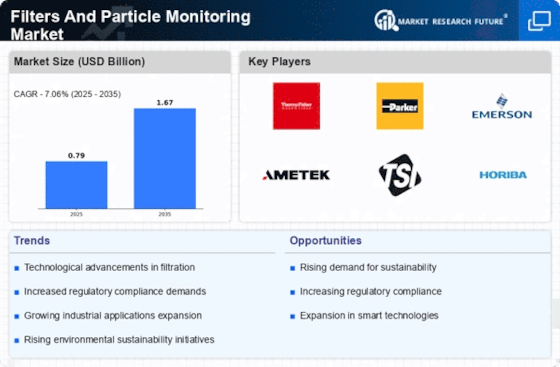
As per Market Research Future analysis, the Filters And Particle Monitoring Market Size was estimated at 0.79 USD Billion in 2024. The Filters And Particle Monitoring industry is projected to grow from USD 0.8458 Billion in 2025 to USD 1.673 Billion by 2035, exhibiting a compound annual growth rate (CAGR) of 7.06% during the forecast period 2025 - 2035

Key Market Trends & Highlights

The Filters and Particle Monitoring Market is poised for substantial growth driven by technological advancements and increasing regulatory compliance.

  • Technological advancements in filtration systems are reshaping the landscape of the Filters and Particle Monitoring Market.
  • North America remains the largest market, while Asia-Pacific is emerging as the fastest-growing region in this sector.
  • Filters represent the largest segment, whereas monitoring devices are witnessing the fastest growth due to rising demand.
  • Key market drivers include technological innovations in particle monitoring and increased focus on health and safety, reflecting a shift towards sustainable solutions.

Market Size & Forecast

2024 Market Size 0.79 (USD Billion)
2035 Market Size 1.673 (USD Billion)
CAGR (2025 - 2035) 7.06%
Largest Regional Market Share in 2024 North America

Major Players

Thermo Fisher Scientific (US), Parker Hannifin (US), Emerson Electric (US), Ametek (US), TSI Incorporated (US), Horiba (JP), Kahn Instruments (US), Grimm Aerosol Technik (DE), Palas GmbH (DE)

Market Trends

The Filters And Particle Monitoring Market is currently experiencing a notable evolution, driven by increasing awareness regarding air quality and environmental health. As industries and consumers alike become more conscious of the impact of particulate matter on health, there is a growing demand for advanced filtration systems and monitoring technologies. This shift is further propelled by regulatory frameworks that emphasize the necessity for stringent air quality standards. Consequently, manufacturers are innovating to develop more efficient filters and monitoring devices that can effectively capture and analyze airborne particles, thereby enhancing public safety and compliance with environmental regulations. Moreover, the integration of smart technologies into filtration systems is emerging as a pivotal trend within the Filters And Particle Monitoring Market. The advent of IoT-enabled devices allows for real-time monitoring and data collection, facilitating proactive measures in managing air quality. This technological advancement not only improves operational efficiency but also provides valuable insights for industries aiming to reduce their environmental footprint. As the market continues to evolve, the interplay between regulatory pressures, technological innovation, and consumer demand will likely shape its trajectory, presenting both challenges and opportunities for stakeholders across various sectors.

Technological Advancements in Filtration Systems

The Filters And Particle Monitoring Market is witnessing a surge in technological innovations, particularly in the development of advanced filtration systems. These systems are designed to enhance efficiency and effectiveness in capturing particulate matter, thereby addressing growing concerns about air quality. Manufacturers are increasingly focusing on integrating smart technologies, such as IoT and AI, to enable real-time monitoring and data analysis, which could lead to improved operational performance.

Regulatory Compliance and Environmental Standards

Regulatory frameworks are becoming increasingly stringent, compelling industries to adopt better filtration and monitoring solutions. The Filters And Particle Monitoring Market is responding to these pressures by innovating products that meet or exceed compliance requirements. This trend suggests that companies prioritizing adherence to environmental standards may gain a competitive edge, as consumers and regulators alike demand higher accountability in air quality management.

Growing Consumer Awareness and Demand

There is a noticeable increase in consumer awareness regarding the health impacts of air pollution, which is driving demand for effective filtration and monitoring solutions. The Filters And Particle Monitoring Market is likely to benefit from this heightened awareness, as individuals and organizations seek to invest in technologies that ensure cleaner air. This trend indicates a shift towards more proactive measures in air quality management, influencing product development and marketing strategies.

Filters Particle Monitoring Market Market Drivers

Increased Focus on Health and Safety

The Filters And Particle Monitoring Market is witnessing a heightened focus on health and safety, particularly in workplaces and public spaces. Organizations are increasingly recognizing the importance of maintaining air quality and minimizing exposure to harmful particles. This awareness is driving the adoption of advanced filtration systems and monitoring technologies across various sectors, including healthcare, education, and hospitality. Market Research Future indicates that investments in health and safety measures are likely to rise, leading to a corresponding increase in demand for effective particle monitoring solutions. As businesses prioritize the well-being of employees and customers, the Filters And Particle Monitoring Market is poised for growth, reflecting this shift in focus.

Consumer Demand for Sustainable Solutions

The Filters And Particle Monitoring Market is being shaped by a growing consumer demand for sustainable and eco-friendly solutions. As environmental concerns gain prominence, consumers are increasingly seeking products that not only filter particles effectively but also minimize ecological impact. This trend is prompting manufacturers to innovate and develop filtration systems that utilize sustainable materials and energy-efficient technologies. Market data suggests that the demand for environmentally friendly filtration solutions is on the rise, with consumers willing to invest in products that align with their values. Consequently, the Filters And Particle Monitoring Market is likely to evolve, driven by this shift towards sustainability and responsible consumption.

Rising Industrialization and Urbanization

The Filters And Particle Monitoring Market is significantly impacted by the ongoing trends of industrialization and urbanization. As urban areas expand and industries proliferate, the demand for effective filtration and monitoring solutions becomes paramount to combat pollution and ensure public health. The rise in manufacturing activities, particularly in developing regions, is contributing to an increased need for efficient particle monitoring systems. Market data indicates that the industrial segment is expected to account for a substantial share of the Filters And Particle Monitoring Market, with growth rates reflecting the urgency of addressing environmental concerns. This trend suggests a robust future for filtration technologies as urban centers continue to grow.

Regulatory Pressures and Compliance Requirements

The Filters And Particle Monitoring Market is heavily influenced by stringent regulatory pressures aimed at ensuring environmental safety and public health. Governments and regulatory bodies are implementing more rigorous standards for air and water quality, necessitating the use of advanced filtration and monitoring systems. Compliance with these regulations is not only a legal obligation but also a competitive advantage for businesses. The market is witnessing an increase in demand for products that meet these compliance standards, with a notable rise in investments in filtration technologies. As regulations evolve, the Filters And Particle Monitoring Market is expected to adapt, fostering innovation and growth in response to these compliance requirements.

Technological Innovations in Particle Monitoring

The Filters And Particle Monitoring Market is experiencing a surge in technological innovations that enhance the efficiency and accuracy of particle detection. Advanced sensors and real-time monitoring systems are being integrated into filtration solutions, allowing for more precise tracking of particulate matter. This trend is driven by the increasing need for high-quality air and water filtration in various sectors, including healthcare, manufacturing, and environmental monitoring. The market for particle monitoring systems is projected to grow significantly, with estimates suggesting a compound annual growth rate of over 10% in the coming years. As industries adopt these cutting-edge technologies, the Filters And Particle Monitoring Market is likely to expand, driven by the demand for improved monitoring capabilities.

Market Segment Insights

By Product: Filters (Largest) vs. Monitoring Devices (Fastest-Growing)

In the Filters and Particle Monitoring Market, "Filters" presently commands the largest share, reflecting its essential role in ensuring air and liquid purity across various sectors. These filtration systems are vital due to increasing regulations on environmental pollution and contamination controls. Conversely, "Monitoring Devices" are emerging as a crucial segment, supported by heightened awareness regarding air quality and safety concerns, capturing the attention of many industries invested in maintaining clean operations and compliance with health standards.

Filters (Dominant) vs. Monitoring Devices (Emerging)

Filters have established themselves as a dominant force in the market, characterized by their widespread application in industrial, residential, and commercial environments. They serve to remove contaminants effectively, ensuring compliance with stringent regulatory standards for air and water quality. On the other hand, Monitoring Devices are rapidly emerging, propelled by advancements in technology that enable real-time monitoring and data analysis. These devices are integral for detecting particulate matter and other pollutants, fostering proactive management practices. As industries increasingly prioritize health and environmental safety, the demand for both markets will continue to rise, but Filters hold a well-entrenched position due to their extensive implementation.

By Technology: Ultrafiltration (Largest) vs. Nanotechnology (Fastest-Growing)

In the Filters and Particle Monitoring Market, the technology segment is primarily characterized by three main players: Ultrafiltration, Microfiltration, and Nanotechnology. Ultrafiltration currently holds the largest market share, driven by its extensive applications in various industries such as water treatment and food processing. However, Microfiltration is not far behind, serving crucial roles in diverse areas including life sciences and environmental monitoring. This distribution illustrates the significant reliance on these technologies for effective filtration solutions across multiple sectors.

Technology: Ultrafiltration (Dominant) vs. Nanotechnology (Emerging)

Ultrafiltration is the dominant technology in the Filters and Particle Monitoring Market, known for its efficacy in separating suspended solids and macromolecular substances from liquids. This technology is heavily employed in water treatment, pharmaceuticals, and the food and beverage industries. In contrast, Nanotechnology is emerging rapidly, offering innovative solutions for even finer particle filtration and detection. Its potential to enhance filter performance and efficiency is driving interest, especially as industries seek more precise monitoring capabilities. As environmental regulations become stricter, the demand for Nanotechnology applications grows, indicating a shifting focus toward advanced filtration methods that promise greater effectiveness.

By End-User: Medical Centers (Largest) vs. Pharma Units (Fastest-Growing)

In the Filters and Particle Monitoring Market, the distribution of market share among different end-user segments highlights a diverse landscape. Medical Centers hold the largest share of this market, benefiting from stringent regulatory requirements and increased emphasis on patient safety. Following closely are Pharma Units, which also command a significant share due to their need for precise monitoring in <a href="https://www.marketresearchfuture.com/reports/drug-development-market-66529" target="_blank" title="drug development">drug development</a> and production processes. Diagnostic Units and Research Companies, while smaller, contribute to the overall ecosystem by seeking advanced filtration solutions for specialized applications.

Medical Centers (Dominant) vs. Pharma Units (Emerging)

Medical Centers are characterized by their extensive use of filters and particle monitoring systems to maintain sterile environments and ensure compliance with health regulations. They prioritize reliability and accuracy in monitoring to prevent contamination risks, making their demand for advanced filtration technologies constant. On the other hand, Pharma Units represent the fastest-growing segment, driven by the increasing complexity of pharmaceuticals and the need for precise particle monitoring during manufacturing. They are emerging as critical players in the market, focusing on innovation and efficiency in their operations, which enhances their relevance in the Filters and Particle Monitoring Market.

Get more detailed insights about Filters and Particle Monitoring Market Report -Forecast to 2035

Regional Insights

North America : Innovation and Regulatory Leadership

North America is the largest market for filters and particle monitoring, holding approximately 40% of the global market share. The region's growth is driven by stringent environmental regulations and increasing demand for air quality monitoring in industrial and urban settings. The U.S. Environmental Protection Agency (EPA) has implemented regulations that promote the use of advanced filtration technologies, further boosting market growth. The United States leads the North American market, with key players like Thermo Fisher Scientific, Parker Hannifin, and Emerson Electric dominating the landscape. The competitive environment is characterized by continuous innovation and partnerships among leading companies to enhance product offerings. The presence of advanced research institutions also contributes to the region's leadership in technology development.

Europe : Sustainability and Compliance Focus

Europe is the second-largest market for filters and particle monitoring, accounting for approximately 30% of the global market share. The region's growth is fueled by stringent EU regulations aimed at improving air quality and reducing pollution levels. The European Commission's Green Deal emphasizes the importance of sustainable practices, which drives demand for advanced filtration solutions across various sectors. Germany, France, and the UK are the leading countries in this market, with significant contributions from companies like Grimm Aerosol Technik and Palas GmbH. The competitive landscape is marked by a strong emphasis on innovation and compliance with environmental standards. European manufacturers are increasingly focusing on developing smart monitoring solutions to meet regulatory requirements and enhance operational efficiency.

Asia-Pacific : Emerging Markets and Growth Potential

Asia-Pacific is witnessing rapid growth in the filters and particle monitoring market, holding approximately 25% of the global market share. The region's expansion is driven by increasing industrialization, urbanization, and rising awareness of air quality issues. Governments are implementing stricter regulations to combat pollution, which is further propelling the demand for advanced filtration technologies in countries like China and India. China is the largest market in the region, followed by India and Japan. The competitive landscape features both local and international players, with companies like Horiba and TSI Incorporated leading the charge. The market is characterized by a mix of established firms and emerging startups, all vying to innovate and capture market share in this dynamic environment.

Middle East and Africa : Resource-Rich and Regulatory Challenges

The Middle East and Africa region is gradually emerging in the filters and particle monitoring market, holding about 5% of the global market share. The growth is primarily driven by increasing industrial activities and a rising focus on environmental sustainability. However, regulatory challenges and varying levels of enforcement across countries can hinder market growth. Governments are beginning to recognize the importance of air quality monitoring, leading to gradual improvements in regulations. South Africa and the UAE are the leading countries in this region, with a growing presence of international players. The competitive landscape is evolving, with local companies starting to invest in advanced technologies. The market is characterized by a mix of traditional practices and modern innovations, as stakeholders seek to balance economic growth with environmental responsibilities.

Key Players and Competitive Insights

The Filters and Particle Monitoring Market is currently characterized by a dynamic competitive landscape, driven by increasing regulatory requirements and a growing emphasis on air quality and environmental sustainability. Key players such as Thermo Fisher Scientific (US), Parker Hannifin (US), and Emerson Electric (US) are strategically positioned to leverage innovation and technological advancements. These companies are focusing on enhancing their product offerings through research and development, while also exploring mergers and acquisitions to expand their market reach. The collective strategies of these firms contribute to a moderately fragmented market structure, where competition is intensifying as companies strive to differentiate themselves through superior product quality and customer service.

In terms of business tactics, companies are increasingly localizing manufacturing to reduce lead times and optimize supply chains. This approach not only enhances operational efficiency but also allows for better responsiveness to regional market demands. The competitive structure of the Filters and Particle Monitoring Market appears to be moderately fragmented, with several key players exerting influence over market dynamics. The interplay between these companies fosters a competitive environment where innovation and customer-centric strategies are paramount.

In August 2025, Thermo Fisher Scientific (US) announced the launch of a new line of advanced air quality monitoring systems designed to meet stringent regulatory standards. This strategic move underscores the company's commitment to innovation and positions it favorably in a market that increasingly prioritizes compliance and environmental responsibility. By enhancing its product portfolio, Thermo Fisher aims to capture a larger share of the growing demand for reliable air quality monitoring solutions.

In September 2025, Parker Hannifin (US) expanded its global footprint by acquiring a leading European manufacturer of particle monitoring equipment. This acquisition not only strengthens Parker Hannifin's market position but also enhances its technological capabilities, allowing for the integration of advanced monitoring solutions into its existing product lines. Such strategic actions reflect a broader trend of consolidation within the industry, as companies seek to bolster their competitive edge through enhanced technological offerings.

In July 2025, Emerson Electric (US) launched a new digital platform that integrates artificial intelligence into its particle monitoring systems. This innovative approach aims to provide real-time data analytics and predictive maintenance capabilities, thereby enhancing operational efficiency for end-users. Emerson's focus on digital transformation aligns with the industry's shift towards smart technologies, indicating a potential competitive advantage in a market that increasingly values data-driven solutions.

As of October 2025, the Filters and Particle Monitoring Market is witnessing significant trends such as digitalization, sustainability, and the integration of artificial intelligence. Strategic alliances among key players are shaping the competitive landscape, fostering collaboration that enhances innovation and market responsiveness. Looking ahead, it is likely that competitive differentiation will evolve, with a pronounced shift from price-based competition to a focus on technological innovation, supply chain reliability, and sustainable practices. Companies that can effectively navigate these trends will likely emerge as leaders in this rapidly evolving market.

Key Companies in the Filters Particle Monitoring Market include

Industry Developments

Future Outlook

Filters Particle Monitoring Market Future Outlook

The Filters And Particle Monitoring Market is projected to grow at a 7.06% CAGR from 2025 to 2035, driven by increasing regulatory standards and technological advancements.

New opportunities lie in:

  • Development of smart filtration systems with IoT integration.
  • Expansion into emerging markets with tailored solutions.
  • Partnerships with environmental agencies for compliance monitoring services.

By 2035, the market is expected to be robust, driven by innovation and strategic partnerships.

Market Segmentation

Filters Particle Monitoring Market Product Outlook

  • Filters
  • Monitoring Devices

Filters Particle Monitoring Market End-User Outlook

  • Medical Centers
  • Diagnostic Units
  • Pharma Units
  • Research Companies

Filters Particle Monitoring Market Technology Outlook

  • Ultrafiltration
  • Microfiltration
  • Nanotechnology

Report Scope

MARKET SIZE 2024 0.79(USD Billion)
MARKET SIZE 2025 0.8458(USD Billion)
MARKET SIZE 2035 1.673(USD Billion)
COMPOUND ANNUAL GROWTH RATE (CAGR) 7.06% (2025 - 2035)
REPORT COVERAGE Revenue Forecast, Competitive Landscape, Growth Factors, and Trends
BASE YEAR 2024
Market Forecast Period 2025 - 2035
Historical Data 2019 - 2024
Market Forecast Units USD Billion
Key Companies Profiled Thermo Fisher Scientific (US), Parker Hannifin (US), Emerson Electric (US), Ametek (US), TSI Incorporated (US), Horiba (JP), Kahn Instruments (US), Grimm Aerosol Technik (DE), Palas GmbH (DE)
Segments Covered Market segmentation analysis in progress
Key Market Opportunities Integration of advanced sensor technologies enhances real-time monitoring in the Filters And Particle Monitoring Market.
Key Market Dynamics Rising regulatory standards drive demand for advanced filters and particle monitoring technologies across various industries.
Countries Covered North America, Europe, APAC, South America, MEA

FAQs

What is the projected market valuation for the Filters And Particle Monitoring Market in 2035?

The projected market valuation for the Filters And Particle Monitoring Market in 2035 is 1.673 USD Billion.

What was the market valuation for the Filters And Particle Monitoring Market in 2024?

The overall market valuation for the Filters And Particle Monitoring Market was 0.79 USD Billion in 2024.

What is the expected CAGR for the Filters And Particle Monitoring Market during the forecast period 2025 - 2035?

The expected CAGR for the Filters And Particle Monitoring Market during the forecast period 2025 - 2035 is 7.06%.

Which companies are considered key players in the Filters And Particle Monitoring Market?

Key players in the Filters And Particle Monitoring Market include Thermo Fisher Scientific, Parker Hannifin, Emerson Electric, and Ametek.

What are the main product segments in the Filters And Particle Monitoring Market?

The main product segments in the Filters And Particle Monitoring Market are Filters and Monitoring Devices, with respective valuations of 0.4 and 0.39 USD Billion in 2024.

How do the technology segments of ultrafiltration, microfiltration, and nanotechnology compare in terms of market valuation?

In 2024, ultrafiltration, microfiltration, and nanotechnology had valuations of 0.25, 0.24, and 0.3 USD Billion, respectively.

What end-user segments are driving growth in the Filters And Particle Monitoring Market?

End-user segments driving growth include Medical Centers, Diagnostic Units, Pharma Units, and Research Companies, with valuations ranging from 0.14 to 0.55 USD Billion in 2024.

What is the anticipated growth trend for monitoring devices within the Filters And Particle Monitoring Market?

Monitoring Devices are expected to grow from a valuation of 0.39 USD Billion in 2024, indicating a positive trend in the market.

How does the market valuation for filters compare to that of monitoring devices in 2024?

In 2024, the market valuation for filters was 0.4 USD Billion, slightly higher than the 0.39 USD Billion for monitoring devices.

What implications does the projected growth of the Filters And Particle Monitoring Market have for industry stakeholders?

The projected growth suggests that industry stakeholders may need to adapt strategies to capitalize on the anticipated increase in market demand by 2035.

  1. SECTION I: EXECUTIVE SUMMARY AND KEY HIGHLIGHTS
    1. | 1.1 EXECUTIVE SUMMARY
    2. | | 1.1.1 Market Overview
    3. | | 1.1.2 Key Findings
    4. | | 1.1.3 Market Segmentation
    5. | | 1.1.4 Competitive Landscape
    6. | | 1.1.5 Challenges and Opportunities
    7. | | 1.1.6 Future Outlook
  2. SECTION II: SCOPING, METHODOLOGY AND MARKET STRUCTURE
    1. | 2.1 MARKET INTRODUCTION
    2. | | 2.1.1 Definition
    3. | | 2.1.2 Scope of the study
    4. | | | 2.1.2.1 Research Objective
    5. | | | 2.1.2.2 Assumption
    6. | | | 2.1.2.3 Limitations
    7. | 2.2 RESEARCH METHODOLOGY
    8. | | 2.2.1 Overview
    9. | | 2.2.2 Data Mining
    10. | | 2.2.3 Secondary Research
    11. | | 2.2.4 Primary Research
    12. | | | 2.2.4.1 Primary Interviews and Information Gathering Process
    13. | | | 2.2.4.2 Breakdown of Primary Respondents
    14. | | 2.2.5 Forecasting Model
    15. | | 2.2.6 Market Size Estimation
    16. | | | 2.2.6.1 Bottom-Up Approach
    17. | | | 2.2.6.2 Top-Down Approach
    18. | | 2.2.7 Data Triangulation
    19. | | 2.2.8 Validation
  3. SECTION III: QUALITATIVE ANALYSIS
    1. | 3.1 MARKET DYNAMICS
    2. | | 3.1.1 Overview
    3. | | 3.1.2 Drivers
    4. | | 3.1.3 Restraints
    5. | | 3.1.4 Opportunities
    6. | 3.2 MARKET FACTOR ANALYSIS
    7. | | 3.2.1 Value chain Analysis
    8. | | 3.2.2 Porter's Five Forces Analysis
    9. | | | 3.2.2.1 Bargaining Power of Suppliers
    10. | | | 3.2.2.2 Bargaining Power of Buyers
    11. | | | 3.2.2.3 Threat of New Entrants
    12. | | | 3.2.2.4 Threat of Substitutes
    13. | | | 3.2.2.5 Intensity of Rivalry
    14. | | 3.2.3 COVID-19 Impact Analysis
    15. | | | 3.2.3.1 Market Impact Analysis
    16. | | | 3.2.3.2 Regional Impact
    17. | | | 3.2.3.3 Opportunity and Threat Analysis
  4. SECTION IV: QUANTITATIVE ANALYSIS
    1. | 4.1 Healthcare, BY Product (USD Billion)
    2. | | 4.1.1 Filters
    3. | | 4.1.2 Monitoring Devices
    4. | 4.2 Healthcare, BY Technology (USD Billion)
    5. | | 4.2.1 Ultrafiltration
    6. | | 4.2.2 Microfiltration
    7. | | 4.2.3 Nanotechnology
    8. | 4.3 Healthcare, BY End-User (USD Billion)
    9. | | 4.3.1 Medical Centers
    10. | | 4.3.2 Diagnostic Units
    11. | | 4.3.3 Pharma Units
    12. | | 4.3.4 Research Companies
    13. | 4.4 Healthcare, BY Region (USD Billion)
    14. | | 4.4.1 North America
    15. | | | 4.4.1.1 US
    16. | | | 4.4.1.2 Canada
    17. | | 4.4.2 Europe
    18. | | | 4.4.2.1 Germany
    19. | | | 4.4.2.2 UK
    20. | | | 4.4.2.3 France
    21. | | | 4.4.2.4 Russia
    22. | | | 4.4.2.5 Italy
    23. | | | 4.4.2.6 Spain
    24. | | | 4.4.2.7 Rest of Europe
    25. | | 4.4.3 APAC
    26. | | | 4.4.3.1 China
    27. | | | 4.4.3.2 India
    28. | | | 4.4.3.3 Japan
    29. | | | 4.4.3.4 South Korea
    30. | | | 4.4.3.5 Malaysia
    31. | | | 4.4.3.6 Thailand
    32. | | | 4.4.3.7 Indonesia
    33. | | | 4.4.3.8 Rest of APAC
    34. | | 4.4.4 South America
    35. | | | 4.4.4.1 Brazil
    36. | | | 4.4.4.2 Mexico
    37. | | | 4.4.4.3 Argentina
    38. | | | 4.4.4.4 Rest of South America
    39. | | 4.4.5 MEA
    40. | | | 4.4.5.1 GCC Countries
    41. | | | 4.4.5.2 South Africa
    42. | | | 4.4.5.3 Rest of MEA
  5. SECTION V: COMPETITIVE ANALYSIS
    1. | 5.1 Competitive Landscape
    2. | | 5.1.1 Overview
    3. | | 5.1.2 Competitive Analysis
    4. | | 5.1.3 Market share Analysis
    5. | | 5.1.4 Major Growth Strategy in the Healthcare
    6. | | 5.1.5 Competitive Benchmarking
    7. | | 5.1.6 Leading Players in Terms of Number of Developments in the Healthcare
    8. | | 5.1.7 Key developments and growth strategies
    9. | | | 5.1.7.1 New Product Launch/Service Deployment
    10. | | | 5.1.7.2 Merger & Acquisitions
    11. | | | 5.1.7.3 Joint Ventures
    12. | | 5.1.8 Major Players Financial Matrix
    13. | | | 5.1.8.1 Sales and Operating Income
    14. | | | 5.1.8.2 Major Players R&D Expenditure. 2023
    15. | 5.2 Company Profiles
    16. | | 5.2.1 Thermo Fisher Scientific (US)
    17. | | | 5.2.1.1 Financial Overview
    18. | | | 5.2.1.2 Products Offered
    19. | | | 5.2.1.3 Key Developments
    20. | | | 5.2.1.4 SWOT Analysis
    21. | | | 5.2.1.5 Key Strategies
    22. | | 5.2.2 Parker Hannifin (US)
    23. | | | 5.2.2.1 Financial Overview
    24. | | | 5.2.2.2 Products Offered
    25. | | | 5.2.2.3 Key Developments
    26. | | | 5.2.2.4 SWOT Analysis
    27. | | | 5.2.2.5 Key Strategies
    28. | | 5.2.3 Emerson Electric (US)
    29. | | | 5.2.3.1 Financial Overview
    30. | | | 5.2.3.2 Products Offered
    31. | | | 5.2.3.3 Key Developments
    32. | | | 5.2.3.4 SWOT Analysis
    33. | | | 5.2.3.5 Key Strategies
    34. | | 5.2.4 Ametek (US)
    35. | | | 5.2.4.1 Financial Overview
    36. | | | 5.2.4.2 Products Offered
    37. | | | 5.2.4.3 Key Developments
    38. | | | 5.2.4.4 SWOT Analysis
    39. | | | 5.2.4.5 Key Strategies
    40. | | 5.2.5 TSI Incorporated (US)
    41. | | | 5.2.5.1 Financial Overview
    42. | | | 5.2.5.2 Products Offered
    43. | | | 5.2.5.3 Key Developments
    44. | | | 5.2.5.4 SWOT Analysis
    45. | | | 5.2.5.5 Key Strategies
    46. | | 5.2.6 Horiba (JP)
    47. | | | 5.2.6.1 Financial Overview
    48. | | | 5.2.6.2 Products Offered
    49. | | | 5.2.6.3 Key Developments
    50. | | | 5.2.6.4 SWOT Analysis
    51. | | | 5.2.6.5 Key Strategies
    52. | | 5.2.7 Kahn Instruments (US)
    53. | | | 5.2.7.1 Financial Overview
    54. | | | 5.2.7.2 Products Offered
    55. | | | 5.2.7.3 Key Developments
    56. | | | 5.2.7.4 SWOT Analysis
    57. | | | 5.2.7.5 Key Strategies
    58. | | 5.2.8 Grimm Aerosol Technik (DE)
    59. | | | 5.2.8.1 Financial Overview
    60. | | | 5.2.8.2 Products Offered
    61. | | | 5.2.8.3 Key Developments
    62. | | | 5.2.8.4 SWOT Analysis
    63. | | | 5.2.8.5 Key Strategies
    64. | | 5.2.9 Palas GmbH (DE)
    65. | | | 5.2.9.1 Financial Overview
    66. | | | 5.2.9.2 Products Offered
    67. | | | 5.2.9.3 Key Developments
    68. | | | 5.2.9.4 SWOT Analysis
    69. | | | 5.2.9.5 Key Strategies
    70. | 5.3 Appendix
    71. | | 5.3.1 References
    72. | | 5.3.2 Related Reports
  6. LIST OF FIGURES
    1. | 6.1 MARKET SYNOPSIS
    2. | 6.2 NORTH AMERICA MARKET ANALYSIS
    3. | 6.3 US MARKET ANALYSIS BY PRODUCT
    4. | 6.4 US MARKET ANALYSIS BY TECHNOLOGY
    5. | 6.5 US MARKET ANALYSIS BY END-USER
    6. | 6.6 CANADA MARKET ANALYSIS BY PRODUCT
    7. | 6.7 CANADA MARKET ANALYSIS BY TECHNOLOGY
    8. | 6.8 CANADA MARKET ANALYSIS BY END-USER
    9. | 6.9 EUROPE MARKET ANALYSIS
    10. | 6.10 GERMANY MARKET ANALYSIS BY PRODUCT
    11. | 6.11 GERMANY MARKET ANALYSIS BY TECHNOLOGY
    12. | 6.12 GERMANY MARKET ANALYSIS BY END-USER
    13. | 6.13 UK MARKET ANALYSIS BY PRODUCT
    14. | 6.14 UK MARKET ANALYSIS BY TECHNOLOGY
    15. | 6.15 UK MARKET ANALYSIS BY END-USER
    16. | 6.16 FRANCE MARKET ANALYSIS BY PRODUCT
    17. | 6.17 FRANCE MARKET ANALYSIS BY TECHNOLOGY
    18. | 6.18 FRANCE MARKET ANALYSIS BY END-USER
    19. | 6.19 RUSSIA MARKET ANALYSIS BY PRODUCT
    20. | 6.20 RUSSIA MARKET ANALYSIS BY TECHNOLOGY
    21. | 6.21 RUSSIA MARKET ANALYSIS BY END-USER
    22. | 6.22 ITALY MARKET ANALYSIS BY PRODUCT
    23. | 6.23 ITALY MARKET ANALYSIS BY TECHNOLOGY
    24. | 6.24 ITALY MARKET ANALYSIS BY END-USER
    25. | 6.25 SPAIN MARKET ANALYSIS BY PRODUCT
    26. | 6.26 SPAIN MARKET ANALYSIS BY TECHNOLOGY
    27. | 6.27 SPAIN MARKET ANALYSIS BY END-USER
    28. | 6.28 REST OF EUROPE MARKET ANALYSIS BY PRODUCT
    29. | 6.29 REST OF EUROPE MARKET ANALYSIS BY TECHNOLOGY
    30. | 6.30 REST OF EUROPE MARKET ANALYSIS BY END-USER
    31. | 6.31 APAC MARKET ANALYSIS
    32. | 6.32 CHINA MARKET ANALYSIS BY PRODUCT
    33. | 6.33 CHINA MARKET ANALYSIS BY TECHNOLOGY
    34. | 6.34 CHINA MARKET ANALYSIS BY END-USER
    35. | 6.35 INDIA MARKET ANALYSIS BY PRODUCT
    36. | 6.36 INDIA MARKET ANALYSIS BY TECHNOLOGY
    37. | 6.37 INDIA MARKET ANALYSIS BY END-USER
    38. | 6.38 JAPAN MARKET ANALYSIS BY PRODUCT
    39. | 6.39 JAPAN MARKET ANALYSIS BY TECHNOLOGY
    40. | 6.40 JAPAN MARKET ANALYSIS BY END-USER
    41. | 6.41 SOUTH KOREA MARKET ANALYSIS BY PRODUCT
    42. | 6.42 SOUTH KOREA MARKET ANALYSIS BY TECHNOLOGY
    43. | 6.43 SOUTH KOREA MARKET ANALYSIS BY END-USER
    44. | 6.44 MALAYSIA MARKET ANALYSIS BY PRODUCT
    45. | 6.45 MALAYSIA MARKET ANALYSIS BY TECHNOLOGY
    46. | 6.46 MALAYSIA MARKET ANALYSIS BY END-USER
    47. | 6.47 THAILAND MARKET ANALYSIS BY PRODUCT
    48. | 6.48 THAILAND MARKET ANALYSIS BY TECHNOLOGY
    49. | 6.49 THAILAND MARKET ANALYSIS BY END-USER
    50. | 6.50 INDONESIA MARKET ANALYSIS BY PRODUCT
    51. | 6.51 INDONESIA MARKET ANALYSIS BY TECHNOLOGY
    52. | 6.52 INDONESIA MARKET ANALYSIS BY END-USER
    53. | 6.53 REST OF APAC MARKET ANALYSIS BY PRODUCT
    54. | 6.54 REST OF APAC MARKET ANALYSIS BY TECHNOLOGY
    55. | 6.55 REST OF APAC MARKET ANALYSIS BY END-USER
    56. | 6.56 SOUTH AMERICA MARKET ANALYSIS
    57. | 6.57 BRAZIL MARKET ANALYSIS BY PRODUCT
    58. | 6.58 BRAZIL MARKET ANALYSIS BY TECHNOLOGY
    59. | 6.59 BRAZIL MARKET ANALYSIS BY END-USER
    60. | 6.60 MEXICO MARKET ANALYSIS BY PRODUCT
    61. | 6.61 MEXICO MARKET ANALYSIS BY TECHNOLOGY
    62. | 6.62 MEXICO MARKET ANALYSIS BY END-USER
    63. | 6.63 ARGENTINA MARKET ANALYSIS BY PRODUCT
    64. | 6.64 ARGENTINA MARKET ANALYSIS BY TECHNOLOGY
    65. | 6.65 ARGENTINA MARKET ANALYSIS BY END-USER
    66. | 6.66 REST OF SOUTH AMERICA MARKET ANALYSIS BY PRODUCT
    67. | 6.67 REST OF SOUTH AMERICA MARKET ANALYSIS BY TECHNOLOGY
    68. | 6.68 REST OF SOUTH AMERICA MARKET ANALYSIS BY END-USER
    69. | 6.69 MEA MARKET ANALYSIS
    70. | 6.70 GCC COUNTRIES MARKET ANALYSIS BY PRODUCT
    71. | 6.71 GCC COUNTRIES MARKET ANALYSIS BY TECHNOLOGY
    72. | 6.72 GCC COUNTRIES MARKET ANALYSIS BY END-USER
    73. | 6.73 SOUTH AFRICA MARKET ANALYSIS BY PRODUCT
    74. | 6.74 SOUTH AFRICA MARKET ANALYSIS BY TECHNOLOGY
    75. | 6.75 SOUTH AFRICA MARKET ANALYSIS BY END-USER
    76. | 6.76 REST OF MEA MARKET ANALYSIS BY PRODUCT
    77. | 6.77 REST OF MEA MARKET ANALYSIS BY TECHNOLOGY
    78. | 6.78 REST OF MEA MARKET ANALYSIS BY END-USER
    79. | 6.79 KEY BUYING CRITERIA OF HEALTHCARE
    80. | 6.80 RESEARCH PROCESS OF MRFR
    81. | 6.81 DRO ANALYSIS OF HEALTHCARE
    82. | 6.82 DRIVERS IMPACT ANALYSIS: HEALTHCARE
    83. | 6.83 RESTRAINTS IMPACT ANALYSIS: HEALTHCARE
    84. | 6.84 SUPPLY / VALUE CHAIN: HEALTHCARE
    85. | 6.85 HEALTHCARE, BY PRODUCT, 2024 (% SHARE)
    86. | 6.86 HEALTHCARE, BY PRODUCT, 2024 TO 2035 (USD Billion)
    87. | 6.87 HEALTHCARE, BY TECHNOLOGY, 2024 (% SHARE)
    88. | 6.88 HEALTHCARE, BY TECHNOLOGY, 2024 TO 2035 (USD Billion)
    89. | 6.89 HEALTHCARE, BY END-USER, 2024 (% SHARE)
    90. | 6.90 HEALTHCARE, BY END-USER, 2024 TO 2035 (USD Billion)
    91. | 6.91 BENCHMARKING OF MAJOR COMPETITORS
  7. LIST OF TABLES
    1. | 7.1 LIST OF ASSUMPTIONS
    2. | | 7.1.1
    3. | 7.2 North America MARKET SIZE ESTIMATES; FORECAST
    4. | | 7.2.1 BY PRODUCT, 2025-2035 (USD Billion)
    5. | | 7.2.2 BY TECHNOLOGY, 2025-2035 (USD Billion)
    6. | | 7.2.3 BY END-USER, 2025-2035 (USD Billion)
    7. | 7.3 US MARKET SIZE ESTIMATES; FORECAST
    8. | | 7.3.1 BY PRODUCT, 2025-2035 (USD Billion)
    9. | | 7.3.2 BY TECHNOLOGY, 2025-2035 (USD Billion)
    10. | | 7.3.3 BY END-USER, 2025-2035 (USD Billion)
    11. | 7.4 Canada MARKET SIZE ESTIMATES; FORECAST
    12. | | 7.4.1 BY PRODUCT, 2025-2035 (USD Billion)
    13. | | 7.4.2 BY TECHNOLOGY, 2025-2035 (USD Billion)
    14. | | 7.4.3 BY END-USER, 2025-2035 (USD Billion)
    15. | 7.5 Europe MARKET SIZE ESTIMATES; FORECAST
    16. | | 7.5.1 BY PRODUCT, 2025-2035 (USD Billion)
    17. | | 7.5.2 BY TECHNOLOGY, 2025-2035 (USD Billion)
    18. | | 7.5.3 BY END-USER, 2025-2035 (USD Billion)
    19. | 7.6 Germany MARKET SIZE ESTIMATES; FORECAST
    20. | | 7.6.1 BY PRODUCT, 2025-2035 (USD Billion)
    21. | | 7.6.2 BY TECHNOLOGY, 2025-2035 (USD Billion)
    22. | | 7.6.3 BY END-USER, 2025-2035 (USD Billion)
    23. | 7.7 UK MARKET SIZE ESTIMATES; FORECAST
    24. | | 7.7.1 BY PRODUCT, 2025-2035 (USD Billion)
    25. | | 7.7.2 BY TECHNOLOGY, 2025-2035 (USD Billion)
    26. | | 7.7.3 BY END-USER, 2025-2035 (USD Billion)
    27. | 7.8 France MARKET SIZE ESTIMATES; FORECAST
    28. | | 7.8.1 BY PRODUCT, 2025-2035 (USD Billion)
    29. | | 7.8.2 BY TECHNOLOGY, 2025-2035 (USD Billion)
    30. | | 7.8.3 BY END-USER, 2025-2035 (USD Billion)
    31. | 7.9 Russia MARKET SIZE ESTIMATES; FORECAST
    32. | | 7.9.1 BY PRODUCT, 2025-2035 (USD Billion)
    33. | | 7.9.2 BY TECHNOLOGY, 2025-2035 (USD Billion)
    34. | | 7.9.3 BY END-USER, 2025-2035 (USD Billion)
    35. | 7.10 Italy MARKET SIZE ESTIMATES; FORECAST
    36. | | 7.10.1 BY PRODUCT, 2025-2035 (USD Billion)
    37. | | 7.10.2 BY TECHNOLOGY, 2025-2035 (USD Billion)
    38. | | 7.10.3 BY END-USER, 2025-2035 (USD Billion)
    39. | 7.11 Spain MARKET SIZE ESTIMATES; FORECAST
    40. | | 7.11.1 BY PRODUCT, 2025-2035 (USD Billion)
    41. | | 7.11.2 BY TECHNOLOGY, 2025-2035 (USD Billion)
    42. | | 7.11.3 BY END-USER, 2025-2035 (USD Billion)
    43. | 7.12 Rest of Europe MARKET SIZE ESTIMATES; FORECAST
    44. | | 7.12.1 BY PRODUCT, 2025-2035 (USD Billion)
    45. | | 7.12.2 BY TECHNOLOGY, 2025-2035 (USD Billion)
    46. | | 7.12.3 BY END-USER, 2025-2035 (USD Billion)
    47. | 7.13 APAC MARKET SIZE ESTIMATES; FORECAST
    48. | | 7.13.1 BY PRODUCT, 2025-2035 (USD Billion)
    49. | | 7.13.2 BY TECHNOLOGY, 2025-2035 (USD Billion)
    50. | | 7.13.3 BY END-USER, 2025-2035 (USD Billion)
    51. | 7.14 China MARKET SIZE ESTIMATES; FORECAST
    52. | | 7.14.1 BY PRODUCT, 2025-2035 (USD Billion)
    53. | | 7.14.2 BY TECHNOLOGY, 2025-2035 (USD Billion)
    54. | | 7.14.3 BY END-USER, 2025-2035 (USD Billion)
    55. | 7.15 India MARKET SIZE ESTIMATES; FORECAST
    56. | | 7.15.1 BY PRODUCT, 2025-2035 (USD Billion)
    57. | | 7.15.2 BY TECHNOLOGY, 2025-2035 (USD Billion)
    58. | | 7.15.3 BY END-USER, 2025-2035 (USD Billion)
    59. | 7.16 Japan MARKET SIZE ESTIMATES; FORECAST
    60. | | 7.16.1 BY PRODUCT, 2025-2035 (USD Billion)
    61. | | 7.16.2 BY TECHNOLOGY, 2025-2035 (USD Billion)
    62. | | 7.16.3 BY END-USER, 2025-2035 (USD Billion)
    63. | 7.17 South Korea MARKET SIZE ESTIMATES; FORECAST
    64. | | 7.17.1 BY PRODUCT, 2025-2035 (USD Billion)
    65. | | 7.17.2 BY TECHNOLOGY, 2025-2035 (USD Billion)
    66. | | 7.17.3 BY END-USER, 2025-2035 (USD Billion)
    67. | 7.18 Malaysia MARKET SIZE ESTIMATES; FORECAST
    68. | | 7.18.1 BY PRODUCT, 2025-2035 (USD Billion)
    69. | | 7.18.2 BY TECHNOLOGY, 2025-2035 (USD Billion)
    70. | | 7.18.3 BY END-USER, 2025-2035 (USD Billion)
    71. | 7.19 Thailand MARKET SIZE ESTIMATES; FORECAST
    72. | | 7.19.1 BY PRODUCT, 2025-2035 (USD Billion)
    73. | | 7.19.2 BY TECHNOLOGY, 2025-2035 (USD Billion)
    74. | | 7.19.3 BY END-USER, 2025-2035 (USD Billion)
    75. | 7.20 Indonesia MARKET SIZE ESTIMATES; FORECAST
    76. | | 7.20.1 BY PRODUCT, 2025-2035 (USD Billion)
    77. | | 7.20.2 BY TECHNOLOGY, 2025-2035 (USD Billion)
    78. | | 7.20.3 BY END-USER, 2025-2035 (USD Billion)
    79. | 7.21 Rest of APAC MARKET SIZE ESTIMATES; FORECAST
    80. | | 7.21.1 BY PRODUCT, 2025-2035 (USD Billion)
    81. | | 7.21.2 BY TECHNOLOGY, 2025-2035 (USD Billion)
    82. | | 7.21.3 BY END-USER, 2025-2035 (USD Billion)
    83. | 7.22 South America MARKET SIZE ESTIMATES; FORECAST
    84. | | 7.22.1 BY PRODUCT, 2025-2035 (USD Billion)
    85. | | 7.22.2 BY TECHNOLOGY, 2025-2035 (USD Billion)
    86. | | 7.22.3 BY END-USER, 2025-2035 (USD Billion)
    87. | 7.23 Brazil MARKET SIZE ESTIMATES; FORECAST
    88. | | 7.23.1 BY PRODUCT, 2025-2035 (USD Billion)
    89. | | 7.23.2 BY TECHNOLOGY, 2025-2035 (USD Billion)
    90. | | 7.23.3 BY END-USER, 2025-2035 (USD Billion)
    91. | 7.24 Mexico MARKET SIZE ESTIMATES; FORECAST
    92. | | 7.24.1 BY PRODUCT, 2025-2035 (USD Billion)
    93. | | 7.24.2 BY TECHNOLOGY, 2025-2035 (USD Billion)
    94. | | 7.24.3 BY END-USER, 2025-2035 (USD Billion)
    95. | 7.25 Argentina MARKET SIZE ESTIMATES; FORECAST
    96. | | 7.25.1 BY PRODUCT, 2025-2035 (USD Billion)
    97. | | 7.25.2 BY TECHNOLOGY, 2025-2035 (USD Billion)
    98. | | 7.25.3 BY END-USER, 2025-2035 (USD Billion)
    99. | 7.26 Rest of South America MARKET SIZE ESTIMATES; FORECAST
    100. | | 7.26.1 BY PRODUCT, 2025-2035 (USD Billion)
    101. | | 7.26.2 BY TECHNOLOGY, 2025-2035 (USD Billion)
    102. | | 7.26.3 BY END-USER, 2025-2035 (USD Billion)
    103. | 7.27 MEA MARKET SIZE ESTIMATES; FORECAST
    104. | | 7.27.1 BY PRODUCT, 2025-2035 (USD Billion)
    105. | | 7.27.2 BY TECHNOLOGY, 2025-2035 (USD Billion)
    106. | | 7.27.3 BY END-USER, 2025-2035 (USD Billion)
    107. | 7.28 GCC Countries MARKET SIZE ESTIMATES; FORECAST
    108. | | 7.28.1 BY PRODUCT, 2025-2035 (USD Billion)
    109. | | 7.28.2 BY TECHNOLOGY, 2025-2035 (USD Billion)
    110. | | 7.28.3 BY END-USER, 2025-2035 (USD Billion)
    111. | 7.29 South Africa MARKET SIZE ESTIMATES; FORECAST
    112. | | 7.29.1 BY PRODUCT, 2025-2035 (USD Billion)
    113. | | 7.29.2 BY TECHNOLOGY, 2025-2035 (USD Billion)
    114. | | 7.29.3 BY END-USER, 2025-2035 (USD Billion)
    115. | 7.30 Rest of MEA MARKET SIZE ESTIMATES; FORECAST
    116. | | 7.30.1 BY PRODUCT, 2025-2035 (USD Billion)
    117. | | 7.30.2 BY TECHNOLOGY, 2025-2035 (USD Billion)
    118. | | 7.30.3 BY END-USER, 2025-2035 (USD Billion)
    119. | 7.31 PRODUCT LAUNCH/PRODUCT DEVELOPMENT/APPROVAL
    120. | | 7.31.1
    121. | 7.32 ACQUISITION/PARTNERSHIP
    122. | | 7.32.1

Healthcare Market Segmentation

Healthcare By Product (USD Billion, 2025-2035)

  • Filters
  • Monitoring Devices

Healthcare By Technology (USD Billion, 2025-2035)

  • Ultrafiltration
  • Microfiltration
  • Nanotechnology

Healthcare By End-User (USD Billion, 2025-2035)

  • Medical Centers
  • Diagnostic Units
  • Pharma Units
  • Research Companies
Infographic

Free Sample Request

Kindly complete the form below to receive a free sample of this Report

Get Free Sample

Customer Strories

Compare Licence

×
Features License Type
Single User Multiuser License Enterprise User
Price $4,950 $5,950 $7,250
Maximum User Access Limit 1 User Upto 10 Users Unrestricted Access Throughout the Organization
Free Customization
Direct Access to Analyst
Deliverable Format
Platform Access
Discount on Next Purchase 10% 15% 15%
Printable Versions
%>