Request Free Sample ×

Kindly complete the form below to receive a free sample of this Report

* Please use a valid business email

Leading companies partner with us for data-driven Insights

clients tt-cursor
Hero Background
English
Chinese
French
Japanese
Korean
German
Spanish

Fertility Testing Market Trends

ID: MRFR/LS/0221-HCR
90 Pages
Rahul Gotadki
December 2024

Fertility Testing Market Research Report Information by Product (Ovulation Predictor Kits, Fertility Monitors, Male Fertility Testing Products and others), Sample (Saliva, Urine, Blood and others), Mode of Purchase (Prescription-Based and OTC-Based), End-User (Home Care Settings, Hospitals, Fertility Clinics and others) and Region (Americas, Europe, Asia-Pacific and the Middle East & Africa) - Global Forecast till 2035

Share:
Download PDF ×

We do not share your information with anyone. However, we may send you emails based on your report interest from time to time. You may contact us at any time to opt-out.

Fertility Testing Market Infographic
Purchase Options

Market Trends

Key Emerging Trends in the Fertility Testing Market

The industry has experienced notable trends that have shaped its landscape, spurred by advancements in innovation and a move toward proactive family planning. Fertility testing products and services are becoming popular as couples become more aware of their reproductive health. This pattern includes persons who are seeking to improve their family planning decisions in addition to those who are facing infertility issues. The introduction of user-friendly, locally developed testing kits has expanded the availability of fertility testing. With these packs, individuals may assess their fertility while feeling safe and secure in their own homes. These packs' adaptability and caution have all contributed to their notoriety and given more people the confidence to take charge of their own regeneration. Computerized wellness assessments have emerged as a key component of the market for fertility testing. A variety of services are available through web platforms and mobile apps, such as fertility tracking, ovulation prediction, and personalized advice. This innovative blend improves the fertility testing procedure while also giving consumers important information about their conceptual health. In general, women have been the focus of fertility testing more often than men. Still, there is a growing recognition of the importance of male fertility. As a result, products designed specifically for male fertility testing have become more widely available, catering to a hitherto neglected segment of the population. The market for fertility testing has generated a lot of conjecture, which has led to more creative work exercises. This endeavour has resulted in the introduction of more precise and comprehensive testing methods. The focus on research has also prepared the way for the discovery of novel biomarkers and technological breakthroughs that enhance the capabilities of fertility testing. There are markets for fertility testing outside of certain areas. The global awareness of reproductive concerns has led to increased market entry in several countries. Global interest in fertility testing is expected to increase as awareness grows and societal constraints loosen, propelling industry expansion. Artificial intelligence has found its way into fertility testing, providing advanced data analysis and personalized experiences. With the ability to process vast amounts of data, artificial intelligence algorithms can provide customers with more accurate predictions and recommendations based on their unique limits for well-being.


Author
Author Profile
Rahul Gotadki
Research Manager

He holds an experience of about 9+ years in Market Research and Business Consulting, working under the spectrum of Life Sciences and Healthcare domains. Rahul conceptualizes and implements a scalable business strategy and provides strategic leadership to the clients. His expertise lies in market estimation, competitive intelligence, pipeline analysis, customer assessment, etc.

Leave a Comment

FAQs

What is the current valuation of the Fertility Testing Market?

<p>As of 2024, the Fertility Testing Market was valued at approximately 0.6996 USD Billion.</p>

What is the projected market size for the Fertility Testing Market by 2035?

<p>The Fertility Testing Market is projected to reach approximately 1.571 USD Billion by 2035.</p>

What is the expected CAGR for the Fertility Testing Market during the forecast period?

<p>The expected CAGR for the Fertility Testing Market from 2025 to 2035 is 7.63%.</p>

Which product segments are included in the Fertility Testing Market?

<p>Key product segments include Ovulation Testing Kits, Fertility Monitors, and Others, with valuations ranging from 0.1399 to 0.6345 USD Billion.</p>

How does the market perform across different genders?

<p>The market is evenly split, with both Male and Female segments valued at approximately 0.3498 USD Billion in 2024, projected to grow to 0.7855 USD Billion by 2035.</p>

What distribution channels are utilized in the Fertility Testing Market?

Distribution channels include Hospital Pharmacy, Retail Pharmacy, and Online Pharmacy, with valuations ranging from 0.2097 to 0.6342 USD Billion.

Who are the key players in the Fertility Testing Market?

Key players include CooperSurgical, Thermo Fisher Scientific, Merck KGaA, Ferring Pharmaceuticals, IVFtech, Genea Limited, OvaScience, and Cimarex Energy Co.

What trends are influencing the growth of the Fertility Testing Market?

The growth appears driven by increasing awareness of fertility issues and advancements in testing technologies.

What is the significance of online pharmacies in the Fertility Testing Market?

Online pharmacies are projected to grow, with a valuation of approximately 0.2101 USD Billion in 2024, indicating a shift towards digital distribution.

How do the valuations of fertility monitors compare to ovulation testing kits?

Both Fertility Monitors and Ovulation Testing Kits are valued similarly, with each segment reaching approximately 0.2798 USD Billion in 2024.

Market Summary

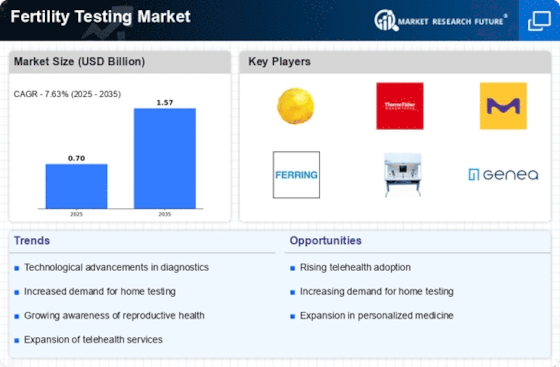
As per Market Research Future analysis, the Fertility Testing Market Size was estimated at 0.6996 USD Billion in 2024. The Fertility Testing industry is projected to grow from 0.753 USD Billion in 2025 to 1.571 USD Billion by 2035, exhibiting a compound annual growth rate (CAGR) of 7.63% during the forecast period 2025 - 2035

Key Market Trends & Highlights

The Fertility Testing Market is experiencing a dynamic shift towards innovative and consumer-centric solutions.

  • Technological advancements are driving the development of more accurate and user-friendly fertility testing products. Increased consumer awareness regarding reproductive health is propelling demand for fertility testing solutions across various demographics. The shift towards at-home testing is particularly pronounced in the North American market, where convenience and privacy are prioritized. Rising infertility rates and changing societal norms are major drivers influencing the growth of the ovulation testing kit and fertility monitor segments.

Market Size & Forecast

2024 Market Size 0.6996 (USD Billion)
2035 Market Size 1.571 (USD Billion)
CAGR (2025 - 2035) 7.63%
Largest Regional Market Share in 2024 North America

Major Players

<a title="CooperSurgical" href="https://www.coopersurgical.com/reproductive-genetic-testing/" target="_blank" rel="noopener">CooperSurgical</a> (US), Thermo Fisher Scientific (US), <a title="Merck KGaA" href="https://www.merckgroup.com/en/expertise/fertility.html" target="_blank" rel="noopener">Merck KGaA</a> (DE), Ferring Pharmaceuticals (CH), IVFtech (DK), Genea Limited (AU), OvaScience (US), Cimarex Energy Co. (US)

Market Trends

The Fertility Testing Market is currently experiencing a notable transformation, driven by advancements in technology and a growing awareness of reproductive health. As individuals and couples increasingly seek to understand their fertility status, the demand for innovative testing solutions has surged. This market encompasses a variety of products, including ovulation prediction kits, sperm analysis devices, and hormone testing kits, which cater to diverse consumer needs. Furthermore, the integration of digital health technologies, such as mobile applications and telemedicine, appears to enhance accessibility and convenience for users, thereby expanding the market's reach. In addition, societal shifts towards delayed parenthood and rising infertility rates contribute to the evolving landscape of the Fertility Testing Market. Consumers are becoming more proactive in managing their reproductive health, leading to a heightened interest in at-home testing options. This trend suggests a potential for growth in the sector, as individuals seek to take control of their fertility journeys. Overall, the Fertility Testing Market is poised for continued expansion, driven by innovation, consumer awareness, and changing societal norms.

Technological Advancements

The Fertility Testing Market is witnessing a wave of technological innovations that enhance the accuracy and convenience of testing. New devices and applications are emerging, allowing users to monitor their reproductive health from the comfort of their homes. These advancements not only improve user experience but also foster greater engagement in fertility management.

Increased Consumer Awareness

There is a growing awareness among consumers regarding reproductive health and fertility issues. This heightened consciousness is prompting individuals to seek out fertility testing solutions earlier in their family planning journeys. As a result, the market is likely to see an influx of new customers who are eager to understand their fertility status.

Shift Towards At-Home Testing

The trend towards at-home fertility testing is gaining momentum, as consumers prefer the privacy and convenience it offers. This shift is likely to drive innovation in product development, with companies focusing on creating user-friendly and reliable testing kits that can be used without professional assistance.

Fertility Testing Market Market Drivers

Changing Societal Norms

Societal changes regarding family planning and childbearing are impacting the Fertility Testing Market. As more individuals prioritize career development and personal goals, the average age of first-time parents has increased. This trend has led to a greater awareness of fertility issues, prompting individuals to seek testing options earlier. The Fertility Testing Market is adapting to these shifts by offering a range of products that cater to different age groups and lifestyles. As societal norms continue to evolve, the demand for fertility testing solutions is expected to rise, reflecting the changing dynamics of family planning.

Rising Infertility Rates

The increasing prevalence of infertility is a primary driver for the Fertility Testing Market. Recent statistics indicate that approximately 15% of couples experience difficulties in conceiving, which has led to a heightened demand for fertility testing solutions. This trend is particularly evident in urban areas where lifestyle factors, such as delayed childbearing and increased stress levels, contribute to reproductive challenges. As more individuals seek to understand their fertility status, the market for testing products and services is expected to expand. The Fertility Testing Market is likely to see innovations in testing methods, catering to the needs of a growing demographic concerned about reproductive health.

Regulatory Support and Initiatives

Regulatory frameworks and initiatives aimed at promoting reproductive health are driving the Fertility Testing Market. Governments and health organizations are increasingly recognizing the importance of fertility awareness and are implementing policies to support access to testing services. This includes funding for educational programs and subsidies for fertility testing products. Such initiatives not only enhance public awareness but also encourage individuals to seek testing services. As regulatory support strengthens, the Fertility Testing Market is likely to experience growth, with increased accessibility to testing solutions that empower individuals to make informed decisions about their reproductive health.

Technological Innovations in Testing

Technological advancements play a crucial role in shaping the Fertility Testing Market. The introduction of sophisticated testing devices, such as ovulation prediction kits and hormone level monitors, has revolutionized how individuals assess their fertility. These innovations not only enhance accuracy but also improve user experience, making testing more accessible. For instance, the integration of mobile applications with testing devices allows users to track their fertility cycles effectively. As technology continues to evolve, the Fertility Testing Market is poised for growth, with new products that offer real-time data and personalized insights into reproductive health.

Increased Focus on Preventive Healthcare

The growing emphasis on preventive healthcare is influencing the Fertility Testing Market. Individuals are increasingly proactive about their health, seeking early detection and intervention for potential fertility issues. This shift is reflected in the rising sales of fertility testing kits, which empower consumers to take charge of their reproductive health. According to recent data, the market for at-home fertility tests is projected to grow significantly, driven by consumer demand for convenience and privacy. As awareness of reproductive health expands, the Fertility Testing Market is likely to benefit from a surge in demand for preventive testing solutions.

Market Segment Insights

By Product: Ovulation Testing Kit (Largest) vs. Fertility Monitors (Fastest-Growing)

In the Fertility Testing Market, the Ovulation Testing Kit retains the largest market share due to its widespread adoption and consumer familiarity. Many individuals and couples prefer this method due to its simplicity and efficacy, making it a go-to option for those trying to conceive. Conversely, Fertility Monitors, although currently smaller in market share, are gaining traction as technology advances, providing detailed insights and user-friendly interfaces that enhance the fertility tracking experience.

Fertility Testing Market Methods: Ovulation Testing Kit (Dominant) vs. Fertility Monitors (Emerging)

Ovulation Testing Kits are the dominant product segment in the Fertility Testing Market, renowned for their reliability and ease of use. They allow users to track their ovulation cycles effectively, empowering couples with information that can optimize their chances of conception. In contrast, Fertility Monitors represent an emerging segment, leveraging smart technology to offer real-time data on hormone levels and fertility patterns. These advanced devices appeal to tech-savvy consumers who seek a more comprehensive approach to fertility management, driving their rapid growth in recent years.

By Gender: Female (Largest) vs. Male (Fastest-Growing)

In the Fertility Testing Market, females represent the largest segment, largely driven by increasing awareness of reproductive health and the growing inclination towards family planning. Female-focused fertility tests are more prevalent, thus capturing a significant share of the market. Men, however, are rapidly emerging as a crucial demographic in this arena, indicating a notable shift in the perception of male infertility and the importance of male reproductive health testing. As a result, their market share is expanding quickly in recent years.

Gender: Female (Dominant) vs. Male (Emerging)

The female segment in the Fertility Testing Market is characterized by a more established presence, largely attributed to historically higher demands for fertility assessments and ovulation tracking tests. These products are largely driven by a proactive approach to fertility management among women. Meanwhile, the male segment is progressively gaining traction, reflecting an emerging recognition of male fertility issues. The rise in awareness about male contributions to infertility has led to an increase in male-specific testing solutions, including sperm analysis and hormonal testing, making this segment an exciting area for growth.

By Distribution Channel: Online Pharmacy (Largest) vs. Retail Pharmacy (Fastest-Growing)

In the Fertility Testing Market, distribution channels play a significant role in reaching consumers effectively. Currently, Online Pharmacy holds the largest share due to the rising trend of e-commerce and the increasing comfort of consumers with online purchases. Retail Pharmacy follows closely, providing immediate access but facing stiff competition from online options. Hospital Pharmacy, while important, captures a smaller segment of the market as it is primarily dependent on healthcare providers and patients in critical care situations.

Retail Pharmacy (Dominant) vs. Online Pharmacy (Emerging)

<a title="Retail Pharmacy" href="https://www.marketresearchfuture.com/reports/retail-pharmacy-market-22432" target="_blank" rel="noopener">Retail Pharmacy</a> has long been a dominant force in the Fertility Testing Market, offering patients easy access to fertility tests and related products. It benefits from foot traffic, immediate product availability, and familiar customer service interactions. Conversely, Online Pharmacy is emerging rapidly, appealing to tech-savvy consumers seeking convenience and privacy in their fertility testing journey. With options for discreet delivery, competitive pricing, and education through online resources, Online Pharmacies are beginning to carve a significant niche and challenge the traditional retail landscape.

Get more detailed insights about Fertility Testing Market Research Report - Global Forecast till 2035

Regional Insights

North America : Leading Innovation and Demand

North America is the largest market for fertility testing, accounting for approximately 45% of the global share. The region's growth is driven by increasing awareness of fertility issues, advancements in reproductive technologies, and supportive regulatory frameworks. The demand for at-home fertility testing kits is also rising, fueled by changing societal norms and the desire for personalized healthcare solutions. The United States dominates the North American market, with key players like CooperSurgical and Thermo Fisher Scientific leading the charge. Canada also shows significant growth potential, supported by government initiatives aimed at improving reproductive health. The competitive landscape is characterized by continuous innovation and strategic partnerships among leading companies, ensuring a robust market presence.

Europe : Emerging Regulatory Frameworks

Europe is the second-largest market for fertility testing, holding around 30% of the global share. The region's growth is propelled by increasing infertility rates, rising healthcare expenditure, and favorable government policies promoting reproductive health. Countries like Germany and the UK are at the forefront, with regulations that encourage research and development in fertility technologies, thus enhancing market dynamics. Germany leads the European market, followed closely by the UK and France. The competitive landscape features major players such as Merck KGaA and Ferring Pharmaceuticals, who are investing heavily in R&D to innovate new products. The presence of advanced healthcare systems and a growing acceptance of assisted reproductive technologies further solidify Europe's position in the fertility testing market.

Asia-Pacific : Rapid Growth and Adoption

Asia-Pacific is witnessing rapid growth in the fertility testing market, accounting for approximately 20% of the global share. The region's expansion is driven by increasing awareness of fertility issues, rising disposable incomes, and a growing number of women delaying childbirth. Countries like China and India are experiencing significant demand for fertility testing solutions, supported by government initiatives aimed at addressing infertility challenges. China is the largest market in the region, with India following closely behind. The competitive landscape is becoming increasingly dynamic, with local and international players like Genea Limited and OvaScience entering the market. The rise of telemedicine and digital health solutions is also transforming how fertility testing is accessed and utilized, making it more convenient for consumers.

Middle East and Africa : Untapped Potential and Growth

The Middle East and Africa region is emerging as a significant player in the fertility testing market, holding about 5% of the global share. The growth is driven by increasing awareness of reproductive health, rising infertility rates, and a growing middle class seeking advanced healthcare solutions. Countries like South Africa and the UAE are leading the charge, with investments in healthcare infrastructure and fertility clinics. South Africa is the largest market in the region, with a growing number of fertility specialists and clinics. The competitive landscape is characterized by a mix of local and international players, focusing on providing affordable and accessible fertility testing solutions. The region's untapped potential presents opportunities for growth, especially as awareness and acceptance of fertility treatments continue to rise.

Key Players and Competitive Insights

The Fertility Testing Market is currently characterized by a dynamic competitive landscape, driven by increasing awareness of reproductive health and advancements in technology. Key players such as CooperSurgical (US), Thermo Fisher Scientific (US), and Merck KGaA (DE) are at the forefront, each adopting distinct strategies to enhance their market presence. CooperSurgical (US) focuses on innovation in reproductive health solutions, while Thermo Fisher Scientific (US) emphasizes its extensive product portfolio and global reach. Merck KGaA (DE) is leveraging its research capabilities to develop cutting-edge fertility testing technologies. Collectively, these strategies contribute to a competitive environment that is increasingly shaped by technological advancements and a growing emphasis on personalized healthcare solutions.

In terms of business tactics, companies are increasingly localizing manufacturing and optimizing supply chains to enhance efficiency and responsiveness to market demands. The Fertility Testing Market appears moderately fragmented, with several players vying for market share. However, the influence of major companies is significant, as they set industry standards and drive innovation. This competitive structure allows for a diverse range of products and services, catering to various consumer needs and preferences.

In August 2025, CooperSurgical (US) announced the launch of a new line of at-home fertility testing kits, aimed at empowering individuals to monitor their reproductive health conveniently. This strategic move not only aligns with the growing trend of consumer-driven healthcare but also positions CooperSurgical as a leader in accessible fertility solutions. The introduction of these kits is likely to enhance customer engagement and expand the company's market reach.

In September 2025, Thermo Fisher Scientific (US) expanded its partnership with leading fertility clinics across Europe to enhance the distribution of its advanced reproductive technologies. This collaboration is strategically important as it allows Thermo Fisher to leverage the expertise of established clinics, thereby increasing the adoption of its innovative products. Such partnerships may also facilitate the integration of new technologies into clinical practices, further solidifying Thermo Fisher's position in the market.

In July 2025, Merck KGaA (DE) unveiled a new AI-driven platform designed to improve the accuracy of fertility assessments. This initiative underscores the company's commitment to integrating artificial intelligence into its product offerings, potentially revolutionizing the way fertility testing is conducted. By enhancing diagnostic precision, Merck KGaA is likely to attract a broader customer base and reinforce its competitive edge in the market.

As of October 2025, the Fertility Testing Market is witnessing trends such as digitalization, sustainability, and the integration of artificial intelligence. These trends are reshaping the competitive landscape, with strategic alliances becoming increasingly vital for success. Companies are moving away from price-based competition, focusing instead on innovation, technological advancements, and supply chain reliability. This shift suggests that future competitive differentiation will hinge on the ability to deliver cutting-edge solutions that meet the evolving needs of consumers.

Key Companies in the Fertility Testing Market include

Industry Developments

Future Outlook

Fertility Testing Market Future Outlook

The Fertility Testing Market is projected to grow at a 7.63% CAGR from 2025 to 2035, driven by technological advancements, increasing awareness, and rising infertility rates.

New opportunities lie in:

  • Development of AI-driven fertility analysis platforms
  • Expansion of home-based fertility testing kits
  • Partnerships with healthcare providers for integrated services

By 2035, the market is expected to be robust, reflecting significant advancements and increased accessibility.

Market Segmentation

Fertility Testing Market Gender Outlook

  • Male
  • Female

Fertility Testing Market Product Outlook

  • Ovulation Testing Kit
  • Fertility Monitors
  • Others

Fertility Testing Market Distribution Channel Outlook

  • Hospital Pharmacy
  • Retail Pharmacy
  • Online Pharmacy

Report Scope

MARKET SIZE 2024 0.6996(USD Billion)
MARKET SIZE 2025 0.753(USD Billion)
MARKET SIZE 2035 1.571(USD Billion)
COMPOUND ANNUAL GROWTH RATE (CAGR) 7.63% (2025 - 2035)
REPORT COVERAGE Revenue Forecast, Competitive Landscape, Growth Factors, and Trends
BASE YEAR 2024
Market Forecast Period 2025 - 2035
Historical Data 2019 - 2024
Market Forecast Units USD Billion
Key Companies Profiled CooperSurgical (US), Thermo Fisher Scientific (US), Merck KGaA (DE), Ferring Pharmaceuticals (CH), IVFtech (DK), Genea Limited (AU), OvaScience (US), Cimarex Energy Co. (US)
Segments Covered Product
Key Market Opportunities Integration of advanced digital platforms enhances accessibility and personalization in the Fertility Testing Market.
Key Market Dynamics Rising consumer awareness drives demand for innovative fertility testing solutions amid evolving regulatory landscapes.
Countries Covered North America, Europe, APAC, South America, MEA

FAQs

What is the current valuation of the Fertility Testing Market?

<p>As of 2024, the Fertility Testing Market was valued at approximately 0.6996 USD Billion.</p>

What is the projected market size for the Fertility Testing Market by 2035?

<p>The Fertility Testing Market is projected to reach approximately 1.571 USD Billion by 2035.</p>

What is the expected CAGR for the Fertility Testing Market during the forecast period?

<p>The expected CAGR for the Fertility Testing Market from 2025 to 2035 is 7.63%.</p>

Which product segments are included in the Fertility Testing Market?

<p>Key product segments include Ovulation Testing Kits, Fertility Monitors, and Others, with valuations ranging from 0.1399 to 0.6345 USD Billion.</p>

How does the market perform across different genders?

<p>The market is evenly split, with both Male and Female segments valued at approximately 0.3498 USD Billion in 2024, projected to grow to 0.7855 USD Billion by 2035.</p>

What distribution channels are utilized in the Fertility Testing Market?

Distribution channels include Hospital Pharmacy, Retail Pharmacy, and Online Pharmacy, with valuations ranging from 0.2097 to 0.6342 USD Billion.

Who are the key players in the Fertility Testing Market?

Key players include CooperSurgical, Thermo Fisher Scientific, Merck KGaA, Ferring Pharmaceuticals, IVFtech, Genea Limited, OvaScience, and Cimarex Energy Co.

What trends are influencing the growth of the Fertility Testing Market?

The growth appears driven by increasing awareness of fertility issues and advancements in testing technologies.

What is the significance of online pharmacies in the Fertility Testing Market?

Online pharmacies are projected to grow, with a valuation of approximately 0.2101 USD Billion in 2024, indicating a shift towards digital distribution.

How do the valuations of fertility monitors compare to ovulation testing kits?

Both Fertility Monitors and Ovulation Testing Kits are valued similarly, with each segment reaching approximately 0.2798 USD Billion in 2024.

  1. SECTION I: EXECUTIVE SUMMARY AND KEY HIGHLIGHTS
    1. | 1.1 EXECUTIVE SUMMARY
    2. | | 1.1.1 Market Overview
    3. | | 1.1.2 Key Findings
    4. | | 1.1.3 Market Segmentation
    5. | | 1.1.4 Competitive Landscape
    6. | | 1.1.5 Challenges and Opportunities
    7. | | 1.1.6 Future Outlook
  2. SECTION II: SCOPING, METHODOLOGY AND MARKET STRUCTURE
    1. | 2.1 MARKET INTRODUCTION
    2. | | 2.1.1 Definition
    3. | | 2.1.2 Scope of the study
    4. | | | 2.1.2.1 Research Objective
    5. | | | 2.1.2.2 Assumption
    6. | | | 2.1.2.3 Limitations
    7. | 2.2 RESEARCH METHODOLOGY
    8. | | 2.2.1 Overview
    9. | | 2.2.2 Data Mining
    10. | | 2.2.3 Secondary Research
    11. | | 2.2.4 Primary Research
    12. | | | 2.2.4.1 Primary Interviews and Information Gathering Process
    13. | | | 2.2.4.2 Breakdown of Primary Respondents
    14. | | 2.2.5 Forecasting Model
    15. | | 2.2.6 Market Size Estimation
    16. | | | 2.2.6.1 Bottom-Up Approach
    17. | | | 2.2.6.2 Top-Down Approach
    18. | | 2.2.7 Data Triangulation
    19. | | 2.2.8 Validation
  3. SECTION III: QUALITATIVE ANALYSIS
    1. | 3.1 MARKET DYNAMICS
    2. | | 3.1.1 Overview
    3. | | 3.1.2 Drivers
    4. | | 3.1.3 Restraints
    5. | | 3.1.4 Opportunities
    6. | 3.2 MARKET FACTOR ANALYSIS
    7. | | 3.2.1 Value chain Analysis
    8. | | 3.2.2 Porter's Five Forces Analysis
    9. | | | 3.2.2.1 Bargaining Power of Suppliers
    10. | | | 3.2.2.2 Bargaining Power of Buyers
    11. | | | 3.2.2.3 Threat of New Entrants
    12. | | | 3.2.2.4 Threat of Substitutes
    13. | | | 3.2.2.5 Intensity of Rivalry
    14. | | 3.2.3 COVID-19 Impact Analysis
    15. | | | 3.2.3.1 Market Impact Analysis
    16. | | | 3.2.3.2 Regional Impact
    17. | | | 3.2.3.3 Opportunity and Threat Analysis
  4. SECTION IV: QUANTITATIVE ANALYSIS
    1. | 4.1 Healthcare, BY Product (USD Billion)
    2. | | 4.1.1 Ovulation Testing Kit
    3. | | 4.1.2 Fertility Monitors
    4. | | 4.1.3 Others
    5. | 4.2 Healthcare, BY Gender (USD Billion)
    6. | | 4.2.1 Male
    7. | | 4.2.2 Female
    8. | 4.3 Healthcare, BY Distribution Channel (USD Billion)
    9. | | 4.3.1 Hospital Pharmacy
    10. | | 4.3.2 Retail Pharmacy
    11. | | 4.3.3 Online Pharmacy
    12. | 4.4 Healthcare, BY Region (USD Billion)
    13. | | 4.4.1 North America
    14. | | | 4.4.1.1 US
    15. | | | 4.4.1.2 Canada
    16. | | 4.4.2 Europe
    17. | | | 4.4.2.1 Germany
    18. | | | 4.4.2.2 UK
    19. | | | 4.4.2.3 France
    20. | | | 4.4.2.4 Russia
    21. | | | 4.4.2.5 Italy
    22. | | | 4.4.2.6 Spain
    23. | | | 4.4.2.7 Rest of Europe
    24. | | 4.4.3 APAC
    25. | | | 4.4.3.1 China
    26. | | | 4.4.3.2 India
    27. | | | 4.4.3.3 Japan
    28. | | | 4.4.3.4 South Korea
    29. | | | 4.4.3.5 Malaysia
    30. | | | 4.4.3.6 Thailand
    31. | | | 4.4.3.7 Indonesia
    32. | | | 4.4.3.8 Rest of APAC
    33. | | 4.4.4 South America
    34. | | | 4.4.4.1 Brazil
    35. | | | 4.4.4.2 Mexico
    36. | | | 4.4.4.3 Argentina
    37. | | | 4.4.4.4 Rest of South America
    38. | | 4.4.5 MEA
    39. | | | 4.4.5.1 GCC Countries
    40. | | | 4.4.5.2 South Africa
    41. | | | 4.4.5.3 Rest of MEA
  5. SECTION V: COMPETITIVE ANALYSIS
    1. | 5.1 Competitive Landscape
    2. | | 5.1.1 Overview
    3. | | 5.1.2 Competitive Analysis
    4. | | 5.1.3 Market share Analysis
    5. | | 5.1.4 Major Growth Strategy in the Healthcare
    6. | | 5.1.5 Competitive Benchmarking
    7. | | 5.1.6 Leading Players in Terms of Number of Developments in the Healthcare
    8. | | 5.1.7 Key developments and growth strategies
    9. | | | 5.1.7.1 New Product Launch/Service Deployment
    10. | | | 5.1.7.2 Merger & Acquisitions
    11. | | | 5.1.7.3 Joint Ventures
    12. | | 5.1.8 Major Players Financial Matrix
    13. | | | 5.1.8.1 Sales and Operating Income
    14. | | | 5.1.8.2 Major Players R&D Expenditure. 2023
    15. | 5.2 Company Profiles
    16. | | 5.2.1 CooperSurgical (US)
    17. | | | 5.2.1.1 Financial Overview
    18. | | | 5.2.1.2 Products Offered
    19. | | | 5.2.1.3 Key Developments
    20. | | | 5.2.1.4 SWOT Analysis
    21. | | | 5.2.1.5 Key Strategies
    22. | | 5.2.2 Thermo Fisher Scientific (US)
    23. | | | 5.2.2.1 Financial Overview
    24. | | | 5.2.2.2 Products Offered
    25. | | | 5.2.2.3 Key Developments
    26. | | | 5.2.2.4 SWOT Analysis
    27. | | | 5.2.2.5 Key Strategies
    28. | | 5.2.3 Merck KGaA (DE)
    29. | | | 5.2.3.1 Financial Overview
    30. | | | 5.2.3.2 Products Offered
    31. | | | 5.2.3.3 Key Developments
    32. | | | 5.2.3.4 SWOT Analysis
    33. | | | 5.2.3.5 Key Strategies
    34. | | 5.2.4 Ferring Pharmaceuticals (CH)
    35. | | | 5.2.4.1 Financial Overview
    36. | | | 5.2.4.2 Products Offered
    37. | | | 5.2.4.3 Key Developments
    38. | | | 5.2.4.4 SWOT Analysis
    39. | | | 5.2.4.5 Key Strategies
    40. | | 5.2.5 IVFtech (DK)
    41. | | | 5.2.5.1 Financial Overview
    42. | | | 5.2.5.2 Products Offered
    43. | | | 5.2.5.3 Key Developments
    44. | | | 5.2.5.4 SWOT Analysis
    45. | | | 5.2.5.5 Key Strategies
    46. | | 5.2.6 Genea Limited (AU)
    47. | | | 5.2.6.1 Financial Overview
    48. | | | 5.2.6.2 Products Offered
    49. | | | 5.2.6.3 Key Developments
    50. | | | 5.2.6.4 SWOT Analysis
    51. | | | 5.2.6.5 Key Strategies
    52. | | 5.2.7 OvaScience (US)
    53. | | | 5.2.7.1 Financial Overview
    54. | | | 5.2.7.2 Products Offered
    55. | | | 5.2.7.3 Key Developments
    56. | | | 5.2.7.4 SWOT Analysis
    57. | | | 5.2.7.5 Key Strategies
    58. | | 5.2.8 Cimarex Energy Co. (US)
    59. | | | 5.2.8.1 Financial Overview
    60. | | | 5.2.8.2 Products Offered
    61. | | | 5.2.8.3 Key Developments
    62. | | | 5.2.8.4 SWOT Analysis
    63. | | | 5.2.8.5 Key Strategies
    64. | 5.3 Appendix
    65. | | 5.3.1 References
    66. | | 5.3.2 Related Reports
  6. LIST OF FIGURES
    1. | 6.1 MARKET SYNOPSIS
    2. | 6.2 NORTH AMERICA MARKET ANALYSIS
    3. | 6.3 US MARKET ANALYSIS BY PRODUCT
    4. | 6.4 US MARKET ANALYSIS BY GENDER
    5. | 6.5 US MARKET ANALYSIS BY DISTRIBUTION CHANNEL
    6. | 6.6 CANADA MARKET ANALYSIS BY PRODUCT
    7. | 6.7 CANADA MARKET ANALYSIS BY GENDER
    8. | 6.8 CANADA MARKET ANALYSIS BY DISTRIBUTION CHANNEL
    9. | 6.9 EUROPE MARKET ANALYSIS
    10. | 6.10 GERMANY MARKET ANALYSIS BY PRODUCT
    11. | 6.11 GERMANY MARKET ANALYSIS BY GENDER
    12. | 6.12 GERMANY MARKET ANALYSIS BY DISTRIBUTION CHANNEL
    13. | 6.13 UK MARKET ANALYSIS BY PRODUCT
    14. | 6.14 UK MARKET ANALYSIS BY GENDER
    15. | 6.15 UK MARKET ANALYSIS BY DISTRIBUTION CHANNEL
    16. | 6.16 FRANCE MARKET ANALYSIS BY PRODUCT
    17. | 6.17 FRANCE MARKET ANALYSIS BY GENDER
    18. | 6.18 FRANCE MARKET ANALYSIS BY DISTRIBUTION CHANNEL
    19. | 6.19 RUSSIA MARKET ANALYSIS BY PRODUCT
    20. | 6.20 RUSSIA MARKET ANALYSIS BY GENDER
    21. | 6.21 RUSSIA MARKET ANALYSIS BY DISTRIBUTION CHANNEL
    22. | 6.22 ITALY MARKET ANALYSIS BY PRODUCT
    23. | 6.23 ITALY MARKET ANALYSIS BY GENDER
    24. | 6.24 ITALY MARKET ANALYSIS BY DISTRIBUTION CHANNEL
    25. | 6.25 SPAIN MARKET ANALYSIS BY PRODUCT
    26. | 6.26 SPAIN MARKET ANALYSIS BY GENDER
    27. | 6.27 SPAIN MARKET ANALYSIS BY DISTRIBUTION CHANNEL
    28. | 6.28 REST OF EUROPE MARKET ANALYSIS BY PRODUCT
    29. | 6.29 REST OF EUROPE MARKET ANALYSIS BY GENDER
    30. | 6.30 REST OF EUROPE MARKET ANALYSIS BY DISTRIBUTION CHANNEL
    31. | 6.31 APAC MARKET ANALYSIS
    32. | 6.32 CHINA MARKET ANALYSIS BY PRODUCT
    33. | 6.33 CHINA MARKET ANALYSIS BY GENDER
    34. | 6.34 CHINA MARKET ANALYSIS BY DISTRIBUTION CHANNEL
    35. | 6.35 INDIA MARKET ANALYSIS BY PRODUCT
    36. | 6.36 INDIA MARKET ANALYSIS BY GENDER
    37. | 6.37 INDIA MARKET ANALYSIS BY DISTRIBUTION CHANNEL
    38. | 6.38 JAPAN MARKET ANALYSIS BY PRODUCT
    39. | 6.39 JAPAN MARKET ANALYSIS BY GENDER
    40. | 6.40 JAPAN MARKET ANALYSIS BY DISTRIBUTION CHANNEL
    41. | 6.41 SOUTH KOREA MARKET ANALYSIS BY PRODUCT
    42. | 6.42 SOUTH KOREA MARKET ANALYSIS BY GENDER
    43. | 6.43 SOUTH KOREA MARKET ANALYSIS BY DISTRIBUTION CHANNEL
    44. | 6.44 MALAYSIA MARKET ANALYSIS BY PRODUCT
    45. | 6.45 MALAYSIA MARKET ANALYSIS BY GENDER
    46. | 6.46 MALAYSIA MARKET ANALYSIS BY DISTRIBUTION CHANNEL
    47. | 6.47 THAILAND MARKET ANALYSIS BY PRODUCT
    48. | 6.48 THAILAND MARKET ANALYSIS BY GENDER
    49. | 6.49 THAILAND MARKET ANALYSIS BY DISTRIBUTION CHANNEL
    50. | 6.50 INDONESIA MARKET ANALYSIS BY PRODUCT
    51. | 6.51 INDONESIA MARKET ANALYSIS BY GENDER
    52. | 6.52 INDONESIA MARKET ANALYSIS BY DISTRIBUTION CHANNEL
    53. | 6.53 REST OF APAC MARKET ANALYSIS BY PRODUCT
    54. | 6.54 REST OF APAC MARKET ANALYSIS BY GENDER
    55. | 6.55 REST OF APAC MARKET ANALYSIS BY DISTRIBUTION CHANNEL
    56. | 6.56 SOUTH AMERICA MARKET ANALYSIS
    57. | 6.57 BRAZIL MARKET ANALYSIS BY PRODUCT
    58. | 6.58 BRAZIL MARKET ANALYSIS BY GENDER
    59. | 6.59 BRAZIL MARKET ANALYSIS BY DISTRIBUTION CHANNEL
    60. | 6.60 MEXICO MARKET ANALYSIS BY PRODUCT
    61. | 6.61 MEXICO MARKET ANALYSIS BY GENDER
    62. | 6.62 MEXICO MARKET ANALYSIS BY DISTRIBUTION CHANNEL
    63. | 6.63 ARGENTINA MARKET ANALYSIS BY PRODUCT
    64. | 6.64 ARGENTINA MARKET ANALYSIS BY GENDER
    65. | 6.65 ARGENTINA MARKET ANALYSIS BY DISTRIBUTION CHANNEL
    66. | 6.66 REST OF SOUTH AMERICA MARKET ANALYSIS BY PRODUCT
    67. | 6.67 REST OF SOUTH AMERICA MARKET ANALYSIS BY GENDER
    68. | 6.68 REST OF SOUTH AMERICA MARKET ANALYSIS BY DISTRIBUTION CHANNEL
    69. | 6.69 MEA MARKET ANALYSIS
    70. | 6.70 GCC COUNTRIES MARKET ANALYSIS BY PRODUCT
    71. | 6.71 GCC COUNTRIES MARKET ANALYSIS BY GENDER
    72. | 6.72 GCC COUNTRIES MARKET ANALYSIS BY DISTRIBUTION CHANNEL
    73. | 6.73 SOUTH AFRICA MARKET ANALYSIS BY PRODUCT
    74. | 6.74 SOUTH AFRICA MARKET ANALYSIS BY GENDER
    75. | 6.75 SOUTH AFRICA MARKET ANALYSIS BY DISTRIBUTION CHANNEL
    76. | 6.76 REST OF MEA MARKET ANALYSIS BY PRODUCT
    77. | 6.77 REST OF MEA MARKET ANALYSIS BY GENDER
    78. | 6.78 REST OF MEA MARKET ANALYSIS BY DISTRIBUTION CHANNEL
    79. | 6.79 KEY BUYING CRITERIA OF HEALTHCARE
    80. | 6.80 RESEARCH PROCESS OF MRFR
    81. | 6.81 DRO ANALYSIS OF HEALTHCARE
    82. | 6.82 DRIVERS IMPACT ANALYSIS: HEALTHCARE
    83. | 6.83 RESTRAINTS IMPACT ANALYSIS: HEALTHCARE
    84. | 6.84 SUPPLY / VALUE CHAIN: HEALTHCARE
    85. | 6.85 HEALTHCARE, BY PRODUCT, 2024 (% SHARE)
    86. | 6.86 HEALTHCARE, BY PRODUCT, 2024 TO 2035 (USD Billion)
    87. | 6.87 HEALTHCARE, BY GENDER, 2024 (% SHARE)
    88. | 6.88 HEALTHCARE, BY GENDER, 2024 TO 2035 (USD Billion)
    89. | 6.89 HEALTHCARE, BY DISTRIBUTION CHANNEL, 2024 (% SHARE)
    90. | 6.90 HEALTHCARE, BY DISTRIBUTION CHANNEL, 2024 TO 2035 (USD Billion)
    91. | 6.91 BENCHMARKING OF MAJOR COMPETITORS
  7. LIST OF TABLES
    1. | 7.1 LIST OF ASSUMPTIONS
    2. | | 7.1.1
    3. | 7.2 North America MARKET SIZE ESTIMATES; FORECAST
    4. | | 7.2.1 BY PRODUCT, 2025-2035 (USD Billion)
    5. | | 7.2.2 BY GENDER, 2025-2035 (USD Billion)
    6. | | 7.2.3 BY DISTRIBUTION CHANNEL, 2025-2035 (USD Billion)
    7. | 7.3 US MARKET SIZE ESTIMATES; FORECAST
    8. | | 7.3.1 BY PRODUCT, 2025-2035 (USD Billion)
    9. | | 7.3.2 BY GENDER, 2025-2035 (USD Billion)
    10. | | 7.3.3 BY DISTRIBUTION CHANNEL, 2025-2035 (USD Billion)
    11. | 7.4 Canada MARKET SIZE ESTIMATES; FORECAST
    12. | | 7.4.1 BY PRODUCT, 2025-2035 (USD Billion)
    13. | | 7.4.2 BY GENDER, 2025-2035 (USD Billion)
    14. | | 7.4.3 BY DISTRIBUTION CHANNEL, 2025-2035 (USD Billion)
    15. | 7.5 Europe MARKET SIZE ESTIMATES; FORECAST
    16. | | 7.5.1 BY PRODUCT, 2025-2035 (USD Billion)
    17. | | 7.5.2 BY GENDER, 2025-2035 (USD Billion)
    18. | | 7.5.3 BY DISTRIBUTION CHANNEL, 2025-2035 (USD Billion)
    19. | 7.6 Germany MARKET SIZE ESTIMATES; FORECAST
    20. | | 7.6.1 BY PRODUCT, 2025-2035 (USD Billion)
    21. | | 7.6.2 BY GENDER, 2025-2035 (USD Billion)
    22. | | 7.6.3 BY DISTRIBUTION CHANNEL, 2025-2035 (USD Billion)
    23. | 7.7 UK MARKET SIZE ESTIMATES; FORECAST
    24. | | 7.7.1 BY PRODUCT, 2025-2035 (USD Billion)
    25. | | 7.7.2 BY GENDER, 2025-2035 (USD Billion)
    26. | | 7.7.3 BY DISTRIBUTION CHANNEL, 2025-2035 (USD Billion)
    27. | 7.8 France MARKET SIZE ESTIMATES; FORECAST
    28. | | 7.8.1 BY PRODUCT, 2025-2035 (USD Billion)
    29. | | 7.8.2 BY GENDER, 2025-2035 (USD Billion)
    30. | | 7.8.3 BY DISTRIBUTION CHANNEL, 2025-2035 (USD Billion)
    31. | 7.9 Russia MARKET SIZE ESTIMATES; FORECAST
    32. | | 7.9.1 BY PRODUCT, 2025-2035 (USD Billion)
    33. | | 7.9.2 BY GENDER, 2025-2035 (USD Billion)
    34. | | 7.9.3 BY DISTRIBUTION CHANNEL, 2025-2035 (USD Billion)
    35. | 7.10 Italy MARKET SIZE ESTIMATES; FORECAST
    36. | | 7.10.1 BY PRODUCT, 2025-2035 (USD Billion)
    37. | | 7.10.2 BY GENDER, 2025-2035 (USD Billion)
    38. | | 7.10.3 BY DISTRIBUTION CHANNEL, 2025-2035 (USD Billion)
    39. | 7.11 Spain MARKET SIZE ESTIMATES; FORECAST
    40. | | 7.11.1 BY PRODUCT, 2025-2035 (USD Billion)
    41. | | 7.11.2 BY GENDER, 2025-2035 (USD Billion)
    42. | | 7.11.3 BY DISTRIBUTION CHANNEL, 2025-2035 (USD Billion)
    43. | 7.12 Rest of Europe MARKET SIZE ESTIMATES; FORECAST
    44. | | 7.12.1 BY PRODUCT, 2025-2035 (USD Billion)
    45. | | 7.12.2 BY GENDER, 2025-2035 (USD Billion)
    46. | | 7.12.3 BY DISTRIBUTION CHANNEL, 2025-2035 (USD Billion)
    47. | 7.13 APAC MARKET SIZE ESTIMATES; FORECAST
    48. | | 7.13.1 BY PRODUCT, 2025-2035 (USD Billion)
    49. | | 7.13.2 BY GENDER, 2025-2035 (USD Billion)
    50. | | 7.13.3 BY DISTRIBUTION CHANNEL, 2025-2035 (USD Billion)
    51. | 7.14 China MARKET SIZE ESTIMATES; FORECAST
    52. | | 7.14.1 BY PRODUCT, 2025-2035 (USD Billion)
    53. | | 7.14.2 BY GENDER, 2025-2035 (USD Billion)
    54. | | 7.14.3 BY DISTRIBUTION CHANNEL, 2025-2035 (USD Billion)
    55. | 7.15 India MARKET SIZE ESTIMATES; FORECAST
    56. | | 7.15.1 BY PRODUCT, 2025-2035 (USD Billion)
    57. | | 7.15.2 BY GENDER, 2025-2035 (USD Billion)
    58. | | 7.15.3 BY DISTRIBUTION CHANNEL, 2025-2035 (USD Billion)
    59. | 7.16 Japan MARKET SIZE ESTIMATES; FORECAST
    60. | | 7.16.1 BY PRODUCT, 2025-2035 (USD Billion)
    61. | | 7.16.2 BY GENDER, 2025-2035 (USD Billion)
    62. | | 7.16.3 BY DISTRIBUTION CHANNEL, 2025-2035 (USD Billion)
    63. | 7.17 South Korea MARKET SIZE ESTIMATES; FORECAST
    64. | | 7.17.1 BY PRODUCT, 2025-2035 (USD Billion)
    65. | | 7.17.2 BY GENDER, 2025-2035 (USD Billion)
    66. | | 7.17.3 BY DISTRIBUTION CHANNEL, 2025-2035 (USD Billion)
    67. | 7.18 Malaysia MARKET SIZE ESTIMATES; FORECAST
    68. | | 7.18.1 BY PRODUCT, 2025-2035 (USD Billion)
    69. | | 7.18.2 BY GENDER, 2025-2035 (USD Billion)
    70. | | 7.18.3 BY DISTRIBUTION CHANNEL, 2025-2035 (USD Billion)
    71. | 7.19 Thailand MARKET SIZE ESTIMATES; FORECAST
    72. | | 7.19.1 BY PRODUCT, 2025-2035 (USD Billion)
    73. | | 7.19.2 BY GENDER, 2025-2035 (USD Billion)
    74. | | 7.19.3 BY DISTRIBUTION CHANNEL, 2025-2035 (USD Billion)
    75. | 7.20 Indonesia MARKET SIZE ESTIMATES; FORECAST
    76. | | 7.20.1 BY PRODUCT, 2025-2035 (USD Billion)
    77. | | 7.20.2 BY GENDER, 2025-2035 (USD Billion)
    78. | | 7.20.3 BY DISTRIBUTION CHANNEL, 2025-2035 (USD Billion)
    79. | 7.21 Rest of APAC MARKET SIZE ESTIMATES; FORECAST
    80. | | 7.21.1 BY PRODUCT, 2025-2035 (USD Billion)
    81. | | 7.21.2 BY GENDER, 2025-2035 (USD Billion)
    82. | | 7.21.3 BY DISTRIBUTION CHANNEL, 2025-2035 (USD Billion)
    83. | 7.22 South America MARKET SIZE ESTIMATES; FORECAST
    84. | | 7.22.1 BY PRODUCT, 2025-2035 (USD Billion)
    85. | | 7.22.2 BY GENDER, 2025-2035 (USD Billion)
    86. | | 7.22.3 BY DISTRIBUTION CHANNEL, 2025-2035 (USD Billion)
    87. | 7.23 Brazil MARKET SIZE ESTIMATES; FORECAST
    88. | | 7.23.1 BY PRODUCT, 2025-2035 (USD Billion)
    89. | | 7.23.2 BY GENDER, 2025-2035 (USD Billion)
    90. | | 7.23.3 BY DISTRIBUTION CHANNEL, 2025-2035 (USD Billion)
    91. | 7.24 Mexico MARKET SIZE ESTIMATES; FORECAST
    92. | | 7.24.1 BY PRODUCT, 2025-2035 (USD Billion)
    93. | | 7.24.2 BY GENDER, 2025-2035 (USD Billion)
    94. | | 7.24.3 BY DISTRIBUTION CHANNEL, 2025-2035 (USD Billion)
    95. | 7.25 Argentina MARKET SIZE ESTIMATES; FORECAST
    96. | | 7.25.1 BY PRODUCT, 2025-2035 (USD Billion)
    97. | | 7.25.2 BY GENDER, 2025-2035 (USD Billion)
    98. | | 7.25.3 BY DISTRIBUTION CHANNEL, 2025-2035 (USD Billion)
    99. | 7.26 Rest of South America MARKET SIZE ESTIMATES; FORECAST
    100. | | 7.26.1 BY PRODUCT, 2025-2035 (USD Billion)
    101. | | 7.26.2 BY GENDER, 2025-2035 (USD Billion)
    102. | | 7.26.3 BY DISTRIBUTION CHANNEL, 2025-2035 (USD Billion)
    103. | 7.27 MEA MARKET SIZE ESTIMATES; FORECAST
    104. | | 7.27.1 BY PRODUCT, 2025-2035 (USD Billion)
    105. | | 7.27.2 BY GENDER, 2025-2035 (USD Billion)
    106. | | 7.27.3 BY DISTRIBUTION CHANNEL, 2025-2035 (USD Billion)
    107. | 7.28 GCC Countries MARKET SIZE ESTIMATES; FORECAST
    108. | | 7.28.1 BY PRODUCT, 2025-2035 (USD Billion)
    109. | | 7.28.2 BY GENDER, 2025-2035 (USD Billion)
    110. | | 7.28.3 BY DISTRIBUTION CHANNEL, 2025-2035 (USD Billion)
    111. | 7.29 South Africa MARKET SIZE ESTIMATES; FORECAST
    112. | | 7.29.1 BY PRODUCT, 2025-2035 (USD Billion)
    113. | | 7.29.2 BY GENDER, 2025-2035 (USD Billion)
    114. | | 7.29.3 BY DISTRIBUTION CHANNEL, 2025-2035 (USD Billion)
    115. | 7.30 Rest of MEA MARKET SIZE ESTIMATES; FORECAST
    116. | | 7.30.1 BY PRODUCT, 2025-2035 (USD Billion)
    117. | | 7.30.2 BY GENDER, 2025-2035 (USD Billion)
    118. | | 7.30.3 BY DISTRIBUTION CHANNEL, 2025-2035 (USD Billion)
    119. | 7.31 PRODUCT LAUNCH/PRODUCT DEVELOPMENT/APPROVAL
    120. | | 7.31.1
    121. | 7.32 ACQUISITION/PARTNERSHIP
    122. | | 7.32.1

Healthcare Market Segmentation

Healthcare By Product (USD Billion, 2025-2035)

  • Ovulation Testing Kit
  • Fertility Monitors
  • Others

Healthcare By Gender (USD Billion, 2025-2035)

  • Male
  • Female

Healthcare By Distribution Channel (USD Billion, 2025-2035)

  • Hospital Pharmacy
  • Retail Pharmacy
  • Online Pharmacy
Infographic

Free Sample Request

Kindly complete the form below to receive a free sample of this Report

Get Free Sample

Customer Strories

Compare Licence

×
Features License Type
Single User Multiuser License Enterprise User
Price $4,950 $5,950 $7,250
Maximum User Access Limit 1 User Upto 10 Users Unrestricted Access Throughout the Organization
Free Customization
Direct Access to Analyst
Deliverable Format
Platform Access
Discount on Next Purchase 10% 15% 15%
Printable Versions