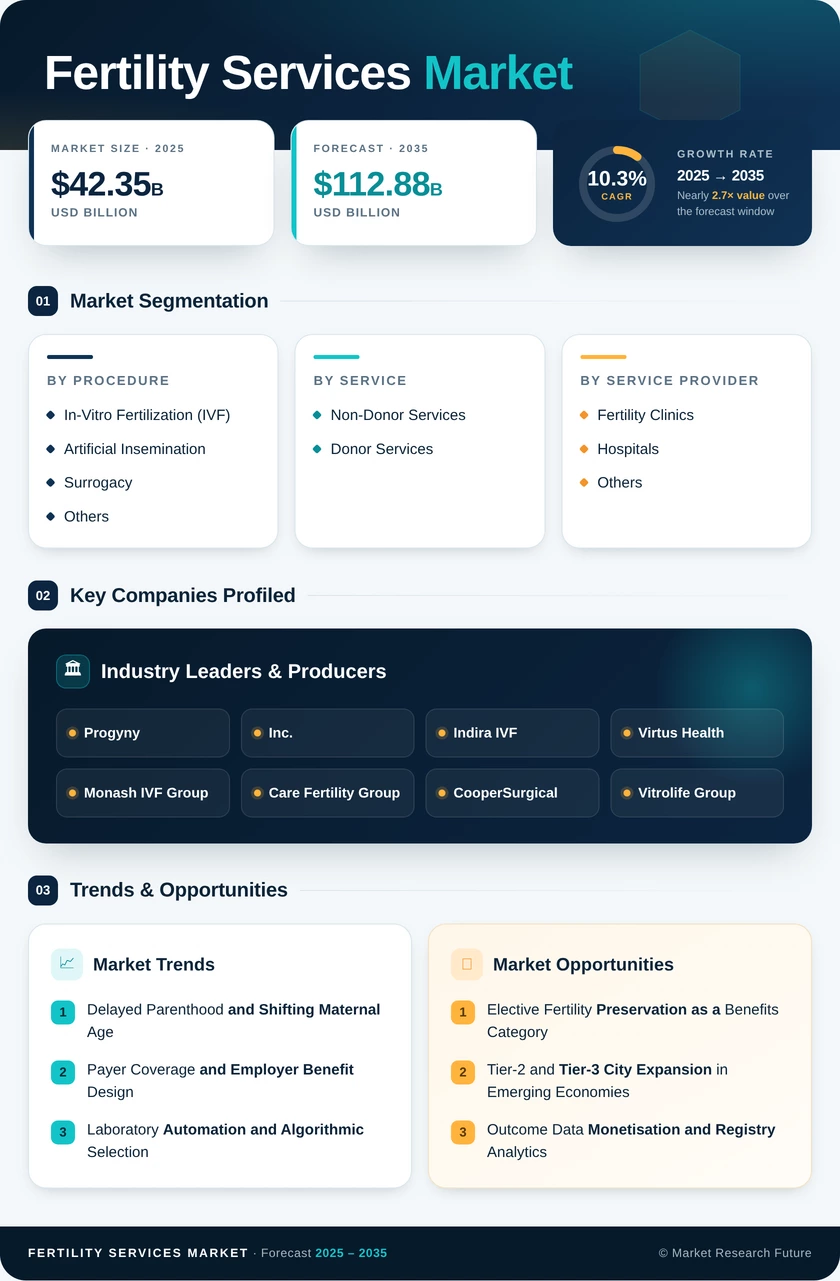
Segmentation Quick Reference
| Dimension | Sub-Segments | Dominant Segment | Fastest Growing Segment |
| By Procedure | In-Vitro Fertilization (IVF), Artificial Insemination, Surrogacy, Others | In-Vitro Fertilization (IVF) | Surrogacy |
| By Service | Donor Services, Non-Donor Services | Non-Donor Services | Donor Services |
| By Service Provider | Fertility Clinics, Hospitals, Others | Fertility Clinics | Others |
| By Geography | North America, Europe, Asia-Pacific, Middle East and Africa, South America | North America | Asia-Pacific |
Market Segmentation Overview
By Procedure
| Sub-Segment | Key Trend |
| In-Vitro Fertilization (IVF) | Time-lapse incubation and algorithmic embryo ranking becoming default laboratory practice |
| Artificial Insemination | Sustained first-line use among single intended parents and same-sex couples |
| Surrogacy | Divergent legal frameworks concentrating volume into a narrowing set of permissive jurisdictions. |
| Others | Ovulation induction and preservation adjuncts attaching to core treatment episodes |
Procedure mix moves slowly because clinical indication, not preference, dictates pathway selection. IVF will retain the majority of value through 2035, though surrogacy grows faster from a smaller base wherever legal clarity arrives.
By Service
| Sub-Segment | Key Trend |
| Donor Services | Cryobank supply constraints emerging in Europe as identity-release rules spread. |
| Non-Donor Services | Remains the default pathway where ovarian reserve and sperm parameters permit |
Donor volumes track patient age distribution closely. As the over-40 cohort expands across mature economies, donor-gamete cycles will claim a steadily larger share of total procedures.
By Service Provider
| Sub-Segment | Key Trend |
| Fertility Clinics | Consolidation into regional platforms with centralised laboratory quality governance |
| Hospitals | Integration with oncology and obstetric referral pathways to capture preservation demand |
| Others | Cryobanks, agencies and diagnostic centres growing as standalone recurring-revenue businesses |
Provider structure is where consolidation shows first. Standalone clinics retain the largest share today, but capital is flowing toward networks that can standardise laboratory outcomes across multiple sites.
By Region
| Sub-Segment | Key Trend |
| North America | Employer benefit administration reshaping demand from cash-pay to managed coverage. |
| Europe | Public reimbursement depth offset by widening legal divergence on surrogacy and donor identity |
| Asia-Pacific | Pronatalist subsidy programmes converting latent demand into funded cycle volume |
| Middle East and Africa | Sovereign health investment building inbound medical tourism capacity in the Gulf |
| South America | Statutory coverage mandates in Argentina anchoring regional access expectations |
Geographic growth divergence widens through the forecast period. Asia-Pacific closes much of its gap with Europe on cycle volume by the early 2030s, driven almost entirely by state reimbursement rather than private-pay expansion.


 Noah Malgeri
Co-Founder
Noah Malgeri
Co-Founder

 Peter Groot koerkamp
Account and Business Manager
Peter Groot koerkamp
Account and Business Manager

 Younghwan Choi
Senior Retail Manager
Younghwan Choi
Senior Retail Manager

 Mark Irwin
Management Consultant
Mark Irwin
Management Consultant

 Akif Moroglu
Strategy & Business Development Director
Akif Moroglu
Strategy & Business Development Director

 Guilherme Gomes Martins
Product Management Director
Guilherme Gomes Martins
Product Management Director

 Joseph Aguayo
Sales Operations & Pricing Manager
Joseph Aguayo
Sales Operations & Pricing Manager

 La Terria Dodd
Program Support Specialist
La Terria Dodd
Program Support Specialist

 Rob Kooiker
Group Product Manager HVAC & Fire Protection GMA
Rob Kooiker
Group Product Manager HVAC & Fire Protection GMA