Request Free Sample ×

Kindly complete the form below to receive a free sample of this Report

* Please use a valid business email

Leading companies partner with us for data-driven Insights

clients tt-cursor
Hero Background

Facial Recognition Market

ID: MRFR/SEM/0742-CR
110 Pages
Ankit Gupta
October 2022

Facial Recognition Market Size, Share and Research Report By Technology (3D Facial Recognition, 2D Facial Recognition, Thermal Imaging, Skin Texture Analysis, Others), By Service (Consulting, Cloud-Based Services), By Components (Hardware, Software), By End-User (Government, BFSI, Commercial Retail, Automotive, Others) And By Region (North America, Europe, Asia-Pacific, And Rest Of The World) – Industry Forecast Till 2035

Share:
Download PDF ×

We do not share your information with anyone. However, we may send you emails based on your report interest from time to time. You may contact us at any time to opt-out.

Facial Recognition Market Infographic
Purchase Options

Facial Recognition Market Summary

As per Market Research Future analysis, the Facial Recognition Market Size was estimated at 6.42 USD Billion in 2024. The Facial Recognition industry is projected to grow from 7.493 USD Billion in 2025 to 35.14 USD Billion by 2035, exhibiting a compound annual growth rate (CAGR) of 16.71% during the forecast period 2025 - 2035

Key Market Trends & Highlights

The Facial Recognition Market is experiencing robust growth driven by technological advancements and increasing security demands.

  • The market is witnessing increased adoption in security applications, particularly in North America, which remains the largest market.
  • Integration with IoT devices is becoming more prevalent, especially in the Asia-Pacific region, recognized as the fastest-growing market.
  • 3D facial recognition technology continues to dominate the market, while 2D facial recognition is emerging as the fastest-growing segment.
  • Rising demand for enhanced security solutions and technological advancements in AI and machine learning are key drivers propelling market growth.

Market Size & Forecast

2024 Market Size 6.42 (USD Billion)
2035 Market Size 35.14 (USD Billion)
CAGR (2025 - 2035) 16.71%

Major Players

Amazon (US), Microsoft (US), IBM (US), Google (US), Face++ (CN), SenseTime (CN), NEC (JP), Cognitec Systems (DE), Ayonix (JP), IDEMIA (FR) – representing leading facial recognition companies and ai facial recognition companies globally.

Our Impact
Enabled $4.3B Revenue Impact for Fortune 500 and Leading Multinationals
Partnering with 2000+ Global Organizations Each Year
30K+ Citations by Top-Tier Firms in the Industry

Facial Recognition Market Trends

The Facial Recognition Market is currently experiencing a transformative phase, driven by advancements in artificial intelligence and technology facial recognition capabilities. This evolution enhances the accuracy and efficiency of software face recognition solutions, making them increasingly appealing for security, retail, healthcare, and facial recognition bfsi applications. Organizations are rapidly integrating face recognition security system solutions and facial recognition devices to improve operational efficiency and customer experiences. Moreover, the growing emphasis on public safety and surveillance is likely to propel the adoption of these technologies, as governments and private entities alike recognize their potential benefits. Despite strong adoption, challenges such as facial recognition software cost, privacy concerns, and regulatory scrutiny persist. Ethical considerations around bias and accuracy in advanced facial recognition systems continue to influence consumer trust. Addressing these issues is critical for sustained growth of facial recognition services and face recognition services globally. Furthermore, ethical considerations surrounding bias and accuracy in facial recognition systems could influence consumer trust and acceptance. As the market evolves, it is essential for industry players to address these issues proactively, fostering transparency and accountability to maintain a positive trajectory in the future.

Increased Adoption in Security Applications

The Facial Recognition Market is witnessing notable growth in security-focused deployments, including face recognition for security system, surveillance, and access control. Face recognition face detection capabilities and face scanning technology are increasingly utilized by governments and enterprises to strengthen security frameworks. This trend indicates a shift towards more secure environments, as businesses and governments recognize the potential of facial recognition technology to enhance safety measures.

Integration with IoT Devices

Integration of facial recognition with IoT devices is accelerating adoption of facial recognition as a service and face recognition as a service models. This convergence supports scalable face recognition software development and enhances smart environments across retail, residential, and commercial settings. Such integration may lead to improved user experiences and operational efficiencies across various sectors, including smart homes and automated retail.

Focus on Ethical Standards and Regulations

The expansion of advanced facial recognition software has intensified focus on ethical standards. Regulatory frameworks emphasize responsible use of facial biometrics and transparency in facial recognition system companies deploying large-scale solutions. This focus may help address public concerns regarding privacy and bias, fostering greater acceptance and trust in facial recognition systems.

Facial Recognition Market Drivers

Expansion of Smart City Initiatives

The Facial Recognition Market is benefiting from the expansion of smart city initiatives, which aim to enhance urban living through technology. Cities are increasingly adopting facial recognition systems for various applications, including traffic management, public safety, and crowd control. These systems provide real-time data that can improve city operations and enhance the quality of life for residents. As urban populations continue to grow, the demand for efficient monitoring and management solutions is likely to increase. Reports suggest that investments in smart city technologies, including facial recognition, could exceed 1 trillion USD by 2030, indicating a robust growth trajectory for the market.

Growing Use in Consumer Electronics

The Facial Recognition Market is increasingly permeating the consumer electronics sector, with devices such as smartphones and laptops incorporating facial recognition features for user authentication. This trend is driven by consumer demand for enhanced security and convenience, as facial recognition offers a seamless alternative to traditional password systems. Major technology companies are investing heavily in this area, leading to innovations that improve user experience and security. The market for facial recognition in consumer electronics is anticipated to grow substantially, with projections indicating a potential market size of around 5 billion USD by 2026. This growth reflects the technology's integration into everyday life, making it a staple in modern devices.

Rising Demand for Enhanced Security Solutions

The Facial Recognition Market is experiencing a notable surge in demand for advanced security solutions. Organizations across various sectors, including banking, retail, and transportation, are increasingly adopting facial recognition technology to bolster security measures. This trend is driven by the need to mitigate risks associated with unauthorized access and criminal activities. According to recent data, the facial recognition market is projected to reach a valuation of approximately 7 billion USD by 2025, reflecting a compound annual growth rate of around 16%. This growth is indicative of the technology's effectiveness in enhancing security protocols, thereby fostering a safer environment for businesses and consumers alike.

Regulatory Support and Standardization Efforts

The Facial Recognition Market is also influenced by regulatory support and standardization efforts aimed at ensuring ethical use of the technology. Governments and regulatory bodies are increasingly recognizing the potential benefits of facial recognition while also addressing privacy concerns. This has led to the establishment of guidelines and frameworks that promote responsible deployment of facial recognition systems. As organizations seek to comply with these regulations, the market is likely to see a rise in demand for compliant solutions. The establishment of clear standards may facilitate broader adoption, potentially leading to a market growth rate of around 12% annually over the next few years.

Technological Advancements in AI and Machine Learning

The Facial Recognition Market is significantly influenced by rapid advancements in artificial intelligence and machine learning technologies. These innovations enhance the accuracy and efficiency of facial recognition systems, making them more reliable for various applications. Enhanced algorithms and processing capabilities allow for real-time identification and verification, which is crucial in high-security environments. As a result, the market is witnessing an influx of sophisticated solutions that cater to diverse needs, from law enforcement to customer engagement. The integration of AI-driven analytics is expected to propel the market further, with estimates suggesting a potential market size of over 10 billion USD by 2027.

Market Segment Insights

By Technology: 3D Facial Recognition (Largest) vs. 2D Facial Recognition (Fastest-Growing)

In the Facial Recognition Market, the technologies are diverse, with 3D Facial Recognition holding a significant share due to its accuracy and robustness in various lighting conditions. 2D Facial Recognition, while slightly behind in overall market presence, is rapidly gaining traction thanks to advancements in deep learning algorithms and its cost-effectiveness, making it a choice for many emerging applications. Thermal Imaging and Skin Texture Analysis are also part of the market, appealing to niche sectors with specialized needs.

Technology: 3D Facial Recognition (Dominant) vs. 2D Facial Recognition (Emerging)

3D Facial Recognition technology is characterized by its capability to capture detailed facial features, allowing for higher accuracy in authentication and identification processes. It is widely used in security systems, law enforcement, and access control, proving its dominance in the market. In contrast, 2D Facial Recognition technology is becoming increasingly popular among various sectors, including retail and online security, due to its lower implementation costs and sufficient accuracy for many applications. While 3D technology offers superior results, 2D technology's growing adoption signifies a shift towards more accessible solutions.

By Service: Consulting (Largest) vs. Cloud-Based Services (Fastest-Growing)

In the Facial Recognition Market, the service segment showcases a notable distribution between consulting services and cloud-based offerings. Consulting, being the largest segment, garners significant attention as enterprises seek tailored solutions to implement facial recognition technologies effectively. Meanwhile, cloud-based services are increasingly capturing interest due to their scalability and flexibility, appealing to a wide array of users looking for efficient integration with existing platforms.

Consulting (Dominant) vs. Cloud-Based Services (Emerging)

Consulting services remain dominant in the Facial Recognition Market, characterized by expert advisory and tailored implementations for clients across various industries. Service providers leverage their expertise to facilitate the adoption of facial recognition technologies, ensuring robust compliance with regulations and enhancing system effectiveness. On the other hand, cloud-based services are emerging as a fast-growing segment, driven by the rising demand for on-demand access to facial recognition capabilities without the need for heavy infrastructure investments. This segment appeals particularly to startups and SMEs seeking cost-effective, quick deployment solutions.

By Components: Software (Largest) vs. Hardware (Fastest-Growing)

In the Facial Recognition Market, the segmentation of components reveals an interesting distribution of market share between software and hardware. Software stands out as the dominant player, capturing a significant share due to its critical role in processing and analyzing facial data. This segment encompasses various applications, including security systems, identity verification, and surveillance. On the other hand, hardware, while currently smaller in share, is gaining traction rapidly as advances in technology drive down costs and improve efficiency.

Software: Dominant vs. Hardware: Emerging

The software segment is characterized by its versatility and vast range of applications including emotion detection, access control, and customer experience enhancement in retail. Driven by innovations such as artificial intelligence and machine learning, it is highly adaptable to various industries. Conversely, the hardware segment, encompassing cameras, sensors, and processing units, is categorized as the emerging component due to its rapid growth fueled by the rising demand for integrated solutions. As end-users seek enhanced security and operational efficiency, advancements in hardware technologies such as improved infrared cameras and high-performance processors are positioning this segment for explosive growth.

By End-User: Government (Largest) vs. BFSI (Fastest-Growing)

In the Facial Recognition Market, the distribution of end-users is prominently led by the Government sector, which utilizes this technology for various applications such as law enforcement, border control, and surveillance. This segment enjoys the largest market share due to increasing security concerns and the necessity for enhanced public safety measures. Following closely is the BFSI (Banking, Financial Services, and Insurance) sector, which employs facial recognition for improved security in banking operations, fraud detection, and customer verification processes.

Government (Dominant) vs. BFSI (Emerging)

The Government segment is the dominant player in the Facial Recognition Market, leveraging technology for public safety, crime prevention, and identification purposes. Governments are increasingly adopting advanced facial recognition systems to enhance security and streamline processes, reflecting a significant demand for reliable tech solutions. On the other hand, the BFSI sector is emerging as a fast-growing segment due to rising concerns over identity fraud and the need for advanced verification methods. BFSI organizations are integrating facial recognition into their services to enhance security protocols, improve customer experience, and comply with regulatory demands, therefore rapidly gaining traction in the market.

Get more detailed insights about Facial Recognition Market

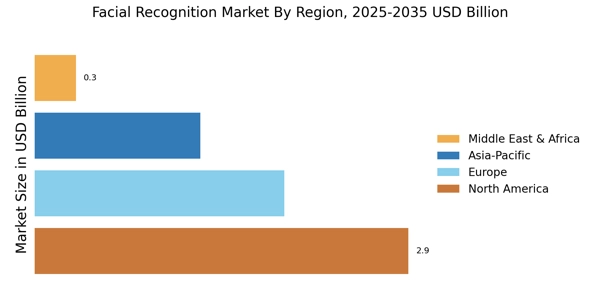
Regional Insights

North America : Technology and Innovation Leader

North America is the largest market for facial recognition technology, holding approximately 45% of the global market share. The region's growth is driven by increasing demand for security solutions, advancements in AI, and supportive regulatory frameworks. The U.S. government has been actively investing in facial recognition technologies for law enforcement and public safety, further propelling market growth. The competitive landscape is dominated by major players such as Amazon, Microsoft, and IBM, which are continuously innovating to enhance their offerings. The presence of these tech giants fosters a robust ecosystem for startups and smaller firms, creating a dynamic market environment. The U.S. leads in adoption rates, while Canada is also emerging as a significant player in the sector.

Europe : Regulatory Framework and Growth

Europe is witnessing rapid growth in the facial recognition market, accounting for approximately 30% of the global share. The region's expansion is fueled by increasing security concerns, the need for efficient identity verification, and stringent regulations that promote ethical use of technology. The General Data Protection Regulation (GDPR) has set a precedent for data privacy, influencing market dynamics significantly. Leading countries in Europe include the UK, Germany, and France, where companies like IDEMIA and Cognitec Systems are making significant strides. The competitive landscape is characterized by a mix of established firms and innovative startups, all navigating the complex regulatory environment. The emphasis on compliance and ethical considerations is shaping product development and market strategies.

Asia-Pacific : Rapid Adoption and Innovation

Asia-Pacific is rapidly emerging as a powerhouse in the facial recognition market, holding about 20% of the global share. The region's growth is driven by increasing urbanization, government initiatives for smart city projects, and a rising demand for security solutions. Countries like China and Japan are at the forefront, with significant investments in AI and surveillance technologies, creating a favorable environment for market expansion. China, with companies like Face++ and SenseTime, leads the market, while Japan is also making notable advancements with firms like NEC and Ayonix. The competitive landscape is vibrant, with numerous startups and established players vying for market share. The region's focus on technological innovation and integration into daily life is propelling the adoption of facial recognition solutions.

Middle East and Africa : Emerging Market with Potential

The Middle East and Africa region is gradually emerging in the facial recognition market, currently holding about 5% of the global share. The growth is primarily driven by increasing security concerns, particularly in urban areas, and government initiatives aimed at enhancing public safety. Countries like the UAE and South Africa are leading the way, investing in advanced surveillance technologies to combat crime and terrorism. The competitive landscape is still developing, with a mix of local and international players entering the market. The presence of key players is growing, but challenges such as regulatory hurdles and varying levels of technology adoption remain. As governments prioritize security, the demand for facial recognition solutions is expected to rise significantly in the coming years.

Facial Recognition Market Regional Image

Key Players and Competitive Insights

Leading market players are investing heavily in research and development in order to expand their product lines, which will help the Facial Recognition Market, grow even more. Market participants are also undertaking a variety of strategic activities to expand their global footprint, with important market developments including new product launches, contractual agreements, mergers and acquisitions, higher investments, and collaboration with other organizations. To expand and survive in a more competitive and rising market climate, Facial Recognitionindustry must offer cost-effective items.Manufacturing locally to minimize operational costs is one of the key business tactics used by manufacturers in the global Facial Recognition industry to benefit clients and increase the market sector. In recent years, the Facial Recognition industry has offered some of the most significant advantages to medicine. Major players in the Facial Recognition Market, including ), Key Lemon Ltd (Switzerland), Safran S.A (France), Face++ (China), Fareclock (US), Nuance Commuication, Inc (US), Google LLC (US), Intel Security Group (US), 3M Company (US) and others, are attempting to increase market demand by investing in research and development operations.Microsoft Azure, sometimes known as Azure, is a cloud computing platform operated by Microsoft that provides access, management, and creation of applications and services across global data centres. It offers a variety of services, such as software as a service (SaaS), platform as a service (PaaS), and infrastructure as a service (IaaS). Microsoft Azure supports a wide range of programming languages, tools, and frameworks, as well as Microsoft and third-party software and systems. In April 2020, Microsoft Azure's facial recognition solution has been improved. The new version features a streamlined User Interface (UI) and can easily respond to consumer feedback.It also assists devices in receiving faster and more up-to-date data, which may be transferred more quickly with better IoT Central application process.Intel RealSense Technology is a product line of depth and tracking technologies designed to provide depth perception capabilities to machines and devices. Intel-owned technology is employed in autonomous drones, robots, AR/VR, and smart home gadgets, among many other broad market items. The RealSense package consists of Vision Processors, Depth and Tracking Modules, and Depth Cameras that are backed by an open source, cross-platform SDK that simplifies camera support for third-party software developers, system integrators, ODMs, and OEMs. In Jan 2021, Intel RealSense ID is a facial recognition system that allows users to unlock items with a glance.The Intel RealSense ID face authentication system combines an active depth sensor with a specialized neural network to provide secure, accurate, and user-aware facial authentication.

Key Companies in the Facial Recognition Market include

Industry Developments

  • Q2 2024: Clearview AI raises $20 million in Series B funding to expand facial recognition technology Clearview AI announced it has secured $20 million in Series B funding to further develop and expand its facial recognition platform, with plans to enhance its AI capabilities and grow its presence in law enforcement and commercial sectors.
  • Q2 2024: AnyVision rebrands as Oosto, launches new facial recognition platform for enterprise security Oosto, formerly known as AnyVision, unveiled a new facial recognition platform designed for enterprise security applications, offering improved real-time identification and privacy features.
  • Q3 2024: NEC Corporation wins contract to supply facial recognition systems for Singapore Changi Airport’s new automated immigration lanes NEC Corporation secured a contract to provide advanced facial recognition systems for Singapore Changi Airport, supporting the airport’s transition to fully automated, passport-free immigration clearance.
  • Q3 2024: UK Home Office awards contract to Idemia for biometric border control upgrade The UK Home Office selected Idemia to deliver a major upgrade to the country’s border control infrastructure, including the deployment of facial recognition technology at key entry points.
  • Q4 2024: Apple acquires Paris-based facial recognition startup Datakalab Apple completed the acquisition of Datakalab, a French startup specializing in edge-based facial recognition and computer vision, to bolster its on-device AI and privacy-focused biometric features.
  • Q4 2024: Microsoft launches Azure Face Verification API for enterprise customers Microsoft announced the general availability of its Azure Face Verification API, enabling enterprise customers to integrate advanced facial recognition capabilities into their applications with enhanced security and compliance features.
  • Q1 2025: SenseTime secures $150 million in Series D funding to accelerate global expansion Chinese AI company SenseTime raised $150 million in Series D funding to support the global rollout of its facial recognition solutions and invest in next-generation AI research.
  • Q1 2025: Amazon Web Services partners with VisionLabs to offer facial recognition as a managed service Amazon Web Services (AWS) announced a partnership with VisionLabs to provide facial recognition as a managed service, targeting financial services and retail clients seeking secure biometric authentication.
  • Q2 2025: Thales opens new biometric R&D center in Munich focused on facial recognition Thales inaugurated a new research and development center in Munich dedicated to advancing biometric technologies, with a primary focus on facial recognition for government and enterprise applications.
  • Q2 2025: NEC launches NeoFace 2.0 with enhanced AI-powered facial recognition for public safety NEC introduced NeoFace 2.0, the latest version of its facial recognition platform, featuring improved AI algorithms for faster and more accurate identification in public safety and law enforcement scenarios.
  • Q3 2025: European Commission grants regulatory approval for facial recognition pilot at major EU airports The European Commission approved a pilot program allowing the use of facial recognition technology for passenger processing at several major EU airports, aiming to streamline border control and enhance security.
  • Q3 2025: Face++ parent Megvii files for Hong Kong IPO to raise $500 million Megvii, the parent company of Face++, filed for an initial public offering in Hong Kong, seeking to raise $500 million to fund the expansion of its facial recognition and AI businesses.

Future Outlook

Facial Recognition Market Future Outlook

The Facial Recognition Market is projected to grow at a 16.71% CAGR from 2025 to 2035, driven by advancements in AI, increasing security concerns, and expanding applications across various sectors.

New opportunities lie in:

  • Integration of facial recognition in smart home devices
  • Development of AI-driven analytics for retail customer insights
  • Expansion of biometric payment systems in e-commerce platforms

By 2035, the market is expected to be robust, driven by innovation and widespread adoption.

Market Segmentation

Facial Recognition Market Service Outlook

  • Consulting
  • Cloud-Based Services

Facial Recognition Market End-User Outlook

  • Government
  • BFSI
  • Commercial Retail
  • Automotive
  • Others

Facial Recognition Market Components Outlook

  • Hardware
  • Software

Facial Recognition Market Technology Outlook

  • 3D Facial Recognition
  • 2D Facial Recognition
  • Thermal Imaging
  • Skin Texture Analysis
  • Others

Report Scope

MARKET SIZE 2024 6.42(USD Billion)
MARKET SIZE 2025 7.493(USD Billion)
MARKET SIZE 2035 35.14(USD Billion)
COMPOUND ANNUAL GROWTH RATE (CAGR) 16.71% (2025 - 2035)
REPORT COVERAGE Revenue Forecast, Competitive Landscape, Growth Factors, and Trends
BASE YEAR 2024
Market Forecast Period 2025 - 2035
Historical Data 2019 - 2024
Market Forecast Units USD Billion
Key Companies Profiled Amazon (US), Microsoft (US), IBM (US), Google (US), Face++ (CN), SenseTime (CN), NEC (JP), Cognitec Systems (DE), Ayonix (JP), IDEMIA (FR)
Segments Covered Technology, Service, Components, End-User, Region
Key Market Opportunities Integration of advanced artificial intelligence in the Facial Recognition Market enhances security and user experience.
Key Market Dynamics Rising demand for enhanced security solutions drives innovation and competition in the facial recognition market.
Countries Covered North America, Europe, APAC, South America, MEA

Market Highlights

Author
Author
Author Profile
Ankit Gupta LinkedIn
Team Lead - Research
Ankit Gupta is a seasoned market intelligence and strategic research professional with over six plus years of experience in the ICT and Semiconductor industries. With academic roots in Telecom, Marketing, and Electronics, he blends technical insight with business strategy. Ankit has led 200+ projects, including work for Fortune 500 clients like Microsoft and Rio Tinto, covering market sizing, tech forecasting, and go-to-market strategies. Known for bridging engineering and enterprise decision-making, his insights support growth, innovation, and investment planning across diverse technology markets.
Leave a Comment

FAQs

What is the current valuation of the Facial Recognition Market as of 2024?

The Facial Recognition Market was valued at 6.42 USD Billion in 2024.

What is the projected market size for the Facial Recognition Market in 2035?

The market is projected to reach 35.14 USD Billion by 2035.

What is the expected CAGR for the Facial Recognition Market during the forecast period 2025 - 2035?

The expected CAGR for the market during 2025 - 2035 is 16.71%.

Which technology segments are included in the Facial Recognition Market?

Key technology segments include 3D Facial Recognition, 2D Facial Recognition, Thermal Imaging, and Skin Texture Analysis.

What are the projected valuations for 2D Facial Recognition by 2035?

The projected valuation for 2D Facial Recognition is expected to reach 15.0 USD Billion by 2035.

How do consulting services contribute to the Facial Recognition Market?

Consulting services are projected to grow from 1.93 USD Billion in 2024 to 10.12 USD Billion by 2035.

What role do key players like Amazon and Microsoft play in the market?

Key players such as Amazon and Microsoft are instrumental in driving innovation and market growth.

What is the expected growth for hardware components in the Facial Recognition Market?

Hardware components are projected to grow from 2.57 USD Billion in 2024 to 13.12 USD Billion by 2035.

Which end-user segments are anticipated to drive market growth?

End-user segments such as Government, BFSI, and Commercial Retail are expected to significantly contribute to market growth.

What is the projected valuation for thermal imaging technology by 2035?

Thermal imaging technology is projected to reach 7.0 USD Billion by 2035.

Research Approach

Secondary Research

The secondary research process involved comprehensive analysis of government databases, technology standards organizations, peer-reviewed journals, industry publications, and authoritative cybersecurity sources. Key sources included the National Institute of Standards and Technology (NIST) Facial Recognition Vendor Test (FRVT) databases, Federal Bureau of Investigation (FBI) Biometric Center of Excellence, Department of Homeland Security (DHS) Science & Technology Directorate, European Union Agency for Law Enforcement Cooperation (Europol), European Data Protection Board (EDPB), National Security Agency (NSA) biometric standards, International Organization for Standardization (ISO/IEC JTC 1/SC 37) biometric standards, IEEE Computer Society publications, ACM Digital Library, National Center for Science & Engineering Statistics (NCSES), World Economic Forum (WEF) Global Technology Governance, International Telecommunication Union (ITU), Biometrics Institute, Electronic Frontier Foundation (EFF) privacy research, National Artificial Intelligence Initiative Office (NAIIO), China Academy of Information and Communications Technology (CAICT), UK Information Commissioner's Office (ICO), Canada's Office of the Privacy Commissioner (OPC), Australian Cyber Security Centre (ACSC), and national digital transformation agency reports from key markets. These sources were used to collect algorithmic accuracy benchmarks, regulatory compliance frameworks, technology adoption statistics, privacy regulation impact analysis, and competitive landscape intelligence for 3D facial recognition, 2D facial recognition, thermal imaging solutions, and skin texture analysis technologies.

Primary Research

To gather both qualitative and quantitative insights, supply-side and demand-side stakeholders were interviewed during the primary research phase. Chief Technology Officers (CTOs), Vice Presidents of Artificial Intelligence/Machine Learning, heads of biometric engineering, directors of product strategy, and directors of government solutions from developers of facial recognition technology, manufacturers of AI chipsets, cloud service providers, and system integrators were examples of supply-side sources. Chief security officers (CSOs), directors of digital transformation from BFSI institutions, IT directors from airport authorities, smart city project managers, retail loss prevention executives, managers of automotive products (ADAS/infotainment), and procurement leads from law enforcement, defense agencies, businesses, and critical infrastructure operators were among the demand-side sources. Primary research verified AI model development schedules, validated technology segmentation, and collected information on pricing models (perpetual license vs. SaaS), deployment architectural preferences (edge vs. cloud), data governance protocols, and regulatory compliance tactics.

Primary Respondent Breakdown:

By Designation: C-level Primaries (32%), Director Level (31%), Others (37%)

By Region: North America (32%), Europe (30%), Asia-Pacific (33%), Rest of World (5%)

Market Size Estimation

Global market valuation was derived through revenue mapping and technology deployment analysis. The methodology included:

Identification of 55+ key technology providers across North America, Europe, Asia-Pacific, and Latin America

Technology mapping across 3D facial recognition, 2D facial recognition, thermal imaging, and skin texture analysis algorithms

Component analysis covering AI chipsets (GPU/TPU/NPU), camera systems, edge devices, SDKs/APIs, and cloud-based recognition platforms

Service segmentation covering consulting/integration services and cloud-based facial recognition-as-a-service (FRaaS)

End-user analysis across government (law enforcement/border control/e-ID), BFSI, commercial retail, automotive, healthcare, and education verticals

Analysis of reported and modeled annual revenues specific to facial recognition product portfolios and licensing deals

Coverage of technology providers representing 75-80% of global market share in 2024

Extrapolation using bottom-up (deployment volume × ASP by country/vertical) and top-down (vendor revenue validation) approaches to derive segment-specific valuations, incorporating AI model accuracy improvements and hardware cost reduction curves

Download Free Sample

Kindly complete the form below to receive a free sample of this Report

Compare Licence

×
Features License Type
Single User Multiuser License Enterprise User
Price $4,950 $5,950 $7,250
Maximum User Access Limit 1 User Upto 10 Users Unrestricted Access Throughout the Organization
Free Customization
Direct Access to Analyst
Deliverable Format
Platform Access
Discount on Next Purchase 10% 15% 15%
Printable Versions