
Request Free Sample ×

Kindly complete the form below to receive a free sample of this Report

* Please use a valid business email

Leading companies partner with us for data-driven Insights

clients tt-cursor
Hero Background
English
Chinese
French
Japanese
Korean
German
Spanish

Face Shield Market Analysis

ID: MRFR/CG/8677-HCR
90 Pages
Snehal Singh
April 2026

Face Shield Market Size, Share, Industry Trend & Analysis Research Report: Information By Material Type (Polycarbonate and Cellulose Acetate), By End-Use (Individual, Professional, Healthcare, Manufacturing, Chemical, and Others), By Application (Store-Based, and Non-Store-Based) and By Region (North America, Europe, Asia-Pacific, and Rest Of The World) – Forecast Till 2035

Share:
Download PDF ×

We do not share your information with anyone. However, we may send you emails based on your report interest from time to time. You may contact us at any time to opt-out.

Face Shield Market Infographic
Purchase Options

Market Analysis

In-depth Analysis of Face Shield Market Industry Landscape

As of year 2022, the global face shield market was estimated at USD 2.1 billion. According to the forecasts, the face shield market industry will increase at a compound annual growth rate (CAGR) of 6.20% from USD 2.23 billion in 2023 to $3.60 billion by 2032 (Biswal et al., p. 15). These dynamics and trends shaping this market are determined by various factors that affect it. The worldwide outbreak of the COVID-19 pandemic has led to increased demand for face shields as one of the personal protective equipment (Suhail et al., Pp25). This also coincided with the realization of the significance of face shields in terms of protection against facial infections not only in healthcare but also during common everyday activities, leading to their widespread adoption (Miller & Bunn,2017). Moreover, apart from pandemic situations, they can be used in health sectors such as hospitals, manufacturing companies, or construction industries because they are versatile. The face shield market is significantly affected by improvements in materials and design technology. Manufacturers continuously invest in producing protective shields capable of being used as a barrier against respiratory droplets while remaining comfortable, optically clear, and wearable for long periods (Varsha & Selvaraj 104). Government regulations and safety standards play a pivotal role in shaping the face shield market. As part of safety measures during the COVID-19 pandemic, people were forced to put on facemasks whenever they were going into certain places, thus increasing demand for face shields, among other things (Jackson et al., p.24). Also, economic factors like the overall health condition of an economy or disposable income influence this kind of market, too (Kotler & Armstrong, 2016). For example, increased demand for face shields may occur during times when there is high demand for public health or during periods characterized by economic downturns that impact purchasing patterns for these goods, among others (Pfeffermann,2017). Moreover, consumers' budget concerns may determine whether they buy disposable or reusable face shields. Manufacturers should, therefore, understand these economic dynamics to align their production and pricing strategies with the demands of the market. The perception and recognition by the public concerning safety and health have a significant impact on market trends in the face shield business. The way face shield benefits are communicated to people, for example, how they protect against infections or unsafe working conditions, shapes their buying habits. Cultural factors and societal factors have also shaped the face shield market. There might be different opinions about using Face shields in different regions; this is influenced by different cultures in these areas as well as the unique customs that exist among them. In some communities, for example, face shields might be embraced as a normal behavior, leading to high demand. This implies, therefore, that producers need to understand these cultural differences so that they can effectively design their marketing strategies and products. Accessibility of face shields to buyers largely depends on distribution channels like healthcare supply chains and online platforms. The pandemic served to remind people of the importance of fortified supply chains to guarantee the on-time availability of personal protective equipment like masks and face shields (Erik 17). Online platforms have made it easier for consumers to access various types of face shields, hence comparing and buying them without any problem.


Author
Author Profile
Snehal Singh
Manager - Research

High acumen in analyzing complex macro & micro markets with more than 6 years of work experience in the field of market research. By implementing her analytical skills in forecasting and estimation into market research reports, she has expertise in Packaging, Construction, and Equipment domains. She handles a team size of 20-25 resources and ensures smooth running of the projects, associated marketing activities, and client servicing.

Leave a Comment

FAQs

What is the projected market valuation of the Face Shield Market by 2035?

<p>The Face Shield Market is projected to reach a valuation of 4.24 USD Billion by 2035.</p>

What was the market valuation of the Face Shield Market in 2024?

<p>In 2024, the Face Shield Market was valued at 2.34 USD Billion.</p>

What is the expected CAGR for the Face Shield Market during the forecast period 2025 - 2035?

<p>The expected CAGR for the Face Shield Market during the forecast period 2025 - 2035 is 5.55%.</p>

Which material types dominate the Face Shield Market?

<p>The dominant material types in the Face Shield Market include Polycarbonate and Cellulose Acetate, with valuations of 2.5 USD Billion and 1.74 USD Billion, respectively, by 2035.</p>

What are the key end-use segments in the Face Shield Market?

<p>Key end-use segments include Healthcare, Professional, and Manufacturing, with projected valuations of 1.5 USD Billion, 0.75 USD Billion, and 0.9 USD Billion by 2035.</p>

How does the distribution channel impact the Face Shield Market?

<p>The distribution channels, particularly Store-Based and Non-Store-Based, are projected to reach valuations of 2.24 USD Billion and 2.0 USD Billion, respectively, by 2035.</p>

Who are the leading players in the Face Shield Market?

<p>Leading players in the Face Shield Market include 3M, Honeywell, and DuPont, among others.</p>

What is the significance of the Chemical end-use segment in the Face Shield Market?

The Chemical end-use segment is projected to grow to 0.4 USD Billion by 2035, indicating its relevance in the market.

What trends are influencing the growth of the Face Shield Market?

Trends such as increased safety regulations and demand for personal protective equipment are likely influencing the growth of the Face Shield Market.

How does the Face Shield Market compare to other personal protective equipment markets?

The Face Shield Market, with a valuation of 2.34 USD Billion in 2024, appears to be growing steadily compared to other personal protective equipment markets.

Market Summary

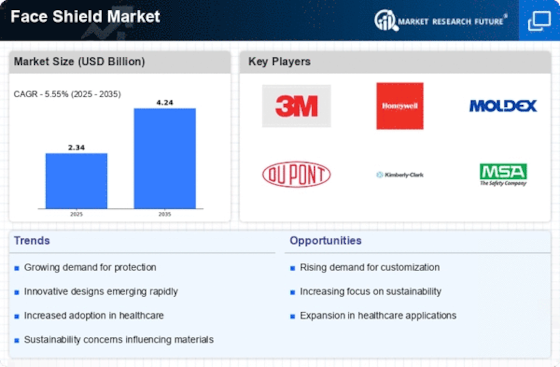
As per Market Research Future analysis, the Face Shield Market Size was estimated at 2.34 USD Billion in 2024. The Face Shield industry is projected to grow from USD 2.47 Billion in 2025 to USD 4.24 Billion by 2035, exhibiting a compound annual growth rate (CAGR) of 5.55% during the forecast period 2025 - 2035

Key Market Trends & Highlights

The Face Shield Market is experiencing robust growth driven by diverse applications and evolving consumer preferences.

  • The healthcare sector continues to drive the largest demand for face shields, particularly in North America. Customization and personalization trends are gaining traction, appealing to individual consumers in the Asia-Pacific region. Sustainability initiatives are influencing product development, with a focus on eco-friendly materials like cellulose acetate. Rising awareness of personal protective equipment and technological advancements in design are key drivers propelling market growth.

Market Size & Forecast

2024 Market Size 2.34 (USD Billion)
2035 Market Size 4.24 (USD Billion)
CAGR (2025 - 2035) 5.55%
Largest Regional Market Share in 2024 North America

Major Players

3M (US), <a href="https://automation.honeywell.com/us/en/products/personal-protective-equipment/face-protection/face-shields">Honeywell</a> (US), Moldex-Metric (US), DuPont (US), Kimberly-Clark (US), MSA Safety (US), Zhejiang Huatong (CN), Hubei Huanan (CN), Bollé Safety (FR), <a href="https://www.uvex-safety.com/en/products/safety-helmets/uvex-9706-visor-9706514/">Uvex Safety</a> (DE)

Market Trends

The face shield market trends are currently experiencing a notable evolution, driven by various factors that influence consumer preferences and regulatory frameworks. As awareness regarding personal protective equipment continues to rise, the demand for face shields is likely to expand across multiple sectors, including healthcare, manufacturing, and retail. This growth appears to be fueled by an increasing emphasis on safety protocols and the need for effective protective gear in various environments. Furthermore, innovations in design and materials are enhancing the functionality and comfort of face shields, making them more appealing to a broader audience.

In addition, the Face Shield Market seems to be witnessing a shift towards customization and personalization, as consumers seek products that cater to their specific needs and preferences. This trend may lead to the emergence of niche markets such as the disposable plastic face shields market and cpr face shield market, where specialized protective solutions are developed for specific medical and emergency response applications. Moreover, sustainability concerns are becoming increasingly relevant, prompting manufacturers to explore eco-friendly materials and production methods. The broader face shields market is also witnessing developments aligned with the eyewear and face shields market, as manufacturers integrate protective eyewear with face shield solutions. Overall, the Face Shield Market is poised for continued growth, with evolving consumer demands and technological advancements shaping its future landscape. These developments also contribute to the expanding medical face shield market and protective face shields market across healthcare and industrial sectors.

Increased Demand in Healthcare Sector

The healthcare sector is likely to remain a primary driver of growth within the Face Shield Market. As healthcare professionals prioritize safety, the adoption of face shields in clinical settings appears to be on the rise. This trend may be further supported by ongoing training and education regarding the importance of protective equipment.

Customization and Personalization Trends

There seems to be a growing inclination towards customized face shields, as consumers increasingly seek products that reflect their individual styles and preferences. This trend could lead to the development of specialized designs that cater to various demographics, enhancing user satisfaction and engagement across the protective face shields market.

Sustainability Initiatives

Sustainability is becoming a focal point in the Face Shield Market, as manufacturers explore eco-friendly materials and production techniques. This shift may not only appeal to environmentally conscious consumers but also align with broader industry trends towards reducing environmental impact within the global face shields market.

Face Shield Market Market Drivers

Growth of E-commerce and Online Retail Channels

The growth of e-commerce and online retail channels is significantly influencing the Face Shield Market. As consumers increasingly turn to online platforms for purchasing PPE, the accessibility and convenience of acquiring face shields have improved markedly. This shift is supported by data indicating that online sales of face shields have surged by over 30% in the past year alone. E-commerce platforms provide a wide range of options, allowing consumers to compare products and prices easily. Consequently, this trend is expected to continue, with online sales projected to account for a larger share of the market. The expansion of e-commerce is likely to drive the Face Shield Market further, as it caters to the evolving purchasing preferences of consumers.

Technological Advancements in Face Shield Design

Technological advancements play a pivotal role in shaping the Face Shield Market. Innovations in materials and design have led to the development of lightweight, anti-fog, and anti-scratch face shields, enhancing user comfort and functionality. Manufacturers are increasingly adopting advanced manufacturing techniques, such as 3D printing, to create customized face shields that cater to specific needs. This trend is supported by market data indicating that the demand for technologically enhanced face shields is expected to rise by 10% annually. As consumers seek products that offer superior protection without compromising on comfort, the Face Shield Market is likely to experience significant growth driven by these advancements.

Increased Focus on Occupational Safety and Health

The increased focus on occupational safety and health is a significant driver for the Face Shield Market. Organizations are prioritizing the well-being of their employees, leading to a rise in the adoption of face shields as a protective measure. This trend is particularly pronounced in industries such as healthcare, construction, and manufacturing, where the risk of exposure to hazardous materials is high. Market data indicates that investments in workplace safety equipment, including face shields, are expected to grow by approximately 12% annually. This commitment to enhancing workplace safety not only protects employees but also fosters a culture of health and safety within organizations, thereby propelling the Face Shield Market forward.

Rising Awareness of Personal Protective Equipment

The increasing awareness regarding the importance of personal protective equipment (PPE) is a key driver for the Face Shield Market. As individuals and organizations recognize the necessity of safeguarding against various hazards, the demand for face shields has surged. This heightened awareness is particularly evident in sectors such as healthcare, manufacturing, and construction, where the risk of exposure to harmful substances is prevalent. According to recent data, the face shield segment within the PPE market is projected to grow at a compound annual growth rate (CAGR) of approximately 7% over the next five years. This growth reflects a broader trend towards prioritizing safety and health, thereby bolstering the Face Shield Market.

Regulatory Support and Standards for Safety Equipment

Regulatory support and the establishment of safety standards are crucial drivers for the Face Shield Market. Governments and health organizations worldwide are implementing stringent regulations to ensure the safety and efficacy of PPE, including face shields. Compliance with these regulations not only enhances consumer confidence but also encourages manufacturers to innovate and improve their products. For instance, the introduction of new safety standards has led to an increase in the production of certified face shields, which are expected to dominate the market. Market analysis suggests that adherence to these regulations could result in a 15% increase in the overall market size of face shields in the coming years, underscoring the importance of regulatory frameworks in the Face Shield Market.

Market Segment Insights

By Material Type: Polycarbonate (Largest) vs. Cellulose Acetate (Fastest-Growing)

The Face Shield Market shows a significant distribution of material types with polycarbonate standing as the largest segment. Its optical clarity, durability, and high resistance to impact contribute to its dominance in various applications, particularly in healthcare and construction. Cellulose acetate, although smaller in market share, is rapidly gaining traction due to its eco-friendly nature and suitability for sustainable practices. As consumers become more environmentally conscious, the demand for biodegradable materials like cellulose acetate is steadily increasing.

Material Type: Polycarbonate (Dominant) vs. Cellulose Acetate (Emerging)

Polycarbonate is known for its outstanding toughness and lightness, making it suitable for face shields, particularly in environments where impact resistance is critical. It remains the preferred choice for high-performance applications, especially in medical and industrial settings. On the other hand, cellulose acetate is emerging as a viable option, favored for its biodegradability and transparency. As the demand for sustainable solutions rises, cellulose acetate is expected to penetrate deeper into the market, appealing to eco-conscious consumers and manufacturers. Its unique properties allow it to deliver adequate protection while aligning with sustainability trends.

By End-Use: Healthcare (Largest) vs. Individual (Fastest-Growing)

The Face Shield Market exhibits a diverse distribution among various end-use segments. Healthcare remains the largest segment, dominating market share due to heightened awareness of safety and hygiene protocols. Professionals in the healthcare sector utilize face shields extensively as a protective mechanism, especially amid the ongoing emphasis on infection control. Other segments, such as manufacturing and chemicals, also contribute significantly but lag behind healthcare in terms of market presence. As we look towards future growth trends, the Individual segment is emerging as the fastest-growing sector. New lifestyle changes brought on by global health crises have made personal protective equipment essential for individuals, particularly in public spaces. Additionally, enhanced awareness around personal safety is driving the demand for face shields among non-professionals, paving the way for sustained expansion in this segment.

Healthcare (Dominant) vs. Individual (Emerging)

The Healthcare segment stands as the dominant force within the Face Shield Market due to its crucial role in protecting employees and patients alike, especially in hospitals and clinics. This segment is characterized by the adoption of high-quality, certified face shields that meet rigorous safety standards. Healthcare professionals require reliable protection from potential exposure, which has led to a robust infrastructure supporting the production and distribution of face shields tailored for medical use. On the other hand, the Individual segment is considered an emerging sector, marked by a surge in consumer interest for personal protection. As individuals become increasingly conscious of safety in everyday scenarios, the demand for stylish, comfortable, and effective face shields is rising, indicating a shifting focus toward personal health and preventive measures.

By Distribution Channel: Store-Based (Largest) vs. Non-Store-Based (Fastest-Growing)

In the Face Shield Market, the distribution of segments shows a clear preference towards store-based channels. This segment accounts for a significant share of the market, driven by consumer familiarity and the convenience of immediate access to products. Physical retail outlets allow customers to see and try face shields before making a purchase, enhancing buyer confidence. Conversely, non-store-based channels, although currently smaller, are rapidly gaining traction, especially among younger, tech-savvy consumers who prefer online shopping for its convenience and variety. Growth trends in the distribution channel reflect changing consumer behaviors influenced by the global pandemic, which propelled e-commerce and online sales. The non-store-based segment is experiencing heightened growth due to the increase in internet penetration and the rise of digital marketing strategies. Retailers are expanding their online presence to capture this emerging market, providing a broader range of face shield options and enhancing customer engagement through targeted promotions and social media campaigns.

Store-Based (Dominant) vs. Non-Store-Based (Emerging)

Store-based distribution channels in the Face Shield Market maintain a dominant position due to established consumer habits and the physical interaction they offer. These channels include pharmacies, health and safety equipment shops, and supermarkets where customers can directly engage with the product. The presence of knowledgeable staff also supports informed purchasing decisions, making store-based channels a trusted choice. In contrast, non-store-based channels are emerging as a strong competitor, particularly among consumers who value convenience and the ability to compare options from the comfort of their homes. E-commerce platforms are capitalizing on unique selling propositions such as home delivery and an extensive range of designs, catering to specific consumer preferences. As these consumer bases evolve, the dynamics between store-based and non-store-based channels will continue to shape the landscape of the Face Shield Market.

Get more detailed insights about Face Shield Market Research Report - Forecast till 2035

Regional Insights

North America : Market Leader in Safety Gear

North America is the largest market for face shields, driven by stringent safety regulations and a growing emphasis on personal protective equipment (PPE) in healthcare and industrial sectors. The U.S. holds approximately 70% of the market share, with Canada following at around 15%. The increasing awareness of workplace safety and the rise in health emergencies have further fueled demand for face shields in this region. The competitive landscape is characterized by major players such as 3M, Honeywell, and DuPont, which dominate the market with innovative products and extensive distribution networks. The presence of advanced manufacturing facilities and a strong regulatory framework enhances the market's growth potential. Additionally, the ongoing COVID-19 pandemic has accelerated the adoption of face shields across various sectors, solidifying North America's position as a leader in the face shield market.

Europe : Regulatory-Driven Market Growth

Europe is witnessing significant growth in the face shield market, primarily driven by regulatory mandates for PPE in healthcare and industrial applications. The region accounts for approximately 20% of the global market share, with Germany and France being the largest contributors. The European Union's stringent safety regulations and initiatives to enhance workplace safety are key factors propelling market demand. Leading countries like Germany, France, and the UK are home to several prominent manufacturers, including Bollé Safety and Uvex Safety. The competitive landscape is marked by innovation and a focus on high-quality products. The increasing awareness of health and safety standards, coupled with the rise in industrial activities, is expected to further boost the face shield market in Europe.

Asia-Pacific : Emerging Market Potential

Asia-Pacific is rapidly emerging as a significant market for face shields, driven by increasing industrialization and a growing focus on health and safety standards. The region holds approximately 15% of the global market share, with China and India being the largest markets. The rising awareness of personal safety and the implementation of stricter regulations are key factors contributing to market growth. China is home to several key players, including Zhejiang Huatong and Hubei Huanan, which are expanding their production capabilities to meet the rising demand. The competitive landscape is evolving, with both local and international companies vying for market share. The ongoing COVID-19 pandemic has further accelerated the adoption of face shields in various sectors, including healthcare and manufacturing, enhancing the region's market potential.

Middle East and Africa : Growing Awareness and Demand

The Middle East and Africa region is experiencing a gradual increase in the demand for face shields, driven by heightened awareness of health and safety protocols. This region currently holds about 5% of the global market share, with countries like South Africa and the UAE leading the way. The growing industrial sector and the need for protective equipment in healthcare are significant growth drivers in this market. In South Africa, local manufacturers are beginning to emerge, while international players are also establishing a presence. The competitive landscape is still developing, with a focus on affordability and accessibility of face shields. As the region continues to recover from the pandemic, the demand for personal protective equipment, including face shields, is expected to rise, further expanding market opportunities.

Key Players and Competitive Insights

The Face Shield Market is currently characterized by a dynamic competitive landscape, driven by heightened demand for personal protective equipment (PPE) across various sectors, including healthcare, manufacturing, and construction. Key players such as 3M (US), Honeywell (US), and DuPont (US) are strategically positioned to leverage their extensive research and development capabilities, focusing on innovation and product diversification. These companies are not only enhancing their product lines but are also exploring partnerships and collaborations to strengthen their market presence. The collective strategies of these firms contribute to a moderately fragmented market structure, where competition is intensifying as companies seek to differentiate themselves through advanced technology and superior product offerings.In terms of business tactics, many companies are localizing manufacturing to reduce lead times and optimize supply chains. This approach appears to be particularly effective in addressing regional demands and mitigating potential disruptions. The competitive structure of the Face Shield Market is moderately fragmented, with several key players exerting influence over pricing and product availability. The presence of both established firms and emerging players creates a complex environment where innovation and operational efficiency are paramount.
In August 3M (US) announced the launch of a new line of face shields designed specifically for healthcare professionals, incorporating antimicrobial properties to enhance safety. This strategic move not only addresses the growing concerns regarding infection control but also positions 3M as a leader in the healthcare PPE segment. The introduction of such innovative products is likely to bolster the company's market share and reinforce its reputation for quality and reliability.
In September Honeywell (US) expanded its manufacturing capabilities by investing in a new facility dedicated to the production of face shields and other PPE. This investment is indicative of Honeywell's commitment to meeting the increasing global demand for protective equipment. By enhancing its production capacity, the company aims to ensure a steady supply of high-quality products, thereby strengthening its competitive edge in the market.
In July DuPont (US) entered into a strategic partnership with a leading technology firm to integrate AI-driven analytics into its supply chain management for face shield production. This collaboration is expected to optimize inventory management and improve responsiveness to market fluctuations. By leveraging advanced technologies, DuPont is likely to enhance its operational efficiency and reduce costs, which could translate into competitive pricing for its products.
As of October the Face Shield Market is witnessing significant trends such as digitalization, sustainability, and the integration of artificial intelligence. These trends are reshaping the competitive landscape, with companies increasingly focusing on strategic alliances to enhance their capabilities. The shift from price-based competition to a focus on innovation, technology, and supply chain reliability is becoming evident. Moving forward, competitive differentiation will likely hinge on the ability to innovate and adapt to changing market demands, positioning companies that prioritize these aspects for sustained success.

Key Companies in the Face Shield Market include

Industry Developments

September 2020: The Wisconsin Health Care Association and Wisconsin Centre for Assisted Living (WHCA/WiCAL) have established a relationship with one of North America's major industrial safety equipment suppliers, Magid Glove & Safety Manufacturing Company LLC.

July 2022: BASF has joined forces with Vadodara-based membrane manufacturer Permionics Membranes to expand the use of its Ultrason E polyethersulphone PESU polymer into coated fabrics that serve as particulate and microbiological filters for face masks.

May 2021: Aspen Surgical Products, Inc., a market leader in surgical disposables, has acquired North Carolina-based Precept Medical Products for an undisclosed sum. The acquisition will broaden Aspen's product offering by bringing in items essential for the well-being and safety of medical staff.

Future Outlook

Face Shield Market Future Outlook

The Face Shield Market is projected to grow at a 5.55% CAGR from 2025 to 2035, driven by increasing safety regulations, technological advancements, and rising health awareness.

New opportunities lie in:

  • <p>Expansion into emerging markets with tailored products</p>
  • <p> </p>
  • <p>Development of customizable face shields for various industries</p>
  • <p>Integration of smart technology for enhanced user experience</p>

By 2035, the Face Shield Market is expected to achieve robust growth and diversification.

Market Segmentation

Face Shield Market End-Use Outlook

  • Individual
  • Professional
  • Healthcare
  • Manufacturing
  • Chemical
  • Others

Face Shield Market Material Type Outlook

  • Polycarbonate
  • Cellulose Acetate

Face Shield Market Distribution Channel Outlook

  • Store-Based
  • Non-Store-Based

Report Scope

MARKET SIZE 2024 2.34(USD Billion)
MARKET SIZE 2025 2.47(USD Billion)
MARKET SIZE 2035 4.24(USD Billion)
COMPOUND ANNUAL GROWTH RATE (CAGR) 5.55% (2025 - 2035)
REPORT COVERAGE Revenue Forecast, Competitive Landscape, Growth Factors, and Trends
BASE YEAR 2024
Market Forecast Period 2025 - 2035
Historical Data 2019 - 2024
Market Forecast Units USD Billion
Key Companies Profiled 3M (US), Honeywell (US), Moldex-Metric (US), DuPont (US), Kimberly-Clark (US), MSA Safety (US), Zhejiang Huatong (CN), Hubei Huanan (CN), Bollé Safety (FR), Uvex Safety (DE)
Segments Covered Material Type, End-Use, Application, Region
Key Market Opportunities Integration of advanced materials and smart technologies enhances safety and comfort in the Face Shield Market.
Key Market Dynamics Rising demand for protective equipment drives innovation and competition in the face shield market.
Countries Covered North America, Europe, APAC, South America, MEA

FAQs

What is the projected market valuation of the Face Shield Market by 2035?

<p>The Face Shield Market is projected to reach a valuation of 4.24 USD Billion by 2035.</p>

What was the market valuation of the Face Shield Market in 2024?

<p>In 2024, the Face Shield Market was valued at 2.34 USD Billion.</p>

What is the expected CAGR for the Face Shield Market during the forecast period 2025 - 2035?

<p>The expected CAGR for the Face Shield Market during the forecast period 2025 - 2035 is 5.55%.</p>

Which material types dominate the Face Shield Market?

<p>The dominant material types in the Face Shield Market include Polycarbonate and Cellulose Acetate, with valuations of 2.5 USD Billion and 1.74 USD Billion, respectively, by 2035.</p>

What are the key end-use segments in the Face Shield Market?

<p>Key end-use segments include Healthcare, Professional, and Manufacturing, with projected valuations of 1.5 USD Billion, 0.75 USD Billion, and 0.9 USD Billion by 2035.</p>

How does the distribution channel impact the Face Shield Market?

<p>The distribution channels, particularly Store-Based and Non-Store-Based, are projected to reach valuations of 2.24 USD Billion and 2.0 USD Billion, respectively, by 2035.</p>

Who are the leading players in the Face Shield Market?

<p>Leading players in the Face Shield Market include 3M, Honeywell, and DuPont, among others.</p>

What is the significance of the Chemical end-use segment in the Face Shield Market?

The Chemical end-use segment is projected to grow to 0.4 USD Billion by 2035, indicating its relevance in the market.

What trends are influencing the growth of the Face Shield Market?

Trends such as increased safety regulations and demand for personal protective equipment are likely influencing the growth of the Face Shield Market.

How does the Face Shield Market compare to other personal protective equipment markets?

The Face Shield Market, with a valuation of 2.34 USD Billion in 2024, appears to be growing steadily compared to other personal protective equipment markets.

  1. SECTION I: EXECUTIVE SUMMARY AND KEY HIGHLIGHTS
    1. | 1.1 EXECUTIVE SUMMARY
    2. | | 1.1.1 Market Overview
    3. | | 1.1.2 Key Findings
    4. | | 1.1.3 Market Segmentation
    5. | | 1.1.4 Competitive Landscape
    6. | | 1.1.5 Challenges and Opportunities
    7. | | 1.1.6 Future Outlook
  2. SECTION II: SCOPING, METHODOLOGY AND MARKET STRUCTURE
    1. | 2.1 MARKET INTRODUCTION
    2. | | 2.1.1 Definition
    3. | | 2.1.2 Scope of the study
    4. | | | 2.1.2.1 Research Objective
    5. | | | 2.1.2.2 Assumption
    6. | | | 2.1.2.3 Limitations
    7. | 2.2 RESEARCH METHODOLOGY
    8. | | 2.2.1 Overview
    9. | | 2.2.2 Data Mining
    10. | | 2.2.3 Secondary Research
    11. | | 2.2.4 Primary Research
    12. | | | 2.2.4.1 Primary Interviews and Information Gathering Process
    13. | | | 2.2.4.2 Breakdown of Primary Respondents
    14. | | 2.2.5 Forecasting Model
    15. | | 2.2.6 Market Size Estimation
    16. | | | 2.2.6.1 Bottom-Up Approach
    17. | | | 2.2.6.2 Top-Down Approach
    18. | | 2.2.7 Data Triangulation
    19. | | 2.2.8 Validation
  3. SECTION III: QUALITATIVE ANALYSIS
    1. | 3.1 MARKET DYNAMICS
    2. | | 3.1.1 Overview
    3. | | 3.1.2 Drivers
    4. | | 3.1.3 Restraints
    5. | | 3.1.4 Opportunities
    6. | 3.2 MARKET FACTOR ANALYSIS
    7. | | 3.2.1 Value chain Analysis
    8. | | 3.2.2 Porter's Five Forces Analysis
    9. | | | 3.2.2.1 Bargaining Power of Suppliers
    10. | | | 3.2.2.2 Bargaining Power of Buyers
    11. | | | 3.2.2.3 Threat of New Entrants
    12. | | | 3.2.2.4 Threat of Substitutes
    13. | | | 3.2.2.5 Intensity of Rivalry
    14. | | 3.2.3 COVID-19 Impact Analysis
    15. | | | 3.2.3.1 Market Impact Analysis
    16. | | | 3.2.3.2 Regional Impact
    17. | | | 3.2.3.3 Opportunity and Threat Analysis
  4. SECTION IV: QUANTITATIVE ANALYSIS
    1. | 4.1 Consumer and Retail, BY Material Type (USD Billion)
    2. | | 4.1.1 Polycarbonate
    3. | | 4.1.2 Cellulose Acetate
    4. | 4.2 Consumer and Retail, BY End-Use (USD Billion)
    5. | | 4.2.1 Individual
    6. | | 4.2.2 Professional
    7. | | 4.2.3 Healthcare
    8. | | 4.2.4 Manufacturing
    9. | | 4.2.5 Chemical
    10. | | 4.2.6 Others
    11. | 4.3 Consumer and Retail, BY Distribution Channel (USD Billion)
    12. | | 4.3.1 Store-Based
    13. | | 4.3.2 Non-Store-Based
    14. | 4.4 Consumer and Retail, BY Region (USD Billion)
    15. | | 4.4.1 North America
    16. | | | 4.4.1.1 US
    17. | | | 4.4.1.2 Canada
    18. | | 4.4.2 Europe
    19. | | | 4.4.2.1 Germany
    20. | | | 4.4.2.2 UK
    21. | | | 4.4.2.3 France
    22. | | | 4.4.2.4 Russia
    23. | | | 4.4.2.5 Italy
    24. | | | 4.4.2.6 Spain
    25. | | | 4.4.2.7 Rest of Europe
    26. | | 4.4.3 APAC
    27. | | | 4.4.3.1 China
    28. | | | 4.4.3.2 India
    29. | | | 4.4.3.3 Japan
    30. | | | 4.4.3.4 South Korea
    31. | | | 4.4.3.5 Malaysia
    32. | | | 4.4.3.6 Thailand
    33. | | | 4.4.3.7 Indonesia
    34. | | | 4.4.3.8 Rest of APAC
    35. | | 4.4.4 South America
    36. | | | 4.4.4.1 Brazil
    37. | | | 4.4.4.2 Mexico
    38. | | | 4.4.4.3 Argentina
    39. | | | 4.4.4.4 Rest of South America
    40. | | 4.4.5 MEA
    41. | | | 4.4.5.1 GCC Countries
    42. | | | 4.4.5.2 South Africa
    43. | | | 4.4.5.3 Rest of MEA
  5. SECTION V: COMPETITIVE ANALYSIS
    1. | 5.1 Competitive Landscape
    2. | | 5.1.1 Overview
    3. | | 5.1.2 Competitive Analysis
    4. | | 5.1.3 Market share Analysis
    5. | | 5.1.4 Major Growth Strategy in the Consumer and Retail
    6. | | 5.1.5 Competitive Benchmarking
    7. | | 5.1.6 Leading Players in Terms of Number of Developments in the Consumer and Retail
    8. | | 5.1.7 Key developments and growth strategies
    9. | | | 5.1.7.1 New Product Launch/Service Deployment
    10. | | | 5.1.7.2 Merger & Acquisitions
    11. | | | 5.1.7.3 Joint Ventures
    12. | | 5.1.8 Major Players Financial Matrix
    13. | | | 5.1.8.1 Sales and Operating Income
    14. | | | 5.1.8.2 Major Players R&D Expenditure. 2023
    15. | 5.2 Company Profiles
    16. | | 5.2.1 3M (US)
    17. | | | 5.2.1.1 Financial Overview
    18. | | | 5.2.1.2 Products Offered
    19. | | | 5.2.1.3 Key Developments
    20. | | | 5.2.1.4 SWOT Analysis
    21. | | | 5.2.1.5 Key Strategies
    22. | | 5.2.2 Honeywell (US)
    23. | | | 5.2.2.1 Financial Overview
    24. | | | 5.2.2.2 Products Offered
    25. | | | 5.2.2.3 Key Developments
    26. | | | 5.2.2.4 SWOT Analysis
    27. | | | 5.2.2.5 Key Strategies
    28. | | 5.2.3 Moldex-Metric (US)
    29. | | | 5.2.3.1 Financial Overview
    30. | | | 5.2.3.2 Products Offered
    31. | | | 5.2.3.3 Key Developments
    32. | | | 5.2.3.4 SWOT Analysis
    33. | | | 5.2.3.5 Key Strategies
    34. | | 5.2.4 DuPont (US)
    35. | | | 5.2.4.1 Financial Overview
    36. | | | 5.2.4.2 Products Offered
    37. | | | 5.2.4.3 Key Developments
    38. | | | 5.2.4.4 SWOT Analysis
    39. | | | 5.2.4.5 Key Strategies
    40. | | 5.2.5 Kimberly-Clark (US)
    41. | | | 5.2.5.1 Financial Overview
    42. | | | 5.2.5.2 Products Offered
    43. | | | 5.2.5.3 Key Developments
    44. | | | 5.2.5.4 SWOT Analysis
    45. | | | 5.2.5.5 Key Strategies
    46. | | 5.2.6 MSA Safety (US)
    47. | | | 5.2.6.1 Financial Overview
    48. | | | 5.2.6.2 Products Offered
    49. | | | 5.2.6.3 Key Developments
    50. | | | 5.2.6.4 SWOT Analysis
    51. | | | 5.2.6.5 Key Strategies
    52. | | 5.2.7 Zhejiang Huatong (CN)
    53. | | | 5.2.7.1 Financial Overview
    54. | | | 5.2.7.2 Products Offered
    55. | | | 5.2.7.3 Key Developments
    56. | | | 5.2.7.4 SWOT Analysis
    57. | | | 5.2.7.5 Key Strategies
    58. | | 5.2.8 Hubei Huanan (CN)
    59. | | | 5.2.8.1 Financial Overview
    60. | | | 5.2.8.2 Products Offered
    61. | | | 5.2.8.3 Key Developments
    62. | | | 5.2.8.4 SWOT Analysis
    63. | | | 5.2.8.5 Key Strategies
    64. | | 5.2.9 Bollé Safety (FR)
    65. | | | 5.2.9.1 Financial Overview
    66. | | | 5.2.9.2 Products Offered
    67. | | | 5.2.9.3 Key Developments
    68. | | | 5.2.9.4 SWOT Analysis
    69. | | | 5.2.9.5 Key Strategies
    70. | | 5.2.10 Uvex Safety (DE)
    71. | | | 5.2.10.1 Financial Overview
    72. | | | 5.2.10.2 Products Offered
    73. | | | 5.2.10.3 Key Developments
    74. | | | 5.2.10.4 SWOT Analysis
    75. | | | 5.2.10.5 Key Strategies
    76. | 5.3 Appendix
    77. | | 5.3.1 References
    78. | | 5.3.2 Related Reports
  6. LIST OF FIGURES
    1. | 6.1 MARKET SYNOPSIS
    2. | 6.2 NORTH AMERICA MARKET ANALYSIS
    3. | 6.3 US MARKET ANALYSIS BY MATERIAL TYPE
    4. | 6.4 US MARKET ANALYSIS BY END-USE
    5. | 6.5 US MARKET ANALYSIS BY DISTRIBUTION CHANNEL
    6. | 6.6 CANADA MARKET ANALYSIS BY MATERIAL TYPE
    7. | 6.7 CANADA MARKET ANALYSIS BY END-USE
    8. | 6.8 CANADA MARKET ANALYSIS BY DISTRIBUTION CHANNEL
    9. | 6.9 EUROPE MARKET ANALYSIS
    10. | 6.10 GERMANY MARKET ANALYSIS BY MATERIAL TYPE
    11. | 6.11 GERMANY MARKET ANALYSIS BY END-USE
    12. | 6.12 GERMANY MARKET ANALYSIS BY DISTRIBUTION CHANNEL
    13. | 6.13 UK MARKET ANALYSIS BY MATERIAL TYPE
    14. | 6.14 UK MARKET ANALYSIS BY END-USE
    15. | 6.15 UK MARKET ANALYSIS BY DISTRIBUTION CHANNEL
    16. | 6.16 FRANCE MARKET ANALYSIS BY MATERIAL TYPE
    17. | 6.17 FRANCE MARKET ANALYSIS BY END-USE
    18. | 6.18 FRANCE MARKET ANALYSIS BY DISTRIBUTION CHANNEL
    19. | 6.19 RUSSIA MARKET ANALYSIS BY MATERIAL TYPE
    20. | 6.20 RUSSIA MARKET ANALYSIS BY END-USE
    21. | 6.21 RUSSIA MARKET ANALYSIS BY DISTRIBUTION CHANNEL
    22. | 6.22 ITALY MARKET ANALYSIS BY MATERIAL TYPE
    23. | 6.23 ITALY MARKET ANALYSIS BY END-USE
    24. | 6.24 ITALY MARKET ANALYSIS BY DISTRIBUTION CHANNEL
    25. | 6.25 SPAIN MARKET ANALYSIS BY MATERIAL TYPE
    26. | 6.26 SPAIN MARKET ANALYSIS BY END-USE
    27. | 6.27 SPAIN MARKET ANALYSIS BY DISTRIBUTION CHANNEL
    28. | 6.28 REST OF EUROPE MARKET ANALYSIS BY MATERIAL TYPE
    29. | 6.29 REST OF EUROPE MARKET ANALYSIS BY END-USE
    30. | 6.30 REST OF EUROPE MARKET ANALYSIS BY DISTRIBUTION CHANNEL
    31. | 6.31 APAC MARKET ANALYSIS
    32. | 6.32 CHINA MARKET ANALYSIS BY MATERIAL TYPE
    33. | 6.33 CHINA MARKET ANALYSIS BY END-USE
    34. | 6.34 CHINA MARKET ANALYSIS BY DISTRIBUTION CHANNEL
    35. | 6.35 INDIA MARKET ANALYSIS BY MATERIAL TYPE
    36. | 6.36 INDIA MARKET ANALYSIS BY END-USE
    37. | 6.37 INDIA MARKET ANALYSIS BY DISTRIBUTION CHANNEL
    38. | 6.38 JAPAN MARKET ANALYSIS BY MATERIAL TYPE
    39. | 6.39 JAPAN MARKET ANALYSIS BY END-USE
    40. | 6.40 JAPAN MARKET ANALYSIS BY DISTRIBUTION CHANNEL
    41. | 6.41 SOUTH KOREA MARKET ANALYSIS BY MATERIAL TYPE
    42. | 6.42 SOUTH KOREA MARKET ANALYSIS BY END-USE
    43. | 6.43 SOUTH KOREA MARKET ANALYSIS BY DISTRIBUTION CHANNEL
    44. | 6.44 MALAYSIA MARKET ANALYSIS BY MATERIAL TYPE
    45. | 6.45 MALAYSIA MARKET ANALYSIS BY END-USE
    46. | 6.46 MALAYSIA MARKET ANALYSIS BY DISTRIBUTION CHANNEL
    47. | 6.47 THAILAND MARKET ANALYSIS BY MATERIAL TYPE
    48. | 6.48 THAILAND MARKET ANALYSIS BY END-USE
    49. | 6.49 THAILAND MARKET ANALYSIS BY DISTRIBUTION CHANNEL
    50. | 6.50 INDONESIA MARKET ANALYSIS BY MATERIAL TYPE
    51. | 6.51 INDONESIA MARKET ANALYSIS BY END-USE
    52. | 6.52 INDONESIA MARKET ANALYSIS BY DISTRIBUTION CHANNEL
    53. | 6.53 REST OF APAC MARKET ANALYSIS BY MATERIAL TYPE
    54. | 6.54 REST OF APAC MARKET ANALYSIS BY END-USE
    55. | 6.55 REST OF APAC MARKET ANALYSIS BY DISTRIBUTION CHANNEL
    56. | 6.56 SOUTH AMERICA MARKET ANALYSIS
    57. | 6.57 BRAZIL MARKET ANALYSIS BY MATERIAL TYPE
    58. | 6.58 BRAZIL MARKET ANALYSIS BY END-USE
    59. | 6.59 BRAZIL MARKET ANALYSIS BY DISTRIBUTION CHANNEL
    60. | 6.60 MEXICO MARKET ANALYSIS BY MATERIAL TYPE
    61. | 6.61 MEXICO MARKET ANALYSIS BY END-USE
    62. | 6.62 MEXICO MARKET ANALYSIS BY DISTRIBUTION CHANNEL
    63. | 6.63 ARGENTINA MARKET ANALYSIS BY MATERIAL TYPE
    64. | 6.64 ARGENTINA MARKET ANALYSIS BY END-USE
    65. | 6.65 ARGENTINA MARKET ANALYSIS BY DISTRIBUTION CHANNEL
    66. | 6.66 REST OF SOUTH AMERICA MARKET ANALYSIS BY MATERIAL TYPE
    67. | 6.67 REST OF SOUTH AMERICA MARKET ANALYSIS BY END-USE
    68. | 6.68 REST OF SOUTH AMERICA MARKET ANALYSIS BY DISTRIBUTION CHANNEL
    69. | 6.69 MEA MARKET ANALYSIS
    70. | 6.70 GCC COUNTRIES MARKET ANALYSIS BY MATERIAL TYPE
    71. | 6.71 GCC COUNTRIES MARKET ANALYSIS BY END-USE
    72. | 6.72 GCC COUNTRIES MARKET ANALYSIS BY DISTRIBUTION CHANNEL
    73. | 6.73 SOUTH AFRICA MARKET ANALYSIS BY MATERIAL TYPE
    74. | 6.74 SOUTH AFRICA MARKET ANALYSIS BY END-USE
    75. | 6.75 SOUTH AFRICA MARKET ANALYSIS BY DISTRIBUTION CHANNEL
    76. | 6.76 REST OF MEA MARKET ANALYSIS BY MATERIAL TYPE
    77. | 6.77 REST OF MEA MARKET ANALYSIS BY END-USE
    78. | 6.78 REST OF MEA MARKET ANALYSIS BY DISTRIBUTION CHANNEL
    79. | 6.79 KEY BUYING CRITERIA OF CONSUMER AND RETAIL
    80. | 6.80 RESEARCH PROCESS OF MRFR
    81. | 6.81 DRO ANALYSIS OF CONSUMER AND RETAIL
    82. | 6.82 DRIVERS IMPACT ANALYSIS: CONSUMER AND RETAIL
    83. | 6.83 RESTRAINTS IMPACT ANALYSIS: CONSUMER AND RETAIL
    84. | 6.84 SUPPLY / VALUE CHAIN: CONSUMER AND RETAIL
    85. | 6.85 CONSUMER AND RETAIL, BY MATERIAL TYPE, 2024 (% SHARE)
    86. | 6.86 CONSUMER AND RETAIL, BY MATERIAL TYPE, 2024 TO 2035 (USD Billion)
    87. | 6.87 CONSUMER AND RETAIL, BY END-USE, 2024 (% SHARE)
    88. | 6.88 CONSUMER AND RETAIL, BY END-USE, 2024 TO 2035 (USD Billion)
    89. | 6.89 CONSUMER AND RETAIL, BY DISTRIBUTION CHANNEL, 2024 (% SHARE)
    90. | 6.90 CONSUMER AND RETAIL, BY DISTRIBUTION CHANNEL, 2024 TO 2035 (USD Billion)
    91. | 6.91 BENCHMARKING OF MAJOR COMPETITORS
  7. LIST OF TABLES
    1. | 7.1 LIST OF ASSUMPTIONS
    2. | | 7.1.1
    3. | 7.2 North America MARKET SIZE ESTIMATES; FORECAST
    4. | | 7.2.1 BY MATERIAL TYPE, 2025-2035 (USD Billion)
    5. | | 7.2.2 BY END-USE, 2025-2035 (USD Billion)
    6. | | 7.2.3 BY DISTRIBUTION CHANNEL, 2025-2035 (USD Billion)
    7. | 7.3 US MARKET SIZE ESTIMATES; FORECAST
    8. | | 7.3.1 BY MATERIAL TYPE, 2025-2035 (USD Billion)
    9. | | 7.3.2 BY END-USE, 2025-2035 (USD Billion)
    10. | | 7.3.3 BY DISTRIBUTION CHANNEL, 2025-2035 (USD Billion)
    11. | 7.4 Canada MARKET SIZE ESTIMATES; FORECAST
    12. | | 7.4.1 BY MATERIAL TYPE, 2025-2035 (USD Billion)
    13. | | 7.4.2 BY END-USE, 2025-2035 (USD Billion)
    14. | | 7.4.3 BY DISTRIBUTION CHANNEL, 2025-2035 (USD Billion)
    15. | 7.5 Europe MARKET SIZE ESTIMATES; FORECAST
    16. | | 7.5.1 BY MATERIAL TYPE, 2025-2035 (USD Billion)
    17. | | 7.5.2 BY END-USE, 2025-2035 (USD Billion)
    18. | | 7.5.3 BY DISTRIBUTION CHANNEL, 2025-2035 (USD Billion)
    19. | 7.6 Germany MARKET SIZE ESTIMATES; FORECAST
    20. | | 7.6.1 BY MATERIAL TYPE, 2025-2035 (USD Billion)
    21. | | 7.6.2 BY END-USE, 2025-2035 (USD Billion)
    22. | | 7.6.3 BY DISTRIBUTION CHANNEL, 2025-2035 (USD Billion)
    23. | 7.7 UK MARKET SIZE ESTIMATES; FORECAST
    24. | | 7.7.1 BY MATERIAL TYPE, 2025-2035 (USD Billion)
    25. | | 7.7.2 BY END-USE, 2025-2035 (USD Billion)
    26. | | 7.7.3 BY DISTRIBUTION CHANNEL, 2025-2035 (USD Billion)
    27. | 7.8 France MARKET SIZE ESTIMATES; FORECAST
    28. | | 7.8.1 BY MATERIAL TYPE, 2025-2035 (USD Billion)
    29. | | 7.8.2 BY END-USE, 2025-2035 (USD Billion)
    30. | | 7.8.3 BY DISTRIBUTION CHANNEL, 2025-2035 (USD Billion)
    31. | 7.9 Russia MARKET SIZE ESTIMATES; FORECAST
    32. | | 7.9.1 BY MATERIAL TYPE, 2025-2035 (USD Billion)
    33. | | 7.9.2 BY END-USE, 2025-2035 (USD Billion)
    34. | | 7.9.3 BY DISTRIBUTION CHANNEL, 2025-2035 (USD Billion)
    35. | 7.10 Italy MARKET SIZE ESTIMATES; FORECAST
    36. | | 7.10.1 BY MATERIAL TYPE, 2025-2035 (USD Billion)
    37. | | 7.10.2 BY END-USE, 2025-2035 (USD Billion)
    38. | | 7.10.3 BY DISTRIBUTION CHANNEL, 2025-2035 (USD Billion)
    39. | 7.11 Spain MARKET SIZE ESTIMATES; FORECAST
    40. | | 7.11.1 BY MATERIAL TYPE, 2025-2035 (USD Billion)
    41. | | 7.11.2 BY END-USE, 2025-2035 (USD Billion)
    42. | | 7.11.3 BY DISTRIBUTION CHANNEL, 2025-2035 (USD Billion)
    43. | 7.12 Rest of Europe MARKET SIZE ESTIMATES; FORECAST
    44. | | 7.12.1 BY MATERIAL TYPE, 2025-2035 (USD Billion)
    45. | | 7.12.2 BY END-USE, 2025-2035 (USD Billion)
    46. | | 7.12.3 BY DISTRIBUTION CHANNEL, 2025-2035 (USD Billion)
    47. | 7.13 APAC MARKET SIZE ESTIMATES; FORECAST
    48. | | 7.13.1 BY MATERIAL TYPE, 2025-2035 (USD Billion)
    49. | | 7.13.2 BY END-USE, 2025-2035 (USD Billion)
    50. | | 7.13.3 BY DISTRIBUTION CHANNEL, 2025-2035 (USD Billion)
    51. | 7.14 China MARKET SIZE ESTIMATES; FORECAST
    52. | | 7.14.1 BY MATERIAL TYPE, 2025-2035 (USD Billion)
    53. | | 7.14.2 BY END-USE, 2025-2035 (USD Billion)
    54. | | 7.14.3 BY DISTRIBUTION CHANNEL, 2025-2035 (USD Billion)
    55. | 7.15 India MARKET SIZE ESTIMATES; FORECAST
    56. | | 7.15.1 BY MATERIAL TYPE, 2025-2035 (USD Billion)
    57. | | 7.15.2 BY END-USE, 2025-2035 (USD Billion)
    58. | | 7.15.3 BY DISTRIBUTION CHANNEL, 2025-2035 (USD Billion)
    59. | 7.16 Japan MARKET SIZE ESTIMATES; FORECAST
    60. | | 7.16.1 BY MATERIAL TYPE, 2025-2035 (USD Billion)
    61. | | 7.16.2 BY END-USE, 2025-2035 (USD Billion)
    62. | | 7.16.3 BY DISTRIBUTION CHANNEL, 2025-2035 (USD Billion)
    63. | 7.17 South Korea MARKET SIZE ESTIMATES; FORECAST
    64. | | 7.17.1 BY MATERIAL TYPE, 2025-2035 (USD Billion)
    65. | | 7.17.2 BY END-USE, 2025-2035 (USD Billion)
    66. | | 7.17.3 BY DISTRIBUTION CHANNEL, 2025-2035 (USD Billion)
    67. | 7.18 Malaysia MARKET SIZE ESTIMATES; FORECAST
    68. | | 7.18.1 BY MATERIAL TYPE, 2025-2035 (USD Billion)
    69. | | 7.18.2 BY END-USE, 2025-2035 (USD Billion)
    70. | | 7.18.3 BY DISTRIBUTION CHANNEL, 2025-2035 (USD Billion)
    71. | 7.19 Thailand MARKET SIZE ESTIMATES; FORECAST
    72. | | 7.19.1 BY MATERIAL TYPE, 2025-2035 (USD Billion)
    73. | | 7.19.2 BY END-USE, 2025-2035 (USD Billion)
    74. | | 7.19.3 BY DISTRIBUTION CHANNEL, 2025-2035 (USD Billion)
    75. | 7.20 Indonesia MARKET SIZE ESTIMATES; FORECAST
    76. | | 7.20.1 BY MATERIAL TYPE, 2025-2035 (USD Billion)
    77. | | 7.20.2 BY END-USE, 2025-2035 (USD Billion)
    78. | | 7.20.3 BY DISTRIBUTION CHANNEL, 2025-2035 (USD Billion)
    79. | 7.21 Rest of APAC MARKET SIZE ESTIMATES; FORECAST
    80. | | 7.21.1 BY MATERIAL TYPE, 2025-2035 (USD Billion)
    81. | | 7.21.2 BY END-USE, 2025-2035 (USD Billion)
    82. | | 7.21.3 BY DISTRIBUTION CHANNEL, 2025-2035 (USD Billion)
    83. | 7.22 South America MARKET SIZE ESTIMATES; FORECAST
    84. | | 7.22.1 BY MATERIAL TYPE, 2025-2035 (USD Billion)
    85. | | 7.22.2 BY END-USE, 2025-2035 (USD Billion)
    86. | | 7.22.3 BY DISTRIBUTION CHANNEL, 2025-2035 (USD Billion)
    87. | 7.23 Brazil MARKET SIZE ESTIMATES; FORECAST
    88. | | 7.23.1 BY MATERIAL TYPE, 2025-2035 (USD Billion)
    89. | | 7.23.2 BY END-USE, 2025-2035 (USD Billion)
    90. | | 7.23.3 BY DISTRIBUTION CHANNEL, 2025-2035 (USD Billion)
    91. | 7.24 Mexico MARKET SIZE ESTIMATES; FORECAST
    92. | | 7.24.1 BY MATERIAL TYPE, 2025-2035 (USD Billion)
    93. | | 7.24.2 BY END-USE, 2025-2035 (USD Billion)
    94. | | 7.24.3 BY DISTRIBUTION CHANNEL, 2025-2035 (USD Billion)
    95. | 7.25 Argentina MARKET SIZE ESTIMATES; FORECAST
    96. | | 7.25.1 BY MATERIAL TYPE, 2025-2035 (USD Billion)
    97. | | 7.25.2 BY END-USE, 2025-2035 (USD Billion)
    98. | | 7.25.3 BY DISTRIBUTION CHANNEL, 2025-2035 (USD Billion)
    99. | 7.26 Rest of South America MARKET SIZE ESTIMATES; FORECAST
    100. | | 7.26.1 BY MATERIAL TYPE, 2025-2035 (USD Billion)
    101. | | 7.26.2 BY END-USE, 2025-2035 (USD Billion)
    102. | | 7.26.3 BY DISTRIBUTION CHANNEL, 2025-2035 (USD Billion)
    103. | 7.27 MEA MARKET SIZE ESTIMATES; FORECAST
    104. | | 7.27.1 BY MATERIAL TYPE, 2025-2035 (USD Billion)
    105. | | 7.27.2 BY END-USE, 2025-2035 (USD Billion)
    106. | | 7.27.3 BY DISTRIBUTION CHANNEL, 2025-2035 (USD Billion)
    107. | 7.28 GCC Countries MARKET SIZE ESTIMATES; FORECAST
    108. | | 7.28.1 BY MATERIAL TYPE, 2025-2035 (USD Billion)
    109. | | 7.28.2 BY END-USE, 2025-2035 (USD Billion)
    110. | | 7.28.3 BY DISTRIBUTION CHANNEL, 2025-2035 (USD Billion)
    111. | 7.29 South Africa MARKET SIZE ESTIMATES; FORECAST
    112. | | 7.29.1 BY MATERIAL TYPE, 2025-2035 (USD Billion)
    113. | | 7.29.2 BY END-USE, 2025-2035 (USD Billion)
    114. | | 7.29.3 BY DISTRIBUTION CHANNEL, 2025-2035 (USD Billion)
    115. | 7.30 Rest of MEA MARKET SIZE ESTIMATES; FORECAST
    116. | | 7.30.1 BY MATERIAL TYPE, 2025-2035 (USD Billion)
    117. | | 7.30.2 BY END-USE, 2025-2035 (USD Billion)
    118. | | 7.30.3 BY DISTRIBUTION CHANNEL, 2025-2035 (USD Billion)
    119. | 7.31 PRODUCT LAUNCH/PRODUCT DEVELOPMENT/APPROVAL
    120. | | 7.31.1
    121. | 7.32 ACQUISITION/PARTNERSHIP
    122. | | 7.32.1

Consumer and Retail Market Segmentation

Consumer and Retail By Material Type (USD Billion, 2025-2035)

  • Polycarbonate
  • Cellulose Acetate

Consumer and Retail By End-Use (USD Billion, 2025-2035)

  • Individual
  • Professional
  • Healthcare
  • Manufacturing
  • Chemical
  • Others

Consumer and Retail By Distribution Channel (USD Billion, 2025-2035)

  • Store-Based
  • Non-Store-Based
Infographic

Free Sample Request

Kindly complete the form below to receive a free sample of this Report

Get Free Sample

Customer Strories

Compare Licence

×
Features License Type
Single User Multiuser License Enterprise User
Price $4,950 $5,950 $7,250
Maximum User Access Limit 1 User Upto 10 Users Unrestricted Access Throughout the Organization
Free Customization
Direct Access to Analyst
Deliverable Format
Platform Access
Discount on Next Purchase 10% 15% 15%
Printable Versions
%>