
×
Request Free Sample ×

Kindly complete the form below to receive a free sample of this Report

* Please use a valid business email

Leading companies partner with us for data-driven Insights

clients tt-cursor
Hero Background
English
Chinese
French
Japanese
Korean
German
Spanish

Eye Tracking Market Analysis

ID: MRFR/SEM/2656-HCR
200 Pages
Shubham Munde
October 2025

Eye Tracking Market Size, Share and Research Report By Technology (Electrooculography, Video-Based, Remote Eye Tracking, Screen-Based Eye Tracking), By Application (Market Research, Healthcare, Gaming, Automotive, Academic Research), By End Use (Consumer Electronics, Education, Advertising, Healthcare Institutions), By Type (Wearable Eye Trackers, Desktop Eye Trackers, Portable Eye Trackers) and By Regional (North America, Europe, South America, Asia Pacific, Middle East and Africa) - Industry Forecast Till 2035

Share:
Download PDF ×

We do not share your information with anyone. However, we may send you emails based on your report interest from time to time. You may contact us at any time to opt-out.

Eye Tracking Market Infographic
Purchase Options

Market Analysis

Eye Tracking Market (Global, 2024)

Introduction

Eye-tracking technology is a developing market that is expected to witness significant developments in the coming years. Eye-tracking technology, which is used to measure eye position and movement, is finding wide-ranging applications in the fields of medicine, automobiles, gaming, and marketing. This new technology is not only used to enhance the user experience but also to study consumer behavior and preferences. As more industries become aware of the importance of understanding visual attention and engagement, the demand for eye-tracking solutions is expected to increase. Artificial intelligence and machine learning are also expected to open up new avenues of application for eye-tracking technology, thus further increasing the demand and investment in the market. These trends are expected to position eye-tracking as a critical area of investment for companies that want to make data-driven decisions and improve the user experience.

PESTLE Analysis

Political
Eye-tracking is influenced by political factors in 2024, such as government regulations on data privacy and the use of technology. The General Data Protection Regulation (GDPR) stipulates how personal data, including biometric data from eye-tracking devices, can be collected and used. To avoid hefty fines of up to €20 million or 4% of annual turnover, companies will have to spend about €150,000 a year on legal and compliance issues. Political stability in North America and Europe also creates a good environment for the development of eye-tracking, especially in the medical and marketing sectors.
Economic
In 2024, the market for eye tracking will be shaped by a rising trend in the spending of consumers on advanced technology. In the United States, the market for consumer electronics is expected to reach $ 1200 billion, with a significant portion of it being earmarked for innovation in the form of eye-tracking systems. The global spending on health care is expected to reach over $ 10 trillion, with a strong demand for eye-tracking applications in the field of medical diagnostics and rehabilitation. The employment situation will be affected by the expected growth in the economy. The technology industry is expected to create over 200 000 new jobs in the United States, which will further stimulate the market for eye-tracking solutions.
Social
In 2024, the public has become more aware of eye-tracking and is becoming more receptive to it. Surveys show that about 65% of people aged between 18 and 34 are familiar with eye-tracking, especially in connection with games and virtual reality. This shift in the age structure is important because the younger generation is more likely to adopt new technology, thereby increasing the demand for eye-tracking. Furthermore, the growth in remote working has led to a greater interest in eye-tracking as a means of increasing productivity and improving the user experience. By the end of 2024, about 30% of companies intend to integrate eye-tracking into their operations.
Technological
The market for eye-tracking is rapidly changing. The advent of eye-tracking systems with an accuracy rate of 95% has revolutionized the application of eye-tracking in various fields, such as gaming, medicine and the automobile industry. The eye-tracking industry has allocated an estimated $500 million to research and development in order to further increase the accuracy and utility of eye-tracking. Furthermore, the integration of artificial intelligence into eye-tracking is expected to increase the level of interactivity, and it is estimated that by 2024, eye-tracking with an artificial intelligence component will account for 40% of the market.
Legal
Legal factors will have a crucial influence on the eye-tracking market in 2024, especially the intellectual property rights and the data protection laws. In the United States, the Federal Trade Commission (FTC) has stepped up its scrutiny of companies that use biometric data, with more than 50 investigations launched in 2024 alone. To ensure compliance, companies have to deal with a complex legal framework, which can cost them up to $1 million in legal advice and changes to their business practices. In addition, the number of patents related to eye-tracking has increased, with more than 1,200 new patents registered in 2024. These new patents are a sign of the increasing competition in the industry and the need to protect intellectual property.
Environmental
In 2024, companies will be striving to adopt sustainable practices. The global electronics industry is under pressure to reduce the estimated 50 million tons of e-waste it produces every year. In response, manufacturers are introducing new materials and recycling programmes. By 2024, it’s expected that a quarter of new products will be made from sustainable sources. Also, the European Union has set a target of reducing the carbon footprint of its digital products by a fifth by 2030. So the industry will have to develop more sustainable eye-tracking solutions.

Porter's Five Forces

Threat of New Entrants
The Eye-Tracking Market in 2024 faces a moderate threat of new entrants. In spite of the increasing availability of the technology, the market is dominated by a number of companies with a large customer base and advanced technology, which can impede the entry of new competitors. Also, the high cost of R & D and compliance with regulatory standards are barriers to entry.
Bargaining Power of Suppliers
Suppliers in the eye-tracking market have low bargaining power, since they have access to a large number of suppliers for both components and technology. The market is characterized by a large number of suppliers offering similar products, which limits their ability to influence prices and conditions significantly. If necessary, companies can easily change suppliers.
Bargaining Power of Buyers
The bargaining power of the buyer in the Eye-Tracking market is high, because there are many options to choose from. With the increasing number of companies that offer Eye-Tracking solutions, the customer can negotiate better terms and conditions. The customer is also able to influence the market, as there are alternatives available.
Threat of Substitutes
The threat of competition in the eye-tracking market is moderate. There are several other ways to interact and collect data, such as gesture and voice recognition. But eye tracking offers unique advantages that are not easily duplicated. However, as technology advances, substitutes may become viable.
Competitive Rivalry
Competition in the Eye-Tracking Market is high, with many established players and new entrants vying for market share. Product differentiation is a major driver of competition, with companies constantly improving their offerings. As a result, competition is fierce, with price wars and aggressive marketing strategies common. Competition is also intense, resulting in a decline in profit margins and increased spending on research and development.

SWOT Analysis

Strengths

  • Advanced technology enabling precise tracking and analysis of eye movements.
  • Growing demand in various sectors such as healthcare, gaming, and marketing.
  • Increased investment in research and development leading to innovative applications.

Weaknesses

  • High cost of eye tracking devices may limit accessibility for smaller businesses.
  • Technical challenges in ensuring accuracy and reliability across diverse environments.
  • Limited consumer awareness and understanding of eye tracking technology.

Opportunities

  • Expansion into emerging markets with increasing adoption of technology.
  • Integration with artificial intelligence and machine learning for enhanced data analysis.
  • Potential for new applications in virtual reality and augmented reality experiences.

Threats

  • Intense competition from alternative technologies and solutions.
  • Rapid technological advancements may lead to obsolescence of current products.
  • Privacy concerns regarding data collection and user consent.

Summary

The Eye Tracking Market 2024 is characterized by its advanced technology and growing demand from different industries, which presents considerable opportunities for expansion and innovation. But to fully take advantage of the opportunities, it is necessary to overcome the high cost, technical limitations and concerns about privacy. The companies that successfully address these weaknesses and threats and use their strengths to take advantage of this developing market will be able to achieve success.


Author
Shubham Munde
Research Analyst Level II

With a technical background in information technology & semiconductors, Shubham has 4.5+ years of experience in market research and analytics with the tasks of data mining, analysis, and project execution. He is the POC for our clients, for their consulting projects running under the ICT/Semiconductor domain. Shubham holds a Bachelor’s in Information and Technology and a Master of Business Administration (MBA). Shubham has executed over 150 research projects for our clients under the brand name Market Research Future in the last 2 years. His core skill is building the research respondent relation for gathering the primary information from industry and market estimation for niche markets. He is having expertise in conducting secondary & primary research, market estimations, market projections, competitive analysis, analysing current market trends and market dynamics, deep-dive analysis on market scenarios, consumer behaviour, technological impact analysis, consulting, analytics, etc. He has worked on fortune 500 companies' syndicate and consulting projects along with several government projects. He has worked on the projects of top tech brands such as IBM, Google, Microsoft, AWS, Meta, Oracle, Cisco Systems, Samsung, Accenture, VMware, Schneider Electric, Dell, HP, Ericsson, and so many others. He has worked on Metaverse, Web 3.0, Zero-Trust security, cyber-security, blockchain, quantum computing, robotics, 5G technology, High-Performance computing, data centers, AI, automation, IT equipment, sensors, semiconductors, consumer electronics and so many tech domain projects.

Leave a Comment

FAQs

What was the expected market size of the Eye Tracking Market in 2024?

The Eye Tracking Market was valued at 2.51 USD Billion in 2024.

What is the projected value of the Eye Tracking Market by 2035?

By 2035, the Eye Tracking Market is anticipated to reach a value of 5.2 USD Billion.

What is the expected CAGR for the Eye Tracking Market from 2025 to 2035?

The expected CAGR for the Eye Tracking Market from 2025 to 2035 is 6.84%.

Which region have the largest market share in 2024?

North America held the largest market share with a value of 0.75 USD Billion in 2024.

How much is the Asia Pacific market for Eye Tracking projected to be in 2035?

The Asia Pacific market for Eye Tracking is expected to reach 1.7 USD Billion by 2035.

What was the market value of the Video-Based Eye Tracking technology in 2024?

The Video-Based Eye Tracking technology was valued at 1.0 USD Billion in 2024.

Which companies are major players in the Eye Tracking Market?

Major players include Tobii, SensoMotoric Instruments, and iMotions, among others.

What is the expected growth rate for the Remote Eye Tracking segment from 2025 to 2035?

The Remote Eye Tracking segment is projected to grow from 0.5 USD Billion in 2024 to 1.1 USD Billion by 2035.

What are the challenges affecting the Eye Tracking Market?

Challenges include technological advancements and market competition among key players.

Market Summary

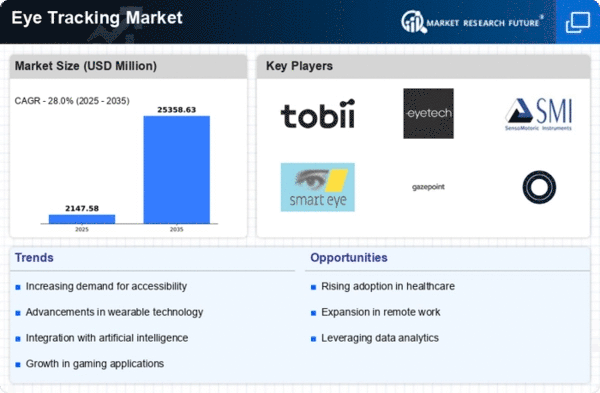
As per MRFR analysis, the Eye Tracking Market Size was estimated at 1677.8 USD Million in 2024. The Eye Tracking industry is projected to grow from 2147.62 USD Million in 2025 to 25358.63 USD Million by 2035, exhibiting a compound annual growth rate (CAGR) of 28.0 during the forecast period 2025 - 2035.

Key Market Trends & Highlights

The Eye Tracking Market is experiencing robust growth driven by technological advancements and expanding applications across various sectors.

  • The integration of AI and machine learning is revolutionizing the capabilities of eye tracking technologies. Miniaturization of devices is enhancing user experience and accessibility in consumer electronics and virtual reality segments. North America remains the largest market, while Asia-Pacific is emerging as the fastest-growing region for eye tracking applications. Rising demand in healthcare and advancements in gaming and entertainment are key drivers propelling market expansion.

Market Size & Forecast

2024 Market Size 1677.8 (USD Million)
2035 Market Size 25358.63 (USD Million)
CAGR (2025 - 2035) 28.0%
Largest Regional Market Share in 2024 North America

Major Players

Tobii AB (SE), EyeTech Digital Systems (IL), SensoMotoric Instruments (DE), Smart Eye AB (SE), Gazepoint (CA), Pupil Labs (DE), iMotions (DK), Cognixion (US), Seeing Machines (AU)

Market Trends

The Eye Tracking Market is currently experiencing a notable evolution, driven by advancements in technology and increasing applications across various sectors. This market encompasses devices and software that track eye movements, providing insights into user behavior and preferences. As industries such as healthcare, gaming, and marketing recognize the value of understanding visual attention, the demand for eye tracking solutions is likely to grow. Furthermore, the integration of artificial intelligence and machine learning into eye tracking systems appears to enhance their accuracy and functionality, making them more appealing to businesses seeking to optimize user experiences. In addition, the Eye Tracking Market is witnessing a shift towards more compact and user-friendly devices. Innovations in hardware design and software capabilities suggest a trend towards greater accessibility for consumers and professionals alike. This democratization of technology may lead to broader adoption across diverse fields, including education and research. As the market continues to expand, it seems poised to play a crucial role in shaping how individuals interact with digital content and environments, ultimately influencing decision-making processes and user engagement strategies.

Integration of AI and Machine Learning

The incorporation of artificial intelligence and machine learning technologies into eye tracking systems is transforming the market. These advancements enhance the precision of data collection and analysis, allowing for more nuanced insights into user behavior. As a result, businesses are increasingly adopting these sophisticated solutions to improve user experience and engagement.

Miniaturization of Devices

There is a discernible trend towards the development of smaller, more portable eye tracking devices. This miniaturization makes technology more accessible to a wider audience, including researchers and consumers. Such advancements could facilitate the use of eye tracking in various settings, from academic research to everyday applications.

Expansion into New Industries

The Eye Tracking Market is broadening its reach into new sectors beyond traditional applications. Industries such as education, automotive, and virtual reality are beginning to explore the potential of eye tracking technology. This expansion indicates a growing recognition of the value that eye tracking can bring to diverse fields, enhancing user interaction and experience.

Eye Tracking Market Market Drivers

Technological Advancements

The Global Eye Tracking Market Industry is experiencing rapid growth due to continuous technological advancements. Innovations in sensor technology and machine learning algorithms enhance the accuracy and efficiency of eye tracking systems. For instance, the integration of artificial intelligence allows for real-time data analysis, which is increasingly utilized in various sectors such as healthcare and marketing. As a result, the market is projected to reach 2.51 USD Billion in 2024, reflecting a growing demand for sophisticated eye tracking solutions. This trend suggests that organizations are increasingly recognizing the value of eye tracking in understanding user behavior and improving product design.

Market Segment Insights

By Application: Market Research Future (Largest) vs. Healthcare (Fastest-Growing)

In the Eye Tracking Market, the application segments demonstrate distinct dynamics, with Market Research Future claiming the largest share due to its utility in consumer behavior studies and usability testing. Healthcare follows closely, leveraging eye tracking for diagnostics and patient monitoring. The Gaming segment also maintains a notable presence, driven by the integration of immersive technologies. However, Advertising and Automotive hold smaller yet significant positions, primarily utilizing eye tracking for targeted ads and driver monitoring systems respectively.

Market Research Future: Dominant vs. Healthcare: Emerging

The Market Research Future application in the Eye Tracking Market remains dominant as it extensively utilizes eye tracking to gauge consumer preferences and enhance user experiences through data-driven insights. As businesses increasingly rely on analytics to inform decisions, the demand for eye tracking technologies in Market Research Future is likely to grow. On the other hand, the Healthcare sector is emerging rapidly, employing eye tracking for varied applications from ocular disease diagnostics to therapeutic assessments, reflecting a shift toward personalized medical solutions. This growth is propelled by technological advancements and the increasing recognition of eye tracking as a critical tool in patient evaluation. Both sectors play pivotal roles but highlight differing strategies based on their objectives.

By End Use: Consumer Electronics (Largest) vs. Virtual Reality (Fastest-Growing)

In the Eye Tracking Market, Consumer Electronics holds the largest share among various end use segments, driven by the high demand for smart devices and advancements in interactive technologies. This segment encompasses applications in smartphones, tablets, and other consumer gadgets where eye-tracking enhances user experience. Following closely, Virtual Reality has emerged as a fast-growing segment, capitalizing on the increasing popularity of VR gaming and training simulators, which incorporate eye-tracking to deliver more immersive experiences. The growth trends in this market are primarily propelled by technological innovations and rising consumer interest in interactive experiences. <a href="https://www.marketresearchfuture.com/categories/medical-devices-market-report">Healthcare Devices </a>are also gaining traction as they augment patient care and diagnostics, while Automotive Systems leverage eye-tracking for enhanced driver assistance and safety. Research Institutions utilize eye-tracking for cognitive and behavioral studies, further underscoring the technology's diverse applications.

Consumer Electronics (Dominant) vs. Virtual Reality (Emerging)

Consumer Electronics stands out as the dominant segment in the Eye Tracking Market due to widespread integration in everyday devices. This segment benefits from continuous innovation and consumer demand for enhanced interaction, resulting in eye-tracking functionalities becoming standard in many smart devices. In contrast,<a href="https://www.marketresearchfuture.com/reports/virtual-reality-headsets-market-1714"> Virtual Reality</a> is an emerging segment that showcases rapid growth, driven by the gaming industry's evolution and professional applications like training simulations. The demand for more immersive experiences in VR is pushing the boundaries of eye-tracking technology, leading to collaborations with software developers and increased investment in R&amp;D. These characteristics position Consumer Electronics as a staple in the market, while Virtual Reality is on the brink of becoming a mainstream application.

By Technology: Video-based Eye Tracking (Largest) vs. Electrooculography (Fastest-Growing)

In the Eye Tracking Market, the technology segment showcases a diverse array of methodologies, with video-based eye tracking emerging as the largest segment. This technique utilizes high-speed cameras to capture eye movements, making it integral for applications ranging from Market Research Future to healthcare. Conversely, electrooculography has gained momentum, emerging as the fastest-growing technology due to its cost-effectiveness and ease of integration in various devices, appealing to developers and researchers seeking innovative solutions. Market growth in the technology segment is propelled by the increasing demand for accurate and robust eye-tracking solutions across various industries. Video-based systems are experiencing steady adoption, driven by advancements in camera technology and processing capabilities. At the same time, the rapid adoption of electrooculography systems in wearable devices and healthcare applications signals a trend towards more accessible and efficient eye-tracking solutions, further expanding market opportunities.

Eye Tracking: Video-based (Dominant) vs. Electrooculography (Emerging)

Video-based eye tracking is considered the dominant technology in the market, characterized by its ability to deliver high precision and real-time results, making it favorable for user experience research and usability testing. With extensive applications in gaming, marketing, and accessibility, video-based systems benefit from ongoing enhancements in imaging technology and <a href="https://www.marketresearchfuture.com/reports/machine-learning-in-banking-market-33033">machine learning</a> algorithms. Conversely, electrooculography is emerging as a significant contender, particularly in portable and wearable eye tracking solutions. Its ability to integrate seamlessly with other technologies, such as virtual or augmented reality devices, offers exciting prospects. This technology captures eye movement through electrical signals from eye muscles, providing an innovative yet cost-effective option for developers and researchers in various sectors, thus signifying its growth potential.

By Component: Cameras (Largest) vs. Software (Fastest-Growing)

In the Eye Tracking Market, the component segment reveals a diverse distribution among its various elements. Cameras hold the largest market share, serving as the fundamental technology for capturing eye movement data. Software follows closely, enabling real-time analysis and visualization of the data collected by the cameras. The remaining components like sensors, processing units, and display systems, while essential, contribute smaller shares to this intricate ecosystem, emphasizing the critical role of cameras and software in shaping market dynamics. Looking ahead, growth trends in the Eye Tracking Market are largely driven by advancements in camera and software technologies. The integration of artificial intelligence and machine learning in software applications is propelling the demand for sophisticated eye tracking solutions. Moreover, increased adoption of eye tracking in sectors like healthcare and gaming is paving the way for rapid innovation and expanding the market's reach, with software emerging as the fastest-growing segment due to its versatile applications across various industries.

Cameras (Dominant) vs. Software (Emerging)

Cameras are the dominant component in the Eye Tracking Market due to their essential function in accurately capturing eye movement. They are evolving to incorporate higher resolutions and enhanced sensitivity, providing robust data for analysis. On the other hand, software represents an emerging force in the market, rapidly gaining traction as facial recognition and user interaction capabilities are integrated into applications. The software segment is characterized by its adaptability and the critical role it plays in data interpretation and user engagement. As technology advances, both cameras and software are expected to coexist, driving market growth by enhancing the user experience and expanding the application landscape.

By Type: Remote Eye Trackers (Largest) vs. Mobile Eye Trackers (Fastest-Growing)

In the Eye Tracking Market, Remote Eye Trackers currently dominate the landscape, capturing the largest market share due to their widespread applications in research and analytics. These systems are primarily utilized in laboratories and controlled environments, making them a staple in academic and commercial research. In contrast, Mobile Eye Trackers, while smaller in overall market share, are rapidly gaining traction due to the increasing need for mobile solutions in fields such as marketing and usability testing, reflecting the growing trend toward real-world data collection. The growth of the Eye Tracking segment is primarily driven by advancements in technology and increased integration of eye tracking in various sectors. While Remote Eye Trackers maintain their lead due to their established presence, the rising demand for flexibility and portability has fostered the rapid expansion of Mobile Eye Trackers. As companies seek innovative ways to enhance user experience and gather actionable insights, the market for mobile solutions is expected to continue its upward trajectory, catering to both researchers and businesses alike.

Remote Eye Trackers (Dominant) vs. Mobile Eye Trackers (Emerging)

Remote Eye Trackers are at the forefront of the Eye Tracking Market, known for their precision and reliability in controlled research settings. With the ability to track eye movements over extended periods and deliver comprehensive data, they are the preferred choice for academic institutions and corporations conducting in-depth studies. Conversely, Mobile Eye Trackers are emerging as a dynamic alternative, providing unprecedented flexibility for real-world applications. These devices are equipped for various environments, including marketing research and user experience evaluations, appealing to sectors looking for actionable insights in dynamic scenarios. As technology evolves, both segments are likely to coexist, each catering to unique user needs while shaping the future of eye tracking technology.

Get more detailed insights about Eye Tracking Market Research Report - Forecast Till 2035

Regional Insights

North America : Market Leader in Eye Tracking

North America continues to lead the Eye Tracking Market, holding a significant share of 800.0M in 2025. The growth is driven by advancements in technology, increasing demand in healthcare, and the integration of eye tracking in various applications such as gaming and virtual reality. Regulatory support and funding for research further catalyze market expansion, making it a hub for innovation in this field. The United States is the primary contributor to this market, with key players like Tobii AB, EyeTech Digital Systems, and Cognixion leading the charge. The competitive landscape is characterized by continuous innovation and strategic partnerships among companies. The presence of advanced research institutions and a robust tech ecosystem enhances the region's attractiveness for eye tracking solutions.

Europe : Emerging Market with Growth Potential

Europe's Eye Tracking Market is poised for growth, valued at 450.0M in 2025. The region benefits from a strong focus on research and development, particularly in healthcare and automotive sectors. Regulatory frameworks promoting technology adoption and user safety are key drivers of market growth. The increasing integration of eye tracking in assistive technologies also contributes to rising demand across various industries. Germany, the UK, and France are leading countries in this market, with companies like SensoMotoric Instruments and Smart Eye AB making significant contributions. The competitive landscape is marked by innovation and collaboration among firms, enhancing product offerings. The presence of regulatory bodies ensures compliance and fosters a conducive environment for market players.

Asia-Pacific : Rapidly Growing Eye Tracking Market

The Asia-Pacific Eye Tracking Market is rapidly growing, projected to reach 350.0M by 2025. Factors such as increasing adoption of eye tracking in education, gaming, and healthcare are driving this growth. The region's expanding tech landscape and rising investments in research and development are also significant contributors. Regulatory initiatives aimed at promoting technology adoption further enhance market dynamics. Leading countries in this region include Japan, China, and Australia, where companies like Gazepoint and Seeing Machines are making strides. The competitive landscape is evolving, with both established players and startups innovating to capture market share. The increasing focus on user experience and accessibility is shaping the future of eye tracking technologies in Asia-Pacific.

Middle East and Africa : Emerging Market with Unique Challenges

The Eye Tracking Market in the Middle East and Africa is valued at 77.8M in 2025, reflecting its emerging status. The growth is driven by increasing awareness of eye tracking applications in healthcare and education, alongside rising investments in technology. However, challenges such as limited infrastructure and regulatory hurdles may impede faster growth. Nonetheless, the region shows potential for future expansion as technology adoption increases. Countries like South Africa and the UAE are leading the way in adopting eye tracking technologies. The competitive landscape is still developing, with a few key players beginning to establish their presence. As awareness grows, more companies are likely to enter the market, enhancing competition and innovation in the region.

Key Players and Competitive Insights

The Eye Tracking Market is currently characterized by a dynamic competitive landscape, driven by advancements in technology and increasing applications across various sectors, including healthcare, automotive, and gaming. Major players such as Tobii AB (SE), EyeTech Digital Systems (IL), and Smart Eye AB (SE) are at the forefront, each adopting distinct strategies to enhance their market positioning. Tobii AB (SE) focuses on innovation and product development, particularly in the realm of assistive technology, while EyeTech Digital Systems (IL) emphasizes partnerships with healthcare providers to expand its reach in medical applications. Smart Eye AB (SE) is actively pursuing regional expansion, particularly in the automotive sector, where eye tracking is becoming integral to driver monitoring systems. Collectively, these strategies contribute to a competitive environment that is increasingly collaborative yet fiercely innovative. In terms of business tactics, companies are localizing manufacturing and optimizing supply chains to enhance efficiency and reduce costs. The market structure appears moderately fragmented, with a mix of established players and emerging startups. This fragmentation allows for diverse offerings and innovation, although the influence of key players remains substantial, shaping market trends and consumer expectations. In November 2025, Tobii AB (SE) announced a strategic partnership with a leading automotive manufacturer to integrate its eye tracking technology into next-generation vehicles. This collaboration is poised to enhance driver safety and user experience, reflecting a growing trend towards the incorporation of advanced technologies in automotive design. The strategic importance of this partnership lies in its potential to set new standards for driver monitoring systems, thereby reinforcing Tobii's position as a leader in the automotive segment. In October 2025, EyeTech Digital Systems (IL) launched a new eye tracking device specifically designed for rehabilitation purposes in stroke patients. This product aims to facilitate better communication and interaction for individuals with mobility challenges. The introduction of this device underscores EyeTech's commitment to innovation in healthcare, potentially expanding its market share in a niche yet critical segment of the eye tracking market. In September 2025, Smart Eye AB (SE) secured a significant contract with a major automotive supplier to provide eye tracking solutions for advanced driver assistance systems (ADAS). This contract not only solidifies Smart Eye's foothold in the automotive sector but also highlights the increasing demand for safety features in vehicles. The strategic importance of this contract lies in its potential to drive revenue growth and enhance Smart Eye's reputation as a key player in the integration of eye tracking technology in automotive applications. As of December 2025, current trends in the Eye Tracking Market indicate a strong focus on digitalization, sustainability, and the integration of artificial intelligence (AI). Strategic alliances are increasingly shaping the competitive landscape, allowing companies to leverage complementary strengths and accelerate innovation. Looking ahead, competitive differentiation is likely to evolve from traditional price-based competition towards a focus on technological innovation, reliability in supply chains, and the ability to deliver tailored solutions that meet the specific needs of diverse industries.

Key Companies in the Eye Tracking Market include

Industry Developments

  • Q2 2024: Eye-tracking startup AdHawk raises $16M Series B to bring its sensor tech to AR glasses AdHawk Microsystems, a company specializing in eye-tracking sensors, secured $16 million in Series B funding to accelerate the integration of its technology into augmented reality (AR) glasses and expand its commercial partnerships.
  • Q2 2024: Tobii and Sony Interactive Entertainment enter partnership to bring eye tracking to PlayStation VR2 Tobii announced a partnership with Sony Interactive Entertainment to supply eye-tracking technology for the PlayStation VR2 headset, marking a significant collaboration in the gaming and virtual reality sector.
  • Q1 2024: Smart Eye Receives New Design Win from Major US Electric Vehicle Manufacturer Smart Eye secured a new design win to deliver its driver monitoring system, which includes eye-tracking technology, for integration into an upcoming electric vehicle model from a leading US automaker.
  • Q2 2024: Apple acquires eye-tracking firm SensoMotoric Instruments to boost AR capabilities Apple completed the acquisition of SensoMotoric Instruments, a German company specializing in eye-tracking hardware and software, to enhance its augmented reality and wearable device initiatives.
  • Q2 2024: Tobii Appoints Anand Srivatsa as New CEO Tobii, a global leader in eye-tracking technology, announced the appointment of Anand Srivatsa as its new Chief Executive Officer, effective immediately.
  • Q1 2024: Smart Eye Launches Aurora, a New Eye Tracking Market Platform for Automotive Safety Smart Eye introduced Aurora, a next-generation eye-tracking platform designed to enhance driver monitoring and safety features in automotive applications.
  • Q2 2024: Tobii Launches New Eye Tracker 6 for Research and Gaming Applications Tobii unveiled the Eye Tracker 6, its latest device aimed at improving accuracy and usability for both academic research and gaming use cases.
  • Q1 2024: Smart Eye and Polestar Announce Partnership to Integrate Eye Tracking Market in Polestar 4 Smart Eye and electric vehicle manufacturer Polestar announced a partnership to integrate Smart Eye's eye-tracking technology into the Polestar 4, enhancing driver safety and monitoring.
  • Q2 2024: Tobii Receives FDA Clearance for Eye-Tracking Assistive Device Tobii received clearance from the U.S. Food and Drug Administration (FDA) for its latest eye-tracking assistive device, enabling expanded use in medical and accessibility applications.
  • Q1 2024: Smart Eye Opens New R&D Center in Detroit to Support North American Automotive Clients Smart Eye inaugurated a new research and development center in Detroit, Michigan, to better serve its automotive customers in North America and accelerate innovation in driver monitoring systems.
  • Q2 2024: Tobii and Lenovo Announce Collaboration to Integrate Eye Tracking Market in ThinkPad Series Tobii and Lenovo revealed a collaboration to integrate Tobii's eye-tracking technology into select models of Lenovo's ThinkPad laptops, targeting productivity and accessibility enhancements.
  • Q1 2024: Smart Eye Secures Multi-Year Contract with European Truck Manufacturer for Eye-Tracking Driver Monitoring Smart Eye signed a multi-year contract to supply its eye-tracking driver monitoring systems to a major European truck manufacturer, supporting advanced safety features in commercial vehicles.

Future Outlook

Eye Tracking Market Future Outlook

The Eye Tracking Market is projected to grow at a 28.0% CAGR from 2025 to 2035, driven by advancements in technology, increasing demand in healthcare, and enhanced user experience in gaming.

New opportunities lie in:

  • <p>Development of eye-tracking software for remote user testing Integration of eye tracking in augmented reality applications Creation of personalized marketing solutions using eye-tracking data</p>

By 2035, the Eye Tracking Market is expected to be a pivotal industry, reflecting robust growth and innovation.

Market Segmentation

Eye Tracking Market Type Outlook

  • Remote Eye Trackers
  • Mobile Eye Trackers
  • Screen-based Eye Trackers
  • Wearable Eye Trackers
  • Integrated Eye Trackers

Eye Tracking Market End Use Outlook

  • Consumer Electronics
  • Healthcare Devices
  • Automotive Systems
  • Research Institutions
  • Virtual Reality

Eye Tracking Market Component Outlook

  • Cameras
  • Software
  • Sensors
  • Processing Units
  • Display Systems

Eye Tracking Market Technology Outlook

  • Electrooculography
  • Video-based Eye Tracking
  • Optical Tracking
  • Screen-based Eye Tracking
  • Wearable Eye Trackers

Eye Tracking Market Application Outlook

  • Market Research Future
  • Healthcare
  • Gaming
  • Advertising
  • Automotive

Report Scope

MARKET SIZE 2024 1677.8(USD Million)
MARKET SIZE 2025 2147.62(USD Million)
MARKET SIZE 2035 25358.63(USD Million)
COMPOUND ANNUAL GROWTH RATE (CAGR) 28.0% (2025 - 2035)
REPORT COVERAGE Revenue Forecast, Competitive Landscape, Growth Factors, and Trends
BASE YEAR 2024
Market Forecast Period 2025 - 2035
Historical Data 2019 - 2024
Market Forecast Units USD Million
Key Companies Profiled Tobii AB (SE), EyeTech Digital Systems (IL), SensoMotoric Instruments (DE), Smart Eye AB (SE), Gazepoint (CA), Pupil Labs (DE), iMotions (DK), Cognixion (US), Seeing Machines (AU)
Segments Covered Application, End Use, Technology, Component, Type
Key Market Opportunities Integration of artificial intelligence in Eye Tracking Market enhances user experience and data analytics capabilities.
Key Market Dynamics Rising demand for eye tracking technology in diverse applications drives innovation and competitive dynamics in the market.
Countries Covered North America, Europe, APAC, South America, MEA

FAQs

What was the expected market size of the Eye Tracking Market in 2024?

The Eye Tracking Market was valued at 2.51 USD Billion in 2024.

What is the projected value of the Eye Tracking Market by 2035?

By 2035, the Eye Tracking Market is anticipated to reach a value of 5.2 USD Billion.

What is the expected CAGR for the Eye Tracking Market from 2025 to 2035?

The expected CAGR for the Eye Tracking Market from 2025 to 2035 is 6.84%.

Which region have the largest market share in 2024?

North America held the largest market share with a value of 0.75 USD Billion in 2024.

How much is the Asia Pacific market for Eye Tracking projected to be in 2035?

The Asia Pacific market for Eye Tracking is expected to reach 1.7 USD Billion by 2035.

What was the market value of the Video-Based Eye Tracking technology in 2024?

The Video-Based Eye Tracking technology was valued at 1.0 USD Billion in 2024.

Which companies are major players in the Eye Tracking Market?

Major players include Tobii, SensoMotoric Instruments, and iMotions, among others.

What is the expected growth rate for the Remote Eye Tracking segment from 2025 to 2035?

The Remote Eye Tracking segment is projected to grow from 0.5 USD Billion in 2024 to 1.1 USD Billion by 2035.

What are the challenges affecting the Eye Tracking Market?

Challenges include technological advancements and market competition among key players.

  1. SECTION I: EXECUTIVE SUMMARY AND KEY HIGHLIGHTS
    1. EXECUTIVE SUMMARY
      1. Market Overview
      2. Key Findings
      3. Market Segmentation
      4. Competitive Landscape
      5. Challenges and Opportunities
      6. Future Outlook 2 SECTION II: SCOPING, METHODOLOGY AND MARKET STRUCTURE
    2. MARKET INTRODUCTION
      1. Definition
      2. Scope of the study
    3. RESEARCH METHODOLOGY
      1. Overview
      2. Data Mining
      3. Secondary Research
      4. Primary Research
      5. Forecasting Model
      6. Market Size Estimation
      7. Data Triangulation
      8. Validation 3 SECTION III: QUALITATIVE ANALYSIS
    4. MARKET DYNAMICS
      1. Overview
      2. Drivers
      3. Restraints
      4. Opportunities
    5. MARKET FACTOR ANALYSIS
      1. Value chain Analysis
      2. Porter's Five Forces Analysis
      3. COVID-19 Impact Analysis
    6. Semiconductor & Electronics, BY Application (USD Million)
      1. Market Research Future
      2. Healthcare
      3. Gaming
      4. Advertising
      5. Automotive
    7. Semiconductor & Electronics, BY End Use (USD Million)
      1. Consumer Electronics
      2. Healthcare Devices
      3. Automotive Systems
      4. Research Institutions
      5. Virtual Reality
    8. Semiconductor & Electronics, BY Technology (USD Million)
      1. Electrooculography
      2. Video-based Eye Tracking
      3. Optical Tracking
      4. Screen-based Eye Tracking
      5. Wearable Eye Trackers
    9. Semiconductor & Electronics, BY Component (USD Million)
      1. Cameras
      2. Software
      3. Sensors
      4. Processing Units
      5. Display Systems
    10. Semiconductor & Electronics, BY Type (USD Million)
      1. Remote Eye Trackers
      2. Mobile Eye Trackers
      3. Screen-based Eye Trackers
      4. Wearable Eye Trackers
      5. Integrated Eye Trackers
    11. Semiconductor & Electronics, BY Region (USD Million)
      1. North America
      2. Europe
      3. APAC
      4. South America
      5. MEA
    12. Competitive Landscape
      1. Overview
      2. Competitive Analysis
      3. Market share Analysis
      4. Major Growth Strategy in the Semiconductor & Electronics
      5. Competitive Benchmarking
      6. Leading Players in Terms of Number of Developments in the Semiconductor & Electronics
      7. Key developments and growth strategies
      8. Major Players Financial Matrix
    13. Company Profiles
      1. Tobii AB (SE)
      2. EyeTech Digital Systems (IL)
      3. SensoMotoric Instruments (DE)
      4. Smart Eye AB (SE)
      5. Gazepoint (CA)
      6. Pupil Labs (DE)
      7. iMotions (DK)
      8. Cognixion (US)
      9. Seeing Machines (AU)
    14. Appendix
      1. References
      2. Related Reports

Semiconductor & Electronics Market Segmentation

Semiconductor & Electronics By Application (USD Million, 2025-2035)

  • Market Research Future
  • Healthcare
  • Gaming
  • Advertising
  • Automotive

Semiconductor & Electronics By End Use (USD Million, 2025-2035)

  • Consumer Electronics
  • Healthcare Devices
  • Automotive Systems
  • Research Institutions
  • Virtual Reality

Semiconductor & Electronics By Technology (USD Million, 2025-2035)

  • Electrooculography
  • Video-based Eye Tracking
  • Optical Tracking
  • Screen-based Eye Tracking
  • Wearable Eye Trackers

Semiconductor & Electronics By Component (USD Million, 2025-2035)

  • Cameras
  • Software
  • Sensors
  • Processing Units
  • Display Systems

Semiconductor & Electronics By Type (USD Million, 2025-2035)

  • Remote Eye Trackers
  • Mobile Eye Trackers
  • Screen-based Eye Trackers
  • Wearable Eye Trackers
  • Integrated Eye Trackers
Infographic

Free Sample Request

Kindly complete the form below to receive a free sample of this Report

Get Free Sample

Customer Strories

Compare Licence

×
Features License Type
Single User Multiuser License Enterprise User
Price $4,950 $5,950 $7,250
Maximum User Access Limit 1 User Upto 10 Users Unrestricted Access Throughout the Organization
Free Customization
Direct Access to Analyst
Deliverable Format
Platform Access
Discount on Next Purchase 10% 15% 15%
Printable Versions