Request Free Sample ×

Kindly complete the form below to receive a free sample of this Report

* Please use a valid business email

Leading companies partner with us for data-driven Insights

clients tt-cursor
Hero Background
English
Chinese
French
Japanese
Korean
German
Spanish

Eye Melanoma Market Share

ID: MRFR/MED/4121-HCR
90 Pages
Vikita Thakur
Last Updated: April 06, 2026

Eye Melanoma Market Research Report Information By Site (Sclera, Retina, Uvea), By Diagnosis (Eye Exam, Imaging, Biopsy), Treatment (Radiation Therapy, Laser Treatment, Surgery), End User (Hospitals & Clinics, Academic Institutes) - Global Forecast Till 2035

Share:
Download PDF ×

We do not share your information with anyone. However, we may send you emails based on your report interest from time to time. You may contact us at any time to opt-out.

Eye Melanoma Market Infographic
Purchase Options

Market Share

Eye Melanoma Market Share Analysis

In the realm of Eye Melanoma, market share positioning strategies play a crucial role in determining a company's success. Before delving into specific strategies, it is essential to comprehend the dynamics of the market, including factors such as prevalence rates, advancements in treatment options, and evolving patient needs. Companies to target significant market shares in the Eye Melanoma field invest their resources on strong research and development activities. By implementing innovative approaches and advanced technologies, these organizations take the lead regarding the provision of state-of-the-art solutions applied by health care professionals with trust on their part. Companies establish alliances and strategic partnerships in an attempt to widen their market reach and leverage on a more competitive position. Through partnering with research establishments, health care organizations or other pharmaceutical companies allow them to capitalize on accumulated knowledge as well as resources while also tapping into networks that increase their standing in the market. Diversity in terms of the products provided and a product that is better than other similar goods or commodities served by competitors, characterize market share positioning. Companies seek to create a diverse portfolio of Eye Melanoma treatments and therapies covering varying stages, which helps cover the entire treatment terrain, gains market shares among medical practitioners with providing broad solutions. The education sector significantly contributes to shaping the outcome of the market. Corporations provide educational programs for healthcare providers as well as patients, which they sponsor. The more they do this to increase awareness about the disease and its risk factors, as well as the existing treatment for it, the better their image is perceived on a market level in order to become authority figures in specific field. Such calculated aggressive marketing and branding is a pre-requisite to be able to win viable market share. Through both digital and conventional branding acts, companies use specific marketing approaches to advertise their products with a purpose of having an effective and prominent brand name. Efficient branding leads to improving recognition of the identity and makes the stakeholders feel confident about them and potential customers who will trust this business. The rapid evolution of technology is a constant in healthcare. Market leaders in Eye Melanoma continually adapt to technological advancements, incorporating new diagnostic tools, treatment modalities, and patient management systems. This adaptability not only keeps them at the forefront of innovation but also solidifies their market position.

Author
Author Profile
Vikita Thakur
Senior Research Analyst

She holds an experience of about 5+ years in market research and business consulting projects for sectors such as life sciences, medical devices, and healthcare IT. She possesses a robust background in data analysis, market estimation, competitive intelligence, pipeline analysis market trend identification, and consumer behavior insights. Her expertise lies in technical Sales support, client interaction and project management, designing and implementing market research studies, conducting competitive analysis, and synthesizing complex data into actionable recommendations that drive business growth.

Leave a Comment

FAQs

What is the current valuation of the Eye Melanoma Market as of 2024?

The Eye Melanoma Market was valued at 5.77 USD Billion in 2024.

What is the projected market valuation for Eye Melanoma by 2035?

The market is projected to reach 11.97 USD Billion by 2035.

What is the expected CAGR for the Eye Melanoma Market during the forecast period 2025 - 2035?

The expected CAGR for the Eye Melanoma Market during 2025 - 2035 is 6.86%.

Which segment of the Eye Melanoma Market had the highest valuation in 2024?

In 2024, the uvea segment had the highest valuation at 2.31 USD Billion.

What are the projected valuations for the treatment segment of the Eye Melanoma Market by 2035?

The treatment segment is projected to reach 5.25 USD Billion by 2035.

Which key players are leading the Eye Melanoma Market?

Key players in the Eye Melanoma Market include Bristol-Myers Squibb, Merck & Co., Novartis, and others.

What is the projected valuation for the diagnosis segment by 2035?

The diagnosis segment is projected to reach 4.62 USD Billion by 2035.

How does the valuation of the retina segment change from 2024 to 2035?

The retina segment is expected to grow from 1.15 USD Billion in 2024 to 2.38 USD Billion by 2035.

What is the expected growth for hospitals and clinics as end users in the Eye Melanoma Market?

Hospitals and clinics are projected to grow from 2.31 USD Billion in 2024 to 4.73 USD Billion by 2035.

What is the projected valuation for the imaging segment by 2035?

The imaging segment is projected to reach 3.0 USD Billion by 2035.

Market Summary

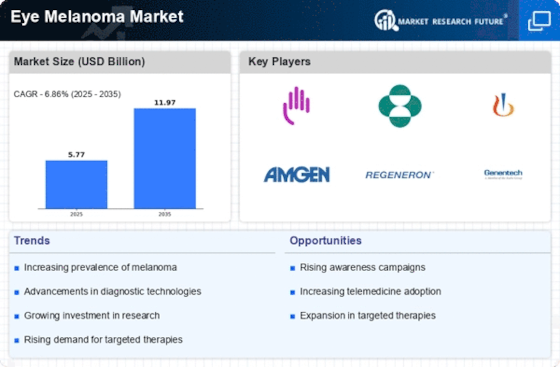
As per Market Research Future analysis, the Eye Melanoma Market Size was estimated at 5.77 USD Billion in 2024. The Eye Melanoma industry is projected to grow from 6.166 USD Billion in 2025 to 11.97 USD Billion by 2035, exhibiting a compound annual growth rate (CAGR) of 6.86% during the forecast period 2025 - 2035

Key Market Trends & Highlights

The Eye Melanoma Market is experiencing significant growth driven by advancements in treatment and diagnostic technologies.

  • North America remains the largest market for eye melanoma, driven by advanced healthcare infrastructure and high awareness levels. The Asia-Pacific region is emerging as the fastest-growing market, fueled by increasing healthcare investments and rising incidence rates. The sclera segment holds the largest market share, while the uvea segment is witnessing rapid growth due to its unique treatment needs. Key market drivers include the growing incidence of eye melanoma and advancements in treatment modalities, which are enhancing patient outcomes.

Market Size & Forecast

2024 Market Size 5.77 (USD Billion)
2035 Market Size 11.97 (USD Billion)
CAGR (2025 - 2035) 6.86%
Largest Regional Market Share in 2024 America

Major Players

Bristol-Myers Squibb (US), Merck &amp; Co. (US), Novartis (CH), Amgen (US), Regeneron Pharmaceuticals (US), Genentech (US), <a href="https://www.pfizer.com/disease-and-conditions/melanoma">Pfizer </a>(US), Eli Lilly and Company (US)

Market Trends

The Eye Melanoma Market is currently experiencing a notable evolution, driven by advancements in diagnostic techniques and treatment modalities. The increasing awareness surrounding ocular health has led to a rise in early detection, which is crucial for improving patient outcomes. Furthermore, the integration of innovative therapies, such as targeted treatments and immunotherapy, appears to enhance the efficacy of existing options. This shift towards personalized medicine may potentially reshape the therapeutic landscape, offering patients more tailored solutions. In addition, the Eye Melanoma Market is influenced by ongoing research initiatives aimed at understanding the underlying mechanisms of this malignancy. Collaborative efforts among academic institutions, healthcare providers, and pharmaceutical companies suggest a commitment to developing novel interventions. As the market continues to evolve, the focus on patient-centric approaches and the incorporation of technology in treatment protocols may further drive growth and improve overall care for individuals affected by this condition.

Advancements in Diagnostic Techniques

The Eye Melanoma Market is witnessing a transformation due to improvements in diagnostic methods. Enhanced imaging technologies and genetic testing are facilitating earlier and more accurate identification of ocular melanoma. This trend is likely to lead to better treatment outcomes and increased survival rates.

Rise of Targeted Therapies

There is a growing emphasis on targeted therapies within the Eye Melanoma Market. These treatments, which focus on specific molecular targets associated with tumor growth, may offer more effective options compared to traditional therapies. This shift could potentially improve patient responses and reduce side effects.

Increased Research and Collaboration

The Eye Melanoma Market is benefiting from heightened research efforts and collaborations among various stakeholders. Academic institutions, healthcare organizations, and pharmaceutical companies are working together to explore new treatment avenues and enhance understanding of the disease, which may lead to innovative solutions.

Eye Melanoma Market Market Drivers

Growing Incidence of Eye Melanoma

The Eye Melanoma Market is experiencing a notable increase in the incidence of eye melanoma, particularly among older adults. Recent statistics indicate that the age-adjusted incidence rate of uveal melanoma is approximately 5.1 cases per million people annually. This rising trend is likely attributed to factors such as increased exposure to ultraviolet light and genetic predispositions. As the population ages, the number of individuals at risk for developing eye melanoma is expected to rise, thereby driving demand for effective diagnostic and therapeutic options within the Eye Melanoma Market. Furthermore, heightened awareness regarding the disease is prompting more individuals to seek medical attention, which may contribute to earlier detection and improved treatment outcomes.

Advancements in Treatment Modalities

Innovations in treatment modalities are significantly influencing the Eye Melanoma Market. Recent developments in targeted therapies and immunotherapies have shown promising results in improving patient outcomes. For instance, the introduction of checkpoint inhibitors has revolutionized the treatment landscape, offering new hope for patients with advanced eye melanoma. Additionally, the market is witnessing an increase in the use of personalized medicine, which tailors treatment plans based on individual genetic profiles. This shift towards more effective and less invasive treatment options is likely to enhance patient compliance and satisfaction, thereby propelling growth in the Eye Melanoma Market. As research continues to evolve, the potential for novel therapies to emerge remains high, further stimulating market dynamics.

Rising Awareness and Screening Programs

The Eye Melanoma Market is benefiting from increased awareness and the implementation of screening programs aimed at early detection. Public health initiatives and educational campaigns are playing a crucial role in informing individuals about the risks and symptoms associated with eye melanoma. As awareness grows, more people are likely to participate in regular eye examinations, leading to earlier diagnosis and treatment. This proactive approach is expected to enhance survival rates and improve overall patient outcomes. Moreover, the establishment of specialized clinics and screening programs is facilitating access to care, which may further drive the demand for services within the Eye Melanoma Market. The emphasis on early detection is likely to create a more favorable environment for market growth.

Technological Innovations in Diagnostic Tools

Technological advancements in diagnostic tools are reshaping the Eye Melanoma Market. Innovations such as optical coherence tomography (OCT) and advanced imaging techniques are enhancing the accuracy of eye melanoma diagnoses. These tools allow for non-invasive assessments, enabling clinicians to detect tumors at earlier stages. The integration of artificial intelligence in diagnostic processes is also emerging, potentially improving the efficiency and precision of evaluations. As these technologies become more widely adopted, they are likely to increase the rate of early detection, which is crucial for effective treatment. Consequently, the demand for these advanced diagnostic tools is expected to rise, further propelling growth within the Eye Melanoma Market.

Increased Investment in Research and Development

Investment in research and development is a key driver of the Eye Melanoma Market. Pharmaceutical companies and research institutions are allocating substantial resources to explore new treatment options and improve existing therapies. This focus on R&D is likely to yield innovative solutions that address unmet medical needs in the management of eye melanoma. Furthermore, collaborations between academia and industry are fostering an environment conducive to breakthroughs in treatment methodologies. As new therapies emerge from these research efforts, they may significantly alter the treatment landscape, enhancing the overall efficacy of care provided to patients. This ongoing investment in R&D is expected to sustain momentum in the Eye Melanoma Market, driving future growth.

Market Segment Insights

By Site: Sclera (Largest) vs. Uvea (Fastest-Growing)

In the Eye Melanoma Market, the distribution of market share among the site segments is quite varied. The sclera segment holds the largest share, primarily due to its visibility and accessibility for diagnosis and treatment. Meanwhile, the uvea segment is experiencing rapid growth as advancements in diagnostic and therapeutic technologies are leading to better detection rates and treatment options for patients. The retina and other sites also contribute to the market, but they remain overshadowed by these dominant segments. Growth trends in the Eye Melanoma Market indicate a significant focus on enhancing treatment methods, particularly for the uvea, which is being recognized as the fastest-growing site for melanoma. Factors driving this growth include increasing awareness of eye health and the rising incidence of eye-related disorders. As research progresses, innovative therapies and better patient management approaches are likely to propel the uvea into a more prominent position within the overall market, highlighting the need for continuous investment in this area.

Sclera (Dominant) vs. Uvea (Emerging)

The sclera segment is well-established in the Eye Melanoma Market, characterized by a significant number of diagnosed cases and treatment modalities that include surgical interventions and radiation therapy. Its dominant position is supported by the fact that scleral melanoma is often more easily diagnosed due to its external location, making it a focus for clinicians. Conversely, the uvea segment is emerging rapidly as new research unveils the complexities of uveal melanoma and its varied presentations. As awareness grows and diagnostic technologies improve, the uvea is becoming a focal point of research, driving innovations in patient care and tailored treatment options, thus carving a significant niche in the market.

By Diagnosis: Eye Exam (Largest) vs. Biopsy (Fastest-Growing)

In the Eye Melanoma Market, the diagnosis segment is predominantly led by eye exams, which hold the largest market share. This traditional method remains the cornerstone of early detection due to its accessibility and effectiveness in identifying potential anomalies in patients. Imaging techniques and biopsies follow but are gaining traction as technological advancements enhance their precision and capabilities. The emerging interest in these methods reflects a growing recognition of their importance in comprehensive diagnostic protocols.

Eye Exam: Dominant vs. Biopsy: Emerging

Eye exams have long established their role as the dominant diagnostic method in the Eye Melanoma Market, primarily due to their routine inclusion in ocular health assessments. Their widespread adoption is attributed to their non-invasive nature and ability to detect early signs of melanoma, making them indispensable in patient care. Conversely, biopsies are emerging as a preferred method for definitive diagnosis. Their rapid growth stems from advancements in techniques, such as fine needle aspiration and excisional biopsy, which offer higher accuracy and are crucial for tailored treatment approaches. Together, these segments underscore the evolving landscape of eye melanoma diagnostics.

By Treatment: Surgery (Largest) vs. Radiation Therapy (Fastest-Growing)

The treatment segment for eye melanoma exhibits a diverse distribution among its primary values. Surgery remains the largest contributor, attracting significant attention due to its immediate effectiveness in tumor removal. Following closely is radiation therapy, which has gained momentum due to its non-invasive nature, making it a preferred choice for many patients. Laser treatment and other methods hold smaller market shares but contribute to the comprehensive management of the disease.

Surgery (Dominant) vs. Radiation Therapy (Emerging)

Surgery is considered the dominant form of treatment for eye melanoma as it directly addresses tumor removal. Surgeons employ various techniques, including enucleation and local resection, to ensure optimal outcomes. The procedure's established history and the ability to provide immediate results fortify its position in the market. Conversely, radiation therapy represents an emerging trend, appealing to patients seeking less invasive options. It utilizes targeted radiation to minimize damage to surrounding tissues, thereby enhancing recovery times and reducing complications. Additionally, advancements in radiation technology have propelled its acceptance, promising a growing role in treatment protocols.

By End User: Hospitals & Clinics (Largest) vs. Academic Institutes (Fastest-Growing)

In the Eye Melanoma Market, the distribution of market share among the end-user segment reveals that hospitals and clinics are currently the largest contributors. They account for a significant portion of the market due to the demand for specialized treatment and advanced surgical procedures. The accessibility of healthcare resources and the growing prevalence of eye melanoma drive their dominance. On the other hand, academic institutes are emerging as a notable segment with a rapid increase in their market share, primarily due to their focus on research and innovation in treatment methodologies. The growth trends in the Eye Melanoma Market for end users are significantly influenced by technological advancements and increased awareness of eye health. Hospitals and clinics are continuously adopting new treatments and technologies, catering to a growing patient population. Meanwhile, academic institutes are seeing accelerated growth as they engage in groundbreaking research, collaborations, and clinical trials that enhance treatment outcomes. The synergy between research organizations and healthcare facilities is likely to further propel this segment, fostering innovation and improved patient care.

Hospitals &amp; Clinics (Dominant) vs. Academic Institutes (Emerging)

Hospitals and clinics represent the dominant end-user segment in the Eye Melanoma Market, characterized by their comprehensive range of services and specialized treatments. Equipped with advanced technology and skilled healthcare professionals, these institutions play a critical role in diagnosing and treating eye melanoma. They focus on providing immediate surgical interventions and post-operative care, contributing to better patient outcomes. Conversely, academic institutes serve as an emerging segment, emphasizing <a href="https://www.marketresearchfuture.com/reports/research-antibodie-market-43439">research</a> and development in eye melanoma therapies. Their role in conducting clinical trials and pioneering innovative treatments positions them as vital contributors to advancements in the field. This duality between established healthcare facilities and research-driven entities creates a dynamic environment that fosters growth and development in the Eye Melanoma Market.

Get more detailed insights about Eye Melanoma Market Research Report- Forecast to 2035

Regional Insights

North America : Leading Innovation and Research

North America is the largest market for eye melanoma, accounting for approximately 45% of the global market share. The region benefits from advanced healthcare infrastructure, high R&D investments, and a growing prevalence of eye melanoma. Regulatory support from agencies like the FDA accelerates the approval of innovative therapies, driving market growth. The increasing awareness of eye health and advancements in treatment options further fuel demand. The United States is the primary contributor, with significant involvement from key players such as Bristol-Myers Squibb, Merck & Co., and Regeneron Pharmaceuticals. Canada also plays a vital role, contributing to the competitive landscape. The presence of leading pharmaceutical companies enhances the market's dynamism, fostering innovation and collaboration in developing effective treatments for eye melanoma.

Europe : Emerging Regulatory Frameworks

Europe is the second-largest market for eye melanoma, holding around 30% of the global market share. The region's growth is propelled by increasing investments in healthcare, a rising incidence of eye melanoma, and supportive regulatory frameworks. The European Medicines Agency (EMA) plays a crucial role in facilitating the approval of new therapies, which enhances market accessibility and patient treatment options. Countries like Germany and France are at the forefront of this growth, with robust healthcare systems and increasing awareness of eye health. Germany leads the market, followed closely by France and the UK, creating a competitive landscape rich in innovation. Major players such as Novartis and Amgen are actively involved in research and development, contributing to the advancement of treatment options. The collaboration between public and private sectors fosters a conducive environment for the introduction of novel therapies, ensuring that patients have access to the latest advancements in eye melanoma treatment.

Asia-Pacific : Rapidly Growing Market Potential

Asia-Pacific is witnessing significant growth in the eye melanoma market, accounting for approximately 15% of the global share. The region's expansion is driven by increasing healthcare expenditure, rising awareness of eye diseases, and a growing aging population. Countries like Japan and Australia are leading the market, supported by advanced healthcare systems and increasing investments in medical research. Regulatory bodies are also becoming more proactive in approving new treatments, which is expected to further boost market growth. Japan is the largest market in the region, with Australia following closely. The competitive landscape is evolving, with both local and international players entering the market. Companies like Pfizer and Eli Lilly are expanding their presence, focusing on innovative therapies and collaborations with local firms. The increasing incidence of eye melanoma in the region highlights the urgent need for effective treatment options, creating opportunities for growth and development in the market.

Middle East and Africa : Untapped Market with Challenges

The Middle East and Africa region represents a smaller segment of the eye melanoma market, holding about 10% of the global share. The growth potential is significant, driven by increasing healthcare investments and a rising awareness of eye health. However, challenges such as limited access to advanced medical facilities and a lack of comprehensive healthcare policies hinder market expansion. Countries like South Africa and the UAE are making strides in improving healthcare infrastructure, which could facilitate market growth in the coming years. South Africa is the leading market in the region, with the UAE emerging as a key player. The competitive landscape is characterized by a mix of local and international companies, although the presence of major players is limited. Efforts to enhance healthcare access and improve treatment options are underway, with a focus on increasing awareness and education about eye melanoma, which is crucial for driving market growth in this region.

Key Players and Competitive Insights

The Eye Melanoma Market is characterized by a dynamic competitive landscape, driven by advancements in treatment modalities and increasing awareness of ocular cancers. Key players such as Bristol-Myers Squibb (US), Merck & Co. (US), and Novartis (CH) are at the forefront, each adopting distinct strategies to enhance their market presence. Bristol-Myers Squibb (US) focuses on immunotherapy innovations, while Merck & Co. (US) emphasizes a robust pipeline of targeted therapies. Novartis (CH) is leveraging its global reach to expand access to novel treatments, thereby shaping a competitive environment that is increasingly reliant on innovation and strategic partnerships.

In terms of business tactics, companies are localizing manufacturing and optimizing supply chains to enhance efficiency and responsiveness to market demands. The Eye Melanoma Market appears moderately fragmented, with a blend of established pharmaceutical giants and emerging biotech firms. The collective influence of these key players fosters a competitive structure that encourages collaboration and innovation, ultimately benefiting patients through improved treatment options.

In August 2025, Bristol-Myers Squibb (US) announced a strategic partnership with a leading biotech firm to co-develop a novel immunotherapy specifically targeting eye melanoma. This collaboration is poised to accelerate the development of new treatment options, reflecting the company's commitment to innovation in oncology. Such partnerships are likely to enhance their competitive edge by diversifying their product offerings and expediting time-to-market for new therapies.

In September 2025, Merck & Co. (US) unveiled promising clinical trial results for a new targeted therapy aimed at advanced eye melanoma. This development not only reinforces Merck's position as a leader in oncology but also highlights the company's focus on precision medicine. The successful outcomes from these trials may lead to regulatory approvals, further solidifying their market share and enhancing patient outcomes.

In July 2025, Novartis (CH) launched a global initiative aimed at increasing awareness and screening for eye melanoma, particularly in underserved regions. This initiative underscores Novartis's commitment to public health and its strategic focus on expanding access to care. By addressing awareness gaps, the company is likely to drive early diagnosis and treatment, which could significantly impact patient survival rates and overall market growth.

As of October 2025, current trends in the Eye Melanoma Market indicate a shift towards digitalization, sustainability, and the integration of artificial intelligence in treatment development. Strategic alliances are increasingly shaping the competitive landscape, fostering innovation and collaboration among key players. Looking ahead, competitive differentiation is expected to evolve, with a pronounced shift from price-based competition to a focus on technological advancements, innovative therapies, and reliable supply chains. This transition may ultimately enhance patient care and drive market growth.

Key Companies in the Eye Melanoma Market include

Industry Developments

Future Outlook

Eye Melanoma Market Future Outlook

The Eye Melanoma Market is projected to grow at a 6.86% CAGR from 2025 to 2035, driven by advancements in treatment options, increasing awareness, and early detection technologies.

New opportunities lie in:

  • Development of targeted therapies for specific genetic mutations.</p><p>Expansion of telemedicine services for remote patient monitoring.</p><p>Investment in AI-driven diagnostic tools for early detection.

By 2035, the Eye Melanoma Market is expected to be robust, driven by innovation and strategic investments.

Market Segmentation

Eye Melanoma Market Site Outlook

  • sclera
  • retina
  • uvea
  • others

Eye Melanoma Market End User Outlook

  • hospitals & clinics
  • academic institutes
  • others

Eye Melanoma Market Diagnosis Outlook

  • eye exam
  • imaging
  • biopsy
  • others

Eye Melanoma Market Treatment Outlook

  • radiation therapy
  • laser treatment
  • surgery
  • others

Report Scope

MARKET SIZE 2024 5.77(USD Billion)
MARKET SIZE 2025 6.166(USD Billion)
MARKET SIZE 2035 11.97(USD Billion)
COMPOUND ANNUAL GROWTH RATE (CAGR) 6.86% (2025 - 2035)
REPORT COVERAGE Revenue Forecast, Competitive Landscape, Growth Factors, and Trends
BASE YEAR 2024
Market Forecast Period 2025 - 2035
Historical Data 2019 - 2024
Market Forecast Units USD Billion
Key Companies Profiled Bristol-Myers Squibb (US), Merck & Co. (US), Novartis (CH), Amgen (US), Regeneron Pharmaceuticals (US), Genentech (US), Pfizer (US), Eli Lilly and Company (US)
Segments Covered Site, Diagnosis
Key Market Opportunities Advancements in targeted therapies and personalized medicine enhance treatment options in the Eye Melanoma Market.
Key Market Dynamics Rising demand for innovative therapies drives competition and regulatory scrutiny in the Eye Melanoma Market.
Countries Covered North America, Europe, APAC, South America, MEA

FAQs

What is the current valuation of the Eye Melanoma Market as of 2024?

The Eye Melanoma Market was valued at 5.77 USD Billion in 2024.

What is the projected market valuation for Eye Melanoma by 2035?

The market is projected to reach 11.97 USD Billion by 2035.

What is the expected CAGR for the Eye Melanoma Market during the forecast period 2025 - 2035?

The expected CAGR for the Eye Melanoma Market during 2025 - 2035 is 6.86%.

Which segment of the Eye Melanoma Market had the highest valuation in 2024?

In 2024, the uvea segment had the highest valuation at 2.31 USD Billion.

What are the projected valuations for the treatment segment of the Eye Melanoma Market by 2035?

The treatment segment is projected to reach 5.25 USD Billion by 2035.

Which key players are leading the Eye Melanoma Market?

Key players in the Eye Melanoma Market include Bristol-Myers Squibb, Merck &amp; Co., Novartis, and others.

What is the projected valuation for the diagnosis segment by 2035?

The diagnosis segment is projected to reach 4.62 USD Billion by 2035.

How does the valuation of the retina segment change from 2024 to 2035?

The retina segment is expected to grow from 1.15 USD Billion in 2024 to 2.38 USD Billion by 2035.

What is the expected growth for hospitals and clinics as end users in the Eye Melanoma Market?

Hospitals and clinics are projected to grow from 2.31 USD Billion in 2024 to 4.73 USD Billion by 2035.

What is the projected valuation for the imaging segment by 2035?

The imaging segment is projected to reach 3.0 USD Billion by 2035.

  1. SECTION I: EXECUTIVE SUMMARY AND KEY HIGHLIGHTS
    1. | 1.1 EXECUTIVE SUMMARY
    2. | | 1.1.1 Market Overview
    3. | | 1.1.2 Key Findings
    4. | | 1.1.3 Market Segmentation
    5. | | 1.1.4 Competitive Landscape
    6. | | 1.1.5 Challenges and Opportunities
    7. | | 1.1.6 Future Outlook
  2. SECTION II: SCOPING, METHODOLOGY AND MARKET STRUCTURE
    1. | 2.1 MARKET INTRODUCTION
    2. | | 2.1.1 Definition
    3. | | 2.1.2 Scope of the study
    4. | | | 2.1.2.1 Research Objective
    5. | | | 2.1.2.2 Assumption
    6. | | | 2.1.2.3 Limitations
    7. | 2.2 RESEARCH METHODOLOGY
    8. | | 2.2.1 Overview
    9. | | 2.2.2 Data Mining
    10. | | 2.2.3 Secondary Research
    11. | | 2.2.4 Primary Research
    12. | | | 2.2.4.1 Primary Interviews and Information Gathering Process
    13. | | | 2.2.4.2 Breakdown of Primary Respondents
    14. | | 2.2.5 Forecasting Model
    15. | | 2.2.6 Market Size Estimation
    16. | | | 2.2.6.1 Bottom-Up Approach
    17. | | | 2.2.6.2 Top-Down Approach
    18. | | 2.2.7 Data Triangulation
    19. | | 2.2.8 Validation
  3. SECTION III: QUALITATIVE ANALYSIS
    1. | 3.1 MARKET DYNAMICS
    2. | | 3.1.1 Overview
    3. | | 3.1.2 Drivers
    4. | | 3.1.3 Restraints
    5. | | 3.1.4 Opportunities
    6. | 3.2 MARKET FACTOR ANALYSIS
    7. | | 3.2.1 Value chain Analysis
    8. | | 3.2.2 Porter's Five Forces Analysis
    9. | | | 3.2.2.1 Bargaining Power of Suppliers
    10. | | | 3.2.2.2 Bargaining Power of Buyers
    11. | | | 3.2.2.3 Threat of New Entrants
    12. | | | 3.2.2.4 Threat of Substitutes
    13. | | | 3.2.2.5 Intensity of Rivalry
    14. | | 3.2.3 COVID-19 Impact Analysis
    15. | | | 3.2.3.1 Market Impact Analysis
    16. | | | 3.2.3.2 Regional Impact
    17. | | | 3.2.3.3 Opportunity and Threat Analysis
  4. SECTION IV: QUANTITATIVE ANALYSIS
    1. | 4.1 Healthcare, BY Site (USD Billion)
    2. | | 4.1.1 sclera
    3. | | 4.1.2 retina
    4. | | 4.1.3 uvea
    5. | | 4.1.4 others
    6. | 4.2 Healthcare, BY Diagnosis (USD Billion)
    7. | | 4.2.1 eye exam
    8. | | 4.2.2 imaging
    9. | | 4.2.3 biopsy
    10. | | 4.2.4 others
    11. | 4.3 Healthcare, BY Treatment (USD Billion)
    12. | | 4.3.1 radiation therapy
    13. | | 4.3.2 laser treatment
    14. | | 4.3.3 surgery
    15. | | 4.3.4 others
    16. | 4.4 Healthcare, BY End User (USD Billion)
    17. | | 4.4.1 hospitals & clinics
    18. | | 4.4.2 academic institutes
    19. | | 4.4.3 others
    20. | 4.5 Healthcare, BY Region (USD Billion)
    21. | | 4.5.1 North America
    22. | | | 4.5.1.1 US
    23. | | | 4.5.1.2 Canada
    24. | | 4.5.2 Europe
    25. | | | 4.5.2.1 Germany
    26. | | | 4.5.2.2 UK
    27. | | | 4.5.2.3 France
    28. | | | 4.5.2.4 Russia
    29. | | | 4.5.2.5 Italy
    30. | | | 4.5.2.6 Spain
    31. | | | 4.5.2.7 Rest of Europe
    32. | | 4.5.3 APAC
    33. | | | 4.5.3.1 China
    34. | | | 4.5.3.2 India
    35. | | | 4.5.3.3 Japan
    36. | | | 4.5.3.4 South Korea
    37. | | | 4.5.3.5 Malaysia
    38. | | | 4.5.3.6 Thailand
    39. | | | 4.5.3.7 Indonesia
    40. | | | 4.5.3.8 Rest of APAC
    41. | | 4.5.4 South America
    42. | | | 4.5.4.1 Brazil
    43. | | | 4.5.4.2 Mexico
    44. | | | 4.5.4.3 Argentina
    45. | | | 4.5.4.4 Rest of South America
    46. | | 4.5.5 MEA
    47. | | | 4.5.5.1 GCC Countries
    48. | | | 4.5.5.2 South Africa
    49. | | | 4.5.5.3 Rest of MEA
  5. SECTION V: COMPETITIVE ANALYSIS
    1. | 5.1 Competitive Landscape
    2. | | 5.1.1 Overview
    3. | | 5.1.2 Competitive Analysis
    4. | | 5.1.3 Market share Analysis
    5. | | 5.1.4 Major Growth Strategy in the Healthcare
    6. | | 5.1.5 Competitive Benchmarking
    7. | | 5.1.6 Leading Players in Terms of Number of Developments in the Healthcare
    8. | | 5.1.7 Key developments and growth strategies
    9. | | | 5.1.7.1 New Product Launch/Service Deployment
    10. | | | 5.1.7.2 Merger & Acquisitions
    11. | | | 5.1.7.3 Joint Ventures
    12. | | 5.1.8 Major Players Financial Matrix
    13. | | | 5.1.8.1 Sales and Operating Income
    14. | | | 5.1.8.2 Major Players R&D Expenditure. 2023
    15. | 5.2 Company Profiles
    16. | | 5.2.1 Bristol-Myers Squibb (US)
    17. | | | 5.2.1.1 Financial Overview
    18. | | | 5.2.1.2 Products Offered
    19. | | | 5.2.1.3 Key Developments
    20. | | | 5.2.1.4 SWOT Analysis
    21. | | | 5.2.1.5 Key Strategies
    22. | | 5.2.2 Merck & Co. (US)
    23. | | | 5.2.2.1 Financial Overview
    24. | | | 5.2.2.2 Products Offered
    25. | | | 5.2.2.3 Key Developments
    26. | | | 5.2.2.4 SWOT Analysis
    27. | | | 5.2.2.5 Key Strategies
    28. | | 5.2.3 Novartis (CH)
    29. | | | 5.2.3.1 Financial Overview
    30. | | | 5.2.3.2 Products Offered
    31. | | | 5.2.3.3 Key Developments
    32. | | | 5.2.3.4 SWOT Analysis
    33. | | | 5.2.3.5 Key Strategies
    34. | | 5.2.4 Amgen (US)
    35. | | | 5.2.4.1 Financial Overview
    36. | | | 5.2.4.2 Products Offered
    37. | | | 5.2.4.3 Key Developments
    38. | | | 5.2.4.4 SWOT Analysis
    39. | | | 5.2.4.5 Key Strategies
    40. | | 5.2.5 Regeneron Pharmaceuticals (US)
    41. | | | 5.2.5.1 Financial Overview
    42. | | | 5.2.5.2 Products Offered
    43. | | | 5.2.5.3 Key Developments
    44. | | | 5.2.5.4 SWOT Analysis
    45. | | | 5.2.5.5 Key Strategies
    46. | | 5.2.6 Genentech (US)
    47. | | | 5.2.6.1 Financial Overview
    48. | | | 5.2.6.2 Products Offered
    49. | | | 5.2.6.3 Key Developments
    50. | | | 5.2.6.4 SWOT Analysis
    51. | | | 5.2.6.5 Key Strategies
    52. | | 5.2.7 Pfizer (US)
    53. | | | 5.2.7.1 Financial Overview
    54. | | | 5.2.7.2 Products Offered
    55. | | | 5.2.7.3 Key Developments
    56. | | | 5.2.7.4 SWOT Analysis
    57. | | | 5.2.7.5 Key Strategies
    58. | | 5.2.8 Eli Lilly and Company (US)
    59. | | | 5.2.8.1 Financial Overview
    60. | | | 5.2.8.2 Products Offered
    61. | | | 5.2.8.3 Key Developments
    62. | | | 5.2.8.4 SWOT Analysis
    63. | | | 5.2.8.5 Key Strategies
    64. | 5.3 Appendix
    65. | | 5.3.1 References
    66. | | 5.3.2 Related Reports
  6. LIST OF FIGURES
    1. | 6.1 MARKET SYNOPSIS
    2. | 6.2 NORTH AMERICA MARKET ANALYSIS
    3. | 6.3 US MARKET ANALYSIS BY SITE
    4. | 6.4 US MARKET ANALYSIS BY DIAGNOSIS
    5. | 6.5 US MARKET ANALYSIS BY TREATMENT
    6. | 6.6 US MARKET ANALYSIS BY END USER
    7. | 6.7 CANADA MARKET ANALYSIS BY SITE
    8. | 6.8 CANADA MARKET ANALYSIS BY DIAGNOSIS
    9. | 6.9 CANADA MARKET ANALYSIS BY TREATMENT
    10. | 6.10 CANADA MARKET ANALYSIS BY END USER
    11. | 6.11 EUROPE MARKET ANALYSIS
    12. | 6.12 GERMANY MARKET ANALYSIS BY SITE
    13. | 6.13 GERMANY MARKET ANALYSIS BY DIAGNOSIS
    14. | 6.14 GERMANY MARKET ANALYSIS BY TREATMENT
    15. | 6.15 GERMANY MARKET ANALYSIS BY END USER
    16. | 6.16 UK MARKET ANALYSIS BY SITE
    17. | 6.17 UK MARKET ANALYSIS BY DIAGNOSIS
    18. | 6.18 UK MARKET ANALYSIS BY TREATMENT
    19. | 6.19 UK MARKET ANALYSIS BY END USER
    20. | 6.20 FRANCE MARKET ANALYSIS BY SITE
    21. | 6.21 FRANCE MARKET ANALYSIS BY DIAGNOSIS
    22. | 6.22 FRANCE MARKET ANALYSIS BY TREATMENT
    23. | 6.23 FRANCE MARKET ANALYSIS BY END USER
    24. | 6.24 RUSSIA MARKET ANALYSIS BY SITE
    25. | 6.25 RUSSIA MARKET ANALYSIS BY DIAGNOSIS
    26. | 6.26 RUSSIA MARKET ANALYSIS BY TREATMENT
    27. | 6.27 RUSSIA MARKET ANALYSIS BY END USER
    28. | 6.28 ITALY MARKET ANALYSIS BY SITE
    29. | 6.29 ITALY MARKET ANALYSIS BY DIAGNOSIS
    30. | 6.30 ITALY MARKET ANALYSIS BY TREATMENT
    31. | 6.31 ITALY MARKET ANALYSIS BY END USER
    32. | 6.32 SPAIN MARKET ANALYSIS BY SITE
    33. | 6.33 SPAIN MARKET ANALYSIS BY DIAGNOSIS
    34. | 6.34 SPAIN MARKET ANALYSIS BY TREATMENT
    35. | 6.35 SPAIN MARKET ANALYSIS BY END USER
    36. | 6.36 REST OF EUROPE MARKET ANALYSIS BY SITE
    37. | 6.37 REST OF EUROPE MARKET ANALYSIS BY DIAGNOSIS
    38. | 6.38 REST OF EUROPE MARKET ANALYSIS BY TREATMENT
    39. | 6.39 REST OF EUROPE MARKET ANALYSIS BY END USER
    40. | 6.40 APAC MARKET ANALYSIS
    41. | 6.41 CHINA MARKET ANALYSIS BY SITE
    42. | 6.42 CHINA MARKET ANALYSIS BY DIAGNOSIS
    43. | 6.43 CHINA MARKET ANALYSIS BY TREATMENT
    44. | 6.44 CHINA MARKET ANALYSIS BY END USER
    45. | 6.45 INDIA MARKET ANALYSIS BY SITE
    46. | 6.46 INDIA MARKET ANALYSIS BY DIAGNOSIS
    47. | 6.47 INDIA MARKET ANALYSIS BY TREATMENT
    48. | 6.48 INDIA MARKET ANALYSIS BY END USER
    49. | 6.49 JAPAN MARKET ANALYSIS BY SITE
    50. | 6.50 JAPAN MARKET ANALYSIS BY DIAGNOSIS
    51. | 6.51 JAPAN MARKET ANALYSIS BY TREATMENT
    52. | 6.52 JAPAN MARKET ANALYSIS BY END USER
    53. | 6.53 SOUTH KOREA MARKET ANALYSIS BY SITE
    54. | 6.54 SOUTH KOREA MARKET ANALYSIS BY DIAGNOSIS
    55. | 6.55 SOUTH KOREA MARKET ANALYSIS BY TREATMENT
    56. | 6.56 SOUTH KOREA MARKET ANALYSIS BY END USER
    57. | 6.57 MALAYSIA MARKET ANALYSIS BY SITE
    58. | 6.58 MALAYSIA MARKET ANALYSIS BY DIAGNOSIS
    59. | 6.59 MALAYSIA MARKET ANALYSIS BY TREATMENT
    60. | 6.60 MALAYSIA MARKET ANALYSIS BY END USER
    61. | 6.61 THAILAND MARKET ANALYSIS BY SITE
    62. | 6.62 THAILAND MARKET ANALYSIS BY DIAGNOSIS
    63. | 6.63 THAILAND MARKET ANALYSIS BY TREATMENT
    64. | 6.64 THAILAND MARKET ANALYSIS BY END USER
    65. | 6.65 INDONESIA MARKET ANALYSIS BY SITE
    66. | 6.66 INDONESIA MARKET ANALYSIS BY DIAGNOSIS
    67. | 6.67 INDONESIA MARKET ANALYSIS BY TREATMENT
    68. | 6.68 INDONESIA MARKET ANALYSIS BY END USER
    69. | 6.69 REST OF APAC MARKET ANALYSIS BY SITE
    70. | 6.70 REST OF APAC MARKET ANALYSIS BY DIAGNOSIS
    71. | 6.71 REST OF APAC MARKET ANALYSIS BY TREATMENT
    72. | 6.72 REST OF APAC MARKET ANALYSIS BY END USER
    73. | 6.73 SOUTH AMERICA MARKET ANALYSIS
    74. | 6.74 BRAZIL MARKET ANALYSIS BY SITE
    75. | 6.75 BRAZIL MARKET ANALYSIS BY DIAGNOSIS
    76. | 6.76 BRAZIL MARKET ANALYSIS BY TREATMENT
    77. | 6.77 BRAZIL MARKET ANALYSIS BY END USER
    78. | 6.78 MEXICO MARKET ANALYSIS BY SITE
    79. | 6.79 MEXICO MARKET ANALYSIS BY DIAGNOSIS
    80. | 6.80 MEXICO MARKET ANALYSIS BY TREATMENT
    81. | 6.81 MEXICO MARKET ANALYSIS BY END USER
    82. | 6.82 ARGENTINA MARKET ANALYSIS BY SITE
    83. | 6.83 ARGENTINA MARKET ANALYSIS BY DIAGNOSIS
    84. | 6.84 ARGENTINA MARKET ANALYSIS BY TREATMENT
    85. | 6.85 ARGENTINA MARKET ANALYSIS BY END USER
    86. | 6.86 REST OF SOUTH AMERICA MARKET ANALYSIS BY SITE
    87. | 6.87 REST OF SOUTH AMERICA MARKET ANALYSIS BY DIAGNOSIS
    88. | 6.88 REST OF SOUTH AMERICA MARKET ANALYSIS BY TREATMENT
    89. | 6.89 REST OF SOUTH AMERICA MARKET ANALYSIS BY END USER
    90. | 6.90 MEA MARKET ANALYSIS
    91. | 6.91 GCC COUNTRIES MARKET ANALYSIS BY SITE
    92. | 6.92 GCC COUNTRIES MARKET ANALYSIS BY DIAGNOSIS
    93. | 6.93 GCC COUNTRIES MARKET ANALYSIS BY TREATMENT
    94. | 6.94 GCC COUNTRIES MARKET ANALYSIS BY END USER
    95. | 6.95 SOUTH AFRICA MARKET ANALYSIS BY SITE
    96. | 6.96 SOUTH AFRICA MARKET ANALYSIS BY DIAGNOSIS
    97. | 6.97 SOUTH AFRICA MARKET ANALYSIS BY TREATMENT
    98. | 6.98 SOUTH AFRICA MARKET ANALYSIS BY END USER
    99. | 6.99 REST OF MEA MARKET ANALYSIS BY SITE
    100. | 6.100 REST OF MEA MARKET ANALYSIS BY DIAGNOSIS
    101. | 6.101 REST OF MEA MARKET ANALYSIS BY TREATMENT
    102. | 6.102 REST OF MEA MARKET ANALYSIS BY END USER
    103. | 6.103 KEY BUYING CRITERIA OF HEALTHCARE
    104. | 6.104 RESEARCH PROCESS OF MRFR
    105. | 6.105 DRO ANALYSIS OF HEALTHCARE
    106. | 6.106 DRIVERS IMPACT ANALYSIS: HEALTHCARE
    107. | 6.107 RESTRAINTS IMPACT ANALYSIS: HEALTHCARE
    108. | 6.108 SUPPLY / VALUE CHAIN: HEALTHCARE
    109. | 6.109 HEALTHCARE, BY SITE, 2024 (% SHARE)
    110. | 6.110 HEALTHCARE, BY SITE, 2024 TO 2035 (USD Billion)
    111. | 6.111 HEALTHCARE, BY DIAGNOSIS, 2024 (% SHARE)
    112. | 6.112 HEALTHCARE, BY DIAGNOSIS, 2024 TO 2035 (USD Billion)
    113. | 6.113 HEALTHCARE, BY TREATMENT, 2024 (% SHARE)
    114. | 6.114 HEALTHCARE, BY TREATMENT, 2024 TO 2035 (USD Billion)
    115. | 6.115 HEALTHCARE, BY END USER, 2024 (% SHARE)
    116. | 6.116 HEALTHCARE, BY END USER, 2024 TO 2035 (USD Billion)
    117. | 6.117 BENCHMARKING OF MAJOR COMPETITORS
  7. LIST OF TABLES
    1. | 7.1 LIST OF ASSUMPTIONS
    2. | | 7.1.1
    3. | 7.2 North America MARKET SIZE ESTIMATES; FORECAST
    4. | | 7.2.1 BY SITE, 2025-2035 (USD Billion)
    5. | | 7.2.2 BY DIAGNOSIS, 2025-2035 (USD Billion)
    6. | | 7.2.3 BY TREATMENT, 2025-2035 (USD Billion)
    7. | | 7.2.4 BY END USER, 2025-2035 (USD Billion)
    8. | 7.3 US MARKET SIZE ESTIMATES; FORECAST
    9. | | 7.3.1 BY SITE, 2025-2035 (USD Billion)
    10. | | 7.3.2 BY DIAGNOSIS, 2025-2035 (USD Billion)
    11. | | 7.3.3 BY TREATMENT, 2025-2035 (USD Billion)
    12. | | 7.3.4 BY END USER, 2025-2035 (USD Billion)
    13. | 7.4 Canada MARKET SIZE ESTIMATES; FORECAST
    14. | | 7.4.1 BY SITE, 2025-2035 (USD Billion)
    15. | | 7.4.2 BY DIAGNOSIS, 2025-2035 (USD Billion)
    16. | | 7.4.3 BY TREATMENT, 2025-2035 (USD Billion)
    17. | | 7.4.4 BY END USER, 2025-2035 (USD Billion)
    18. | 7.5 Europe MARKET SIZE ESTIMATES; FORECAST
    19. | | 7.5.1 BY SITE, 2025-2035 (USD Billion)
    20. | | 7.5.2 BY DIAGNOSIS, 2025-2035 (USD Billion)
    21. | | 7.5.3 BY TREATMENT, 2025-2035 (USD Billion)
    22. | | 7.5.4 BY END USER, 2025-2035 (USD Billion)
    23. | 7.6 Germany MARKET SIZE ESTIMATES; FORECAST
    24. | | 7.6.1 BY SITE, 2025-2035 (USD Billion)
    25. | | 7.6.2 BY DIAGNOSIS, 2025-2035 (USD Billion)
    26. | | 7.6.3 BY TREATMENT, 2025-2035 (USD Billion)
    27. | | 7.6.4 BY END USER, 2025-2035 (USD Billion)
    28. | 7.7 UK MARKET SIZE ESTIMATES; FORECAST
    29. | | 7.7.1 BY SITE, 2025-2035 (USD Billion)
    30. | | 7.7.2 BY DIAGNOSIS, 2025-2035 (USD Billion)
    31. | | 7.7.3 BY TREATMENT, 2025-2035 (USD Billion)
    32. | | 7.7.4 BY END USER, 2025-2035 (USD Billion)
    33. | 7.8 France MARKET SIZE ESTIMATES; FORECAST
    34. | | 7.8.1 BY SITE, 2025-2035 (USD Billion)
    35. | | 7.8.2 BY DIAGNOSIS, 2025-2035 (USD Billion)
    36. | | 7.8.3 BY TREATMENT, 2025-2035 (USD Billion)
    37. | | 7.8.4 BY END USER, 2025-2035 (USD Billion)
    38. | 7.9 Russia MARKET SIZE ESTIMATES; FORECAST
    39. | | 7.9.1 BY SITE, 2025-2035 (USD Billion)
    40. | | 7.9.2 BY DIAGNOSIS, 2025-2035 (USD Billion)
    41. | | 7.9.3 BY TREATMENT, 2025-2035 (USD Billion)
    42. | | 7.9.4 BY END USER, 2025-2035 (USD Billion)
    43. | 7.10 Italy MARKET SIZE ESTIMATES; FORECAST
    44. | | 7.10.1 BY SITE, 2025-2035 (USD Billion)
    45. | | 7.10.2 BY DIAGNOSIS, 2025-2035 (USD Billion)
    46. | | 7.10.3 BY TREATMENT, 2025-2035 (USD Billion)
    47. | | 7.10.4 BY END USER, 2025-2035 (USD Billion)
    48. | 7.11 Spain MARKET SIZE ESTIMATES; FORECAST
    49. | | 7.11.1 BY SITE, 2025-2035 (USD Billion)
    50. | | 7.11.2 BY DIAGNOSIS, 2025-2035 (USD Billion)
    51. | | 7.11.3 BY TREATMENT, 2025-2035 (USD Billion)
    52. | | 7.11.4 BY END USER, 2025-2035 (USD Billion)
    53. | 7.12 Rest of Europe MARKET SIZE ESTIMATES; FORECAST
    54. | | 7.12.1 BY SITE, 2025-2035 (USD Billion)
    55. | | 7.12.2 BY DIAGNOSIS, 2025-2035 (USD Billion)
    56. | | 7.12.3 BY TREATMENT, 2025-2035 (USD Billion)
    57. | | 7.12.4 BY END USER, 2025-2035 (USD Billion)
    58. | 7.13 APAC MARKET SIZE ESTIMATES; FORECAST
    59. | | 7.13.1 BY SITE, 2025-2035 (USD Billion)
    60. | | 7.13.2 BY DIAGNOSIS, 2025-2035 (USD Billion)
    61. | | 7.13.3 BY TREATMENT, 2025-2035 (USD Billion)
    62. | | 7.13.4 BY END USER, 2025-2035 (USD Billion)
    63. | 7.14 China MARKET SIZE ESTIMATES; FORECAST
    64. | | 7.14.1 BY SITE, 2025-2035 (USD Billion)
    65. | | 7.14.2 BY DIAGNOSIS, 2025-2035 (USD Billion)
    66. | | 7.14.3 BY TREATMENT, 2025-2035 (USD Billion)
    67. | | 7.14.4 BY END USER, 2025-2035 (USD Billion)
    68. | 7.15 India MARKET SIZE ESTIMATES; FORECAST
    69. | | 7.15.1 BY SITE, 2025-2035 (USD Billion)
    70. | | 7.15.2 BY DIAGNOSIS, 2025-2035 (USD Billion)
    71. | | 7.15.3 BY TREATMENT, 2025-2035 (USD Billion)
    72. | | 7.15.4 BY END USER, 2025-2035 (USD Billion)
    73. | 7.16 Japan MARKET SIZE ESTIMATES; FORECAST
    74. | | 7.16.1 BY SITE, 2025-2035 (USD Billion)
    75. | | 7.16.2 BY DIAGNOSIS, 2025-2035 (USD Billion)
    76. | | 7.16.3 BY TREATMENT, 2025-2035 (USD Billion)
    77. | | 7.16.4 BY END USER, 2025-2035 (USD Billion)
    78. | 7.17 South Korea MARKET SIZE ESTIMATES; FORECAST
    79. | | 7.17.1 BY SITE, 2025-2035 (USD Billion)
    80. | | 7.17.2 BY DIAGNOSIS, 2025-2035 (USD Billion)
    81. | | 7.17.3 BY TREATMENT, 2025-2035 (USD Billion)
    82. | | 7.17.4 BY END USER, 2025-2035 (USD Billion)
    83. | 7.18 Malaysia MARKET SIZE ESTIMATES; FORECAST
    84. | | 7.18.1 BY SITE, 2025-2035 (USD Billion)
    85. | | 7.18.2 BY DIAGNOSIS, 2025-2035 (USD Billion)
    86. | | 7.18.3 BY TREATMENT, 2025-2035 (USD Billion)
    87. | | 7.18.4 BY END USER, 2025-2035 (USD Billion)
    88. | 7.19 Thailand MARKET SIZE ESTIMATES; FORECAST
    89. | | 7.19.1 BY SITE, 2025-2035 (USD Billion)
    90. | | 7.19.2 BY DIAGNOSIS, 2025-2035 (USD Billion)
    91. | | 7.19.3 BY TREATMENT, 2025-2035 (USD Billion)
    92. | | 7.19.4 BY END USER, 2025-2035 (USD Billion)
    93. | 7.20 Indonesia MARKET SIZE ESTIMATES; FORECAST
    94. | | 7.20.1 BY SITE, 2025-2035 (USD Billion)
    95. | | 7.20.2 BY DIAGNOSIS, 2025-2035 (USD Billion)
    96. | | 7.20.3 BY TREATMENT, 2025-2035 (USD Billion)
    97. | | 7.20.4 BY END USER, 2025-2035 (USD Billion)
    98. | 7.21 Rest of APAC MARKET SIZE ESTIMATES; FORECAST
    99. | | 7.21.1 BY SITE, 2025-2035 (USD Billion)
    100. | | 7.21.2 BY DIAGNOSIS, 2025-2035 (USD Billion)
    101. | | 7.21.3 BY TREATMENT, 2025-2035 (USD Billion)
    102. | | 7.21.4 BY END USER, 2025-2035 (USD Billion)
    103. | 7.22 South America MARKET SIZE ESTIMATES; FORECAST
    104. | | 7.22.1 BY SITE, 2025-2035 (USD Billion)
    105. | | 7.22.2 BY DIAGNOSIS, 2025-2035 (USD Billion)
    106. | | 7.22.3 BY TREATMENT, 2025-2035 (USD Billion)
    107. | | 7.22.4 BY END USER, 2025-2035 (USD Billion)
    108. | 7.23 Brazil MARKET SIZE ESTIMATES; FORECAST
    109. | | 7.23.1 BY SITE, 2025-2035 (USD Billion)
    110. | | 7.23.2 BY DIAGNOSIS, 2025-2035 (USD Billion)
    111. | | 7.23.3 BY TREATMENT, 2025-2035 (USD Billion)
    112. | | 7.23.4 BY END USER, 2025-2035 (USD Billion)
    113. | 7.24 Mexico MARKET SIZE ESTIMATES; FORECAST
    114. | | 7.24.1 BY SITE, 2025-2035 (USD Billion)
    115. | | 7.24.2 BY DIAGNOSIS, 2025-2035 (USD Billion)
    116. | | 7.24.3 BY TREATMENT, 2025-2035 (USD Billion)
    117. | | 7.24.4 BY END USER, 2025-2035 (USD Billion)
    118. | 7.25 Argentina MARKET SIZE ESTIMATES; FORECAST
    119. | | 7.25.1 BY SITE, 2025-2035 (USD Billion)
    120. | | 7.25.2 BY DIAGNOSIS, 2025-2035 (USD Billion)
    121. | | 7.25.3 BY TREATMENT, 2025-2035 (USD Billion)
    122. | | 7.25.4 BY END USER, 2025-2035 (USD Billion)
    123. | 7.26 Rest of South America MARKET SIZE ESTIMATES; FORECAST
    124. | | 7.26.1 BY SITE, 2025-2035 (USD Billion)
    125. | | 7.26.2 BY DIAGNOSIS, 2025-2035 (USD Billion)
    126. | | 7.26.3 BY TREATMENT, 2025-2035 (USD Billion)
    127. | | 7.26.4 BY END USER, 2025-2035 (USD Billion)
    128. | 7.27 MEA MARKET SIZE ESTIMATES; FORECAST
    129. | | 7.27.1 BY SITE, 2025-2035 (USD Billion)
    130. | | 7.27.2 BY DIAGNOSIS, 2025-2035 (USD Billion)
    131. | | 7.27.3 BY TREATMENT, 2025-2035 (USD Billion)
    132. | | 7.27.4 BY END USER, 2025-2035 (USD Billion)
    133. | 7.28 GCC Countries MARKET SIZE ESTIMATES; FORECAST
    134. | | 7.28.1 BY SITE, 2025-2035 (USD Billion)
    135. | | 7.28.2 BY DIAGNOSIS, 2025-2035 (USD Billion)
    136. | | 7.28.3 BY TREATMENT, 2025-2035 (USD Billion)
    137. | | 7.28.4 BY END USER, 2025-2035 (USD Billion)
    138. | 7.29 South Africa MARKET SIZE ESTIMATES; FORECAST
    139. | | 7.29.1 BY SITE, 2025-2035 (USD Billion)
    140. | | 7.29.2 BY DIAGNOSIS, 2025-2035 (USD Billion)
    141. | | 7.29.3 BY TREATMENT, 2025-2035 (USD Billion)
    142. | | 7.29.4 BY END USER, 2025-2035 (USD Billion)
    143. | 7.30 Rest of MEA MARKET SIZE ESTIMATES; FORECAST
    144. | | 7.30.1 BY SITE, 2025-2035 (USD Billion)
    145. | | 7.30.2 BY DIAGNOSIS, 2025-2035 (USD Billion)
    146. | | 7.30.3 BY TREATMENT, 2025-2035 (USD Billion)
    147. | | 7.30.4 BY END USER, 2025-2035 (USD Billion)
    148. | 7.31 PRODUCT LAUNCH/PRODUCT DEVELOPMENT/APPROVAL
    149. | | 7.31.1
    150. | 7.32 ACQUISITION/PARTNERSHIP
    151. | | 7.32.1

Healthcare Market Segmentation

Healthcare By Site (USD Billion, 2025-2035)

  • sclera
  • retina
  • uvea
  • others

Healthcare By Diagnosis (USD Billion, 2025-2035)

  • eye exam
  • imaging
  • biopsy
  • others

Healthcare By Treatment (USD Billion, 2025-2035)

  • radiation therapy
  • laser treatment
  • surgery
  • others

Healthcare By End User (USD Billion, 2025-2035)

  • hospitals & clinics
  • academic institutes
  • others
Infographic

Free Sample Request

Kindly complete the form below to receive a free sample of this Report

Get Free Sample

Customer Strories

Compare Licence

×
Features License Type
Single User Multiuser License Enterprise User
Price $4,950 $5,950 $7,250
Maximum User Access Limit 1 User Upto 10 Users Unrestricted Access Throughout the Organization
Free Customization
Direct Access to Analyst
Deliverable Format
Platform Access
Discount on Next Purchase 10% 15% 15%
Printable Versions