Request Free Sample ×

Kindly complete the form below to receive a free sample of this Report

* Please use a valid business email

Leading companies partner with us for data-driven Insights

clients tt-cursor
Hero Background
English
Chinese
French
Japanese
Korean
German
Spanish

Eye Allergy Treatment Market Trends

ID: MRFR/Pharma/2523-CR
148 Pages
Satyendra Maurya
June 2024

Eye Allergy Treatment Market Research Report Information By Type (Seasonal and Perennial Allergic Conjunctivitis, Vernal Keratoconjunctivitis, Atopic Keratoconjunctivitis, Contact Allergic Conjunctivitis, Giant Papillary Conjunctivitis), By Drug Class (Antihistamine, Mast Cell Stabilizer, NASAIDs, Corticosteroid, Decongestants, Immunotherapy Allergy Shots, Others), By Treatment Form (Eyedrops, Injectables, Tablets & Capsules), By Distribution Channel (Hospital Pharmacies, Online Pharmacies and Retail Pharmacies) And By Region (North America, Europe, Asia-Pacific, And Rest Of The World) –Market Forecast Till 2035

Share:
Download PDF ×

We do not share your information with anyone. However, we may send you emails based on your report interest from time to time. You may contact us at any time to opt-out.

Eye Allergy Treatment Market Infographic
Purchase Options

Market Trends

Key Emerging Trends in the Eye Allergy Treatment Market

The eye allergy treatment market is experiencing growth due to the emergence of new players introducing innovative products for treating eye allergies. This growth is primarily fueled by the introduction of advanced technologies and novel treatment options. For example, companies like Novartis have introduced Olopatadine Hydrochloride, an advanced ophthalmic solution designed specifically for treating allergic conjunctivitis. Similarly, Santen has launched Verkazia eye drops emulsion, a specialized treatment for severe vernal keratoconjunctivitis in children. Another noteworthy development comes from Bausch & Lomb, a subsidiary of Valeant, which is in the process of developing a new topical corticosteroid called mapracorat. This product is currently in the clinical phase II and aims to address symptoms associated with eye allergies.

These technological advancements and the introduction of innovative products are key drivers of the market's growth. The influx of new and improved treatment options contributes significantly to meeting the evolving needs of patients suffering from eye allergies. As companies invest in research and development, they are able to bring forth solutions that not only provide effective relief but also represent a step forward in the field of eye allergy treatment.

One notable example of this trend is Novartis' Olopatadine Hydrochloride. By developing this ophthalmic solution, Novartis has not only expanded the range of available treatments but has also incorporated advanced technologies to enhance the effectiveness of the product. This reflects a commitment to addressing the specific challenges posed by allergic conjunctivitis through cutting-edge solutions.

Santen's Verkazia eye drops emulsion is another noteworthy addition to the market. Specifically designed for the treatment of severe vernal keratoconjunctivitis in children, this product fills a critical gap in the available treatments for pediatric patients. The focus on developing solutions tailored to the unique needs of different patient groups highlights the industry's dedication to inclusivity and comprehensive care.

The ongoing clinical development of Bausch & Lomb's mapracorat is a clear indicator of the industry's commitment to continuous improvement. As this topical corticosteroid progresses through clinical phase II, it represents a potential breakthrough in addressing eye allergy symptoms. The investment in research and development stages underscores the industry's dedication to pushing the boundaries of treatment options and making significant strides in the field.

In conclusion, the eye allergy treatment market is witnessing growth driven by the entry of new players and the introduction of innovative products. Companies like Novartis, Santen, and Bausch & Lomb are at the forefront of this trend, bringing advanced solutions to the market. These developments not only expand the range of available treatments but also reflect a commitment to addressing specific challenges associated with eye allergies. As the industry continues to invest in research and development, patients can expect further advancements that will enhance the effectiveness and inclusivity of eye allergy treatments.


Author
Author Profile
Satyendra Maurya
Research Analyst

An accomplished research analyst with high proficiency in market forecasting, data visualization, competitive benchmarking, and others. He holds a pronounced track record in research and consulting projects for sectors such as life sciences, medical devices, and healthcare IT. His capabilities in qualitative and quantitative analysis have resulted in positive client outcomes. Working on niche market trends, opportunities, sales, and forecasted value is part of his skill set.

Leave a Comment

FAQs

What is the projected market valuation of the Eye Allergy Treatment Market by 2035?

<p>The Eye Allergy Treatment Market is projected to reach approximately 6.299 USD Billion by 2035.</p>

What was the market valuation of the Eye Allergy Treatment Market in 2024?

<p>In 2024, the Eye Allergy Treatment Market was valued at 3.55 USD Billion.</p>

What is the expected CAGR for the Eye Allergy Treatment Market during the forecast period 2025 - 2035?

<p>The expected CAGR for the Eye Allergy Treatment Market during the forecast period 2025 - 2035 is 5.35%.</p>

Which drug class is anticipated to have the highest market value in 2035?

<p>Antihistamines are anticipated to have the highest market value, projected to reach 1.5 USD Billion by 2035.</p>

How do the revenues from eyedrops compare to other treatment forms in 2035?

<p>Eyedrops are projected to generate revenues of 2.5 USD Billion in 2035, surpassing injectables and tablets & capsules.</p>

What are the key players in the Eye Allergy Treatment Market?

Key players in the Eye Allergy Treatment Market include Allergan, Novartis, Bausch Health, and Regeneron Pharmaceuticals.

What segment of allergic conjunctivitis is expected to show significant growth by 2035?

Seasonal and Perennial Allergic Conjunctivitis is expected to show significant growth, with a projected value of 2.7 USD Billion by 2035.

Which distribution channel is projected to have the highest revenue in 2035?

Both Hospital Pharmacy and Retail Pharmacy are projected to generate revenues of 2.54 USD Billion each by 2035.

What is the projected market value for corticosteroids in 2035?

Corticosteroids are projected to reach a market value of 1.1 USD Billion by 2035.

How does the market for online pharmacies compare to retail pharmacies in 2035?

By 2035, online pharmacies are projected to reach 1.27 USD Billion, while retail pharmacies are expected to match Hospital Pharmacy at 2.54 USD Billion.

Market Summary

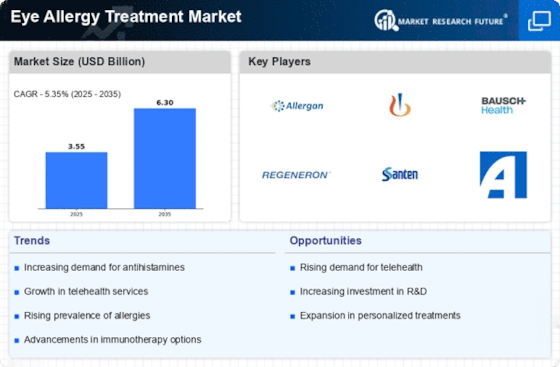
As per Market Research Future analysis, the Eye Allergy Treatment Market Size was estimated at 3.55 USD Billion in 2024. The Eye Allergy Treatment industry is projected to grow from 3.74 USD Billion in 2025 to 6.299 USD Billion by 2035, exhibiting a compound annual growth rate (CAGR) of 5.35% during the forecast period 2025 - 2035

Key Market Trends & Highlights

The Eye Allergy Treatment Market is experiencing robust growth driven by increasing awareness and advancements in treatment options.

  • The market is witnessing a rising incidence of allergies, particularly in North America, which remains the largest market for eye allergy treatments. Advancements in treatment modalities, including digital health solutions, are reshaping patient management in the Asia-Pacific region, the fastest-growing market. Seasonal and perennial allergic conjunctivitis continues to dominate the market, while vernal keratoconjunctivitis is emerging as the fastest-growing segment. Key drivers such as increasing awareness of eye allergies and the rising prevalence of allergic conditions are propelling market expansion.

Market Size & Forecast

2024 Market Size 3.55 (USD Billion)
2035 Market Size 6.299 (USD Billion)
CAGR (2025 - 2035) 5.35%
Largest Regional Market Share in 2024 North America

Major Players

Allergan (US), Novartis (CH), Bausch Health (CA), Regeneron Pharmaceuticals (US), Santen Pharmaceutical (JP), Horizon Therapeutics (IE), Mylan (US), Teva Pharmaceutical Industries (IL), AstraZeneca (GB)

Market Trends

The Eye Allergy Treatment Market is currently experiencing a notable evolution, driven by an increasing prevalence of allergic conditions and a growing awareness of treatment options. This market encompasses a variety of therapeutic approaches, including antihistamines, corticosteroids, and immunotherapy, which are designed to alleviate symptoms associated with eye allergies. The rise in environmental allergens, such as pollen and dust mites, appears to be contributing to a heightened demand for effective solutions. Furthermore, advancements in pharmaceutical formulations and delivery systems may enhance patient compliance and treatment outcomes, suggesting a positive trajectory for market growth. In addition, the Eye Allergy Treatment Market is likely to benefit from ongoing research and development efforts aimed at introducing innovative therapies. The integration of digital health technologies, such as telemedicine and mobile health applications, may also play a pivotal role in improving access to care and patient education. As healthcare providers increasingly recognize the importance of personalized treatment plans, the market may witness a shift towards tailored therapies that address individual patient needs. Overall, the Eye Allergy Treatment Market seems poised for continued expansion, driven by a combination of factors that enhance both awareness and accessibility of treatment options.

Rising Incidence of Allergies

The increasing occurrence of allergic reactions, particularly in urban areas, is driving demand for eye allergy treatments. This trend suggests a growing need for effective management strategies to address the symptoms associated with these conditions.

Advancements in Treatment Modalities

Innovations in therapeutic options, including new drug formulations and delivery methods, are emerging within the Eye Allergy Treatment Market. These advancements may improve efficacy and patient adherence, potentially transforming treatment paradigms.

Integration of Digital Health Solutions

The incorporation of digital health technologies into allergy management is becoming more prevalent. This trend indicates a shift towards enhanced patient engagement and education, which could lead to better treatment outcomes.

Eye Allergy Treatment Market Market Drivers

Increasing Awareness of Eye Allergies

The rising awareness regarding eye allergies is a pivotal driver for the Eye Allergy Treatment Market. Educational campaigns and initiatives by healthcare organizations have led to a greater understanding of the symptoms and triggers associated with eye allergies. This heightened awareness encourages individuals to seek medical advice and treatment, thereby expanding the patient base for eye allergy treatments. As more people recognize the impact of allergens such as pollen, dust mites, and pet dander on their eye health, the demand for effective treatment options is likely to increase. Consequently, this trend is expected to contribute to the growth of the Eye Allergy Treatment Market, as more patients turn to healthcare providers for solutions to alleviate their symptoms.

Technological Innovations in Treatment

Technological advancements in treatment modalities are transforming the Eye Allergy Treatment Market. Innovations such as targeted therapies, biologics, and advanced delivery systems are enhancing the efficacy of treatments for eye allergies. For instance, the development of monoclonal antibodies has shown promise in treating severe allergic conjunctivitis, offering patients new hope for relief. Furthermore, the integration of telemedicine and digital health solutions allows for more accessible consultations and personalized treatment plans. These technological innovations not only improve patient outcomes but also stimulate market growth by attracting investment and encouraging research and development in the Eye Allergy Treatment Market.

Increased Focus on Preventive Healthcare

The growing emphasis on preventive healthcare is influencing the Eye Allergy Treatment Market. As individuals become more health-conscious, there is a shift towards proactive measures to manage and prevent allergic reactions, including eye allergies. This trend is reflected in the rising popularity of allergy testing and personalized treatment plans tailored to individual needs. Healthcare providers are increasingly advocating for preventive strategies, such as allergen avoidance and lifestyle modifications, which can mitigate the severity of symptoms. This focus on prevention not only enhances patient quality of life but also drives demand for products and services within the Eye Allergy Treatment Market, as patients seek comprehensive solutions to manage their allergies effectively.

Rising Prevalence of Allergic Conditions

The increasing prevalence of allergic conditions, including eye allergies, is a significant driver for the Eye Allergy Treatment Market. Statistics indicate that a substantial portion of the population experiences allergic reactions, with eye allergies affecting millions worldwide. This trend is particularly pronounced in urban areas, where environmental factors such as pollution and allergens are more prevalent. As the number of individuals suffering from eye allergies continues to rise, the demand for effective treatment options is expected to grow correspondingly. This surge in prevalence not only highlights the need for innovative therapies but also presents opportunities for pharmaceutical companies to develop and market new products within the Eye Allergy Treatment Market.

Growing Demand for Over-the-Counter Solutions

The increasing demand for over-the-counter (OTC) solutions is a notable driver for the Eye Allergy Treatment Market. Consumers are increasingly seeking convenient and accessible treatment options for their eye allergy symptoms, leading to a surge in the availability of OTC antihistamines, eye drops, and other remedies. This trend is particularly appealing to individuals who prefer self-management of their conditions without the need for prescription medications. The rise of e-commerce platforms has further facilitated access to these products, allowing consumers to purchase them with ease. As the preference for OTC solutions continues to grow, it is likely to have a positive impact on the Eye Allergy Treatment Market, driving sales and expanding product offerings.

Market Segment Insights

By Type: Seasonal and Perennial Allergic Conjunctivitis (Largest) vs. Vernal Keratoconjunctivitis (Fastest-Growing)

The Eye Allergy Treatment Market presents a diverse array of conditions, with Seasonal and Perennial Allergic Conjunctivitis holding the largest share. This category continues to dominate due to widespread prevalence, primarily driven by environmental factors such as pollen and dust. In contrast, Vernal Keratoconjunctivitis, though smaller in market share, is emerging rapidly as a significant player, thanks to increasing awareness and improved treatment options that cater specifically to this condition. Growth trends indicate a notable shift in the Eye Allergy Treatment landscape, where factors like climate change and urbanization contribute to rising incidence rates of eye allergies. Additionally, the development of innovative therapies and personalized treatment plans for conditions like Atopic Keratoconjunctivitis and Contact Allergic Conjunctivitis are expected to gain traction, ultimately enhancing the market on a whole and diversifying treatment options further.

Seasonal and Perennial Allergic Conjunctivitis (Dominant) vs. Vernal Keratoconjunctivitis (Emerging)

Seasonal and Perennial Allergic Conjunctivitis is characterized by its significant prevalence in both urban and rural settings, affecting individuals annually based on seasonal allergens. The dominant segment showcases established treatment protocols, including antihistamines and mast cell stabilizers, making them widely available and recognized. Meanwhile, Vernal Keratoconjunctivitis is recognized as an emerging condition, primarily affecting children and young adults, with increasing incidences particularly in warmer climates. Though historically less emphasized in treatment discussions, growing investment in research and development is leading to new therapies tailored to its unique profile, enhancing its position within the Eye Allergy Treatment Market.

By Drug Class: Antihistamine (Largest) vs. Mast Cell Stabilizer (Fastest-Growing)

The Eye Allergy Treatment Market showcases a diverse range of drug classes, with antihistamines holding the largest market share due to their wide acceptance and effectiveness in alleviating allergic reactions. Mast cell stabilizers are also significant but are growing at a faster rate as more patients become aware of their benefits, particularly in preventing allergy symptoms rather than just treating them. Other segments, such as corticosteroids and NSAIDs, play a role but with lesser market shares compared to these leading classes.

Antihistamine: (Dominant) vs. Mast Cell Stabilizer (Emerging)

Antihistamines remain the dominant force in the Eye Allergy Treatment Market, appreciated for their quick action and proven efficacy in reducing allergy symptoms like itching and redness, making them the first line of treatment for many patients. On the other hand, mast cell stabilizers, although currently smaller in market share, are emerging rapidly due to their unique mechanism of action, which prevents the release of histamine and other chemicals that trigger allergy symptoms. This preventive approach is appealing to many healthcare providers and patients looking for long-term solutions. As awareness increases and research continues to validate their effectiveness, it's anticipated that mast cell stabilizers will capture more market share in the coming years, complementing the established antihistamine segment.

By Treatment Form: Eyedrops (Largest) vs. Injectables (Fastest-Growing)

The Eye Allergy Treatment Market exhibits a diverse distribution of treatment forms, with eyedrops taking the lion's share due to their accessibility and ease of use. Eyedrops remain the most preferred choice among patients experiencing eye allergies, offering immediate relief of symptoms. In contrast, injectables are experiencing significant growth as they tend to provide longer-lasting effects for patients with severe allergies. Tablets and capsules show steady demand but are not as favored as eyedrops. As consumers become increasingly aware of allergies and their treatments, the demand for eyedrops continues to rise, driven by an inclination for convenient and effective solutions. The growth of injectables is attributed to the introduction of innovative formulations that offer rapid and sustained relief, appealing particularly to individuals with chronic allergy conditions. The overall trend suggests a market shift towards more effective treatment options that can cater to varying levels of allergy severity.

Eyedrops (Dominant) vs. Tablets &amp; Capsules (Emerging)

In the Eye Allergy Treatment Market, eyedrops are recognized as the dominant treatment form due to their effectiveness and ease of administration. They provide rapid relief from allergy symptoms, making them the first choice for consumers. The market growth for eyedrops is supported by ongoing innovations, such as preservative-free formulations that enhance patient comfort and compliance. On the other hand, tablets and capsules are viewed as an emerging alternative, particularly appealing to those who prefer oral medications over topical applications. While they do not hold the same market share as eyedrops, the convenience of oral dosage forms, combined with a growing interest in systemic treatments, positions them favorably for gradual market expansion.

By Distribution Channel: Hospital Pharmacy (Largest) vs. Online Pharmacy (Fastest-Growing)

In the Eye Allergy Treatment Market, the distribution of revenue among various channels shows that the Hospital Pharmacy segment leads significantly, accounting for the largest share. This dominance can be attributed to a higher patient footfall and established patient-physician relationships that support prescriptions within hospital settings. On the other hand, the Online Pharmacy segment is gaining traction due to changing consumer preferences towards convenience and accessibility, especially post-pandemic, allowing patients to receive treatments quickly and discreetly.

Hospital Pharmacy: Dominant vs. Online Pharmacy: Emerging

The Hospital Pharmacy segment remains a dominant player in the Eye Allergy Treatment Market, leveraging strong collaborations with healthcare providers and hospital networks that ensure patient adherence to treatment regimes. These pharmacies are often the first point of contact for patients, where they receive comprehensive care alongside medications. Conversely, the Online Pharmacy segment is emerging rapidly, propelled by increased digitalization and a shift in consumer behavior towards e-commerce. With a growing number of patients opting for the convenience of home delivery and telehealth services, online pharmacies are innovating their offerings, including easy access to prescription refills and over-the-counter treatments, carving a niche in this competitive landscape.

Get more detailed insights about Eye Allergy Treatment Market Research Report - Forecast till 2035

Regional Insights

North America : Market Leader in Treatments

North America is the largest market for eye allergy treatments, accounting for approximately 45% of the global market share. The region's growth is driven by increasing prevalence of allergic conjunctivitis, rising healthcare expenditure, and advanced healthcare infrastructure. Regulatory support from agencies like the FDA facilitates the introduction of innovative therapies, enhancing market dynamics. The United States leads the market, followed by Canada, with significant contributions from key players such as Allergan and Regeneron Pharmaceuticals. The competitive landscape is characterized by a mix of established pharmaceutical companies and emerging biotech firms, focusing on novel treatment options and patient-centric solutions. The presence of major players ensures a robust supply chain and accessibility of treatments across the region.

Europe : Emerging Market with Growth Potential

Europe is the second-largest market for eye allergy treatments, holding around 30% of the global market share. The region's growth is propelled by increasing awareness of eye allergies, a growing aging population, and supportive regulatory frameworks. The European Medicines Agency (EMA) plays a crucial role in approving new therapies, which enhances market accessibility and innovation. Leading countries include Germany, France, and the UK, where the presence of key players like Novartis and AstraZeneca strengthens the competitive landscape. The market is characterized by a mix of established brands and new entrants focusing on innovative solutions. The increasing demand for over-the-counter treatments also contributes to market expansion, making Europe a dynamic region for eye allergy therapies.

Asia-Pacific : Rapidly Growing Market Segment

Asia-Pacific is witnessing rapid growth in the eye allergy treatment market, accounting for approximately 20% of the global share. The region's expansion is driven by rising pollution levels, increasing urbanization, and a growing population prone to allergies. Countries like Japan and China are at the forefront, with supportive healthcare policies and increasing investments in healthcare infrastructure. The competitive landscape is evolving, with local players like Santen Pharmaceutical gaining traction alongside global giants. The market is characterized by a growing demand for both prescription and over-the-counter treatments, reflecting changing consumer preferences. The increasing focus on research and development in the region is expected to further enhance the availability of innovative treatment options.

Middle East and Africa : Untapped Market with Potential

The Middle East and Africa represent an emerging market for eye allergy treatments, holding about 5% of the global market share. The growth in this region is driven by increasing awareness of eye health, rising disposable incomes, and a growing prevalence of allergic conditions. Regulatory bodies are beginning to recognize the importance of allergy treatments, which is expected to catalyze market growth in the coming years. Countries like South Africa and the UAE are leading the market, with a mix of local and international players. The competitive landscape is still developing, with opportunities for new entrants to introduce innovative solutions. The increasing focus on healthcare infrastructure and patient education is likely to enhance market dynamics, making this region a potential hotspot for eye allergy treatments.

Key Players and Competitive Insights

The Eye Allergy Treatment Market is characterized by a dynamic competitive landscape, driven by increasing prevalence of allergic conjunctivitis and a growing awareness of treatment options. Key players such as Allergan (US), Novartis (CH), and Bausch Health (CA) are strategically positioned to leverage innovation and expand their product portfolios. Allergan (US) focuses on developing advanced therapies, while Novartis (CH) emphasizes research and development to enhance its offerings. Bausch Health (CA) is actively pursuing partnerships to broaden its market reach, indicating a collective strategy among these companies to enhance their competitive edge through innovation and collaboration.

In terms of business tactics, companies are increasingly localizing manufacturing and optimizing supply chains to improve efficiency and responsiveness to market demands. The Eye Allergy Treatment Market appears moderately fragmented, with several players vying for market share. However, the influence of major companies is significant, as they set trends in product development and marketing strategies, thereby shaping the overall market structure.

In August 2025, Allergan (US) announced the launch of a new eye drop formulation aimed at providing rapid relief for allergic conjunctivitis. This strategic move is likely to enhance its competitive positioning by addressing unmet patient needs and expanding its product line. The introduction of this innovative treatment underscores Allergan's commitment to research and development, potentially increasing its market share in the eye allergy segment.

Similarly, in July 2025, Novartis (CH) entered into a collaboration with a biotechnology firm to develop a novel biologic therapy for severe allergic conjunctivitis. This partnership not only signifies Novartis's focus on cutting-edge treatments but also reflects a broader trend of companies seeking alliances to accelerate drug development. Such collaborations may enhance the speed and efficiency of bringing new therapies to market, thereby strengthening Novartis's competitive stance.

In September 2025, Bausch Health (CA) expanded its distribution network in Asia-Pacific, aiming to tap into the growing demand for eye allergy treatments in this region. This strategic expansion is indicative of Bausch Health's intent to capitalize on emerging markets, which could lead to increased revenue streams and a stronger global presence. By enhancing its distribution capabilities, Bausch Health positions itself favorably against competitors in a rapidly evolving market.

As of October 2025, current trends in the Eye Allergy Treatment Market include a pronounced shift towards digitalization, sustainability, and the integration of artificial intelligence in product development. Strategic alliances are increasingly shaping the competitive landscape, allowing companies to pool resources and expertise. Looking ahead, competitive differentiation is likely to evolve from traditional price-based competition to a focus on innovation, technological advancements, and supply chain reliability, as companies strive to meet the diverse needs of patients and healthcare providers.

Key Companies in the Eye Allergy Treatment Market include

Industry Developments

June 2021:

Santen Pharmaceutical Co., ltd receives U.S. FDA Approval for Verkazia (Cyclosporine ophthalmic emulsion, 0.1%) for the treatment of vernal keratoconjunctivitis (VKC) in children and adults.

May 2021:

Teva Pharmaceuticals (Israel) has announced the launch of generic Erythromycin tablets in 250 mg and 500 mg strengths, which are therapeutic equivalents of Arbor Pharmaceuticals' reference listed drug (RLD) Erythromycin Tablets.

February 2021: 

Bausch + Lomb (Canada) Launched Alaway Preservative Free Antihistamine Eye Drops.  This medication is used to prevent and treat itching of the eyes caused by allergies (allergic/seasonal conjunctivitis)

May 2020

: The US Food and Drug Administration (FDA) has approved Alcon's Pataday eye allergy scratch drop. Pataday Ophthalmic Solution belongs to the class of medications called antihistamines. It is used to treat seasonal allergic conjunctivitis, an allergic reaction caused by fur, dust, pollen, and other allergens that cause an eye infection, redness, inflammation, and swelling.

November 2019

: Santen Pharmaceutical Co. Ltd (Japan) launched an anti-allergic ophthalmic solution Alesion LX Ophthalmic Solution 0.1% in Japan.  This medicine suppresses allergic symptoms such as itchy/bloodshot eyes by histamine H1-receptor antagonism and suppressing the release of allergy-causing substances such as histamine. In most cases, allergic conjunctivitis is treated with it.

October 2019:

Sun Pharmaceutical Industries Ltd.'s (India) wholly owned subsidiary has launched CEQUA (cyclosporine ophthalmic solution) 0.09% in the United States. CEQUA, the FDA-approved highest dosage of cyclosporine for ocular usage, can boost tear production in patients with keratoconjunctivitis sicca.

Future Outlook

Eye Allergy Treatment Market Future Outlook

The Eye Allergy Treatment Market is projected to grow at a 5.35% CAGR from 2025 to 2035, driven by increasing prevalence of allergies and advancements in treatment options.

New opportunities lie in:

  • <p>Development of personalized allergy treatment plans using AI technology. Expansion of <a href="https://www.marketresearchfuture.com/reports/telehealth-service-market-43509" target="_blank" title="telehealth service">telehealth services</a> for remote allergy consultations. Introduction of combination therapies to enhance treatment efficacy.</p>

By 2035, the market is expected to achieve substantial growth, reflecting evolving consumer needs and innovative treatment solutions.

Market Segmentation

Eye Allergy Treatment Market Type Outlook

  • Seasonal and Perennial Allergic Conjunctivitis
  • Vernal Keratoconjunctivitis
  • Atopic Keratoconjunctivitis
  • Contact Allergic Conjunctivitis
  • Giant Papillary Conjunctivitis

Eye Allergy Treatment Market Drug Class Outlook

  • Antihistamine
  • Mast Cell Stabilizer
  • NSAIDs
  • Corticosteroid
  • Decongestants
  • Immunotherapy Allergy Shots
  • Others

Eye Allergy Treatment Market Treatment Form Outlook

  • Eyedrops
  • Injectables
  • Tablets & Capsules

Eye Allergy Treatment Market Distribution Channel Outlook

  • Hospital Pharmacy
  • Online Pharmacy
  • Retail Pharmacy

Report Scope

MARKET SIZE 2024 3.55(USD Billion)
MARKET SIZE 2025 3.74(USD Billion)
MARKET SIZE 2035 6.299(USD Billion)
COMPOUND ANNUAL GROWTH RATE (CAGR) 5.35% (2025 - 2035)
REPORT COVERAGE Revenue Forecast, Competitive Landscape, Growth Factors, and Trends
BASE YEAR 2024
Market Forecast Period 2025 - 2035
Historical Data 2019 - 2024
Market Forecast Units USD Billion
Key Companies Profiled Allergan (US), Novartis (CH), Bausch Health (CA), Regeneron Pharmaceuticals (US), Santen Pharmaceutical (JP), Horizon Therapeutics (IE), Mylan (US), Teva Pharmaceutical Industries (IL), AstraZeneca (GB)
Segments Covered Type, Drug Class, Treatment Form, Distribution Channel, Region
Key Market Opportunities Emerging biologics and personalized therapies are reshaping the Eye Allergy Treatment Market landscape.
Key Market Dynamics Rising consumer awareness and technological advancements drive innovation in eye allergy treatment solutions.
Countries Covered North America, Europe, APAC, South America, MEA

FAQs

What is the projected market valuation of the Eye Allergy Treatment Market by 2035?

<p>The Eye Allergy Treatment Market is projected to reach approximately 6.299 USD Billion by 2035.</p>

What was the market valuation of the Eye Allergy Treatment Market in 2024?

<p>In 2024, the Eye Allergy Treatment Market was valued at 3.55 USD Billion.</p>

What is the expected CAGR for the Eye Allergy Treatment Market during the forecast period 2025 - 2035?

<p>The expected CAGR for the Eye Allergy Treatment Market during the forecast period 2025 - 2035 is 5.35%.</p>

Which drug class is anticipated to have the highest market value in 2035?

<p>Antihistamines are anticipated to have the highest market value, projected to reach 1.5 USD Billion by 2035.</p>

How do the revenues from eyedrops compare to other treatment forms in 2035?

<p>Eyedrops are projected to generate revenues of 2.5 USD Billion in 2035, surpassing injectables and tablets & capsules.</p>

What are the key players in the Eye Allergy Treatment Market?

Key players in the Eye Allergy Treatment Market include Allergan, Novartis, Bausch Health, and Regeneron Pharmaceuticals.

What segment of allergic conjunctivitis is expected to show significant growth by 2035?

Seasonal and Perennial Allergic Conjunctivitis is expected to show significant growth, with a projected value of 2.7 USD Billion by 2035.

Which distribution channel is projected to have the highest revenue in 2035?

Both Hospital Pharmacy and Retail Pharmacy are projected to generate revenues of 2.54 USD Billion each by 2035.

What is the projected market value for corticosteroids in 2035?

Corticosteroids are projected to reach a market value of 1.1 USD Billion by 2035.

How does the market for online pharmacies compare to retail pharmacies in 2035?

By 2035, online pharmacies are projected to reach 1.27 USD Billion, while retail pharmacies are expected to match Hospital Pharmacy at 2.54 USD Billion.

  1. SECTION I: EXECUTIVE SUMMARY AND KEY HIGHLIGHTS
    1. | 1.1 EXECUTIVE SUMMARY
    2. | | 1.1.1 Market Overview
    3. | | 1.1.2 Key Findings
    4. | | 1.1.3 Market Segmentation
    5. | | 1.1.4 Competitive Landscape
    6. | | 1.1.5 Challenges and Opportunities
    7. | | 1.1.6 Future Outlook
  2. SECTION II: SCOPING, METHODOLOGY AND MARKET STRUCTURE
    1. | 2.1 MARKET INTRODUCTION
    2. | | 2.1.1 Definition
    3. | | 2.1.2 Scope of the study
    4. | | | 2.1.2.1 Research Objective
    5. | | | 2.1.2.2 Assumption
    6. | | | 2.1.2.3 Limitations
    7. | 2.2 RESEARCH METHODOLOGY
    8. | | 2.2.1 Overview
    9. | | 2.2.2 Data Mining
    10. | | 2.2.3 Secondary Research
    11. | | 2.2.4 Primary Research
    12. | | | 2.2.4.1 Primary Interviews and Information Gathering Process
    13. | | | 2.2.4.2 Breakdown of Primary Respondents
    14. | | 2.2.5 Forecasting Model
    15. | | 2.2.6 Market Size Estimation
    16. | | | 2.2.6.1 Bottom-Up Approach
    17. | | | 2.2.6.2 Top-Down Approach
    18. | | 2.2.7 Data Triangulation
    19. | | 2.2.8 Validation
  3. SECTION III: QUALITATIVE ANALYSIS
    1. | 3.1 MARKET DYNAMICS
    2. | | 3.1.1 Overview
    3. | | 3.1.2 Drivers
    4. | | 3.1.3 Restraints
    5. | | 3.1.4 Opportunities
    6. | 3.2 MARKET FACTOR ANALYSIS
    7. | | 3.2.1 Value chain Analysis
    8. | | 3.2.2 Porter's Five Forces Analysis
    9. | | | 3.2.2.1 Bargaining Power of Suppliers
    10. | | | 3.2.2.2 Bargaining Power of Buyers
    11. | | | 3.2.2.3 Threat of New Entrants
    12. | | | 3.2.2.4 Threat of Substitutes
    13. | | | 3.2.2.5 Intensity of Rivalry
    14. | | 3.2.3 COVID-19 Impact Analysis
    15. | | | 3.2.3.1 Market Impact Analysis
    16. | | | 3.2.3.2 Regional Impact
    17. | | | 3.2.3.3 Opportunity and Threat Analysis
  4. SECTION IV: QUANTITATIVE ANALYSIS
    1. | 4.1 Healthcare, BY Type (USD Billion)
    2. | | 4.1.1 Seasonal and Perennial Allergic Conjunctivitis
    3. | | 4.1.2 Vernal Keratoconjunctivitis
    4. | | 4.1.3 Atopic Keratoconjunctivitis
    5. | | 4.1.4 Contact Allergic Conjunctivitis
    6. | | 4.1.5 Giant Papillary Conjunctivitis
    7. | 4.2 Healthcare, BY Drug Class (USD Billion)
    8. | | 4.2.1 Antihistamine
    9. | | 4.2.2 Mast Cell Stabilizer
    10. | | 4.2.3 NSAIDs
    11. | | 4.2.4 Corticosteroid
    12. | | 4.2.5 Decongestants
    13. | | 4.2.6 Immunotherapy Allergy Shots
    14. | | 4.2.7 Others
    15. | 4.3 Healthcare, BY Treatment Form (USD Billion)
    16. | | 4.3.1 Eyedrops
    17. | | 4.3.2 Injectables
    18. | | 4.3.3 Tablets & Capsules
    19. | 4.4 Healthcare, BY Distribution Channel (USD Billion)
    20. | | 4.4.1 Hospital Pharmacy
    21. | | 4.4.2 Online Pharmacy
    22. | | 4.4.3 Retail Pharmacy
    23. | 4.5 Healthcare, BY Region (USD Billion)
    24. | | 4.5.1 North America
    25. | | | 4.5.1.1 US
    26. | | | 4.5.1.2 Canada
    27. | | 4.5.2 Europe
    28. | | | 4.5.2.1 Germany
    29. | | | 4.5.2.2 UK
    30. | | | 4.5.2.3 France
    31. | | | 4.5.2.4 Russia
    32. | | | 4.5.2.5 Italy
    33. | | | 4.5.2.6 Spain
    34. | | | 4.5.2.7 Rest of Europe
    35. | | 4.5.3 APAC
    36. | | | 4.5.3.1 China
    37. | | | 4.5.3.2 India
    38. | | | 4.5.3.3 Japan
    39. | | | 4.5.3.4 South Korea
    40. | | | 4.5.3.5 Malaysia
    41. | | | 4.5.3.6 Thailand
    42. | | | 4.5.3.7 Indonesia
    43. | | | 4.5.3.8 Rest of APAC
    44. | | 4.5.4 South America
    45. | | | 4.5.4.1 Brazil
    46. | | | 4.5.4.2 Mexico
    47. | | | 4.5.4.3 Argentina
    48. | | | 4.5.4.4 Rest of South America
    49. | | 4.5.5 MEA
    50. | | | 4.5.5.1 GCC Countries
    51. | | | 4.5.5.2 South Africa
    52. | | | 4.5.5.3 Rest of MEA
  5. SECTION V: COMPETITIVE ANALYSIS
    1. | 5.1 Competitive Landscape
    2. | | 5.1.1 Overview
    3. | | 5.1.2 Competitive Analysis
    4. | | 5.1.3 Market share Analysis
    5. | | 5.1.4 Major Growth Strategy in the Healthcare
    6. | | 5.1.5 Competitive Benchmarking
    7. | | 5.1.6 Leading Players in Terms of Number of Developments in the Healthcare
    8. | | 5.1.7 Key developments and growth strategies
    9. | | | 5.1.7.1 New Product Launch/Service Deployment
    10. | | | 5.1.7.2 Merger & Acquisitions
    11. | | | 5.1.7.3 Joint Ventures
    12. | | 5.1.8 Major Players Financial Matrix
    13. | | | 5.1.8.1 Sales and Operating Income
    14. | | | 5.1.8.2 Major Players R&D Expenditure. 2023
    15. | 5.2 Company Profiles
    16. | | 5.2.1 Allergan (US)
    17. | | | 5.2.1.1 Financial Overview
    18. | | | 5.2.1.2 Products Offered
    19. | | | 5.2.1.3 Key Developments
    20. | | | 5.2.1.4 SWOT Analysis
    21. | | | 5.2.1.5 Key Strategies
    22. | | 5.2.2 Novartis (CH)
    23. | | | 5.2.2.1 Financial Overview
    24. | | | 5.2.2.2 Products Offered
    25. | | | 5.2.2.3 Key Developments
    26. | | | 5.2.2.4 SWOT Analysis
    27. | | | 5.2.2.5 Key Strategies
    28. | | 5.2.3 Bausch Health (CA)
    29. | | | 5.2.3.1 Financial Overview
    30. | | | 5.2.3.2 Products Offered
    31. | | | 5.2.3.3 Key Developments
    32. | | | 5.2.3.4 SWOT Analysis
    33. | | | 5.2.3.5 Key Strategies
    34. | | 5.2.4 Regeneron Pharmaceuticals (US)
    35. | | | 5.2.4.1 Financial Overview
    36. | | | 5.2.4.2 Products Offered
    37. | | | 5.2.4.3 Key Developments
    38. | | | 5.2.4.4 SWOT Analysis
    39. | | | 5.2.4.5 Key Strategies
    40. | | 5.2.5 Santen Pharmaceutical (JP)
    41. | | | 5.2.5.1 Financial Overview
    42. | | | 5.2.5.2 Products Offered
    43. | | | 5.2.5.3 Key Developments
    44. | | | 5.2.5.4 SWOT Analysis
    45. | | | 5.2.5.5 Key Strategies
    46. | | 5.2.6 Horizon Therapeutics (IE)
    47. | | | 5.2.6.1 Financial Overview
    48. | | | 5.2.6.2 Products Offered
    49. | | | 5.2.6.3 Key Developments
    50. | | | 5.2.6.4 SWOT Analysis
    51. | | | 5.2.6.5 Key Strategies
    52. | | 5.2.7 Mylan (US)
    53. | | | 5.2.7.1 Financial Overview
    54. | | | 5.2.7.2 Products Offered
    55. | | | 5.2.7.3 Key Developments
    56. | | | 5.2.7.4 SWOT Analysis
    57. | | | 5.2.7.5 Key Strategies
    58. | | 5.2.8 Teva Pharmaceutical Industries (IL)
    59. | | | 5.2.8.1 Financial Overview
    60. | | | 5.2.8.2 Products Offered
    61. | | | 5.2.8.3 Key Developments
    62. | | | 5.2.8.4 SWOT Analysis
    63. | | | 5.2.8.5 Key Strategies
    64. | | 5.2.9 AstraZeneca (GB)
    65. | | | 5.2.9.1 Financial Overview
    66. | | | 5.2.9.2 Products Offered
    67. | | | 5.2.9.3 Key Developments
    68. | | | 5.2.9.4 SWOT Analysis
    69. | | | 5.2.9.5 Key Strategies
    70. | 5.3 Appendix
    71. | | 5.3.1 References
    72. | | 5.3.2 Related Reports
  6. LIST OF FIGURES
    1. | 6.1 MARKET SYNOPSIS
    2. | 6.2 NORTH AMERICA MARKET ANALYSIS
    3. | 6.3 US MARKET ANALYSIS BY TYPE
    4. | 6.4 US MARKET ANALYSIS BY DRUG CLASS
    5. | 6.5 US MARKET ANALYSIS BY TREATMENT FORM
    6. | 6.6 US MARKET ANALYSIS BY DISTRIBUTION CHANNEL
    7. | 6.7 CANADA MARKET ANALYSIS BY TYPE
    8. | 6.8 CANADA MARKET ANALYSIS BY DRUG CLASS
    9. | 6.9 CANADA MARKET ANALYSIS BY TREATMENT FORM
    10. | 6.10 CANADA MARKET ANALYSIS BY DISTRIBUTION CHANNEL
    11. | 6.11 EUROPE MARKET ANALYSIS
    12. | 6.12 GERMANY MARKET ANALYSIS BY TYPE
    13. | 6.13 GERMANY MARKET ANALYSIS BY DRUG CLASS
    14. | 6.14 GERMANY MARKET ANALYSIS BY TREATMENT FORM
    15. | 6.15 GERMANY MARKET ANALYSIS BY DISTRIBUTION CHANNEL
    16. | 6.16 UK MARKET ANALYSIS BY TYPE
    17. | 6.17 UK MARKET ANALYSIS BY DRUG CLASS
    18. | 6.18 UK MARKET ANALYSIS BY TREATMENT FORM
    19. | 6.19 UK MARKET ANALYSIS BY DISTRIBUTION CHANNEL
    20. | 6.20 FRANCE MARKET ANALYSIS BY TYPE
    21. | 6.21 FRANCE MARKET ANALYSIS BY DRUG CLASS
    22. | 6.22 FRANCE MARKET ANALYSIS BY TREATMENT FORM
    23. | 6.23 FRANCE MARKET ANALYSIS BY DISTRIBUTION CHANNEL
    24. | 6.24 RUSSIA MARKET ANALYSIS BY TYPE
    25. | 6.25 RUSSIA MARKET ANALYSIS BY DRUG CLASS
    26. | 6.26 RUSSIA MARKET ANALYSIS BY TREATMENT FORM
    27. | 6.27 RUSSIA MARKET ANALYSIS BY DISTRIBUTION CHANNEL
    28. | 6.28 ITALY MARKET ANALYSIS BY TYPE
    29. | 6.29 ITALY MARKET ANALYSIS BY DRUG CLASS
    30. | 6.30 ITALY MARKET ANALYSIS BY TREATMENT FORM
    31. | 6.31 ITALY MARKET ANALYSIS BY DISTRIBUTION CHANNEL
    32. | 6.32 SPAIN MARKET ANALYSIS BY TYPE
    33. | 6.33 SPAIN MARKET ANALYSIS BY DRUG CLASS
    34. | 6.34 SPAIN MARKET ANALYSIS BY TREATMENT FORM
    35. | 6.35 SPAIN MARKET ANALYSIS BY DISTRIBUTION CHANNEL
    36. | 6.36 REST OF EUROPE MARKET ANALYSIS BY TYPE
    37. | 6.37 REST OF EUROPE MARKET ANALYSIS BY DRUG CLASS
    38. | 6.38 REST OF EUROPE MARKET ANALYSIS BY TREATMENT FORM
    39. | 6.39 REST OF EUROPE MARKET ANALYSIS BY DISTRIBUTION CHANNEL
    40. | 6.40 APAC MARKET ANALYSIS
    41. | 6.41 CHINA MARKET ANALYSIS BY TYPE
    42. | 6.42 CHINA MARKET ANALYSIS BY DRUG CLASS
    43. | 6.43 CHINA MARKET ANALYSIS BY TREATMENT FORM
    44. | 6.44 CHINA MARKET ANALYSIS BY DISTRIBUTION CHANNEL
    45. | 6.45 INDIA MARKET ANALYSIS BY TYPE
    46. | 6.46 INDIA MARKET ANALYSIS BY DRUG CLASS
    47. | 6.47 INDIA MARKET ANALYSIS BY TREATMENT FORM
    48. | 6.48 INDIA MARKET ANALYSIS BY DISTRIBUTION CHANNEL
    49. | 6.49 JAPAN MARKET ANALYSIS BY TYPE
    50. | 6.50 JAPAN MARKET ANALYSIS BY DRUG CLASS
    51. | 6.51 JAPAN MARKET ANALYSIS BY TREATMENT FORM
    52. | 6.52 JAPAN MARKET ANALYSIS BY DISTRIBUTION CHANNEL
    53. | 6.53 SOUTH KOREA MARKET ANALYSIS BY TYPE
    54. | 6.54 SOUTH KOREA MARKET ANALYSIS BY DRUG CLASS
    55. | 6.55 SOUTH KOREA MARKET ANALYSIS BY TREATMENT FORM
    56. | 6.56 SOUTH KOREA MARKET ANALYSIS BY DISTRIBUTION CHANNEL
    57. | 6.57 MALAYSIA MARKET ANALYSIS BY TYPE
    58. | 6.58 MALAYSIA MARKET ANALYSIS BY DRUG CLASS
    59. | 6.59 MALAYSIA MARKET ANALYSIS BY TREATMENT FORM
    60. | 6.60 MALAYSIA MARKET ANALYSIS BY DISTRIBUTION CHANNEL
    61. | 6.61 THAILAND MARKET ANALYSIS BY TYPE
    62. | 6.62 THAILAND MARKET ANALYSIS BY DRUG CLASS
    63. | 6.63 THAILAND MARKET ANALYSIS BY TREATMENT FORM
    64. | 6.64 THAILAND MARKET ANALYSIS BY DISTRIBUTION CHANNEL
    65. | 6.65 INDONESIA MARKET ANALYSIS BY TYPE
    66. | 6.66 INDONESIA MARKET ANALYSIS BY DRUG CLASS
    67. | 6.67 INDONESIA MARKET ANALYSIS BY TREATMENT FORM
    68. | 6.68 INDONESIA MARKET ANALYSIS BY DISTRIBUTION CHANNEL
    69. | 6.69 REST OF APAC MARKET ANALYSIS BY TYPE
    70. | 6.70 REST OF APAC MARKET ANALYSIS BY DRUG CLASS
    71. | 6.71 REST OF APAC MARKET ANALYSIS BY TREATMENT FORM
    72. | 6.72 REST OF APAC MARKET ANALYSIS BY DISTRIBUTION CHANNEL
    73. | 6.73 SOUTH AMERICA MARKET ANALYSIS
    74. | 6.74 BRAZIL MARKET ANALYSIS BY TYPE
    75. | 6.75 BRAZIL MARKET ANALYSIS BY DRUG CLASS
    76. | 6.76 BRAZIL MARKET ANALYSIS BY TREATMENT FORM
    77. | 6.77 BRAZIL MARKET ANALYSIS BY DISTRIBUTION CHANNEL
    78. | 6.78 MEXICO MARKET ANALYSIS BY TYPE
    79. | 6.79 MEXICO MARKET ANALYSIS BY DRUG CLASS
    80. | 6.80 MEXICO MARKET ANALYSIS BY TREATMENT FORM
    81. | 6.81 MEXICO MARKET ANALYSIS BY DISTRIBUTION CHANNEL
    82. | 6.82 ARGENTINA MARKET ANALYSIS BY TYPE
    83. | 6.83 ARGENTINA MARKET ANALYSIS BY DRUG CLASS
    84. | 6.84 ARGENTINA MARKET ANALYSIS BY TREATMENT FORM
    85. | 6.85 ARGENTINA MARKET ANALYSIS BY DISTRIBUTION CHANNEL
    86. | 6.86 REST OF SOUTH AMERICA MARKET ANALYSIS BY TYPE
    87. | 6.87 REST OF SOUTH AMERICA MARKET ANALYSIS BY DRUG CLASS
    88. | 6.88 REST OF SOUTH AMERICA MARKET ANALYSIS BY TREATMENT FORM
    89. | 6.89 REST OF SOUTH AMERICA MARKET ANALYSIS BY DISTRIBUTION CHANNEL
    90. | 6.90 MEA MARKET ANALYSIS
    91. | 6.91 GCC COUNTRIES MARKET ANALYSIS BY TYPE
    92. | 6.92 GCC COUNTRIES MARKET ANALYSIS BY DRUG CLASS
    93. | 6.93 GCC COUNTRIES MARKET ANALYSIS BY TREATMENT FORM
    94. | 6.94 GCC COUNTRIES MARKET ANALYSIS BY DISTRIBUTION CHANNEL
    95. | 6.95 SOUTH AFRICA MARKET ANALYSIS BY TYPE
    96. | 6.96 SOUTH AFRICA MARKET ANALYSIS BY DRUG CLASS
    97. | 6.97 SOUTH AFRICA MARKET ANALYSIS BY TREATMENT FORM
    98. | 6.98 SOUTH AFRICA MARKET ANALYSIS BY DISTRIBUTION CHANNEL
    99. | 6.99 REST OF MEA MARKET ANALYSIS BY TYPE
    100. | 6.100 REST OF MEA MARKET ANALYSIS BY DRUG CLASS
    101. | 6.101 REST OF MEA MARKET ANALYSIS BY TREATMENT FORM
    102. | 6.102 REST OF MEA MARKET ANALYSIS BY DISTRIBUTION CHANNEL
    103. | 6.103 KEY BUYING CRITERIA OF HEALTHCARE
    104. | 6.104 RESEARCH PROCESS OF MRFR
    105. | 6.105 DRO ANALYSIS OF HEALTHCARE
    106. | 6.106 DRIVERS IMPACT ANALYSIS: HEALTHCARE
    107. | 6.107 RESTRAINTS IMPACT ANALYSIS: HEALTHCARE
    108. | 6.108 SUPPLY / VALUE CHAIN: HEALTHCARE
    109. | 6.109 HEALTHCARE, BY TYPE, 2024 (% SHARE)
    110. | 6.110 HEALTHCARE, BY TYPE, 2024 TO 2035 (USD Billion)
    111. | 6.111 HEALTHCARE, BY DRUG CLASS, 2024 (% SHARE)
    112. | 6.112 HEALTHCARE, BY DRUG CLASS, 2024 TO 2035 (USD Billion)
    113. | 6.113 HEALTHCARE, BY TREATMENT FORM, 2024 (% SHARE)
    114. | 6.114 HEALTHCARE, BY TREATMENT FORM, 2024 TO 2035 (USD Billion)
    115. | 6.115 HEALTHCARE, BY DISTRIBUTION CHANNEL, 2024 (% SHARE)
    116. | 6.116 HEALTHCARE, BY DISTRIBUTION CHANNEL, 2024 TO 2035 (USD Billion)
    117. | 6.117 BENCHMARKING OF MAJOR COMPETITORS
  7. LIST OF TABLES
    1. | 7.1 LIST OF ASSUMPTIONS
    2. | | 7.1.1
    3. | 7.2 North America MARKET SIZE ESTIMATES; FORECAST
    4. | | 7.2.1 BY TYPE, 2025-2035 (USD Billion)
    5. | | 7.2.2 BY DRUG CLASS, 2025-2035 (USD Billion)
    6. | | 7.2.3 BY TREATMENT FORM, 2025-2035 (USD Billion)
    7. | | 7.2.4 BY DISTRIBUTION CHANNEL, 2025-2035 (USD Billion)
    8. | 7.3 US MARKET SIZE ESTIMATES; FORECAST
    9. | | 7.3.1 BY TYPE, 2025-2035 (USD Billion)
    10. | | 7.3.2 BY DRUG CLASS, 2025-2035 (USD Billion)
    11. | | 7.3.3 BY TREATMENT FORM, 2025-2035 (USD Billion)
    12. | | 7.3.4 BY DISTRIBUTION CHANNEL, 2025-2035 (USD Billion)
    13. | 7.4 Canada MARKET SIZE ESTIMATES; FORECAST
    14. | | 7.4.1 BY TYPE, 2025-2035 (USD Billion)
    15. | | 7.4.2 BY DRUG CLASS, 2025-2035 (USD Billion)
    16. | | 7.4.3 BY TREATMENT FORM, 2025-2035 (USD Billion)
    17. | | 7.4.4 BY DISTRIBUTION CHANNEL, 2025-2035 (USD Billion)
    18. | 7.5 Europe MARKET SIZE ESTIMATES; FORECAST
    19. | | 7.5.1 BY TYPE, 2025-2035 (USD Billion)
    20. | | 7.5.2 BY DRUG CLASS, 2025-2035 (USD Billion)
    21. | | 7.5.3 BY TREATMENT FORM, 2025-2035 (USD Billion)
    22. | | 7.5.4 BY DISTRIBUTION CHANNEL, 2025-2035 (USD Billion)
    23. | 7.6 Germany MARKET SIZE ESTIMATES; FORECAST
    24. | | 7.6.1 BY TYPE, 2025-2035 (USD Billion)
    25. | | 7.6.2 BY DRUG CLASS, 2025-2035 (USD Billion)
    26. | | 7.6.3 BY TREATMENT FORM, 2025-2035 (USD Billion)
    27. | | 7.6.4 BY DISTRIBUTION CHANNEL, 2025-2035 (USD Billion)
    28. | 7.7 UK MARKET SIZE ESTIMATES; FORECAST
    29. | | 7.7.1 BY TYPE, 2025-2035 (USD Billion)
    30. | | 7.7.2 BY DRUG CLASS, 2025-2035 (USD Billion)
    31. | | 7.7.3 BY TREATMENT FORM, 2025-2035 (USD Billion)
    32. | | 7.7.4 BY DISTRIBUTION CHANNEL, 2025-2035 (USD Billion)
    33. | 7.8 France MARKET SIZE ESTIMATES; FORECAST
    34. | | 7.8.1 BY TYPE, 2025-2035 (USD Billion)
    35. | | 7.8.2 BY DRUG CLASS, 2025-2035 (USD Billion)
    36. | | 7.8.3 BY TREATMENT FORM, 2025-2035 (USD Billion)
    37. | | 7.8.4 BY DISTRIBUTION CHANNEL, 2025-2035 (USD Billion)
    38. | 7.9 Russia MARKET SIZE ESTIMATES; FORECAST
    39. | | 7.9.1 BY TYPE, 2025-2035 (USD Billion)
    40. | | 7.9.2 BY DRUG CLASS, 2025-2035 (USD Billion)
    41. | | 7.9.3 BY TREATMENT FORM, 2025-2035 (USD Billion)
    42. | | 7.9.4 BY DISTRIBUTION CHANNEL, 2025-2035 (USD Billion)
    43. | 7.10 Italy MARKET SIZE ESTIMATES; FORECAST
    44. | | 7.10.1 BY TYPE, 2025-2035 (USD Billion)
    45. | | 7.10.2 BY DRUG CLASS, 2025-2035 (USD Billion)
    46. | | 7.10.3 BY TREATMENT FORM, 2025-2035 (USD Billion)
    47. | | 7.10.4 BY DISTRIBUTION CHANNEL, 2025-2035 (USD Billion)
    48. | 7.11 Spain MARKET SIZE ESTIMATES; FORECAST
    49. | | 7.11.1 BY TYPE, 2025-2035 (USD Billion)
    50. | | 7.11.2 BY DRUG CLASS, 2025-2035 (USD Billion)
    51. | | 7.11.3 BY TREATMENT FORM, 2025-2035 (USD Billion)
    52. | | 7.11.4 BY DISTRIBUTION CHANNEL, 2025-2035 (USD Billion)
    53. | 7.12 Rest of Europe MARKET SIZE ESTIMATES; FORECAST
    54. | | 7.12.1 BY TYPE, 2025-2035 (USD Billion)
    55. | | 7.12.2 BY DRUG CLASS, 2025-2035 (USD Billion)
    56. | | 7.12.3 BY TREATMENT FORM, 2025-2035 (USD Billion)
    57. | | 7.12.4 BY DISTRIBUTION CHANNEL, 2025-2035 (USD Billion)
    58. | 7.13 APAC MARKET SIZE ESTIMATES; FORECAST
    59. | | 7.13.1 BY TYPE, 2025-2035 (USD Billion)
    60. | | 7.13.2 BY DRUG CLASS, 2025-2035 (USD Billion)
    61. | | 7.13.3 BY TREATMENT FORM, 2025-2035 (USD Billion)
    62. | | 7.13.4 BY DISTRIBUTION CHANNEL, 2025-2035 (USD Billion)
    63. | 7.14 China MARKET SIZE ESTIMATES; FORECAST
    64. | | 7.14.1 BY TYPE, 2025-2035 (USD Billion)
    65. | | 7.14.2 BY DRUG CLASS, 2025-2035 (USD Billion)
    66. | | 7.14.3 BY TREATMENT FORM, 2025-2035 (USD Billion)
    67. | | 7.14.4 BY DISTRIBUTION CHANNEL, 2025-2035 (USD Billion)
    68. | 7.15 India MARKET SIZE ESTIMATES; FORECAST
    69. | | 7.15.1 BY TYPE, 2025-2035 (USD Billion)
    70. | | 7.15.2 BY DRUG CLASS, 2025-2035 (USD Billion)
    71. | | 7.15.3 BY TREATMENT FORM, 2025-2035 (USD Billion)
    72. | | 7.15.4 BY DISTRIBUTION CHANNEL, 2025-2035 (USD Billion)
    73. | 7.16 Japan MARKET SIZE ESTIMATES; FORECAST
    74. | | 7.16.1 BY TYPE, 2025-2035 (USD Billion)
    75. | | 7.16.2 BY DRUG CLASS, 2025-2035 (USD Billion)
    76. | | 7.16.3 BY TREATMENT FORM, 2025-2035 (USD Billion)
    77. | | 7.16.4 BY DISTRIBUTION CHANNEL, 2025-2035 (USD Billion)
    78. | 7.17 South Korea MARKET SIZE ESTIMATES; FORECAST
    79. | | 7.17.1 BY TYPE, 2025-2035 (USD Billion)
    80. | | 7.17.2 BY DRUG CLASS, 2025-2035 (USD Billion)
    81. | | 7.17.3 BY TREATMENT FORM, 2025-2035 (USD Billion)
    82. | | 7.17.4 BY DISTRIBUTION CHANNEL, 2025-2035 (USD Billion)
    83. | 7.18 Malaysia MARKET SIZE ESTIMATES; FORECAST
    84. | | 7.18.1 BY TYPE, 2025-2035 (USD Billion)
    85. | | 7.18.2 BY DRUG CLASS, 2025-2035 (USD Billion)
    86. | | 7.18.3 BY TREATMENT FORM, 2025-2035 (USD Billion)
    87. | | 7.18.4 BY DISTRIBUTION CHANNEL, 2025-2035 (USD Billion)
    88. | 7.19 Thailand MARKET SIZE ESTIMATES; FORECAST
    89. | | 7.19.1 BY TYPE, 2025-2035 (USD Billion)
    90. | | 7.19.2 BY DRUG CLASS, 2025-2035 (USD Billion)
    91. | | 7.19.3 BY TREATMENT FORM, 2025-2035 (USD Billion)
    92. | | 7.19.4 BY DISTRIBUTION CHANNEL, 2025-2035 (USD Billion)
    93. | 7.20 Indonesia MARKET SIZE ESTIMATES; FORECAST
    94. | | 7.20.1 BY TYPE, 2025-2035 (USD Billion)
    95. | | 7.20.2 BY DRUG CLASS, 2025-2035 (USD Billion)
    96. | | 7.20.3 BY TREATMENT FORM, 2025-2035 (USD Billion)
    97. | | 7.20.4 BY DISTRIBUTION CHANNEL, 2025-2035 (USD Billion)
    98. | 7.21 Rest of APAC MARKET SIZE ESTIMATES; FORECAST
    99. | | 7.21.1 BY TYPE, 2025-2035 (USD Billion)
    100. | | 7.21.2 BY DRUG CLASS, 2025-2035 (USD Billion)
    101. | | 7.21.3 BY TREATMENT FORM, 2025-2035 (USD Billion)
    102. | | 7.21.4 BY DISTRIBUTION CHANNEL, 2025-2035 (USD Billion)
    103. | 7.22 South America MARKET SIZE ESTIMATES; FORECAST
    104. | | 7.22.1 BY TYPE, 2025-2035 (USD Billion)
    105. | | 7.22.2 BY DRUG CLASS, 2025-2035 (USD Billion)
    106. | | 7.22.3 BY TREATMENT FORM, 2025-2035 (USD Billion)
    107. | | 7.22.4 BY DISTRIBUTION CHANNEL, 2025-2035 (USD Billion)
    108. | 7.23 Brazil MARKET SIZE ESTIMATES; FORECAST
    109. | | 7.23.1 BY TYPE, 2025-2035 (USD Billion)
    110. | | 7.23.2 BY DRUG CLASS, 2025-2035 (USD Billion)
    111. | | 7.23.3 BY TREATMENT FORM, 2025-2035 (USD Billion)
    112. | | 7.23.4 BY DISTRIBUTION CHANNEL, 2025-2035 (USD Billion)
    113. | 7.24 Mexico MARKET SIZE ESTIMATES; FORECAST
    114. | | 7.24.1 BY TYPE, 2025-2035 (USD Billion)
    115. | | 7.24.2 BY DRUG CLASS, 2025-2035 (USD Billion)
    116. | | 7.24.3 BY TREATMENT FORM, 2025-2035 (USD Billion)
    117. | | 7.24.4 BY DISTRIBUTION CHANNEL, 2025-2035 (USD Billion)
    118. | 7.25 Argentina MARKET SIZE ESTIMATES; FORECAST
    119. | | 7.25.1 BY TYPE, 2025-2035 (USD Billion)
    120. | | 7.25.2 BY DRUG CLASS, 2025-2035 (USD Billion)
    121. | | 7.25.3 BY TREATMENT FORM, 2025-2035 (USD Billion)
    122. | | 7.25.4 BY DISTRIBUTION CHANNEL, 2025-2035 (USD Billion)
    123. | 7.26 Rest of South America MARKET SIZE ESTIMATES; FORECAST
    124. | | 7.26.1 BY TYPE, 2025-2035 (USD Billion)
    125. | | 7.26.2 BY DRUG CLASS, 2025-2035 (USD Billion)
    126. | | 7.26.3 BY TREATMENT FORM, 2025-2035 (USD Billion)
    127. | | 7.26.4 BY DISTRIBUTION CHANNEL, 2025-2035 (USD Billion)
    128. | 7.27 MEA MARKET SIZE ESTIMATES; FORECAST
    129. | | 7.27.1 BY TYPE, 2025-2035 (USD Billion)
    130. | | 7.27.2 BY DRUG CLASS, 2025-2035 (USD Billion)
    131. | | 7.27.3 BY TREATMENT FORM, 2025-2035 (USD Billion)
    132. | | 7.27.4 BY DISTRIBUTION CHANNEL, 2025-2035 (USD Billion)
    133. | 7.28 GCC Countries MARKET SIZE ESTIMATES; FORECAST
    134. | | 7.28.1 BY TYPE, 2025-2035 (USD Billion)
    135. | | 7.28.2 BY DRUG CLASS, 2025-2035 (USD Billion)
    136. | | 7.28.3 BY TREATMENT FORM, 2025-2035 (USD Billion)
    137. | | 7.28.4 BY DISTRIBUTION CHANNEL, 2025-2035 (USD Billion)
    138. | 7.29 South Africa MARKET SIZE ESTIMATES; FORECAST
    139. | | 7.29.1 BY TYPE, 2025-2035 (USD Billion)
    140. | | 7.29.2 BY DRUG CLASS, 2025-2035 (USD Billion)
    141. | | 7.29.3 BY TREATMENT FORM, 2025-2035 (USD Billion)
    142. | | 7.29.4 BY DISTRIBUTION CHANNEL, 2025-2035 (USD Billion)
    143. | 7.30 Rest of MEA MARKET SIZE ESTIMATES; FORECAST
    144. | | 7.30.1 BY TYPE, 2025-2035 (USD Billion)
    145. | | 7.30.2 BY DRUG CLASS, 2025-2035 (USD Billion)
    146. | | 7.30.3 BY TREATMENT FORM, 2025-2035 (USD Billion)
    147. | | 7.30.4 BY DISTRIBUTION CHANNEL, 2025-2035 (USD Billion)
    148. | 7.31 PRODUCT LAUNCH/PRODUCT DEVELOPMENT/APPROVAL
    149. | | 7.31.1
    150. | 7.32 ACQUISITION/PARTNERSHIP
    151. | | 7.32.1

Healthcare Market Segmentation

Healthcare By Type (USD Billion, 2025-2035)

  • Seasonal and Perennial Allergic Conjunctivitis
  • Vernal Keratoconjunctivitis
  • Atopic Keratoconjunctivitis
  • Contact Allergic Conjunctivitis
  • Giant Papillary Conjunctivitis

Healthcare By Drug Class (USD Billion, 2025-2035)

  • Antihistamine
  • Mast Cell Stabilizer
  • NSAIDs
  • Corticosteroid
  • Decongestants
  • Immunotherapy Allergy Shots
  • Others

Healthcare By Treatment Form (USD Billion, 2025-2035)

  • Eyedrops
  • Injectables
  • Tablets & Capsules

Healthcare By Distribution Channel (USD Billion, 2025-2035)

  • Hospital Pharmacy
  • Online Pharmacy
  • Retail Pharmacy
Infographic

Free Sample Request

Kindly complete the form below to receive a free sample of this Report

Get Free Sample

Customer Strories

Compare Licence

×
Features License Type
Single User Multiuser License Enterprise User
Price $4,950 $5,950 $7,250
Maximum User Access Limit 1 User Upto 10 Users Unrestricted Access Throughout the Organization
Free Customization
Direct Access to Analyst
Deliverable Format
Platform Access
Discount on Next Purchase 10% 15% 15%
Printable Versions