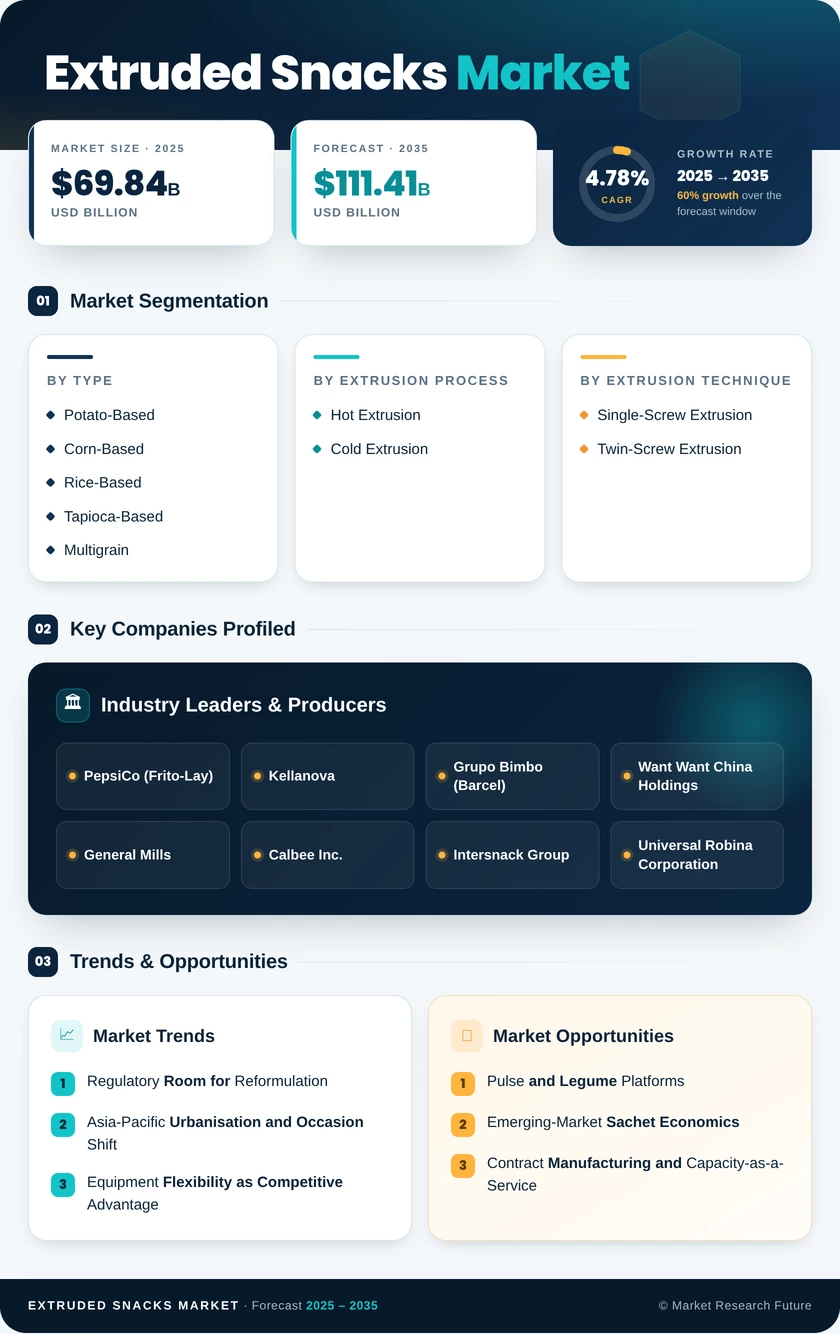
Extruded Snacks Market (2026 - 2035)

ID: MRFR/FnB/3391-HCR 110 Pages Tejas Chaudhary Last Updated: September 10, 2026
Extruded Snacks Market Size, Share, Industry Trend & Analysis Research Report Information By Product Type (Potato-Based, Corn-Based, Rice-Based, Tapioca-Based, Multigrain, Others), By Extrusion Process (Hot Extrusion, Cold Extrusion), By Extrusion Technique (Single-Screw Extrusion, Twin-Screw Extrusion), By Distribution Channel (Supermarkets/Hypermarkets, Convenience Stores, Online Retail, Specialty Stores, Others), By Geography (North America, Europe, Asia-Pacific, South America, Middle East & Africa) – Forecast Till 2035
Extruded Snacks Market
Market Size
Forecast Period2026-2035
CAGR (2026-2035)4.78%
2025 Market SizeUSD 69.84 Billion
2035 Market SizeUSD 111.41 Billion
Key Players
PepsiCo
Kellanova
Grupo Bimbo
Want Want China Holdings
General Mills
Calbee Inc.
Opportunities
  • Pulse and Legume Platforms
  • Emerging-Market Sachet Economics
  • Contract Manufacturing and Capacity-as-a-Service
  1. 1 Market Overview |
    1. 1.1 Study Assumptions & Market Definition |
    2. 1.2 Scope of the Study |
    3. 1.3 Research Methodology
  2. 2 Market Summary & Key Report Takeaways |
    1. 2.1 By Product Type |
    2. 2.2 By Process and Technique |
    3. 2.3 By Geography
  3. 3 Market Size & Forecast (2021–2035) |
    1. 3.1 Historical Market Size (2021–2025) |
    2. 3.2 Current & Forecast Market Size (2026–2035) |
    3. 3.3 Market Size by Revenue (USD Billion) |
    4. 3.4 Year-over-Year Growth Analysis
  4. 4 Driver Impact Analysis |
    1. 4.1 Regulatory Room for Reformulation |
    2. 4.2 Asia-Pacific Urbanisation and Occasion Shift |
    3. 4.3 Equipment Flexibility as Competitive Advantage |
    4. 4.4 Channel Economics
  5. 5 Restraints Impact Analysis |
    1. 5.1 Nutrient Profiling Closes Shelf Space |
    2. 5.2 Agricultural Input Volatility |
    3. 5.3 Compliance Chemistry
  6. 6 Opportunity Analysis |
    1. 6.1 Pulse and Legume Platforms |
    2. 6.2 Emerging-Market Sachet Economics |
    3. 6.3 Contract Manufacturing and Capacity-as-a-Service |
    4. 6.4 Data-Led Flavour Development |
    5. 6.5 Reduced-Sodium Premiumisation |
    6. 6.6 Industry Value Chain Analysis |
    7. 6.7 Porter's Five Forces Analysis
  7. 7 Regional Market Share & Country-Level Analysis |
    1. 7.1 North America | |
      1. 7.1.1 US | |
      2. 7.1.2 Canada | |
      3. 7.1.3 Mexico |
    2. 7.2 Europe | |
      1. 7.2.1 Germany | |
      2. 7.2.2 UK | |
      3. 7.2.3 France | |
      4. 7.2.4 Italy | |
      5. 7.2.5 Spain | |
      6. 7.2.6 Nordic Countries | |
      7. 7.2.7 Russia | |
      8. 7.2.8 Rest of Europe |
    3. 7.3 Asia-Pacific | |
      1. 7.3.1 China | |
      2. 7.3.2 India | |
      3. 7.3.3 Japan | |
      4. 7.3.4 South Korea | |
      5. 7.3.5 ASEAN | |
      6. 7.3.6 Rest of Asia-Pacific |
    4. 7.4 South America | |
      1. 7.4.1 Brazil | |
      2. 7.4.2 Argentina | |
      3. 7.4.3 Rest of South America |
    5. 7.5 Middle East & Africa | |
      1. 7.5.1 Saudi Arabia | |
      2. 7.5.2 UAE | |
      3. 7.5.3 South Africa | |
      4. 7.5.4 Egypt | |
      5. 7.5.5 Rest of Middle East & Africa
  8. 8 Future Outlook (2026–2035) |
    1. 8.1 Algorithmic Product Development |
    2. 8.2 Protein Reframing |
    3. 8.3 Energy and Emissions Discipline |
    4. 8.4 Packaging Circularity
  9. 9 Market Segmentation Analysis |
    1. 9.1 By Product Type | |
      1. 9.1.1 Potato-Based | |
      2. 9.1.2 Corn-Based | |
      3. 9.1.3 Rice-Based | |
      4. 9.1.4 Tapioca-Based | |
      5. 9.1.5 Multigrain | |
      6. 9.1.6 Others |
    2. 9.2 By Extrusion Process | |
      1. 9.2.1 Hot Extrusion | |
      2. 9.2.2 Cold Extrusion |
    3. 9.3 By Extrusion Technique | |
      1. 9.3.1 Single-Screw Extrusion | |
      2. 9.3.2 Twin-Screw Extrusion |
    4. 9.4 By Distribution Channel | |
      1. 9.4.1 Supermarkets/Hypermarkets | |
      2. 9.4.2 Convenience Stores | |
      3. 9.4.3 Online Retail | |
      4. 9.4.4 Specialty Stores | |
      5. 9.4.5 Others
  10. 10 Competitive Landscape |
    1. 10.1 Market Concentration Analysis (2026) |
    2. 10.2 Competitive Benchmarking Matrix |
    3. 10.3 Company Profiles | |
      1. 10.3.1 PepsiCo (Frito-Lay) | |
      2. 10.3.2 Kellanova | |
      3. 10.3.3 Grupo Bimbo (Barcel) | |
      4. 10.3.4 Want Want China Holdings | |
      5. 10.3.5 General Mills | |
      6. 10.3.6 Calbee Inc. | |
      7. 10.3.7 Intersnack Group | |
      8. 10.3.8 Universal Robina Corporation | |
      9. 10.3.9 ITC Limited | |
      10. 10.3.10 Lorenz Snack-World | |
      11. 10.3.11 Utz Brands | |
      12. 10.3.12 Haldiram's
  11. 11 Recent News & Developments
  12. 12 Report Scope & Methodology |
    1. 12.1 Study Period & Base Year |
    2. 12.2 Data Sources & Citations |
    3. 12.3 Abbreviations
  13. 13 Detailed Sources & Citations
  14. 14 Frequently Asked Questions (FAQs)
  15. 15 LIST OF TABLES |
  16. TABLE 1 Global Extruded Snacks Market Size & Forecast, by Revenue (USD Billion), 2021–2035 |
  17. TABLE 2 Global Extruded Snacks Market — Year-over-Year Growth Analysis, 2021–2035 |
  18. TABLE 3 Driver Impact Analysis Matrix, 2026–2035 |
  19. TABLE 4 Restraint Impact Analysis Matrix, 2026–2035 |
  20. TABLE 5 Global Market Size, by Region, 2021–2035 (USD Billion) |
  21. TABLE 6 North America Market Size, by Country, 2021–2035 (USD Billion) |
  22. TABLE 7 Europe Market Size, by Country, 2021–2035 (USD Billion) |
  23. TABLE 8 Asia-Pacific Market Size, by Country, 2021–2035 (USD Billion) |
  24. TABLE 9 South America Market Size, by Country, 2021–2035 (USD Billion) |
  25. TABLE 10 Middle East & Africa Market Size, by Country, 2021–2035 (USD Billion) |
  26. TABLE 11 Global Market Size, by Product Type, 2021–2035 (USD Billion) |
  27. TABLE 12 Global Market Size, by Extrusion Process, 2021–2035 (USD Billion) |
  28. TABLE 13 Global Market Size, by Extrusion Technique, 2021–2035 (USD Billion) |
  29. TABLE 14 Global Market Size, by Distribution Channel, 2021–2035 (USD Billion) |
  30. TABLE 15 North America Market Size, by Product Type, 2021–2035 (USD Billion) |
  31. TABLE 16 Europe Market Size, by Product Type, 2021–2035 (USD Billion) |
  32. TABLE 17 Asia-Pacific Market Size, by Product Type, 2021–2035 (USD Billion) |
  33. TABLE 18 South America Market Size, by Distribution Channel, 2021–2035 (USD Billion) |
  34. TABLE 19 Middle East & Africa Market Size, by Distribution Channel, 2021–2035 (USD Billion) |
  35. TABLE 20 Competitive Benchmarking Matrix, 2026 |
  36. TABLE 21 Company Profiles — Key Players |
  37. TABLE 22 Recent Developments & Strategic Announcements, 2023–2025 |
  38. TABLE 23 Report Scope & Methodology Summary |
  39. TABLE 24 Detailed Sources & Citations Index
  40. 16 LIST OF FIGURES |
  41. FIGURE 1 Market Dynamics — Drivers, Restraints and Opportunities Snapshot |
  42. FIGURE 2 Industry Value Chain Analysis |
  43. FIGURE 3 Porter's Five Forces Analysis |
  44. FIGURE 4 Global Market Size Trend, 2021–2035 (USD Billion) |
  45. FIGURE 5 Year-over-Year Growth Trajectory, 2022–2035 |
  46. FIGURE 6 Market Share by Product Type, 2025 vs 2035 |
  47. FIGURE 7 Market Share by Extrusion Process, 2025 vs 2035 |
  48. FIGURE 8 Market Share by Extrusion Technique, 2025 vs 2035 |
  49. FIGURE 9 Market Share by Distribution Channel, 2025 vs 2035 |
  50. FIGURE 10 Regional Market Share Distribution, 2025 |
  51. FIGURE 11 Regional CAGR Comparison, 2026–2035 |
  52. FIGURE 12 Country-Level Growth Heat Map |
  53. FIGURE 13 Competitive Landscape Positioning Matrix |
  54. FIGURE 14 Top Player Revenue Share Bands, 2026 |
  55. FIGURE 15 Reformulation and Regulatory Timeline, 2023–2035

Segmentation Quick Reference

DimensionSub-SegmentsDominant SegmentFastest Growing Segment
By Product TypePotato-Based, Corn-Based, Rice-Based, Tapioca-Based, Multigrain, OthersPotato-BasedMultigrain
By Extrusion ProcessHot Extrusion, Cold ExtrusionHot ExtrusionCold Extrusion
By Extrusion TechniqueSingle-Screw Extrusion, Twin-Screw ExtrusionSingle-Screw ExtrusionTwin-Screw Extrusion
By Distribution ChannelSupermarkets/Hypermarkets, Convenience Stores, Online Retail, Specialty Stores, OthersSupermarkets/HypermarketsOnline Retail
By GeographyNorth America, Europe, Asia-Pacific, South America, Middle East & AfricaEuropeAsia-Pacific


Market Segmentation Overview

By Product Type

Sub-SegmentKey Trend
Potato-BasedTaste equity sustains volume, though promotional support narrows under nutrient-profile screening
Corn-BasedLowest input cost per serving keeps it dominant in price-sensitive emerging economies
Rice-BasedGluten-free positioning drives Western uptake while remaining a heritage format in East Asia
Tapioca-BasedCassava supply advantage in Brazil, Nigeria and Thailand supports allergen-free claims
MultigrainFibre and whole-grain messaging attracts health-oriented shoppers at premium price points
OthersLegume, vegetable and insect-protein bases occupy the experimental innovation frontier


Product mix is the clearest indicator of where a manufacturer sits on the value curve. Legacy potato and corn portfolios generate cash but face regulatory friction in Europe and Latin America, while multigrain and legume formats absorb reformulation investment and return higher gross margin per pack.

By Extrusion Process

Sub-SegmentKey Trend
Hot ExtrusionRemains the throughput and cost benchmark for expanded, crisp textures at scale
Cold ExtrusionPreserves heat-sensitive vitamins, probiotics, and botanicals, enabling functional claims


Process choice increasingly follows claim strategy rather than plant convenience. Producers targeting functional positioning are commissioning dedicated cold lines instead of attempting compromise settings on existing hot equipment.

By Extrusion Technique

Sub-SegmentKey Trend
Single-Screw ExtrusionLarge installed base and low capital cost sustain relevance for standardised recipes
Twin-Screw ExtrusionIndependent shear and moisture control handles pulse flours, high fat and high-moisture inputs


Technique migration is the category's principal capital story through 2030. Plants running fewer than four recipes rarely justify conversion, but multi-SKU facilities recover the premium through reduced changeover loss and access to protein-forward formats.

By Distribution Channel

Sub-SegmentKey Trend
Supermarkets/HypermarketsAssortment breadth and promotional real estate keep the channel structurally dominant
Convenience StoresSingle-serve impulse occasions concentrate here, especially across ASEAN and Japan
Online RetailMulti-pack bundling and subscription models lift basket value and repeat purchase
Specialty StoresPremium, organic and better-for-you brands build credibility before mass-channel entry
OthersVending, foodservice and travel retail recover steadily on restored mobility


Channel strategy now determines pack architecture rather than following it. Brands designing simultaneously for shelf impulse and e-commerce shipment carry two distinct pack formats, and those that do not typically underperform in whichever channel they neglected.

By Region

Sub-SegmentKey Trend
North AmericaRevenue growth arrives through premium mix and reformulation rather than volume
EuropePrivate label and discount grocery shape supply economics; compliance costs rise
Asia-PacificUrbanisation, incentive-backed capacity and sachet pricing drive the fastest expansion
South AmericaLocal cassava and maize sourcing offsets currency exposure; warning labels reshape recipes
Middle East & AfricaLocalisation policy and domestic milling open cost-competitive manufacturing pathways


Geographic strategy divides cleanly between defending margin in mature territories and buying distribution in growth ones. The producers compounding fastest are running both plays simultaneously, funding Asian and African expansion from Western cash generation.




Download PDF ×

We do not share your information with anyone. However, we may send you emails based on your report interest from time to time. You may contact us at any time to opt-out.