×
Request Free Sample ×

Kindly complete the form below to receive a free sample of this Report

* Please use a valid business email

Leading companies partner with us for data-driven Insights

clients tt-cursor
Hero Background
English
Chinese
French
Japanese
Korean
German
Spanish

Exterior Doors Market Trends

ID: MRFR/PCM/5130-HCR
111 Pages
Snehal Singh
October 2025

Exterior Doors Market Research Report Information By Type (Panel, Bypass, Bifold, Pocket), By Material (Wood, Glass, Metal, Composite, Plastic), By Mechanism (Swinging, Sliding, Folding, Overhead), By Application (Non-Residential, Residential) And By Region (North America, Europe, Asia-Pacific, And Rest Of The World) –Market Forecast Till 2035

Share:
Download PDF ×

We do not share your information with anyone. However, we may send you emails based on your report interest from time to time. You may contact us at any time to opt-out.

Exterior Doors Market Infographic
×
Exterior Doors Market Infographic Full View
Purchase Options

Market Trends

Key Emerging Trends in the Exterior Doors Market

Significant trends in the outside doors market have been brought about by changing tastes in architecture, advances in technology, and an increasing focus on security and energy efficiency. The evolving needs of architects, builders, and homeowners are reflected in these patterns. This is a summary of the main market trends in the form of a pointer: Sustainability and Energy Efficiency: An emerging trend in the exterior doors market is the growing emphasis on sustainability and energy efficiency. Doors with improved insulation qualities, energy-efficient materials, and eco-friendly certifications are in high demand among builders and homeowners. In response, producers are creating doors with superior thermal efficiency, cutting energy use, and supporting green building techniques. Integration of smart door technology is becoming more and more popular in the market. Smart exterior doors are become more and more popular. These doors come with features like remote locking, keyless entry, and connectivity with home automation systems. With these doors, homeowners can monitor and manage access to their homes remotely, as well as enjoy increased security and convenience. Personalization and Customization: Customers are becoming more and more interested in having their external doors personalized and customized. To accommodate different tastes and blend in with different architectural designs, manufacturers are providing a variety of design alternatives, materials, finishes, and sizes. This trend shows a move toward distinctive and beautiful entryways that improve a home's overall curb appeal. Effect of Material Selection: The materials used for external doors have a significant influence on market trends. Alternative materials like fiberglass and steel are becoming more and more in demand, even if conventional materials like wood remain popular due to their timeless charm. External doors last longer because of these materials' strength, security, and capacity to withstand the weather. Emphasis on Security Elements Because home security is a top priority, there is a trend for outside doors incorporating cutting-edge security technologies. This incorporates multi-point locking mechanisms, impact-resistant glass, reinforced frames, and intelligent security technology. In addition to adding aesthetic value, homeowners are looking for doors that offer strong security against intruders and break-ins.


Author
Snehal Singh
Assistant Manager - Research

High acumen in analyzing complex macro & micro markets with more than 6 years of work experience in the field of market research. By implementing her analytical skills in forecasting and estimation into market research reports, she has expertise in Packaging, Construction, and Equipment domains. She handles a team size of 20-25 resources and ensures smooth running of the projects, associated marketing activities, and client servicing.

Leave a Comment

FAQs

How much is the Exterior Doors Market?

The Exterior Doors Market size was valued at USD 124.63 Billion in 2024.

What is the growth rate of the Exterior Doors Market?

Exterior Doors Market is projected to register a CAGR of 5.23% from 2025-2035

Which Region witnessed the largest market share in the Exterior Doors Market?

Asia Pacific had the largest share of the Exterior Doors Market.

Who are the major players in the Exterior Doors Market?

The major players in the market are ASSA ABLOY (Sweden), Anderson Corporation (US), JELD-WEN, Inc. (US), Yuanda China Holdings Limited (China), Marvin Windows and Doors (US), and LIXIL Group Corporation. (Japan), PELLA Corporation (US).

Which type led the Exterior Doors Market?

The Panel Exterior Doors category dominated the Exterior Doors Market in 2024.

Which Application witnessed the largest market share in the Exterior Doors Market?

Residential had the largest share in the Exterior Doors Market.

Market Summary

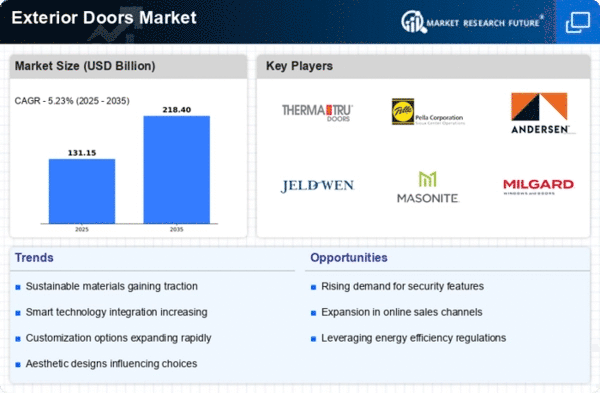
As per MRFR analysis, the Exterior Doors Market Size was estimated at 124.63 USD Billion in 2024. The Exterior Doors industry is projected to grow from 131.15 USD Billion in 2025 to 218.4 USD Billion by 2035, exhibiting a compound annual growth rate (CAGR) of 5.23 during the forecast period 2025 - 2035.

Key Market Trends & Highlights

The Exterior Doors Market is experiencing a dynamic shift towards sustainability and technological integration.

  • The North American market remains the largest, driven by a strong demand for residential exterior doors.
  • In the Asia-Pacific region, the market is rapidly expanding, particularly in the commercial segment.
  • Customization and aesthetic appeal are increasingly influencing consumer preferences, especially in the wood segment.
  • Sustainability initiatives and urbanization trends are key drivers propelling growth in both residential and commercial markets.

Market Size & Forecast

2024 Market Size 124.63 (USD Billion)
2035 Market Size 218.4 (USD Billion)
CAGR (2025 - 2035) 5.23%
Largest Regional Market Share in 2024 North America

Major Players

Therma-Tru (US), Pella Corporation (US), Andersen Corporation (US), Jeld-Wen (US), Masonite International (CA), Milgard Windows & Doors (US), Simpson Door Company (US), ProVia (US)

Market Trends

The Exterior Doors Market is currently experiencing a dynamic evolution, driven by various factors that influence consumer preferences and technological advancements. As sustainability becomes a focal point for many industries, the demand for eco-friendly materials in door manufacturing is on the rise. This shift not only reflects a growing awareness of environmental issues but also aligns with regulatory frameworks that encourage energy efficiency and reduced carbon footprints. Furthermore, the integration of smart technology into exterior doors is gaining traction, appealing to consumers seeking enhanced security and convenience. This trend indicates a broader movement towards smart home solutions, where exterior doors serve as critical components in home automation systems. In addition to technological innovations, aesthetic considerations play a pivotal role in shaping the Exterior Doors Market. Homeowners increasingly prioritize design elements that complement their architectural styles, leading to a diverse range of products that cater to various tastes. Customization options are becoming more prevalent, allowing consumers to select finishes, colors, and styles that reflect their personal preferences. This emphasis on personalization suggests that manufacturers must remain agile and responsive to evolving market demands. Overall, the Exterior Doors Market appears poised for continued growth, driven by a combination of sustainability, technology, and design innovation.

Sustainability Focus

The trend towards sustainability is reshaping the Exterior Doors Market, as consumers increasingly seek products made from eco-friendly materials. This shift reflects a broader societal commitment to environmental responsibility, influencing manufacturers to adopt greener practices in production.

Smart Technology Integration

The incorporation of smart technology into exterior doors is becoming more prevalent, enhancing security and convenience for homeowners. This trend aligns with the growing interest in home automation, where doors serve as integral components of smart home systems.

Customization and Aesthetic Appeal

Aesthetic considerations are driving demand for customizable exterior doors that align with individual tastes and architectural styles. This trend highlights the importance of personalization in the market, prompting manufacturers to offer a diverse range of designs and finishes.

Exterior Doors Market Market Drivers

Focus on Energy Efficiency

Energy efficiency remains a pivotal driver in the Global Exterior Doors Market Industry. With growing awareness of environmental sustainability, consumers increasingly prefer doors that provide better insulation and reduce energy consumption. This trend is supported by regulations and incentives aimed at promoting energy-efficient building practices. As a result, manufacturers are innovating with materials and designs that enhance thermal performance. The market is projected to grow at a CAGR of 5.23% from 2025 to 2035, reflecting the rising demand for energy-efficient exterior doors that align with global sustainability goals.

Technological Advancements

Technological advancements play a crucial role in shaping the Global Exterior Doors Market Industry. Innovations in materials, such as fiberglass and composite doors, offer enhanced durability and security features. Smart door technology, including keyless entry systems and integrated security features, is gaining traction among consumers seeking convenience and safety. These advancements not only improve the functionality of exterior doors but also cater to the growing demand for modern home automation solutions. As the market evolves, manufacturers are likely to invest in research and development to stay competitive and meet consumer expectations.

Market Trends and Projections

The Global Exterior Doors Market Industry exhibits promising trends and projections, indicating a dynamic landscape. The market is expected to reach a valuation of 124.6 USD Billion in 2024, with a projected growth trajectory leading to 218.3 USD Billion by 2035. This growth is underpinned by a compound annual growth rate of 5.23% from 2025 to 2035, suggesting a robust demand for exterior doors driven by factors such as construction activities, energy efficiency, and consumer preferences. The industry appears well-positioned to adapt to changing market dynamics and consumer expectations.

Rising Construction Activities

The Global Exterior Doors Market Industry experiences a notable surge due to increasing construction activities across residential and commercial sectors. As urbanization accelerates, the demand for new housing and commercial buildings rises, leading to an estimated market value of 124.6 USD Billion in 2024. This growth is driven by the need for durable and aesthetically pleasing exterior doors that enhance property value and security. Furthermore, government initiatives promoting infrastructure development contribute to this trend, suggesting a robust future for the industry as it adapts to evolving architectural styles and energy efficiency standards.

Growing Demand for Security Features

Security concerns are paramount for consumers, driving demand in the Global Exterior Doors Market Industry. As crime rates fluctuate, homeowners prioritize robust security measures, leading to increased interest in reinforced doors and advanced locking systems. Manufacturers are responding by integrating cutting-edge security technologies into their products, such as smart locks and surveillance systems. This heightened focus on security not only addresses consumer concerns but also enhances the overall value of properties. As a result, the market is poised for growth, reflecting the ongoing need for reliable and secure exterior door solutions.

Increasing Consumer Preferences for Aesthetics

The aesthetic appeal of exterior doors significantly influences purchasing decisions in the Global Exterior Doors Market Industry. Homeowners increasingly seek doors that complement their architectural style and enhance curb appeal. This trend is particularly pronounced in the residential sector, where design choices reflect personal taste and lifestyle. Manufacturers are responding by offering a diverse range of styles, colors, and finishes, allowing consumers to customize their selections. As the market continues to evolve, the emphasis on aesthetics is expected to drive growth, with an anticipated market value of 218.3 USD Billion by 2035.

Market Segment Insights

By Application: Residential (Largest) vs. Commercial (Fastest-Growing)

In the Exterior Doors Market, the application segments reveal considerable diversity in market share distribution. The residential sector holds the largest share, primarily driven by increasing home renovations and new residential constructions. Meanwhile, the commercial segment is experiencing significant interest as businesses invest in enhancing building aesthetics and energy efficiency through improved door technologies.

Residential (Dominant) vs. Commercial (Emerging)

The residential application of exterior doors continues to dominate the market thanks to the consistent demand for aesthetic and energy-efficient solutions among homeowners. This segment is characterized by a wide range of styles, materials, and security features that cater to diverse homeowner preferences. In contrast, the commercial segment is emerging rapidly, fueled by a growing focus on architectural innovation and sustainability. Businesses are increasingly choosing high-performance doors that not only enhance appearance but also contribute to energy savings, making this segment attractive for manufacturers looking to innovate and meet rising demand.

By Material: Wood (Largest) vs. Fiberglass (Fastest-Growing)

In the Exterior Doors Market, the material distribution reveals that wood holds the largest share, owing to its traditional appeal and aesthetic advantages. Steel, with its robust characteristics, closely follows, providing strong competition in terms of durability and security. Fiberglass, increasingly favored for its energy efficiency and resilience, shows rapid growth, indicating shifting consumer preferences towards more modern and versatile options. Aluminum, while less dominant, appeals to specific demographics seeking lightweight and low-maintenance solutions, thus forming a niche market.

Wood (Dominant) vs. Fiberglass (Emerging)

Wooden doors are the dominant choice, valued for their classic beauty and customization potential. They offer exceptional insulation and can be painted or stained to match diverse architectural styles. However, the emerging fiberglass segment is growing rapidly, capturing attention for its durability and low maintenance needs. Fiberglass doors are designed to withstand the elements without warping or cracking, making them an ideal option for homeowners in varied climates. This shift in preference reflects a broader trend towards composite materials that combine aesthetics with functional benefits, answering contemporary demands for efficiency and sustainability.

By Door Type: Swinging (Largest) vs. Sliding (Fastest-Growing)

In the Exterior Doors Market, the 'Swinging' door type holds the largest market share, characterized by its traditional design and ease of use. It remains a popular choice among homeowners and builders due to its simplicity and aesthetic appeal. Following closely is the 'Sliding' door type, which has gained significant traction, particularly in modern architectural designs, as it maximizes space and allows for seamless indoor-outdoor transitions. As consumers increasingly seek functionality without sacrificing style, swinging doors continue to lead, while sliding doors emerge as a strong contender.

Swinging: Dominant vs. Sliding: Emerging

Swinging doors are the dominant segment in the Exterior Doors Market, praised for their classic design and reliable performance. They are generally preferred for residential properties due to their versatility and robustness, making them suitable for various architectural styles. In contrast, sliding doors are seen as an emerging option, particularly favored in contemporary homes where space optimization is essential. Their minimalist aesthetic and ability to enhance natural light appeal to tech-savvy and design-oriented consumers. Both types face unique demands; however, the trend toward modern living spaces positions sliding doors as a noteworthy alternative, propelling market growth in this area.

By Security Features: Smart Locks (Largest) vs. Reinforced Frames (Fastest-Growing)

In the Exterior Doors Market, security features play a critical role, with Smart Locks capturing the largest market share due to their convenience and technological integration into smart homes. Reinforced Frames are quickly gaining traction, appealing to homeowners seeking enhanced structural integrity. Together, these features not only enhance security but also contribute to the overall aesthetic appeal of exterior doors, making them increasingly popular among consumers.

Smart Locks (Dominant) vs. Reinforced Frames (Emerging)

Smart Locks are the dominant force in the exterior doors market, offering advanced technology and ease of access. They provide features such as remote access, integration with smart home systems, and advanced user authentication methods. On the other hand, Reinforced Frames are emerging as a vital component of security, recognized for their durability and enhanced protection against break-ins. While Smart Locks cater to tech-savvy consumers prioritizing convenience, Reinforced Frames appeal to those focused on physical security. As both segments evolve, they offer unique features that cater to varying consumer preferences.

By Design Style: Traditional (Largest) vs. Modern (Fastest-Growing)

The Exterior Doors Market showcases a diverse distribution among design styles, with Traditional doors holding the largest market share. This enduring design choice appeals to homeowners seeking classic aesthetics and lasting appeal. Modern styles, on the other hand, while currently smaller in market share, are rapidly gaining traction due to their sleek appearance and minimalistic approach, reflecting the changing preferences in home design. In recent years, the growth of Modern exterior doors has been fueled by urbanization and a surge in contemporary home designs. Consumers increasingly favor doors that offer energy efficiency and advanced materials while aligning with modern architectural styles. This trend indicates a shift where aesthetics intertwine with sustainability, highlighting an emerging consumer consciousness that values both form and function.

Traditional (Dominant) vs. Contemporary (Emerging)

Traditional exterior doors embody a classic charm, characterized by intricate designs, rich wood finishes, and ornate hardware. They remain highly popular among homeowners seeking to enhance curb appeal and add value to their properties. These doors often feature robust construction, ensuring durability and security, which resonates with buyers prioritizing longevity. Conversely, Contemporary doors represent an emerging trend that embraces simplicity and innovation. They often integrate modern materials such as fiberglass and aluminum, appealing to the environmentally conscious consumer. While they may not yet match Traditional doors in dominance, their minimalist designs and customization options are attracting a growing number of homeowners who appreciate blending functionality with modern aesthetics.

Get more detailed insights about Exterior Doors Market Research Report-Global Forecast till 2035

Regional Insights

North America : Market Leader in Innovation

North America continues to lead the exterior doors market, holding a significant share of 62.31% in 2024. The growth is driven by rising residential construction, increased consumer spending on home improvement, and a shift towards energy-efficient products. Regulatory support for sustainable building practices further fuels demand, as homeowners seek to enhance energy efficiency and aesthetics in their properties. The competitive landscape is robust, with key players like Therma-Tru, Pella Corporation, and Andersen Corporation dominating the market. The U.S. remains the largest contributor, supported by a strong economy and a focus on innovation. Canadian companies like Masonite International also play a crucial role, ensuring a diverse range of products that cater to varying consumer preferences.

Europe : Emerging Market with Growth Potential

Europe's exterior doors market is valued at €35.0 million, reflecting a growing demand driven by urbanization and renovation projects. The region is witnessing a shift towards sustainable materials and smart home technologies, supported by EU regulations promoting energy efficiency. This regulatory environment is expected to enhance market growth as consumers increasingly prioritize eco-friendly options in their purchasing decisions. Leading countries such as Germany, France, and the UK are at the forefront of this market, with a competitive landscape featuring established brands and innovative startups. Key players like Jeld-Wen and Masonite International are expanding their offerings to meet diverse consumer needs, ensuring a dynamic market environment. The focus on design and functionality is also shaping product development, making Europe a vibrant hub for exterior door solutions.

Asia-Pacific : Rapid Growth in Emerging Economies

The Asia-Pacific exterior doors market, valued at $22.32 million, is experiencing rapid growth, driven by urbanization and rising disposable incomes. Countries like China and India are leading this trend, with increasing investments in residential and commercial construction. The demand for modern designs and energy-efficient products is also on the rise, supported by government initiatives promoting sustainable building practices. China stands out as the largest market, with significant contributions from local manufacturers and international players. The competitive landscape is evolving, with companies like Milgard Windows & Doors and Simpson Door Company expanding their presence. As the region embraces modernization, the focus on quality and innovation is expected to drive further growth in the exterior doors sector.

Middle East and Africa : Emerging Market with Unique Challenges

The Middle East and Africa (MEA) region, with a market size of $5.0 million, presents unique challenges and opportunities in the exterior doors market. The growth is primarily driven by increasing urbanization and infrastructure development, particularly in countries like the UAE and South Africa. However, economic fluctuations and regulatory hurdles can impact market stability, necessitating adaptive strategies from manufacturers. In this region, local players are gaining traction alongside international brands, focusing on affordable and durable solutions. The competitive landscape is characterized by a mix of established companies and emerging startups, each vying for market share. As the region continues to develop, the demand for innovative and cost-effective exterior door solutions is expected to rise, creating a dynamic market environment.

Key Players and Competitive Insights

The Exterior Doors Market is currently characterized by a dynamic competitive landscape, driven by factors such as increasing consumer demand for energy-efficient solutions, aesthetic appeal, and enhanced security features. Major players like Therma-Tru (US), Pella Corporation (US), and Jeld-Wen (US) are strategically positioned to leverage these trends. Therma-Tru (US) focuses on innovation in fiberglass door technology, while Pella Corporation (US) emphasizes sustainable practices and energy efficiency in its product offerings. Jeld-Wen (US) is actively pursuing regional expansion and digital transformation to enhance customer engagement and streamline operations. Collectively, these strategies contribute to a competitive environment that is increasingly focused on innovation and sustainability.Key business tactics within the market include localizing manufacturing to reduce costs and optimize supply chains, which is particularly relevant given the current global economic climate. The competitive structure of the Exterior Doors Market appears moderately fragmented, with several key players holding substantial market shares. This fragmentation allows for a diverse range of products and innovations, although the influence of major companies remains significant in shaping market trends and consumer preferences.

In November Therma-Tru (US) announced the launch of a new line of energy-efficient fiberglass doors designed to meet the latest energy standards. This strategic move not only reinforces the company's commitment to sustainability but also positions it favorably against competitors who are also focusing on energy efficiency. The introduction of these products is likely to attract environmentally conscious consumers and enhance Therma-Tru's market share.

In October Pella Corporation (US) unveiled a partnership with a leading smart home technology provider to integrate advanced security features into its exterior doors. This collaboration signifies a shift towards smart home solutions, appealing to tech-savvy consumers who prioritize security and convenience. By aligning with technological advancements, Pella Corporation (US) is likely to enhance its competitive edge in a rapidly evolving market.

In September Jeld-Wen (US) expanded its manufacturing capabilities in North America, aiming to increase production efficiency and reduce lead times. This strategic expansion is indicative of Jeld-Wen's commitment to meeting growing consumer demand while optimizing its supply chain. Such operational enhancements may provide the company with a competitive advantage in terms of responsiveness and product availability.

As of December the competitive trends within the Exterior Doors Market are increasingly defined by digitalization, sustainability, and the integration of artificial intelligence (AI) in product development and customer engagement. Strategic alliances are becoming more prevalent, as companies seek to enhance their technological capabilities and market reach. The competitive differentiation is likely to evolve from traditional price-based competition to a focus on innovation, technology integration, and supply chain reliability, reflecting a broader shift in consumer expectations and market dynamics.

Key Companies in the Exterior Doors Market include

Industry Developments

The doors market has witnessed growth, driven by the gradual resurgence of the economy. The construction industry contributes approximately one-tenth of the GDP and is projected to reach approximately USD 8 trillion by 2030. This overall growth outlook is anticipated to drive the demand for doors in the forecast period. This factor drives the market CAGR.

Additionally, The demand for doors is expected to rise due to the increasing renovation trend and higher expenditure on renovation materials. The exterior doors market has been divided into residential and commercial sectors to cater to the diverse needs of the audience seeking investment opportunities. The residential application segment is projected to hold a considerable share of the market, mainly driven by the growing construction of residential projects over the forecast period. The demand for exterior doors is also fueled by the surge in construction and repair activities in emerging countries like China, India, Brazil, and others.

Factors such as rapid economic development, rising disposable income, and the increasing preference for sliding and hinged doors contribute to the growth of the exterior doors market. Thus, these factors drive the Exterior Doors Market revenue.

Exterior Doors Market Segment Insights

Exterior Doors Market Type Insights

Future Outlook

Exterior Doors Market Future Outlook

The Exterior Doors Market is projected to grow at a 5.23% CAGR from 2025 to 2035, driven by increasing demand for energy-efficient solutions and innovative designs.

New opportunities lie in:

  • Expansion into smart door technology integration
  • Development of eco-friendly materials for door manufacturing
  • Targeting emerging markets with customized door solutions

By 2035, the market is expected to achieve robust growth, driven by innovation and sustainability.

Market Segmentation

Exterior Doors Market Material Outlook

  • Wood
  • Steel
  • Fiberglass
  • Aluminum

Exterior Doors Market Door Type Outlook

  • Swinging
  • Sliding
  • Folding
  • French

Exterior Doors Market Application Outlook

  • Residential
  • Commercial
  • Industrial
  • Institutional

Exterior Doors Market Design Style Outlook

  • Traditional
  • Modern
  • Contemporary
  • Rustic

Exterior Doors Market Security Features Outlook

  • Smart Locks
  • Reinforced Frames
  • Impact Resistance
  • Fire Resistance

Report Scope

MARKET SIZE 2024124.63(USD Billion)
MARKET SIZE 2025131.15(USD Billion)
MARKET SIZE 2035218.4(USD Billion)
COMPOUND ANNUAL GROWTH RATE (CAGR)5.23% (2025 - 2035)
REPORT COVERAGERevenue Forecast, Competitive Landscape, Growth Factors, and Trends
BASE YEAR2024
Market Forecast Period2025 - 2035
Historical Data2019 - 2024
Market Forecast UnitsUSD Billion
Key Companies ProfiledTherma-Tru (US), Pella Corporation (US), Andersen Corporation (US), Jeld-Wen (US), Masonite International (CA), Milgard Windows & Doors (US), Simpson Door Company (US), ProVia (US)
Segments CoveredApplication, Material, Door Type, Security Features, Design Style
Key Market OpportunitiesIntegration of smart technology in Exterior Doors Market enhances security and energy efficiency.
Key Market DynamicsRising consumer preference for energy-efficient exterior doors drives innovation and competition among manufacturers.
Countries CoveredNorth America, Europe, APAC, South America, MEA

FAQs

How much is the Exterior Doors Market?

The Exterior Doors Market size was valued at USD 124.63 Billion in 2024.

What is the growth rate of the Exterior Doors Market?

Exterior Doors Market is projected to register a CAGR of 5.23% from 2025-2035

Which Region witnessed the largest market share in the Exterior Doors Market?

Asia Pacific had the largest share of the Exterior Doors Market.

Who are the major players in the Exterior Doors Market?

The major players in the market are ASSA ABLOY (Sweden), Anderson Corporation (US), JELD-WEN, Inc. (US), Yuanda China Holdings Limited (China), Marvin Windows and Doors (US), and LIXIL Group Corporation. (Japan), PELLA Corporation (US).

Which type led the Exterior Doors Market?

The Panel Exterior Doors category dominated the Exterior Doors Market in 2024.

Which Application witnessed the largest market share in the Exterior Doors Market?

Residential had the largest share in the Exterior Doors Market.

  1. SECTION I: EXECUTIVE SUMMARY AND KEY HIGHLIGHTS
    1. | 1.1 EXECUTIVE SUMMARY
    2. | 1.1.1 Market Overview
    3. | 1.1.2 Key Findings
    4. | 1.1.3 Market Segmentation
    5. | 1.1.4 Competitive Landscape
    6. | 1.1.5 Challenges and Opportunities
    7. | 1.1.6 Future Outlook
  2. SECTION II: SCOPING, METHODOLOGY AND MARKET STRUCTURE
    1. | 2.1 MARKET INTRODUCTION
    2. | 2.1.1 Definition
    3. | 2.1.2 Scope of the study
    4. |-- 2.1.2.1 Research Objective
    5. |-- 2.1.2.2 Assumption
    6. |-- 2.1.2.3 Limitations
    7. | 2.2 RESEARCH METHODOLOGY
    8. | 2.2.1 Overview
    9. | 2.2.2 Data Mining
    10. | 2.2.3 Secondary Research
    11. | 2.2.4 Primary Research
    12. |-- 2.2.4.1 Primary Interviews and Information Gathering Process
    13. |-- 2.2.4.2 Breakdown of Primary Respondents
    14. | 2.2.5 Forecasting Model
    15. | 2.2.6 Market Size Estimation
    16. |-- 2.2.6.1 Bottom-Up Approach
    17. |-- 2.2.6.2 Top-Down Approach
    18. | 2.2.7 Data Triangulation
    19. | 2.2.8 Validation
  3. SECTION III: QUALITATIVE ANALYSIS
    1. | 3.1 MARKET DYNAMICS
    2. | 3.1.1 Overview
    3. | 3.1.2 Drivers
    4. | 3.1.3 Restraints
    5. | 3.1.4 Opportunities
    6. | 3.2 MARKET FACTOR ANALYSIS
    7. | 3.2.1 Value chain Analysis
    8. | 3.2.2 Porter's Five Forces Analysis
    9. |-- 3.2.2.1 Bargaining Power of Suppliers
    10. |-- 3.2.2.2 Bargaining Power of Buyers
    11. |-- 3.2.2.3 Threat of New Entrants
    12. |-- 3.2.2.4 Threat of Substitutes
    13. |-- 3.2.2.5 Intensity of Rivalry
    14. | 3.2.3 COVID-19 Impact Analysis
    15. |-- 3.2.3.1 Market Impact Analysis
    16. |-- 3.2.3.2 Regional Impact
    17. |-- 3.2.3.3 Opportunity and Threat Analysis
  4. SECTION IV: QUANTITATIVE ANALYSIS
    1. | 4.1 Packaging & Transport, BY Application (USD Billion)
    2. | 4.1.1 Residential
    3. | 4.1.2 Commercial
    4. | 4.1.3 Industrial
    5. | 4.1.4 Institutional
    6. | 4.2 Packaging & Transport, BY Material (USD Billion)
    7. | 4.2.1 Wood
    8. | 4.2.2 Steel
    9. | 4.2.3 Fiberglass
    10. | 4.2.4 Aluminum
    11. | 4.3 Packaging & Transport, BY Door Type (USD Billion)
    12. | 4.3.1 Swinging
    13. | 4.3.2 Sliding
    14. | 4.3.3 Folding
    15. | 4.3.4 French
    16. | 4.4 Packaging & Transport, BY Security Features (USD Billion)
    17. | 4.4.1 Smart Locks
    18. | 4.4.2 Reinforced Frames
    19. | 4.4.3 Impact Resistance
    20. | 4.4.4 Fire Resistance
    21. | 4.5 Packaging & Transport, BY Design Style (USD Billion)
    22. | 4.5.1 Traditional
    23. | 4.5.2 Modern
    24. | 4.5.3 Contemporary
    25. | 4.5.4 Rustic
    26. | 4.6 Packaging & Transport, BY Region (USD Billion)
    27. | 4.6.1 North America
    28. |-- 4.6.1.1 US
    29. |-- 4.6.1.2 Canada
    30. | 4.6.2 Europe
    31. |-- 4.6.2.1 Germany
    32. |-- 4.6.2.2 UK
    33. |-- 4.6.2.3 France
    34. |-- 4.6.2.4 Russia
    35. |-- 4.6.2.5 Italy
    36. |-- 4.6.2.6 Spain
    37. |-- 4.6.2.7 Rest of Europe
    38. | 4.6.3 APAC
    39. |-- 4.6.3.1 China
    40. |-- 4.6.3.2 India
    41. |-- 4.6.3.3 Japan
    42. |-- 4.6.3.4 South Korea
    43. |-- 4.6.3.5 Malaysia
    44. |-- 4.6.3.6 Thailand
    45. |-- 4.6.3.7 Indonesia
    46. |-- 4.6.3.8 Rest of APAC
    47. | 4.6.4 South America
    48. |-- 4.6.4.1 Brazil
    49. |-- 4.6.4.2 Mexico
    50. |-- 4.6.4.3 Argentina
    51. |-- 4.6.4.4 Rest of South America
    52. | 4.6.5 MEA
    53. |-- 4.6.5.1 GCC Countries
    54. |-- 4.6.5.2 South Africa
    55. |-- 4.6.5.3 Rest of MEA
  5. SECTION V: COMPETITIVE ANALYSIS
    1. | 5.1 Competitive Landscape
    2. | 5.1.1 Overview
    3. | 5.1.2 Competitive Analysis
    4. | 5.1.3 Market share Analysis
    5. | 5.1.4 Major Growth Strategy in the Packaging & Transport
    6. | 5.1.5 Competitive Benchmarking
    7. | 5.1.6 Leading Players in Terms of Number of Developments in the Packaging & Transport
    8. | 5.1.7 Key developments and growth strategies
    9. |-- 5.1.7.1 New Product Launch/Service Deployment
    10. |-- 5.1.7.2 Merger & Acquisitions
    11. |-- 5.1.7.3 Joint Ventures
    12. | 5.1.8 Major Players Financial Matrix
    13. |-- 5.1.8.1 Sales and Operating Income
    14. |-- 5.1.8.2 Major Players R&D Expenditure. 2023
    15. | 5.2 Company Profiles
    16. | 5.2.1 Therma-Tru (US)
    17. |-- 5.2.1.1 Financial Overview
    18. |-- 5.2.1.2 Products Offered
    19. |-- 5.2.1.3 Key Developments
    20. |-- 5.2.1.4 SWOT Analysis
    21. |-- 5.2.1.5 Key Strategies
    22. | 5.2.2 Pella Corporation (US)
    23. |-- 5.2.2.1 Financial Overview
    24. |-- 5.2.2.2 Products Offered
    25. |-- 5.2.2.3 Key Developments
    26. |-- 5.2.2.4 SWOT Analysis
    27. |-- 5.2.2.5 Key Strategies
    28. | 5.2.3 Andersen Corporation (US)
    29. |-- 5.2.3.1 Financial Overview
    30. |-- 5.2.3.2 Products Offered
    31. |-- 5.2.3.3 Key Developments
    32. |-- 5.2.3.4 SWOT Analysis
    33. |-- 5.2.3.5 Key Strategies
    34. | 5.2.4 Jeld-Wen (US)
    35. |-- 5.2.4.1 Financial Overview
    36. |-- 5.2.4.2 Products Offered
    37. |-- 5.2.4.3 Key Developments
    38. |-- 5.2.4.4 SWOT Analysis
    39. |-- 5.2.4.5 Key Strategies
    40. | 5.2.5 Masonite International (CA)
    41. |-- 5.2.5.1 Financial Overview
    42. |-- 5.2.5.2 Products Offered
    43. |-- 5.2.5.3 Key Developments
    44. |-- 5.2.5.4 SWOT Analysis
    45. |-- 5.2.5.5 Key Strategies
    46. | 5.2.6 Milgard Windows & Doors (US)
    47. |-- 5.2.6.1 Financial Overview
    48. |-- 5.2.6.2 Products Offered
    49. |-- 5.2.6.3 Key Developments
    50. |-- 5.2.6.4 SWOT Analysis
    51. |-- 5.2.6.5 Key Strategies
    52. | 5.2.7 Simpson Door Company (US)
    53. |-- 5.2.7.1 Financial Overview
    54. |-- 5.2.7.2 Products Offered
    55. |-- 5.2.7.3 Key Developments
    56. |-- 5.2.7.4 SWOT Analysis
    57. |-- 5.2.7.5 Key Strategies
    58. | 5.2.8 ProVia (US)
    59. |-- 5.2.8.1 Financial Overview
    60. |-- 5.2.8.2 Products Offered
    61. |-- 5.2.8.3 Key Developments
    62. |-- 5.2.8.4 SWOT Analysis
    63. |-- 5.2.8.5 Key Strategies
    64. | 5.3 Appendix
    65. | 5.3.1 References
    66. | 5.3.2 Related Reports

Packaging & Transport Market Segmentation

Packaging & Transport By Application (USD Billion, 2025-2035)

  • Residential
  • Commercial
  • Industrial
  • Institutional

Packaging & Transport By Material (USD Billion, 2025-2035)

  • Wood
  • Steel
  • Fiberglass
  • Aluminum

Packaging & Transport By Door Type (USD Billion, 2025-2035)

  • Swinging
  • Sliding
  • Folding
  • French

Packaging & Transport By Security Features (USD Billion, 2025-2035)

  • Smart Locks
  • Reinforced Frames
  • Impact Resistance
  • Fire Resistance

Packaging & Transport By Design Style (USD Billion, 2025-2035)

  • Traditional
  • Modern
  • Contemporary
  • Rustic
Infographic

Free Sample Request

Kindly complete the form below to receive a free sample of this Report

Get Free Sample

Customer Strories

Compare Licence

×
Features License Type
Single User Multiuser License Enterprise User
Price $4,950 $5,950 $7,250
Maximum User Access Limit 1 User Upto 10 Users Unrestricted Access Throughout the Organization
Free Customization
Direct Access to Analyst
Deliverable Format
Platform Access
Discount on Next Purchase 10% 15% 15%
Printable Versions