×
Hero Background
English
Chinese
French
Japanese
Korean
German
Spanish

Expanded Beam Cable Market Analysis

ID: MRFR/SEM/9468-CR
110 Pages
Aarti Dhapte
October 2022

Expanded Beam Cable Market Research Report Information By Lens Size (0.8 mm, 1.25 mm, 2.0 mm, 2.5 mm, 3.0 mm, Other), By Technology (Single Mode, Multi-Mode, Hybrid), By Connector Type (Single Channel Expanded Beam Connector, Multi-Channel Beam Connector), By Single vs Multi-Channel Connector (Rack & Panel, Panel Mount Connectors, In-Line Circular, Quick-Disconnect, Other), By Application (Military Communications, Oil & Gas, Medical, Robotics, Energy & Power, Marine Operation, Military/Aerospace) and Region- Industry Forecast Til... read more

Share:
Download PDF ×

We do not share your information with anyone. However, we may send you emails based on your report interest from time to time. You may contact us at any time to opt-out.

Expanded Beam Cable Market Infographic
Purchase Options

Market Analysis

In-depth Analysis of Expanded Beam Cable Market Industry Landscape

The surge in networks and digitalization has led to a heightened demand for fiber-optic solutions across various industries. However, many of these solutions must function in demanding and challenging environments, including underwater or subterranean conditions. Traditional fiber-optic connectors have faced limitations related to high failure rates caused by debris, particularly in such harsh settings.

To address this issue and overcome the challenges posed by adverse environments, new connectors and solutions designed specifically for harsh conditions have emerged. Among these solutions, expanded beam cable assemblies are anticipated to witness a substantial surge in adoption rates throughout the forecast period. These specialized cable assemblies offer distinct advantages over conventional connectors, particularly in environments characterized by debris, dust, moisture, extreme temperatures, and other challenging factors.

Expanded beam cable assemblies have been engineered to tackle the shortcomings of traditional fiber-optic connectors in harsh conditions. Their design mitigates the susceptibility to debris, ensuring a more reliable and robust connection. Unlike traditional connectors that rely on physical contact between fibers, expanded beam connectors use lenses or non-contact mating interfaces. This design significantly reduces the risk of damage caused by contaminants, thereby enhancing the reliability and durability of the connection.

Furthermore, the increased adoption of expanded beam cable assemblies is attributed to their resilience in adverse conditions. These connectors are adept at withstanding the challenges posed by rugged terrains, extreme temperatures, and even corrosive substances. Their ability to maintain stable performance despite harsh environmental factors positions them as the go-to choice for deployments in challenging settings, such as marine operations, underground installations, aerospace applications, and more.

The anticipated high adoption rate of expanded beam cable assemblies during the forecast period is a testament to the growing recognition of their effectiveness in harsh environments. As industries continue to expand their network infrastructures and deploy fiber-optic solutions in demanding conditions, the reliability, durability, and resilience offered by expanded beam connectors make them a pivotal component in ensuring seamless and dependable connectivity in adverse environments.


Author
Aarti Dhapte
Team Lead - Research

She holds an experience of about 6+ years in Market Research and Business Consulting, working under the spectrum of Information Communication Technology, Telecommunications and Semiconductor domains. Aarti conceptualizes and implements a scalable business strategy and provides strategic leadership to the clients. Her expertise lies in market estimation, competitive intelligence, pipeline analysis, customer assessment, etc.

Leave a Comment

FAQs

What is the CAGR of the expanded beam cable market in the upcoming period?

A 23.7% CAGR is expected to transform the market

Who are the contenders in the market for expanded beam cable?

The major contenders in the global market are TE Connectivity LTD. (Switzerland), Optical Cable Corporation (US), 3M Company (US), Amphenol FSI (US), and Bel Fuse Inc. (US)

Which region is a major driver in the expanded beam cable market?

North America regional market is projected to be the major driver of the market.

What segments are utilized for better understanding the expanded beam cable market?

The segments in the market are Lens Size, Technology, Connector Type, Single vs Multi-Channel Connector, And Application.

Market Summary

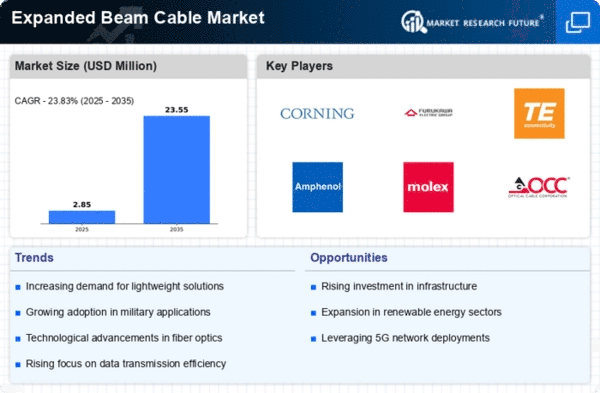
As per MRFR analysis, the Expanded Beam Cable Market Size was estimated at 2.3 USD Million in 2024. The Expanded Beam Cable industry is projected to grow from 2.77 in 2025 to 23.55 by 2035, exhibiting a compound annual growth rate (CAGR) of 23.83 during the forecast period 2025 - 2035.

Key Market Trends & Highlights

The Expanded Beam Cable Market is experiencing robust growth driven by technological advancements and increasing demand across various sectors.

  • The market is witnessing increased adoption in military applications, particularly in North America, which remains the largest market.
  • Growth in telecommunications infrastructure is prominent, with the telecommunications segment leading in market size.
  • The Asia-Pacific region is emerging as the fastest-growing area, fueled by advancements in smart technologies and data centers.
  • Key market drivers include rising demand for high-speed data transmission and increased investment in infrastructure development.

Market Size & Forecast

2024 Market Size 2.3 (USD Million)
2035 Market Size 23.55 (USD Million)
CAGR (2025 - 2035) 23.83%
Largest Regional Market Share in 2024 North America

Major Players

<p>Corning (US), Furukawa Electric (JP), TE Connectivity (CH), Amphenol (US), Molex (US), Optical Cable Corporation (US), Huber+Suhner (CH), Leviton (US), Southwire (US)</p>

Market Trends

The Expanded Beam Cable Market is currently experiencing a notable evolution, driven by advancements in optical technology and increasing demand for high-performance connectivity solutions. This market appears to be characterized by a growing preference for expanded beam connectors, which offer enhanced durability and reduced signal loss compared to traditional fiber optic cables. Industries such as telecommunications, military, and aerospace are increasingly adopting these cables due to their ability to withstand harsh environments and provide reliable data transmission. Furthermore, the trend towards miniaturization in electronic devices seems to be influencing the design and application of expanded beam cables, as manufacturers strive to create more compact and efficient solutions. In addition, the Expanded Beam Cable Market is likely to benefit from the rising emphasis on data security and network reliability. As organizations continue to prioritize secure communication channels, the demand for robust and resilient cabling solutions is expected to grow. Moreover, the integration of expanded beam technology into emerging applications, such as autonomous vehicles and smart cities, suggests a promising future for this market. Overall, the landscape of the Expanded Beam Cable Market appears to be dynamic, with various factors contributing to its ongoing development and expansion.

Increased Adoption in Military Applications

The military sector is increasingly utilizing expanded beam cables due to their resilience and performance in challenging environments. These cables are particularly valued for their ability to maintain signal integrity under extreme conditions, making them suitable for defense communications.

Growth in Telecommunications Infrastructure

Telecommunications companies are progressively incorporating expanded beam technology into their infrastructure. This trend is driven by the need for high-speed data transmission and the growing demand for reliable connectivity solutions in urban and rural areas.

Emergence of Smart Technologies

The rise of smart technologies, including IoT devices and smart cities, is likely to propel the demand for expanded beam cables. These applications require efficient and secure data transmission, positioning expanded beam technology as a favorable choice for future developments.

Expanded Beam Cable Market Market Drivers

Market Growth Projections

The Global Expanded Beam Cable Market Industry is poised for substantial growth, with projections indicating a market value of 2.27 USD Billion in 2024 and an anticipated increase to 18.4 USD Billion by 2035. This growth trajectory reflects a compound annual growth rate (CAGR) of 20.95% from 2025 to 2035. Such figures underscore the increasing reliance on advanced connectivity solutions across various sectors, including telecommunications, military, and data centers. The market's expansion is likely driven by technological advancements, rising demand for high-speed data transmission, and the growing adoption of expanded beam cables in emerging markets.

Growing Adoption in Military Applications

The Global Expanded Beam Cable Market Industry sees a notable increase in the adoption of expanded beam cables within military applications. These cables offer superior performance in challenging environments, making them ideal for defense communication systems. The military's need for reliable and secure data transmission drives the demand for advanced connectivity solutions. As defense budgets expand globally, investments in modern communication infrastructure are likely to rise, further propelling the market. The unique properties of expanded beam cables, such as resistance to dust and moisture, position them as a preferred choice for military applications, indicating a promising growth trajectory.

Technological Advancements in Fiber Optics

Technological advancements in fiber optics significantly influence the Global Expanded Beam Cable Market Industry. Innovations such as improved manufacturing techniques and enhanced materials contribute to the performance and durability of expanded beam cables. These advancements enable the production of cables that can withstand harsh environmental conditions, making them suitable for various applications, including military and aerospace. As technology evolves, the demand for high-performance cables is likely to increase, further driving market growth. The industry's trajectory suggests a strong alignment with future technological developments, potentially leading to increased adoption rates across multiple sectors.

Expansion of Data Centers and Cloud Services

The expansion of data centers and cloud services plays a crucial role in shaping the Global Expanded Beam Cable Market Industry. As organizations increasingly migrate to cloud-based solutions, the demand for high-capacity and efficient data transmission systems rises. Expanded beam cables, with their ability to support high data rates and long-distance transmission, are well-suited for data center applications. The global trend towards digital transformation and the growing reliance on cloud services suggest a sustained demand for these cables. This sector's growth is likely to contribute significantly to the overall market expansion, aligning with the projected increase in market value.

Rising Demand for High-Speed Data Transmission

The Global Expanded Beam Cable Market Industry experiences a surge in demand for high-speed data transmission solutions. As industries increasingly rely on data-intensive applications, the need for efficient and reliable connectivity becomes paramount. Expanded beam cables, known for their ability to minimize signal loss and enhance bandwidth, are becoming essential in sectors such as telecommunications and data centers. This trend is reflected in the projected market growth, with the industry expected to reach 2.27 USD Billion in 2024 and potentially expand to 18.4 USD Billion by 2035, indicating a robust CAGR of 20.95% from 2025 to 2035.

Emerging Markets and Infrastructure Development

Emerging markets and ongoing infrastructure development significantly impact the Global Expanded Beam Cable Market Industry. Countries investing in telecommunications and broadband infrastructure are likely to drive demand for advanced connectivity solutions. As urbanization accelerates and internet penetration increases, the need for reliable and high-speed data transmission becomes critical. Expanded beam cables, known for their efficiency and performance, are expected to play a vital role in these developments. The potential for growth in emerging markets presents opportunities for manufacturers and suppliers, suggesting a favorable environment for the expansion of the industry.

Market Segment Insights

By Application: Telecommunications (Largest) vs. Military (Fastest-Growing)

<p>The Expanded Beam Cable Market's application segment is diverse, featuring telecommunications, military, aerospace, industrial, and medical applications. Currently, telecommunications leads the market, driven by the increasing demand for high-speed data transfer and connectivity solutions. This segment's robust infrastructure demands continuous evolution in cable technologies to meet growing bandwidth requirements. Meanwhile, the military application is gaining traction due to its need for advanced communication systems, resulting in a shifting market dynamic that is beginning to favor military solutions.</p>

<p>Telecommunications (Dominant) vs. Military (Emerging)</p>

<p>The telecommunications sector is the dominant force in the Expanded Beam Cable Market, owing to its reliance on high-performance cables for data transmission over long distances. Telecommunications companies increasingly adopt expanded beam cables due to their advantages like reduced signal loss, improved durability, and resilience to harsh environmental conditions. On the other hand, the military application is emerging rapidly, driven by the demand for secure and reliable communication systems in various military operations. As technological advancements continue to enhance the performance characteristics of expanded beam cables, this sector is poised for significant growth, catering to the specialized needs of military operations that require high-speed and secure data transfer.</p>

By End Use: Data Centers (Largest) vs. Broadcasting (Fastest-Growing)

<p>In the Expanded Beam Cable Market, the end-use segments exhibit varied levels of market share, with Data Centers commanding the largest portion due to the increasing demand for high-speed data transmission and connectivity. Broadcasting follows closely, benefiting from the robust growth in live broadcasting and production studios which necessitate high-quality, reliable data transmission solutions for seamless operations. Other segments, like Transportation and Security Systems, while important, represent smaller shares of the market. The ongoing digitalization brings about critical infrastructure upgrades that fuel the demand across these segments, particularly for reliable and efficient cabling solutions.</p>

<p>Broadcasting: Live Production (Dominant) vs. Transportation (Emerging)</p>

<p>In the context of the Expanded Beam Cable Market, Live Production within Broadcasting is currently the dominant segment due to the high requirements for bandwidth and reliability in live events, where data loss can severely affect broadcast quality. This segment leverages advanced technologies for distortion-free transmission, ensuring superior performance under high-stress conditions. Meanwhile, the Transportation segment is emerging as a significant player, driven by the need for advanced communication systems in an increasingly automated and integrated transportation infrastructure. As smart transportation systems evolve, there is a growing demand for robust cabling solutions that can support extensive data transfer needs in real-time. This creates a unique opportunity for innovation and growth in this emerging segment.</p>

By Cable Type: Single Fiber (Largest) vs. Multi Fiber (Fastest-Growing)

<p>In the Expanded Beam Cable Market, the distribution of market share among various cable types reveals a strong preference for Single Fiber cables, which currently dominate due to their effectiveness in high-demand environments. Multi Fiber cables are steadily gaining traction, particularly among industries requiring high data transfer rates, thereby becoming the fastest-growing segment. These trends suggest a shift towards maximizing fiber efficiency in various applications.</p>

<p>Single Fiber (Dominant) vs. Multi Fiber (Emerging)</p>

<p>Single Fiber cables are characterized by their singular strand design, allowing for lighter weight and simpler connections in numerous applications. As the dominant player in the market, they are preferred in settings where space and weight constraints are critical. Meanwhile, Multi Fiber cables, which integrate multiple strands into one cable, offer a robust solution for high-bandwidth requirements in modern optical networks. Their emerging status is largely driven by increasing demand for data connectivity and efficiency in telecommunications and networking sectors.</p>

By Connector Type: Expanded Beam Connector (Largest) vs. Standard Connector (Fastest-Growing)

<p>In the Expanded Beam Cable Market, the connector type segment is prominently led by the Expanded Beam Connector, which holds a substantial market share due to its advantages in minimizing signal loss and improving performance over long distances. Meanwhile, the Standard Connector, while currently smaller in share, is seeing rapid adoption, owing to its cost-effectiveness and ease of integration in various applications. Other connector types, including Hybrid, Ruggedized, and Field-Installable, play niche roles that serve specific market demands but are comparatively less dominant in terms of overall market presence. The growth trends in the connector type segment are driven by increasing demand for high-performance and reliable connectivity solutions, particularly in telecommunication, military, and industrial applications. The Expanded Beam Connector is favored for critical infrastructure due to its robustness. In contrast, the Standard Connector's emergence can be attributed to the need for competitive pricing and flexibility in deployment. As technologies evolve and industries seek faster, more reliable solutions, both connector types are positioned to experience continued growth in the foreseeable future.</p>

<p>Expanded Beam Connector (Dominant) vs. Standard Connector (Emerging)</p>

<p>The Expanded Beam Connector has established itself as the dominant player in the Expanded Beam Cable Market, recognized for its high performance in demanding environments. These connectors are designed to minimize losses, resist environmental challenges, and provide efficient optical transmission, making them ideal for telecommunications and aerospace industries. On the other hand, the Standard Connector, while currently an emerging option, is gaining traction due to its affordability and versatility. This type of connector serves various applications where maximum performance is not as critical, appealing to budget-sensitive sectors. As industries grow and technology advances, both connector types present unique advantages, allowing them to thrive in different market niches.</p>

By Material Type: Plastic (Largest) vs. Glass (Fastest-Growing)

<p>In the Expanded Beam Cable Market, the distribution of materials highlights Plastic as the most significant segment, representing the largest share due to its versatility, lightweight nature, and cost-effectiveness. This segment's dominance can be attributed to the extensive application of plastic in various industries such as telecommunications and data centers, where durability and flexibility are crucial for infrastructure. Glass, on the other hand, is emerging as the fastest-growing segment, primarily due to its superior transmission performance and increased awareness of the advantages of fiber optics in high-bandwidth applications.</p>

<p>Plastic (Dominant) vs. Glass (Emerging)</p>

<p>Plastic cables dominate the Expanded Beam Cable Market due to their manageable production costs, resilience, and adaptability to a variety of environments. They are particularly favored in applications requiring lightweight and flexible cabling solutions, allowing for ease of installation and maintenance. Conversely, Glass cables are rapidly gaining ground as an emerging segment, recognized for their enhanced performance in data transmission over long distances and resistance to environmental factors. This growing preference for high-speed data solutions is driving innovations in glass fiber technology, thereby setting the stage for more significant market penetration as industries increasingly demand efficient, high-capacity communication infrastructures.</p>

Get more detailed insights about Expanded Beam Cable Market Research Report—Global Forecast till 2035

Regional Insights

North America : Market Leader in Innovation

North America is poised to maintain its leadership in the Expanded Beam Cable market, holding a significant market share of 1.15 billion. The region's growth is driven by increasing demand for high-speed data transmission and advancements in telecommunications infrastructure. Regulatory support for broadband expansion and 5G deployment further catalyzes market growth, making it a hub for innovation and technology adoption. The competitive landscape in North America is robust, featuring key players such as Corning, Amphenol, and TE Connectivity. These companies are at the forefront of technological advancements, focusing on product innovation and strategic partnerships. The U.S. remains the largest market, with Canada and Mexico also contributing to the regional growth. The presence of established manufacturers and a strong supply chain enhances the region's market position.

Europe : Emerging Market with Potential

Europe is witnessing a growing demand for Expanded Beam Cables, with a market size of €0.7 billion. The region's growth is fueled by the increasing need for high-speed internet and the expansion of data centers. Regulatory initiatives aimed at enhancing digital infrastructure and connectivity are pivotal in driving market dynamics. The European Union's focus on digital transformation is expected to further boost the market in the coming years. Leading countries in this region include Germany, France, and the UK, which are home to several key players like Furukawa Electric and Huber+Suhner. The competitive landscape is characterized by a mix of established companies and emerging startups, fostering innovation. The presence of stringent regulations ensures high-quality standards, making Europe a significant player in the global market.

Asia-Pacific : Rapidly Growing Market

Asia-Pacific is emerging as a significant player in the Expanded Beam Cable market, with a market size of $0.35 billion. The region's growth is driven by rapid urbanization, increasing internet penetration, and the expansion of telecommunications networks. Government initiatives aimed at enhancing digital connectivity and infrastructure development are key catalysts for market growth, positioning Asia-Pacific as a vital region for future investments. Countries like Japan, China, and India are leading the charge, with major players such as Furukawa Electric and TE Connectivity establishing a strong presence. The competitive landscape is evolving, with local manufacturers also entering the market, increasing competition. The region's diverse market dynamics and growing demand for high-speed data solutions make it a focal point for industry growth.

Middle East and Africa : Emerging Market Opportunities

The Middle East and Africa region is gradually developing its Expanded Beam Cable market, currently valued at $0.1 billion. The growth is primarily driven by increasing investments in telecommunications infrastructure and the rising demand for high-speed internet services. Government initiatives aimed at improving connectivity and digital transformation are crucial in shaping the market landscape, providing opportunities for growth in this emerging region. Leading countries in this region include South Africa and the UAE, where key players like Optical Cable Corporation and Southwire are making significant inroads. The competitive landscape is characterized by a mix of local and international companies, fostering innovation and collaboration. As the region continues to invest in its digital infrastructure, the demand for advanced cable solutions is expected to rise significantly.

Key Players and Competitive Insights

The Expanded Beam Cable Market is currently characterized by a dynamic competitive landscape, driven by technological advancements and increasing demand for high-performance connectivity solutions. Key players such as Corning (US), TE Connectivity (CH), and Amphenol (US) are strategically positioned to leverage innovation and expand their market presence. Corning (US) focuses on enhancing its product portfolio through continuous research and development, while TE Connectivity (CH) emphasizes partnerships to integrate advanced technologies into its offerings. Amphenol (US) adopts a strategy of regional expansion, targeting emerging markets to capitalize on the growing need for robust communication infrastructure. Collectively, these strategies contribute to a competitive environment that is increasingly focused on innovation and customer-centric solutions.

In terms of business tactics, companies are localizing manufacturing and optimizing supply chains to enhance operational efficiency. The market structure appears moderately fragmented, with several key players exerting influence over various segments. This fragmentation allows for a diverse range of products and services, catering to different customer needs while fostering competition among established and emerging players.

In November 2025, Corning (US) announced the launch of its latest line of expanded beam cables designed for high-speed data transmission in data centers. This strategic move is significant as it aligns with the growing demand for faster and more reliable connectivity solutions, positioning Corning to capture a larger share of the data center market. The introduction of these advanced products is likely to enhance Corning's competitive edge and reinforce its reputation as a leader in optical fiber technology.

In October 2025, TE Connectivity (CH) entered into a strategic partnership with a leading telecommunications provider to develop next-generation expanded beam cable solutions. This collaboration is indicative of TE's commitment to innovation and its proactive approach to addressing the evolving needs of the telecommunications sector. By leveraging the expertise of both companies, this partnership is expected to accelerate the development of cutting-edge technologies that enhance connectivity and performance.

In September 2025, Amphenol (US) completed the acquisition of a regional competitor specializing in expanded beam cable manufacturing. This acquisition is pivotal as it not only expands Amphenol's product offerings but also enhances its manufacturing capabilities. The integration of the acquired company is anticipated to streamline operations and improve supply chain efficiencies, thereby strengthening Amphenol's market position.

As of December 2025, current competitive trends in the Expanded Beam Cable Market are increasingly influenced by digitalization, sustainability, and the integration of artificial intelligence (AI) into product development. Strategic alliances are becoming more prevalent, enabling companies to pool resources and expertise to drive innovation. The competitive differentiation is likely to evolve from traditional price-based competition to a focus on technological advancements, reliability, and sustainability in supply chains. This shift underscores the importance of innovation as a key driver of market success in the coming years.

Key Companies in the Expanded Beam Cable Market market include

Industry Developments

  • In November 2021, Tech Optics had invested 18 million USD in a new manufacturing plant for microducts in the south-east USA, via the wholly owned subsidiary Blue Diamond Industries.
  • In February 2021, Smith Group had acquired Royal metal products the acquisition helped the company to expand into the pathogen detection market in the US.
  • In January 2021, Bel Fuse Inc had acquired RMS connectors. With this acquisition, Bel Fuse Inc aims to expand its offering of Mil-Spec qualified connectors, including the addition of the MIL-DTL-83723 Series III connector family.

Future Outlook

Expanded Beam Cable Market Future Outlook

<p>The Expanded Beam Cable Market is projected to grow at a 23.83% CAGR from 2024 to 2035, driven by increasing demand for high-speed data transmission and robust connectivity solutions.</p>

New opportunities lie in:

  • <p>Development of advanced fiber optic connectors for military applications.</p>
  • <p>Expansion into emerging markets with tailored product offerings.</p>
  • <p>Integration of smart technologies for enhanced cable management systems.</p>

<p>By 2035, the market is expected to solidify its position as a leader in high-performance connectivity solutions.</p>

Market Segmentation

Expanded Beam Cable Market End Use Outlook

  • Data Centers
  • Broadcasting
  • Transportation
  • Security Systems
  • Test and Measurement

Expanded Beam Cable Market Cable Type Outlook

  • Single Fiber
  • Multi Fiber
  • Custom Fiber
  • Armored Fiber
  • Non-Armored Fiber

Expanded Beam Cable Market Application Outlook

  • Telecommunications
  • Military
  • Aerospace
  • Industrial
  • Medical

Expanded Beam Cable Market Material Type Outlook

  • Plastic
  • Glass
  • Metal
  • Composite
  • Ceramic

Expanded Beam Cable Market Connector Type Outlook

  • Expanded Beam Connector
  • Standard Connector
  • Hybrid Connector
  • Ruggedized Connector
  • Field-Installable Connector

Report Scope

MARKET SIZE 20242.3(USD Million)
MARKET SIZE 20252.77(USD Million)
MARKET SIZE 203523.55(USD Million)
COMPOUND ANNUAL GROWTH RATE (CAGR)23.83% (2024 - 2035)
REPORT COVERAGERevenue Forecast, Competitive Landscape, Growth Factors, and Trends
BASE YEAR2024
Market Forecast Period2025 - 2035
Historical Data2019 - 2024
Market Forecast UnitsUSD Million
Key Companies ProfiledCorning (US), Furukawa Electric (JP), TE Connectivity (CH), Amphenol (US), Molex (US), Optical Cable Corporation (US), Huber+Suhner (CH), Leviton (US), Southwire (US)
Segments CoveredApplication, End Use, Cable Type, Connector Type, Material Type
Key Market OpportunitiesGrowing demand for high-speed data transmission in telecommunications drives opportunities in the Expanded Beam Cable Market.
Key Market DynamicsRising demand for high-speed data transmission drives innovation and competition in the Expanded Beam Cable Market.
Countries CoveredNorth America, Europe, APAC, South America, MEA

FAQs

What is the CAGR of the expanded beam cable market in the upcoming period?

A 23.7% CAGR is expected to transform the market

Who are the contenders in the market for expanded beam cable?

The major contenders in the global market are TE Connectivity LTD. (Switzerland), Optical Cable Corporation (US), 3M Company (US), Amphenol FSI (US), and Bel Fuse Inc. (US)

Which region is a major driver in the expanded beam cable market?

North America regional market is projected to be the major driver of the market.

What segments are utilized for better understanding the expanded beam cable market?

The segments in the market are Lens Size, Technology, Connector Type, Single vs Multi-Channel Connector, And Application.

  1. EXECUTIVE SUMMARY 22
  2. MARKET INTRODUCTION 24
    1. DEFINITION 24
    2. SCOPE OF THE STUDY 24
    3. RESEARCH OBJECTIVE 24
    4. MARKET STRUCTURE 25
  3. RESEARCH METHODOLOGY 26
  4. MARKET DYNAMICS 33
    1. INTRODUCTION 33
    2. DRIVERS 34
      1. INCREASING DEMAND IN MISSION-CRITICAL
      2. GROWING BENEFITS OF EXPANDED BEAM CONNECTORS 34
    3. APPLICATIONS 34
    4. EXPANDED BEAM FIBRE OPTIC CONNECTORS FOR MEDICAL DEVICES 34
    5. RESTRAINT 35
      1. HIGH
    6. MANUFACTURING AND IMPLEMENTATION COSTS 35
    7. OPPORTUNITY 36
      1. GROWING
      2. INCREASING
    8. POTENTIAL FOR NEW APPLICATIONS THROUGH EXPANDED BEAM OPTICAL 36
    9. NEED FOR EXPANDED BEAM CONNECTORS IN HARSH CONDITION APPLICATIONS 36
    10. IMPACT
      1. COVID-19 IMPACT ON THE MANUFACTURERS 36
      2. IMPACT
      3. IMPACT ON SUPPLY CHAIN AMIDST THE
    11. OF COVID-19 36
    12. ON OVERALL FIBRE OPTIC INDUSTRY 37
    13. PANDEMIC 37
    14. TECHNOLOGY ANALYSIS 37
      1. EXPANDED BEAM TECHNOLOGY
    15. IMPROVEMENTS 37
  5. MARKET FACTOR ANALYSIS 39
    1. SUPPLY CHAIN 39
      1. MANUFACTURERS/DISTRIBUTORS
      2. END USER 39
    2. PORTER''S FIVE FORCES MODEL 41
      1. THREAT
      2. BARGAINING POWER OF SUPPLIERS 42
      3. BARGAINING POWER OF BUYERS
      4. THREAT OF SUBSTITUTES 42
      5. INTENSITY OF RIVALRY 42
    3. OF NEW ENTRANTS 42
    4. PATENT INFORMATION 43
    5. TECHNICAL COMPARISONS 44
      1. PHYSICAL CONTACT (PC) CONNECTOR
      2. FIBRE OPTIC BUTT-JOINED CONNECTORS
      3. FIBRE CABLE COMPARISONS 46
    6. VS EXPANDED BEAM CONNECTOR TECHNOLOGY 44
    7. VS EXPANDED BEAM CONNECTORS 45
  6. GLOBAL EXPANDED
  7. BEAM CABLE MARKET, BY LENS SIZE 47
    1. INTRODUCTION 47
    2. 0.8 MM
    3. 1.25 MM 48
    4. 2.0 MM 48
    5. 2.5 MM 48
    6. 3.0 MM
    7. OTHERS 48
  8. GLOBAL EXPANDED BEAM CABLE MARKET, BY TECHNOLOGY 49
    1. INTRODUCTION 49
    2. SINGLE MODE 50
    3. MULTI-MODE 50
    4. HYBRID 50
  9. GLOBAL EXPANDED
  10. BEAM CABLE MARKET, BY CONNECTOR TYPE 51
    1. INTRODUCTION 51
    2. SINGLE-CHANNEL
    3. EXPANDED BEAM CONNECTOR 52
    4. MULTI-CHANNEL EXPANDED BEAM CONNECTOR 52
  11. GLOBAL EXPANDED BEAM CABLE MARKET, BY SINGLE VS MULTI-CHANNEL
    1. CONNECTOR
    2. INTRODUCTION 53
    3. RACK & PANEL 54
    4. PANEL MOUNT CONNECTORS 54
    5. IN-LINE CIRCULAR 54
    6. QUICK-DISCONNECT 54
    7. OTHERS 54
  12. GLOBAL
  13. EXPANDED BEAM CABLE MARKET, BY APPLICATION 55
    1. INTRODUCTION 55
    2. MILITARY COMMUNICATIONS 56
    3. OIL & GAS 56
    4. MEDICAL 56
    5. ROBOTICS
    6. ENERGY & POWER 57
    7. BROADCAST SYSTEMS 57
    8. MANUFACTURING
    9. AND INDUSTRIAL 57
    10. GEOPHYSICAL EXPLORATION 57
    11. MARINE OPERATIONS 57
      1. COMMERCIAL AEROSPACE 58
      2. SPACE FLIGHT 58
    12. MILITARY/ AEROSPACE 58
    13. OTHERS 58
  14. GLOBAL EXPANDED BEAM CABLE MARKET, BY REGION 59
    1. OVERVIEW 59
    2. NORTH
      1. NORTH AMERICA EXPANDED BEAM CABLE MARKET, BY COUNTRY, 2018–2030
      2. NORTH AMERICA EXPANDED BEAM CABLE MARKET, BY LENS SIZE,
      3. NORTH AMERICA EXPANDED BEAM CABLE MARKET,
      4. NORTH AMERICA EXPANDED
    3. AMERICA 61
    4. (USD MILLION) 61
    5. BY TECHNOLOGY, 2018–2030 (USD MILLION) 62
  15. BEAM CABLE MARKET, BY CONNECTOR TYPE, 2018–2030 (USD MILLION) 63
  16. NORTH AMERICA EXPANDED BEAM CABLE MARKET, BY SINGLE VS MULTI-CHANNEL CONNECTOR,
  17. NORTH AMERICA EXPANDED
  18. BEAM CABLE MARKET, BY APPLICATION, 2018–2030 (USD MILLION) 65
  19. NORTH
  20. AMERICA EXPANDED BEAM CABLE MARKET, BY MILITARY/ AEROSPACE,
    1. (USD MILLION) 66
    2. (USD MILLION) 66
    3. (USD MILLION) 67
    4. CONNECTOR,
  21. US 66
  22. US EXPANDED BEAM CABLE MARKET, BY LENS SIZE, 2018–2030
  23. US EXPANDED BEAM CABLE MARKET, BY TECHNOLOGY, 2018–2030
  24. US EXPANDED BEAM CABLE MARKET, BY CONNECTOR TYPE, 2018–2030
  25. US EXPANDED BEAM CABLE MARKET, BY SINGLE VS MULTI-CHANNEL
  26. US EXPANDED BEAM CABLE
  27. MARKET, BY APPLICATION, 2018–2030 (USD MILLION) 67
  28. US EXPANDED BEAM CABLE
  29. MARKET, BY MILITARY/ AEROSPACE, 2018–2030 (USD MILLION) 68
    1. (USD MILLION) 68
    2. (USD MILLION) 68
    3. VS MULTI-CHANNEL CONNECTOR,
  30. CANADA
  31. CANADA EXPANDED BEAM CABLE MARKET, BY LENS SIZE, 2018–2030
  32. CANADA EXPANDED BEAM CABLE MARKET, BY TECHNOLOGY, 2018–2030
  33. CANADA EXPANDED BEAM CABLE MARKET, BY CONNECTOR TYPE,
  34. CANADA EXPANDED BEAM CABLE MARKET, BY SINGLE
  35. CANADA
  36. EXPANDED BEAM CABLE MARKET, BY APPLICATION, 2018–2030 (USD MILLION) 69
  37. CANADA EXPANDED BEAM CABLE MARKET, BY MILITARY/ AEROSPACE, 2018–2030 (USD
    1. MILLION) 70
    2. BY LENS SIZE, 2018–2030, (USD MILLION) 70
  38. MEXICO 70
  39. MEXICO EXPANDED BEAM CABLE MARKET,
  40. MEXICO EXPANDED BEAM
  41. CABLE MARKET, BY TECHNOLOGY, 2018–2030 (USD MILLION) 70
  42. MEXICO
  43. EXPANDED BEAM CABLE MARKET, BY CONNECTOR TYPE, 2018–2030 (USD MILLION) 71
  44. MEXICO EXPANDED BEAM CABLE MARKET, BY SINGLE VS MULTI-CHANNEL CONNECTOR,
    1. (USD MILLION) 71
    2. MILITARY/ AEROSPACE, 2018–2030 (USD MILLION) 72
  45. MEXICO EXPANDED BEAM CABLE MARKET, BY APPLICATION,
  46. MEXICO EXPANDED BEAM CABLE MARKET, BY
    1. EUROPE 73
      1. EUROPE
  47. EXPANDED BEAM CABLE MARKET, BY COUNTRY, 2018–2030 (USD MILLION) 73
  48. EUROPE EXPANDED BEAM CABLE MARKET, BY LENS SIZE, 2018–2030 (USD MILLION) 74
  49. EUROPE EXPANDED BEAM CABLE MARKET, BY TECHNOLOGY, 2018–2030 (USD MILLION)
    1. (USD MILLION) 75
    2. CONNECTOR,
  50. EUROPE EXPANDED BEAM CABLE MARKET, BY CONNECTOR TYPE, 2018–2030
  51. EUROPE EXPANDED BEAM CABLE MARKET, BY SINGLE VS MULTI-CHANNEL
  52. EUROPE EXPANDED BEAM CABLE
  53. MARKET, BY APPLICATION, 2018–2030 (USD MILLION) 77
  54. EUROPE EXPANDED BEAM
  55. CABLE MARKET, BY MILITARY/ AEROSPACE, 2018–2030 (USD MILLION) 78
    1. UK 78
    2. MILLION) 78
    3. (USD MILLION) 78
    4. (USD MILLION) 79
    5. CONNECTOR,
  56. UK EXPANDED BEAM CABLE MARKET, BY LENS SIZE, 2018–2030 (USD
  57. UK EXPANDED BEAM CABLE MARKET, BY TECHNOLOGY, 2018–2030
  58. UK EXPANDED BEAM CABLE MARKET, BY CONNECTOR TYPE, 2018–2030
  59. UK EXPANDED BEAM CABLE MARKET, BY SINGLE VS MULTI-CHANNEL
  60. UK EXPANDED BEAM CABLE
  61. MARKET, BY APPLICATION, 2018–2030 (USD MILLION) 79
  62. UK EXPANDED BEAM CABLE
  63. MARKET, BY MILITARY/ AEROSPACE, 2018–2030 (USD MILLION) 80
    1. (USD MILLION) 80
    2. CONNECTOR TYPE, 2018–2030 (USD MILLION) 81
  64. GERMANY
  65. GERMANY EXPANDED BEAM CABLE MARKET, BY LENS SIZE, 2018–2030
  66. GERMANY EXPANDED BEAM CABLE MARKET, BY TECHNOLOGY,
  67. GERMANY EXPANDED BEAM CABLE MARKET, BY
  68. GERMANY EXPANDED BEAM
  69. CABLE MARKET, BY SINGLE VS MULTI-CHANNEL CONNECTOR,
    1. (USD MILLION) 81
    2. AEROSPACE, 2018–2030 (USD MILLION) 82
  70. GERMANY EXPANDED BEAM CABLE MARKET, BY APPLICATION, 2018–2030
  71. GERMANY EXPANDED BEAM CABLE MARKET, BY MILITARY/
  72. FRANCE 82
  73. FRANCE
  74. EXPANDED BEAM CABLE MARKET, BY LENS SIZE, 2018–2030 (USD MILLION) 82
  75. FRANCE EXPANDED BEAM CABLE MARKET, BY TECHNOLOGY, 2018–2030 (USD MILLION)
    1. (USD MILLION) 83
    2. CONNECTOR,
  76. FRANCE EXPANDED BEAM CABLE MARKET, BY CONNECTOR TYPE, 2018–2030
  77. FRANCE EXPANDED BEAM CABLE MARKET, BY SINGLE VS MULTI-CHANNEL
  78. FRANCE EXPANDED BEAM
  79. CABLE MARKET, BY APPLICATION, 2018–2030 (USD MILLION) 83
  80. FRANCE EXPANDED BEAM CABLE MARKET, BY MILITARY/ AEROSPACE, 2018–2030 (USD
    1. MILLION) 84
    2. BY LENS SIZE, 2018–2030 (USD MILLION) 84
  81. ITALY 84
  82. ITALY EXPANDED BEAM CABLE MARKET,
  83. ITALY EXPANDED BEAM
  84. CABLE MARKET, BY TECHNOLOGY, 2018–2030 (USD MILLION) 84
  85. ITALY EXPANDED BEAM CABLE MARKET, BY CONNECTOR TYPE, 2018–2030 (USD MILLION)
    1. CONNECTOR,
  86. ITALY EXPANDED BEAM CABLE MARKET, BY SINGLE VS MULTI-CHANNEL
  87. ITALY EXPANDED BEAM
  88. CABLE MARKET, BY APPLICATION, 2018–2030 (USD MILLION) 85
  89. ITALY EXPANDED BEAM CABLE MARKET, BY MILITARY/ AEROSPACE, 2018–2030 (USD MILLION)
  90. REST OF EUROPE 86
  91. REST OF EUROPE EXPANDED BEAM
  92. CABLE MARKET, BY LENS SIZE, 2018–2030 (USD MILLION) 86
  93. REST OF EUROPE EXPANDED
  94. BEAM CABLE MARKET, BY TECHNOLOGY, 2018–2030 (USD MILLION) 86
  95. REST OF EUROPE EXPANDED BEAM CABLE MARKET, BY CONNECTOR TYPE, 2018–2030 (USD
    1. MILLION) 87
    2. VS MULTI-CHANNEL CONNECTOR,
  96. REST OF EUROPE EXPANDED BEAM CABLE MARKET, BY SINGLE
  97. REST OF EUROPE EXPANDED BEAM CABLE MARKET, BY APPLICATION, 2018–2030 (USD
    1. MILLION) 87
    2. AEROSPACE,
  98. REST OF EUROPE EXPANDED BEAM CABLE MARKET, BY MILITARY/
    1. ASIA-PACIFIC 89
  99. ASIA-PACIFIC EXPANDED BEAM CABLE MARKET, BY COUNTRY, 2018–2030 (USD MILLION)
    1. (USD MILLION) 90
    2. BY CONNECTOR TYPE, 2018–2030 (USD MILLION) 91
  100. ASIA-PACIFIC EXPANDED BEAM CABLE MARKET, BY LENS SIZE, 2018–2030
  101. ASIA-PACIFIC EXPANDED BEAM CABLE MARKET, BY TECHNOLOGY,
  102. ASIA-PACIFIC EXPANDED BEAM CABLE MARKET,
  103. ASIA-PACIFIC EXPANDED BEAM
  104. CABLE MARKET, BY SINGLE VS MULTI-CHANNEL CONNECTOR,
    1. (USD MILLION) 93
    2. AEROSPACE, 2018–2030 (USD MILLION) 94
  105. ASIA-PACIFIC EXPANDED BEAM CABLE MARKET, BY APPLICATION, 2018–2030
  106. ASIA-PACIFIC EXPANDED BEAM CABLE MARKET, BY MILITARY/
  107. CHINA 94
  108. CHINA
  109. EXPANDED BEAM CABLE MARKET, BY LENS SIZE, 2018–2030 (USD MILLION) 94
  110. CHINA EXPANDED BEAM CABLE MARKET, BY TECHNOLOGY, 2018–2030 (USD MILLION) 94
  111. CHINA EXPANDED BEAM CABLE MARKET, BY CONNECTOR TYPE, 2018–2030 (USD MILLION)
  112. CHINA EXPANDED BEAM CABLE MARKET, BY SINGLE VS MULTI-CHANNEL CONNECTOR,
  113. CHINA EXPANDED BEAM CABLE
  114. MARKET, BY APPLICATION, 2018–2030 (USD MILLION) 95
  115. CHINA EXPANDED BEAM
  116. CABLE MARKET, BY MILITARY/ AEROSPACE, 2018–2030 (USD MILLION) 96
    1. JAPAN 96
    2. (USD MILLION) 96
    3. (USD MILLION) 96
    4. VS MULTI-CHANNEL CONNECTOR,
  117. JAPAN EXPANDED BEAM CABLE MARKET, BY LENS SIZE, 2018–2030
  118. JAPAN EXPANDED BEAM CABLE MARKET, BY TECHNOLOGY, 2018–2030
  119. JAPAN EXPANDED BEAM CABLE MARKET, BY CONNECTOR TYPE,
  120. JAPAN EXPANDED BEAM CABLE MARKET, BY SINGLE
  121. JAPAN
  122. EXPANDED BEAM CABLE MARKET, BY APPLICATION, 2018–2030 (USD MILLION) 97
  123. JAPAN EXPANDED BEAM CABLE MARKET, BY MILITARY/ AEROSPACE, 2018–2030 (USD MILLION)
    1. SIZE, 2018–2030 (USD MILLION) 98
    2. BY TECHNOLOGY, 2018–2030 (USD MILLION) 98
  124. INDIA 98
  125. INDIA EXPANDED BEAM CABLE MARKET, BY LENS
  126. INDIA EXPANDED BEAM CABLE MARKET,
  127. INDIA EXPANDED BEAM CABLE
  128. MARKET, BY CONNECTOR TYPE, 2018–2030 (USD MILLION) 98
  129. INDIA EXPANDED BEAM CABLE
  130. MARKET, BY SINGLE VS MULTI-CHANNEL CONNECTOR,
    1. (USD MILLION) 99
  131. INDIA EXPANDED BEAM CABLE MARKET, BY APPLICATION, 2018–2030
  132. INDIA EXPANDED BEAM CABLE MARKET, BY MILITARY/ AEROSPACE,
  133. SOUTH KOREA 100
  134. SOUTH KOREA EXPANDED
  135. BEAM CABLE MARKET, BY LENS SIZE, 2018–2030 (USD MILLION) 100
  136. SOUTH KOREA EXPANDED BEAM CABLE MARKET, BY TECHNOLOGY, 2018–2030 (USD MILLION)
    1. (USD MILLION) 100
    2. VS MULTI-CHANNEL CONNECTOR,
  137. SOUTH KOREA EXPANDED BEAM CABLE MARKET, BY CONNECTOR TYPE, 2018–2030
  138. SOUTH KOREADIA EXPANDED BEAM CABLE MARKET, BY SINGLE
  139. SOUTH KOREA EXPANDED BEAM CABLE MARKET, BY APPLICATION, 2018–2030 (USD MILLION)
  140. SOUTH KOREA EXPANDED BEAM CABLE MARKET, BY MILITARY/ AEROSPACE,
  141. REST OF ASIA-PACIFIC 102
  142. REST OF ASIA-PACIFIC EXPANDED BEAM CABLE MARKET, BY LENS SIZE, 2018–2030 (USD
    1. MILLION) 102
    2. TECHNOLOGY, 2018–2030 (USD MILLION) 102
  143. REST OF ASIA-PACIFIC EXPANDED BEAM CABLE MARKET, BY
  144. REST OF ASIA-PACIFIC
  145. EXPANDED BEAM CABLE MARKET, BY CONNECTOR TYPE,
    1. MULTI-CHANNEL
    2. CONNECTOR, 2018–2030 (USD MILLION) 103
  146. REST OF ASIA-PACIFIC EXPANDED BEAM CABLE MARKET, BY SINGLE VS
  147. REST OF ASIA-PACIFIC EXPANDED BEAM CABLE MARKET, BY APPLICATION, 2018–2030
    1. (USD MILLION) 103
    2. BY MILITARY/ AEROSPACE,
    3. EAST & AFRICA 104
    4. BY LENS SIZE, 2018–2030 (USD MILLION) 104
  148. REST OF ASIA-PACIFIC EXPANDED BEAM CABLE MARKET,
    1. MIDDLE
      1. MIDDLE EAST & AFRICA EXPANDED BEAM CABLE MARKET,
      2. MIDDLE EAS

Expanded Beam Cable Market Segmentation

Market Segmentation Overview

  • Detailed segmentation data will be available in the full report
  • Comprehensive analysis by multiple parameters
  • Regional and country-level breakdowns
  • Market size forecasts by segment
Infographic

Free Sample Request

Kindly complete the form below to receive a free sample of this Report

Get Free Sample

Customer Strories

Compare Licence

×
Features License Type
Single User Multiuser License Enterprise User
Price $4,950 $5,950 $7,250
Maximum User Access Limit 1 User Upto 10 Users Unrestricted Access Throughout the Organization
Free Customization
Direct Access to Analyst
Deliverable Format
Platform Access
Discount on Next Purchase 10% 15% 15%
Printable Versions