
×
Hero Background
English
Chinese
French
Japanese
Korean
German
Spanish

Event Tourism Market Size

ID: MRFR/CG/10970-HCR
128 Pages
Pradeep Nandi
October 2025

Event Tourism Market Research Report Information By Type (Exhibitions and Conferences, Festivals, Corporate Events, Music Concert, Sports, Others), By Channel (Virtual Channel And Physical Channel), By Revenue Source (On-line registration, Off-line registration, Sponsorship, Others), By Age Group (Below 18 Years, 18-50 Years, Above 50 Years), And By Region (North America, Europe, Asia-Pacific, And Rest Of The World) –Market Forecast Till 2035

Share:
Download PDF ×

We do not share your information with anyone. However, we may send you emails based on your report interest from time to time. You may contact us at any time to opt-out.

Event Tourism Market Infographic
Purchase Options

Event Tourism Size

Event Tourism Market Growth Projections and Opportunities

The event tourism market is influenced by a myriad of factors that contribute to its growth and dynamics, reflecting the intersection of travel, leisure, and experiential events. One primary driver is the increasing desire for unique and memorable experiences. As consumers seek more than traditional vacations, the demand for events, festivals, conferences, and cultural happenings has surged. Event tourism satisfies the craving for novel experiences, offering travelers the opportunity to immerse themselves in diverse cultures, celebrations, and themed gatherings.

Economic factors play a crucial role in the event tourism market. The economic health of a region can impact both the frequency and scale of events hosted. Strong economies often result in increased spending on leisure activities, including event tourism. Additionally, events themselves can contribute significantly to the local economy by attracting visitors who spend on accommodation, dining, transportation, and local attractions.

Government policies and support are integral to the success of the event tourism market. Supportive policies, financial incentives, and efficient infrastructure contribute to attracting and hosting events. Governments may invest in event venues, transportation networks, and promotional campaigns to position their regions as attractive destinations for conferences, festivals, and other events. Political stability and favorable regulations further enhance the appeal of a destination for event organizers.

Technological advancements play a significant role in the event tourism market. The use of technology, including event management software, mobile apps, and virtual reality, enhances the overall event experience for attendees and organizers alike. Technology facilitates efficient planning, marketing, and execution of events, contributing to the industry's growth and ensuring a seamless experience for participants.

Social and cultural factors influence the event tourism market, with preferences and trends shaping the types of events that gain popularity. Cultural festivals, music concerts, sporting events, and business conferences cater to diverse interests and demographics. Changing societal preferences for experiences over possessions contribute to the growth of the event tourism market, as consumers prioritize spending on memorable moments.

Environmental sustainability considerations are gaining importance in the event tourism market. Event organizers, destinations, and participants are increasingly mindful of the environmental impact of large gatherings. Sustainable practices, such as waste reduction, eco-friendly transportation options, and responsible event planning, contribute to the attractiveness of destinations for environmentally conscious event tourism.

Global connectivity and ease of travel are key factors driving the event tourism market. With improved transportation infrastructure and accessibility, individuals can attend events in different parts of the world more easily. The rise of budget airlines, efficient public transportation, and digital platforms for travel booking make it convenient for participants to explore event opportunities beyond their local regions.

Marketing and promotional efforts significantly impact the event tourism market. Destinations and event organizers leverage effective marketing strategies to attract attendees and sponsors. Social media, online advertising, and influencer partnerships play a crucial role in creating awareness and generating interest in upcoming events. Successful marketing campaigns contribute to the overall success of events and the sustained growth of the event tourism market.

Security and safety considerations are paramount in the event tourism market. Ensuring the safety of participants and maintaining a secure environment is critical for the success of any event. Destinations that prioritize safety measures and have effective emergency response plans are more likely to attract organizers and participants, fostering a positive reputation in the event tourism industry.

Competitive dynamics among destinations influence the event tourism market. Regions vie for the opportunity to host prestigious events that can enhance their global visibility and reputation. The bidding process for major conferences, sports events, and cultural festivals is highly competitive, with destinations competing to offer attractive packages, infrastructure, and logistical support to secure hosting rights.

Event Tourism Market Size Graph
Author
Pradeep Nandi
Senior Research Analyst

I have a bachelor's degree in mechanical engineering and an MBA. I have more than two years of expertise in the retail, food, and beverage, chemical, and material industries, and hence have developed a sound cross-domain expertise. A firm believer in lifelong learning and sharing of knowledge. Having a proclivity for hatching ideas and trying to absorb as much information as possible in a short amount of time. Introducing corporates to the data and insight, which enables them to move from probability to possibility, has been my key areas of interest. 

Leave a Comment

FAQs

What is the current valuation of the Event Tourism Market as of 2024?

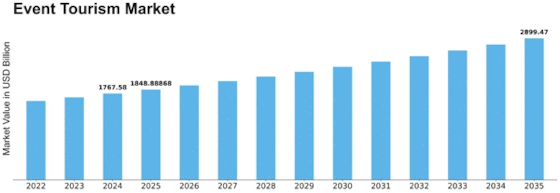
The Event Tourism Market was valued at 1767.58 USD Billion in 2024.

What is the projected market valuation for the Event Tourism Market in 2035?

The market is projected to reach 2899.47 USD Billion by 2035.

What is the expected CAGR for the Event Tourism Market during the forecast period 2025 - 2035?

The expected CAGR for the Event Tourism Market during 2025 - 2035 is 4.6%.

Which segments are included in the Event Tourism Market analysis?

The market analysis includes segments such as Exhibitions and Conferences, Festivals, Corporate Events, Music Concerts, Sports, and Others.

How much revenue is generated from Corporate Events in the Event Tourism Market?

Corporate Events generated revenue between 400.0 and 640.0 USD Billion.

What is the revenue potential of the Physical Channel in the Event Tourism Market?

The Physical Channel is expected to generate revenue between 1367.58 and 2249.47 USD Billion.

Market Summary

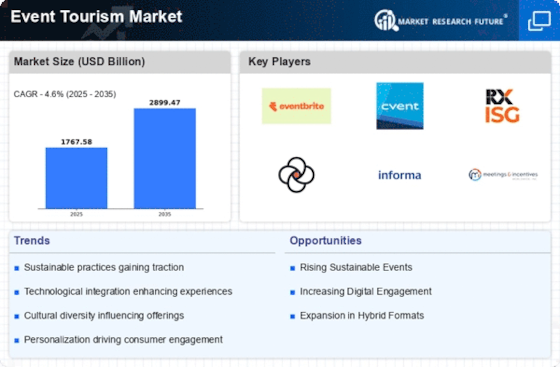
As per MRFR analysis, the Event Tourism Market Size was estimated at 1767.58 USD Billion in 2024. The Event Tourism industry is projected to grow from 1848.92 USD Billion in 2025 to 2899.47 USD Billion by 2035, exhibiting a compound annual growth rate (CAGR) of 4.6 during the forecast period 2025 - 2035.

Key Market Trends & Highlights

The Event Tourism Market is experiencing dynamic growth driven by diverse trends and regional influences.

  • The rise of niche events is reshaping the landscape of event tourism, particularly in North America. Technological integration is enhancing attendee experiences, especially in the exhibitions and conferences segment. A strong focus on sustainability is becoming increasingly prevalent, particularly in the fast-growing festivals segment in Asia-Pacific. Increased disposable income and the rise of experiential travel are key drivers propelling market expansion.

Market Size & Forecast

2024 Market Size 1767.58 (USD Billion)
2035 Market Size 2899.47 (USD Billion)
CAGR (2025 - 2035) 4.6%
Largest Regional Market Share in 2024 North America

Major Players

<p>Eventbrite (US), Cvent (US), Reed Exhibitions (GB), MCI Group (CH), Informa (GB), Meetings &amp; Incentives Worldwide (GB), GL Events (FR), Tarsus Group (GB), Clarion Events (GB)</p>

Market Trends

The Event Tourism Market is currently experiencing a dynamic evolution, driven by a confluence of factors that shape consumer preferences and industry practices. As travelers increasingly seek unique experiences, destinations are adapting their offerings to cater to this demand. This shift is evident in the rise of niche events, which focus on specific interests such as culinary arts, music festivals, and cultural celebrations. Such events not only attract local attendees but also draw international visitors, thereby enhancing the economic impact on host locations. Furthermore, the integration of technology into event planning and execution appears to be transforming the landscape, allowing for more personalized experiences and streamlined operations. In addition, sustainability has emerged as a pivotal consideration within the Event Tourism Market. Stakeholders are increasingly recognizing the importance of minimizing environmental footprints while maximizing social benefits. This trend suggests a growing commitment to responsible tourism practices, which may include eco-friendly event management and community engagement initiatives. As the market continues to evolve, it seems likely that these trends will shape the future of event tourism, fostering a more inclusive and sustainable approach to travel and leisure activities.

Rise of Niche Events

The Event Tourism Market is witnessing a notable increase in niche events that cater to specific interests. These gatherings, which may focus on themes such as gastronomy, arts, or technology, attract targeted audiences and create unique experiences. This trend not only enhances visitor engagement but also supports local economies by promoting cultural exchange.

Technological Integration

The incorporation of advanced technology into event planning and execution is reshaping the Event Tourism Market. Innovations such as virtual reality, mobile applications, and data analytics are enhancing attendee experiences and streamlining operations. This trend indicates a shift towards more personalized and efficient event management.

Sustainability Focus

Sustainability is becoming increasingly central to the Event Tourism Market. Stakeholders are prioritizing eco-friendly practices and community involvement, reflecting a broader commitment to responsible tourism. This trend suggests that future events will likely emphasize environmental stewardship and social responsibility.

Event Tourism Market Market Drivers

Increased Disposable Income

The rise in disposable income among consumers appears to be a pivotal driver for the Event Tourism Market. As individuals experience greater financial freedom, they are more inclined to spend on travel and leisure activities, including attending events. This trend is particularly evident in emerging economies, where a burgeoning middle class is increasingly seeking unique experiences. According to recent data, the average household income has seen a steady increase, which correlates with higher spending on tourism-related activities. This financial capability enables consumers to travel for events such as music festivals, sports competitions, and cultural exhibitions, thereby propelling the growth of the Event Tourism Market. The willingness to invest in memorable experiences suggests a robust potential for future expansion in this sector.

Rise of Experiential Travel

The rise of experiential travel is a notable driver for the Event Tourism Market, as travelers increasingly seek immersive experiences rather than traditional sightseeing. This shift in consumer preferences has led to a surge in demand for events that offer unique, hands-on activities. Data shows that experiential travel has grown by over 60% in recent years, with travelers prioritizing events that allow them to engage with local cultures and communities. This trend is particularly evident in sectors such as culinary tourism, adventure sports, and wellness retreats, where participants are drawn to events that provide authentic experiences. The Event Tourism Market stands to benefit from this growing inclination towards experiential travel, as it aligns with the desire for meaningful connections and memorable adventures.

Government Support and Investment

Government support and investment play a crucial role in the development of the Event Tourism Market. Many governments recognize the economic benefits of hosting events, leading to increased funding and resources allocated to tourism initiatives. This support often manifests in the form of infrastructure development, marketing campaigns, and incentives for event organizers. Recent data indicates that countries investing in event tourism have experienced a 20% increase in visitor numbers, highlighting the positive impact of such initiatives. Additionally, government-backed events often attract international attention, further enhancing a destination's profile. This strategic investment not only stimulates local economies but also positions the Event Tourism Market as a vital component of national tourism strategies, fostering long-term growth and sustainability.

Cultural Exchange and Globalization

Cultural exchange, driven by globalization, significantly influences the Event Tourism Market. As societies become more interconnected, there is a growing interest in experiencing diverse cultures through events. This phenomenon is reflected in the increasing number of international festivals and conferences that attract attendees from various backgrounds. Data indicates that cultural events, such as art fairs and culinary festivals, have seen a rise in participation, with many cities positioning themselves as cultural hubs. This trend not only enhances the visibility of local cultures but also fosters economic growth through tourism. The Event Tourism Market benefits from this cultural exchange, as it encourages travelers to explore new destinations while participating in unique events, thereby creating a symbiotic relationship between tourism and cultural appreciation.

Technological Advancements in Event Management

Technological advancements are reshaping the Event Tourism Market, offering innovative solutions for event management and attendee engagement. The integration of technology, such as mobile applications and virtual reality, enhances the overall experience for participants. For instance, event organizers are increasingly utilizing data analytics to tailor experiences to attendee preferences, leading to higher satisfaction rates. Moreover, the rise of online ticketing platforms has simplified the purchasing process, making it more accessible for consumers. Recent statistics suggest that events leveraging technology see a 30% increase in attendance compared to those that do not. This trend indicates that as technology continues to evolve, it will play a crucial role in driving the growth of the Event Tourism Market, making events more interactive and engaging for attendees.

Market Segment Insights

By Type: Exhibitions and Conferences (Largest) vs. Festivals (Fastest-Growing)

<p>In the Event Tourism Market, the distribution of market share reveals that Exhibitions and Conferences hold the largest share among the various segment types. This is primarily due to the increasing demand for professional gatherings, showcasing new products, and facilitating networking opportunities. Festivals, while smaller in market share, are gaining traction due to the rising popularity of cultural events attracting diverse audiences, indicating a shifting preference towards immersive experiences. The growth trends within this segment are influenced by factors such as globalization, enhanced technological advancements, and consumers' desire for memorable experiences. The emergence of unique festivals and concerts enhances the vibrancy of local cultures and economies, making them more appealing. Additionally, corporate events are capitalizing on experiential marketing, which further drives their demand. This dynamic landscape suggests that while Exhibitions and Conferences remain dominant, festivals are rapidly becoming an essential part of the event tourism tapestry.</p>

<p>Exhibitions and Conferences: Dominant vs. Festivals: Emerging</p>

<p>Exhibitions and Conferences are characterized by their structured formats that cater to business professionals, often leading to significant networking opportunities and industry collaboration. This segment benefits from corporate sponsorship and participation, ensuring a steady influx of attendees looking to gain insights and foster business relationships. In contrast, Festivals encompass a broader array of events, from cultural to music festivals, appealing to larger audiences and fostering community participation. Their appeal lies in the experiential aspect, where attendees seek not just entertainment but a shared social experience. Festivals are increasingly supported by digital marketing strategies, making them accessible to global audiences. Together, these segments illustrate the diverse motivations and preferences driving the Event Tourism Market.</p>

By Channel: Physical Channel (Largest) vs. Virtual Channel (Fastest-Growing)

<p>The Event Tourism Market is characterized by its diverse channels, primarily segmented into Physical and Virtual channels. The Physical Channel currently holds a substantial market share, appealing to traditional tourists who value in-person experiences, social interactions, and the immersive aspects of events. In contrast, the Virtual Channel, while smaller in share, is rapidly gaining traction as more events incorporate digital elements, attracting a tech-savvy audience while offering accessibility to a global market.</p>

<p>Channel Dynamics: Physical (Dominant) vs. Virtual (Emerging)</p>

<p>The Physical Channel remains the dominant segment within the Event Tourism Market, appealing to traditional tourists who seek tangible, in-person experiences such as conferences, concerts, and festivals. This channel thrives on the emotional engagement and social connectivity that live events facilitate, which are challenging to replicate in virtual formats. Meanwhile, the Virtual Channel is emerging as a strong contender, with its ability to reach wider audiences and lower logistical barriers. This segment leverages technology to create engaging experiences, often blending live streaming, augmented reality, and interactive elements, making it particularly attractive for niche markets and younger demographics who prioritize convenience and accessibility.</p>

By Revenue Source: On-line Registration (Largest) vs. Sponsorship (Fastest-Growing)

<p>In the Event Tourism Market, the revenue distribution among sources reveals that on-line registration represents the largest segment, capitalizing on the growing trend of digital engagement. This method has become increasingly popular due to the convenience it offers travelers and event participants, facilitating a seamless registration process. Off-line registration follows, albeit at a slower pace, while sponsorship and other sources play a crucial role in shaping the overall revenue landscape. As the industry adapts to changing consumer preferences, the fastest-growing segment is sponsorship. Companies are increasingly recognizing the value of associating their brands with popular events, as this allows them to enhance their visibility and engage with target audiences effectively. The rise of experiential marketing and the focus on immersive experiences are driving this trend, contributing significantly to the overall growth of the Event Tourism Market.</p>

<p>On-line Registration (Dominant) vs. Sponsorship (Emerging)</p>

<p>On-line registration has established itself as the dominant revenue source in the Event Tourism Market due to the increasing reliance on technology by consumers. It offers a streamlined approach for attendees to secure tickets and sign up for events, which significantly enhances user experience. In contrast, sponsorship is emerging as a key player, providing brands with unique opportunities to connect with event-goers in authentic ways. This segment allows companies to strategically position themselves in front of enthusiastic audiences, leveraging the excitement of events to bolster their marketing efforts. Both segments highlight the importance of evolving strategies in line with consumer behavior, with on-line registration reflecting established practices while sponsorship embodies innovative approaches to engaging potential customers.</p>

By Age Group: 18-50 Years (Largest) vs. Above 50 Years (Fastest-Growing)

<p>The Event Tourism Market showcases a prominent share distribution across various age groups. The segment of 18-50 years takes the lead as the largest demographic, driven by the active participation of young adults and professionals seeking leisure and cultural experiences. Meanwhile, the older age group, particularly those above 50 years, is increasingly engaging in event tourism, reflecting a notable growth in this segment as they seek more leisurely and enriching travel experiences.</p>

<p>18-50 Years (Dominant) vs. Above 50 Years (Emerging)</p>

<p>The 18-50 years age segment dominates the Event Tourism Market, characterized by a high propensity for travel and participation in various events such as music festivals, sports events, and cultural gatherings. This group is tech-savvy, often leveraging digital platforms to plan and book their trips. In contrast, the above 50 years segment is emerging as a significant player in this market. This demographic is motivated by the desire for enriching experiences, nostalgia, and socio-cultural engagement, often traveling for wellness retreats, cultural festivals, and family gatherings. Their growing presence indicates a shift in market dynamics, catering to diverse interests and preferences.</p>

Get more detailed insights about Event Tourism Market Research Report – Forecast till 2035

Regional Insights

North America : Leading Event Tourism Market Hub

North America is the largest market for event tourism, holding approximately 45% of the global share. The region benefits from a strong economy, advanced infrastructure, and a high demand for diverse events, including conferences, exhibitions, and festivals. Regulatory support from government bodies encourages tourism initiatives, enhancing the overall market landscape. The growing trend of experiential travel further drives demand, making this region a focal point for event tourism growth. The United States and Canada are the leading countries in this market, with the U.S. accounting for the majority of the share. Key players such as Eventbrite and Cvent dominate the landscape, offering innovative solutions for event management. The competitive environment is characterized by a mix of established firms and emerging startups, all vying for a share of the lucrative event tourism market. The presence of major international events further solidifies North America's position as a leader in this sector.

Europe : Cultural and Historical Richness

Europe is the second-largest market for event tourism, capturing around 30% of the global market share. The region's rich cultural heritage, historical landmarks, and diverse offerings make it a prime destination for various events. Regulatory frameworks across countries support tourism initiatives, enhancing the attractiveness of Europe as a host for international events. The increasing trend of sustainable tourism is also shaping the market, with a focus on eco-friendly events and practices. Leading countries in this region include Germany, France, and the United Kingdom, each contributing significantly to the market. The competitive landscape features major players like Reed Exhibitions and Informa, alongside numerous local firms. The presence of iconic venues and a well-established infrastructure further bolster Europe's appeal for event tourism. As the region continues to innovate and adapt, it remains a key player in The Event Tourism Market.

Asia-Pacific : Emerging Market Potential

Asia-Pacific is rapidly emerging as a significant player in the event tourism market, holding approximately 20% of the global share. The region's economic growth, urbanization, and increasing disposable incomes are driving demand for various events. Countries are implementing supportive regulations to attract international events, enhancing the overall market landscape. The rise of technology and digital platforms is also transforming how events are organized and marketed, contributing to the region's growth. Key players in this market include MCI Group and GL Events, with countries like China, Japan, and Australia leading the charge. The competitive landscape is characterized by a mix of local and international firms, all striving to capture the growing demand for event tourism. As Asia-Pacific continues to develop its infrastructure and event capabilities, it is poised for significant growth in the coming years.

Middle East and Africa : Diverse Opportunities Await

The Middle East and Africa region is an emerging frontier in the event tourism market, accounting for about 5% of the global share. The region's unique cultural offerings, coupled with significant investments in infrastructure, are driving growth. Governments are actively promoting tourism through various initiatives and regulations, making it an attractive destination for international events. The rise of mega-events, such as expos and conferences, is also contributing to the market's expansion. Leading countries in this region include the United Arab Emirates and South Africa, which are becoming hubs for international events. The competitive landscape features both local and international players, including Tarsus Group and Clarion Events. As the region continues to invest in its tourism infrastructure and marketing strategies, it is set to capture a larger share of The Event Tourism Market.

Key Players and Competitive Insights

The Event Tourism Market is currently characterized by a dynamic competitive landscape, driven by a confluence of technological advancements, evolving consumer preferences, and a growing emphasis on sustainability. Major players such as Eventbrite (US), Cvent (US), and Reed Exhibitions (GB) are strategically positioning themselves to capitalize on these trends. Eventbrite (US) focuses on enhancing user experience through innovative digital solutions, while Cvent (US) emphasizes comprehensive event management software that integrates seamlessly with various platforms. Reed Exhibitions (GB), on the other hand, is leveraging its extensive global network to expand its portfolio of events, thereby enhancing its market presence. Collectively, these strategies not only foster competition but also drive the overall growth of the market by catering to diverse consumer needs.

In terms of business tactics, companies are increasingly localizing their operations to better serve regional markets, which appears to be a response to the growing demand for personalized experiences. The competitive structure of the Event Tourism Market is moderately fragmented, with a mix of established players and emerging startups. This fragmentation allows for a variety of offerings, yet the influence of key players remains substantial, as they set industry standards and trends that smaller companies often follow.

In September 2025, Eventbrite (US) announced a partnership with a leading social media platform to enhance event discovery and ticket sales through targeted advertising. This strategic move is likely to bolster Eventbrite's market share by tapping into a broader audience, thereby increasing ticket sales and enhancing user engagement. The integration of social media into their marketing strategy signifies a shift towards more interactive and community-driven event promotion.

In August 2025, Cvent (US) launched a new AI-driven analytics tool designed to provide event planners with real-time insights into attendee behavior and preferences. This innovation is expected to revolutionize how events are planned and executed, allowing for more tailored experiences that meet the specific needs of attendees. By leveraging AI, Cvent positions itself as a leader in data-driven event management, potentially setting a new standard in the industry.

In July 2025, Reed Exhibitions (GB) expanded its portfolio by acquiring a regional event organizer specializing in sustainable tourism events. This acquisition not only diversifies Reed's offerings but also aligns with the growing consumer demand for environmentally conscious events. The strategic importance of this move lies in Reed's ability to capture a niche market that is increasingly relevant in today's tourism landscape, thereby enhancing its competitive edge.

As of October 2025, the Event Tourism Market is witnessing a pronounced shift towards digitalization, sustainability, and the integration of artificial intelligence. Strategic alliances are becoming increasingly pivotal, as companies collaborate to enhance their service offerings and expand their reach. The competitive differentiation is likely to evolve from traditional price-based competition to a focus on innovation, technology, and supply chain reliability. This transition suggests that companies that prioritize these elements will be better positioned to thrive in an increasingly complex and competitive environment.

Key Companies in the Event Tourism Market market include

Industry Developments

In 2023: Live Nation and the Busan Metropolitan City in South Korea announced a partnership to build a world-class arena and multi-cultural entertainment complex in Busan, South Korea's second-most populous city after Seoul. This cutting-edge entertainment hub will include a 20,000-seat arena, a convention centre, lodging, and a facility for developing K-pop and K-culture talent. Live Nation will manage the facility and provide their superior experience in venue planning, design, and ongoing operations. The local Live Nation Korea staff will also contribute event promotion and content knowledge to the venue's booking of performers.

In 2022: In 2022, the ATPI Group, a market leader in travel and event management, has revealed a new investment plan that is heavily centered on technology. The corporation is introducing its Endeavour program as part of this plan in order to provide financial support and market insight to technological start-ups that are driving and changing the industry. The program will expand on ATPI's current exclusive technological capabilities and be organized as a number of separate investment and development initiatives.

Future Outlook

Event Tourism Market Future Outlook

<p>The Event Tourism Market is projected to grow at a 4.6% CAGR from 2024 to 2035, driven by technological advancements, increased consumer spending, and a rise in experiential travel.</p>

New opportunities lie in:

  • <p>Integration of augmented reality experiences at events</p>
  • <p>Development of sustainable event management solutions</p>
  • <p>Creation of personalized travel packages for event attendees</p>

<p>By 2035, the Event Tourism Market is expected to be robust, reflecting dynamic growth and innovation.</p>

Market Segmentation

Event Tourism Market Type Outlook

  • Exhibitions and Conferences
  • Festivals
  • Corporate Events
  • Music Concert
  • Sports
  • Others

Event Tourism Market Channel Outlook

  • Virtual Channel
  • Physical Channel

Event Tourism Market Age Group Outlook

  • Below 18 Years
  • 18-50 Years
  • Above 50 Years

Event Tourism Market Revenue Source Outlook

  • On-line registration
  • Off-line registration
  • Sponsorship
  • Others

Report Scope

MARKET SIZE 2024 1767.58(USD Billion)
MARKET SIZE 2025 1848.92(USD Billion)
MARKET SIZE 2035 2899.47(USD Billion)
COMPOUND ANNUAL GROWTH RATE (CAGR) 4.6% (2024 - 2035)
REPORT COVERAGE Revenue Forecast, Competitive Landscape, Growth Factors, and Trends
BASE YEAR 2024
Market Forecast Period 2025 - 2035
Historical Data 2019 - 2024
Market Forecast Units USD Billion
Key Companies Profiled Market analysis in progress
Segments Covered Market segmentation analysis in progress
Key Market Opportunities Integration of immersive technologies enhances attendee engagement in the Event Tourism Market.
Key Market Dynamics Rising consumer demand for immersive experiences drives innovation and competition in the Event Tourism Market.
Countries Covered North America, Europe, APAC, South America, MEA

FAQs

What is the current valuation of the Event Tourism Market as of 2024?

The Event Tourism Market was valued at 1767.58 USD Billion in 2024.

What is the projected market valuation for the Event Tourism Market in 2035?

The market is projected to reach 2899.47 USD Billion by 2035.

What is the expected CAGR for the Event Tourism Market during the forecast period 2025 - 2035?

The expected CAGR for the Event Tourism Market during 2025 - 2035 is 4.6%.

Which segments are included in the Event Tourism Market analysis?

The market analysis includes segments such as Exhibitions and Conferences, Festivals, Corporate Events, Music Concerts, Sports, and Others.

How much revenue is generated from Corporate Events in the Event Tourism Market?

Corporate Events generated revenue between 400.0 and 640.0 USD Billion.

What is the revenue potential of the Physical Channel in the Event Tourism Market?

The Physical Channel is expected to generate revenue between 1367.58 and 2249.47 USD Billion.

  1. SECTION I: EXECUTIVE SUMMARY AND KEY HIGHLIGHTS
    1. EXECUTIVE SUMMARY
      1. Market Overview
      2. Key Findings
      3. Market Segmentation
      4. Competitive Landscape
      5. Challenges and Opportunities
      6. Future Outlook 2
  2. SECTION II: SCOPING, METHODOLOGY AND MARKET STRUCTURE
    1. MARKET INTRODUCTION
      1. Definition
      2. Scope of the study
    2. RESEARCH METHODOLOGY
      1. Overview
      2. Data Mining
      3. Secondary Research
      4. Primary Research
      5. Forecasting Model
      6. Market Size Estimation
      7. Data Triangulation
      8. Validation 3
  3. SECTION III: QUALITATIVE ANALYSIS
    1. MARKET DYNAMICS
      1. Overview
      2. Drivers
      3. Restraints
      4. Opportunities
    2. MARKET FACTOR ANALYSIS
      1. Value chain Analysis
      2. Porter's Five Forces Analysis
      3. COVID-19 Impact Analysis
  4. SECTION IV: QUANTITATIVE ANALYSIS
    1. Consumer and Retail, BY Type (USD Billion)
      1. Exhibitions and Conferences
      2. Festivals
      3. Corporate Events
      4. Music Concert
      5. Sports
      6. Others
    2. Consumer and Retail, BY Channel (USD Billion)
      1. Virtual Channel
      2. Physical Channel
    3. Consumer and Retail, BY Revenue Source (USD Billion)
      1. On-line registration
      2. Off-line registration
      3. Sponsorship
      4. Others
    4. Consumer and Retail, BY Age Group (USD Billion)
      1. Below 18 Years
      2. 18-50 Years
      3. Above 50 Years
    5. Consumer and Retail, BY Region (USD Billion)
      1. North America
      2. Europe
      3. APAC
      4. South America
      5. MEA
  5. SECTION V: COMPETITIVE ANALYSIS
    1. Competitive Landscape
      1. Overview
      2. Competitive Analysis
      3. Market share Analysis
      4. Major Growth Strategy in the Consumer and Retail
      5. Competitive Benchmarking
      6. Leading Players in Terms of Number of Developments in the Consumer and Retail
      7. Key developments and growth strategies
      8. Major Players Financial Matrix
    2. Company Profiles
      1. Eventbrite (US)
      2. Cvent (US)
      3. Reed Exhibitions (GB)
      4. MCI Group (CH)
      5. Informa (GB)
      6. Meetings & Incentives Worldwide (GB)
      7. GL Events (FR)
      8. Tarsus Group (GB)
      9. Clarion Events (GB)
    3. Appendix
      1. References
      2. Related Reports 6 LIST OF FIGURES
    4. MARKET SYNOPSIS
    5. NORTH AMERICA MARKET ANALYSIS
    6. US MARKET ANALYSIS BY TYPE
    7. US MARKET ANALYSIS BY CHANNEL
    8. US MARKET ANALYSIS BY REVENUE SOURCE
    9. US MARKET ANALYSIS BY AGE GROUP
    10. CANADA MARKET ANALYSIS BY TYPE
    11. CANADA MARKET ANALYSIS BY CHANNEL
    12. CANADA MARKET ANALYSIS BY REVENUE SOURCE
    13. CANADA MARKET ANALYSIS BY AGE GROUP
    14. EUROPE MARKET ANALYSIS
    15. GERMANY MARKET ANALYSIS BY TYPE
    16. GERMANY MARKET ANALYSIS BY CHANNEL
    17. GERMANY MARKET ANALYSIS BY REVENUE SOURCE
    18. GERMANY MARKET ANALYSIS BY AGE GROUP
    19. UK MARKET ANALYSIS BY TYPE
    20. UK MARKET ANALYSIS BY CHANNEL
    21. UK MARKET ANALYSIS BY REVENUE SOURCE
    22. UK MARKET ANALYSIS BY AGE GROUP
    23. FRANCE MARKET ANALYSIS BY TYPE
    24. FRANCE MARKET ANALYSIS BY CHANNEL
    25. FRANCE MARKET ANALYSIS BY REVENUE SOURCE
    26. FRANCE MARKET ANALYSIS BY AGE GROUP
    27. RUSSIA MARKET ANALYSIS BY TYPE
    28. RUSSIA MARKET ANALYSIS BY CHANNEL
    29. RUSSIA MARKET ANALYSIS BY REVENUE SOURCE
    30. RUSSIA MARKET ANALYSIS BY AGE GROUP
    31. ITALY MARKET ANALYSIS BY TYPE
    32. ITALY MARKET ANALYSIS BY CHANNEL
    33. ITALY MARKET ANALYSIS BY REVENUE SOURCE
    34. ITALY MARKET ANALYSIS BY AGE GROUP
    35. SPAIN MARKET ANALYSIS BY TYPE
    36. SPAIN MARKET ANALYSIS BY CHANNEL
    37. SPAIN MARKET ANALYSIS BY REVENUE SOURCE
    38. SPAIN MARKET ANALYSIS BY AGE GROUP
    39. REST OF EUROPE MARKET ANALYSIS BY TYPE
    40. REST OF EUROPE MARKET ANALYSIS BY CHANNEL
    41. REST OF EUROPE MARKET ANALYSIS BY REVENUE SOURCE
    42. REST OF EUROPE MARKET ANALYSIS BY AGE GROUP
    43. APAC MARKET ANALYSIS
    44. CHINA MARKET ANALYSIS BY TYPE
    45. CHINA MARKET ANALYSIS BY CHANNEL
    46. CHINA MARKET ANALYSIS BY REVENUE SOURCE
    47. CHINA MARKET ANALYSIS BY AGE GROUP
    48. INDIA MARKET ANALYSIS BY TYPE
    49. INDIA MARKET ANALYSIS BY CHANNEL
    50. INDIA MARKET ANALYSIS BY REVENUE SOURCE
    51. INDIA MARKET ANALYSIS BY AGE GROUP
    52. JAPAN MARKET ANALYSIS BY TYPE
    53. JAPAN MARKET ANALYSIS BY CHANNEL
    54. JAPAN MARKET ANALYSIS BY REVENUE SOURCE
    55. JAPAN MARKET ANALYSIS BY AGE GROUP
    56. SOUTH KOREA MARKET ANALYSIS BY TYPE
    57. SOUTH KOREA MARKET ANALYSIS BY CHANNEL
    58. SOUTH KOREA MARKET ANALYSIS BY REVENUE SOURCE
    59. SOUTH KOREA MARKET ANALYSIS BY AGE GROUP
    60. MALAYSIA MARKET ANALYSIS BY TYPE
    61. MALAYSIA MARKET ANALYSIS BY CHANNEL
    62. MALAYSIA MARKET ANALYSIS BY REVENUE SOURCE
    63. MALAYSIA MARKET ANALYSIS BY AGE GROUP
    64. THAILAND MARKET ANALYSIS BY TYPE
    65. THAILAND MARKET ANALYSIS BY CHANNEL
    66. THAILAND MARKET ANALYSIS BY REVENUE SOURCE
    67. THAILAND MARKET ANALYSIS BY AGE GROUP
    68. INDONESIA MARKET ANALYSIS BY TYPE
    69. INDONESIA MARKET ANALYSIS BY CHANNEL
    70. INDONESIA MARKET ANALYSIS BY REVENUE SOURCE
    71. INDONESIA MARKET ANALYSIS BY AGE GROUP
    72. REST OF APAC MARKET ANALYSIS BY TYPE
    73. REST OF APAC MARKET ANALYSIS BY CHANNEL
    74. REST OF APAC MARKET ANALYSIS BY REVENUE SOURCE
    75. REST OF APAC MARKET ANALYSIS BY AGE GROUP
    76. SOUTH AMERICA MARKET ANALYSIS
    77. BRAZIL MARKET ANALYSIS BY TYPE
    78. BRAZIL MARKET ANALYSIS BY CHANNEL
    79. BRAZIL MARKET ANALYSIS BY REVENUE SOURCE
    80. BRAZIL MARKET ANALYSIS BY AGE GROUP
    81. MEXICO MARKET ANALYSIS BY TYPE
    82. MEXICO MARKET ANALYSIS BY CHANNEL
    83. MEXICO MARKET ANALYSIS BY REVENUE SOURCE
    84. MEXICO MARKET ANALYSIS BY AGE GROUP
    85. ARGENTINA MARKET ANALYSIS BY TYPE
    86. ARGENTINA MARKET ANALYSIS BY CHANNEL
    87. ARGENTINA MARKET ANALYSIS BY REVENUE SOURCE
    88. ARGENTINA MARKET ANALYSIS BY AGE GROUP
    89. REST OF SOUTH AMERICA MARKET ANALYSIS BY TYPE
    90. REST OF SOUTH AMERICA MARKET ANALYSIS BY CHANNEL
    91. REST OF SOUTH AMERICA MARKET ANALYSIS BY REVENUE SOURCE
    92. REST OF SOUTH AMERICA MARKET ANALYSIS BY AGE GROUP
    93. MEA MARKET ANALYSIS
    94. GCC COUNTRIES MARKET ANALYSIS BY TYPE
    95. GCC COUNTRIES MARKET ANALYSIS BY CHANNEL
    96. GCC COUNTRIES MARKET ANALYSIS BY REVENUE SOURCE
    97. GCC COUNTRIES MARKET ANALYSIS BY AGE GROUP
    98. SOUTH AFRICA MARKET ANALYSIS BY TYPE
    99. SOUTH AFRICA MARKET ANALYSIS BY CHANNEL
    100. SOUTH AFRICA MARKET ANALYSIS BY REVENUE SOURCE
    101. SOUTH AFRICA MARKET ANALYSIS BY AGE GROUP
    102. REST OF MEA MARKET ANALYSIS BY TYPE
    103. REST OF MEA MARKET ANALYSIS BY CHANNEL
    104. REST OF MEA MARKET ANALYSIS BY REVENUE SOURCE
    105. REST OF MEA MARKET ANALYSIS BY AGE GROUP
    106. KEY BUYING CRITERIA OF CONSUMER AND RETAIL
    107. RESEARCH PROCESS OF MRFR
    108. DRO ANALYSIS OF CONSUMER AND RETAIL
    109. DRIVERS IMPACT ANALYSIS: CONSUMER AND RETAIL
    110. RESTRAINTS IMPACT ANALYSIS: CONSUMER AND RETAIL
    111. SUPPLY / VALUE CHAIN: CONSUMER AND RETAIL
    112. CONSUMER AND RETAIL, BY TYPE, 2024 (% SHARE)
    113. CONSUMER AND RETAIL, BY TYPE, 2024 TO 2035 (USD Billion)
    114. CONSUMER AND RETAIL, BY CHANNEL, 2024 (% SHARE)
    115. CONSUMER AND RETAIL, BY CHANNEL, 2024 TO 2035 (USD Billion)
    116. CONSUMER AND RETAIL, BY REVENUE SOURCE, 2024 (% SHARE)
    117. CONSUMER AND RETAIL, BY REVENUE SOURCE, 2024 TO 2035 (USD Billion)
    118. CONSUMER AND RETAIL, BY AGE GROUP, 2024 (% SHARE)
    119. CONSUMER AND RETAIL, BY AGE GROUP, 2024 TO 2035 (USD Billion)
    120. BENCHMARKING OF MAJOR COMPETITORS 7 LIST OF TABLES
    121. LIST OF ASSUMPTIONS
    122. North America MARKET SIZE ESTIMATES; FORECAST
      1. BY TYPE, 2025-2035 (USD Billion)
      2. BY CHANNEL, 2025-2035 (USD Billion)
      3. BY REVENUE SOURCE, 2025-2035 (USD Billion)
      4. BY AGE GROUP, 2025-2035 (USD Billion)
    123. US MARKET SIZE ESTIMATES; FORECAST
      1. BY TYPE, 2025-2035 (USD Billion)
      2. BY CHANNEL, 2025-2035 (USD Billion)
      3. BY REVENUE SOURCE, 2025-2035 (USD Billion)
      4. BY AGE GROUP, 2025-2035 (USD Billion)
    124. Canada MARKET SIZE ESTIMATES; FORECAST
      1. BY TYPE, 2025-2035 (USD Billion)
      2. BY CHANNEL, 2025-2035 (USD Billion)
      3. BY REVENUE SOURCE, 2025-2035 (USD Billion)
      4. BY AGE GROUP, 2025-2035 (USD Billion)
    125. Europe MARKET SIZE ESTIMATES; FORECAST
      1. BY TYPE, 2025-2035 (USD Billion)
      2. BY CHANNEL, 2025-2035 (USD Billion)
      3. BY REVENUE SOURCE, 2025-2035 (USD Billion)
      4. BY AGE GROUP, 2025-2035 (USD Billion)
    126. Germany MARKET SIZE ESTIMATES; FORECAST
      1. BY TYPE, 2025-2035 (USD Billion)
      2. BY CHANNEL, 2025-2035 (USD Billion)
      3. BY REVENUE SOURCE, 2025-2035 (USD Billion)
      4. BY AGE GROUP, 2025-2035 (USD Billion)
    127. UK MARKET SIZE ESTIMATES; FORECAST
      1. BY TYPE, 2025-2035 (USD Billion)
      2. BY CHANNEL, 2025-2035 (USD Billion)
      3. BY REVENUE SOURCE, 2025-2035 (USD Billion)
      4. BY AGE GROUP, 2025-2035 (USD Billion)
    128. France MARKET SIZE ESTIMATES; FORECAST
      1. BY TYPE, 2025-2035 (USD Billion)
      2. BY CHANNEL, 2025-2035 (USD Billion)
      3. BY REVENUE SOURCE, 2025-2035 (USD Billion)
      4. BY AGE GROUP, 2025-2035 (USD Billion)
    129. Russia MARKET SIZE ESTIMATES; FORECAST
      1. BY TYPE, 2025-2035 (USD Billion)
      2. BY CHANNEL, 2025-2035 (USD Billion)
      3. BY REVENUE SOURCE, 2025-2035 (USD Billion)
      4. BY AGE GROUP, 2025-2035 (USD Billion)
    130. Italy MARKET SIZE ESTIMATES; FORECAST
      1. BY TYPE, 2025-2035 (USD Billion)
      2. BY CHANNEL, 2025-2035 (USD Billion)
      3. BY REVENUE SOURCE, 2025-2035 (USD Billion)
      4. BY AGE GROUP, 2025-2035 (USD Billion)
    131. Spain MARKET SIZE ESTIMATES; FORECAST
      1. BY TYPE, 2025-2035 (USD Billion)
      2. BY CHANNEL, 2025-2035 (USD Billion)
      3. BY REVENUE SOURCE, 2025-2035 (USD Billion)
      4. BY AGE GROUP, 2025-2035 (USD Billion)
    132. Rest of Europe MARKET SIZE ESTIMATES; FORECAST
      1. BY TYPE, 2025-2035 (USD Billion)
      2. BY CHANNEL, 2025-2035 (USD Billion)
      3. BY REVENUE SOURCE, 2025-2035 (USD Billion)
      4. BY AGE GROUP, 2025-2035 (USD Billion)
    133. APAC MARKET SIZE ESTIMATES; FORECAST
      1. BY TYPE, 2025-2035 (USD Billion)
      2. BY CHANNEL, 2025-2035 (USD Billion)
      3. BY REVENUE SOURCE, 2025-2035 (USD Billion)
      4. BY AGE GROUP, 2025-2035 (USD Billion)
    134. China MARKET SIZE ESTIMATES; FORECAST
      1. BY TYPE, 2025-2035 (USD Billion)
      2. BY CHANNEL, 2025-2035 (USD Billion)
      3. BY REVENUE SOURCE, 2025-2035 (USD Billion)
      4. BY AGE GROUP, 2025-2035 (USD Billion)
    135. India MARKET SIZE ESTIMATES; FORECAST
      1. BY TYPE, 2025-2035 (USD Billion)
      2. BY CHANNEL, 2025-2035 (USD Billion)
      3. BY REVENUE SOURCE, 2025-2035 (USD Billion)
      4. BY AGE GROUP, 2025-2035 (USD Billion)
    136. Japan MARKET SIZE ESTIMATES; FORECAST
      1. BY TYPE, 2025-2035 (USD Billion)
      2. BY CHANNEL, 2025-2035 (USD Billion)
      3. BY REVENUE SOURCE, 2025-2035 (USD Billion)
      4. BY AGE GROUP, 2025-2035 (USD Billion)
    137. South Korea MARKET SIZE ESTIMATES; FORECAST
      1. BY TYPE, 2025-2035 (USD Billion)
      2. BY CHANNEL, 2025-2035 (USD Billion)
      3. BY REVENUE SOURCE, 2025-2035 (USD Billion)
      4. BY AGE GROUP, 2025-2035 (USD Billion)
    138. Malaysia MARKET SIZE ESTIMATES; FORECAST
      1. BY TYPE, 2025-2035 (USD Billion)
      2. BY CHANNEL, 2025-2035 (USD Billion)
      3. BY REVENUE SOURCE, 2025-2035 (USD Billion)
      4. BY AGE GROUP, 2025-2035 (USD Billion)
    139. Thailand MARKET SIZE ESTIMATES; FORECAST
      1. BY TYPE, 2025-2035 (USD Billion)
      2. BY CHANNEL, 2025-2035 (USD Billion)
      3. BY REVENUE SOURCE, 2025-2035 (USD Billion)
      4. BY AGE GROUP, 2025-2035 (USD Billion)
    140. Indonesia MARKET SIZE ESTIMATES; FORECAST
      1. BY TYPE, 2025-2035 (USD Billion)
      2. BY CHANNEL, 2025-2035 (USD Billion)
      3. BY REVENUE SOURCE, 2025-2035 (USD Billion)
      4. BY AGE GROUP, 2025-2035 (USD Billion)
    141. Rest of APAC MARKET SIZE ESTIMATES; FORECAST
      1. BY TYPE, 2025-2035 (USD Billion)
      2. BY CHANNEL, 2025-2035 (USD Billion)
      3. BY REVENUE SOURCE, 2025-2035 (USD Billion)
      4. BY AGE GROUP, 2025-2035 (USD Billion)
    142. South America MARKET SIZE ESTIMATES; FORECAST
      1. BY TYPE, 2025-2035 (USD Billion)
      2. BY CHANNEL, 2025-2035 (USD Billion)
      3. BY REVENUE SOURCE, 2025-2035 (USD Billion)
      4. BY AGE GROUP, 2025-2035 (USD Billion)
    143. Brazil MARKET SIZE ESTIMATES; FORECAST
      1. BY TYPE, 2025-2035 (USD Billion)
      2. BY CHANNEL, 2025-2035 (USD Billion)
      3. BY REVENUE SOURCE, 2025-2035 (USD Billion)
      4. BY AGE GROUP, 2025-2035 (USD Billion)
    144. Mexico MARKET SIZE ESTIMATES; FORECAST
      1. BY TYPE, 2025-2035 (USD Billion)
      2. BY CHANNEL, 2025-2035 (USD Billion)
      3. BY REVENUE SOURCE, 2025-2035 (USD Billion)
      4. BY AGE GROUP, 2025-2035 (USD Billion)
    145. Argentina MARKET SIZE ESTIMATES; FORECAST
      1. BY TYPE, 2025-2035 (USD Billion)
      2. BY CHANNEL, 2025-2035 (USD Billion)
      3. BY REVENUE SOURCE, 2025-2035 (USD Billion)
      4. BY AGE GROUP, 2025-2035 (USD Billion)
    146. Rest of South America MARKET SIZE ESTIMATES; FORECAST
      1. BY TYPE, 2025-2035 (USD Billion)
      2. BY CHANNEL, 2025-2035 (USD Billion)
      3. BY REVENUE SOURCE, 2025-2035 (USD Billion)
      4. BY AGE GROUP, 2025-2035 (USD Billion)
    147. MEA MARKET SIZE ESTIMATES; FORECAST
      1. BY TYPE, 2025-2035 (USD Billion)
      2. BY CHANNEL, 2025-2035 (USD Billion)
      3. BY REVENUE SOURCE, 2025-2035 (USD Billion)
      4. BY AGE GROUP, 2025-2035 (USD Billion)
    148. GCC Countries MARKET SIZE ESTIMATES; FORECAST
      1. BY TYPE, 2025-2035 (USD Billion)
      2. BY CHANNEL, 2025-2035 (USD Billion)
      3. BY REVENUE SOURCE, 2025-2035 (USD Billion)
      4. BY AGE GROUP, 2025-2035 (USD Billion)
    149. South Africa MARKET SIZE ESTIMATES; FORECAST
      1. BY TYPE, 2025-2035 (USD Billion)
      2. BY CHANNEL, 2025-2035 (USD Billion)
      3. BY REVENUE SOURCE, 2025-2035 (USD Billion)
      4. BY AGE GROUP, 2025-2035 (USD Billion)
    150. Rest of MEA MARKET SIZE ESTIMATES; FORECAST
      1. BY TYPE, 2025-2035 (USD Billion)
      2. BY CHANNEL, 2025-2035 (USD Billion)
      3. BY REVENUE SOURCE, 2025-2035 (USD Billion)
      4. BY AGE GROUP, 2025-2035 (USD Billion)
    151. PRODUCT LAUNCH/PRODUCT DEVELOPMENT/APPROVAL
    152. ACQUISITION/PARTNERSHIP

Event Tourism Market Segmentation

Event Tourism Type Outlook (USD Billion, 2018-2032)

Exhibitions and Conferences

Festivals

Corporate Events

Music Concert

Sports

Others

Event Tourism Channel Outlook (USD Billion, 2018-2032)

Virtual Channel

Physical Channel

Event Tourism Revenue Source Outlook (USD Billion, 2018-2032)

On-line registration

Off-line registration

Sponsorship

Others

Event Tourism Age Group Outlook (USD Billion, 2018-2032)

Below 18 Years

18-50 Years

Above 50 Years

Event Tourism Regional Outlook (USD Billion, 2018-2032)

North America Outlook (USD Billion, 2018-2032)

North America Event Tourism by Type

Exhibitions and Conferences

Festivals

Corporate Events

Music Concert

Sports

Others

North America Event Tourism by Channel

Virtual Channel

Physical Channel

North America Event Tourism by Revenue Source

On-line registration

Off-line registration

Sponsorship

Others

North America Event Tourism by Age Group

Below 18 Years

18-50 Years

Above 50 Years

US Outlook (USD Billion, 2018-2032)

US Event Tourism by Type

Exhibitions and Conferences

Festivals

Corporate Events

Music Concert

Sports

Others

US Event Tourism by Channel

Virtual Channel

Physical Channel

US Event Tourism by Revenue Source

On-line registration

Off-line registration

Sponsorship

Others

US Event Tourism by Age Group

Below 18 Years

18-50 Years

Above 50 Years

CANADA Outlook (USD Billion, 2018-2032)

CANADA Event Tourism by Type

Exhibitions and Conferences

Festivals

Corporate Events

Music Concert

Sports

Others

CANADA Event Tourism by Channel

Virtual Channel

Physical Channel

CANADA Event Tourism by Revenue Source

On-line registration

Off-line registration

Sponsorship

Others

CANADA Event Tourism by Age Group

Below 18 Years

18-50 Years

Above 50 Years

Europe Outlook (USD Billion, 2018-2032)

Europe Event Tourism by Type

Exhibitions and Conferences

Festivals

Corporate Events

Music Concert

Sports

Others

Europe Event Tourism by Channel

Virtual Channel

Physical Channel

Europe Event Tourism by Revenue Source

On-line registration

Off-line registration

Sponsorship

Others

Europe Event Tourism by Age Group

Below 18 Years

18-50 Years

Above 50 Years

Germany Outlook (USD Billion, 2018-2032)

Germany Event Tourism by Type

Exhibitions and Conferences

Festivals

Corporate Events

Music Concert

Sports

Others

Germany Event Tourism by Channel

Virtual Channel

Physical Channel

Germany Event Tourism by Revenue Source

On-line registration

Off-line registration

Sponsorship

Others

Germany Event Tourism by Age Group

Below 18 Years

18-50 Years

Above 50 Years

France Outlook (USD Billion, 2018-2032)

France Event Tourism by Type

Exhibitions and Conferences

Festivals

Corporate Events

Music Concert

Sports

Others

France Event Tourism by Channel

Virtual Channel

Physical Channel

France Event Tourism by Revenue Source

On-line registration

Off-line registration

Sponsorship

Others

France Event Tourism by Age Group

Below 18 Years

18-50 Years

Above 50 Years

UK Outlook (USD Billion, 2018-2032)

UK Event Tourism by Type

Exhibitions and Conferences

Festivals

Corporate Events

Music Concert

Sports

Others

UK Event Tourism by Channel

Virtual Channel

Physical Channel

UK Event Tourism by Revenue Source

On-line registration

Off-line registration

Sponsorship

Others

UK Event Tourism by Age Group

Below 18 Years

18-50 Years

Above 50 Years

ITALY Outlook (USD Billion, 2018-2032)

Italy Event Tourism by Type

Exhibitions and Conferences

Festivals

Corporate Events

Music Concert

Sports

Others

Italy Event Tourism by Channel

Virtual Channel

Physical Channel

Italy Event Tourism by Revenue Source

On-line registration

Off-line registration

Sponsorship

Others

Italy Event Tourism by Age Group

Below 18 Years

18-50 Years

Above 50 Years

SPAIN Outlook (USD Billion, 2018-2032)

Spain Event Tourism by Type

Exhibitions and Conferences

Festivals

Corporate Events

Music Concert

Sports

Others

Spain Event Tourism by Channel

Virtual Channel

Physical Channel

Spain Event Tourism by Revenue Source

On-line registration

Off-line registration

Sponsorship

Others

Spain Event Tourism by Age Group

Below 18 Years

18-50 Years

Above 50 Years

Rest Of Europe Outlook (USD Billion, 2018-2032)

Rest of Europe Event Tourism by Type

Exhibitions and Conferences

Festivals

Corporate Events

Music Concert

Sports

Others

Rest of Europe Event Tourism by Channel

Virtual Channel

Physical Channel

Rest of Europe Event Tourism by Revenue Source

On-line registration

Off-line registration

Sponsorship

Others

Rest of Europe Event Tourism by Age Group

Below 18 Years

18-50 Years

Above 50 Years

Asia-Pacific Outlook (USD Billion, 2018-2032)

Asia Pacific Event Tourism by Type

Exhibitions and Conferences

Festivals

Corporate Events

Music Concert

Sports

Others

Asia Pacific Event Tourism by Channel

Virtual Channel

Physical Channel

Asia Pacific Event Tourism by Revenue Source

On-line registration

Off-line registration

Sponsorship

Others

Asia Pacific Event Tourism by Age Group

Below 18 Years

18-50 Years

Above 50 Years

China Outlook (USD Billion, 2018-2032)

China Event Tourism by Type

Exhibitions and Conferences

Festivals

Corporate Events

Music Concert

Sports

Others

China Event Tourism by Channel

Virtual Channel

Physical Channel

China Event Tourism by Revenue Source

On-line registration

Off-line registration

Sponsorship

Others

China Event Tourism by Age Group

Below 18 Years

18-50 Years

Above 50 Years

Japan Outlook (USD Billion, 2018-2032)

Japan Event Tourism by Type

Exhibitions and Conferences

Festivals

Corporate Events

Music Concert

Sports

Others

Japan Event Tourism by Channel

Virtual Channel

Physical Channel

Japan Event Tourism by Revenue Source

On-line registration

Off-line registration

Sponsorship

Others

Japan Event Tourism by Age Group

Below 18 Years

18-50 Years

Above 50 Years

India Outlook (USD Billion, 2018-2032)

India Event Tourism by Type

Exhibitions and Conferences

Festivals

Corporate Events

Music Concert

Sports

Others

India Event Tourism by Channel

Virtual Channel

Physical Channel

India Event Tourism by Revenue Source

On-line registration

Off-line registration

Sponsorship

Others

India Event Tourism by Age Group

Below 18 Years

18-50 Years

Above 50 Years

Australia Outlook (USD Billion, 2018-2032)

Australia Event Tourism by Type

Exhibitions and Conferences

Festivals

Corporate Events

Music Concert

Sports

Others

Australia Event Tourism by Channel

Virtual Channel

Physical Channel

Australia Event Tourism by Revenue Source

On-line registration

Off-line registration

Sponsorship

Others

Australia Event Tourism by Age Group

Below 18 Years

18-50 Years

Above 50 Years

Rest of Asia-Pacific Outlook (USD Billion, 2018-2032)

Rest of Asia Pacific Event Tourism by Type

Exhibitions and Conferences

Festivals

Corporate Events

Music Concert

Sports

Others

Rest of Asia Pacific Event Tourism by Channel

Virtual Channel

Physical Channel

Rest of Asia Pacific Event Tourism by Revenue Source

On-line registration

Off-line registration

Sponsorship

Others

Rest of Asia Pacific Event Tourism by Age Group

Below 18 Years

18-50 Years

Above 50 Years

Rest of the World Outlook (USD Billion, 2018-2032)

Rest of World Event Tourism by Type

Exhibitions and Conferences

Festivals

Corporate Events

Music Concert

Sports

Others

Rest of World Event Tourism by Channel

Virtual Channel

Physical Channel

Rest of World Event Tourism by Revenue Source

On-line registration

Off-line registration

Sponsorship

Others

Rest of World Event Tourism by Age Group

Below 18 Years

18-50 Years

Above 50 Years

Middle East Outlook (USD Billion, 2018-2032)

Middle East Event Tourism by Type

Exhibitions and Conferences

Festivals

Corporate Events

Music Concert

Sports

Others

Middle East Event Tourism by Channel

Virtual Channel

Physical Channel

Middle East Event Tourism by Revenue Source

On-line registration

Off-line registration

Sponsorship

Others

Middle East Event Tourism by Age Group

Below 18 Years

18-50 Years

Above 50 Years

Africa Outlook (USD Billion, 2018-2032)

Africa Event Tourism by Type

Exhibitions and Conferences

Festivals

Corporate Events

Music Concert

Sports

Others

Africa Event Tourism by Channel

Virtual Channel

Physical Channel

Africa Event Tourism by Revenue Source

On-line registration

Off-line registration

Sponsorship

Others

Africa Event Tourism by Age Group

Below 18 Years

18-50 Years

Above 50 Years

Latin America Outlook (USD Billion, 2018-2032)

Latin America Event Tourism by Type

Exhibitions and Conferences

Festivals

Corporate Events

Music Concert

Sports

Others

Latin America Event Tourism by Channel

Virtual Channel

Physical Channel

Latin America Event Tourism by Revenue Source

On-line registration

Off-line registration

Sponsorship

Others

Latin America Event Tourism by Age Group

Below 18 Years

18-50 Years

Above 50 Years

Infographic

Free Sample Request

Kindly complete the form below to receive a free sample of this Report

Get Free Sample

Customer Strories

Compare Licence

×
Features License Type
Single User Multiuser License Enterprise User
Price $4,950 $5,950 $7,250
Maximum User Access Limit 1 User Upto 10 Users Unrestricted Access Throughout the Organization
Free Customization
Direct Access to Analyst
Deliverable Format
Platform Access
Discount on Next Purchase 10% 15% 15%
Printable Versions