Europe Electric Bus Market (2026 - 2035)

ID: MRFR/AT/19886-HCR
128 Pages
Shubham Munde
Last Updated: August 24, 2026
Europe Electric Bus Market Research Report By Propulsion Type (Battery Electric Bus (BEB), Plug-In Hybrid Electric Bus (PHEB), Fuel Cell Electric Bus (FCEB)), By Battery Chemistry (Lithium-Iron-Phosphate (LFP), Nickel-Metal Hydride (NiMH), Other Chemistries), By Bus Length (Less Than 9 m (Midibus), 9–14 m (Standard), Greater Than 14 m (Articulated / Double-Decker)), By Consumer Type (Government and Municipal Agencies, Private Operators), By Application (Intra-City Urban Transit, Intercity and Regional Transit) and By Regional (Europe) - Forecast to 2035
Europe Electric Bus Market
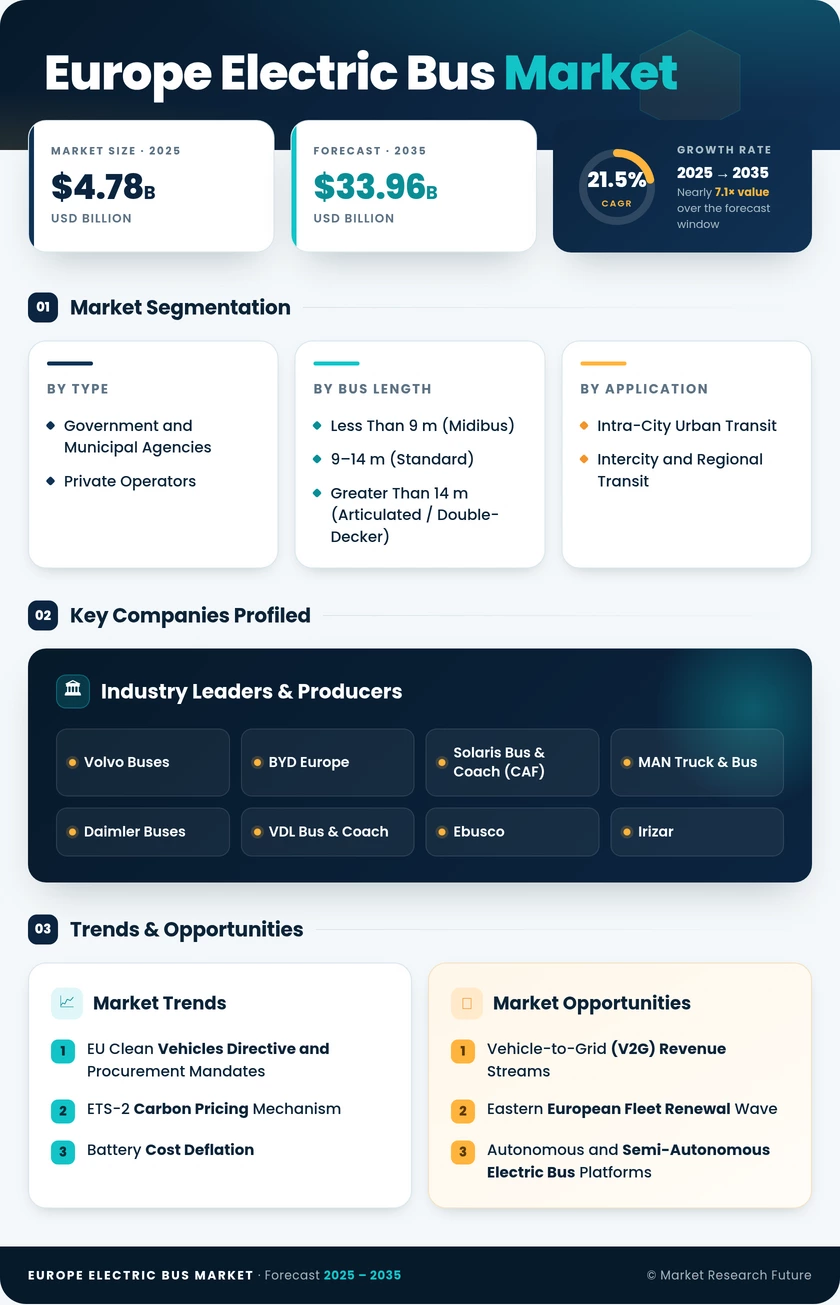
Market Size
Forecast Period2026-2035
CAGR (2026-2035)21.5%
2025 Market SizeUSD 4.78 Billion
2035 Market SizeUSD 33.96 Billion
Key Players
Volvo Buses
BYD Europe
Solaris Bus & Coach
MAN Truck & Bus
Daimler Buses
VDL Bus & Coach
Opportunities
  • Vehicle-to-Grid (V2G) Revenue Streams
  • Eastern European Fleet Renewal Wave
  • Autonomous and Semi-Autonomous Electric Bus Platforms
  1. 1 Market Overview |
    1. 1.1 Study Assumptions & Market Definition |
    2. 1.2 Scope of the Study |
    3. 1.3 Research Methodology
  2. 2 Market Summary & Key Takeaways
  3. 3 Market Dynamics |
    1. 3.1 Market Drivers Analysis | |
      1. 3.1.1 EU Clean Vehicles Directive Procurement Mandates | |
      2. 3.1.2 ETS-2 Carbon Pricing Mechanism | |
      3. 3.1.3 Battery Cost Deflation | |
      4. 3.1.4 National Subsidy Stacking (Germany, France, Italy) | |
      5. 3.1.5 Charging Infrastructure EU Funding (CEF Transport) | |
      6. 3.1.6 Urban Air-Quality Zones and Diesel Bans | |
      7. 3.1.7 Municipal ESG Reporting and Green Bond Issuance |
    2. 3.2 Market Restraints Analysis | |
      1. 3.2.1 Grid Capacity and Depot Power Constraints | |
      2. 3.2.2 High Upfront Capital Cost vs. Diesel | |
      3. 3.2.3 Intercity Range Limitations | |
      4. 3.2.4 Supply Chain Bottlenecks (Batteries, Chips) | |
      5. 3.2.5 Skilled Workforce Shortages for HV Maintenance |
    3. 3.3 Market Opportunity Analysis | |
      1. 3.3.1 Vehicle-to-Grid (V2G) Revenue Streams | |
      2. 3.3.2 Eastern European Fleet Renewal Wave | |
      3. 3.3.3 Autonomous and Semi-Autonomous Electric Bus Platforms | |
      4. 3.3.4 Battery-as-a-Service and Leasing Models | |
      5. 3.3.5 Hydrogen Fuel-Cell Buses for Long-Distance Regional Routes |
    4. 3.4 Industry Value Chain Analysis |
    5. 3.5 Porter's Five Forces Analysis
  4. 4 Europe Electric Bus Market Size & Forecast (2021–2035) |
    1. 4.1 Historical Market Size (2021–2025) |
    2. 4.2 Current & Forecast Market Size (2026–2035) |
    3. 4.3 Market Size by Revenue (USD Billion) |
    4. 4.4 Year-over-Year Growth Analysis
  5. 5 Segmentation Analysis |
    1. 5.1 By Propulsion Type | |
      1. 5.1.1 Battery Electric Bus (BEB) | |
      2. 5.1.2 Plug-In Hybrid Electric Bus (PHEB) | |
      3. 5.1.3 Fuel Cell Electric Bus (FCEB) |
    2. 5.2 By Battery Chemistry | |
      1. 5.2.1 Lithium-Iron-Phosphate (LFP) | |
      2. 5.2.2 Nickel-Metal Hydride (NiMH) | |
      3. 5.2.3 Other Chemistries |
    3. 5.3 By Bus Length | |
      1. 5.3.1 Less Than 9 m (Midibus) | |
      2. 5.3.2 9–14 m (Standard) | |
      3. 5.3.3 Greater Than 14 m (Articulated / Double-Decker) |
    4. 5.4 By Consumer Type | |
      1. 5.4.1 Government and Municipal Agencies | |
      2. 5.4.2 Private Operators |
    5. 5.5 By Application | |
      1. 5.5.1 Intra-City Urban Transit | |
      2. 5.5.2 Intercity and Regional Transit
  6. 6 Country-Level Analysis |
    1. 6.1 Germany |
    2. 6.2 United Kingdom |
    3. 6.3 France |
    4. 6.4 Italy |
    5. 6.5 Spain |
    6. 6.6 Nordic Countries |
    7. 6.7 Rest of Europe
  7. 7 Competitive Landscape |
    1. 7.1 Market Share Analysis (2025) |
    2. 7.2 Competitive Benchmarking Matrix |
    3. 7.3 Company Profiles | |
      1. 7.3.1 Volvo Buses | |
      2. 7.3.2 BYD Europe | |
      3. 7.3.3 Solaris Bus & Coach (CAF) | |
      4. 7.3.4 MAN Truck & Bus | |
      5. 7.3.5 Daimler Buses | |
      6. 7.3.6 VDL Bus & Coach | |
      7. 7.3.7 Ebusco | |
      8. 7.3.8 Irizar | |
      9. 7.3.9 Yutong Europe | |
      10. 7.3.10 IVECO Bus
  8. 8 Future Outlook & Strategic Recommendations (2026–2035) |
    1. 8.1 Electrification Supercycle and Fleet Transition Milestones |
    2. 8.2 Autonomous Operations and Smart Fleet Management |
    3. 8.3 ESG Reporting and Green Finance Integration |
    4. 8.4 Solid-State Batteries and Next-Generation Chemistries
  9. 9 Recent Developments & News
  10. 10 Frequently Asked Questions (FAQs)
  11. 11 Report Scope & Methodology |
    1. 11.1 Study Period & Base Year |
    2. 11.2 Data Sources & Citations |
    3. 11.3 Abbreviations
  12. 12 LIST OF TABLES |
  13. TABLE 1 Europe Electric Bus Market Size & Forecast, by Revenue (USD Billion), 2021–2035 |
  14. TABLE 2 Europe Electric Bus Market — Year-over-Year Growth Analysis, 2021–2035 |
  15. TABLE 3 Europe Electric Bus Market — Driver Impact Analysis |
  16. TABLE 4 Europe Electric Bus Market — Restraints Impact Analysis |
  17. TABLE 5 Europe Electric Bus Market Size, by Propulsion Type, 2021–2035 (USD Billion) |
  18. TABLE 6 Europe Electric Bus Market Size, by Battery Chemistry, 2021–2035 (USD Billion) |
  19. TABLE 7 Europe Electric Bus Market Size, by Bus Length, 2021–2035 (USD Billion) |
  20. TABLE 8 Europe Electric Bus Market Size, by Consumer Type, 2021–2035 (USD Billion) |
  21. TABLE 9 Europe Electric Bus Market Size, by Application, 2021–2035 (USD Billion) |
  22. TABLE 10 Europe Electric Bus Market Size, by Country, 2021–2035 (USD Billion) |
  23. TABLE 11 Germany Electric Bus Market Size, by Propulsion Type, 2021–2035 (USD Billion) |
  24. TABLE 12 Germany Electric Bus Market Size, by Bus Length, 2021–2035 (USD Billion) |
  25. TABLE 13 United Kingdom Electric Bus Market Size, by Propulsion Type, 2021–2035 (USD Billion) |
  26. TABLE 14 United Kingdom Electric Bus Market Size, by Bus Length, 2021–2035 (USD Billion) |
  27. TABLE 15 France Electric Bus Market Size, by Propulsion Type, 2021–2035 (USD Billion) |
  28. TABLE 16 France Electric Bus Market Size, by Bus Length, 2021–2035 (USD Billion) |
  29. TABLE 17 Italy Electric Bus Market Size, by Propulsion Type, 2021–2035 (USD Billion) |
  30. TABLE 18 Italy Electric Bus Market Size, by Bus Length, 2021–2035 (USD Billion) |
  31. TABLE 19 Spain Electric Bus Market Size, by Propulsion Type, 2021–2035 (USD Billion) |
  32. TABLE 20 Spain Electric Bus Market Size, by Bus Length, 2021–2035 (USD Billion) |
  33. TABLE 21 Nordic Countries Electric Bus Market Size, by Propulsion Type, 2021–2035 (USD Billion) |
  34. TABLE 22 Nordic Countries Electric Bus Market Size, by Bus Length, 2021–2035 (USD Billion) |
  35. TABLE 23 Rest of Europe Electric Bus Market Size, by Propulsion Type, 2021–2035 (USD Billion) |
  36. TABLE 24 Rest of Europe Electric Bus Market Size, by Bus Length, 2021–2035 (USD Billion) |
  37. TABLE 25 Competitive Benchmarking Matrix — Europe Electric Bus Market, 2025 |
  38. TABLE 26 Company Profiles — Key Players, Europe Electric Bus Market |
  39. TABLE 27 Recent Developments & Strategic Announcements, 2023–2025 |
  40. TABLE 28 Report Scope and Methodology Summary
  41. 13 LIST OF FIGURES |
  42. FIGURE 1 Europe Electric Bus Market Dynamics — Drivers, Restraints, and Opportunities |
  43. FIGURE 2 Industry Value Chain Analysis — Europe Electric Bus Market |
  44. FIGURE 3 Porter's Five Forces Analysis — Europe Electric Bus Market |
  45. FIGURE 4 Europe Electric Bus Market Size Trend (USD Billion), 2021–2035 |
  46. FIGURE 5 Europe Electric Bus Market Share, by Propulsion Type, 2025 (%) |
  47. FIGURE 6 Europe Electric Bus Market Share, by Bus Length, 2025 (%) |
  48. FIGURE 7 Europe Electric Bus Market Share, by Consumer Type, 2025 (%) |
  49. FIGURE 8 Europe Electric Bus Market Share, by Application, 2025 (%) |
  50. FIGURE 9 Europe Electric Bus Market Share, by Country, 2025 (%) |
  51. FIGURE 10 Europe Electric Bus Market — Competitive Landscape Heat Map, 2025 |
  52. FIGURE 11 Europe Electric Bus Market Revenue Forecast by Propulsion Type, 2026–2035

Segmentation Quick Reference

DimensionSub-SegmentsDominant Segment (2025)Fastest Growing Segment (2026–2035)
Propulsion TypeBattery Electric Bus (BEB); Plug-In Hybrid Electric Bus (PHEB); Fuel Cell Electric Bus (FCEB)Battery Electric Bus (BEB)Fuel Cell Electric Bus (FCEB)
Battery ChemistryLithium-Iron-Phosphate (LFP); Nickel-Metal Hydride (NiMH); OthersLFPLFP
Bus LengthLess Than 9 m; 9–14 m (Standard); Greater Than 14 m (Articulated / Double-Decker)9–14 m (Standard)Greater Than 14 m (Articulated / Double-Decker)
Consumer TypeGovernment and Municipal Agencies; Private OperatorsGovernment and Municipal AgenciesPrivate Operators
ApplicationIntra-City Urban Transit; Intercity and Regional TransitIntra-City Urban TransitIntercity and Regional Transit
GeographyGermany; UK; France; Italy; Spain; Nordic Countries; Rest of EuropeGermanyItaly


Market Segmentation Overview

By Propulsion Type

Sub-SegmentKey Trend
Battery Electric Bus (BEB)Dominant and fastest-growing propulsion segment, driven by depot-charging maturity and LFP battery cost declines
Plug-In Hybrid Electric Bus (PHEB)Declining share as full-electric range improves; serves as transitional technology in infrastructure-limited corridors
Fuel Cell Electric Bus (FCEB)Rising adoption for intercity routes exceeding 400 km; tied to EU hydrogen backbone investments


Battery-electric buses account for the vast majority of new procurement orders across Europe, supported by falling battery costs and standardized depot-charging systems. Fuel-cell electric buses are carving a niche on longer regional routes where hydrogen refueling provides faster turnaround than opportunity charging.

By Battery Chemistry

Sub-SegmentKey Trend
Lithium-Iron-Phosphate (LFP)Preferred chemistry for European e-bus OEMs due to thermal stability, long cycle life, and lower per-kWh cost
Nickel-Metal Hydride (NiMH)Legacy chemistry with declining share; retained in select hybrid applications
Other ChemistriesIncludes NMC and emerging solid-state technologies targeting higher energy density applications


LFP dominates new European electric bus installations due to superior cycle life (3,000+), lower fire risk, and a cost structure that dropped below USD 100/kWh at cell level in late 2024. NMC chemistries retain a role where weight constraints or range requirements justify the premium.

By Bus Length

Sub-SegmentKey Trend
Less Than 9 m (Midibus)Used for low-demand feeder routes, historic city centers, and shuttle services
9–14 m (Standard)Workhorse segment for urban transit; highest procurement volume across all European markets
Greater Than 14 m (Articulated / Double-Decker)Fastest-growing format; deployed on high-capacity trunk routes and BRT corridors


Standard 12-meter buses remain the most-ordered configuration, but articulated 18-meter models and double-decker platforms are gaining share as transit authorities seek to maximize passenger capacity per driver on trunk routes.

By Consumer Type

Sub-SegmentKey Trend
Government and Municipal AgenciesDominant buyer segment; driven by Clean Vehicles Directive procurement quotas
Private OperatorsFastest-growing segment; airport shuttles, tourism, and corporate campus electrification


Public transit authorities remain the primary demand driver, but private-sector adoption is accelerating as total cost of ownership reaches parity with diesel on high-utilization shuttle and tourism routes.

By Application

Sub-SegmentKey Trend
Intra-City Urban TransitCore application; fixed-route, depot-return profiles maximize BEB economics
Intercity and Regional TransitFastest-growing application segment; enabled by hydrogen fuel cells and next-generation battery chemistries


Intra-city urban transit represents the natural stronghold for electric bus deployment, while intercity applications are emerging as hydrogen refueling infrastructure and higher-density batteries extend viable operating range beyond 400 km per day.


just now

Download PDF ×

We do not share your information with anyone. However, we may send you emails based on your report interest from time to time. You may contact us at any time to opt-out.