×
Hero Background
English
Chinese
French
Japanese
Korean
German
Spanish

EUROPE CCUS Market Share

ID: MRFR/EnP/14636-HCR
128 Pages
Garvit Vyas
October 2025

EUROPE CCUS Market Research Report Information By Service (Capture, Transportation, Utilization, Storage), By Technology (Pre-combustion capture, Oxy-fuel combustion capture, Post-combustion capture), By End Use Industry (Oil & gas, Power generation, Iron & steel, Chemical & petrochemical, Cement, Others), – and Europe Market Forecast Till 2035

Share:
Download PDF ×

We do not share your information with anyone. However, we may send you emails based on your report interest from time to time. You may contact us at any time to opt-out.

EUROPE CCUS Market Infographic
Purchase Options

Market Share

EUROPE CCUS Market Share Analysis

The Europe CCUS (Carbon Capture, Utilization, and Storage) market is currently experiencing dynamic trends that reflect the region's commitment to mitigating climate change and achieving carbon neutrality. One prominent trend is the increasing adoption of CCUS technologies across various industries. Governments and businesses alike are recognizing the pivotal role that carbon capture plays in reducing greenhouse gas emissions.

Several European countries are actively investing in CCUS infrastructure and projects to achieve their climate targets. The European Union's ambitious Green Deal, aiming for net-zero emissions by 2050, has been a driving force behind the surge in CCUS initiatives. As a result, the market is witnessing a notable uptick in funding for research and development, as well as the implementation of large-scale CCUS projects.

In recent years, there has been a growing emphasis on the utilization aspect of CCUS. Beyond merely capturing and storing carbon dioxide, there is a push towards finding innovative ways to utilize this captured carbon. Industries are exploring avenues such as carbon utilization in the production of fuels, chemicals, and materials. This trend aligns with the circular economy concept, where waste products are repurposed, contributing to a more sustainable and resource-efficient future.

Collaboration between public and private sectors is another key trend in the Europe CCUS market. Governments are incentivizing businesses to invest in CCUS technologies through subsidies, tax breaks, and other financial incentives. This collaborative approach is essential for overcoming the financial barriers associated with CCUS projects, making them more economically viable for implementation.

Furthermore, there is a noticeable shift towards regional cooperation in the development and deployment of CCUS infrastructure. European countries are recognizing the shared challenges and opportunities in achieving carbon neutrality, leading to collaborative efforts to create interconnected CCUS networks. This approach enhances the efficiency of carbon capture and storage, facilitating the movement of captured carbon across borders for storage or utilization.

The energy sector plays a pivotal role in the Europe CCUS market trends. As the region transitions towards cleaner energy sources, there is an increased focus on decarbonizing existing fossil fuel-based energy production. CCUS is viewed as a crucial tool in this transition, allowing for the continued use of fossil fuels while minimizing their environmental impact. The retrofitting of existing power plants with carbon capture technology is becoming a prevalent practice, ensuring a more sustainable energy mix.

Public awareness and acceptance of CCUS technologies are also on the rise. As the urgency of addressing climate change becomes more apparent, there is a growing understanding among the general population about the role of CCUS in mitigating carbon emissions. This increased awareness is influencing both public and private sectors to allocate resources and efforts towards CCUS projects.

However, challenges persist in the Europe CCUS market. One notable obstacle is the need for a robust regulatory framework that addresses issues related to liability, storage, and transportation of captured carbon. Clear and standardized regulations are essential for fostering a conducive environment for CCUS investments and operations.

In conclusion, the Europe CCUS market is characterized by dynamic and positive trends driven by environmental imperatives, government policies, and technological advancements. The increasing adoption of CCUS technologies, emphasis on carbon utilization, collaborative efforts, energy sector transformations, and growing public awareness collectively contribute to a promising future for carbon capture, utilization, and storage in Europe. As the region continues to prioritize sustainability and climate action, the CCUS market is poised for further growth and innovation in the coming years.


Author
Garvit Vyas
Analyst

Explore the profile of Garvit Vyas, one of our esteemed authors at Market Research Future, and access their expert research contributions in the field of market research and industry analysis

Leave a Comment

FAQs

What is the current valuation of the Europe CCUS Market as of 2024?

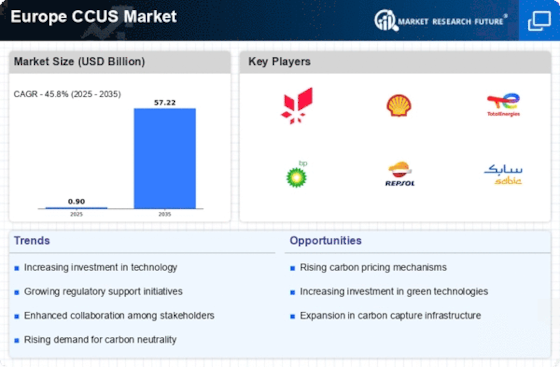
The Europe CCUS Market was valued at 0.904 USD Billion in 2024.

What is the projected market size for the Europe CCUS Market by 2035?

The market is projected to reach 57.22 USD Billion by 2035.

What is the expected CAGR for the Europe CCUS Market during the forecast period 2025 - 2035?

The expected CAGR for the Europe CCUS Market during 2025 - 2035 is 45.8%.

Which companies are considered key players in the Europe CCUS Market?

Key players include Equinor, Shell, TotalEnergies, BP, Repsol, SABIC, Linde, Air Liquide, Climeworks, and Carbon Clean Solutions.

What are the main segments of the Europe CCUS Market?

The main segments include Capture, Transportation, Utilization, and Storage.

Market Summary

As per Market Research Future analysis, the Europe CCUS Market Size was estimated at 0.904 USD Billion in 2024. The Europe CCUS industry is projected to grow from 1.318 USD Billion in 2025 to 57.22 USD Billion by 2035, exhibiting a compound annual growth rate (CAGR) of 45% during the forecast period 2025 - 2035

Key Market Trends & Highlights

The Europe CCUS market is poised for substantial growth driven by regulatory enhancements and technological advancements.

  • The regulatory framework enhancement across Europe is fostering a more conducive environment for CCUS projects. Corporate sustainability initiatives are increasingly influencing investment decisions in the CCUS sector. Technological advancements in post-combustion capture are solidifying its position as the largest segment in the market. Investment in infrastructure development and public awareness are key drivers propelling the growth of the storage segment.

Market Size & Forecast

2024 Market Size 0.904 (USD Billion)
2035 Market Size 57.22 (USD Billion)
CAGR (2025 - 2035) 45.8%
Largest Regional Market Share in 2024 Europe

Major Players

<p><a href="https://www.equinor.com/energy/carbon-capture-utilisation-and-storage">Equinor</a> (NO), Shell (GB), TotalEnergies (FR), BP (GB), Repsol (ES), SABIC (SA), <a href="https://www.linde.com/clean-energy/carbon-capture">Linde</a> (DE), Air Liquide (FR), Climeworks (CH), Carbon Clean Solutions (GB)</p>

Market Trends

The Europe CCUS Market is currently experiencing a transformative phase, driven by a confluence of regulatory support, technological advancements, and increasing awareness of climate change impacts. Governments across the region are implementing policies that encourage the adoption of carbon capture, utilization, and storage technologies. This regulatory framework appears to be fostering investment in innovative solutions that aim to reduce greenhouse gas emissions. Furthermore, the collaboration between public and private sectors is likely to enhance research and development efforts, potentially leading to breakthroughs in efficiency and cost-effectiveness. In addition to regulatory influences, the Europe CCUS Market is witnessing a growing emphasis on sustainability among industries. Companies are increasingly recognizing the necessity of integrating carbon management strategies into their operations. This shift not only aligns with corporate social responsibility goals but also addresses the rising expectations of consumers and stakeholders. As a result, the market is poised for expansion, with various sectors exploring CCUS technologies as viable options for achieving net-zero targets. The interplay of these factors suggests a dynamic landscape for the Europe CCUS Market, characterized by innovation and a commitment to environmental stewardship.

Regulatory Framework Enhancement

The regulatory landscape in Europe is evolving, with governments establishing supportive policies that promote carbon capture technologies. This enhancement appears to stimulate investment and innovation, encouraging industries to adopt CCUS solutions.

Corporate Sustainability Initiatives

There is a noticeable trend among companies in Europe to prioritize sustainability. Many organizations are integrating carbon management into their business models, reflecting a commitment to environmental responsibility and responding to stakeholder expectations.

Technological Advancements in CCUS

Ongoing research and development efforts are yielding significant technological advancements in carbon capture and storage. These innovations may lead to improved efficiency and reduced costs, making CCUS more accessible to various industries.

EUROPE CCUS Market Market Drivers

Public Awareness and Support

Public awareness and support for climate action are emerging as critical drivers for the Europe CCUS Market. As citizens become more informed about the impacts of climate change, there is a growing demand for effective solutions to mitigate carbon emissions. Surveys indicate that a significant portion of the European population supports the implementation of CCUS technologies as part of broader climate strategies. This public backing is likely to influence policymakers to prioritize funding and resources for CCUS projects. Additionally, community engagement initiatives are fostering local support for CCUS facilities, which is essential for their successful deployment. The increasing recognition of the importance of carbon management in achieving climate goals is expected to create a conducive environment for the expansion of the Europe CCUS Market.

Regulatory Framework Enhancement

The Europe CCUS Market is currently experiencing a robust transformation due to the enhancement of regulatory frameworks. Governments across Europe are implementing stringent policies aimed at reducing carbon emissions, which is likely to drive investment in carbon capture, utilization, and storage technologies. For instance, the European Union's Green Deal aims to achieve net-zero emissions by 2050, creating a favorable environment for CCUS projects. This regulatory push is expected to increase funding opportunities, with the European Commission allocating substantial financial resources to support CCUS initiatives. As a result, the market is projected to grow significantly, with estimates suggesting a compound annual growth rate of over 20% in the coming years. This regulatory landscape not only incentivizes innovation but also fosters collaboration among stakeholders, thereby enhancing the overall viability of the Europe CCUS Market.

Technological Advancements in CCUS

Technological advancements are playing a pivotal role in shaping the Europe CCUS Market. Innovations in carbon capture technologies, such as direct air capture and bioenergy with carbon capture and storage, are enhancing the efficiency and cost-effectiveness of CCUS solutions. Recent developments indicate that the cost of capturing carbon has decreased significantly, making it more accessible for various industries. Furthermore, the integration of artificial intelligence and machine learning in monitoring and optimizing CCUS processes is expected to improve operational efficiency. As these technologies continue to evolve, they are likely to attract increased investment and interest from both public and private sectors. The potential for scaling up these technologies could lead to a substantial increase in carbon capture capacity across Europe, thereby bolstering the growth trajectory of the Europe CCUS Market.

Corporate Sustainability Initiatives

In the context of the Europe CCUS Market, corporate sustainability initiatives are becoming increasingly prevalent. Many companies are recognizing the importance of reducing their carbon footprints and are actively seeking solutions to achieve their sustainability goals. This trend is particularly evident in sectors such as energy, manufacturing, and transportation, where carbon emissions are substantial. A report indicates that over 60% of major corporations in Europe have set ambitious targets for carbon neutrality by 2030. Consequently, these companies are investing in CCUS technologies as a means to offset their emissions. The growing demand for sustainable practices is likely to stimulate innovation within the CCUS sector, leading to the development of more efficient and cost-effective solutions. This shift not only enhances the competitive advantage of businesses but also contributes to the overall growth of the Europe CCUS Market.

Investment in Infrastructure Development

Investment in infrastructure development is a crucial driver for the Europe CCUS Market. The establishment of a robust infrastructure for carbon transport and storage is essential for the successful implementation of CCUS technologies. Recent data suggests that substantial investments are being made in pipeline networks and storage facilities across Europe, with several projects in the planning stages. For instance, the North Sea is being developed as a major hub for carbon storage, with the potential to store millions of tons of CO2 annually. This infrastructure investment not only facilitates the deployment of CCUS technologies but also enhances the overall efficiency of carbon management strategies. As more stakeholders recognize the importance of infrastructure in supporting CCUS initiatives, the Europe CCUS Market is likely to witness accelerated growth and development.

Market Segment Insights

By Type: Capture (Largest) vs. Storage (Fastest-Growing)

<p>In the Europe CCUS market, the capture segment dominates with a significant market share, attributed to advanced technologies and increasing industrial adoption. The emphasis on reducing carbon emissions has propelled capture solutions into the limelight, making it a leading player in this sector. Conversely, the storage segment is emerging as the fastest-growing segment, as industry stakeholders recognize the necessity of safe long-term storage solutions for captured carbon. This rapid growth is driven by new regulations and investments aimed at enhancing infrastructure for underground storage facilities.</p>

<p>Storage: Capture (Dominant) vs. Storage (Emerging)</p>

<p>The capture segment is currently the dominant force in the Europe CCUS market, characterized by mature technologies and well-established practices within various sectors. Leading companies focus on developing more efficient capture methods, which fuel the demand across sectors such as power generation and manufacturing. In contrast, the storage segment is rapidly evolving, thanks to the growing requirement for effective long-term carbon sequestration solutions. Companies are investing heavily in research to improve storage technologies, and regulatory support is increasingly backing initiatives for carbon storage, positioning this segment as an emerging leader in the Europe CCUS landscape.</p>

By Technology: Post-combustion capture (Largest) vs. Oxy-fuel combustion capture (Fastest-Growing)

<p>In the Europe CCUS Market, the technology segment is dominated by post-combustion capture, which holds the largest market share. This method is favored for its compatibility with existing power plants and industrial facilities, making it easier to implement. Meanwhile, pre-combustion capture is also present, comprising a smaller but significant portion of the market. Together, these technologies shape the CCUS landscape in Europe, contributing to the region's carbon reduction goals.</p>

<p>Technology: Post-combustion capture (Dominant) vs. Oxy-fuel combustion capture (Emerging)</p>

<p>Post-combustion capture has established itself as a dominant technology within the Europe CCUS market due to its integration capabilities with existing infrastructure, leading to lower costs and reduced implementation times. In contrast, oxy-fuel combustion capture is emerging rapidly as a transformative technology, driven by advancements in equipment and growing government support for innovative solutions to carbon emissions. The unique advantages of oxy-fuel combustion, including higher purity of captured CO2, position it well for growth, especially as industries seek cleaner and more efficient processes. This technological evolution indicates a shift towards more sophisticated carbon capture solutions.</p>

By End Users: Oil & gas (Largest) vs. Power generation (Fastest-Growing)

<p>In the Europe CCUS market, the end users' segment is primarily dominated by the oil and gas industry, which accounts for a significant portion of the market share. This sector utilizes CCUS technologies to enhance oil recovery and reduce emissions, solidifying its market leader status. On the other hand, the power generation industry is witnessing rapid adoption of CCUS solutions as governments push for emissions reduction in alignment with climate policies, making it one of the fastest-growing segments within the market.</p>

<p>Oil &amp; gas (Dominant) vs. Power generation (Emerging)</p>

<p>The oil and gas sector remains the dominant end user in the Europe CCUS market due to its established infrastructure and necessity for carbon management in extraction processes. Companies within this sector are leveraging CCUS to meet regulatory requirements and enhance the sustainability of their operations. In contrast, the power generation segment is emerging as a key player by adopting innovative technologies to lower carbon emissions associated with <a href="https://www.marketresearchfuture.com/reports/fossil-fuel-market-31570">fossil fuel</a> power plants. This segment is investing in CCUS to not only comply with environmental regulations but also to transition towards cleaner energy sources, indicating a substantial shift in the energy landscape.</p>

Get more detailed insights about EUROPE CCUS Market Research Report – Forecast till 2035

Regional Insights

North America : Innovation Hub

North America is a frontrunner in the CCUS market, driven by robust investments and supportive regulations. The U.S. holds the largest market share at approximately 70%, with Canada following at around 20%. Key drivers include federal tax incentives and state-level initiatives aimed at reducing carbon emissions. The growing demand for sustainable energy solutions further propels market growth, making it a critical region for CCUS advancements. The competitive landscape is dominated by major players such as ExxonMobil, Occidental Petroleum, and Chevron, which are heavily investing in CCUS technologies. The presence of innovative startups and research institutions also enhances the region's capabilities. With a focus on large-scale projects and collaborations, North America is set to lead The Europe CCUS in the coming years.

Europe : Sustainable Transition Leader

Europe is emerging as a leader in the CCUS market, driven by stringent climate policies and ambitious carbon neutrality goals. The European Union aims to achieve net-zero emissions by 2050, creating a favorable regulatory environment. The largest market share is held by Germany at approximately 30%, followed closely by the Netherlands at around 25%. This regulatory push is fostering innovation and investment in CCUS technologies across the region. Key players such as Equinor, Shell, and TotalEnergies are actively involved in various CCUS projects, enhancing the competitive landscape. Countries like Norway and the UK are also making significant strides in developing infrastructure for carbon capture and storage. The collaboration between governments and private sectors is crucial for scaling up CCUS initiatives, positioning Europe as a global leader in sustainable energy solutions.

Asia-Pacific : Emerging Powerhouse

The Asia-Pacific region is witnessing a surge in demand for CCUS technologies, driven by rapid industrialization and urbanization. Countries like China and Japan are at the forefront, with China holding the largest market share at approximately 40%, while Japan accounts for about 15%. Government initiatives aimed at reducing carbon footprints and enhancing energy security are key growth drivers in this region. The increasing focus on renewable energy sources further complements the demand for CCUS solutions. The competitive landscape features major players such as Mitsubishi Heavy Industries and Sinopec, which are investing heavily in CCUS projects. Additionally, collaborations between governments and private sectors are fostering innovation and technology transfer. As the region seeks to balance economic growth with environmental sustainability, CCUS is becoming an integral part of the energy transition strategy.

Middle East and Africa : Resource-Rich Frontier

The Middle East and Africa region presents significant potential for CCUS development, driven by abundant natural resources and a growing focus on sustainability. Countries like Saudi Arabia and South Africa are leading the charge, with Saudi Arabia holding a market share of approximately 25%. The region's commitment to diversifying its economy and reducing carbon emissions is fostering a conducive environment for CCUS investments. Regulatory frameworks are gradually evolving to support these initiatives. Key players such as SABIC and Linde are actively involved in CCUS projects, enhancing the competitive landscape. The presence of oil and gas companies is crucial, as they seek to integrate CCUS into their operations. As the region continues to explore sustainable energy solutions, CCUS is expected to play a vital role in achieving environmental goals and economic diversification.

Key Players and Competitive Insights

The Europe Carbon Capture, Utilization, and Storage (CCUS) market is currently characterized by a dynamic competitive landscape, driven by increasing regulatory pressures and a collective commitment to achieving net-zero emissions. Key players such as Equinor (NO), Shell (GB), and TotalEnergies (FR) are strategically positioning themselves through innovation and partnerships, which appear to be pivotal in shaping the market's trajectory. These companies are not only investing in advanced technologies but are also exploring collaborative ventures to enhance their operational capabilities and market reach, thereby fostering a more integrated approach to CCUS solutions.

In terms of business tactics, companies are increasingly localizing their operations and optimizing supply chains to enhance efficiency and reduce costs. The competitive structure of the Europe CCUS market seems moderately fragmented, with several players vying for market share. However, the influence of major corporations is substantial, as they leverage their resources and expertise to set industry standards and drive technological advancements.

In September 2025, Equinor (NO) announced a significant partnership with a leading European utility company to develop a large-scale CCUS project in the North Sea. This collaboration is expected to enhance Equinor's capabilities in carbon storage and utilization, positioning the company as a frontrunner in the region. The strategic importance of this move lies in its potential to accelerate the deployment of CCUS technologies, thereby contributing to the decarbonization of the energy sector.

In August 2025, Shell (GB) unveiled its plans to invest in a new carbon capture facility in the Netherlands, which aims to capture up to 1 million tons of CO2 annually. This initiative underscores Shell's commitment to sustainability and its proactive approach to addressing climate change. The facility is anticipated to play a crucial role in the company's broader strategy to achieve net-zero emissions by 2050, highlighting the growing trend of integrating CCUS into corporate sustainability frameworks.

In July 2025, TotalEnergies (FR) expanded its CCUS portfolio by acquiring a stake in a pioneering carbon utilization startup. This acquisition is indicative of TotalEnergies' strategy to diversify its technological capabilities and enhance its competitive edge in the CCUS market. By investing in innovative solutions, the company aims to not only capture carbon but also convert it into valuable products, thus aligning with the circular economy principles.

As of October 2025, the competitive trends within the Europe CCUS market are increasingly defined by digitalization, sustainability, and the integration of artificial intelligence. Strategic alliances among key players are shaping the landscape, fostering innovation and collaboration. Looking ahead, it appears that competitive differentiation will evolve from traditional price-based competition to a focus on technological innovation, reliability in supply chains, and the ability to deliver sustainable solutions. This shift may redefine the parameters of success in the CCUS market, emphasizing the importance of adaptability and forward-thinking strategies.

Key Companies in the EUROPE CCUS Market market include

Industry Developments

In 2020:ExxonMobil and Global Thermostat extended their collaborative development agreement after a year of technical assessment aimed at gauging the viability and scalability of Global Thermostat's technology, which involves capturing carbon dioxide (CO2) directly from the air.

Future Outlook

EUROPE CCUS Market Future Outlook

<p>The Europe CCUS Market is projected to grow at a 45.8% CAGR from 2024 to 2035, driven by regulatory support, technological advancements, and increasing carbon pricing.</p>

New opportunities lie in:

  • <p>Development of integrated carbon capture and storage networks</p>
  • <p>Investment in carbon utilization technologies for industrial applications</p>
  • <p>Expansion of carbon credit trading platforms for enhanced revenue streams</p>

<p>By 2035, the Europe CCUS Market is poised for substantial growth, establishing a robust framework for carbon management.</p>

Market Segmentation

EUROPE CCUS Market Type Outlook

  • Capture
  • Transportation
  • Utilization
  • Storage

EUROPE CCUS Market End Users Outlook

  • Oil & gas
  • Power generation
  • Iron & steel
  • Chemical & petrochemical
  • Cement
  • Others

EUROPE CCUS Market Technology Outlook

  • Pre-combustion capture
  • Oxy-fuel combustion capture
  • Post-combustion capture

Report Scope

MARKET SIZE 2024 0.904(USD Billion)
MARKET SIZE 2025 1.318(USD Billion)
MARKET SIZE 2035 57.22(USD Billion)
COMPOUND ANNUAL GROWTH RATE (CAGR) 45.8% (2024 - 2035)
REPORT COVERAGE Revenue Forecast, Competitive Landscape, Growth Factors, and Trends
BASE YEAR 2024
Market Forecast Period 2025 - 2035
Historical Data 2019 - 2024
Market Forecast Units USD Billion
Key Companies Profiled Equinor (NO), Shell (GB), TotalEnergies (FR), BP (GB), Repsol (ES), SABIC (SA), Linde (DE), Air Liquide (FR), Climeworks (CH), Carbon Clean Solutions (GB)
Segments Covered Service, Technology, End Use Industry
Key Market Opportunities Expansion of carbon capture utilization and storage technologies driven by stringent European climate policies.
Key Market Dynamics Rising regulatory support and technological advancements drive growth in the Europe Carbon Capture, Utilization, and Storage market.
Countries Covered North America, Europe, APAC, South America, MEA

FAQs

What is the current valuation of the Europe CCUS Market as of 2024?

The Europe CCUS Market was valued at 0.904 USD Billion in 2024.

What is the projected market size for the Europe CCUS Market by 2035?

The market is projected to reach 57.22 USD Billion by 2035.

What is the expected CAGR for the Europe CCUS Market during the forecast period 2025 - 2035?

The expected CAGR for the Europe CCUS Market during 2025 - 2035 is 45.8%.

Which companies are considered key players in the Europe CCUS Market?

Key players include Equinor, Shell, TotalEnergies, BP, Repsol, SABIC, Linde, Air Liquide, Climeworks, and Carbon Clean Solutions.

What are the main segments of the Europe CCUS Market?

The main segments include Capture, Transportation, Utilization, and Storage.

  1. SECTION I: EXECUTIVE SUMMARY AND KEY HIGHLIGHTS
    1. EXECUTIVE SUMMARY
      1. Market Overview
      2. Key Findings
      3. Market Segmentation
      4. Competitive Landscape
      5. Challenges and Opportunities
      6. Future Outlook 2
  2. SECTION II: SCOPING, METHODOLOGY AND MARKET STRUCTURE
    1. MARKET INTRODUCTION
      1. Definition
      2. Scope of the study
    2. RESEARCH METHODOLOGY
      1. Overview
      2. Data Mining
      3. Secondary Research
      4. Primary Research
      5. Forecasting Model
      6. Market Size Estimation
      7. Data Triangulation
      8. Validation 3
  3. SECTION III: QUALITATIVE ANALYSIS
    1. MARKET DYNAMICS
      1. Overview
      2. Drivers
      3. Restraints
      4. Opportunities
    2. MARKET FACTOR ANALYSIS
      1. Value chain Analysis
      2. Porter's Five Forces Analysis
      3. COVID-19 Impact Analysis
  4. SECTION IV: QUANTITATIVE ANALYSIS
    1. Energy & Power, BY Type (USD Billion)
      1. Capture
      2. Transportation
      3. Utilization
      4. Storage
    2. Energy & Power, BY Technology (USD Billion)
      1. Pre-combustion capture
      2. Oxy-fuel combustion capture
      3. Post-combustion capture
    3. Energy & Power, BY End Users (USD Billion)
      1. Oil & gas
      2. Power generation
      3. Iron & steel
      4. Chemical & petrochemical
      5. Cement
      6. Others
    4. Energy & Power, BY Region (USD Billion)
      1. North America
      2. Europe
      3. APAC
      4. South America
      5. MEA
  5. SECTION V: COMPETITIVE ANALYSIS
    1. Competitive Landscape
      1. Overview
      2. Competitive Analysis
      3. Market share Analysis
      4. Major Growth Strategy in the Energy & Power
      5. Competitive Benchmarking
      6. Leading Players in Terms of Number of Developments in the Energy & Power
      7. Key developments and growth strategies
      8. Major Players Financial Matrix
    2. Company Profiles
      1. Equinor (NO)
      2. Shell (GB)
      3. TotalEnergies (FR)
      4. BP (GB)
      5. Repsol (ES)
      6. SABIC (SA)
      7. Linde (DE)
      8. Air Liquide (FR)
      9. Climeworks (CH)
      10. Carbon Clean Solutions (GB)
    3. Appendix
      1. References
      2. Related Reports 6 LIST OF FIGURES
    4. MARKET SYNOPSIS
    5. NORTH AMERICA MARKET ANALYSIS
    6. US MARKET ANALYSIS BY TYPE
    7. US MARKET ANALYSIS BY TECHNOLOGY
    8. US MARKET ANALYSIS BY END USERS
    9. CANADA MARKET ANALYSIS BY TYPE
    10. CANADA MARKET ANALYSIS BY TECHNOLOGY
    11. CANADA MARKET ANALYSIS BY END USERS
    12. EUROPE MARKET ANALYSIS
    13. GERMANY MARKET ANALYSIS BY TYPE
    14. GERMANY MARKET ANALYSIS BY TECHNOLOGY
    15. GERMANY MARKET ANALYSIS BY END USERS
    16. UK MARKET ANALYSIS BY TYPE
    17. UK MARKET ANALYSIS BY TECHNOLOGY
    18. UK MARKET ANALYSIS BY END USERS
    19. FRANCE MARKET ANALYSIS BY TYPE
    20. FRANCE MARKET ANALYSIS BY TECHNOLOGY
    21. FRANCE MARKET ANALYSIS BY END USERS
    22. RUSSIA MARKET ANALYSIS BY TYPE
    23. RUSSIA MARKET ANALYSIS BY TECHNOLOGY
    24. RUSSIA MARKET ANALYSIS BY END USERS
    25. ITALY MARKET ANALYSIS BY TYPE
    26. ITALY MARKET ANALYSIS BY TECHNOLOGY
    27. ITALY MARKET ANALYSIS BY END USERS
    28. SPAIN MARKET ANALYSIS BY TYPE
    29. SPAIN MARKET ANALYSIS BY TECHNOLOGY
    30. SPAIN MARKET ANALYSIS BY END USERS
    31. REST OF EUROPE MARKET ANALYSIS BY TYPE
    32. REST OF EUROPE MARKET ANALYSIS BY TECHNOLOGY
    33. REST OF EUROPE MARKET ANALYSIS BY END USERS
    34. APAC MARKET ANALYSIS
    35. CHINA MARKET ANALYSIS BY TYPE
    36. CHINA MARKET ANALYSIS BY TECHNOLOGY
    37. CHINA MARKET ANALYSIS BY END USERS
    38. INDIA MARKET ANALYSIS BY TYPE
    39. INDIA MARKET ANALYSIS BY TECHNOLOGY
    40. INDIA MARKET ANALYSIS BY END USERS
    41. JAPAN MARKET ANALYSIS BY TYPE
    42. JAPAN MARKET ANALYSIS BY TECHNOLOGY
    43. JAPAN MARKET ANALYSIS BY END USERS
    44. SOUTH KOREA MARKET ANALYSIS BY TYPE
    45. SOUTH KOREA MARKET ANALYSIS BY TECHNOLOGY
    46. SOUTH KOREA MARKET ANALYSIS BY END USERS
    47. MALAYSIA MARKET ANALYSIS BY TYPE
    48. MALAYSIA MARKET ANALYSIS BY TECHNOLOGY
    49. MALAYSIA MARKET ANALYSIS BY END USERS
    50. THAILAND MARKET ANALYSIS BY TYPE
    51. THAILAND MARKET ANALYSIS BY TECHNOLOGY
    52. THAILAND MARKET ANALYSIS BY END USERS
    53. INDONESIA MARKET ANALYSIS BY TYPE
    54. INDONESIA MARKET ANALYSIS BY TECHNOLOGY
    55. INDONESIA MARKET ANALYSIS BY END USERS
    56. REST OF APAC MARKET ANALYSIS BY TYPE
    57. REST OF APAC MARKET ANALYSIS BY TECHNOLOGY
    58. REST OF APAC MARKET ANALYSIS BY END USERS
    59. SOUTH AMERICA MARKET ANALYSIS
    60. BRAZIL MARKET ANALYSIS BY TYPE
    61. BRAZIL MARKET ANALYSIS BY TECHNOLOGY
    62. BRAZIL MARKET ANALYSIS BY END USERS
    63. MEXICO MARKET ANALYSIS BY TYPE
    64. MEXICO MARKET ANALYSIS BY TECHNOLOGY
    65. MEXICO MARKET ANALYSIS BY END USERS
    66. ARGENTINA MARKET ANALYSIS BY TYPE
    67. ARGENTINA MARKET ANALYSIS BY TECHNOLOGY
    68. ARGENTINA MARKET ANALYSIS BY END USERS
    69. REST OF SOUTH AMERICA MARKET ANALYSIS BY TYPE
    70. REST OF SOUTH AMERICA MARKET ANALYSIS BY TECHNOLOGY
    71. REST OF SOUTH AMERICA MARKET ANALYSIS BY END USERS
    72. MEA MARKET ANALYSIS
    73. GCC COUNTRIES MARKET ANALYSIS BY TYPE
    74. GCC COUNTRIES MARKET ANALYSIS BY TECHNOLOGY
    75. GCC COUNTRIES MARKET ANALYSIS BY END USERS
    76. SOUTH AFRICA MARKET ANALYSIS BY TYPE
    77. SOUTH AFRICA MARKET ANALYSIS BY TECHNOLOGY
    78. SOUTH AFRICA MARKET ANALYSIS BY END USERS
    79. REST OF MEA MARKET ANALYSIS BY TYPE
    80. REST OF MEA MARKET ANALYSIS BY TECHNOLOGY
    81. REST OF MEA MARKET ANALYSIS BY END USERS
    82. KEY BUYING CRITERIA OF ENERGY & POWER
    83. RESEARCH PROCESS OF MRFR
    84. DRO ANALYSIS OF ENERGY & POWER
    85. DRIVERS IMPACT ANALYSIS: ENERGY & POWER
    86. RESTRAINTS IMPACT ANALYSIS: ENERGY & POWER
    87. SUPPLY / VALUE CHAIN: ENERGY & POWER
    88. ENERGY & POWER, BY TYPE, 2024 (% SHARE)
    89. ENERGY & POWER, BY TYPE, 2024 TO 2035 (USD Billion)
    90. ENERGY & POWER, BY TECHNOLOGY, 2024 (% SHARE)
    91. ENERGY & POWER, BY TECHNOLOGY, 2024 TO 2035 (USD Billion)
    92. ENERGY & POWER, BY END USERS, 2024 (% SHARE)
    93. ENERGY & POWER, BY END USERS, 2024 TO 2035 (USD Billion)
    94. BENCHMARKING OF MAJOR COMPETITORS 7 LIST OF TABLES
    95. LIST OF ASSUMPTIONS
    96. North America MARKET SIZE ESTIMATES; FORECAST
      1. BY TYPE, 2025-2035 (USD Billion)
      2. BY TECHNOLOGY, 2025-2035 (USD Billion)
      3. BY END USERS, 2025-2035 (USD Billion)
    97. US MARKET SIZE ESTIMATES; FORECAST
      1. BY TYPE, 2025-2035 (USD Billion)
      2. BY TECHNOLOGY, 2025-2035 (USD Billion)
      3. BY END USERS, 2025-2035 (USD Billion)
    98. Canada MARKET SIZE ESTIMATES; FORECAST
      1. BY TYPE, 2025-2035 (USD Billion)
      2. BY TECHNOLOGY, 2025-2035 (USD Billion)
      3. BY END USERS, 2025-2035 (USD Billion)
    99. Europe MARKET SIZE ESTIMATES; FORECAST
      1. BY TYPE, 2025-2035 (USD Billion)
      2. BY TECHNOLOGY, 2025-2035 (USD Billion)
      3. BY END USERS, 2025-2035 (USD Billion)
    100. Germany MARKET SIZE ESTIMATES; FORECAST
      1. BY TYPE, 2025-2035 (USD Billion)
      2. BY TECHNOLOGY, 2025-2035 (USD Billion)
      3. BY END USERS, 2025-2035 (USD Billion)
    101. UK MARKET SIZE ESTIMATES; FORECAST
      1. BY TYPE, 2025-2035 (USD Billion)
      2. BY TECHNOLOGY, 2025-2035 (USD Billion)
      3. BY END USERS, 2025-2035 (USD Billion)
    102. France MARKET SIZE ESTIMATES; FORECAST
      1. BY TYPE, 2025-2035 (USD Billion)
      2. BY TECHNOLOGY, 2025-2035 (USD Billion)
      3. BY END USERS, 2025-2035 (USD Billion)
    103. Russia MARKET SIZE ESTIMATES; FORECAST
      1. BY TYPE, 2025-2035 (USD Billion)
      2. BY TECHNOLOGY, 2025-2035 (USD Billion)
      3. BY END USERS, 2025-2035 (USD Billion)
    104. Italy MARKET SIZE ESTIMATES; FORECAST
      1. BY TYPE, 2025-2035 (USD Billion)
      2. BY TECHNOLOGY, 2025-2035 (USD Billion)
      3. BY END USERS, 2025-2035 (USD Billion)
    105. Spain MARKET SIZE ESTIMATES; FORECAST
      1. BY TYPE, 2025-2035 (USD Billion)
      2. BY TECHNOLOGY, 2025-2035 (USD Billion)
      3. BY END USERS, 2025-2035 (USD Billion)
    106. Rest of Europe MARKET SIZE ESTIMATES; FORECAST
      1. BY TYPE, 2025-2035 (USD Billion)
      2. BY TECHNOLOGY, 2025-2035 (USD Billion)
      3. BY END USERS, 2025-2035 (USD Billion)
    107. APAC MARKET SIZE ESTIMATES; FORECAST
      1. BY TYPE, 2025-2035 (USD Billion)
      2. BY TECHNOLOGY, 2025-2035 (USD Billion)
      3. BY END USERS, 2025-2035 (USD Billion)
    108. China MARKET SIZE ESTIMATES; FORECAST
      1. BY TYPE, 2025-2035 (USD Billion)
      2. BY TECHNOLOGY, 2025-2035 (USD Billion)
      3. BY END USERS, 2025-2035 (USD Billion)
    109. India MARKET SIZE ESTIMATES; FORECAST
      1. BY TYPE, 2025-2035 (USD Billion)
      2. BY TECHNOLOGY, 2025-2035 (USD Billion)
      3. BY END USERS, 2025-2035 (USD Billion)
    110. Japan MARKET SIZE ESTIMATES; FORECAST
      1. BY TYPE, 2025-2035 (USD Billion)
      2. BY TECHNOLOGY, 2025-2035 (USD Billion)
      3. BY END USERS, 2025-2035 (USD Billion)
    111. South Korea MARKET SIZE ESTIMATES; FORECAST
      1. BY TYPE, 2025-2035 (USD Billion)
      2. BY TECHNOLOGY, 2025-2035 (USD Billion)
      3. BY END USERS, 2025-2035 (USD Billion)
    112. Malaysia MARKET SIZE ESTIMATES; FORECAST
      1. BY TYPE, 2025-2035 (USD Billion)
      2. BY TECHNOLOGY, 2025-2035 (USD Billion)
      3. BY END USERS, 2025-2035 (USD Billion)
    113. Thailand MARKET SIZE ESTIMATES; FORECAST
      1. BY TYPE, 2025-2035 (USD Billion)
      2. BY TECHNOLOGY, 2025-2035 (USD Billion)
      3. BY END USERS, 2025-2035 (USD Billion)
    114. Indonesia MARKET SIZE ESTIMATES; FORECAST
      1. BY TYPE, 2025-2035 (USD Billion)
      2. BY TECHNOLOGY, 2025-2035 (USD Billion)
      3. BY END USERS, 2025-2035 (USD Billion)
    115. Rest of APAC MARKET SIZE ESTIMATES; FORECAST
      1. BY TYPE, 2025-2035 (USD Billion)
      2. BY TECHNOLOGY, 2025-2035 (USD Billion)
      3. BY END USERS, 2025-2035 (USD Billion)
    116. South America MARKET SIZE ESTIMATES; FORECAST
      1. BY TYPE, 2025-2035 (USD Billion)
      2. BY TECHNOLOGY, 2025-2035 (USD Billion)
      3. BY END USERS, 2025-2035 (USD Billion)
    117. Brazil MARKET SIZE ESTIMATES; FORECAST
      1. BY TYPE, 2025-2035 (USD Billion)
      2. BY TECHNOLOGY, 2025-2035 (USD Billion)
      3. BY END USERS, 2025-2035 (USD Billion)
    118. Mexico MARKET SIZE ESTIMATES; FORECAST
      1. BY TYPE, 2025-2035 (USD Billion)
      2. BY TECHNOLOGY, 2025-2035 (USD Billion)
      3. BY END USERS, 2025-2035 (USD Billion)
    119. Argentina MARKET SIZE ESTIMATES; FORECAST
      1. BY TYPE, 2025-2035 (USD Billion)
      2. BY TECHNOLOGY, 2025-2035 (USD Billion)
      3. BY END USERS, 2025-2035 (USD Billion)
    120. Rest of South America MARKET SIZE ESTIMATES; FORECAST
      1. BY TYPE, 2025-2035 (USD Billion)
      2. BY TECHNOLOGY, 2025-2035 (USD Billion)
      3. BY END USERS, 2025-2035 (USD Billion)
    121. MEA MARKET SIZE ESTIMATES; FORECAST
      1. BY TYPE, 2025-2035 (USD Billion)
      2. BY TECHNOLOGY, 2025-2035 (USD Billion)
      3. BY END USERS, 2025-2035 (USD Billion)
    122. GCC Countries MARKET SIZE ESTIMATES; FORECAST
      1. BY TYPE, 2025-2035 (USD Billion)
      2. BY TECHNOLOGY, 2025-2035 (USD Billion)
      3. BY END USERS, 2025-2035 (USD Billion)
    123. South Africa MARKET SIZE ESTIMATES; FORECAST
      1. BY TYPE, 2025-2035 (USD Billion)
      2. BY TECHNOLOGY, 2025-2035 (USD Billion)
      3. BY END USERS, 2025-2035 (USD Billion)
    124. Rest of MEA MARKET SIZE ESTIMATES; FORECAST
      1. BY TYPE, 2025-2035 (USD Billion)
      2. BY TECHNOLOGY, 2025-2035 (USD Billion)
      3. BY END USERS, 2025-2035 (USD Billion)
    125. PRODUCT LAUNCH/PRODUCT DEVELOPMENT/APPROVAL
    126. ACQUISITION/PARTNERSHIP

EUROPE CCUS Market Segmentation

Market Segmentation Overview

  • Detailed segmentation data will be available in the full report
  • Comprehensive analysis by multiple parameters
  • Regional and country-level breakdowns
  • Market size forecasts by segment
Infographic

Free Sample Request

Kindly complete the form below to receive a free sample of this Report

Get Free Sample

Customer Strories

Compare Licence

×
Features License Type
Single User Multiuser License Enterprise User
Price $4,950 $5,950 $7,250
Maximum User Access Limit 1 User Upto 10 Users Unrestricted Access Throughout the Organization
Free Customization
Direct Access to Analyst
Deliverable Format
Platform Access
Discount on Next Purchase 10% 15% 15%
Printable Versions