×
Request Free Sample ×

Kindly complete the form below to receive a free sample of this Report

* Please use a valid business email

Leading companies partner with us for data-driven Insights

clients tt-cursor
Hero Background
English
Chinese
French
Japanese
Korean
German
Spanish

Europe Battery Energy Storage System Market Share

ID: MRFR/EnP/12424-HCR
128 Pages
Garvit Vyas
October 2025

Europe Battery Energy Storage System Market Research Report Information By Battery Type (Lithium-ion, Lead-acid, Flow, and Others), By Application (Residential, Commercial, and Industry), By Region (Germany, France, UK, Italy, Spain, Sweden, Denmark, Luxembourg, Norway, Austria and Rest of Europe) – Growth & Industry Forecast to 2035

Share:
Download PDF ×

We do not share your information with anyone. However, we may send you emails based on your report interest from time to time. You may contact us at any time to opt-out.

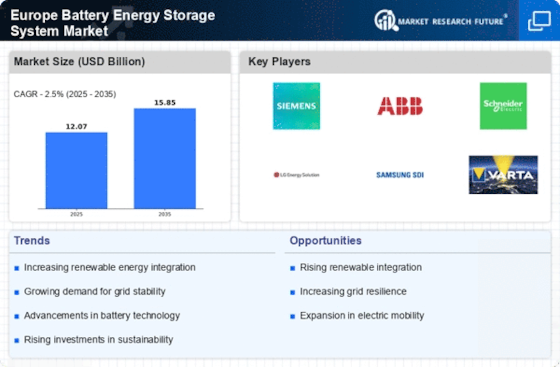
Europe Battery Energy Storage System Market Infographic
×
Europe Battery Energy Storage System Market Infographic Full View
Purchase Options

Market Share

Europe Battery Energy Storage System Market Share Analysis

In the rapidly evolving landscape of the Europe Battery Energy Storage System (BESS) market, companies employ various strategies to position themselves effectively and gain market share. One prevalent strategy is differentiation, where companies aim to distinguish their products or services from competitors. This could involve offering unique features, superior quality, or innovative solutions that address specific customer needs. By carving out a niche or offering something distinct, companies can attract customers who value those particular attributes, thereby capturing a portion of the market share.

Another key strategy is cost leadership, where companies focus on offering products or services at the lowest possible cost while maintaining acceptable quality levels. This approach can be particularly effective in price-sensitive markets where customers prioritize affordability over other factors. By optimizing production processes, sourcing materials efficiently, and minimizing overhead expenses, companies can undercut competitors on price, attracting budget-conscious consumers and gaining market share in the process.

Furthermore, companies may pursue a focused strategy by targeting specific market segments or geographical regions where they believe they can excel. By concentrating their efforts and resources on a defined subset of the market, companies can tailor their offerings to better meet the needs of those customers, gaining a competitive edge in the process. This approach allows companies to become specialists in their chosen areas, positioning themselves as the go-to option for customers with particular requirements or preferences.

Collaboration and partnerships also play a significant role in market share positioning strategies. By forming alliances with complementary businesses or industry stakeholders, companies can leverage each other's strengths and resources to expand their market reach. This could involve joint marketing initiatives, co-development of products or services, or strategic alliances to access new distribution channels or customer segments. Through collaboration, companies can amplify their competitive advantage and gain a larger share of the market than they could achieve alone.

Moreover, innovation is a crucial driver of market share growth in the BESS market. Companies that invest in research and development to create cutting-edge technologies or improve existing solutions can gain a competitive advantage by offering superior performance, efficiency, or reliability. By staying ahead of technological advancements and anticipating future market trends, companies can position themselves as leaders in innovation, attracting customers who value forward-thinking solutions and capturing a larger share of the market as a result.

Additionally, customer-centric strategies are essential for gaining and retaining market share in the BESS market. Companies that prioritize customer satisfaction, engage in active listening, and respond effectively to feedback can build strong relationships with their customer base, fostering loyalty and repeat business. By consistently delivering value and exceeding customer expectations, companies can differentiate themselves from competitors and secure a larger share of the market through positive word-of-mouth referrals and reputation building.

Lastly, continuous improvement and adaptation are critical for sustaining market share growth in the dynamic BESS market. Companies that monitor market trends, track competitor activities, and remain agile in response to changing customer needs can stay ahead of the curve and maintain their competitive edge over time. By continuously refining their strategies, optimizing their operations, and adapting to evolving market conditions, companies can ensure their long-term success and continued growth in the Europe Battery Energy Storage System market.

Author
Garvit Vyas
Analyst

Explore the profile of Garvit Vyas, one of our esteemed authors at Market Research Future, and access their expert research contributions in the field of market research and industry analysis

Leave a Comment

FAQs

What is the projected market valuation of the Europe Battery Energy Storage System Market by 2035?

<p>The projected market valuation is expected to reach 11.08 USD Billion by 2035.</p>

What was the market valuation of the Europe Battery Energy Storage System Market in 2024?

<p>The overall market valuation was 5.0 USD Billion in 2024.</p>

What is the expected CAGR for the Europe Battery Energy Storage System Market during the forecast period 2025 - 2035?

<p>The expected CAGR for the market is 7.5% during the forecast period 2025 - 2035.</p>

Which application segment is projected to have the highest valuation by 2035?

<p>The Grid Energy Storage application segment is projected to reach 3.5 USD Billion by 2035.</p>

What is the anticipated valuation for the Lithium-ion technology segment by 2035?

<p>The Lithium-ion technology segment is expected to reach 7.0 USD Billion by 2035.</p>

Market Summary

As per analysis, the Europe Battery Energy Storage System Market is projected to grow from USD 5.41 Billion in 2025 to USD 11.08 Billion by 2035, exhibiting a compound annual growth rate (CAGR) of 7.5% during the forecast period (2025 - 2035).

Key Market Trends & Highlights

The Europe Battery Energy Storage System Market is poised for substantial growth driven by technological advancements and regulatory support.

  • Germany remains the largest market for battery energy storage systems, reflecting its robust renewable energy policies.
  • The UK is emerging as the fastest-growing region, propelled by increasing investments in energy storage technologies.
  • Grid energy storage continues to dominate the market, while renewable energy integration is rapidly gaining traction.
  • Key market drivers include the growing demand for renewable energy integration and government incentives that support energy storage deployment.

Market Size & Forecast

2024 Market Size 5.0 (USD Billion)
2035 Market Size 11.08 (USD Billion)
CAGR (2025 - 2035) 7.5%

Major Players

<p>Siemens (DE), ABB (CH), Schneider Electric (FR), LG Energy Solution (KR), Samsung SDI (KR), VARTA (DE), Saft (FR), EnerSys (US), Fluence (US), Northvolt (SE)</p>

Market Trends

The Europe Battery Energy Storage System Market is currently experiencing a transformative phase, driven by the increasing demand for renewable energy integration and the need for grid stability. As countries within Europe strive to meet ambitious climate targets, energy storage solutions are becoming essential for managing intermittent energy sources such as wind and solar. This market appears to be characterized by a growing emphasis on technological advancements, which may enhance the efficiency and lifespan of battery systems. Furthermore, the regulatory landscape is evolving, with various governments implementing supportive policies that encourage investment in energy storage technologies. In addition to regulatory support, the Europe Battery Energy Storage System Market is witnessing a surge in private sector participation. Companies are increasingly recognizing the potential of energy storage as a means to optimize energy usage and reduce costs. This trend suggests a shift towards more decentralized energy systems, where consumers and businesses alike can harness the benefits of battery storage. As the market continues to mature, collaboration between stakeholders, including utilities, technology providers, and policymakers, is likely to play a crucial role in shaping the future of energy storage in Europe.

Technological Innovation in Energy Storage

The Europe Battery Energy Storage System Market is seeing rapid advancements in battery technologies, particularly in lithium-ion and solid-state batteries. These innovations are likely to improve energy density, reduce costs, and enhance safety, making energy storage solutions more accessible to a broader range of users. As research and development efforts intensify, the market may witness the emergence of new materials and chemistries that could further revolutionize energy storage capabilities.

Regulatory Support and Policy Frameworks

Governments across Europe are increasingly recognizing the importance of energy storage in achieving sustainability goals. Various initiatives and incentives are being introduced to promote the adoption of battery storage systems. This regulatory support appears to be fostering a favorable environment for investment, encouraging both public and private entities to explore energy storage solutions as a viable option for enhancing grid resilience and reliability.

Decentralization of Energy Systems

The trend towards decentralized energy systems is gaining momentum within the Europe Battery Energy Storage System Market. As consumers and businesses seek greater control over their energy usage, the integration of battery storage with renewable energy sources is becoming more prevalent. This shift may lead to increased self-consumption of generated energy, reducing reliance on traditional grid infrastructure and promoting energy independence.

Europe Battery Energy Storage System Market Market Drivers

Decentralization of Energy Generation

The decentralization of energy generation is another key driver influencing the Europe Battery Energy Storage System Market. With the rise of distributed energy resources, such as rooftop solar panels and small wind turbines, there is a growing need for localized energy storage solutions. This trend is particularly evident in urban areas, where energy consumers are increasingly looking to generate and store their own electricity. The European Union has set ambitious targets for decentralized energy generation, aiming for 65% of electricity to come from local sources by 2030. This shift towards decentralization not only empowers consumers but also enhances grid resilience, thereby creating a favorable environment for the growth of the Europe Battery Energy Storage System Market.

Rising Energy Prices and Cost Savings

The Europe Battery Energy Storage System Market is also influenced by the rising energy prices across the region. As energy costs continue to escalate, consumers and businesses are increasingly seeking ways to mitigate expenses. Battery storage systems offer a viable solution by enabling users to store energy during off-peak hours when prices are lower and utilize it during peak demand periods. This shift towards energy independence and cost savings is driving the adoption of battery storage solutions. In 2025, the average electricity price in Europe reached approximately 0.22 euros per kWh, prompting a growing interest in energy storage technologies as a means to reduce overall energy expenditures. Thus, the Europe Battery Energy Storage System Market is poised for growth as more stakeholders recognize the financial benefits of energy storage.

Government Incentives and Funding Programs

The Europe Battery Energy Storage System Market benefits significantly from various government incentives and funding programs aimed at promoting energy storage technologies. Numerous European nations have implemented financial support mechanisms, such as grants, tax credits, and subsidies, to encourage investment in battery storage systems. For instance, the European Commission has allocated substantial funds to support innovative energy storage projects, with an estimated budget of over 1 billion euros for the period 2021-2027. These initiatives not only stimulate market growth but also foster research and development in the battery sector, thereby enhancing the competitiveness of the Europe Battery Energy Storage System Market.

Growing Demand for Renewable Energy Integration

The Europe Battery Energy Storage System Market is experiencing a surge in demand driven by the increasing integration of renewable energy sources. As countries across Europe strive to meet ambitious climate targets, the need for efficient energy storage solutions becomes paramount. In 2025, renewable energy accounted for approximately 40% of the total energy mix in the European Union, highlighting the critical role of battery storage in balancing supply and demand. This trend is expected to continue, with projections indicating that by 2030, renewables could represent over 50% of the energy mix. Consequently, the Europe Battery Energy Storage System Market is likely to expand as utilities and energy providers seek to enhance grid stability and reliability.

Technological Advancements in Battery Technologies

Technological advancements in battery technologies are playing a pivotal role in shaping the Europe Battery Energy Storage System Market. Innovations in lithium-ion batteries, flow batteries, and solid-state batteries are enhancing energy density, efficiency, and lifespan, making these systems more attractive for various applications. The ongoing research and development efforts are expected to yield batteries with improved performance characteristics, which could further drive adoption rates. For instance, the energy density of lithium-ion batteries has improved by approximately 30% over the past five years, making them more suitable for large-scale energy storage applications. As these advancements continue, the Europe Battery Energy Storage System Market is likely to witness increased investment and deployment of advanced battery technologies.

Market Segment Insights

By Application: Grid Energy Storage (Largest) vs. Renewable Energy Integration (Fastest-Growing)

<p>In the Europe Battery Energy Storage System Market, the application segment demonstrates varied distribution, with Grid Energy Storage leading as the largest segment, thanks to its widespread adoption in balancing supply and demand. Renewable Energy Integration follows closely, gaining traction as countries transition to cleaner energy sources, necessitating efficient energy management systems. Uninterruptible Power Supply and Electric Vehicle Charging Infrastructure also contribute to the market but hold smaller shares compared to the leading segments. The growth trends indicate a strong push towards enhancing Grid Energy Storage capabilities as European nations commit to renewable energy goals. Renewable Energy Integration is rapidly expanding due to increased investments in solar and wind technologies, making it the fastest-growing application. Uninterruptible Power Supply is witnessing a surge due to the rising demand for continuous power supply in critical sectors, while Electric Vehicle Charging Infrastructure is poised for accelerated growth with the increasing penetration of electric vehicles in Europe.</p>

<p>Grid Energy Storage (Dominant) vs. Renewable Energy Integration (Emerging)</p>

<p>Grid Energy Storage stands out as the dominant application in the Europe Battery Energy Storage System Market, primarily due to its crucial role in stabilizing the grid and enabling the integration of renewable energy sources. It encompasses a wide range of technologies, including lithium-ion batteries and flow batteries, designed for large-scale deployment. In contrast, Renewable Energy Integration, while emerging, is gaining momentum with the escalating adoption of solar and wind energy. This segment focuses on storing excess energy generated during peak production periods and releasing it when needed, thus allowing for smoother operation of renewable energy assets. The innovations in battery technologies particularly enhance the efficiency and reliability of these interconnections, making Renewable Energy Integration a vital component of the energy transition.</p>

By End Use: Residential (Largest) vs. Utility (Fastest-Growing)

<p>In the Europe Battery Energy Storage System Market, the end use segments are primarily classified into Residential, Commercial, Industrial, and Utility. The Residential segment holds the largest market share due to the increasing adoption of home solar systems and the demand for energy independence. The Commercial sector follows closely, driven by the need for energy cost reductions and sustainability initiatives among businesses.</p>

<p>Utility: Dominant vs. Residential: Emerging</p>

<p>Within the Europe Battery Energy Storage System Market, the Utility segment emerges as a dominant player, focusing on large-scale applications that enhance grid stability and efficiency. This segment is characterized by significant investments in renewable energy integration and enhanced regulatory support. Meanwhile, the Residential segment, though emerging, is being driven by advancements in home energy management systems and consumer preferences for clean energy solutions. Both segments play crucial roles, with Utilities leading in scalability while Residential applications grow rapidly to complement the shift towards decentralized energy generation.</p>

By Technology: Lithium-ion (Largest) vs. Lead-acid (Fastest-Growing)

<p>In the Europe Battery Energy Storage System Market, Lithium-ion batteries hold the largest market share due to their high efficiency, compact design, and decreasing costs. Lead-acid batteries, traditionally popular, are now experiencing a resurgence as advancements improve their efficiency and reduce their environmental impact. Flow batteries and sodium-sulfur solutions are also present, but their market shares remain smaller as they cater to specific applications and niches. The growth trends in this segment indicate a shift towards more sustainable and efficient solutions. Lithium-ion technology continues to evolve with innovations in materials and technology leading to enhanced performance. Conversely, Lead-acid batteries are positioning themselves as cost-effective alternatives for backup and grid applications, making them the fastest-growing segment alongside a gradual shift in regulatory support for environmentally friendly solutions.</p>

<p>Technology: Lithium-ion (Dominant) vs. Lead-acid (Emerging)</p>

<p>Lithium-ion batteries are the dominant technology in the Europe Battery Energy Storage System Market, favored for their high energy density, long cycle life, and decreasing production costs. They are ideal for large-scale applications such as grid energy storage and electric vehicles, driving mass adoption and significant market presence. On the other hand, Lead-acid batteries are emerging as a viable option, appreciated for their cost-effectiveness and established recycling processes. Although traditionally seen as an older technology, innovations have enhanced their performance and sustainability, compelling industries to reconsider them for various applications ranging from commercial to residential energy storage solutions.</p>

By Ownership: Utility-owned (Largest) vs. Third-party-owned (Fastest-Growing)

<p>In the Europe Battery Energy Storage System (BESS) Market, the ownership structure is delineated among utility-owned, customer-owned, and third-party-owned systems. Utility-owned systems currently hold the largest portion of the market share, attributed to the significant investments made by energy providers in large-scale storage facilities to enhance grid stability and energy management. In contrast, customer-owned systems are gaining traction as more consumers and businesses aim to harness renewable energy for self-consumption, although they occupy a smaller market share relative to utilities. Growth trends in this ownership segment are shaped by evolving energy policies, incentives for renewable energy adoption, and technological advancements that enhance system efficiency. The rise of decentralized energy solutions and energy independence is fostering an environment where customer-owned systems are anticipated to grow swiftly. Additionally, third-party ownership models are transitioning into fast-growing alternatives, providing flexibility and reduced capital burden for users, which is increasingly appealing in the current market landscape.</p>

<p>Utility-owned (Dominant) vs. Customer-owned (Emerging)</p>

<p>In the context of the Europe Battery Energy Storage System Market, utility-owned systems represent a dominant force, characterized by large-scale investments that facilitate significant grid-scale storage capabilities. These systems provide essential services like frequency regulation and peak shaving for utilities, ensuring grid reliability as renewable penetration increases. Conversely, customer-owned systems are emerging, fueled by a growing emphasis on energy self-sufficiency and sustainability among consumers. This segment attracts individuals looking to mitigate energy costs and reduce carbon footprints. With advancements in energy storage technology, customer ownership is projected to evolve further, driven largely by the increasing affordability of battery systems and the allure of renewable energy integration, setting a stage for an impressive growth trajectory.</p>

By Capacity: Large Scale (Largest) vs. Medium Scale (Fastest-Growing)

<p>In the Europe Battery Energy Storage System Market, the capacity segment reveals a significant distribution among Small Scale, Medium Scale, and Large Scale systems. Currently, the Large Scale segment holds the largest market share, capitalizing on the increasing demand for utility-scale energy storage solutions. This growth is primarily driven by the rising integration of renewable energy sources and the need for grid stability within Europe. Conversely, Medium Scale systems have been gaining traction due to their versatility in application, catering to both commercial and residential sectors, thus reflecting a growing preference for mid-sized energy storage solutions.</p>

<p>Medium Scale (Emerging) vs. Large Scale (Dominant)</p>

<p>The Large Scale capacity segment is characterized by its ability to provide substantial energy storage solutions, which are essential for balancing supply and demand on a national grid level. Conversely, the Medium Scale segment is increasingly viewed as an emerging solution for both industrial and commercial sectors, in addition to residential applications. This versatility enables Medium Scale systems to adapt to varying energy consumption needs and regulatory environments. As cities and businesses strive for sustainability, these medium-sized solutions offer an attractive alternative, often paired with renewable energy sources. This duality between the segments enhances the overall market dynamics, making Large Scale systems the dominant force while allowing Medium Scale solutions to flourish.</p>

Get more detailed insights about Europe Battery Energy Storage System Market Research Report – Forecast till 2035

Regional Insights

Germany : Germany's Dominance in Energy Storage

Germany holds a commanding 1.8% market share in the Battery Energy Storage System (BESS) market, driven by robust industrial policies and a strong push towards renewable energy integration. Key growth drivers include government incentives for energy transition, increasing demand for grid stability, and advancements in battery technology. The country’s ambitious climate goals and regulatory frameworks, such as the Renewable Energy Sources Act (EEG), further bolster market growth, alongside significant investments in infrastructure and industrial development.

UK : Innovative Solutions for Energy Needs

The UK accounts for a 1.2% share in the BESS market, fueled by increasing energy demands and a shift towards sustainable energy solutions. Key growth drivers include government initiatives like the Smart Systems and Flexibility Plan, which encourages energy storage adoption. The market is characterized by a rising trend in residential and commercial energy storage systems, driven by the need for energy independence and cost savings. Regulatory support and technological advancements are pivotal in shaping consumption patterns.

France : Investing in Sustainable Solutions

France holds a 0.8% market share in the BESS sector, supported by national policies aimed at reducing carbon emissions and enhancing energy efficiency. The French government has implemented various initiatives, such as the Multiannual Energy Program (PPE), to promote energy storage solutions. Demand is growing in urban areas, particularly in Île-de-France and Provence-Alpes-Côte d'Azur, where renewable energy projects are proliferating. The competitive landscape features major players like Schneider Electric and Saft, driving innovation and market growth.

Russia : Harnessing Energy for Future Growth

With a 0.5% market share, Russia's BESS market is gradually evolving, driven by the need for energy security and modernization of the power grid. Key growth drivers include government initiatives aimed at enhancing energy efficiency and integrating renewable sources. The market is characterized by increasing investments in infrastructure, particularly in regions like Moscow and St. Petersburg. Local players are beginning to emerge, although international companies like Siemens are also establishing a foothold in this developing market.

Italy : Storage Solutions for Sustainable Growth

Italy's BESS market, with a 0.4% share, is experiencing growth due to a strong focus on renewable energy sources and energy efficiency. Government policies, such as the National Integrated Energy and Climate Plan (PNIEC), are pivotal in promoting energy storage adoption. Demand is particularly high in regions like Lombardy and Emilia-Romagna, where solar energy installations are prevalent. The competitive landscape includes key players like Enel and VARTA, who are actively investing in innovative storage solutions.

Spain : Pioneering Sustainable Energy Solutions

Spain's BESS market, accounting for 0.3%, is on the rise, driven by increasing investments in renewable energy and supportive government policies. The Spanish government has introduced initiatives like the National Energy and Climate Plan (NECP) to promote energy storage technologies. Key markets include Andalusia and Catalonia, where solar energy projects are booming. The competitive landscape features major players such as Siemens and LG Energy Solution, who are focusing on innovative storage technologies to meet growing demand.

Rest of Europe : Emerging Markets and Innovations

The Rest of Europe holds a modest 0.1% market share in the BESS sector, with varying growth potential across different countries. Key growth drivers include increasing energy demands and the transition towards renewable energy sources. Regulatory frameworks are evolving, with many countries implementing policies to support energy storage adoption. The competitive landscape is diverse, with local players emerging alongside established international companies, creating opportunities for innovation and collaboration in the energy sector.

Key Players and Competitive Insights

The Battery Energy Storage System Market in Europe is characterized by a dynamic competitive landscape, driven by the increasing demand for renewable energy integration and grid stability. Key players are actively pursuing strategies that emphasize innovation, regional expansion, and strategic partnerships. Companies such as Siemens (DE), ABB (CH), and Northvolt (SE) are at the forefront, leveraging their technological expertise and market presence to enhance their competitive positioning. Siemens (DE) focuses on digital transformation and smart grid solutions, while ABB (CH) emphasizes its commitment to sustainability through innovative energy storage solutions. Northvolt (SE), on the other hand, is concentrating on localizing battery production to reduce supply chain vulnerabilities and enhance sustainability.

The market structure appears moderately fragmented, with a mix of established players and emerging companies. Key tactics such as localizing manufacturing and optimizing supply chains are becoming increasingly prevalent. This fragmentation allows for diverse offerings, yet the collective influence of major players like LG Energy Solution (KR) and VARTA (DE) is significant, as they continue to innovate and expand their operational capabilities.

In December 2025, Siemens (DE) announced a partnership with a leading European utility to develop a large-scale battery storage project aimed at enhancing grid resilience. This strategic move underscores Siemens' commitment to integrating renewable energy sources and demonstrates its ability to leverage partnerships for large-scale implementations. The collaboration is expected to facilitate the deployment of advanced energy management systems, thereby reinforcing Siemens' position in the market.

In November 2025, ABB (CH) unveiled a new energy storage solution designed to optimize energy usage in commercial buildings. This innovation is particularly relevant as businesses increasingly seek to reduce energy costs and carbon footprints. By introducing this solution, ABB (CH) not only enhances its product portfolio but also positions itself as a leader in energy efficiency, catering to the growing demand for sustainable energy solutions.

In October 2025, Northvolt (SE) secured a significant investment from a consortium of European investors to expand its battery manufacturing capabilities. This funding is pivotal for Northvolt as it aims to scale up production to meet the surging demand for electric vehicle batteries and energy storage systems. The investment reflects a broader trend of increasing financial backing for companies that prioritize sustainability and local production, further solidifying Northvolt's competitive edge.

As of January 2026, the competitive trends in the Battery Energy Storage System Market are increasingly defined by digitalization, sustainability, and the integration of AI technologies. Strategic alliances are shaping the landscape, enabling companies to pool resources and expertise to drive innovation. The shift from price-based competition to a focus on technological advancement and supply chain reliability is evident. Companies that can effectively differentiate themselves through innovative solutions and sustainable practices are likely to thrive in this evolving market.

Key Companies in the Europe Battery Energy Storage System Market include

Industry Developments

February 2023: Power & Air Solutions, the Deutsche Telekom subsidiary, completed its first battery energy storage system (BESS) installation supplied by Pixii. The storage system was installed at one of Deutsche Telekom's main offices in Munich, Germany. The installation in Munich has 1 MW of conversion capacity and 6 MWh of storage capacity.


Future Outlook

Europe Battery Energy Storage System Market Future Outlook

The Battery Energy Storage System Market in Europe is projected to grow at a 7.5% CAGR from 2025 to 2035, driven by renewable energy integration, grid stability needs, and technological advancements.

New opportunities lie in:

  • Development of modular energy storage solutions for commercial applications.
  • Investment in AI-driven energy management systems for optimized performance.
  • Expansion of partnerships with renewable energy providers for integrated solutions.

By 2035, the market is expected to be robust, driven by innovation and strategic collaborations.

Market Segmentation

Europe Battery Energy Storage System Market End Use Outlook

  • Residential
  • Commercial
  • Industrial
  • Utility

Europe Battery Energy Storage System Market Capacity Outlook

  • Small Scale
  • Medium Scale
  • Large Scale

Europe Battery Energy Storage System Market Ownership Outlook

  • Utility-owned
  • Customer-owned
  • Third-party-owned

Europe Battery Energy Storage System Market Technology Outlook

  • Lithium-ion
  • Lead-acid
  • Flow Battery
  • Sodium-sulfur

Europe Battery Energy Storage System Market Application Outlook

  • Grid Energy Storage
  • Renewable Energy Integration
  • Uninterruptible Power Supply
  • Electric Vehicle Charging Infrastructure

Report Scope

MARKET SIZE 20245.0(USD Billion)
MARKET SIZE 20255.41(USD Billion)
MARKET SIZE 203511.08(USD Billion)
COMPOUND ANNUAL GROWTH RATE (CAGR)7.5% (2024 - 2035)
REPORT COVERAGERevenue Forecast, Competitive Landscape, Growth Factors, and Trends
BASE YEAR2024
Market Forecast Period2025 - 2035
Historical Data2019 - 2024
Market Forecast UnitsUSD Billion
Key Companies ProfiledSiemens (DE), ABB (CH), Schneider Electric (FR), LG Energy Solution (KR), Samsung SDI (KR), VARTA (DE), Saft (FR), EnerSys (US), Fluence (US), Northvolt (SE)
Segments CoveredApplication, End Use, Technology, Ownership, Capacity
Key Market OpportunitiesGrowing demand for renewable energy integration drives innovation in the Europe Battery Energy Storage System Market.
Key Market DynamicsGrowing regulatory support and technological advancements drive the expansion of the Europe Battery Energy Storage System Market.
Countries CoveredGermany, UK, France, Russia, Italy, Spain, Rest of Europe

FAQs

What is the projected market valuation of the Europe Battery Energy Storage System Market by 2035?

<p>The projected market valuation is expected to reach 11.08 USD Billion by 2035.</p>

What was the market valuation of the Europe Battery Energy Storage System Market in 2024?

<p>The overall market valuation was 5.0 USD Billion in 2024.</p>

What is the expected CAGR for the Europe Battery Energy Storage System Market during the forecast period 2025 - 2035?

<p>The expected CAGR for the market is 7.5% during the forecast period 2025 - 2035.</p>

Which application segment is projected to have the highest valuation by 2035?

<p>The Grid Energy Storage application segment is projected to reach 3.5 USD Billion by 2035.</p>

What is the anticipated valuation for the Lithium-ion technology segment by 2035?

<p>The Lithium-ion technology segment is expected to reach 7.0 USD Billion by 2035.</p>

  1. SECTION I: EXECUTIVE SUMMARY AND KEY HIGHLIGHTS
    1. EXECUTIVE SUMMARY
      1. Market Overview
      2. Key Findings
      3. Market Segmentation
      4. Competitive Landscape
      5. Challenges and Opportunities
      6. Future Outlook 2
  2. SECTION II: SCOPING, METHODOLOGY AND MARKET STRUCTURE
    1. MARKET INTRODUCTION
      1. Definition
      2. Scope of the study
    2. RESEARCH METHODOLOGY
      1. Overview
      2. Data Mining
      3. Secondary Research
      4. Primary Research
      5. Forecasting Model
      6. Market Size Estimation
      7. Data Triangulation
      8. Validation 3
  3. SECTION III: QUALITATIVE ANALYSIS
    1. MARKET DYNAMICS
      1. Overview
      2. Drivers
      3. Restraints
      4. Opportunities
    2. MARKET FACTOR ANALYSIS
      1. Value chain Analysis
      2. Porter's Five Forces Analysis
      3. COVID-19 Impact Analysis
  4. SECTION IV: QUANTITATIVE ANALYSIS
    1. Energy & Power, BY Type (USD Billion)
      1. Lithium-ion
      2. Lead-acid
      3. Flow
      4. Others
    2. Energy & Power, BY Application (USD Billion)
      1. Residential
      2. Commercial
      3. Industrial
    3. Energy & Power, BY Region (USD Billion)
      1. North America
      2. Europe
      3. APAC
      4. South America
      5. MEA
  5. SECTION V: COMPETITIVE ANALYSIS
    1. Competitive Landscape
      1. Overview
      2. Competitive Analysis
      3. Market share Analysis
      4. Major Growth Strategy in the Energy & Power
      5. Competitive Benchmarking
      6. Leading Players in Terms of Number of Developments in the Energy & Power
      7. Key developments and growth strategies
      8. Major Players Financial Matrix
    2. Company Profiles
      1. Siemens (DE)
      2. ABB (CH)
      3. Schneider Electric (FR)
      4. LG Energy Solution (KR)
      5. Samsung SDI (KR)
      6. VARTA (DE)
      7. Fluence (US)
      8. Eaton (IE)
      9. Tesla (US)
      10. Northvolt (SE)
    3. Appendix
      1. References
      2. Related Reports 6 LIST OF FIGURES
    4. MARKET SYNOPSIS
    5. NORTH AMERICA MARKET ANALYSIS
    6. US MARKET ANALYSIS BY TYPE
    7. US MARKET ANALYSIS BY APPLICATION
    8. CANADA MARKET ANALYSIS BY TYPE
    9. CANADA MARKET ANALYSIS BY APPLICATION
    10. EUROPE MARKET ANALYSIS
    11. GERMANY MARKET ANALYSIS BY TYPE
    12. GERMANY MARKET ANALYSIS BY APPLICATION
    13. UK MARKET ANALYSIS BY TYPE
    14. UK MARKET ANALYSIS BY APPLICATION
    15. FRANCE MARKET ANALYSIS BY TYPE
    16. FRANCE MARKET ANALYSIS BY APPLICATION
    17. RUSSIA MARKET ANALYSIS BY TYPE
    18. RUSSIA MARKET ANALYSIS BY APPLICATION
    19. ITALY MARKET ANALYSIS BY TYPE
    20. ITALY MARKET ANALYSIS BY APPLICATION
    21. SPAIN MARKET ANALYSIS BY TYPE
    22. SPAIN MARKET ANALYSIS BY APPLICATION
    23. REST OF EUROPE MARKET ANALYSIS BY TYPE
    24. REST OF EUROPE MARKET ANALYSIS BY APPLICATION
    25. APAC MARKET ANALYSIS
    26. CHINA MARKET ANALYSIS BY TYPE
    27. CHINA MARKET ANALYSIS BY APPLICATION
    28. INDIA MARKET ANALYSIS BY TYPE
    29. INDIA MARKET ANALYSIS BY APPLICATION
    30. JAPAN MARKET ANALYSIS BY TYPE
    31. JAPAN MARKET ANALYSIS BY APPLICATION
    32. SOUTH KOREA MARKET ANALYSIS BY TYPE
    33. SOUTH KOREA MARKET ANALYSIS BY APPLICATION
    34. MALAYSIA MARKET ANALYSIS BY TYPE
    35. MALAYSIA MARKET ANALYSIS BY APPLICATION
    36. THAILAND MARKET ANALYSIS BY TYPE
    37. THAILAND MARKET ANALYSIS BY APPLICATION
    38. INDONESIA MARKET ANALYSIS BY TYPE
    39. INDONESIA MARKET ANALYSIS BY APPLICATION
    40. REST OF APAC MARKET ANALYSIS BY TYPE
    41. REST OF APAC MARKET ANALYSIS BY APPLICATION
    42. SOUTH AMERICA MARKET ANALYSIS
    43. BRAZIL MARKET ANALYSIS BY TYPE
    44. BRAZIL MARKET ANALYSIS BY APPLICATION
    45. MEXICO MARKET ANALYSIS BY TYPE
    46. MEXICO MARKET ANALYSIS BY APPLICATION
    47. ARGENTINA MARKET ANALYSIS BY TYPE
    48. ARGENTINA MARKET ANALYSIS BY APPLICATION
    49. REST OF SOUTH AMERICA MARKET ANALYSIS BY TYPE
    50. REST OF SOUTH AMERICA MARKET ANALYSIS BY APPLICATION
    51. MEA MARKET ANALYSIS
    52. GCC COUNTRIES MARKET ANALYSIS BY TYPE
    53. GCC COUNTRIES MARKET ANALYSIS BY APPLICATION
    54. SOUTH AFRICA MARKET ANALYSIS BY TYPE
    55. SOUTH AFRICA MARKET ANALYSIS BY APPLICATION
    56. REST OF MEA MARKET ANALYSIS BY TYPE
    57. REST OF MEA MARKET ANALYSIS BY APPLICATION
    58. KEY BUYING CRITERIA OF ENERGY & POWER
    59. RESEARCH PROCESS OF MRFR
    60. DRO ANALYSIS OF ENERGY & POWER
    61. DRIVERS IMPACT ANALYSIS: ENERGY & POWER
    62. RESTRAINTS IMPACT ANALYSIS: ENERGY & POWER
    63. SUPPLY / VALUE CHAIN: ENERGY & POWER
    64. ENERGY & POWER, BY TYPE, 2024 (% SHARE)
    65. ENERGY & POWER, BY TYPE, 2024 TO 2035 (USD Billion)
    66. ENERGY & POWER, BY APPLICATION, 2024 (% SHARE)
    67. ENERGY & POWER, BY APPLICATION, 2024 TO 2035 (USD Billion)
    68. BENCHMARKING OF MAJOR COMPETITORS 7 LIST OF TABLES
    69. LIST OF ASSUMPTIONS
    70. North America MARKET SIZE ESTIMATES; FORECAST
      1. BY TYPE, 2025-2035 (USD Billion)
      2. BY APPLICATION, 2025-2035 (USD Billion)
    71. US MARKET SIZE ESTIMATES; FORECAST
      1. BY TYPE, 2025-2035 (USD Billion)
      2. BY APPLICATION, 2025-2035 (USD Billion)
    72. Canada MARKET SIZE ESTIMATES; FORECAST
      1. BY TYPE, 2025-2035 (USD Billion)
      2. BY APPLICATION, 2025-2035 (USD Billion)
    73. Europe MARKET SIZE ESTIMATES; FORECAST
      1. BY TYPE, 2025-2035 (USD Billion)
      2. BY APPLICATION, 2025-2035 (USD Billion)
    74. Germany MARKET SIZE ESTIMATES; FORECAST
      1. BY TYPE, 2025-2035 (USD Billion)
      2. BY APPLICATION, 2025-2035 (USD Billion)
    75. UK MARKET SIZE ESTIMATES; FORECAST
      1. BY TYPE, 2025-2035 (USD Billion)
      2. BY APPLICATION, 2025-2035 (USD Billion)
    76. France MARKET SIZE ESTIMATES; FORECAST
      1. BY TYPE, 2025-2035 (USD Billion)
      2. BY APPLICATION, 2025-2035 (USD Billion)
    77. Russia MARKET SIZE ESTIMATES; FORECAST
      1. BY TYPE, 2025-2035 (USD Billion)
      2. BY APPLICATION, 2025-2035 (USD Billion)
    78. Italy MARKET SIZE ESTIMATES; FORECAST
      1. BY TYPE, 2025-2035 (USD Billion)
      2. BY APPLICATION, 2025-2035 (USD Billion)
    79. Spain MARKET SIZE ESTIMATES; FORECAST
      1. BY TYPE, 2025-2035 (USD Billion)
      2. BY APPLICATION, 2025-2035 (USD Billion)
    80. Rest of Europe MARKET SIZE ESTIMATES; FORECAST
      1. BY TYPE, 2025-2035 (USD Billion)
      2. BY APPLICATION, 2025-2035 (USD Billion)
    81. APAC MARKET SIZE ESTIMATES; FORECAST
      1. BY TYPE, 2025-2035 (USD Billion)
      2. BY APPLICATION, 2025-2035 (USD Billion)
    82. China MARKET SIZE ESTIMATES; FORECAST
      1. BY TYPE, 2025-2035 (USD Billion)
      2. BY APPLICATION, 2025-2035 (USD Billion)
    83. India MARKET SIZE ESTIMATES; FORECAST
      1. BY TYPE, 2025-2035 (USD Billion)
      2. BY APPLICATION, 2025-2035 (USD Billion)
    84. Japan MARKET SIZE ESTIMATES; FORECAST
      1. BY TYPE, 2025-2035 (USD Billion)
      2. BY APPLICATION, 2025-2035 (USD Billion)
    85. South Korea MARKET SIZE ESTIMATES; FORECAST
      1. BY TYPE, 2025-2035 (USD Billion)
      2. BY APPLICATION, 2025-2035 (USD Billion)
    86. Malaysia MARKET SIZE ESTIMATES; FORECAST
      1. BY TYPE, 2025-2035 (USD Billion)
      2. BY APPLICATION, 2025-2035 (USD Billion)
    87. Thailand MARKET SIZE ESTIMATES; FORECAST
      1. BY TYPE, 2025-2035 (USD Billion)
      2. BY APPLICATION, 2025-2035 (USD Billion)
    88. Indonesia MARKET SIZE ESTIMATES; FORECAST
      1. BY TYPE, 2025-2035 (USD Billion)
      2. BY APPLICATION, 2025-2035 (USD Billion)
    89. Rest of APAC MARKET SIZE ESTIMATES; FORECAST
      1. BY TYPE, 2025-2035 (USD Billion)
      2. BY APPLICATION, 2025-2035 (USD Billion)
    90. South America MARKET SIZE ESTIMATES; FORECAST
      1. BY TYPE, 2025-2035 (USD Billion)
      2. BY APPLICATION, 2025-2035 (USD Billion)
    91. Brazil MARKET SIZE ESTIMATES; FORECAST
      1. BY TYPE, 2025-2035 (USD Billion)
      2. BY APPLICATION, 2025-2035 (USD Billion)
    92. Mexico MARKET SIZE ESTIMATES; FORECAST
      1. BY TYPE, 2025-2035 (USD Billion)
      2. BY APPLICATION, 2025-2035 (USD Billion)
    93. Argentina MARKET SIZE ESTIMATES; FORECAST
      1. BY TYPE, 2025-2035 (USD Billion)
      2. BY APPLICATION, 2025-2035 (USD Billion)
    94. Rest of South America MARKET SIZE ESTIMATES; FORECAST
      1. BY TYPE, 2025-2035 (USD Billion)
      2. BY APPLICATION, 2025-2035 (USD Billion)
    95. MEA MARKET SIZE ESTIMATES; FORECAST
      1. BY TYPE, 2025-2035 (USD Billion)
      2. BY APPLICATION, 2025-2035 (USD Billion)
    96. GCC Countries MARKET SIZE ESTIMATES; FORECAST
      1. BY TYPE, 2025-2035 (USD Billion)
      2. BY APPLICATION, 2025-2035 (USD Billion)
    97. South Africa MARKET SIZE ESTIMATES; FORECAST
      1. BY TYPE, 2025-2035 (USD Billion)
      2. BY APPLICATION, 2025-2035 (USD Billion)
    98. Rest of MEA MARKET SIZE ESTIMATES; FORECAST
      1. BY TYPE, 2025-2035 (USD Billion)
      2. BY APPLICATION, 2025-2035 (USD Billion)
    99. PRODUCT LAUNCH/PRODUCT DEVELOPMENT/APPROVAL
    100. ACQUISITION/PARTNERSHIP

Europe Battery Energy Storage System Market Segmentation

Market Segmentation Overview

  • Detailed segmentation data will be available in the full report
  • Comprehensive analysis by multiple parameters
  • Regional and country-level breakdowns
  • Market size forecasts by segment
Infographic

Free Sample Request

Kindly complete the form below to receive a free sample of this Report

Get Free Sample

Customer Strories

Compare Licence

×
Features License Type
Single User Multiuser License Enterprise User
Price $4,950 $5,950 $7,250
Maximum User Access Limit 1 User Upto 10 Users Unrestricted Access Throughout the Organization
Free Customization
Direct Access to Analyst
Deliverable Format
Platform Access
Discount on Next Purchase 10% 15% 15%
Printable Versions