×
Hero Background
English
Chinese
French
Japanese
Korean
German
Spanish

Ethylbenzene Market Analysis

ID: MRFR/CnM/6556-HCR
140 Pages
Priya Nagrale
October 2025

Ethylbenzene Market Research Report Information by Application (Gasoline, Paint, Natural Gas, Asphalt & Naptha, Diethylbenzene and others), End-Use Industry (Polymers, Construction, Agricultural, Packaging, Electronics, Paints & Coatings and other Industrial) and Region (Asia-Pacific, North America, Europe, Latin America and Middle East & Africa) - Forecast till 2035

Share:
Download PDF ×

We do not share your information with anyone. However, we may send you emails based on your report interest from time to time. You may contact us at any time to opt-out.

Ethylbenzene Market Infographic
Purchase Options

Market Analysis

In-depth Analysis of Ethylbenzene Market Industry Landscape

Ethylbenzene market has high worldwide position since it is closely related to the global petrochemical industry. These industrial and environmental factors occupy market dynamics. Ethylbenzene is a useful chemical compound formed by reacting benzene with ethylene molecules. Ethylbenzene is the main raw material used in the synthesis of styrene which is a core element in the production of polystyrene. The linked demand for ethylbenzene to grow in about proportion with the end-use industries, especially the automotive, construction, and the packaging is a matter of great concern.

Although negative market dynamics are a very relevant aspect of the petrochemical industry, the cyclic nature of this industry is also present. The industry has a high demand in response to the industry's vulnerability to economic fluctuations and changes around the world. The quality of ethyl benzene is going to help me understand the price of ethylbenzene and demand. Economic recession occurs in reaction to a decrease in upstream activities like manufacturing, the requirement level for ethylbenzene lowers. On the other hand, economic recessions can cause demand growth across industries as manufacturing and production lines ramp up manufacturing output.

Another important factor is also the regional distribution of production and demand which contributes into the global carbon dilemma. The ethylbenzene industry does not have a uniform geographical distribution across the globe, where the main production areas in Asia - Pacific, North America and Europe are dominant. The Pacific Asian countries, the main burden arising from industrialization and urbanization in the countries like China and India, hold a considerable portion of world trade both as suppliers and consumers. This regional dependence subjects the market to the vicissitudes by geopolitical and economic changes in these regions.

Other than ensuring a healthful environment, environmental rules also constitute value-determining factors in the ethylbenzene market. With the rising global concern about environmental problems, the role of sustainability in businesses is highlighted beyond the issues of environment. For ethylbenzene production, source of raw material is regulated either with respect to emissions or dumping of waste at the factories, thereby, affecting the production processes and guiding the choices of raw materials. In the market, companies are likely change their technology to be cleaner and practice sustainability toward staying competitive in the industry.

Technological achievements, too, are a part of the complexity of the ethyl benzene market. This industry benefited from the constant and progressive growth in the research and development field in the petrochemical sector which has improved its production process making it more efficient and less costly. Technological alterations could be the key to manufacturers' survival in this ethylbenzene market; they also serve to attract more market share and profits.

Not only ethylbenzene market relies on the substitution of its material by others, but it also faces the risk due to the vast development of renewable resources. As the market pressure for ecofriendly materials are strengthening, industries begin to transition from petrochemical-based materials. This trend signifies the both a demand and chance for ethylbenzene sector and therefore entities ought to bear more expense for scientific research and development in order to mirror nature-friendly technologies together with offset the risks of the up-to-date technology and substances.

Author
Priya Nagrale
Senior Research Analyst

With an experience of over five years in market research industry (Chemicals & Materials domain), I gather and analyze market data from diverse sources to produce results, which are then presented back to a client. Also, provide recommendations based on the findings. As a Senior Research Analyst, I perform quality checks (QC) for market estimations, QC for reports, and handle queries and work extensively on client customizations. Also, handle the responsibilities of client proposals, report planning, report finalization, and execution

Leave a Comment

FAQs

What was the value of the global Ethylbenzene Market in 2035?

Valuation of the global Ethylbenzene Market had reached USD 25 BN in 2035.

At what CAGR is the global Ethylbenzene Market projected to grow during the forecast period (2019-2025)?

Ethylbenzene Market is projected to expand at over 2.8% CAGR during the assessment period.

Which is the largest application segment in the global Ethylbenzene Market?

Gasoline is the largest application segment in the global Ethylbenzene Market.

Which region holds the largest share in the global Ethylbenzene Market?

Asia Pacific holds the largest share in the global Ethylbenzene Market, followed by North America and Europe, respectively.

Who are the top players in the global Ethylbenzene Market?

Chevron Phillips Chemical Company (US), Synthos S.A. (Germany), LyondellBasell Industries (The Netherlands), Versalis (Italy), Total S.A. (France), ufu Xindi Chemical Research Limited Company. (China), Zhejiang Weishi Biotechnology Co., Ltd (China), Royal Dutch Shell Plc (The Netherlands), SABIC (Saudi Arabia), BASF SE (Europe), and DowDuPont (US), are some of the major players operating in the Ethylbenzene Market.

Market Summary

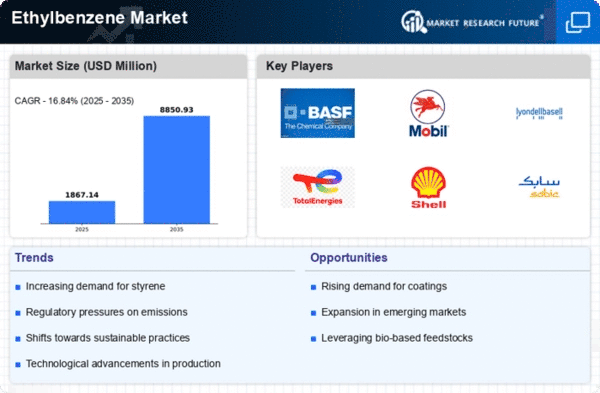
As per MRFR analysis, the Ethylbenzene Market Size was estimated at 1598.03 USD Million in 2024. The Ethylbenzene industry is projected to grow from 1867.1 USD Million in 2025 to 8850.93 USD Million by 2035, exhibiting a compound annual growth rate (CAGR) of 16.84 during the forecast period 2025 - 2035.

Key Market Trends & Highlights

The Ethylbenzene Market is currently experiencing robust growth driven by technological advancements and rising demand across various sectors.

  • North America remains the largest market for ethylbenzene, primarily due to its established chemical manufacturing base.
  • Asia-Pacific is identified as the fastest-growing region, fueled by increasing industrialization and urbanization.
  • The adhesives segment holds the largest share in the market, while the synthetic rubber segment is witnessing rapid growth.
  • Key market drivers include the rising demand for styrene and the growth in the automotive sector, which is enhancing ethylbenzene applications.

Market Size & Forecast

2024 Market Size 1598.03 (USD Million)
2035 Market Size 8850.93 (USD Million)
CAGR (2025 - 2035) 16.84%
Largest Regional Market Share in 2024 Asia-Pacific

Major Players

<p>BASF SE (DE), ExxonMobil Chemical (US), LyondellBasell Industries (US), Shell Chemicals (GB), TotalEnergies SE (FR), SABIC (SA), Ineos Group (GB), Chevron Phillips Chemical (US), Reliance Industries Limited (IN)</p>

Market Trends

The Ethylbenzene Market is currently experiencing a dynamic phase characterized by evolving demand patterns and regulatory influences. The increasing utilization of ethylbenzene in the production of styrene, a key component in various plastics and resins, appears to drive market growth. Additionally, the rising focus on sustainable practices and environmental regulations may compel manufacturers to adopt cleaner production technologies. This shift could potentially reshape the competitive landscape, as companies strive to align with eco-friendly initiatives while maintaining profitability. Furthermore, the expansion of the automotive and construction sectors seems to bolster the demand for styrene-based products, thereby indirectly benefiting the Ethylbenzene Market. In the context of global trade, the Ethylbenzene Market is likely to witness shifts in supply chains as geopolitical factors and trade agreements evolve. Emerging economies may present new opportunities for market players, as industrialization and urbanization continue to accelerate. However, challenges such as fluctuating raw material prices and stringent regulatory frameworks could pose risks to market stability. Overall, the Ethylbenzene Market appears poised for growth, albeit with complexities that stakeholders must navigate carefully.

Sustainability Initiatives

The Ethylbenzene Market is increasingly influenced by sustainability initiatives. Manufacturers are exploring eco-friendly production methods to reduce environmental impact. This trend reflects a broader commitment to sustainable practices across industries, potentially reshaping market dynamics.

Technological Advancements

Technological advancements in production processes are likely to enhance efficiency within the Ethylbenzene Market. Innovations may lead to reduced energy consumption and improved yield, allowing companies to optimize operations while meeting growing demand.

Emerging Market Opportunities

Emerging markets are presenting new opportunities for the Ethylbenzene Market. As industrialization progresses in these regions, the demand for styrene and its derivatives is expected to rise, creating avenues for growth and expansion for market participants.

Ethylbenzene Market Market Drivers

Rising Demand from End-Use Industries

The Global Ethylbenzene Market Industry experiences a notable surge in demand driven by its extensive applications in various end-use sectors, particularly in the production of styrene, which is a precursor for numerous plastics and resins. As industries such as automotive, construction, and consumer goods expand, the need for ethylbenzene is likely to increase. In 2024, the market is projected to reach 17.4 USD Billion, reflecting the growing consumption of styrene-based products. Furthermore, the anticipated growth in these sectors suggests a robust outlook for ethylbenzene, potentially leading to a compound annual growth rate of 4.66% from 2025 to 2035.

Market Segment Insights

By Application: Adhesives (Largest) vs. Synthetic Rubber (Fastest-Growing)

<p>In the Ethylbenzene Market, the distribution of application segments reveals that adhesives hold the largest share, primarily due to their wide-ranging utility in bonding applications across various industries, including construction and automotive. Coatings, plastics, and textiles follow, each playing pivotal roles in packaging, protective layers, and fabric production respectively. Synthetic rubber, while a smaller share, represents a key application showing significant growth potential due to increased demand in automotive and construction sectors.</p>

<p>Adhesives (Dominant) vs. Synthetic Rubber (Emerging)</p>

<p>In the Ethylbenzene Market, adhesives are the dominant application, favored for their versatility and efficacy in numerous industries. The increasing trend towards sustainable and high-performance adhesives further strengthens this segment's market position. Meanwhile, synthetic rubber is an emerging application, gaining traction due to its adaptability across various sectors, most notably in automotive and construction. The shift towards electric vehicles and green construction practices is propelling the demand for synthetic rubber, positioning it as a rapidly growing segment with substantial market opportunities in the coming years.</p>

By End Use: Automotive (Largest) vs. Consumer Goods (Fastest-Growing)

<p>The Ethylbenzene market showcases a diverse distribution among its end-use segments, with Automotive leading the way due to its significant demand in the production of styrene used in various automotive components. Following this, the Construction segment also holds a notable share, driven by rising urbanization and infrastructure development. Electronics and Consumer Goods occupy smaller proportions of the market yet are gaining traction as innovative applications and consumer preferences evolve. Growth trends within the Ethylbenzene market are being propelled predominantly by the Automotive and Consumer Goods sectors. The Automotive industry extends its influence through advancements in electric vehicles, which require enhanced polymer materials, while the Consumer Goods segment benefits from increasing demand for plastic products and packaging solutions. The focus on sustainability and eco-friendly materials also plays a crucial role in shaping future trends in this market.</p>

<p>Automotive (Dominant) vs. Consumer Goods (Emerging)</p>

<p>The Automotive segment stands out as a dominant force in the Ethylbenzene market, driven by the continuous innovation in automotive manufacturing and a persistent demand for lightweight, durable materials. This segment leverages Ethylbenzene primarily for producing styrene monomer, essential for manufacturing various plastic components. Conversely, the Consumer Goods segment is emerging rapidly, spurred by the increasing demand for plastics in household items and packaging. As consumer preferences shift towards convenience and sustainability, this segment is adapting by incorporating recyclable materials. Additionally, the rise of e-commerce is further escalating the demand for efficient packaging solutions within the Consumer Goods sector, marking it as a key area of growth in the Ethylbenzene market.</p>

By Production Method: Catalytic Dehydrogenation (Largest) vs. Friedel-Crafts Alkylation (Fastest-Growing)

<p>In the Ethylbenzene Market, Catalytic Dehydrogenation holds the largest share among the production methods, driven by its efficiency and cost-effectiveness in producing high-purity ethylbenzene. This method benefits from advancements in catalyst technology, which enhances yield and reduces energy consumption. Friedel-Crafts Alkylation, on the other hand, is gaining popularity as a fast-growing method, attributed to its favorable production characteristics and the increasing demand for high-quality intermediates. As environmental regulations tighten, industries are increasingly adopting this method for its lower environmental impact compared to others.</p>

<p>Production Method: Catalytic Dehydrogenation (Dominant) vs. Friedel-Crafts Alkylation (Emerging)</p>

<p>Catalytic Dehydrogenation is the dominant production method in the Ethylbenzene Market, known for its ability to convert ethylbenzene efficiently by removing hydrogen from the hydrocarbon feedstock. This method is recognized for producing high yields and maintaining product purity, which are crucial for meeting stringent industry standards. Conversely, Friedel-Crafts Alkylation is positioned as an emerging method, appreciated for its flexibility and ability to facilitate the synthesis of various ethylbenzene derivatives. As stakeholders seek innovative solutions to enhance production efficiency while complying with environmental regulations, Friedel-Crafts Alkylation is expected to capture a more significant share of the market due to its greener approach.</p>

By Purity Level: High Purity (Largest) vs. Standard Purity (Fastest-Growing)

<p>The Ethylbenzene market is characterized by varying purity levels that cater to different industrial requirements. Among these, High Purity ethylbenzene commands the largest market share, driven by its application in high-performance materials. Standard Purity, while currently smaller in share, is rapidly gaining traction due to its increasing use in standard-grade applications that require less stringent purity requirements. Technical Grade ethylbenzene, although essential, holds a minor market share as it primarily serves niche segments. The growth trends within the Purity Level segment indicate a robust shift towards High Purity ethylbenzene as industries prioritize quality and performance. Standard Purity is emerging as the fastest-growing category, spurred by increasing industrial activity and demand for cost-effective solutions. The focus on sustainability and improved manufacturing processes is driving the adoption rates across all purity levels, but particularly for Standard Purity, as manufacturers seek to optimize their operations and reduce costs while maintaining functional viability.</p>

<p>High Purity (Dominant) vs. Standard Purity (Emerging)</p>

<p>High Purity ethylbenzene represents the dominant segment in the market, owing to its crucial role in the production of high-quality styrene, which is a fundamental building block for numerous polymers and resins. This purity level ensures minimal impurities, leading to superior performance in applications where quality is paramount. On the other hand, Standard Purity ethylbenzene is recognized as the emerging segment, presenting a more economical choice for various applications where stringent quality is not essential. This category is gaining momentum as manufacturers leverage its cost-effectiveness while still meeting the necessary regulatory requirements for production. Both segments exhibit unique characteristics that cater to diverse industrial needs, ensuring their relevance in the ever-evolving Ethylbenzene market.</p>

By Distribution Channel: Direct Sales (Largest) vs. Distributors (Fastest-Growing)

<p>The Ethylbenzene market exhibits a diverse structure in distribution channels. Direct Sales currently dominate the segment, representing the most substantial share of the overall channel distribution. This method provides manufacturers with direct access to their clients, facilitating stronger relationships and understanding of customer needs. Distributors, while holding a smaller share compared to direct sales, have been gaining traction in recent years, becoming an essential part of the supply chain for many producers.</p>

<p>Sales Method: Direct Sales (Dominant) vs. Distributors (Emerging)</p>

<p>In the Ethylbenzene market, Direct Sales hold a dominant position due to the ability to foster direct customer relationships and control market dynamics effectively. However, Distributors are emerging as a vital alternative, catering to regions and segments where manufacturers are unable to reach directly. These distributors capitalize on their extensive networks and established market presence, allowing them to penetrate new regions swiftly. The synergy between both distribution methods is crucial for companies aiming to balance scale with personalization to enhance customer satisfaction.</p>

Get more detailed insights about Ethylbenzene Market Research Report - Forecast till 2035

Regional Insights

North America : Established Market Leader

The North American ethylbenzene market is projected to reach $600.0 million by December 2025, driven by robust demand from the styrene production sector. Regulatory support for petrochemical industries and advancements in production technologies are key growth catalysts. The region's strong infrastructure and established supply chains further enhance its market position, making it a critical player in the global landscape. Leading countries such as the US and Canada are home to major players like ExxonMobil Chemical and LyondellBasell Industries. The competitive landscape is characterized by significant investments in R&D and sustainability initiatives. The presence of established companies ensures a stable supply of ethylbenzene, catering to the growing demand in various applications, including plastics and resins.

Europe : Regulatory Framework Drives Growth

Europe's ethylbenzene market is expected to reach $400.0 million by December 2025, fueled by increasing demand in the automotive and construction sectors. Stringent environmental regulations are pushing manufacturers towards cleaner production methods, which is a significant growth driver. The region's focus on sustainability and innovation is expected to enhance market dynamics, making it a key player in the global market. Germany, France, and the UK are leading countries in this market, with key players like BASF SE and TotalEnergies SE. The competitive landscape is marked by collaborations and partnerships aimed at enhancing production efficiency and sustainability. The presence of established companies ensures a steady supply of ethylbenzene, meeting the rising demand across various industries.

Asia-Pacific : Emerging Powerhouse in Production

Asia-Pacific is projected to dominate the ethylbenzene market with a size of $550.0 million by December 2025, driven by rapid industrialization and urbanization. The region's growing demand for styrene in packaging and automotive applications is a significant growth driver. Additionally, favorable government policies and investments in petrochemical infrastructure are expected to further boost market dynamics. China and India are the leading countries in this region, with major players like Reliance Industries Limited and SABIC. The competitive landscape is characterized by a mix of local and international companies, ensuring a diverse supply chain. The presence of key players enhances the region's capability to meet the increasing demand for ethylbenzene, solidifying its position as a global leader.

Middle East and Africa : Resource-Rich Frontier

The Middle East and Africa's ethylbenzene market is expected to reach $48.03 million by December 2025, driven by the region's abundant natural resources and growing industrial base. The demand for ethylbenzene is increasing due to its applications in the production of styrene and other chemicals. Government initiatives to promote petrochemical industries are also contributing to market growth, making it a promising frontier for investment. Countries like Saudi Arabia and the UAE are leading the market, with key players such as SABIC and Ineos Group. The competitive landscape is evolving, with new entrants and established companies vying for market share. The region's strategic location and resource availability position it well for future growth in the ethylbenzene market.

Key Players and Competitive Insights

The Ethylbenzene Market is characterized by a competitive landscape that is increasingly shaped by innovation, sustainability initiatives, and strategic partnerships. Key players such as BASF SE (DE), ExxonMobil Chemical (US), and LyondellBasell Industries (US) are actively pursuing strategies that emphasize technological advancements and operational efficiencies. For instance, BASF SE (DE) has focused on enhancing its production capabilities through digital transformation, which not only optimizes processes but also reduces environmental impact. Similarly, ExxonMobil Chemical (US) is leveraging its extensive research and development resources to innovate in product formulations, thereby maintaining a competitive edge in a market that demands high-quality and sustainable solutions.

The business tactics employed by these companies reflect a concerted effort to localize manufacturing and optimize supply chains, which are crucial in a moderately fragmented market. This competitive structure allows for a diverse range of offerings, yet the influence of major players remains significant. The collective strategies of these companies indicate a trend towards greater collaboration and integration within the supply chain, which is essential for meeting the evolving demands of customers and regulatory bodies alike.

In November 2025, LyondellBasell Industries (US) announced a strategic partnership with a leading technology firm to develop advanced recycling technologies aimed at enhancing the sustainability of its ethylbenzene production processes. This move is particularly noteworthy as it aligns with the growing emphasis on circular economy principles, potentially positioning LyondellBasell as a leader in sustainable practices within the market. The partnership is expected to yield innovative solutions that not only reduce waste but also improve the overall efficiency of production.

In October 2025, TotalEnergies SE (FR) unveiled plans to expand its ethylbenzene production capacity in response to increasing global demand. This expansion is indicative of TotalEnergies' commitment to maintaining a robust market presence while addressing the needs of its customers. By increasing capacity, the company aims to enhance its competitive positioning and ensure a reliable supply of ethylbenzene, which is critical for various downstream applications.

In September 2025, SABIC (SA) launched a new line of ethylbenzene products that incorporate bio-based feedstocks, reflecting a strategic pivot towards sustainability. This initiative not only caters to the growing consumer preference for environmentally friendly products but also demonstrates SABIC's proactive approach in adapting to market trends. The introduction of bio-based options could potentially attract a new customer base and enhance brand loyalty in an increasingly eco-conscious market.

As of December 2025, the Ethylbenzene Market is witnessing a shift towards digitalization, sustainability, and the integration of AI technologies. These trends are reshaping competitive dynamics, with strategic alliances becoming more prevalent as companies seek to leverage each other's strengths. The focus is gradually shifting from price-based competition to differentiation through innovation and supply chain reliability. This evolution suggests that companies that prioritize technological advancements and sustainable practices are likely to emerge as leaders in the market.

Key Companies in the Ethylbenzene Market market include

Industry Developments

Future Outlook

Ethylbenzene Market Future Outlook

<p>The Ethylbenzene Market is projected to grow at a 16.84% CAGR from 2024 to 2035, driven by increasing demand in the production of styrene and expanding applications in various industries.</p>

New opportunities lie in:

  • <p>Development of bio-based ethylbenzene production methods.</p>
  • <p>Expansion into emerging markets with high styrene demand.</p>
  • <p>Investment in advanced recycling technologies for ethylbenzene derivatives.</p>

<p>By 2035, the Ethylbenzene Market is expected to achieve robust growth, solidifying its position in the global chemical industry.</p>

Market Segmentation

Ethylbenzene Market End Use Outlook

  • Automotive
  • Construction
  • Electronics
  • Consumer Goods
  • Industrial

Ethylbenzene Market Application Outlook

  • Adhesives
  • Coatings
  • Plastics
  • Synthetic Rubber
  • Textiles

Ethylbenzene Market Purity Level Outlook

  • High Purity
  • Standard Purity
  • Technical Grade

Ethylbenzene Market Production Method Outlook

  • Catalytic Dehydrogenation
  • Friedel-Crafts Alkylation
  • Steam Cracking
  • Hydrocarbon Processing

Ethylbenzene Market Distribution Channel Outlook

  • Direct Sales
  • Distributors
  • Online Sales

Report Scope

MARKET SIZE 20241598.03(USD Million)
MARKET SIZE 20251867.1(USD Million)
MARKET SIZE 20358850.93(USD Million)
COMPOUND ANNUAL GROWTH RATE (CAGR)16.84% (2024 - 2035)
REPORT COVERAGERevenue Forecast, Competitive Landscape, Growth Factors, and Trends
BASE YEAR2024
Market Forecast Period2025 - 2035
Historical Data2019 - 2024
Market Forecast UnitsUSD Million
Key Companies ProfiledBASF SE (DE), ExxonMobil Chemical (US), LyondellBasell Industries (US), Shell Chemicals (GB), TotalEnergies SE (FR), SABIC (SA), Ineos Group (GB), Chevron Phillips Chemical (US), Reliance Industries Limited (IN)
Segments CoveredApplication, End Use, Production Method, Purity Level, Distribution Channel
Key Market OpportunitiesGrowing demand for sustainable materials enhances opportunities in the Ethylbenzene Market.
Key Market DynamicsRising demand for styrene production drives ethylbenzene market growth amid evolving regulatory frameworks and technological advancements.
Countries CoveredNorth America, Europe, APAC, South America, MEA

FAQs

What was the value of the global Ethylbenzene Market in 2035?

Valuation of the global Ethylbenzene Market had reached USD 25 BN in 2035.

At what CAGR is the global Ethylbenzene Market projected to grow during the forecast period (2019-2025)?

Ethylbenzene Market is projected to expand at over 2.8% CAGR during the assessment period.

Which is the largest application segment in the global Ethylbenzene Market?

Gasoline is the largest application segment in the global Ethylbenzene Market.

Which region holds the largest share in the global Ethylbenzene Market?

Asia Pacific holds the largest share in the global Ethylbenzene Market, followed by North America and Europe, respectively.

Who are the top players in the global Ethylbenzene Market?

Chevron Phillips Chemical Company (US), Synthos S.A. (Germany), LyondellBasell Industries (The Netherlands), Versalis (Italy), Total S.A. (France), ufu Xindi Chemical Research Limited Company. (China), Zhejiang Weishi Biotechnology Co., Ltd (China), Royal Dutch Shell Plc (The Netherlands), SABIC (Saudi Arabia), BASF SE (Europe), and DowDuPont (US), are some of the major players operating in the Ethylbenzene Market.

  1. Executive Summary
  2. Scope of the Report
    1. Market Definition
    2. Scope of the Study
      1. Research Objectives
      2. Assumptions & Limitations
    3. Market Structure
  3. Market
    1. Research Methodology
    2. Research Process
    3. Secondary Research
    4. Primary Research
    5. Forecast Model
  4. Market Landscape
    1. Five Forces Analysis
    2. of Buyers
    3. Market
  5. Threat of New Entrants
  6. Bargaining power
  7. Bargaining power of Suppliers
  8. Threat of Substitutes
  9. Segment Rivalry
    1. Value Chain/Supply Chain of Global Ethylbenzene
    2. Pricing Analysis, By Region
  10. Industry Overview of Global Ethylbenzene
    1. Market
    2. Introduction
    3. Growth Drivers
    4. Impact Analysis
    5. Market Challenges
  11. Market Trends
    1. Introduction
    2. Growth Trends
    3. Impact Analysis
  12. Global Ethylbenzene Market, by
    1. Application
    2. Introduction
    3. Gasoline
      1. Market Estimates
      2. Market Estimates & Forecast, by Region,
    4. & Forecast, 2020–2025
    5. Paint
      1. Market Estimates & Forecast, 2020–2025
      2. Market Estimates & Forecast, by Region, 2020–2025
    6. Natural
      1. Market Estimates & Forecast, 2020–2025
      2. Market
    7. Gas
    8. Estimates & Forecast, by Region, 2020–2025
    9. Asphalt & Naphtha
      1. Market Estimates & Forecast, 2020–2025
      2. Market Estimates
    10. & Forecast, by Region, 2020–2025
    11. Dimethylbenzene
      1. Market
      2. Market Estimates & Forecast,
    12. Estimates & Forecast, 2020–2025
    13. by Region, 2020–2025
    14. Others
      1. Market Estimates & Forecast,
      2. Market Estimates & Forecast, by Region, 2020–2025
  13. Global Ethylbenzene Market, by End-Use Industry
    1. Introduction
      1. Market Estimates & Forecast, 2020–2025
    2. Polymers
  14. Market Estimates & Forecast, by Region, 2020–2025
    1. Construction
      1. Market Estimates & Forecast, 2020–2025
      2. Market Estimates
    2. & Forecast, by Region, 2020–2025
    3. Agriculture
      1. Market
      2. Market Estimates & Forecast,
    4. Estimates & Forecast, 2020–2025
    5. by Region, 2020–2025
    6. Packaging
      1. Market Estimates &
      2. Market Estimates & Forecast, by Region,
    7. Forecast, 2020–2025
    8. Electronics
      1. Market Estimates & Forecast,
      2. Market Estimates & Forecast, by Region, 2020–2025
    9. Other Industrial
      1. Market Estimates & Forecast, 2020–2025
      2. Market Estimates & Forecast, by Region, 2020–2025
  15. Global
  16. Ethylbenzene Market, by Region
    1. Introduction
    2. North America
      1. Market Estimates &
      2. Market Estimates & Forecast,
      3. US
      4. Canada
    3. Market Estimates & Forecast, 2020–2025
    4. Forecast, by Application, 2020–2025
    5. by End-Use Industry, 2020–2025
    6. & Forecast, 2020–2025
    7. Application, 2020–2025
    8. Industry, 2020–2025
    9. Forecast, 2020–2025
    10. Europe
      1. Market Estimates & Forecast, 2020–2025
      2. Market Estimates & Forecast, by Application, 2020–2025
  17. Market Estimates & Forecast, by End-Use Industry, 2020–2025
    1. Germany
  18. Market Estimates & Forecast, 2020–2025
  19. Market Estimates & Forecast, by Application, 2020–2025
    1. Estimates & Forecast, by End-Use Industry, 2020–2025
    2. & Forecast, by Application, 2020–2025
    3. Forecast, by End-Use Industry, 2020–2025
    4. Estimates & Forecast, 2020–2025
    5. by Application, 2020–2025
    6. End-Use Industry, 2020–2025
    7. & Forecast, 2020–2025
    8. Application, 2020–2025
    9. Industry, 2020–2025
  20. Market
  21. France
  22. Market Estimates & Forecast, 2020–2025
  23. Market Estimates
  24. Market Estimates &
  25. Italy
  26. Market
  27. Market Estimates & Forecast,
  28. Market Estimates & Forecast, by
  29. Spain
  30. Market Estimates
  31. Market Estimates & Forecast, by
  32. Market Estimates & Forecast, by End-Use
  33. UK
  34. Market Estimates & Forecast,
  35. Market Estimates & Forecast, by Application, 2020–2025
  36. Market Estimates & Forecast, by End-Use Industry, 2020–2025
  37. Russia
  38. Market Estimates & Forecast, 2020–2025
  39. Market Estimates & Forecast, by Application, 2020–2025
  40. Market Estimates & Forecast, by End-Use Industry, 2020–2025
    1. Poland
  41. Market Estimates & Forecast, 2020–2025
  42. Market Estimates & Forecast, by Application, 2020–2025
    1. Estimates & Forecast, by End-Use Industry, 2020–2025
    2. of Europe
  43. Market
  44. Rest
  45. Market Estimates & Forecast, 2020–2025
  46. Market Estimates & Forecast, by Application, 2020–2025
    1. Estimates & Forecast, by End-Use Industry, 2020–2025
    2. & Forecast, by Application, 2020–2025
    3. Forecast, by End-Use Industry, 2020–2025
    4. Estimates & Forecast, 2020–2025
    5. by Application, 2020–2025
    6. End-Use Industry, 2020–2025
    7. & Forecast, 2020–2025
    8. Application, 2020–2025
    9. Industry, 2020–2025
  47. Market
    1. Asia-Pacific
      1. Market Estimates & Forecast, 2020–2025
      2. Market Estimates
      3. Market Estimates &
      4. China
      5. India
      6. Japan
      7. Australia
  48. Market Estimates & Forecast, by End-Use Industry, 2020–2025
    1. New Zealand
  49. Market Estimates & Forecast, 2020–2025
  50. Market Estimates & Forecast, by Application, 2020–2025
    1. Estimates & Forecast, by End-Use Industry, 2020–2025
    2. Asia-Pacific
  51. Market
  52. Rest of
  53. Market Estimates & Forecast, 2020–2025
  54. Market Estimates & Forecast, by Application, 2020–2025
    1. Estimates & Forecast, by End-Use Industry, 2020–2025
    2. & Africa
  55. Market
    1. Middle East
      1. Market Estimates & Forecast, 2020–2025
  56. Market Estimates & Forecast, by Application, 2020–2025
    1. Estimates & Forecast, by End-Use Industry, 2020–2025
    2. & Forecast, by Application, 2020–2025
    3. Forecast, by End-Use Industry, 2020–2025
    4. Estimates & Forecast, 2020–2025
    5. by Application, 2020–2025
    6. End-Use Industry, 2020–2025
    7. & Forecast, 2020–2025
    8. Application, 2020–2025
    9. Industry, 2020–2025
    10. Forecast, 2020–2025
  57. Market
  58. Turkey
  59. Market Estimates & Forecast, 2020–2025
  60. Market Estimates
  61. Market Estimates &
  62. Israel
  63. Market
  64. Market Estimates & Forecast,
  65. Market Estimates & Forecast, by
  66. North Africa
  67. Market Estimates
  68. Market Estimates & Forecast, by
  69. Market Estimates & Forecast, by End-Use
  70. GCC
  71. Market Estimates & Forecast,
  72. Market Estimates & Forecast, by Application, 2020–2025
  73. Market Estimates & Forecast, by End-Use Industry, 2020–2025
  74. Rest of the Middle East & Africa
  75. Market Estimates &
  76. Market Estimates & Forecast, by Application,
  77. Market Estimates & Forecast, by End-Use Industry,
    1. Latin America
      1. Market Estimates & Forecast,
      2. Market Estimates & Forecast, by Application, 2020–2025
      3. Market Estimates & Forecast, by End-Use Industry, 2020–2025
      4. Brazil
  78. Market Estimates & Forecast, by End-Use Industry, 2020–2025
    1. Argentina
  79. Market Estimates & Forecast, 2020–2025
  80. Market Estimates & Forecast, by Application, 2020–2025
    1. Estimates & Forecast, by End-Use Industry, 2020–2025
    2. Estimates & Forecast, by Application, 2020–2025
    3. & Forecast, by End-Use Industry, 2020–2025
    4. Estimates & Forecast, by Application, 2020–2025
    5. & Forecast, by End-Use Industry, 2020–2025
  81. Market
  82. Mexico
  83. Market Estimates & Forecast, 2020–2025
  84. Market
  85. Market Estimates
  86. Rest of Latin America
  87. Market Estimates & Forecast, 2020–2025
  88. Market
  89. Market Estimates
  90. Company Landscape
  91. Company Profiles
    1. Chevron Phillips Chemical Company
      1. Application/Business Segment Overview
      2. Financial
      3. Key Developments
    2. Company Overview
    3. Updates
    4. Synthos S.A.
      1. Company
      2. Application/Business Segment Overview
      3. Financial
      4. Key Developments
    5. Overview
    6. Updates
    7. Total S.A.
      1. Company Overview
      2. Application/Business Segment Overview
      3. Financial Updates
      4. Key Developments
    8. Versalis
      1. Company Overview
      2. Financial Updates
    9. Application/Business Segment Overview
    10. Key Developments
    11. ufu Xindi Chemical Research Limited Company
      1. Application/Business Segment Overview
      2. Financial
      3. Key Developments
    12. Company Overview
    13. Updates
    14. LyondellBasell Industries
      1. Application/Business Segment Overview
      2. Financial
      3. Key Developments
    15. Company Overview
    16. Updates
    17. Zhejiang Weishi Biotechnology Co.,
      1. Company Overview
      2. Application/Business Segment Overview
      3. Financial Updates
      4. Key Developments
    18. Ltd
    19. SABIC
      1. Application/Business Segment Overview
      2. Financial
      3. Key Developments
    20. Company Overview
    21. Updates
    22. DowDuPont
      1. Company Overview
      2. Application/Business Segment Overview
      3. Financial Updates
      4. Key Developments
    23. BASF SE
      1. Company Overview
      2. Financial Updates
    24. Application/Business Segment Overview
    25. Key Developments
  92. Conclusion
  93. LIST OF TABLES
  94. World Population
    1. in Major Regions (2016–2030)
  95. Global Ethylbenzene Market, by
    1. Region, 2020–2025
  96. North America: Ethylbenzene Market, by Country,
  97. Europe: Ethylbenzene Market, by Country, 2020–2025
  98. Asia-Pacific: Ethylbenzene Market, by Country, 2020–2025
    1. Table
  99. Middle East & Africa: Ethylbenzene Market, by Country, 2020–2025
  100. Latin America: Ethylbenzene Market, by Country, 2020–2025
    1. Table
  101. Global Ethylbenzene Application Market, by Region, 2020–2025
    1. Table
  102. North America: Ethylbenzene Application Market, by Country, 2020–2025
  103. Europe: Ethylbenzene Application Market, by Country, 2020–2025
  104. Table11 Asia-Pacific: Ethylbenzene Application Market, by Country, 2020–2025
  105. Table13 Middle East & Africa: Ethylbenzene Application Market, by Country,
    1. Table12 Latin America: Ethylbenzene Application Market, by
    2. Country, 2020–2025
    3. Table14 North America: Ethylbenzene End-Use Industry
  106. Market, by Country, 2020–2025
    1. Table13 Europe: Ethylbenzene End-Use Industry
  107. Market, by Country, 2020–2025
    1. Table14 Asia-Pacific: Ethylbenzene End-Use
  108. Industry Market, by Country, 2020–2025
    1. Table16 Middle East & Africa:
  109. Ethylbenzene End-Use Industry Market, by Country, 2020–2025
    1. Table15 Latin
  110. America: Ethylbenzene End-Use Industry Market, by Country, 2020–2025
    1. Table23
  111. Global Application Market, by Region, 2020–2025
    1. Table24 Global End-Use
  112. Industry Market, by Region, 2020–2025
    1. Table25 North America: Ethylbenzene
  113. Market, by Country, 2020–2025
    1. Table26 North America: Ethylbenzene Market,
    2. by Application, 2020–2025
    3. Table27 North America: Ethylbenzene Market,
    4. by End-Use Industry, 2020–2025
    5. Table28 Europe: Ethylbenzene Market, by
    6. Country, 2020–2025
  114. Table29 Europe: Ethylbenzene Market, by Application,
  115. Table30 Europe: Ethylbenzene Market, by End-Use Industry,
  116. Table31 Asia-Pacific: Ethylbenzene Market, by Country, 2020–2025
  117. Table32 Asia-Pacific: Ethylbenzene Market, by Application, 2020–2025
  118. Table33 Asia-Pacific: Ethylbenzene Market, by End-Use Industry, 2020–2025
  119. Table36 Middle East & Africa: Ethylbenzene Market, by Country, 2020–2025
  120. Table37 Middle East & Africa Ethylbenzene Market, by Application, 2020–2025
  121. Table33 Middle East & Africa: Ethylbenzene Market, by End-Use Industry,
  122. Table34 Latin America: Ethylbenzene Market, by Country, 2020–2025
  123. Table35 Latin America Ethylbenzene Market, by Application, 2020–2025
  124. Table33 Latin America: Ethylbenzene Market, by End-Use Industry, 2020–2025
  125. LIST OF FIGURES
  126. Global Ethylbenzene Market Segmentation
  127. Forecast Methodology
  128. Five Forces Analysis of Global Ethylbenzene
    1. Market
  129. Value Chain of Global Ethylbenzene Market
  130. Share
  131. of Global Ethylbenzene Market in 2020, by Country (%)
  132. Global Ethylbenzene
    1. Market, 2020–2025,
  133. Sub-Segments of Application, 2020
    1. FIGURE
  134. Global Ethylbenzene Market Size, by Application, 2020
  135. Share of Global
  136. Ethylbenzene Market, by Application, 2020–2025
  137. Sub-Segments
    1. of End-Use Industry
  138. Global Ethylbenzene Market Size, by End-Use Industry,
  139. Share of Global Ethylbenzene Market, by End-Use Industry, 2020–2025

Ethylbenzene Market Segmentation

Market Segmentation Overview

  • Detailed segmentation data will be available in the full report
  • Comprehensive analysis by multiple parameters
  • Regional and country-level breakdowns
  • Market size forecasts by segment
Infographic

Free Sample Request

Kindly complete the form below to receive a free sample of this Report

Get Free Sample

Customer Strories

Compare Licence

×
Features License Type
Single User Multiuser License Enterprise User
Price $4,950 $5,950 $7,250
Maximum User Access Limit 1 User Upto 10 Users Unrestricted Access Throughout the Organization
Free Customization
Direct Access to Analyst
Deliverable Format
Platform Access
Discount on Next Purchase 10% 15% 15%
Printable Versions