
×
  • Cat-intel
  • MedIntelliX
  • Resources
  • About Us
  • Hero Background
    English
    Chinese
    French
    Japanese
    Korean
    German
    Spanish

    Escalator Market Trends

    ID: MRFR/PCM/1075-HCR
    112 Pages
    Snehal Singh
    October 2025

    Escalator Market Research Report Information By Type (Parallel, Multi parallel, Spiral type, Crisscross, and Others), By Application (Residential and Commercial), and By Region (North America, Europe, Asia-Pacific, and the Rest of the World)—Forecast till 2035

    Share:
    Download PDF ×

    We do not share your information with anyone. However, we may send you emails based on your report interest from time to time. You may contact us at any time to opt-out.

    Escalator Market Infographic
    Purchase Options

    Market Trends

    Key Emerging Trends in the Escalator Market

    The escalator market is witnessing notable trends that highlight the continuous evolution of urban infrastructure, transportation, and architectural design. Escalators, commonly found in shopping malls, airports, metro stations, and commercial buildings, play a crucial role in enhancing vertical mobility and providing efficient passenger transportation. One significant trend is the growing demand for energy-efficient and eco-friendly escalators. Manufacturers are incorporating advanced technologies, such as regenerative drives and LED lighting, to reduce energy consumption and enhance the sustainability of escalator systems. This trend aligns with global efforts to create environmentally conscious urban spaces and promote energy-efficient solutions.

    Moreover, the market is experiencing increased emphasis on safety features and technological innovations in escalator design. The integration of advanced sensors, cameras, and artificial intelligence (AI) technologies enhances the safety and security of escalator systems. Features such as handrail sanitization, real-time monitoring of escalator conditions, and predictive maintenance using IoT (Internet of Things) contribute to the reliability and safety of escalator operations. This trend reflects the industry's commitment to passenger safety and the adoption of smart technologies in urban transportation infrastructure.

    Additionally, there is a focus on space-saving and aesthetically pleasing escalator designs. As architects and building designers seek innovative solutions for urban spaces, manufacturers are developing escalators with compact footprints and customizable aesthetics. This trend addresses the challenges of integrating escalators into modern architectural designs while optimizing space utilization in crowded urban environments. Escalators with glass balustrades, LED lighting, and sleek designs contribute to creating visually appealing and harmonious urban spaces.

    Furthermore, the market is influenced by the integration of touchless and contactless technologies in escalator operation. With the global emphasis on hygiene and sanitation, touchless interfaces, such as proximity sensors and foot-activated controls, are becoming increasingly popular in escalator systems. This trend aligns with the changing expectations of passengers for cleaner and safer transportation experiences in public spaces.

    The escalator market is also witnessing increased demand for smart and connected escalator solutions. The adoption of smart escalators equipped with connectivity features, remote monitoring capabilities, and data analytics enables real-time performance analysis and predictive maintenance. This trend allows building operators and maintenance teams to optimize escalator performance, reduce downtime, and enhance the overall passenger experience. Smart escalators contribute to the development of intelligent transportation systems within urban environments.

    Despite these positive trends, challenges exist within the escalator market. Economic factors, such as construction and infrastructure investment fluctuations, can impact the demand for new escalator installations. Additionally, the high initial costs associated with advanced escalator technologies may pose considerations for budget-conscious projects. Manufacturers and suppliers are addressing these challenges by offering a range of escalator solutions tailored to different market segments and project requirements.


    Author
    Snehal Singh
    Assistant Manager - Research

    High acumen in analyzing complex macro & micro markets with more than 6 years of work experience in the field of market research. By implementing her analytical skills in forecasting and estimation into market research reports, she has expertise in Packaging, Construction, and Equipment domains. She handles a team size of 20-25 resources and ensures smooth running of the projects, associated marketing activities, and client servicing.

    Leave a Comment

    FAQs

    What is the study period of the escalator market report?

    The escalator market forecast period is 2025 - 2035

    What is the escalator market growth rate?

    Escalator Market is projected to register a CAGR of 5.6% from 2025-2035

    Which region has the highest market growth rate?

    Escalator Market is expected to grow with a CAGR of 5.6% in the period 2025-2035

    Which region has the largest share of the market?

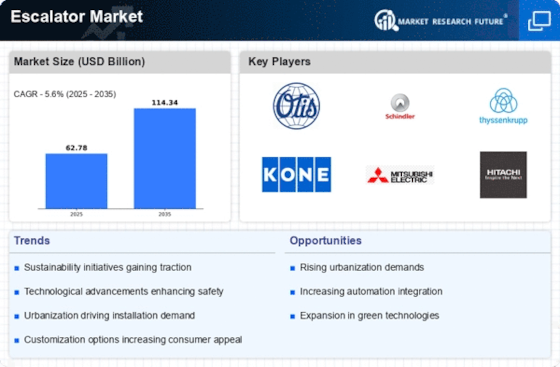
    Escalator Market size was valued at USD 62.78 Billion in 2024

    What is the expected escalator market size by 2035?

    The market size is expected to be USD 114.34 billion by 2035

    Who are the key players in the Market?

    Schindler (Switzerland), ThyssenKrupp AG (Germany), KONE Corporation (Finland), United Technologies (US), Hitachi Ltd. (Japan), Toshiba Corporation (Japan), Mitsubishi Electric Corporation, Electra Ltd. (Israel), FUJITA (Japan), Hyundai Elevator Co. Ltd., and others are the major companies operating in the market.

    Market Summary

    As per MRFR analysis, the Escalator Market Size was estimated at 62.78 USD Billion in 2024. The escalator industry is projected to grow from 66.3 USD Billion in 2025 to 114.34 USD Billion by 2035, exhibiting a compound annual growth rate (CAGR) of 5.6 during the forecast period 2025 - 2035.

    Key Market Trends & Highlights

    The escalator market is experiencing a dynamic shift towards smart technologies and sustainability, driven by urbanization and evolving consumer needs.

    • The integration of smart technologies is reshaping escalator designs, enhancing user experience and operational efficiency.
    • Aesthetic design is becoming increasingly important, particularly in commercial spaces, as businesses seek to create visually appealing environments.
    • The Asia-Pacific region is emerging as the fastest-growing market, driven by rapid urbanization and infrastructure development.
    • Urbanization and the aging population are key drivers, fueling demand in the commercial segment while sustainability initiatives gain traction in residential applications.

    Market Size & Forecast

    2024 Market Size 62.78 (USD Billion)
    2035 Market Size 114.34 (USD Billion)
    CAGR (2025 - 2035) 5.6%
    Largest Regional Market Share in 2024 North America

    Major Players

    <p>Otis Elevator Company (US), Schindler Group (CH), Thyssenkrupp AG (DE), Kone Corporation (FI), Mitsubishi Electric Corporation (JP), Hitachi Ltd. (JP), Toshiba Elevator and Building Systems Corporation (JP), Fujitec Co., Ltd. (JP)</p>

    Market Trends

    The Escalator Market is currently experiencing a dynamic phase characterized by evolving consumer preferences and technological advancements. As urbanization continues to rise, the demand for efficient vertical transportation solutions is becoming increasingly pronounced. Escalators are not merely functional; they are also being integrated into architectural designs, enhancing aesthetic appeal while providing convenience. This trend suggests a shift towards more innovative designs that cater to both utility and visual impact, indicating a broader acceptance of escalators in various environments, including commercial, residential, and public spaces. Moreover, sustainability is emerging as a pivotal factor influencing the Escalator Market. Manufacturers are exploring eco-friendly materials and energy-efficient technologies to meet the growing demand for sustainable infrastructure. This inclination towards green solutions appears to resonate with consumers and businesses alike, as they seek to reduce their carbon footprint. Consequently, the market is likely to witness a surge in products that not only fulfill functional requirements but also align with environmental considerations, thereby shaping the future landscape of escalator installations across the globe.

    Integration of Smart Technologies

    The Escalator Market is witnessing a notable trend towards the incorporation of smart technologies. This includes features such as sensors for monitoring usage patterns and predictive maintenance systems that enhance operational efficiency. Such advancements not only improve safety but also optimize energy consumption, aligning with modern demands for intelligent infrastructure.

    Focus on Aesthetic Design

    There is a growing emphasis on the aesthetic aspects of escalators, as they are increasingly viewed as integral components of architectural design. Manufacturers are responding by offering customizable options that blend seamlessly with various environments, thereby enhancing the overall visual appeal of spaces where escalators are installed.

    Sustainability Initiatives

    Sustainability is becoming a central theme in the Escalator Market, with manufacturers prioritizing eco-friendly materials and energy-efficient technologies. This trend reflects a broader commitment to reducing environmental impact, as stakeholders seek solutions that contribute to sustainable urban development.

    Escalator Market Market Drivers

    Aging Population and Accessibility Needs

    The Escalator Market is also influenced by the aging population, which necessitates improved accessibility in public spaces. As the demographic shifts towards an older population, there is a growing emphasis on making buildings and transport systems more accessible. Escalators serve as a vital component in ensuring that individuals with mobility challenges can navigate urban environments effectively. Data suggests that by 2030, the number of individuals aged 65 and older will reach approximately 1.5 billion, highlighting the increasing demand for accessible solutions. This demographic shift presents a significant opportunity for escalator manufacturers to innovate and cater to the needs of an aging society.

    Sustainability and Energy Efficiency Trends

    Sustainability is becoming a key driver in the Escalator Market, as consumers and businesses alike prioritize energy-efficient solutions. Manufacturers are increasingly focusing on developing escalators that consume less energy and utilize eco-friendly materials. The push for sustainability is not only a response to regulatory pressures but also aligns with consumer preferences for environmentally responsible products. Data indicates that energy-efficient escalators can reduce operational costs by up to 30%, making them an attractive option for building owners. This trend towards sustainability is likely to shape product development and marketing strategies within the escalator industry.

    Urbanization and Infrastructure Development

    The Escalator Market is experiencing a notable surge due to rapid urbanization and infrastructure development. As cities expand, the demand for efficient vertical transportation solutions increases. Urban centers are investing heavily in public transport systems, including metro stations and commercial buildings, which often require escalators for seamless movement. According to recent data, the construction sector is projected to grow at a compound annual growth rate of 4.5% over the next five years, further driving the need for escalators. This trend indicates a robust market potential for escalator manufacturers, as they align their products with the evolving needs of urban infrastructure.

    Technological Advancements in Safety Features

    Technological advancements are playing a crucial role in shaping the Escalator Market, particularly concerning safety features. Innovations such as sensors, emergency stop buttons, and advanced braking systems are becoming standard in escalator designs. These enhancements not only improve user safety but also comply with stringent regulations and standards set by authorities. The integration of smart technologies, such as predictive maintenance systems, is also gaining traction, allowing for real-time monitoring and reducing downtime. As safety becomes a paramount concern for consumers and regulatory bodies alike, manufacturers are likely to invest in these technologies to remain competitive in the market.

    Rising Demand in Retail and Commercial Sectors

    The Escalator Market is witnessing a rising demand from the retail and commercial sectors. As shopping malls, airports, and office complexes continue to proliferate, the need for efficient vertical transportation solutions becomes increasingly critical. Escalators are favored for their ability to handle high foot traffic while providing a seamless experience for users. Recent statistics indicate that the retail sector is expected to grow by 3.5% annually, further driving the installation of escalators in new and existing facilities. This trend suggests a robust market opportunity for escalator manufacturers to cater to the evolving needs of commercial spaces.

    Market Segment Insights

    Type Insights

    The  escalator market segmentation, based on type, is parallel, multi-parallel, walkway, crisscross, and spiral type. The  escalator market growth was prominently high under the parallel segment in 2021 due to increased demand from commercial buildings.

    Application Insights

    The  escalator market segmentation, based on application, is residential and commercial. The residential segment dominated the market in 2021 and is also anticipated to rise at a higher CAGR. The rising economic living standards are propelling the worldwide property market. Developing economies such as India, China, the Middle East, and North Africa are experiencing unprecedented urban growth as more people migrate to cities for work. As a result, high-rise building construction — nearly invariably equipped with smart elevators — has become increasingly important in urban expansion.

    Also, the industry is being pushed significantly by increased demand for commercial space and increased investment in public transportation projects such as metro lines and airports. However, constraints like the need for frequent maintenance and escalators' high energy consumption have the potential to impede market expansion.

    By region, the  escalator market has been divided into North America, Europe, Asia-Pacific, and the Rest of the World. North America accounted for the most extensive market share, and Asia-Pacific is anticipated to register the highest CAGR during the forecast period.

    Get more detailed insights about Escalator Market Research Report - Forecast to 2035

    Regional Insights

    North America : Innovation and Demand Surge

    The North American escalator market is driven by urbanization, infrastructure development, and a growing focus on energy-efficient solutions. The U.S. holds the largest market share at approximately 70%, followed by Canada at around 20%. Regulatory support for modernization and safety standards further fuels demand, particularly in commercial and public transport sectors. Leading players like Otis Elevator Company and Schindler Group dominate the landscape, focusing on innovative technologies and sustainability. The competitive environment is characterized by strategic partnerships and acquisitions aimed at enhancing service offerings. The presence of established companies ensures a robust supply chain and customer support, contributing to market stability.

    Europe : Sustainability and Innovation Focus

    Europe's escalator market is characterized by a strong emphasis on sustainability and innovation, driven by stringent regulations and a push for energy-efficient solutions. Germany and the UK are the largest markets, holding approximately 30% and 25% shares, respectively. The European Union's commitment to reducing carbon emissions has catalyzed investments in modern escalator technologies, enhancing safety and efficiency. Countries like Switzerland and France also contribute significantly to market growth, with key players such as Thyssenkrupp AG and Kone Corporation leading the charge. The competitive landscape is marked by a focus on R&D and the introduction of smart escalators, which integrate IoT technologies. This innovation is crucial for meeting the evolving demands of urban infrastructure.

    Asia-Pacific : Rapid Urbanization Drives Demand

    The Asia-Pacific escalator market is experiencing rapid growth, fueled by urbanization, population growth, and increasing investments in infrastructure. China is the largest market, accounting for approximately 50% of the regional share, followed by Japan at around 20%. Government initiatives to enhance public transport systems and smart city projects are significant drivers of demand. Countries like India and South Korea are also witnessing substantial growth, with key players such as Mitsubishi Electric Corporation and Hitachi Ltd. expanding their operations. The competitive landscape is dynamic, with a focus on technological advancements and customization to meet local needs. The presence of multiple manufacturers ensures a competitive pricing environment, benefiting consumers.

    Key Companies in the Escalator Market market include

    Industry Developments

    December, 2022: Otis China Adds More Than 100 Digitally Connected Elevators to Tianjin Metro - Otis China has been selected to provide more than 120 escalators and Gen3™ elevators for Tianjin Metro’s new Line 4 northern extension.The new Gen3™ elevators will be connected to Otis ONE™, an Internet of Things (IoT)-based platform already delivering real-time monitoring and predictive maintenance for Tianjin Metro.

    The digital ecosystem supports on-site service engineers to provide around-the-clock service to maximize passenger safety and minimize disruption.With 17 stations along a 22-kilometer route, the Line 4 extension builds on a southern section that opened in December 2021 with 186 Otis elevators and escalators.

    Overall, the latest addition takes the number of Otis units on the port city’s expanding subway network to more than 1,500.December, 2022: Athens Selects Otis for Nearly 100 Units on Important Metro Line Extension - New contract builds on success of Lines 2 and 3; brings total number of units installed and maintained by Otis to more than 580 - Athens residents and visitors are now able to travel from Venizelos International Airport to the Port of Piraeus in less than an hour on the 47 km Metro Line 3.That line includes six newly opened stations that complete the journey to Piraeus, including 21 Gen2® elevators and 72 heavy-duty Otis escalators.The six new stations are expected to help Piraeus and the greater area meet sustainability and traffic reduction goals – increasing overall passenger traffic on the metro network by 132,000 commuters daily and reducing the need for 23,000 vehicles on the roads above, cutting CO2 emissions by an estimated 60 tons every day.January, 2021: Schindler Launches ElevateMe Mobile App Touchless Elevator OperationThe Schindler ElevateMe smartphone app is part of the new touchless solutions in the Schindler CleanMobility range.

    The app allows passengers to simply call the elevator and select the destination with a swipe of a smartphone.Schindler's ElevateMe App is an innovative mobile app that allows passengers to call an elevator and select the destination floor via smartphone, without having to touch any buttons outside or inside the elevator car.With the new ElevateMe app, Schindler offers an end-to-end solution that provides a high level of security, while being easy to activate. Based on Schindler’s Internet of Elevators and Escalators (IoEE) platform, the app works with Schindler Ahead connected elevators.

    Installation involves a simple upgrade, after which the service can run instantly. Building owners or managers simply have to place the provided QR code stickers on the elevators and passenger can start operating the elevator via the Schindler ElevateMe app.

    Scope of the Escalator Market Report

    Type Outlook

      • Parallel
      • Multi parallel
      • Spiral type
      • Crisscross
      • Others

    Application Outlook

      • Residential
      • Commercial

    Region Outlook

      • North America
        • US
        • Canada
        • Mexico
      • Europe
        • UK
        • Germany
        • France
        • Italy
        • Spain
        • Rest of Europe
      • Asia-Pacific
        • China
        • India
        • Japan
        • Australia and New Zealand
        • Rest of Asia-Pacific
      • Rest of the World
        • South America
        • Middle East
        • Africa

    Objectives of the Study

    The objectives of the study are summarized in 5 stages. They are as mentioned below:

    Escalator Market Forecast & Size:

    To identify and estimate the market size for the  escalator market report segmented by type and application by value (in US dollars). Also, to understand the consumption/ demand created by consumers in the  escalator market forecast between 2022 and 2030

    Market Landscape and Trends:

    To identify and infer the drivers, restraints, opportunities, and challenges in the  escalator market growth

    Market Influencing Factors:

    To find out the factors which are affecting the  escalator market size among consumers

    Impact of COVID-19:

    To identify and understand the various factors involved in the market affected by the pandemic

    Company Profiling:

    To provide a detailed insight into the major companies operating in the market. The profiling will include the financial health of the company in the past 2-3 years with segmental and regional revenue breakup, product offering, recent developments, SWOT analysis, and key strategies.

    Intended Audience

      • Escalator manufacturers
      • Escalator dealers
      • Investors and traders

    Future Outlook

    Escalator Market Future Outlook

    <p>The Escalator Market is projected to grow at a 5.6% CAGR from 2024 to 2035, driven by urbanization, infrastructure development, and technological advancements.</p>

    New opportunities lie in:

    • <p>Integration of smart technology for predictive maintenance solutions.</p>
    • <p>Expansion into emerging markets with tailored escalator designs.</p>
    • <p>Development of eco-friendly escalators using sustainable materials.</p>

    <p>By 2035, the Escalator Market is expected to achieve robust growth, reflecting evolving urban infrastructure needs.</p>

    Market Segmentation

    Type Outlook

    • Parallel
    • Multi parallel
    • Spiral type
    • Crisscross
    • Others

    Region Outlook

    • North America US Canada Mexico
    • US
    • Canada
    • Mexico
    • Europe UK Germany France Italy Spain Rest of Europe
    • UK
    • Germany
    • France
    • Italy
    • Spain
    • Rest of Europe
    • Asia-Pacific China India Japan Australia and New Zealand Rest of Asia-Pacific
    • China
    • India
    • Japan
    • Australia and New Zealand
    • Rest of Asia-Pacific
    • Rest of the World South America Middle East Africa
    • South America
    • Middle East
    • Africa

    Application Outlook

    • Residential
    • Commercial

    Report Scope

    MARKET SIZE 202462.78(USD Billion)
    MARKET SIZE 202566.3(USD Billion)
    MARKET SIZE 2035114.34(USD Billion)
    COMPOUND ANNUAL GROWTH RATE (CAGR)5.6% (2024 - 2035)
    REPORT COVERAGERevenue Forecast, Competitive Landscape, Growth Factors, and Trends
    BASE YEAR2024
    Market Forecast Period2025 - 2035
    Historical Data2019 - 2024
    Market Forecast UnitsUSD Billion
    Key Companies ProfiledMarket analysis in progress
    Segments CoveredMarket segmentation analysis in progress
    Key Market OpportunitiesIntegration of smart technology and energy-efficient designs in the Escalator Market.
    Key Market DynamicsTechnological advancements and urbanization drive demand for escalators, influencing competitive dynamics and market consolidation.
    Countries CoveredNorth America, Europe, APAC, South America, MEA

    FAQs

    What is the study period of the escalator market report?

    The escalator market forecast period is 2025 - 2035

    What is the escalator market growth rate?

    Escalator Market is projected to register a CAGR of 5.6% from 2025-2035

    Which region has the highest market growth rate?

    Escalator Market is expected to grow with a CAGR of 5.6% in the period 2025-2035

    Which region has the largest share of the market?

    Escalator Market size was valued at USD 62.78 Billion in 2024

    What is the expected escalator market size by 2035?

    The market size is expected to be USD 114.34 billion by 2035

    Who are the key players in the Market?

    Schindler (Switzerland), ThyssenKrupp AG (Germany), KONE Corporation (Finland), United Technologies (US), Hitachi Ltd. (Japan), Toshiba Corporation (Japan), Mitsubishi Electric Corporation, Electra Ltd. (Israel), FUJITA (Japan), Hyundai Elevator Co. Ltd., and others are the major companies operating in the market.

    1. SECTION I: EXECUTIVE SUMMARY AND KEY HIGHLIGHTS
      1. | 1.1 EXECUTIVE SUMMARY
      2. | | 1.1.1 Market Overview
      3. | | 1.1.2 Key Findings
      4. | | 1.1.3 Market Segmentation
      5. | | 1.1.4 Competitive Landscape
      6. | | 1.1.5 Challenges and Opportunities
      7. | | 1.1.6 Future Outlook
    2. SECTION II: SCOPING, METHODOLOGY AND MARKET STRUCTURE
      1. | 2.1 MARKET INTRODUCTION
      2. | | 2.1.1 Definition
      3. | | 2.1.2 Scope of the study
      4. | | | 2.1.2.1 Research Objective
      5. | | | 2.1.2.2 Assumption
      6. | | | 2.1.2.3 Limitations
      7. | 2.2 RESEARCH METHODOLOGY
      8. | | 2.2.1 Overview
      9. | | 2.2.2 Data Mining
      10. | | 2.2.3 Secondary Research
      11. | | 2.2.4 Primary Research
      12. | | | 2.2.4.1 Primary Interviews and Information Gathering Process
      13. | | | 2.2.4.2 Breakdown of Primary Respondents
      14. | | 2.2.5 Forecasting Model
      15. | | 2.2.6 Market Size Estimation
      16. | | | 2.2.6.1 Bottom-Up Approach
      17. | | | 2.2.6.2 Top-Down Approach
      18. | | 2.2.7 Data Triangulation
      19. | | 2.2.8 Validation
    3. SECTION III: QUALITATIVE ANALYSIS
      1. | 3.1 MARKET DYNAMICS
      2. | | 3.1.1 Overview
      3. | | 3.1.2 Drivers
      4. | | 3.1.3 Restraints
      5. | | 3.1.4 Opportunities
      6. | 3.2 MARKET FACTOR ANALYSIS
      7. | | 3.2.1 Value chain Analysis
      8. | | 3.2.2 Porter's Five Forces Analysis
      9. | | | 3.2.2.1 Bargaining Power of Suppliers
      10. | | | 3.2.2.2 Bargaining Power of Buyers
      11. | | | 3.2.2.3 Threat of New Entrants
      12. | | | 3.2.2.4 Threat of Substitutes
      13. | | | 3.2.2.5 Intensity of Rivalry
      14. | | 3.2.3 COVID-19 Impact Analysis
      15. | | | 3.2.3.1 Market Impact Analysis
      16. | | | 3.2.3.2 Regional Impact
      17. | | | 3.2.3.3 Opportunity and Threat Analysis
    4. SECTION IV: QUANTITATIVE ANALYSIS
      1. | 4.1 Packaging & Transport, BY Type (USD Billion)
      2. | | 4.1.1 Parallel
      3. | | 4.1.2 Multi parallel
      4. | | 4.1.3 Spiral type
      5. | | 4.1.4 Crisscross
      6. | | 4.1.5 Others
      7. | 4.2 Packaging & Transport, BY Application (USD Billion)
      8. | | 4.2.1 Residential
      9. | | 4.2.2 Commercial
      10. | 4.3 Packaging & Transport, BY Region (USD Billion)
      11. | | 4.3.1 North America
      12. | | | 4.3.1.1 US
      13. | | | 4.3.1.2 Canada
      14. | | 4.3.2 Europe
      15. | | | 4.3.2.1 Germany
      16. | | | 4.3.2.2 UK
      17. | | | 4.3.2.3 France
      18. | | | 4.3.2.4 Russia
      19. | | | 4.3.2.5 Italy
      20. | | | 4.3.2.6 Spain
      21. | | | 4.3.2.7 Rest of Europe
      22. | | 4.3.3 APAC
      23. | | | 4.3.3.1 China
      24. | | | 4.3.3.2 India
      25. | | | 4.3.3.3 Japan
      26. | | | 4.3.3.4 South Korea
      27. | | | 4.3.3.5 Malaysia
      28. | | | 4.3.3.6 Thailand
      29. | | | 4.3.3.7 Indonesia
      30. | | | 4.3.3.8 Rest of APAC
      31. | | 4.3.4 South America
      32. | | | 4.3.4.1 Brazil
      33. | | | 4.3.4.2 Mexico
      34. | | | 4.3.4.3 Argentina
      35. | | | 4.3.4.4 Rest of South America
      36. | | 4.3.5 MEA
      37. | | | 4.3.5.1 GCC Countries
      38. | | | 4.3.5.2 South Africa
      39. | | | 4.3.5.3 Rest of MEA
    5. SECTION V: COMPETITIVE ANALYSIS
      1. | 5.1 Competitive Landscape
      2. | | 5.1.1 Overview
      3. | | 5.1.2 Competitive Analysis
      4. | | 5.1.3 Market share Analysis
      5. | | 5.1.4 Major Growth Strategy in the Packaging & Transport
      6. | | 5.1.5 Competitive Benchmarking
      7. | | 5.1.6 Leading Players in Terms of Number of Developments in the Packaging & Transport
      8. | | 5.1.7 Key developments and growth strategies
      9. | | | 5.1.7.1 New Product Launch/Service Deployment
      10. | | | 5.1.7.2 Merger & Acquisitions
      11. | | | 5.1.7.3 Joint Ventures
      12. | | 5.1.8 Major Players Financial Matrix
      13. | | | 5.1.8.1 Sales and Operating Income
      14. | | | 5.1.8.2 Major Players R&D Expenditure. 2023
      15. | 5.2 Company Profiles
      16. | | 5.2.1 Otis Elevator Company (US)
      17. | | | 5.2.1.1 Financial Overview
      18. | | | 5.2.1.2 Products Offered
      19. | | | 5.2.1.3 Key Developments
      20. | | | 5.2.1.4 SWOT Analysis
      21. | | | 5.2.1.5 Key Strategies
      22. | | 5.2.2 Schindler Group (CH)
      23. | | | 5.2.2.1 Financial Overview
      24. | | | 5.2.2.2 Products Offered
      25. | | | 5.2.2.3 Key Developments
      26. | | | 5.2.2.4 SWOT Analysis
      27. | | | 5.2.2.5 Key Strategies
      28. | | 5.2.3 Thyssenkrupp AG (DE)
      29. | | | 5.2.3.1 Financial Overview
      30. | | | 5.2.3.2 Products Offered
      31. | | | 5.2.3.3 Key Developments
      32. | | | 5.2.3.4 SWOT Analysis
      33. | | | 5.2.3.5 Key Strategies
      34. | | 5.2.4 Kone Corporation (FI)
      35. | | | 5.2.4.1 Financial Overview
      36. | | | 5.2.4.2 Products Offered
      37. | | | 5.2.4.3 Key Developments
      38. | | | 5.2.4.4 SWOT Analysis
      39. | | | 5.2.4.5 Key Strategies
      40. | | 5.2.5 Mitsubishi Electric Corporation (JP)
      41. | | | 5.2.5.1 Financial Overview
      42. | | | 5.2.5.2 Products Offered
      43. | | | 5.2.5.3 Key Developments
      44. | | | 5.2.5.4 SWOT Analysis
      45. | | | 5.2.5.5 Key Strategies
      46. | | 5.2.6 Hitachi Ltd. (JP)
      47. | | | 5.2.6.1 Financial Overview
      48. | | | 5.2.6.2 Products Offered
      49. | | | 5.2.6.3 Key Developments
      50. | | | 5.2.6.4 SWOT Analysis
      51. | | | 5.2.6.5 Key Strategies
      52. | | 5.2.7 Toshiba Elevator and Building Systems Corporation (JP)
      53. | | | 5.2.7.1 Financial Overview
      54. | | | 5.2.7.2 Products Offered
      55. | | | 5.2.7.3 Key Developments
      56. | | | 5.2.7.4 SWOT Analysis
      57. | | | 5.2.7.5 Key Strategies
      58. | | 5.2.8 Fujitec Co., Ltd. (JP)
      59. | | | 5.2.8.1 Financial Overview
      60. | | | 5.2.8.2 Products Offered
      61. | | | 5.2.8.3 Key Developments
      62. | | | 5.2.8.4 SWOT Analysis
      63. | | | 5.2.8.5 Key Strategies
      64. | 5.3 Appendix
      65. | | 5.3.1 References
      66. | | 5.3.2 Related Reports
    6. LIST OF FIGURES
      1. | 6.1 MARKET SYNOPSIS
      2. | 6.2 NORTH AMERICA MARKET ANALYSIS
      3. | 6.3 US MARKET ANALYSIS BY TYPE
      4. | 6.4 US MARKET ANALYSIS BY APPLICATION
      5. | 6.5 CANADA MARKET ANALYSIS BY TYPE
      6. | 6.6 CANADA MARKET ANALYSIS BY APPLICATION
      7. | 6.7 EUROPE MARKET ANALYSIS
      8. | 6.8 GERMANY MARKET ANALYSIS BY TYPE
      9. | 6.9 GERMANY MARKET ANALYSIS BY APPLICATION
      10. | 6.10 UK MARKET ANALYSIS BY TYPE
      11. | 6.11 UK MARKET ANALYSIS BY APPLICATION
      12. | 6.12 FRANCE MARKET ANALYSIS BY TYPE
      13. | 6.13 FRANCE MARKET ANALYSIS BY APPLICATION
      14. | 6.14 RUSSIA MARKET ANALYSIS BY TYPE
      15. | 6.15 RUSSIA MARKET ANALYSIS BY APPLICATION
      16. | 6.16 ITALY MARKET ANALYSIS BY TYPE
      17. | 6.17 ITALY MARKET ANALYSIS BY APPLICATION
      18. | 6.18 SPAIN MARKET ANALYSIS BY TYPE
      19. | 6.19 SPAIN MARKET ANALYSIS BY APPLICATION
      20. | 6.20 REST OF EUROPE MARKET ANALYSIS BY TYPE
      21. | 6.21 REST OF EUROPE MARKET ANALYSIS BY APPLICATION
      22. | 6.22 APAC MARKET ANALYSIS
      23. | 6.23 CHINA MARKET ANALYSIS BY TYPE
      24. | 6.24 CHINA MARKET ANALYSIS BY APPLICATION
      25. | 6.25 INDIA MARKET ANALYSIS BY TYPE
      26. | 6.26 INDIA MARKET ANALYSIS BY APPLICATION
      27. | 6.27 JAPAN MARKET ANALYSIS BY TYPE
      28. | 6.28 JAPAN MARKET ANALYSIS BY APPLICATION
      29. | 6.29 SOUTH KOREA MARKET ANALYSIS BY TYPE
      30. | 6.30 SOUTH KOREA MARKET ANALYSIS BY APPLICATION
      31. | 6.31 MALAYSIA MARKET ANALYSIS BY TYPE
      32. | 6.32 MALAYSIA MARKET ANALYSIS BY APPLICATION
      33. | 6.33 THAILAND MARKET ANALYSIS BY TYPE
      34. | 6.34 THAILAND MARKET ANALYSIS BY APPLICATION
      35. | 6.35 INDONESIA MARKET ANALYSIS BY TYPE
      36. | 6.36 INDONESIA MARKET ANALYSIS BY APPLICATION
      37. | 6.37 REST OF APAC MARKET ANALYSIS BY TYPE
      38. | 6.38 REST OF APAC MARKET ANALYSIS BY APPLICATION
      39. | 6.39 SOUTH AMERICA MARKET ANALYSIS
      40. | 6.40 BRAZIL MARKET ANALYSIS BY TYPE
      41. | 6.41 BRAZIL MARKET ANALYSIS BY APPLICATION
      42. | 6.42 MEXICO MARKET ANALYSIS BY TYPE
      43. | 6.43 MEXICO MARKET ANALYSIS BY APPLICATION
      44. | 6.44 ARGENTINA MARKET ANALYSIS BY TYPE
      45. | 6.45 ARGENTINA MARKET ANALYSIS BY APPLICATION
      46. | 6.46 REST OF SOUTH AMERICA MARKET ANALYSIS BY TYPE
      47. | 6.47 REST OF SOUTH AMERICA MARKET ANALYSIS BY APPLICATION
      48. | 6.48 MEA MARKET ANALYSIS
      49. | 6.49 GCC COUNTRIES MARKET ANALYSIS BY TYPE
      50. | 6.50 GCC COUNTRIES MARKET ANALYSIS BY APPLICATION
      51. | 6.51 SOUTH AFRICA MARKET ANALYSIS BY TYPE
      52. | 6.52 SOUTH AFRICA MARKET ANALYSIS BY APPLICATION
      53. | 6.53 REST OF MEA MARKET ANALYSIS BY TYPE
      54. | 6.54 REST OF MEA MARKET ANALYSIS BY APPLICATION
      55. | 6.55 KEY BUYING CRITERIA OF PACKAGING & TRANSPORT
      56. | 6.56 RESEARCH PROCESS OF MRFR
      57. | 6.57 DRO ANALYSIS OF PACKAGING & TRANSPORT
      58. | 6.58 DRIVERS IMPACT ANALYSIS: PACKAGING & TRANSPORT
      59. | 6.59 RESTRAINTS IMPACT ANALYSIS: PACKAGING & TRANSPORT
      60. | 6.60 SUPPLY / VALUE CHAIN: PACKAGING & TRANSPORT
      61. | 6.61 PACKAGING & TRANSPORT, BY TYPE, 2024 (% SHARE)
      62. | 6.62 PACKAGING & TRANSPORT, BY TYPE, 2024 TO 2035 (USD Billion)
      63. | 6.63 PACKAGING & TRANSPORT, BY APPLICATION, 2024 (% SHARE)
      64. | 6.64 PACKAGING & TRANSPORT, BY APPLICATION, 2024 TO 2035 (USD Billion)
      65. | 6.65 BENCHMARKING OF MAJOR COMPETITORS
    7. LIST OF TABLES
      1. | 7.1 LIST OF ASSUMPTIONS
      2. | | 7.1.1
      3. | 7.2 North America MARKET SIZE ESTIMATES; FORECAST
      4. | | 7.2.1 BY TYPE, 2025-2035 (USD Billion)
      5. | | 7.2.2 BY APPLICATION, 2025-2035 (USD Billion)
      6. | 7.3 US MARKET SIZE ESTIMATES; FORECAST
      7. | | 7.3.1 BY TYPE, 2025-2035 (USD Billion)
      8. | | 7.3.2 BY APPLICATION, 2025-2035 (USD Billion)
      9. | 7.4 Canada MARKET SIZE ESTIMATES; FORECAST
      10. | | 7.4.1 BY TYPE, 2025-2035 (USD Billion)
      11. | | 7.4.2 BY APPLICATION, 2025-2035 (USD Billion)
      12. | 7.5 Europe MARKET SIZE ESTIMATES; FORECAST
      13. | | 7.5.1 BY TYPE, 2025-2035 (USD Billion)
      14. | | 7.5.2 BY APPLICATION, 2025-2035 (USD Billion)
      15. | 7.6 Germany MARKET SIZE ESTIMATES; FORECAST
      16. | | 7.6.1 BY TYPE, 2025-2035 (USD Billion)
      17. | | 7.6.2 BY APPLICATION, 2025-2035 (USD Billion)
      18. | 7.7 UK MARKET SIZE ESTIMATES; FORECAST
      19. | | 7.7.1 BY TYPE, 2025-2035 (USD Billion)
      20. | | 7.7.2 BY APPLICATION, 2025-2035 (USD Billion)
      21. | 7.8 France MARKET SIZE ESTIMATES; FORECAST
      22. | | 7.8.1 BY TYPE, 2025-2035 (USD Billion)
      23. | | 7.8.2 BY APPLICATION, 2025-2035 (USD Billion)
      24. | 7.9 Russia MARKET SIZE ESTIMATES; FORECAST
      25. | | 7.9.1 BY TYPE, 2025-2035 (USD Billion)
      26. | | 7.9.2 BY APPLICATION, 2025-2035 (USD Billion)
      27. | 7.10 Italy MARKET SIZE ESTIMATES; FORECAST
      28. | | 7.10.1 BY TYPE, 2025-2035 (USD Billion)
      29. | | 7.10.2 BY APPLICATION, 2025-2035 (USD Billion)
      30. | 7.11 Spain MARKET SIZE ESTIMATES; FORECAST
      31. | | 7.11.1 BY TYPE, 2025-2035 (USD Billion)
      32. | | 7.11.2 BY APPLICATION, 2025-2035 (USD Billion)
      33. | 7.12 Rest of Europe MARKET SIZE ESTIMATES; FORECAST
      34. | | 7.12.1 BY TYPE, 2025-2035 (USD Billion)
      35. | | 7.12.2 BY APPLICATION, 2025-2035 (USD Billion)
      36. | 7.13 APAC MARKET SIZE ESTIMATES; FORECAST
      37. | | 7.13.1 BY TYPE, 2025-2035 (USD Billion)
      38. | | 7.13.2 BY APPLICATION, 2025-2035 (USD Billion)
      39. | 7.14 China MARKET SIZE ESTIMATES; FORECAST
      40. | | 7.14.1 BY TYPE, 2025-2035 (USD Billion)
      41. | | 7.14.2 BY APPLICATION, 2025-2035 (USD Billion)
      42. | 7.15 India MARKET SIZE ESTIMATES; FORECAST
      43. | | 7.15.1 BY TYPE, 2025-2035 (USD Billion)
      44. | | 7.15.2 BY APPLICATION, 2025-2035 (USD Billion)
      45. | 7.16 Japan MARKET SIZE ESTIMATES; FORECAST
      46. | | 7.16.1 BY TYPE, 2025-2035 (USD Billion)
      47. | | 7.16.2 BY APPLICATION, 2025-2035 (USD Billion)
      48. | 7.17 South Korea MARKET SIZE ESTIMATES; FORECAST
      49. | | 7.17.1 BY TYPE, 2025-2035 (USD Billion)
      50. | | 7.17.2 BY APPLICATION, 2025-2035 (USD Billion)
      51. | 7.18 Malaysia MARKET SIZE ESTIMATES; FORECAST
      52. | | 7.18.1 BY TYPE, 2025-2035 (USD Billion)
      53. | | 7.18.2 BY APPLICATION, 2025-2035 (USD Billion)
      54. | 7.19 Thailand MARKET SIZE ESTIMATES; FORECAST
      55. | | 7.19.1 BY TYPE, 2025-2035 (USD Billion)
      56. | | 7.19.2 BY APPLICATION, 2025-2035 (USD Billion)
      57. | 7.20 Indonesia MARKET SIZE ESTIMATES; FORECAST
      58. | | 7.20.1 BY TYPE, 2025-2035 (USD Billion)
      59. | | 7.20.2 BY APPLICATION, 2025-2035 (USD Billion)
      60. | 7.21 Rest of APAC MARKET SIZE ESTIMATES; FORECAST
      61. | | 7.21.1 BY TYPE, 2025-2035 (USD Billion)
      62. | | 7.21.2 BY APPLICATION, 2025-2035 (USD Billion)
      63. | 7.22 South America MARKET SIZE ESTIMATES; FORECAST
      64. | | 7.22.1 BY TYPE, 2025-2035 (USD Billion)
      65. | | 7.22.2 BY APPLICATION, 2025-2035 (USD Billion)
      66. | 7.23 Brazil MARKET SIZE ESTIMATES; FORECAST
      67. | | 7.23.1 BY TYPE, 2025-2035 (USD Billion)
      68. | | 7.23.2 BY APPLICATION, 2025-2035 (USD Billion)
      69. | 7.24 Mexico MARKET SIZE ESTIMATES; FORECAST
      70. | | 7.24.1 BY TYPE, 2025-2035 (USD Billion)
      71. | | 7.24.2 BY APPLICATION, 2025-2035 (USD Billion)
      72. | 7.25 Argentina MARKET SIZE ESTIMATES; FORECAST
      73. | | 7.25.1 BY TYPE, 2025-2035 (USD Billion)
      74. | | 7.25.2 BY APPLICATION, 2025-2035 (USD Billion)
      75. | 7.26 Rest of South America MARKET SIZE ESTIMATES; FORECAST
      76. | | 7.26.1 BY TYPE, 2025-2035 (USD Billion)
      77. | | 7.26.2 BY APPLICATION, 2025-2035 (USD Billion)
      78. | 7.27 MEA MARKET SIZE ESTIMATES; FORECAST
      79. | | 7.27.1 BY TYPE, 2025-2035 (USD Billion)
      80. | | 7.27.2 BY APPLICATION, 2025-2035 (USD Billion)
      81. | 7.28 GCC Countries MARKET SIZE ESTIMATES; FORECAST
      82. | | 7.28.1 BY TYPE, 2025-2035 (USD Billion)
      83. | | 7.28.2 BY APPLICATION, 2025-2035 (USD Billion)
      84. | 7.29 South Africa MARKET SIZE ESTIMATES; FORECAST
      85. | | 7.29.1 BY TYPE, 2025-2035 (USD Billion)
      86. | | 7.29.2 BY APPLICATION, 2025-2035 (USD Billion)
      87. | 7.30 Rest of MEA MARKET SIZE ESTIMATES; FORECAST
      88. | | 7.30.1 BY TYPE, 2025-2035 (USD Billion)
      89. | | 7.30.2 BY APPLICATION, 2025-2035 (USD Billion)
      90. | 7.31 PRODUCT LAUNCH/PRODUCT DEVELOPMENT/APPROVAL
      91. | | 7.31.1
      92. | 7.32 ACQUISITION/PARTNERSHIP
      93. | | 7.32.1

    Escalator Market Segmentation

    Market Segmentation Overview

    • Detailed segmentation data will be available in the full report
    • Comprehensive analysis by multiple parameters
    • Regional and country-level breakdowns
    • Market size forecasts by segment
    Infographic

    Free Sample Request

    Kindly complete the form below to receive a free sample of this Report

    Get Free Sample

    Customer Strories

    “I am very pleased with how market segments have been defined in a relevant way for my purposes (such as "Portable Freezers & refrigerators" and "last-mile"). In general the report is well structured. Thanks very much for your efforts.”

    Victoria Milne

    Founder
    Case Study
    Chemicals and Materials

    Compare Licence

    ×
    Features License Type
    Single User Multiuser License Enterprise User
    Price $4,950 $5,950 $7,250
    Maximum User Access Limit 1 User Upto 10 Users Unrestricted Access Throughout the Organization
    Free Customization
    Direct Access to Analyst
    Deliverable Format
    Platform Access
    Discount on Next Purchase 10% 15% 15%
    Printable Versions