Request Free Sample ×

Kindly complete the form below to receive a free sample of this Report

* Please use a valid business email

Leading companies partner with us for data-driven Insights

clients tt-cursor
Hero Background
English
Chinese
French
Japanese
Korean
German
Spanish

Epichlorohydrin Market Analysis

ID: MRFR/CnM/2118-HCR
111 Pages
Chitranshi Jaiswal
March 2026

Epichlorohydrin Market Research Report Information - by Application (Epoxy Resins, Synthetic Glycerin, Water Treatment Chemicals, and Others), By End User (Automotive, Electronics, Textiles, Pharmaceutical, Construction Industry, and Others) and by Region - Forecast till 2035

Share:
Download PDF ×

We do not share your information with anyone. However, we may send you emails based on your report interest from time to time. You may contact us at any time to opt-out.

Epichlorohydrin Market Infographic
Purchase Options

Market Analysis

In-depth Analysis of Epichlorohydrin Market Industry Landscape

Dynamic forces drive the growth and trends in the epichlorohydrin market since it plays a crucial role in manufacturing various chemicals such as epoxy resins and synthetic rubbers among many others. It finds applications like automotive construction electronics etc due to these varied uses. Demand for epoxy resins drives dynamics of the market, where epichlorohydrin is the main raw material. If these end-user industries grow, the consumption of epichlorohydrin in them will also follow suit. Epichlorohydrin Market opportunities are evident in its wide usage within construction sector for paints and coatings. Opportunities arise from a growing economy and government initiatives on infrastructure improvement. The construction of residential places that results from an improved economic state leads to expansion of the market. The increased population growth and growing motor vehicle industry present a chance for application of paints and coats thereby boosting the market for epichlorohydrin. The automotive sector has a major effect on epichlorohydrin market dynamics because epoxy resins made from this chemical are important in making lightweight components like composites and coatings which contribute to fuel efficiency as well as general performance of vehicles. Changes in automobile demand, influenced by consumer preferences, regulatory standards, and technological advancements determine how much epichlorohydrin is required. Construction as well as infrastructure development also determines the dynamics of Epichlorohydrin market. Epoxy resins obtained from epi-chloro hydrate find big applications in construction materials such as adhesive, coating or sealants. The construction industry trends change alongside with urbanization, infrastructure projects or demand for green building materials. Consequently, changes in construction practices architectural designs may alter levels of consumption within these applications. Economic indicators are globally significant determinants of the epichlorohydrin market. Economic growth, industrial production as well as trade agreements affect demand for epichlorohydrin in different parts of the world. Additionally, currency fluctuations, geopolitical risks and supply chain weak points also introduce ambiguities that influence market prices and supplies. In addition to this, regional distribution of epichlorohydrin manufacture and consumption adds to variations in the markets with some regions playing very important roles in chemical manufacturing.

Author
Author Profile
Chitranshi Jaiswal
Team Lead - Research

Chitranshi is a Team Leader in the Chemicals & Materials (CnM) and Energy & Power (EnP) domains, with 6+ years of experience in market research. She leads and mentors teams to deliver cross-domain projects that equip clients with actionable insights and growth strategies. She is skilled in market estimation, forecasting, competitive benchmarking, and both primary & secondary research, enabling her to turn complex data into decision-ready insights. An engineer and MBA professional, she combines technical expertise with strategic acumen to solve dynamic market challenges. Chitranshi has successfully managed projects that support market entry, investment planning, and competitive positioning, while building strong client relationships. Certified in Advanced Excel & Power BI she leverages data-driven approaches to ensure accuracy, clarity, and impactful outcomes.

Leave a Comment

FAQs

What is the current valuation of the Epichlorohydrin Market?

<p>The Epichlorohydrin Market was valued at 2.99 USD Billion in 2024.</p>

What is the projected market valuation for the Epichlorohydrin Market in 2035?

<p>The market is projected to reach 5.736 USD Billion by 2035.</p>

What is the expected CAGR for the Epichlorohydrin Market during the forecast period?

<p>The expected CAGR for the Epichlorohydrin Market from 2025 to 2035 is 6.1%.</p>

Which companies are considered key players in the Epichlorohydrin Market?

<p>Key players include Momentive, Hexion, Olin Corporation, Kuwait Chemical, DOW Chemical, BASF, SABIC, Shin-Etsu Chemical, and Mitsubishi Chemical.</p>

What are the primary applications of Epichlorohydrin?

<p>Primary applications include epoxy resins, elastomers, surfactants, water treatment chemicals, and resin for paper manufacture.</p>

How much was the market value for epoxy resins in 2024?

<p>The market value for epoxy resins was 1.2 USD Billion in 2024.</p>

What is the projected market value for surfactants by 2035?

<p>The projected market value for surfactants is expected to reach 1.0 USD Billion by 2035.</p>

What was the market value for Epichlorohydrin elastomers in 2024?

<p>The market value for Epichlorohydrin elastomers was 0.8 USD Billion in 2024.</p>

What is the expected growth trend for water treatment chemicals in the Epichlorohydrin Market?

<p>Water treatment chemicals are projected to grow from 0.3 USD Billion in 2024 to 0.6 USD Billion by 2035.</p>

How does the Epichlorohydrin Market's growth compare to other chemical markets?

<p>The Epichlorohydrin Market's growth appears robust, with a projected CAGR of 6.1% from 2025 to 2035, indicating strong demand.</p>

Market Summary

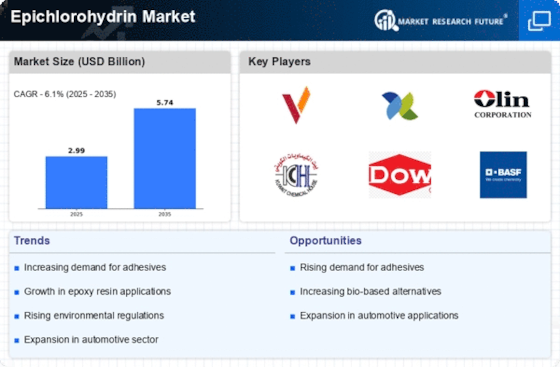
As per Market Research Future analysis, the Epichlorohydrin Market Size was estimated at 2.99 USD Billion in 2024. The Epichlorohydrin industry is projected to grow from 3.172 USD Billion in 2025 to 5.736 USD Billion by 2035, exhibiting a compound annual growth rate (CAGR) of 6.1% during the forecast period 2025 - 2035

Key Market Trends & Highlights

The Epichlorohydrin Market is poised for growth driven by sustainability and technological advancements.

  • North America remains the largest market for epichlorohydrin, primarily due to its established industrial base. The Asia-Pacific region is emerging as the fastest-growing market, fueled by increasing demand in various applications. Epoxy resins dominate the market, while epichlorohydrin elastomers are experiencing rapid growth due to their versatility. Rising demand in adhesives and sealants, along with expansion in the automotive sector, are key drivers of market growth.

Market Size & Forecast

2024 Market Size 2.99 (USD Billion)
2035 Market Size 5.736 (USD Billion)
CAGR (2025 - 2035) 6.1%
Largest Regional Market Share in 2024 Asia Pacific

Major Players

Momentive (US), Hexion (US), Olin Corporation (US), Kuwait Chemical (KW), DOW Chemical (US), BASF (DE), SABIC (SA), Shin-Etsu Chemical (JP), Mitsubishi Chemical (JP)

Market Trends

The Epichlorohydrin Market is currently experiencing a dynamic phase characterized by evolving demand patterns and technological advancements. This compound, primarily utilized in the production of epoxy resins, is witnessing increased interest from various sectors, including automotive, construction, and electronics. The growing emphasis on sustainable materials and eco-friendly practices appears to be influencing manufacturers to explore innovative production methods. As a result, the market landscape is shifting, with companies investing in research and development to enhance product efficiency and reduce environmental impact. Moreover, the regulatory environment surrounding chemical production is becoming more stringent, prompting industry players to adapt their practices accordingly. This shift may lead to a more competitive market, as firms strive to comply with new standards while maintaining profitability. The interplay between regulatory pressures and market demand could potentially reshape the future of the Epichlorohydrin Market, fostering a climate of innovation and sustainability. As stakeholders navigate these complexities, the focus on quality and performance remains paramount, ensuring that the market continues to evolve in response to both consumer needs and environmental considerations.

Sustainability Initiatives

The Epichlorohydrin Market is increasingly influenced by sustainability initiatives. Manufacturers are exploring greener production methods and raw materials to align with global environmental goals. This trend reflects a broader commitment to reducing carbon footprints and enhancing the lifecycle of products.

Technological Advancements

Technological advancements are playing a crucial role in the evolution of the Epichlorohydrin Market. Innovations in production processes and applications are enabling companies to improve efficiency and product quality. This ongoing development may lead to new applications and expanded market reach.

Regulatory Compliance

Regulatory compliance is becoming a significant factor in the Epichlorohydrin Market. Stricter regulations regarding chemical production and safety are prompting companies to adapt their practices. This trend may drive investment in compliance technologies and practices, influencing overall market dynamics.

Epichlorohydrin Market Market Drivers

Expansion in the Automotive Sector

The automotive industry plays a pivotal role in the Epichlorohydrin Market, with increasing utilization of epichlorohydrin-based materials in various applications such as coatings, adhesives, and sealants. The demand for lightweight and durable materials is driving manufacturers to incorporate epichlorohydrin into their production processes. In 2025, the automotive segment is expected to witness a growth rate of around 4.8%, reflecting the industry's ongoing transformation towards more efficient and sustainable vehicles. This expansion is further supported by the rising consumer preference for electric vehicles, which often require advanced materials for enhanced performance and safety. As automotive manufacturers continue to innovate, the reliance on epichlorohydrin is likely to intensify, thereby propelling the overall market forward.

Growth in the Construction Industry

The construction sector is a significant driver of the Epichlorohydrin Market, as the demand for high-performance materials continues to rise. Epichlorohydrin is increasingly used in the production of sealants, coatings, and adhesives, which are essential for modern construction projects. In 2025, the construction industry is projected to contribute substantially to the market, with an anticipated growth rate of approximately 5.5%. This growth is attributed to the ongoing urbanization and infrastructure development initiatives worldwide, which necessitate the use of durable and efficient materials. Additionally, the trend towards sustainable building practices is likely to enhance the appeal of epichlorohydrin-based products, as they offer improved performance while aligning with environmental standards.

Regulatory Support for Chemical Safety

The regulatory landscape surrounding chemical safety is evolving, and this is impacting the Epichlorohydrin Market. Governments are increasingly implementing stringent regulations aimed at ensuring the safe use of chemicals in various applications. In 2025, compliance with these regulations is expected to drive innovation and investment in safer alternatives and production methods. This regulatory support may encourage manufacturers to enhance their product offerings, focusing on safety and environmental impact. As a result, the epichlorohydrin market could see a shift towards more sustainable practices, with companies striving to meet regulatory requirements while maintaining product performance. This dynamic may ultimately foster a more responsible and forward-thinking industry.

Rising Demand in Adhesives and Sealants

The Epichlorohydrin Market is experiencing a notable surge in demand for adhesives and sealants, primarily driven by the construction and automotive sectors. These industries increasingly utilize epichlorohydrin-based products due to their superior bonding properties and resistance to environmental factors. In 2025, the adhesives segment is projected to account for a significant share of the market, reflecting a compound annual growth rate (CAGR) of approximately 5.2% from 2023 to 2025. This trend indicates a robust growth trajectory, as manufacturers seek high-performance materials that enhance product durability and longevity. Furthermore, the shift towards eco-friendly formulations is likely to bolster the adoption of epichlorohydrin in these applications, as companies strive to meet sustainability goals while maintaining product efficacy.

Technological Innovations in Production

Technological advancements in the production of epichlorohydrin are significantly influencing the Epichlorohydrin Market. Innovations such as improved synthesis methods and enhanced purification processes are leading to higher yields and reduced production costs. In 2025, these advancements are expected to facilitate a more efficient supply chain, thereby increasing the availability of epichlorohydrin for various applications. Furthermore, the development of novel catalysts and reaction conditions may enhance the overall sustainability of the production process, aligning with the industry's shift towards greener practices. As manufacturers adopt these technologies, the market is likely to witness a transformation, characterized by increased competitiveness and a broader range of applications for epichlorohydrin.

Market Segment Insights

By Application: Epoxy Resins (Largest) vs. Epichlorohydrin Elastomers (Fastest-Growing)

<p>The Epichlorohydrin market features a diverse range of applications, among which Epoxy <a href="https://www.marketresearchfuture.com/reports/resins-market-12613" target="_blank" title="resins">Resins</a> hold the largest market share due to their widespread use in adhesives, coatings, and composite materials. Following closely are Epichlorohydrin Elastomers, which are gaining traction owing to their unique flexibility and resistance, positioning them as a growing segment. Other applications like Surfactants, Water Treatment Chemicals, and Resin for Paper Manufacture contribute to the market but do not dominate the share like the former two segments.</p>

<p>Epoxy Resins (Dominant) vs. Epichlorohydrin Elastomers (Emerging)</p>

<p>Epoxy Resins dominate the Epichlorohydrin market due to their superior adhesion properties and versatility in various applications, particularly in coatings and composites. Their robust performance under harsh conditions makes them a preferred choice in industries such as automotive, aerospace, and construction. Conversely, Epichlorohydrin Elastomers are emerging rapidly, driven by the demand for high-performance materials that offer flexibility and chemical resistance for automotive seals and gaskets. As industries increasingly seek innovative materials that enhance product performance, the growth of both segments underscores a dynamic shift in application demands.</p>

Get more detailed insights about Epichlorohydrin Market Research Report- Forecast to 2035

Regional Insights

North America : Innovation and Demand Growth

North America is the largest market for epichlorohydrin, holding approximately 45% of the global share. The region's growth is driven by increasing demand from the automotive and construction sectors, alongside stringent environmental regulations promoting the use of eco-friendly materials. The U.S. leads this market, supported by a robust chemical manufacturing base and investments in sustainable technologies. Key players such as DOW Chemical, Momentive, and Hexion dominate the landscape, leveraging advanced production techniques and strategic partnerships. The competitive environment is characterized by innovation and a focus on R&D, with companies striving to enhance product performance and reduce environmental impact. The presence of established firms ensures a stable supply chain and fosters market resilience.

Europe : Regulatory Framework and Growth

Europe is the second-largest market for epichlorohydrin, accounting for about 30% of the global share. The region's growth is significantly influenced by stringent regulations aimed at reducing carbon emissions and promoting sustainable practices. The European Union's Green Deal and REACH regulations are pivotal in shaping market dynamics, encouraging the adoption of eco-friendly alternatives in various applications. Germany and France are the leading countries in this market, with major players like BASF and SABIC actively participating in the development of innovative solutions. The competitive landscape is marked by a focus on sustainability, with companies investing in green technologies and processes. This commitment to environmental responsibility is expected to drive further growth in the epichlorohydrin market across Europe.

Asia-Pacific : Emerging Markets and Opportunities

Asia-Pacific is witnessing rapid growth in the epichlorohydrin market, holding approximately 20% of the global share. The region's expansion is driven by increasing industrialization, urbanization, and rising demand from the automotive and electronics sectors. Countries like China and India are at the forefront, with government initiatives supporting infrastructure development and manufacturing growth, further boosting market demand. China is the largest market in the region, with significant contributions from local manufacturers and multinational corporations. Key players such as Shin-Etsu Chemical and Mitsubishi Chemical are enhancing their production capabilities to meet the growing demand. The competitive landscape is evolving, with a focus on innovation and cost-effective production methods, positioning Asia-Pacific as a vital player in The Epichlorohydrin.

Middle East and Africa : Resource-Rich and Growing Demand

The Middle East and Africa region is emerging as a potential market for epichlorohydrin, currently holding about 5% of the global share. The growth is primarily driven by increasing industrial activities and the availability of raw materials. Countries like Saudi Arabia and the UAE are investing in chemical manufacturing, aiming to diversify their economies and reduce dependence on oil exports. The competitive landscape is still developing, with local players and international companies exploring opportunities in this region. Key players such as Kuwait Chemical are establishing a presence, focusing on leveraging local resources for production. As infrastructure improves and demand rises, the Middle East and Africa are poised for significant growth in the epichlorohydrin market.

Key Players and Competitive Insights

The Epichlorohydrin Market is characterized by a dynamic competitive landscape, driven by increasing demand across various applications, including epoxy resins, elastomers, and coatings. Key players such as DOW Chemical (US), Momentive (US), and BASF (Germany) are strategically positioned to leverage their extensive product portfolios and technological advancements. DOW Chemical (US) focuses on innovation and sustainability, aiming to enhance its production processes while reducing environmental impact. Momentive (US) emphasizes partnerships and collaborations to expand its market reach, particularly in emerging economies. Meanwhile, BASF (Germany) is investing in digital transformation initiatives to optimize its operations and improve customer engagement, collectively shaping a competitive environment that prioritizes innovation and sustainability.

The Epichlorohydrin Market exhibits a moderately fragmented structure, with several key players competing for market share. Companies are increasingly localizing manufacturing and optimizing supply chains to enhance efficiency and responsiveness to market demands. This competitive structure allows for a diverse range of products and services, fostering innovation and driving growth within the sector. The collective influence of these major players is significant, as they set industry standards and trends that smaller companies often follow.

In August 2025, DOW Chemical (US) announced the launch of a new eco-friendly epichlorohydrin product line aimed at reducing carbon emissions during production. This strategic move not only aligns with global sustainability goals but also positions DOW as a leader in environmentally responsible manufacturing. The introduction of this product line is likely to attract environmentally conscious customers and enhance DOW's competitive edge in the market.

In September 2025, Momentive (US) entered into a strategic partnership with a leading technology firm to develop advanced digital solutions for its manufacturing processes. This collaboration is expected to enhance operational efficiency and reduce production costs, thereby allowing Momentive to offer more competitive pricing. The integration of digital technologies into their operations may also lead to improved product quality and customer satisfaction, further solidifying Momentive's market position.

In July 2025, BASF (Germany) expanded its production capacity for epichlorohydrin in response to rising global demand. This expansion is indicative of BASF's commitment to meeting market needs and enhancing its supply chain reliability. By increasing production capacity, BASF not only strengthens its market presence but also positions itself to capitalize on future growth opportunities in the epichlorohydrin sector.

As of October 2025, the competitive trends in the Epichlorohydrin Market are increasingly defined by digitalization, sustainability, and the integration of artificial intelligence in production processes. Strategic alliances among key players are shaping the landscape, fostering innovation and enhancing operational efficiencies. Looking ahead, competitive differentiation is likely to evolve from traditional price-based competition to a focus on technological advancements, sustainability initiatives, and supply chain reliability, reflecting the changing priorities of consumers and regulatory frameworks.

Key Companies in the Epichlorohydrin Market include

Industry Developments

In March 2022, Grasim Industries Limited (India) and Aditya Birla Chemicals (Thailand) Pvt. Ltd said that they intended to expand its global epichlorohydrin (ECH) production capacity during Quarter 1 of 2025.

On January 3rd, 2022, Hexion Corp. announced plans to increase production of epichlorohydrin (ECH) at its Pernis, Netherlands, plant while incorporating more sustainable technology after completion. This growth plan includes a new expansion, which is part of Hexion’s overall sustainability strategy by adding another annual output of twenty-five thousand metric tons with input from biobased renewable feedstocks through glycerin-to-hydride glycerin technology and supports efforts towards energy reduction in ECH manufacturing throughout whole mix at Pernis site.

According to Nama Chemicals Company, one of the world's largest producers of ECH, scheduled periodic maintenance work within Hassad project's Subsidiary Facilities was completed successfully in October 2021. On Wednesday October 20th - plant operation will begin again! Throughout this time period for regular maintenance works, the chemical catalysts have been replaced, and many related units have been checked out, repaired and maintained as necessary. For example, it has already completed incorporating the utility unit’s chilled water system. Henceforth, on October 25th, reoperation will be stopped altogether.

DCM Shriram approved an investment worth US$133.9m (₹10bn) to develop downstream capabilities in the chemical space. The proposed investments include a hydrogen peroxide unit of 52,500 tonnes per year and an epichlorohydrin unit of 51,000 tonnes, as well as a glycerine purification facility for the Bharuch plant in Gujarat.

Future Outlook

Epichlorohydrin Market Future Outlook

The Epichlorohydrin Market is projected to grow at a 6.1% CAGR from 2024 to 2035, driven by increasing demand in adhesives, coatings, and <a href="https://www.marketresearchfuture.com/reports/epoxy-resin-market-1736" target="_blank" title="epoxy resin">epoxy resins</a>.

New opportunities lie in:

  • Expansion into bio-based epichlorohydrin production methods.
  • Development of high-performance epoxy resins for automotive applications.
  • Strategic partnerships with construction firms for specialty coatings.

By 2035, the Epichlorohydrin Market is expected to solidify its position as a key player in specialty chemicals.

Market Segmentation

Epichlorohydrin Market Application Outlook

  • Epoxy Resins
  • Epichlorohydrin Elastomers
  • Surfactants
  • Water Treatment Chemicals
  • Resin for Paper Manufacture

Report Scope

MARKET SIZE 20242.99(USD Billion)
MARKET SIZE 20253.172(USD Billion)
MARKET SIZE 20355.736(USD Billion)
COMPOUND ANNUAL GROWTH RATE (CAGR)6.1% (2024 - 2035)
REPORT COVERAGERevenue Forecast, Competitive Landscape, Growth Factors, and Trends
BASE YEAR2024
Market Forecast Period2025 - 2035
Historical Data2019 - 2024
Market Forecast UnitsUSD Billion
Key Companies ProfiledMarket analysis in progress
Segments CoveredMarket segmentation analysis in progress
Key Market OpportunitiesGrowing demand for bio-based epichlorohydrin in sustainable applications presents a significant opportunity.
Key Market DynamicsRising demand for epoxy resins drives innovation and competition in the Epichlorohydrin market.
Countries CoveredNorth America, Europe, APAC, South America, MEA

FAQs

What is the current valuation of the Epichlorohydrin Market?

<p>The Epichlorohydrin Market was valued at 2.99 USD Billion in 2024.</p>

What is the projected market valuation for the Epichlorohydrin Market in 2035?

<p>The market is projected to reach 5.736 USD Billion by 2035.</p>

What is the expected CAGR for the Epichlorohydrin Market during the forecast period?

<p>The expected CAGR for the Epichlorohydrin Market from 2025 to 2035 is 6.1%.</p>

Which companies are considered key players in the Epichlorohydrin Market?

<p>Key players include Momentive, Hexion, Olin Corporation, Kuwait Chemical, DOW Chemical, BASF, SABIC, Shin-Etsu Chemical, and Mitsubishi Chemical.</p>

What are the primary applications of Epichlorohydrin?

<p>Primary applications include epoxy resins, elastomers, surfactants, water treatment chemicals, and resin for paper manufacture.</p>

How much was the market value for epoxy resins in 2024?

<p>The market value for epoxy resins was 1.2 USD Billion in 2024.</p>

What is the projected market value for surfactants by 2035?

<p>The projected market value for surfactants is expected to reach 1.0 USD Billion by 2035.</p>

What was the market value for Epichlorohydrin elastomers in 2024?

<p>The market value for Epichlorohydrin elastomers was 0.8 USD Billion in 2024.</p>

What is the expected growth trend for water treatment chemicals in the Epichlorohydrin Market?

<p>Water treatment chemicals are projected to grow from 0.3 USD Billion in 2024 to 0.6 USD Billion by 2035.</p>

How does the Epichlorohydrin Market's growth compare to other chemical markets?

<p>The Epichlorohydrin Market's growth appears robust, with a projected CAGR of 6.1% from 2025 to 2035, indicating strong demand.</p>

  1. SECTION I: EXECUTIVE SUMMARY AND KEY HIGHLIGHTS
    1. | 1.1 EXECUTIVE SUMMARY
    2. | | 1.1.1 Market Overview
    3. | | 1.1.2 Key Findings
    4. | | 1.1.3 Market Segmentation
    5. | | 1.1.4 Competitive Landscape
    6. | | 1.1.5 Challenges and Opportunities
    7. | | 1.1.6 Future Outlook
  2. SECTION II: SCOPING, METHODOLOGY AND MARKET STRUCTURE
    1. | 2.1 MARKET INTRODUCTION
    2. | | 2.1.1 Definition
    3. | | 2.1.2 Scope of the study
    4. | | | 2.1.2.1 Research Objective
    5. | | | 2.1.2.2 Assumption
    6. | | | 2.1.2.3 Limitations
    7. | 2.2 RESEARCH METHODOLOGY
    8. | | 2.2.1 Overview
    9. | | 2.2.2 Data Mining
    10. | | 2.2.3 Secondary Research
    11. | | 2.2.4 Primary Research
    12. | | | 2.2.4.1 Primary Interviews and Information Gathering Process
    13. | | | 2.2.4.2 Breakdown of Primary Respondents
    14. | | 2.2.5 Forecasting Model
    15. | | 2.2.6 Market Size Estimation
    16. | | | 2.2.6.1 Bottom-Up Approach
    17. | | | 2.2.6.2 Top-Down Approach
    18. | | 2.2.7 Data Triangulation
    19. | | 2.2.8 Validation
  3. SECTION III: QUALITATIVE ANALYSIS
    1. | 3.1 MARKET DYNAMICS
    2. | | 3.1.1 Overview
    3. | | 3.1.2 Drivers
    4. | | 3.1.3 Restraints
    5. | | 3.1.4 Opportunities
    6. | 3.2 MARKET FACTOR ANALYSIS
    7. | | 3.2.1 Value chain Analysis
    8. | | 3.2.2 Porter's Five Forces Analysis
    9. | | | 3.2.2.1 Bargaining Power of Suppliers
    10. | | | 3.2.2.2 Bargaining Power of Buyers
    11. | | | 3.2.2.3 Threat of New Entrants
    12. | | | 3.2.2.4 Threat of Substitutes
    13. | | | 3.2.2.5 Intensity of Rivalry
    14. | | 3.2.3 COVID-19 Impact Analysis
    15. | | | 3.2.3.1 Market Impact Analysis
    16. | | | 3.2.3.2 Regional Impact
    17. | | | 3.2.3.3 Opportunity and Threat Analysis
  4. SECTION IV: QUANTITATIVE ANALYSIS
    1. | 4.1 Chemicals and Materials, BY Application (USD Billion)
    2. | | 4.1.1 Epoxy Resins
    3. | | 4.1.2 Epichlorohydrin Elastomers
    4. | | 4.1.3 Surfactants
    5. | | 4.1.4 Water Treatment Chemicals
    6. | | 4.1.5 Resin for Paper Manufacture
    7. | 4.2 Chemicals and Materials, BY Region (USD Billion)
    8. | | 4.2.1 North America
    9. | | | 4.2.1.1 US
    10. | | | 4.2.1.2 Canada
    11. | | 4.2.2 Europe
    12. | | | 4.2.2.1 Germany
    13. | | | 4.2.2.2 UK
    14. | | | 4.2.2.3 France
    15. | | | 4.2.2.4 Russia
    16. | | | 4.2.2.5 Italy
    17. | | | 4.2.2.6 Spain
    18. | | | 4.2.2.7 Rest of Europe
    19. | | 4.2.3 APAC
    20. | | | 4.2.3.1 China
    21. | | | 4.2.3.2 India
    22. | | | 4.2.3.3 Japan
    23. | | | 4.2.3.4 South Korea
    24. | | | 4.2.3.5 Malaysia
    25. | | | 4.2.3.6 Thailand
    26. | | | 4.2.3.7 Indonesia
    27. | | | 4.2.3.8 Rest of APAC
    28. | | 4.2.4 South America
    29. | | | 4.2.4.1 Brazil
    30. | | | 4.2.4.2 Mexico
    31. | | | 4.2.4.3 Argentina
    32. | | | 4.2.4.4 Rest of South America
    33. | | 4.2.5 MEA
    34. | | | 4.2.5.1 GCC Countries
    35. | | | 4.2.5.2 South Africa
    36. | | | 4.2.5.3 Rest of MEA
  5. SECTION V: COMPETITIVE ANALYSIS
    1. | 5.1 Competitive Landscape
    2. | | 5.1.1 Overview
    3. | | 5.1.2 Competitive Analysis
    4. | | 5.1.3 Market share Analysis
    5. | | 5.1.4 Major Growth Strategy in the Chemicals and Materials
    6. | | 5.1.5 Competitive Benchmarking
    7. | | 5.1.6 Leading Players in Terms of Number of Developments in the Chemicals and Materials
    8. | | 5.1.7 Key developments and growth strategies
    9. | | | 5.1.7.1 New Product Launch/Service Deployment
    10. | | | 5.1.7.2 Merger & Acquisitions
    11. | | | 5.1.7.3 Joint Ventures
    12. | | 5.1.8 Major Players Financial Matrix
    13. | | | 5.1.8.1 Sales and Operating Income
    14. | | | 5.1.8.2 Major Players R&D Expenditure. 2023
    15. | 5.2 Company Profiles
    16. | | 5.2.1 Momentive (US)
    17. | | | 5.2.1.1 Financial Overview
    18. | | | 5.2.1.2 Products Offered
    19. | | | 5.2.1.3 Key Developments
    20. | | | 5.2.1.4 SWOT Analysis
    21. | | | 5.2.1.5 Key Strategies
    22. | | 5.2.2 Hexion (US)
    23. | | | 5.2.2.1 Financial Overview
    24. | | | 5.2.2.2 Products Offered
    25. | | | 5.2.2.3 Key Developments
    26. | | | 5.2.2.4 SWOT Analysis
    27. | | | 5.2.2.5 Key Strategies
    28. | | 5.2.3 Olin Corporation (US)
    29. | | | 5.2.3.1 Financial Overview
    30. | | | 5.2.3.2 Products Offered
    31. | | | 5.2.3.3 Key Developments
    32. | | | 5.2.3.4 SWOT Analysis
    33. | | | 5.2.3.5 Key Strategies
    34. | | 5.2.4 Kuwait Chemical (KW)
    35. | | | 5.2.4.1 Financial Overview
    36. | | | 5.2.4.2 Products Offered
    37. | | | 5.2.4.3 Key Developments
    38. | | | 5.2.4.4 SWOT Analysis
    39. | | | 5.2.4.5 Key Strategies
    40. | | 5.2.5 DOW Chemical (US)
    41. | | | 5.2.5.1 Financial Overview
    42. | | | 5.2.5.2 Products Offered
    43. | | | 5.2.5.3 Key Developments
    44. | | | 5.2.5.4 SWOT Analysis
    45. | | | 5.2.5.5 Key Strategies
    46. | | 5.2.6 BASF (DE)
    47. | | | 5.2.6.1 Financial Overview
    48. | | | 5.2.6.2 Products Offered
    49. | | | 5.2.6.3 Key Developments
    50. | | | 5.2.6.4 SWOT Analysis
    51. | | | 5.2.6.5 Key Strategies
    52. | | 5.2.7 SABIC (SA)
    53. | | | 5.2.7.1 Financial Overview
    54. | | | 5.2.7.2 Products Offered
    55. | | | 5.2.7.3 Key Developments
    56. | | | 5.2.7.4 SWOT Analysis
    57. | | | 5.2.7.5 Key Strategies
    58. | | 5.2.8 Shin-Etsu Chemical (JP)
    59. | | | 5.2.8.1 Financial Overview
    60. | | | 5.2.8.2 Products Offered
    61. | | | 5.2.8.3 Key Developments
    62. | | | 5.2.8.4 SWOT Analysis
    63. | | | 5.2.8.5 Key Strategies
    64. | | 5.2.9 Mitsubishi Chemical (JP)
    65. | | | 5.2.9.1 Financial Overview
    66. | | | 5.2.9.2 Products Offered
    67. | | | 5.2.9.3 Key Developments
    68. | | | 5.2.9.4 SWOT Analysis
    69. | | | 5.2.9.5 Key Strategies
    70. | 5.3 Appendix
    71. | | 5.3.1 References
    72. | | 5.3.2 Related Reports
  6. LIST OF FIGURES
    1. | 6.1 MARKET SYNOPSIS
    2. | 6.2 NORTH AMERICA MARKET ANALYSIS
    3. | 6.3 US MARKET ANALYSIS BY APPLICATION
    4. | 6.4 CANADA MARKET ANALYSIS BY APPLICATION
    5. | 6.5 EUROPE MARKET ANALYSIS
    6. | 6.6 GERMANY MARKET ANALYSIS BY APPLICATION
    7. | 6.7 UK MARKET ANALYSIS BY APPLICATION
    8. | 6.8 FRANCE MARKET ANALYSIS BY APPLICATION
    9. | 6.9 RUSSIA MARKET ANALYSIS BY APPLICATION
    10. | 6.10 ITALY MARKET ANALYSIS BY APPLICATION
    11. | 6.11 SPAIN MARKET ANALYSIS BY APPLICATION
    12. | 6.12 REST OF EUROPE MARKET ANALYSIS BY APPLICATION
    13. | 6.13 APAC MARKET ANALYSIS
    14. | 6.14 CHINA MARKET ANALYSIS BY APPLICATION
    15. | 6.15 INDIA MARKET ANALYSIS BY APPLICATION
    16. | 6.16 JAPAN MARKET ANALYSIS BY APPLICATION
    17. | 6.17 SOUTH KOREA MARKET ANALYSIS BY APPLICATION
    18. | 6.18 MALAYSIA MARKET ANALYSIS BY APPLICATION
    19. | 6.19 THAILAND MARKET ANALYSIS BY APPLICATION
    20. | 6.20 INDONESIA MARKET ANALYSIS BY APPLICATION
    21. | 6.21 REST OF APAC MARKET ANALYSIS BY APPLICATION
    22. | 6.22 SOUTH AMERICA MARKET ANALYSIS
    23. | 6.23 BRAZIL MARKET ANALYSIS BY APPLICATION
    24. | 6.24 MEXICO MARKET ANALYSIS BY APPLICATION
    25. | 6.25 ARGENTINA MARKET ANALYSIS BY APPLICATION
    26. | 6.26 REST OF SOUTH AMERICA MARKET ANALYSIS BY APPLICATION
    27. | 6.27 MEA MARKET ANALYSIS
    28. | 6.28 GCC COUNTRIES MARKET ANALYSIS BY APPLICATION
    29. | 6.29 SOUTH AFRICA MARKET ANALYSIS BY APPLICATION
    30. | 6.30 REST OF MEA MARKET ANALYSIS BY APPLICATION
    31. | 6.31 KEY BUYING CRITERIA OF CHEMICALS AND MATERIALS
    32. | 6.32 RESEARCH PROCESS OF MRFR
    33. | 6.33 DRO ANALYSIS OF CHEMICALS AND MATERIALS
    34. | 6.34 DRIVERS IMPACT ANALYSIS: CHEMICALS AND MATERIALS
    35. | 6.35 RESTRAINTS IMPACT ANALYSIS: CHEMICALS AND MATERIALS
    36. | 6.36 SUPPLY / VALUE CHAIN: CHEMICALS AND MATERIALS
    37. | 6.37 CHEMICALS AND MATERIALS, BY APPLICATION, 2024 (% SHARE)
    38. | 6.38 CHEMICALS AND MATERIALS, BY APPLICATION, 2024 TO 2035 (USD Billion)
    39. | 6.39 BENCHMARKING OF MAJOR COMPETITORS
  7. LIST OF TABLES
    1. | 7.1 LIST OF ASSUMPTIONS
    2. | | 7.1.1
    3. | 7.2 North America MARKET SIZE ESTIMATES; FORECAST
    4. | | 7.2.1 BY APPLICATION, 2025-2035 (USD Billion)
    5. | 7.3 US MARKET SIZE ESTIMATES; FORECAST
    6. | | 7.3.1 BY APPLICATION, 2025-2035 (USD Billion)
    7. | 7.4 Canada MARKET SIZE ESTIMATES; FORECAST
    8. | | 7.4.1 BY APPLICATION, 2025-2035 (USD Billion)
    9. | 7.5 Europe MARKET SIZE ESTIMATES; FORECAST
    10. | | 7.5.1 BY APPLICATION, 2025-2035 (USD Billion)
    11. | 7.6 Germany MARKET SIZE ESTIMATES; FORECAST
    12. | | 7.6.1 BY APPLICATION, 2025-2035 (USD Billion)
    13. | 7.7 UK MARKET SIZE ESTIMATES; FORECAST
    14. | | 7.7.1 BY APPLICATION, 2025-2035 (USD Billion)
    15. | 7.8 France MARKET SIZE ESTIMATES; FORECAST
    16. | | 7.8.1 BY APPLICATION, 2025-2035 (USD Billion)
    17. | 7.9 Russia MARKET SIZE ESTIMATES; FORECAST
    18. | | 7.9.1 BY APPLICATION, 2025-2035 (USD Billion)
    19. | 7.10 Italy MARKET SIZE ESTIMATES; FORECAST
    20. | | 7.10.1 BY APPLICATION, 2025-2035 (USD Billion)
    21. | 7.11 Spain MARKET SIZE ESTIMATES; FORECAST
    22. | | 7.11.1 BY APPLICATION, 2025-2035 (USD Billion)
    23. | 7.12 Rest of Europe MARKET SIZE ESTIMATES; FORECAST
    24. | | 7.12.1 BY APPLICATION, 2025-2035 (USD Billion)
    25. | 7.13 APAC MARKET SIZE ESTIMATES; FORECAST
    26. | | 7.13.1 BY APPLICATION, 2025-2035 (USD Billion)
    27. | 7.14 China MARKET SIZE ESTIMATES; FORECAST
    28. | | 7.14.1 BY APPLICATION, 2025-2035 (USD Billion)
    29. | 7.15 India MARKET SIZE ESTIMATES; FORECAST
    30. | | 7.15.1 BY APPLICATION, 2025-2035 (USD Billion)
    31. | 7.16 Japan MARKET SIZE ESTIMATES; FORECAST
    32. | | 7.16.1 BY APPLICATION, 2025-2035 (USD Billion)
    33. | 7.17 South Korea MARKET SIZE ESTIMATES; FORECAST
    34. | | 7.17.1 BY APPLICATION, 2025-2035 (USD Billion)
    35. | 7.18 Malaysia MARKET SIZE ESTIMATES; FORECAST
    36. | | 7.18.1 BY APPLICATION, 2025-2035 (USD Billion)
    37. | 7.19 Thailand MARKET SIZE ESTIMATES; FORECAST
    38. | | 7.19.1 BY APPLICATION, 2025-2035 (USD Billion)
    39. | 7.20 Indonesia MARKET SIZE ESTIMATES; FORECAST
    40. | | 7.20.1 BY APPLICATION, 2025-2035 (USD Billion)
    41. | 7.21 Rest of APAC MARKET SIZE ESTIMATES; FORECAST
    42. | | 7.21.1 BY APPLICATION, 2025-2035 (USD Billion)
    43. | 7.22 South America MARKET SIZE ESTIMATES; FORECAST
    44. | | 7.22.1 BY APPLICATION, 2025-2035 (USD Billion)
    45. | 7.23 Brazil MARKET SIZE ESTIMATES; FORECAST
    46. | | 7.23.1 BY APPLICATION, 2025-2035 (USD Billion)
    47. | 7.24 Mexico MARKET SIZE ESTIMATES; FORECAST
    48. | | 7.24.1 BY APPLICATION, 2025-2035 (USD Billion)
    49. | 7.25 Argentina MARKET SIZE ESTIMATES; FORECAST
    50. | | 7.25.1 BY APPLICATION, 2025-2035 (USD Billion)
    51. | 7.26 Rest of South America MARKET SIZE ESTIMATES; FORECAST
    52. | | 7.26.1 BY APPLICATION, 2025-2035 (USD Billion)
    53. | 7.27 MEA MARKET SIZE ESTIMATES; FORECAST
    54. | | 7.27.1 BY APPLICATION, 2025-2035 (USD Billion)
    55. | 7.28 GCC Countries MARKET SIZE ESTIMATES; FORECAST
    56. | | 7.28.1 BY APPLICATION, 2025-2035 (USD Billion)
    57. | 7.29 South Africa MARKET SIZE ESTIMATES; FORECAST
    58. | | 7.29.1 BY APPLICATION, 2025-2035 (USD Billion)
    59. | 7.30 Rest of MEA MARKET SIZE ESTIMATES; FORECAST
    60. | | 7.30.1 BY APPLICATION, 2025-2035 (USD Billion)
    61. | 7.31 PRODUCT LAUNCH/PRODUCT DEVELOPMENT/APPROVAL
    62. | | 7.31.1
    63. | 7.32 ACQUISITION/PARTNERSHIP
    64. | | 7.32.1

Chemicals and Materials Market Segmentation

Chemicals and Materials By Application (USD Billion, 2025-2035)

  • Epoxy Resins
  • Epichlorohydrin Elastomers
  • Surfactants
  • Water Treatment Chemicals
  • Resin for Paper Manufacture
Infographic

Free Sample Request

Kindly complete the form below to receive a free sample of this Report

Get Free Sample

Customer Strories

Compare Licence

×
Features License Type
Single User Multiuser License Enterprise User
Price $4,950 $5,950 $7,250
Maximum User Access Limit 1 User Upto 10 Users Unrestricted Access Throughout the Organization
Free Customization
Direct Access to Analyst
Deliverable Format
Platform Access
Discount on Next Purchase 10% 15% 15%
Printable Versions