×
Request Free Sample ×

Kindly complete the form below to receive a free sample of this Report

Leading companies partner with us for data-driven Insights

clients tt-cursor
Hero Background

Heavy Duty Telehandler Machines Market

ID: MRFR/PCM/9386-CR
111 Pages
Snehal Singh
July 2022

Heavy-Duty Telehandler Machines Market Research Report By Application (Construction, Agriculture, Mining, Logistics), By Engine Type (Internal Combustion Engine, Electric Engine, Hybrid Engine), By Load Capacity (Less than 3 tons, 3 to 5 tons, 5 to 8 tons, More than 8 tons), By Tire Type (Solid Tires, Pneumatic Tires, Foam Filled Tires) and By Regional (North America, Europe, South America, Asia Pacific, Middle East and Africa) - Forecast to 2035.

Share:
Download PDF ×

We do not share your information with anyone. However, we may send you emails based on your report interest from time to time. You may contact us at any time to opt-out.

Heavy Duty Telehandler Machines Market Infographic
Purchase Options

Heavy Duty Telehandler Machines Market Summary

As per MRFR analysis, the Heavy-Duty Telehandler Machines Market was estimated at 2.58 USD Billion in 2024. The Heavy-Duty Telehandler Machines industry is projected to grow from 2.739 USD Billion in 2025 to 4.981 USD Billion by 2035, exhibiting a compound annual growth rate (CAGR) of 6.16 during the forecast period 2025 - 2035.

Key Market Trends & Highlights

The Heavy-Duty Telehandler Machines Market is poised for growth driven by technological advancements and sustainability initiatives.

  • North America remains the largest market for heavy-duty telehandler machines, reflecting robust infrastructure development.
  • The Asia-Pacific region is emerging as the fastest-growing market, fueled by increasing construction activities.
  • The construction segment dominates the market, while the agriculture segment is witnessing rapid growth due to rising demand.
  • Technological advancements and a shift towards sustainability are key drivers, alongside the growing focus on safety regulations.

Market Size & Forecast

2024 Market Size 2.58 (USD Billion)
2035 Market Size 4.981 (USD Billion)
CAGR (2025 - 2035) 6.16%

Major Players

JCB (GB), Caterpillar (US), Manitou (FR), Bobcat (US), Liebherr (DE), Doosan (KR), Merlo (IT), Genie (US), Skyjack (CA)

Heavy Duty Telehandler Machines Market Trends

The Heavy-Duty Telehandler Machines Market is currently experiencing a notable transformation, driven by advancements in technology and increasing demand across various sectors. These machines, known for their versatility and efficiency, are becoming essential in construction, agriculture, and industrial applications. The integration of smart technologies, such as telematics and automation, appears to enhance operational efficiency and safety, thereby attracting a broader customer base. Furthermore, the growing emphasis on sustainability and eco-friendly practices is influencing manufacturers to develop machines that are not only powerful but also environmentally conscious. In addition, the Heavy-Duty Telehandler Machines Market is witnessing a shift towards electric and hybrid models, which may offer reduced emissions and lower operating costs. This trend aligns with global efforts to minimize carbon footprints and adhere to stricter regulations. As industries evolve, the demand for innovative solutions that combine power with sustainability is likely to shape the future landscape of this market. Overall, the Heavy-Duty Telehandler Machines Market seems poised for growth, driven by technological advancements and changing consumer preferences.

Technological Advancements

The Heavy-Duty Telehandler Machines Market is increasingly influenced by technological innovations. Features such as telematics, automation, and enhanced safety systems are becoming standard. These advancements not only improve operational efficiency but also provide real-time data for better decision-making.

Shift Towards Sustainability

There is a growing trend towards sustainability within the Heavy-Duty Telehandler Machines Market. Manufacturers are focusing on developing eco-friendly models, including electric and hybrid options. This shift is driven by regulatory pressures and a rising awareness of environmental impacts.

Increased Demand in Diverse Sectors

The Heavy-Duty Telehandler Machines Market is experiencing heightened demand across various industries, including construction, agriculture, and logistics. This diversification indicates a broader acceptance of telehandlers as essential equipment, enhancing their market presence.

Heavy Duty Telehandler Machines Market Drivers

Growing Focus on Safety Regulations

The Heavy-Duty Telehandler Machines Market is increasingly shaped by a growing focus on safety regulations within the construction and industrial sectors. As safety standards evolve, companies are compelled to invest in equipment that meets stringent safety requirements. Heavy-duty telehandlers, designed with advanced safety features such as stability monitoring systems and operator protection mechanisms, are becoming essential assets for businesses aiming to comply with these regulations. This heightened emphasis on safety is likely to drive demand for telehandlers, with market forecasts indicating a potential increase of 5% in sales as companies prioritize worker safety and operational reliability. The alignment of safety with equipment choice is thus a pivotal driver in the Heavy-Duty Telehandler Machines Market.

Increased Demand in Diverse Sectors

The Heavy-Duty Telehandler Machines Market is experiencing increased demand across various sectors, including agriculture, construction, and logistics. The versatility of telehandlers makes them indispensable for tasks such as lifting, moving, and placing materials in challenging environments. In agriculture, for instance, the need for efficient material handling solutions is driving the adoption of heavy-duty telehandlers, with market analysts estimating a growth rate of 4% in this segment alone. Similarly, the construction industry is leveraging telehandlers for their ability to navigate rough terrains and tight spaces, further propelling market growth. This cross-sector demand is likely to sustain the momentum of the Heavy-Duty Telehandler Machines Market in the coming years.

Rising Infrastructure Development Projects

The Heavy-Duty Telehandler Machines Market is significantly influenced by the rising number of infrastructure development projects worldwide. Governments and private entities are investing heavily in infrastructure to support economic growth, which in turn drives the demand for heavy-duty telehandlers. These machines are essential for various construction activities, including road building, bridge construction, and urban development. As infrastructure projects expand, the need for efficient material handling solutions becomes paramount, suggesting a potential market growth of approximately 7% in the coming years. This trend underscores the critical role that heavy-duty telehandlers play in facilitating large-scale construction efforts.

Shift Towards Sustainability in Construction

The Heavy-Duty Telehandler Machines Market is witnessing a notable shift towards sustainability, particularly within the construction sector. As environmental regulations become more stringent, companies are increasingly seeking equipment that minimizes carbon footprints. Heavy-duty telehandlers equipped with eco-friendly engines and hybrid technologies are gaining traction, as they align with the industry's sustainability goals. This trend is further supported by government incentives aimed at promoting green construction practices. Consequently, the demand for sustainable heavy-duty telehandlers is expected to rise, potentially leading to a market expansion of around 6% annually. This shift not only reflects a commitment to environmental stewardship but also positions companies favorably in a competitive landscape.

Technological Advancements in Heavy-Duty Telehandler Machines

The Heavy-Duty Telehandler Machines Market is experiencing a surge in technological advancements that enhance operational efficiency and safety. Innovations such as telematics, which provide real-time data on machine performance, are becoming increasingly prevalent. These technologies allow operators to monitor fuel consumption, maintenance needs, and overall productivity, thereby reducing operational costs. Furthermore, advancements in automation and remote control capabilities are likely to improve the usability of telehandlers, making them more appealing to a broader range of industries. As a result, the integration of cutting-edge technology is expected to drive growth in the Heavy-Duty Telehandler Machines Market, with projections indicating a compound annual growth rate of approximately 5% over the next few years.


Market Segment Insights

By Application: Construction (Largest) vs. Agriculture (Fastest-Growing)

In the Heavy-Duty Telehandler Machines Market, the application segment is primarily dominated by construction, which holds the largest market share. Construction activities demand versatile telehandlers for lifting and transporting materials, and this has made the construction sector a key player. Agriculture follows, driven by the increasing adoption of telehandlers for farming operations, enhancing efficiency in various agricultural tasks. Both sectors significantly outline the demand for robust machinery, contributing to the overall growth of the market.

Construction (Dominant) vs. Agriculture (Emerging)

The construction sector is the dominant application for heavy-duty telehandler machines, characterized by its robust demand for high-capacity lifting and manipulating heavy materials on job sites. Telehandlers in this sector are integral to improving productivity and safety in construction operations. In contrast, agriculture is the emerging application, where the demand for telehandlers is rapidly increasing, thanks to advancements in mechanization and precision farming. Telehandlers provide farmers with flexibility and efficiency in handling various crops and products, marking a shift in how agricultural tasks are executed.

By Engine Type: Internal Combustion Engine (Largest) vs. Electric Engine (Fastest-Growing)

In the Heavy-Duty Telehandler Machines Market, the engine type segment is characterized by a diverse range of technologies. The Internal Combustion Engine (ICE) segment holds the largest share, propelled by its robustness and longer operational history in challenging environments. In contrast, the Electric Engine segment is emerging rapidly, driven by advancements in battery technology and an increasing focus on sustainability. These trends reflect a significant shift in consumer preferences towards cleaner energy solutions.

Engine Type: Internal Combustion Engine (Dominant) vs. Electric Engine (Emerging)

The Internal Combustion Engine (ICE) remains the dominant engine type in the Heavy-Duty Telehandler Machines Market due to its established reliability, extensive refueling infrastructure, and efficiency in heavy lifting tasks. Conversely, the Electric Engine is emerging as a strong competitor, particularly favored in urban construction settings where emissions regulations are stringent. The rise of hybrid engines also highlights a growing interest in combining traditional power with electric capabilities, appealing to users seeking versatility and reduced environmental impact. As technology evolves, the synergy between these engine types is poised to shape the future of telehandler operations.

By Load Capacity: 3 to 5 tons (Largest) vs. More than 8 tons (Fastest-Growing)

In the Heavy-Duty Telehandler Machines Market, the load capacity segment is significantly distributed among various categories, with '3 to 5 tons' holding the largest market share. This segment is predominantly favored for its versatility and adaptability across various construction and industrial applications. Following this, the segment of '5 to 8 tons' showcases a robust market presence, while 'Less than 3 tons' captures niche applications where high maneuverability is essential. Lastly, the segment of 'More than 8 tons' is emerging rapidly as industries demand larger handling capabilities, fueling a dynamic shift in product offerings. The growth trends within the load capacity segment are being driven by the increasing demands from construction and agricultural sectors, which are seeking machines that can handle heavier loads efficiently. As infrastructural projects expand, the need for telehandlers in the 'More than 8 tons' category is gaining traction, marking it as the fastest-growing segment. Furthermore, technological advancements in machinery and performance-enhancing features continue to optimize load handling capabilities, thus attracting new users to heavier capacity segments. This trend indicates a clear movement towards maximizing productivity through reliance on higher-capacity telehandlers.

3 to 5 tons (Dominant) vs. More than 8 tons (Emerging)

The '3 to 5 tons' load capacity segment remains the dominant player in the Heavy-Duty Telehandler Machines Market, providing an ideal balance between load-bearing capability and maneuverability. This segment is well-suited for mid-sized construction sites and agricultural operations, where flexibility and ease of use are critical. Telehandlers within this range are often equipped with versatile attachments, making them essential tools for contractors and operators looking for efficiency. Conversely, the 'More than 8 tons' segment is emerging strongly, driven by the increasing demand for heavy-duty applications in large-scale construction projects and warehousing operations. This segment focuses on high-capacity machines designed to handle substantial loads with enhanced stability. With advancements in engineering and design, these machines are becoming more reliable and efficient, attracting a broader range of industrial users.

By Tire Type: Solid Tires (Largest) vs. Pneumatic Tires (Fastest-Growing)

In the Heavy-Duty Telehandler Machines Market, the distribution of tire types is a reflection of the operational demands within the industry. Solid tires dominate the market due to their durability and low maintenance requirements, making them a preferred choice for many heavy-duty applications. Following closely are pneumatic tires, which are recognized for their ability to provide cushioned rides in rugged terrains. Foam filled tires, while gaining traction, remain a smaller share primarily due to their specialized applications that don't cater to mainstream heavy-duty telehandlers.

Solid Tires (Dominant) vs. Foam Filled Tires (Emerging)

Solid tires are the dominant choice in the Heavy-Duty Telehandler Machines Market, thanks to their robust construction that withstands wear and tear in challenging work environments. They offer excellent stability and minimize the risk of punctures, which is critical in construction and industrial settings. In contrast, foam filled tires are emerging as a viable alternative, providing enhanced shock absorption and added weight support. While they cater to a niche segment, foam filled tires are increasingly favored for specific applications where operational safety and load stability are prioritized. As the market evolves, both types will play unique roles, catering to the diverse needs of telehandler users.

Get more detailed insights about Heavy Duty Telehandler Machines Market

Regional Insights

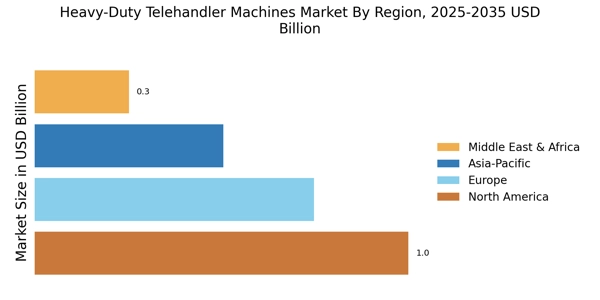
North America : Market Leader in Telehandlers

North America is the largest market for heavy-duty telehandler machines, accounting for approximately 40% of the global market share. The growth is driven by increasing construction activities, infrastructure development, and a rising demand for efficient material handling solutions. Regulatory support for construction safety and equipment standards further catalyzes market expansion. The U.S. and Canada are the primary contributors to this growth, with significant investments in construction and agriculture sectors. The competitive landscape in North America is robust, featuring key players such as Caterpillar, JCB, and Bobcat. These companies are focusing on innovation and technology to enhance product offerings. The presence of established manufacturers and a growing rental market are also pivotal in shaping the competitive dynamics. The region's emphasis on sustainability and efficiency in construction practices is expected to drive further demand for telehandlers.

Europe : Emerging Market Dynamics

Europe is witnessing a significant rise in the demand for heavy-duty telehandler machines, holding approximately 30% of the global market share. The growth is fueled by increasing investments in renewable energy projects, infrastructure upgrades, and a shift towards automation in construction. Regulatory frameworks promoting safety and environmental standards are also key drivers. Germany and France are the largest markets in this region, contributing significantly to the overall growth trajectory. Leading countries in Europe, such as Germany, France, and the UK, are home to major manufacturers like Manitou and Liebherr. The competitive landscape is characterized by a mix of established players and emerging companies focusing on innovative solutions. The presence of a strong rental market and a growing emphasis on sustainability are shaping the future of telehandler usage in Europe. The region is poised for continued growth as it adapts to evolving market needs.

Asia-Pacific : Rapid Growth and Adoption

Asia-Pacific is rapidly emerging as a significant market for heavy-duty telehandler machines, accounting for around 20% of the global market share. The region's growth is driven by urbanization, infrastructure development, and increasing mechanization in agriculture. Countries like China and India are leading this growth, supported by government initiatives aimed at enhancing construction capabilities and improving agricultural productivity. Regulatory frameworks are evolving to support these developments, further boosting market potential. China is the largest market in the region, with substantial investments in construction and infrastructure projects. India follows closely, with a growing focus on mechanization in agriculture. The competitive landscape features both local and international players, including Doosan and Merlo, who are expanding their presence. The increasing demand for efficient material handling solutions is expected to drive further growth in the telehandler market across Asia-Pacific.

Middle East and Africa : Emerging Opportunities Ahead

The Middle East and Africa region is gradually emerging in the heavy-duty telehandler machines market, holding about 10% of the global market share. The growth is primarily driven by ongoing infrastructure projects, particularly in the Gulf Cooperation Council (GCC) countries, and a rising demand for efficient construction equipment. Regulatory initiatives aimed at enhancing safety standards and promoting local manufacturing are also contributing to market growth. The UAE and South Africa are the leading markets in this region, showcasing significant potential for expansion. In the Middle East, countries like the UAE are investing heavily in construction and real estate, while South Africa is focusing on improving agricultural productivity. The competitive landscape includes both global players and local manufacturers, with companies like Genie and Skyjack making their mark. The region's unique challenges and opportunities present a dynamic environment for telehandler adoption, with a focus on innovation and efficiency.

Heavy Duty Telehandler Machines Market Regional Image

Key Players and Competitive Insights

The  Heavy-Duty Telehandler Machines Market is characterized by a highly competitive landscape where numerous players strive to enhance their market presence through innovative product offerings and strategic business initiatives. As industries such as construction, agriculture and logistics increasingly adopt heavy-duty telehandlers for their versatility and efficiency, understanding the competitive dynamics becomes crucial for stakeholders. The market is segmented by product type, application and geography, with players vying for market share by capitalizing on technological advancements, product differentiation, and expanding their distribution networks.

This competitive arena is marked by both established manufacturers with a significant presence and new entrants focusing on niche markets, all working towards meeting the evolving needs of their customer base. CASE Construction stands out in the  Heavy-Duty Telehandler Machines Market through its strong emphasis on performance, reliability, and customer-focused solutions. Its telehandlers are known for their high lifting capacities, excellent maneuverability, and sophisticated features that enhance operator safety and productivity. The company leverages its extensive experience in the construction equipment sector to deliver machines that integrate advanced technology, thereby improving efficiency on job sites.

With a robust distribution network and after-sales service, CASE Construction ensures strong customer support, reinforcing brand loyalty and facilitating repeat business. Their commitment to sustainability and innovation is reflected in their evolving product line, which continuously adapts to meet the demands of modern construction projects. JCB is a leading player in the  Heavy-Duty Telehandler Machines Market, renowned for its advanced engineering and commitment to quality. The company's telehandlers are designed to deliver superior performance, characterized by their robust build and versatile applications across various sectors.

JCB has garnered a reputation for incorporating state-of-the-art technology into its machines, which enhances operational efficiency and reduces downtime. Their wide range of telehandlers caters to diverse market needs, and their strong brand presence across multiple regions has enabled them to enact significant market penetration. The company also places a strong emphasis on customer service, ensuring that clients receive essential support and rapid service, thus solidifying its competitive edge in the heavy-duty telehandler segment.

Key Companies in the Heavy Duty Telehandler Machines Market market include

Industry Developments

Recent developments in the  Heavy-Duty Telehandler Machines Market indicate a significant surge in demand driven by growth in the construction and material handling sectors. Companies like JCB, CASE Construction, and Caterpillar are increasing production to meet this demand, while SANY and Merlo are focusing on expanding their product lines with advanced technologies. Notably, Doosan has introduced telehandlers equipped with enhanced safety features, which are being well-received in the market.

Additionally, the market has witnessed strategic mergers and acquisitions; for instance, Genie has expanded its portfolio through acquisitions aimed at integrating innovative technologies into their telehandler offerings. The rise in electric and hybrid telehandlers is also gaining attention, with Haulotte and Wacker Neuson investing in sustainable technology. The financial performance of the companies involved, particularly Bobcat and Manitou, reflects positive growth valuations, which are impacting market dynamics by encouraging investments and partnerships. As various nations ramp up infrastructure projects, the outlook for heavy-duty telehandlers appears optimistic, suggesting robust growth opportunities ahead for leading manufacturers in this space.

Future Outlook

Heavy Duty Telehandler Machines Market Future Outlook

The Heavy-Duty Telehandler Machines Market is projected to grow at a 6.16% CAGR from 2024 to 2035, driven by increasing construction activities, technological advancements, and demand for material handling efficiency.

New opportunities lie in:

  • Development of electric telehandlers for sustainable operations.
  • Integration of telematics for real-time fleet management.
  • Expansion into emerging markets with tailored financing solutions.

By 2035, the market is expected to achieve robust growth, positioning itself as a leader in material handling solutions.

Market Segmentation

Heavy Duty Telehandler Machines Market Tire Type Outlook

  • Solid Tires
  • Pneumatic Tires
  • Foam Filled Tires

Heavy Duty Telehandler Machines Market Application Outlook

  • Construction
  • Agriculture
  • Mining
  • Logistics

Heavy Duty Telehandler Machines Market Engine Type Outlook

  • Internal Combustion Engine
  • Electric Engine
  • Hybrid Engine

Heavy Duty Telehandler Machines Market Load Capacity Outlook

  • Less than 3 tons
  • 3 to 5 tons
  • 5 to 8 tons
  • More than 8 tons

Report Scope

MARKET SIZE 20242.58(USD Billion)
MARKET SIZE 20252.739(USD Billion)
MARKET SIZE 20354.981(USD Billion)
COMPOUND ANNUAL GROWTH RATE (CAGR)6.16% (2024 - 2035)
REPORT COVERAGERevenue Forecast, Competitive Landscape, Growth Factors, and Trends
BASE YEAR2024
Market Forecast Period2025 - 2035
Historical Data2019 - 2024
Market Forecast UnitsUSD Billion
Key Companies ProfiledMarket analysis in progress
Segments CoveredMarket segmentation analysis in progress
Key Market OpportunitiesIntegration of advanced automation and telematics in Heavy-Duty Telehandler Machines Market enhances operational efficiency and safety.
Key Market DynamicsRising demand for advanced telehandler features drives innovation and competition among manufacturers in the heavy-duty sector.
Countries CoveredNorth America, Europe, APAC, South America, MEA

Market Highlights

Author
Snehal Singh
Assistant Manager - Research

High acumen in analyzing complex macro & micro markets with more than 6 years of work experience in the field of market research. By implementing her analytical skills in forecasting and estimation into market research reports, she has expertise in Packaging, Construction, and Equipment domains. She handles a team size of 20-25 resources and ensures smooth running of the projects, associated marketing activities, and client servicing.

Leave a Comment

FAQs

What is the projected market valuation for the Heavy-Duty Telehandler Machines Market in 2035?

The projected market valuation for the Heavy-Duty Telehandler Machines Market in 2035 is 4.981 USD Billion.

What was the market valuation for Heavy-Duty Telehandler Machines in 2024?

The market valuation for Heavy-Duty Telehandler Machines in 2024 was 2.58 USD Billion.

What is the expected CAGR for the Heavy-Duty Telehandler Machines Market from 2025 to 2035?

The expected CAGR for the Heavy-Duty Telehandler Machines Market during the forecast period 2025 - 2035 is 6.16%.

Which companies are considered key players in the Heavy-Duty Telehandler Machines Market?

Key players in the Heavy-Duty Telehandler Machines Market include JCB, Caterpillar, Manitou, Bobcat, Liebherr, Doosan, Merlo, Genie, and Skyjack.

What are the projected revenues for the Construction segment of the Heavy-Duty Telehandler Machines Market by 2035?

The projected revenue for the Construction segment of the Heavy-Duty Telehandler Machines Market is expected to reach 1.5 USD Billion by 2035.

How does the revenue for Electric Engine telehandlers compare to Internal Combustion Engine telehandlers by 2035?

By 2035, the revenue for Electric Engine telehandlers is projected to be 1.25 USD Billion, compared to 2.85 USD Billion for Internal Combustion Engine telehandlers.

What is the anticipated revenue for the Logistics application segment by 2035?

The anticipated revenue for the Logistics application segment of the Heavy-Duty Telehandler Machines Market is expected to be 1.48 USD Billion by 2035.

What are the projected revenues for different load capacities of telehandlers by 2035?

By 2035, telehandlers with a load capacity of more than 8 tons are projected to generate 0.15 USD Billion, while those under 3 tons are expected to reach 0.15 USD Billion.

What is the expected revenue for Pneumatic Tires in the Heavy-Duty Telehandler Machines Market by 2035?

The expected revenue for Pneumatic Tires in the Heavy-Duty Telehandler Machines Market is projected to be 2.0 USD Billion by 2035.

Download Free Sample

Kindly complete the form below to receive a free sample of this Report

Compare Licence

×
Features License Type
Single User Multiuser License Enterprise User
Price $4,950 $5,950 $7,250
Maximum User Access Limit 1 User Upto 10 Users Unrestricted Access Throughout the Organization
Free Customization
Direct Access to Analyst
Deliverable Format
Platform Access
Discount on Next Purchase 10% 15% 15%
Printable Versions