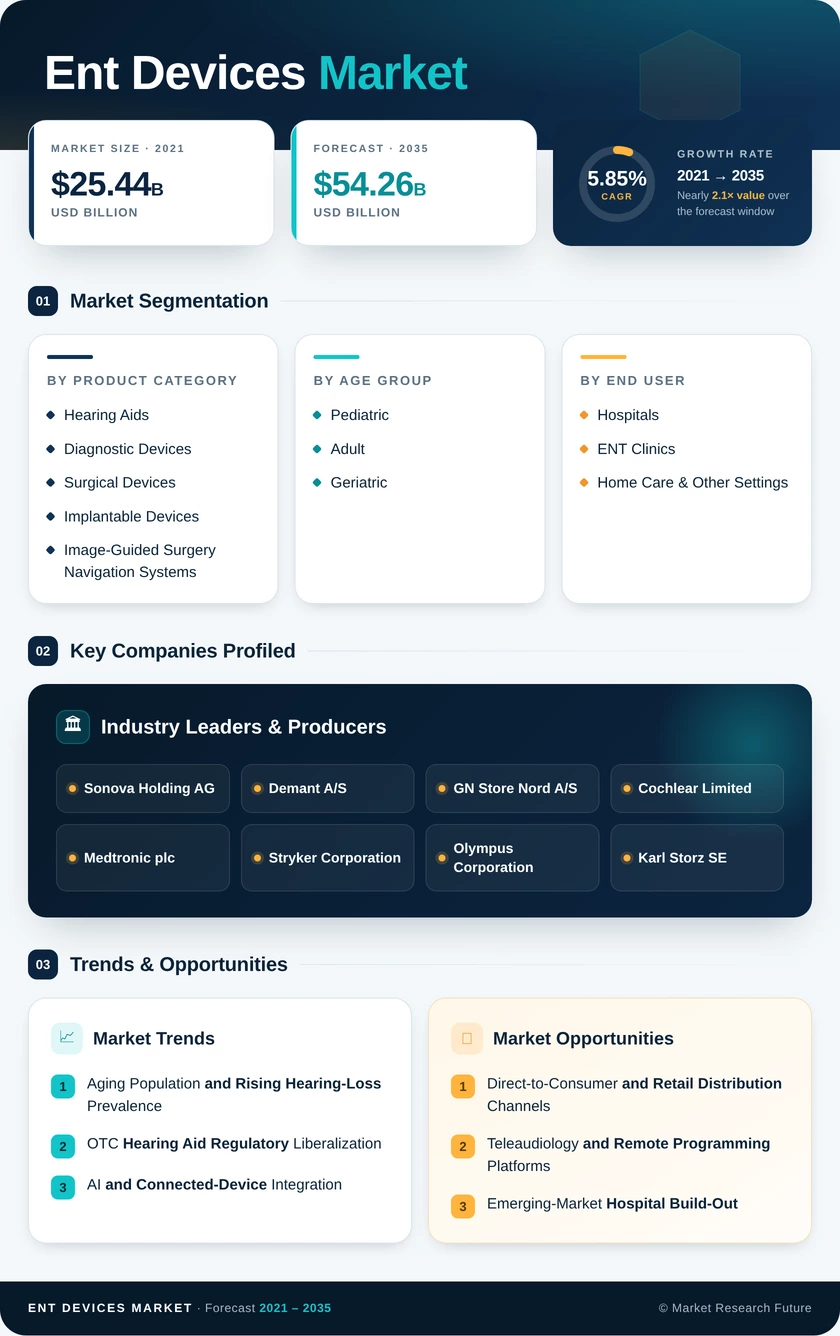
Segmentation Quick Reference
| Dimension | Sub-Segments | Dominant Segment | Fastest Growing Segment |
| By Product Category | Hearing Aids, Diagnostic Devices, Surgical Devices, Implantable Devices, Image-Guided Surgery Navigation Systems, Other ENT Devices | Hearing Aids | Implantable Devices |
| By Age Group | Pediatric, Adult, Geriatric | Adult | Geriatric |
| By End User | Hospitals, ENT Clinics, Home Care & Other Settings | Hospitals | Home Care & Other Settings |
| By Geography | North America, Europe, Asia-Pacific, South America, Middle East & Africa | North America | Asia-Pacific |
Market Segmentation Overview
By Product Category
| Sub-Segment | Key Trend |
| Hearing Aids | AI-driven acoustic processing; OTC retail channel expansion; rechargeable battery adoption |
| Diagnostic Devices | Video-otoscope integration with EHR systems; portable audiometry for primary care |
| Surgical Devices | Shift to office-based balloon dilation; powered microdebrider miniaturization |
| Implantable Devices | Bilateral cochlear implantation growth; expanded candidacy to single-sided deafness |
| Image-Guided Surgery Navigation Systems | Real-time CT overlay integration; electromagnetic tracking replacing optical systems |
| Other ENT Devices | Voice prosthetic improvements; silicone tracheostomy tube innovation |
Hearing aids remain the revenue anchor of the ENT Devices Market, while implantable devices are capturing a rapidly growing share as candidacy criteria expand and surgical techniques improve. Diagnostic devices are evolving toward portable, connected platforms that support screening at the primary-care level.
By Age Group
| Sub-Segment | Key Trend |
| Pediatric | Universal newborn hearing screening mandates; early cochlear implantation at nine months |
| Adult | Occupational noise protection compliance; workplace audiometric monitoring |
| Geriatric | Presbycusis management; comorbidity-linked ENT interventions in aging populations |
Adults form the largest user base, but geriatric patients represent the fastest-growing cohort due to accelerating demographic aging and rising awareness of hearing loss as a modifiable risk factor for cognitive decline.
By End User
| Sub-Segment | Key Trend |
| Hospitals | Complex implant surgery concentration; image-guided navigation suite adoption |
| ENT Clinics | Office-based procedure migration; walk-in audiological assessment services |
| Home Care & Other Settings | Teleaudiology adoption; OTC self-fitting hearing aid management |
Hospitals continue to handle the most capital-intensive and surgically complex procedures within the ENT Devices Market. Home care is the fastest-growing channel, driven by connected-device ecosystems and consumer comfort with self-directed hearing health management.
By Geography
| Sub-Segment | Key Trend |
| North America | OTC regulatory liberalization; CMS coverage expansion for implants |
| Europe | 100% Santé reform impact; EU MDR compliance reshaping competitive landscape |
| Asia-Pacific | Government hospital build-out programs; domestic manufacturer scaling in China and India |
| South America | SUS procurement modernization; private hospital chain expansion |
| Middle East & Africa | Vision 2030 healthcare investment; NGO-led audiological access programs |
North America leads the ENT Devices Market in revenue, while Asia-Pacific is the fastest-growing region. Europe maintains a strong position through universal coverage frameworks, and emerging regions are building foundational infrastructure that will support sustained device demand beyond 2035.