
Request Free Sample ×

Kindly complete the form below to receive a free sample of this Report

* Please use a valid business email

Leading companies partner with us for data-driven Insights

clients tt-cursor
Hero Background
English
Chinese
French
Japanese
Korean
German
Spanish

Enhanced Flight Vision Systems Market Analysis

ID: MRFR/AD/4406-HCR
100 Pages
Shubham Munde
March 2026

Enhanced Flight Vision Systems ( EFVS) Market Size, Share, Industry Trend & Analysis Research Report Information by Technology (Infrared and Synthetic Vision), By Component (Display, Camera, and Sensor), By Platform (Fixed-Wing and Rotary-Wing), And By Region (North America, Europe, Asia-Pacific, And Rest Of The World) – Forecast Till 2032

Share:
Download PDF ×

We do not share your information with anyone. However, we may send you emails based on your report interest from time to time. You may contact us at any time to opt-out.

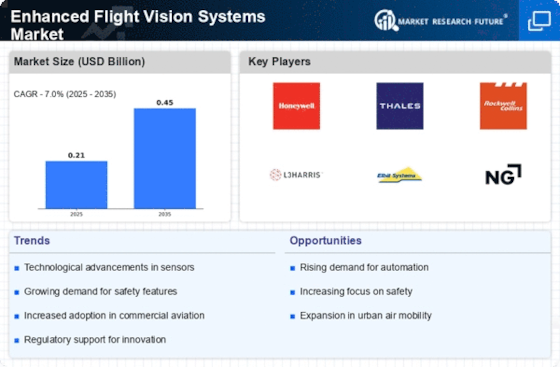
Enhanced Flight Vision Systems Market Infographic
Purchase Options

Market Analysis

In-depth Analysis of Enhanced Flight Vision Systems Market Industry Landscape

The Enhanced Flight Vision Systems (EFVS) market operates within a dynamic framework shaped by several key factors that influence its growth and evolution in the aviation industry. One of the primary drivers of this market is the increasing emphasis on improving flight safety and operational efficiency. EFVS technology enhances a pilot's ability to see and navigate in challenging weather conditions, such as low visibility, fog, or darkness. As aviation stakeholders prioritize safety measures, the demand for EFVS solutions rises, allowing pilots to make informed decisions and conduct safer landings and takeoffs.

Technological advancements play a pivotal role in shaping the market dynamics of Enhanced Flight Vision Systems. Continuous innovations in sensors, imaging technologies, and display systems contribute to the development of more advanced and capable EFVS solutions. These systems typically include infrared sensors, synthetic vision technology, and head-up displays, providing pilots with real-time, enhanced images of the external environment. The dynamic nature of technology-driven improvements positions EFVS as a critical element in modernizing aviation safety and navigation.

Regulatory considerations are crucial factors influencing the market dynamics of EFVS. Aviation authorities, such as the Federal Aviation Administration (FAA) and the European Union Aviation Safety Agency (EASA), establish standards and regulations for the certification and use of EFVS in commercial and business aviation. Compliance with these regulations is essential for EFVS manufacturers and operators, ensuring the safety and reliability of these systems. The alignment of EFVS technology with regulatory standards is critical for market acceptance and widespread adoption within the aviation industry.

The competitive landscape within the EFVS market is characterized by the presence of major avionics manufacturers, technology providers, and aviation stakeholders. Intense competition fosters innovation, with companies striving to offer advanced EFVS solutions that provide superior performance, ease of integration, and enhanced safety features. Collaborations and partnerships between EFVS manufacturers and aircraft manufacturers contribute to market dynamics, enabling the seamless integration of EFVS technology into modern aircraft cockpits.

Global economic factors significantly impact the EFVS market. Economic growth, increasing air travel demand, and the expansion of commercial and business aviation contribute to the adoption of EFVS solutions. Airlines and operators seek to enhance their fleets with technologies that improve safety and operational capabilities. Conversely, economic downturns or disruptions in air travel demand may influence investment decisions and impact the overall market outlook for EFVS solutions.

The market is further influenced by the growing trend of retrofitting existing aircraft with EFVS technology. As aviation stakeholders recognize the benefits of EFVS in improving safety and operational efficiency, there is a growing market for retrofitting older aircraft with modern EFVS solutions. This trend creates opportunities for EFVS manufacturers and service providers to offer upgrade packages, extending the applicability of EFVS technology to a broader range of aircraft.

Environmental considerations are becoming increasingly relevant in the EFVS market. As the aviation industry seeks to reduce its environmental impact, EFVS technology contributes to more fuel-efficient operations by enabling safe landings and takeoffs in adverse weather conditions. The environmental benefits of EFVS align with broader industry goals to enhance sustainability, creating opportunities for market players to position their solutions as contributors to greener aviation practices.


Author
Author Profile
Shubham Munde
Team Lead - Research

Shubham brings over 7 years of expertise in Market Intelligence and Strategic Consulting, with a strong focus on the Automotive, Aerospace, and Defense sectors. Backed by a solid foundation in semiconductors, electronics, and software, he has successfully delivered high-impact syndicated and custom research on a global scale. His core strengths include market sizing, forecasting, competitive intelligence, consumer insights, and supply chain mapping. Widely recognized for developing scalable growth strategies, Shubham empowers clients to navigate complex markets and achieve a lasting competitive edge. Trusted by start-ups and Fortune 500 companies alike, he consistently converts challenges into strategic opportunities that drive sustainable growth.

Leave a Comment

FAQs

What is the projected market valuation of the Enhanced Flight Vision Systems Market by 2035?

<p>The Enhanced Flight Vision Systems Market is projected to reach a valuation of 0.4504 USD Billion by 2035.</p>

What was the market valuation of the Enhanced Flight Vision Systems Market in 2024?

<p>In 2024, the market valuation of the Enhanced Flight Vision Systems Market was 0.214 USD Billion.</p>

What is the expected CAGR for the Enhanced Flight Vision Systems Market during the forecast period 2025 - 2035?

<p>The expected CAGR for the Enhanced Flight Vision Systems Market during the forecast period 2025 - 2035 is 7.0%.</p>

Which companies are considered key players in the Enhanced Flight Vision Systems Market?

<p>Key players in the Enhanced Flight Vision Systems Market include Honeywell, Thales, Rockwell Collins, L3Harris Technologies, Elbit Systems, Northrop Grumman, General Electric, BAE Systems, and Garmin.</p>

What are the main technology segments within the Enhanced Flight Vision Systems Market?

<p>The main technology segments within the Enhanced Flight Vision Systems Market are Infrared and Synthetic Vision, each projected to grow from 0.107 USD Billion to 0.2252 USD Billion.</p>

What components are included in the Enhanced Flight Vision Systems Market?

<p>The components of the Enhanced Flight Vision Systems Market include Display, Camera, and Sensor, with valuations expected to rise from 0.0857 USD Billion, 0.0712 USD Billion, and 0.0571 USD Billion respectively.</p>

How do the platform segments of the Enhanced Flight Vision Systems Market compare?

The platform segments of the Enhanced Flight Vision Systems Market, Fixed-Wing and Rotary-Wing, are both projected to grow from 0.107 USD Billion to 0.2252 USD Billion.

What factors are driving growth in the Enhanced Flight Vision Systems Market?

Growth in the Enhanced Flight Vision Systems Market is likely driven by advancements in technology and increasing demand for safety and efficiency in aviation.

How does the Enhanced Flight Vision Systems Market's growth compare to other aviation technologies?

The Enhanced Flight Vision Systems Market appears to be growing at a robust pace, with a projected CAGR of 7.0%, indicating strong potential relative to other aviation technologies.

What implications does the growth of the Enhanced Flight Vision Systems Market have for aviation safety?

The growth of the Enhanced Flight Vision Systems Market may enhance aviation safety by providing pilots with improved situational awareness and decision-making capabilities.

Market Summary

As per Market Research Future analysis, the Enhanced Flight Vision Systems Market was estimated at 0.214 USD Billion in 2024. The Enhanced Flight Vision Systems industry is projected to grow from USD 0.229 Billion in 2025 to USD 0.4504 Billion by 2035, exhibiting a compound annual growth rate (CAGR) of 7.0% during the forecast period 2025 - 2035

Key Market Trends & Highlights

The Enhanced Flight Vision Systems Market is poised for substantial growth driven by technological advancements and regulatory support.

  • North America remains the largest market for Enhanced Flight Vision Systems Market, driven by high demand for advanced aviation technologies.
  • The Asia-Pacific region is emerging as the fastest-growing market, reflecting increasing investments in aviation infrastructure and modernization.
  • Infrared systems dominate the market, while synthetic vision systems are rapidly gaining traction due to their innovative capabilities.
  • Key market drivers include technological advancements and regulatory support, which are fostering a focus on safety and automation in aviation.

Market Size & Forecast

2024 Market Size 0.214 (USD Billion)
2035 Market Size 0.4504 (USD Billion)
CAGR (2025 - 2035) 7.0%
Largest Regional Market Share in 2024 North America

Major Players

Honeywell (US), Thales (FR), Rockwell Collins (US), L3Harris Technologies (US), Elbit Systems (IL), Northrop Grumman (US), General Electric (US), BAE Systems (GB), Garmin (US)

Market Trends

The Enhanced Flight Vision Systems Market is currently experiencing a notable transformation, driven by advancements in technology and increasing demand for safety in aviation. Enhanced Flight Vision Systems, which utilize advanced sensors and imaging technologies, are becoming integral to modern aircraft. These systems enhance pilots' situational awareness, particularly in low-visibility conditions, thereby improving overall flight safety. As regulatory bodies emphasize the importance of safety measures, the adoption of these systems is likely to rise, reflecting a broader trend towards automation and enhanced operational efficiency in aviation. Moreover, the market appears to be influenced by the growing emphasis on reducing operational costs and improving fuel efficiency. Airlines and operators are increasingly recognizing the potential of Enhanced Flight Vision Systems to optimize flight paths and reduce delays. This trend suggests a shift towards more sustainable aviation practices, as these systems can contribute to lower fuel consumption and emissions. As the aviation industry continues to evolve, the Enhanced Flight Vision Systems Market is poised for growth, driven by technological innovation and a commitment to safety and efficiency in air travel.

Technological Advancements

The Enhanced Flight Vision Systems Market is witnessing rapid technological advancements, particularly in sensor and imaging technologies. Innovations in infrared and multi-spectral imaging are enhancing the capabilities of these systems, allowing for improved visibility in challenging weather conditions. This trend indicates a shift towards more sophisticated systems that can provide real-time data to pilots, thereby enhancing decision-making processes.

Regulatory Support

Regulatory bodies are increasingly supporting the integration of Enhanced Flight Vision Systems into commercial aviation. This support is manifested through updated guidelines and standards that encourage the adoption of these systems. Such regulatory backing suggests a growing recognition of the importance of safety and situational awareness in aviation, potentially leading to wider acceptance and implementation across the industry.

Focus on Sustainability

There is a notable focus on sustainability within the Enhanced Flight Vision Systems Market, as operators seek to reduce their environmental impact. Enhanced Flight Vision Systems can contribute to more efficient flight operations, which may lead to lower fuel consumption and reduced emissions. This trend reflects a broader commitment within the aviation sector to adopt practices that align with environmental sustainability goals.

Enhanced Flight Vision Systems Market Market Drivers

Focus on Safety

The focus on safety within the aviation sector is a primary driver for the enhanced flight vision systems Market. As air travel continues to grow, the demand for systems that enhance safety and reduce the risk of accidents is paramount. Enhanced flight vision systems provide critical information to pilots, enabling them to make informed decisions during challenging flight conditions. Recent statistics indicate that the implementation of these systems has contributed to a reduction in accident rates, thereby reinforcing their value in the industry. Airlines and operators are increasingly investing in these technologies to ensure compliance with safety standards and to enhance passenger confidence. This heightened focus on safety is likely to propel the Enhanced Flight Vision Systems Market forward, as stakeholders prioritize investments in systems that can demonstrably improve operational safety.

Regulatory Support

Regulatory support plays a crucial role in the growth of the Enhanced Flight Vision Systems Market. Various aviation authorities are increasingly recognizing the importance of enhanced flight vision systems in improving safety and operational efficiency. For instance, regulations that mandate the use of advanced vision systems in commercial aircraft are becoming more prevalent. This regulatory push is expected to drive market growth, as manufacturers and operators seek to comply with these new standards. Furthermore, the Federal Aviation Administration (FAA) and the European Union Aviation Safety Agency (EASA) have been actively promoting the adoption of these systems, which could lead to a significant increase in market penetration. The Enhanced Flight Vision Systems Market is thus positioned to benefit from this supportive regulatory environment, which may facilitate the introduction of innovative products and technologies.

Technological Advancements

The Enhanced Flight Vision Systems Market is experiencing a surge in technological advancements that are reshaping aviation safety and efficiency. Innovations such as improved sensor technologies, advanced image processing algorithms, and integration with artificial intelligence are enhancing the capabilities of flight vision systems. These advancements allow pilots to have better situational awareness, particularly in low-visibility conditions. According to recent data, the market for enhanced flight vision systems is projected to grow at a compound annual growth rate of approximately 10% over the next five years. This growth is driven by the increasing demand for safer and more efficient flight operations, as well as the need for compliance with stringent aviation regulations. As technology continues to evolve, the Enhanced Flight Vision Systems Market is likely to see further enhancements that could redefine operational standards.

Market Demand for Automation

The growing demand for automation in aviation is significantly influencing the Enhanced Flight Vision Systems Market. As airlines and operators seek to streamline operations and reduce human error, the integration of automated systems is becoming increasingly prevalent. Enhanced flight vision systems are at the forefront of this trend, providing pilots with automated visual information that aids in navigation and decision-making. The market is projected to expand as more operators recognize the benefits of these systems in enhancing operational efficiency and safety. Furthermore, advancements in automation technologies are likely to lead to the development of more sophisticated flight vision systems, which could further stimulate market growth. The Enhanced Flight Vision Systems Market is thus poised to capitalize on this trend, as the aviation sector increasingly embraces automation as a means to improve performance.

Investment in Research and Development

Investment in research and development is a key driver for the Enhanced Flight Vision Systems Market. As competition intensifies among manufacturers, there is a growing emphasis on innovation and the development of next-generation flight vision systems. Companies are allocating substantial resources to R&D initiatives aimed at enhancing the functionality and reliability of these systems. This focus on innovation is expected to yield advanced technologies that can address emerging challenges in aviation, such as increased air traffic and the need for improved situational awareness. Moreover, partnerships between industry stakeholders and research institutions are fostering the development of cutting-edge solutions. The Enhanced Flight Vision Systems Market stands to benefit from these investments, as new technologies are likely to enhance product offerings and meet the evolving needs of the aviation sector.

Market Segment Insights

By Technology: Infrared (Largest) vs. Synthetic Vision (Fastest-Growing)

<p>In the Enhanced Flight Vision Systems Market, the two primary technology segments are Infrared and Synthetic Vision, with Infrared holding a significant share of the market. This technology is widely adopted for its reliability and effectiveness in various weather conditions, enabling pilots to visualize obstacles and terrain ahead. Conversely, Synthetic Vision is rapidly gaining traction among operators seeking advanced situational awareness and enhanced safety features, but it currently holds a smaller market presence than Infrared.</p>

<p>Technology: Infrared (Dominant) vs. Synthetic Vision (Emerging)</p>

<p>Infrared technology has established itself as the dominant force in the Enhanced Flight Vision Systems Market, known for its ability to provide clear imagery in low visibility conditions, essential for safe navigation. Its applications extend from commercial aviation to military operations, where it plays a crucial role in mission success. On the other hand, Synthetic Vision is an emerging technology offering a 3D view of terrain and obstacles based on database inputs. While currently less prevalent than Infrared, its potential for integrating real-time data is driving interest among manufacturers and operators, positioning it as a growth leader for future advancements in flight safety and operational efficiency.</p>

By Component: Display (Largest) vs. Camera (Fastest-Growing)

<p>In the Enhanced Flight Vision Systems Market, the component segment is dominated by displays, which hold the largest market share due to their critical role in providing pilots with essential flight information. Displays facilitate improved situational awareness and decision-making capabilities in various weather conditions. Cameras also occupy a significant position in this segment, but they are rapidly gaining traction as innovations enhance their capabilities and integration into flight systems. The competition between these components is shaping the future of flight vision systems.</p>

<p>Display (Dominant) vs. Camera (Emerging)</p>

<p>The display segment within Enhanced Flight Vision Systems is characterized by its advanced technologies that provide superior visual clarity and information presentation. Displays are considered the backbone of these systems, enabling pilots to receive a clear view of critical data and enhancing operational safety. On the other hand, the camera segment is emerging strongly; innovation and technological advancements are driving its rapid growth. Cameras are being increasingly integrated with advanced algorithms for better image processing, improving real-time visibility. This dual growth in displays and cameras indicates a shift towards comprehensive systems that combine both visual and sensor technologies, ensuring optimal flight security and operational efficiency.</p>

By Platform: Fixed-Wing (Largest) vs. Rotary-Wing (Fastest-Growing)

<p>In the Enhanced Flight Vision Systems Market, the platform segment is primarily divided into two categories: Fixed-Wing and Rotary-Wing. Fixed-Wing platforms currently dominate the market, reflecting a significant portion of the overall market share. Their widespread application in commercial aviation and military operations makes them a critical component of the market's structure, ensuring they hold a leading position over rotary-wing systems. On the other hand, Rotary-Wing platforms are emerging as the fastest-growing segment in this market. The increasing demand for rotary-wing operations in surveillance, search and rescue, and urban air mobility is driving innovations and investments in this category. This heightened interest is expected to sustain growth in the rotary-wing systems, particularly as technological advancements enhance their operational capabilities and efficiency.</p>

<p>Fixed-Wing (Dominant) vs. Rotary-Wing (Emerging)</p>

<p>Fixed-Wing platforms are established as the dominant segment in the Enhanced Flight Vision Systems Market due to their efficiency in covering long distances and ability to carry larger payloads, particularly in commercial and military applications. These systems often benefit from robust, scalable designs and have been integrated with advanced technologies to improve situational awareness and safety. Conversely, Rotary-Wing platforms are recognized as the emerging segment, experiencing rapid growth fueled by advancements in technology, regulatory support for urban air mobility, and a rising need for versatile, agile air support in various operations such as law enforcement and emergency services. Their inherent flexibility allows them to operate in diverse environments, further enhancing their market appeal.</p>

Get more detailed insights about Enhanced Flight Vision Systems Market Research Report – Forecast to 2035

Regional Insights

aviation infrastructure

Key Players and Competitive Insights

Leading market players are investing heavily in research and development to expand their product lines, which will help the Enhanced Flight Vision Systems Market grow even more. Market participants are also undertaking various strategic activities to expand their footprint, with important market developments including new product launches, contractual agreements, mergers and acquisitions, higher investments, and collaboration with other organizations. To expand and survive in a more competitive and rising market climate, the Enhanced Flight Vision Systems industry must offer cost-effective items.Manufacturing locally to minimize operational costs is one of the key business tactics manufacturers use in the Enhanced Flight Vision Systems industry to benefit clients and increase the market sector. The Enhanced Flight Vision Systems industry has recently offered some of the most significant medical advantages. Major players in the Enhanced Flight Vision Systems Market, including Honeywell International, Inc. (U.S.), United Technologies Corporation (U.S.), L-3 Communications Holdings, Inc. (U.S.), Thales Group (France), and Elbit Systems Ltd. (Israel). and others, are attempting to increase market demand by investing in research and development operations.United Technologies Corporation (U.S.) is an American multinational corporation with its main office in Farmington, Connecticut. It researched, developed, and produced goods in various industries, including industrial goods, HVAC, elevators, and escalators, and products for aircraft engines, aerospace systems, and other uses. With the U.S. contributing about 10% of its revenue, UTC was also a sizable military contractor. S. government. Gregg J. Hayes served as both CEO and chairman.L-3 Communications Holdings specializes in government services, aircraft maintenance and modernization, and C3ISR (command, control, communications, intelligence, surveillance, and reconnaissance) systems. The company also sells electronic systems for use on commercial and military platforms. The DoD, DHS, DoS, DoJ, and other organizations are some of L-3's clients.

Key Companies in the Enhanced Flight Vision Systems Market include

Industry Developments

For instance, August 2021 Opgal, a pioneer in thermal imaging technology, announced today that it has entered into a new agreement with Elbit Systems of America, LLC, for the design and construction of numerous sophisticated EVS (Enhanced Vision System) units. The next-generation EVS from Elbit Systems of America will incorporate Opgal's cutting-edge thermal imaging and optics technology into the newly improved designed systems.

For instance, September 2022The new Enhanced Flight Vision System (EFVS) for Boeing 737 aircraft will be installed by Collins Aerospace in July 2021. Texel Air, which operates from Bahrain International Airport, will be one of the first users of the new system incorporating Collins' EVS-3600 multi-spectral imaging sensor.

For instance, January 2021 Two letters that Honeywell NASDAQ has signed will help the company's relationships with stakeholders in Malaysia and the surrounding area and its presence there. Since Honeywell has separate MOUs with Airod Techno Power (ATP) and Galaxy Aerospace, the collaboration aims to take advantage of Honeywell's expertise in the MRO of aircraft in various dimensions.

Future Outlook

Enhanced Flight Vision Systems Market Future Outlook

The Enhanced Flight Vision Systems Market is projected to grow at a 7.0% CAGR from 2025 to 2035, driven by technological advancements, regulatory support, and increasing demand for safety features.

New opportunities lie in:

  • Development of AI-driven predictive maintenance solutions
  • Integration of augmented reality for pilot training
  • Expansion into emerging markets with tailored solutions

By 2035, the market is expected to achieve substantial growth, solidifying its role in aviation safety and efficiency.

Market Segmentation

Enhanced Flight Vision Systems Market Platform Outlook

  • Fixed-Wing
  • Rotary-Wing

Enhanced Flight Vision Systems Market Component Outlook

  • Display
  • Camera
  • Sensor

Enhanced Flight Vision Systems Market Technology Outlook

  • Infrared
  • Synthetic Vision

Report Scope

MARKET SIZE 2024 0.214(USD Billion)
MARKET SIZE 2025 0.229(USD Billion)
MARKET SIZE 2035 0.4504(USD Billion)
COMPOUND ANNUAL GROWTH RATE (CAGR) 7.0% (2025 - 2035)
REPORT COVERAGE Revenue Forecast, Competitive Landscape, Growth Factors, and Trends
BASE YEAR 2024
Market Forecast Period 2025 - 2035
Historical Data 2019 - 2024
Market Forecast Units USD Billion
Key Companies Profiled Honeywell (US), Thales (FR), Rockwell Collins (US), L3Harris Technologies (US), Elbit Systems (IL), Northrop Grumman (US), General Electric (US), BAE Systems (GB), Garmin (US)
Segments Covered Technology, Component, Platform, Region
Key Market Opportunities Integration of artificial intelligence enhances situational awareness in the Enhanced Flight Vision Systems Market.
Key Market Dynamics Technological advancements and regulatory changes drive demand for Enhanced Flight Vision Systems in aviation safety and efficiency.
Countries Covered North America, Europe, APAC, South America, MEA

FAQs

What is the projected market valuation of the Enhanced Flight Vision Systems Market by 2035?

<p>The Enhanced Flight Vision Systems Market is projected to reach a valuation of 0.4504 USD Billion by 2035.</p>

What was the market valuation of the Enhanced Flight Vision Systems Market in 2024?

<p>In 2024, the market valuation of the Enhanced Flight Vision Systems Market was 0.214 USD Billion.</p>

What is the expected CAGR for the Enhanced Flight Vision Systems Market during the forecast period 2025 - 2035?

<p>The expected CAGR for the Enhanced Flight Vision Systems Market during the forecast period 2025 - 2035 is 7.0%.</p>

Which companies are considered key players in the Enhanced Flight Vision Systems Market?

<p>Key players in the Enhanced Flight Vision Systems Market include Honeywell, Thales, Rockwell Collins, L3Harris Technologies, Elbit Systems, Northrop Grumman, General Electric, BAE Systems, and Garmin.</p>

What are the main technology segments within the Enhanced Flight Vision Systems Market?

<p>The main technology segments within the Enhanced Flight Vision Systems Market are Infrared and Synthetic Vision, each projected to grow from 0.107 USD Billion to 0.2252 USD Billion.</p>

What components are included in the Enhanced Flight Vision Systems Market?

<p>The components of the Enhanced Flight Vision Systems Market include Display, Camera, and Sensor, with valuations expected to rise from 0.0857 USD Billion, 0.0712 USD Billion, and 0.0571 USD Billion respectively.</p>

How do the platform segments of the Enhanced Flight Vision Systems Market compare?

The platform segments of the Enhanced Flight Vision Systems Market, Fixed-Wing and Rotary-Wing, are both projected to grow from 0.107 USD Billion to 0.2252 USD Billion.

What factors are driving growth in the Enhanced Flight Vision Systems Market?

Growth in the Enhanced Flight Vision Systems Market is likely driven by advancements in technology and increasing demand for safety and efficiency in aviation.

How does the Enhanced Flight Vision Systems Market's growth compare to other aviation technologies?

The Enhanced Flight Vision Systems Market appears to be growing at a robust pace, with a projected CAGR of 7.0%, indicating strong potential relative to other aviation technologies.

What implications does the growth of the Enhanced Flight Vision Systems Market have for aviation safety?

The growth of the Enhanced Flight Vision Systems Market may enhance aviation safety by providing pilots with improved situational awareness and decision-making capabilities.

  1. SECTION I: EXECUTIVE SUMMARY AND KEY HIGHLIGHTS
    1. | 1.1 EXECUTIVE SUMMARY
    2. | | 1.1.1 Market Overview
    3. | | 1.1.2 Key Findings
    4. | | 1.1.3 Market Segmentation
    5. | | 1.1.4 Competitive Landscape
    6. | | 1.1.5 Challenges and Opportunities
    7. | | 1.1.6 Future Outlook
  2. SECTION II: SCOPING, METHODOLOGY AND MARKET STRUCTURE
    1. | 2.1 MARKET INTRODUCTION
    2. | | 2.1.1 Definition
    3. | | 2.1.2 Scope of the study
    4. | | | 2.1.2.1 Research Objective
    5. | | | 2.1.2.2 Assumption
    6. | | | 2.1.2.3 Limitations
    7. | 2.2 RESEARCH METHODOLOGY
    8. | | 2.2.1 Overview
    9. | | 2.2.2 Data Mining
    10. | | 2.2.3 Secondary Research
    11. | | 2.2.4 Primary Research
    12. | | | 2.2.4.1 Primary Interviews and Information Gathering Process
    13. | | | 2.2.4.2 Breakdown of Primary Respondents
    14. | | 2.2.5 Forecasting Model
    15. | | 2.2.6 Market Size Estimation
    16. | | | 2.2.6.1 Bottom-Up Approach
    17. | | | 2.2.6.2 Top-Down Approach
    18. | | 2.2.7 Data Triangulation
    19. | | 2.2.8 Validation
  3. SECTION III: QUALITATIVE ANALYSIS
    1. | 3.1 MARKET DYNAMICS
    2. | | 3.1.1 Overview
    3. | | 3.1.2 Drivers
    4. | | 3.1.3 Restraints
    5. | | 3.1.4 Opportunities
    6. | 3.2 MARKET FACTOR ANALYSIS
    7. | | 3.2.1 Value chain Analysis
    8. | | 3.2.2 Porter's Five Forces Analysis
    9. | | | 3.2.2.1 Bargaining Power of Suppliers
    10. | | | 3.2.2.2 Bargaining Power of Buyers
    11. | | | 3.2.2.3 Threat of New Entrants
    12. | | | 3.2.2.4 Threat of Substitutes
    13. | | | 3.2.2.5 Intensity of Rivalry
    14. | | 3.2.3 COVID-19 Impact Analysis
    15. | | | 3.2.3.1 Market Impact Analysis
    16. | | | 3.2.3.2 Regional Impact
    17. | | | 3.2.3.3 Opportunity and Threat Analysis
  4. SECTION IV: QUANTITATIVE ANALYSIS
    1. | 4.1 Aerospace & Defense, BY Technology (USD Billion)
    2. | | 4.1.1 Infrared
    3. | | 4.1.2 Synthetic Vision
    4. | 4.2 Aerospace & Defense, BY Component (USD Billion)
    5. | | 4.2.1 Display
    6. | | 4.2.2 Camera
    7. | | 4.2.3 Sensor
    8. | 4.3 Aerospace & Defense, BY Platform (USD Billion)
    9. | | 4.3.1 Fixed-Wing
    10. | | 4.3.2 Rotary-Wing
    11. | 4.4 Aerospace & Defense, BY Region (USD Billion)
    12. | | 4.4.1 North America
    13. | | | 4.4.1.1 US
    14. | | | 4.4.1.2 Canada
    15. | | 4.4.2 Europe
    16. | | | 4.4.2.1 Germany
    17. | | | 4.4.2.2 UK
    18. | | | 4.4.2.3 France
    19. | | | 4.4.2.4 Russia
    20. | | | 4.4.2.5 Italy
    21. | | | 4.4.2.6 Spain
    22. | | | 4.4.2.7 Rest of Europe
    23. | | 4.4.3 APAC
    24. | | | 4.4.3.1 China
    25. | | | 4.4.3.2 India
    26. | | | 4.4.3.3 Japan
    27. | | | 4.4.3.4 South Korea
    28. | | | 4.4.3.5 Malaysia
    29. | | | 4.4.3.6 Thailand
    30. | | | 4.4.3.7 Indonesia
    31. | | | 4.4.3.8 Rest of APAC
    32. | | 4.4.4 South America
    33. | | | 4.4.4.1 Brazil
    34. | | | 4.4.4.2 Mexico
    35. | | | 4.4.4.3 Argentina
    36. | | | 4.4.4.4 Rest of South America
    37. | | 4.4.5 MEA
    38. | | | 4.4.5.1 GCC Countries
    39. | | | 4.4.5.2 South Africa
    40. | | | 4.4.5.3 Rest of MEA
  5. SECTION V: COMPETITIVE ANALYSIS
    1. | 5.1 Competitive Landscape
    2. | | 5.1.1 Overview
    3. | | 5.1.2 Competitive Analysis
    4. | | 5.1.3 Market share Analysis
    5. | | 5.1.4 Major Growth Strategy in the Aerospace & Defense
    6. | | 5.1.5 Competitive Benchmarking
    7. | | 5.1.6 Leading Players in Terms of Number of Developments in the Aerospace & Defense
    8. | | 5.1.7 Key developments and growth strategies
    9. | | | 5.1.7.1 New Product Launch/Service Deployment
    10. | | | 5.1.7.2 Merger & Acquisitions
    11. | | | 5.1.7.3 Joint Ventures
    12. | | 5.1.8 Major Players Financial Matrix
    13. | | | 5.1.8.1 Sales and Operating Income
    14. | | | 5.1.8.2 Major Players R&D Expenditure. 2023
    15. | 5.2 Company Profiles
    16. | | 5.2.1 Honeywell (US)
    17. | | | 5.2.1.1 Financial Overview
    18. | | | 5.2.1.2 Products Offered
    19. | | | 5.2.1.3 Key Developments
    20. | | | 5.2.1.4 SWOT Analysis
    21. | | | 5.2.1.5 Key Strategies
    22. | | 5.2.2 Thales (FR)
    23. | | | 5.2.2.1 Financial Overview
    24. | | | 5.2.2.2 Products Offered
    25. | | | 5.2.2.3 Key Developments
    26. | | | 5.2.2.4 SWOT Analysis
    27. | | | 5.2.2.5 Key Strategies
    28. | | 5.2.3 Rockwell Collins (US)
    29. | | | 5.2.3.1 Financial Overview
    30. | | | 5.2.3.2 Products Offered
    31. | | | 5.2.3.3 Key Developments
    32. | | | 5.2.3.4 SWOT Analysis
    33. | | | 5.2.3.5 Key Strategies
    34. | | 5.2.4 L3Harris Technologies (US)
    35. | | | 5.2.4.1 Financial Overview
    36. | | | 5.2.4.2 Products Offered
    37. | | | 5.2.4.3 Key Developments
    38. | | | 5.2.4.4 SWOT Analysis
    39. | | | 5.2.4.5 Key Strategies
    40. | | 5.2.5 Elbit Systems (IL)
    41. | | | 5.2.5.1 Financial Overview
    42. | | | 5.2.5.2 Products Offered
    43. | | | 5.2.5.3 Key Developments
    44. | | | 5.2.5.4 SWOT Analysis
    45. | | | 5.2.5.5 Key Strategies
    46. | | 5.2.6 Northrop Grumman (US)
    47. | | | 5.2.6.1 Financial Overview
    48. | | | 5.2.6.2 Products Offered
    49. | | | 5.2.6.3 Key Developments
    50. | | | 5.2.6.4 SWOT Analysis
    51. | | | 5.2.6.5 Key Strategies
    52. | | 5.2.7 General Electric (US)
    53. | | | 5.2.7.1 Financial Overview
    54. | | | 5.2.7.2 Products Offered
    55. | | | 5.2.7.3 Key Developments
    56. | | | 5.2.7.4 SWOT Analysis
    57. | | | 5.2.7.5 Key Strategies
    58. | | 5.2.8 BAE Systems (GB)
    59. | | | 5.2.8.1 Financial Overview
    60. | | | 5.2.8.2 Products Offered
    61. | | | 5.2.8.3 Key Developments
    62. | | | 5.2.8.4 SWOT Analysis
    63. | | | 5.2.8.5 Key Strategies
    64. | | 5.2.9 Garmin (US)
    65. | | | 5.2.9.1 Financial Overview
    66. | | | 5.2.9.2 Products Offered
    67. | | | 5.2.9.3 Key Developments
    68. | | | 5.2.9.4 SWOT Analysis
    69. | | | 5.2.9.5 Key Strategies
    70. | 5.3 Appendix
    71. | | 5.3.1 References
    72. | | 5.3.2 Related Reports
  6. LIST OF FIGURES
    1. | 6.1 MARKET SYNOPSIS
    2. | 6.2 NORTH AMERICA MARKET ANALYSIS
    3. | 6.3 US MARKET ANALYSIS BY TECHNOLOGY
    4. | 6.4 US MARKET ANALYSIS BY COMPONENT
    5. | 6.5 US MARKET ANALYSIS BY PLATFORM
    6. | 6.6 CANADA MARKET ANALYSIS BY TECHNOLOGY
    7. | 6.7 CANADA MARKET ANALYSIS BY COMPONENT
    8. | 6.8 CANADA MARKET ANALYSIS BY PLATFORM
    9. | 6.9 EUROPE MARKET ANALYSIS
    10. | 6.10 GERMANY MARKET ANALYSIS BY TECHNOLOGY
    11. | 6.11 GERMANY MARKET ANALYSIS BY COMPONENT
    12. | 6.12 GERMANY MARKET ANALYSIS BY PLATFORM
    13. | 6.13 UK MARKET ANALYSIS BY TECHNOLOGY
    14. | 6.14 UK MARKET ANALYSIS BY COMPONENT
    15. | 6.15 UK MARKET ANALYSIS BY PLATFORM
    16. | 6.16 FRANCE MARKET ANALYSIS BY TECHNOLOGY
    17. | 6.17 FRANCE MARKET ANALYSIS BY COMPONENT
    18. | 6.18 FRANCE MARKET ANALYSIS BY PLATFORM
    19. | 6.19 RUSSIA MARKET ANALYSIS BY TECHNOLOGY
    20. | 6.20 RUSSIA MARKET ANALYSIS BY COMPONENT
    21. | 6.21 RUSSIA MARKET ANALYSIS BY PLATFORM
    22. | 6.22 ITALY MARKET ANALYSIS BY TECHNOLOGY
    23. | 6.23 ITALY MARKET ANALYSIS BY COMPONENT
    24. | 6.24 ITALY MARKET ANALYSIS BY PLATFORM
    25. | 6.25 SPAIN MARKET ANALYSIS BY TECHNOLOGY
    26. | 6.26 SPAIN MARKET ANALYSIS BY COMPONENT
    27. | 6.27 SPAIN MARKET ANALYSIS BY PLATFORM
    28. | 6.28 REST OF EUROPE MARKET ANALYSIS BY TECHNOLOGY
    29. | 6.29 REST OF EUROPE MARKET ANALYSIS BY COMPONENT
    30. | 6.30 REST OF EUROPE MARKET ANALYSIS BY PLATFORM
    31. | 6.31 APAC MARKET ANALYSIS
    32. | 6.32 CHINA MARKET ANALYSIS BY TECHNOLOGY
    33. | 6.33 CHINA MARKET ANALYSIS BY COMPONENT
    34. | 6.34 CHINA MARKET ANALYSIS BY PLATFORM
    35. | 6.35 INDIA MARKET ANALYSIS BY TECHNOLOGY
    36. | 6.36 INDIA MARKET ANALYSIS BY COMPONENT
    37. | 6.37 INDIA MARKET ANALYSIS BY PLATFORM
    38. | 6.38 JAPAN MARKET ANALYSIS BY TECHNOLOGY
    39. | 6.39 JAPAN MARKET ANALYSIS BY COMPONENT
    40. | 6.40 JAPAN MARKET ANALYSIS BY PLATFORM
    41. | 6.41 SOUTH KOREA MARKET ANALYSIS BY TECHNOLOGY
    42. | 6.42 SOUTH KOREA MARKET ANALYSIS BY COMPONENT
    43. | 6.43 SOUTH KOREA MARKET ANALYSIS BY PLATFORM
    44. | 6.44 MALAYSIA MARKET ANALYSIS BY TECHNOLOGY
    45. | 6.45 MALAYSIA MARKET ANALYSIS BY COMPONENT
    46. | 6.46 MALAYSIA MARKET ANALYSIS BY PLATFORM
    47. | 6.47 THAILAND MARKET ANALYSIS BY TECHNOLOGY
    48. | 6.48 THAILAND MARKET ANALYSIS BY COMPONENT
    49. | 6.49 THAILAND MARKET ANALYSIS BY PLATFORM
    50. | 6.50 INDONESIA MARKET ANALYSIS BY TECHNOLOGY
    51. | 6.51 INDONESIA MARKET ANALYSIS BY COMPONENT
    52. | 6.52 INDONESIA MARKET ANALYSIS BY PLATFORM
    53. | 6.53 REST OF APAC MARKET ANALYSIS BY TECHNOLOGY
    54. | 6.54 REST OF APAC MARKET ANALYSIS BY COMPONENT
    55. | 6.55 REST OF APAC MARKET ANALYSIS BY PLATFORM
    56. | 6.56 SOUTH AMERICA MARKET ANALYSIS
    57. | 6.57 BRAZIL MARKET ANALYSIS BY TECHNOLOGY
    58. | 6.58 BRAZIL MARKET ANALYSIS BY COMPONENT
    59. | 6.59 BRAZIL MARKET ANALYSIS BY PLATFORM
    60. | 6.60 MEXICO MARKET ANALYSIS BY TECHNOLOGY
    61. | 6.61 MEXICO MARKET ANALYSIS BY COMPONENT
    62. | 6.62 MEXICO MARKET ANALYSIS BY PLATFORM
    63. | 6.63 ARGENTINA MARKET ANALYSIS BY TECHNOLOGY
    64. | 6.64 ARGENTINA MARKET ANALYSIS BY COMPONENT
    65. | 6.65 ARGENTINA MARKET ANALYSIS BY PLATFORM
    66. | 6.66 REST OF SOUTH AMERICA MARKET ANALYSIS BY TECHNOLOGY
    67. | 6.67 REST OF SOUTH AMERICA MARKET ANALYSIS BY COMPONENT
    68. | 6.68 REST OF SOUTH AMERICA MARKET ANALYSIS BY PLATFORM
    69. | 6.69 MEA MARKET ANALYSIS
    70. | 6.70 GCC COUNTRIES MARKET ANALYSIS BY TECHNOLOGY
    71. | 6.71 GCC COUNTRIES MARKET ANALYSIS BY COMPONENT
    72. | 6.72 GCC COUNTRIES MARKET ANALYSIS BY PLATFORM
    73. | 6.73 SOUTH AFRICA MARKET ANALYSIS BY TECHNOLOGY
    74. | 6.74 SOUTH AFRICA MARKET ANALYSIS BY COMPONENT
    75. | 6.75 SOUTH AFRICA MARKET ANALYSIS BY PLATFORM
    76. | 6.76 REST OF MEA MARKET ANALYSIS BY TECHNOLOGY
    77. | 6.77 REST OF MEA MARKET ANALYSIS BY COMPONENT
    78. | 6.78 REST OF MEA MARKET ANALYSIS BY PLATFORM
    79. | 6.79 KEY BUYING CRITERIA OF AEROSPACE & DEFENSE
    80. | 6.80 RESEARCH PROCESS OF MRFR
    81. | 6.81 DRO ANALYSIS OF AEROSPACE & DEFENSE
    82. | 6.82 DRIVERS IMPACT ANALYSIS: AEROSPACE & DEFENSE
    83. | 6.83 RESTRAINTS IMPACT ANALYSIS: AEROSPACE & DEFENSE
    84. | 6.84 SUPPLY / VALUE CHAIN: AEROSPACE & DEFENSE
    85. | 6.85 AEROSPACE & DEFENSE, BY TECHNOLOGY, 2024 (% SHARE)
    86. | 6.86 AEROSPACE & DEFENSE, BY TECHNOLOGY, 2024 TO 2035 (USD Billion)
    87. | 6.87 AEROSPACE & DEFENSE, BY COMPONENT, 2024 (% SHARE)
    88. | 6.88 AEROSPACE & DEFENSE, BY COMPONENT, 2024 TO 2035 (USD Billion)
    89. | 6.89 AEROSPACE & DEFENSE, BY PLATFORM, 2024 (% SHARE)
    90. | 6.90 AEROSPACE & DEFENSE, BY PLATFORM, 2024 TO 2035 (USD Billion)
    91. | 6.91 BENCHMARKING OF MAJOR COMPETITORS
  7. LIST OF TABLES
    1. | 7.1 LIST OF ASSUMPTIONS
    2. | | 7.1.1
    3. | 7.2 North America MARKET SIZE ESTIMATES; FORECAST
    4. | | 7.2.1 BY TECHNOLOGY, 2025-2035 (USD Billion)
    5. | | 7.2.2 BY COMPONENT, 2025-2035 (USD Billion)
    6. | | 7.2.3 BY PLATFORM, 2025-2035 (USD Billion)
    7. | 7.3 US MARKET SIZE ESTIMATES; FORECAST
    8. | | 7.3.1 BY TECHNOLOGY, 2025-2035 (USD Billion)
    9. | | 7.3.2 BY COMPONENT, 2025-2035 (USD Billion)
    10. | | 7.3.3 BY PLATFORM, 2025-2035 (USD Billion)
    11. | 7.4 Canada MARKET SIZE ESTIMATES; FORECAST
    12. | | 7.4.1 BY TECHNOLOGY, 2025-2035 (USD Billion)
    13. | | 7.4.2 BY COMPONENT, 2025-2035 (USD Billion)
    14. | | 7.4.3 BY PLATFORM, 2025-2035 (USD Billion)
    15. | 7.5 Europe MARKET SIZE ESTIMATES; FORECAST
    16. | | 7.5.1 BY TECHNOLOGY, 2025-2035 (USD Billion)
    17. | | 7.5.2 BY COMPONENT, 2025-2035 (USD Billion)
    18. | | 7.5.3 BY PLATFORM, 2025-2035 (USD Billion)
    19. | 7.6 Germany MARKET SIZE ESTIMATES; FORECAST
    20. | | 7.6.1 BY TECHNOLOGY, 2025-2035 (USD Billion)
    21. | | 7.6.2 BY COMPONENT, 2025-2035 (USD Billion)
    22. | | 7.6.3 BY PLATFORM, 2025-2035 (USD Billion)
    23. | 7.7 UK MARKET SIZE ESTIMATES; FORECAST
    24. | | 7.7.1 BY TECHNOLOGY, 2025-2035 (USD Billion)
    25. | | 7.7.2 BY COMPONENT, 2025-2035 (USD Billion)
    26. | | 7.7.3 BY PLATFORM, 2025-2035 (USD Billion)
    27. | 7.8 France MARKET SIZE ESTIMATES; FORECAST
    28. | | 7.8.1 BY TECHNOLOGY, 2025-2035 (USD Billion)
    29. | | 7.8.2 BY COMPONENT, 2025-2035 (USD Billion)
    30. | | 7.8.3 BY PLATFORM, 2025-2035 (USD Billion)
    31. | 7.9 Russia MARKET SIZE ESTIMATES; FORECAST
    32. | | 7.9.1 BY TECHNOLOGY, 2025-2035 (USD Billion)
    33. | | 7.9.2 BY COMPONENT, 2025-2035 (USD Billion)
    34. | | 7.9.3 BY PLATFORM, 2025-2035 (USD Billion)
    35. | 7.10 Italy MARKET SIZE ESTIMATES; FORECAST
    36. | | 7.10.1 BY TECHNOLOGY, 2025-2035 (USD Billion)
    37. | | 7.10.2 BY COMPONENT, 2025-2035 (USD Billion)
    38. | | 7.10.3 BY PLATFORM, 2025-2035 (USD Billion)
    39. | 7.11 Spain MARKET SIZE ESTIMATES; FORECAST
    40. | | 7.11.1 BY TECHNOLOGY, 2025-2035 (USD Billion)
    41. | | 7.11.2 BY COMPONENT, 2025-2035 (USD Billion)
    42. | | 7.11.3 BY PLATFORM, 2025-2035 (USD Billion)
    43. | 7.12 Rest of Europe MARKET SIZE ESTIMATES; FORECAST
    44. | | 7.12.1 BY TECHNOLOGY, 2025-2035 (USD Billion)
    45. | | 7.12.2 BY COMPONENT, 2025-2035 (USD Billion)
    46. | | 7.12.3 BY PLATFORM, 2025-2035 (USD Billion)
    47. | 7.13 APAC MARKET SIZE ESTIMATES; FORECAST
    48. | | 7.13.1 BY TECHNOLOGY, 2025-2035 (USD Billion)
    49. | | 7.13.2 BY COMPONENT, 2025-2035 (USD Billion)
    50. | | 7.13.3 BY PLATFORM, 2025-2035 (USD Billion)
    51. | 7.14 China MARKET SIZE ESTIMATES; FORECAST
    52. | | 7.14.1 BY TECHNOLOGY, 2025-2035 (USD Billion)
    53. | | 7.14.2 BY COMPONENT, 2025-2035 (USD Billion)
    54. | | 7.14.3 BY PLATFORM, 2025-2035 (USD Billion)
    55. | 7.15 India MARKET SIZE ESTIMATES; FORECAST
    56. | | 7.15.1 BY TECHNOLOGY, 2025-2035 (USD Billion)
    57. | | 7.15.2 BY COMPONENT, 2025-2035 (USD Billion)
    58. | | 7.15.3 BY PLATFORM, 2025-2035 (USD Billion)
    59. | 7.16 Japan MARKET SIZE ESTIMATES; FORECAST
    60. | | 7.16.1 BY TECHNOLOGY, 2025-2035 (USD Billion)
    61. | | 7.16.2 BY COMPONENT, 2025-2035 (USD Billion)
    62. | | 7.16.3 BY PLATFORM, 2025-2035 (USD Billion)
    63. | 7.17 South Korea MARKET SIZE ESTIMATES; FORECAST
    64. | | 7.17.1 BY TECHNOLOGY, 2025-2035 (USD Billion)
    65. | | 7.17.2 BY COMPONENT, 2025-2035 (USD Billion)
    66. | | 7.17.3 BY PLATFORM, 2025-2035 (USD Billion)
    67. | 7.18 Malaysia MARKET SIZE ESTIMATES; FORECAST
    68. | | 7.18.1 BY TECHNOLOGY, 2025-2035 (USD Billion)
    69. | | 7.18.2 BY COMPONENT, 2025-2035 (USD Billion)
    70. | | 7.18.3 BY PLATFORM, 2025-2035 (USD Billion)
    71. | 7.19 Thailand MARKET SIZE ESTIMATES; FORECAST
    72. | | 7.19.1 BY TECHNOLOGY, 2025-2035 (USD Billion)
    73. | | 7.19.2 BY COMPONENT, 2025-2035 (USD Billion)
    74. | | 7.19.3 BY PLATFORM, 2025-2035 (USD Billion)
    75. | 7.20 Indonesia MARKET SIZE ESTIMATES; FORECAST
    76. | | 7.20.1 BY TECHNOLOGY, 2025-2035 (USD Billion)
    77. | | 7.20.2 BY COMPONENT, 2025-2035 (USD Billion)
    78. | | 7.20.3 BY PLATFORM, 2025-2035 (USD Billion)
    79. | 7.21 Rest of APAC MARKET SIZE ESTIMATES; FORECAST
    80. | | 7.21.1 BY TECHNOLOGY, 2025-2035 (USD Billion)
    81. | | 7.21.2 BY COMPONENT, 2025-2035 (USD Billion)
    82. | | 7.21.3 BY PLATFORM, 2025-2035 (USD Billion)
    83. | 7.22 South America MARKET SIZE ESTIMATES; FORECAST
    84. | | 7.22.1 BY TECHNOLOGY, 2025-2035 (USD Billion)
    85. | | 7.22.2 BY COMPONENT, 2025-2035 (USD Billion)
    86. | | 7.22.3 BY PLATFORM, 2025-2035 (USD Billion)
    87. | 7.23 Brazil MARKET SIZE ESTIMATES; FORECAST
    88. | | 7.23.1 BY TECHNOLOGY, 2025-2035 (USD Billion)
    89. | | 7.23.2 BY COMPONENT, 2025-2035 (USD Billion)
    90. | | 7.23.3 BY PLATFORM, 2025-2035 (USD Billion)
    91. | 7.24 Mexico MARKET SIZE ESTIMATES; FORECAST
    92. | | 7.24.1 BY TECHNOLOGY, 2025-2035 (USD Billion)
    93. | | 7.24.2 BY COMPONENT, 2025-2035 (USD Billion)
    94. | | 7.24.3 BY PLATFORM, 2025-2035 (USD Billion)
    95. | 7.25 Argentina MARKET SIZE ESTIMATES; FORECAST
    96. | | 7.25.1 BY TECHNOLOGY, 2025-2035 (USD Billion)
    97. | | 7.25.2 BY COMPONENT, 2025-2035 (USD Billion)
    98. | | 7.25.3 BY PLATFORM, 2025-2035 (USD Billion)
    99. | 7.26 Rest of South America MARKET SIZE ESTIMATES; FORECAST
    100. | | 7.26.1 BY TECHNOLOGY, 2025-2035 (USD Billion)
    101. | | 7.26.2 BY COMPONENT, 2025-2035 (USD Billion)
    102. | | 7.26.3 BY PLATFORM, 2025-2035 (USD Billion)
    103. | 7.27 MEA MARKET SIZE ESTIMATES; FORECAST
    104. | | 7.27.1 BY TECHNOLOGY, 2025-2035 (USD Billion)
    105. | | 7.27.2 BY COMPONENT, 2025-2035 (USD Billion)
    106. | | 7.27.3 BY PLATFORM, 2025-2035 (USD Billion)
    107. | 7.28 GCC Countries MARKET SIZE ESTIMATES; FORECAST
    108. | | 7.28.1 BY TECHNOLOGY, 2025-2035 (USD Billion)
    109. | | 7.28.2 BY COMPONENT, 2025-2035 (USD Billion)
    110. | | 7.28.3 BY PLATFORM, 2025-2035 (USD Billion)
    111. | 7.29 South Africa MARKET SIZE ESTIMATES; FORECAST
    112. | | 7.29.1 BY TECHNOLOGY, 2025-2035 (USD Billion)
    113. | | 7.29.2 BY COMPONENT, 2025-2035 (USD Billion)
    114. | | 7.29.3 BY PLATFORM, 2025-2035 (USD Billion)
    115. | 7.30 Rest of MEA MARKET SIZE ESTIMATES; FORECAST
    116. | | 7.30.1 BY TECHNOLOGY, 2025-2035 (USD Billion)
    117. | | 7.30.2 BY COMPONENT, 2025-2035 (USD Billion)
    118. | | 7.30.3 BY PLATFORM, 2025-2035 (USD Billion)
    119. | 7.31 PRODUCT LAUNCH/PRODUCT DEVELOPMENT/APPROVAL
    120. | | 7.31.1
    121. | 7.32 ACQUISITION/PARTNERSHIP
    122. | | 7.32.1

Aerospace & Defense Market Segmentation

Aerospace & Defense By Technology (USD Billion, 2025-2035)

  • Infrared
  • Synthetic Vision

Aerospace & Defense By Component (USD Billion, 2025-2035)

  • Display
  • Camera
  • Sensor

Aerospace & Defense By Platform (USD Billion, 2025-2035)

  • Fixed-Wing
  • Rotary-Wing
Infographic

Free Sample Request

Kindly complete the form below to receive a free sample of this Report

Get Free Sample

Customer Strories

Compare Licence

×
Features License Type
Single User Multiuser License Enterprise User
Price $4,950 $5,950 $7,250
Maximum User Access Limit 1 User Upto 10 Users Unrestricted Access Throughout the Organization
Free Customization
Direct Access to Analyst
Deliverable Format
Platform Access
Discount on Next Purchase 10% 15% 15%
Printable Versions