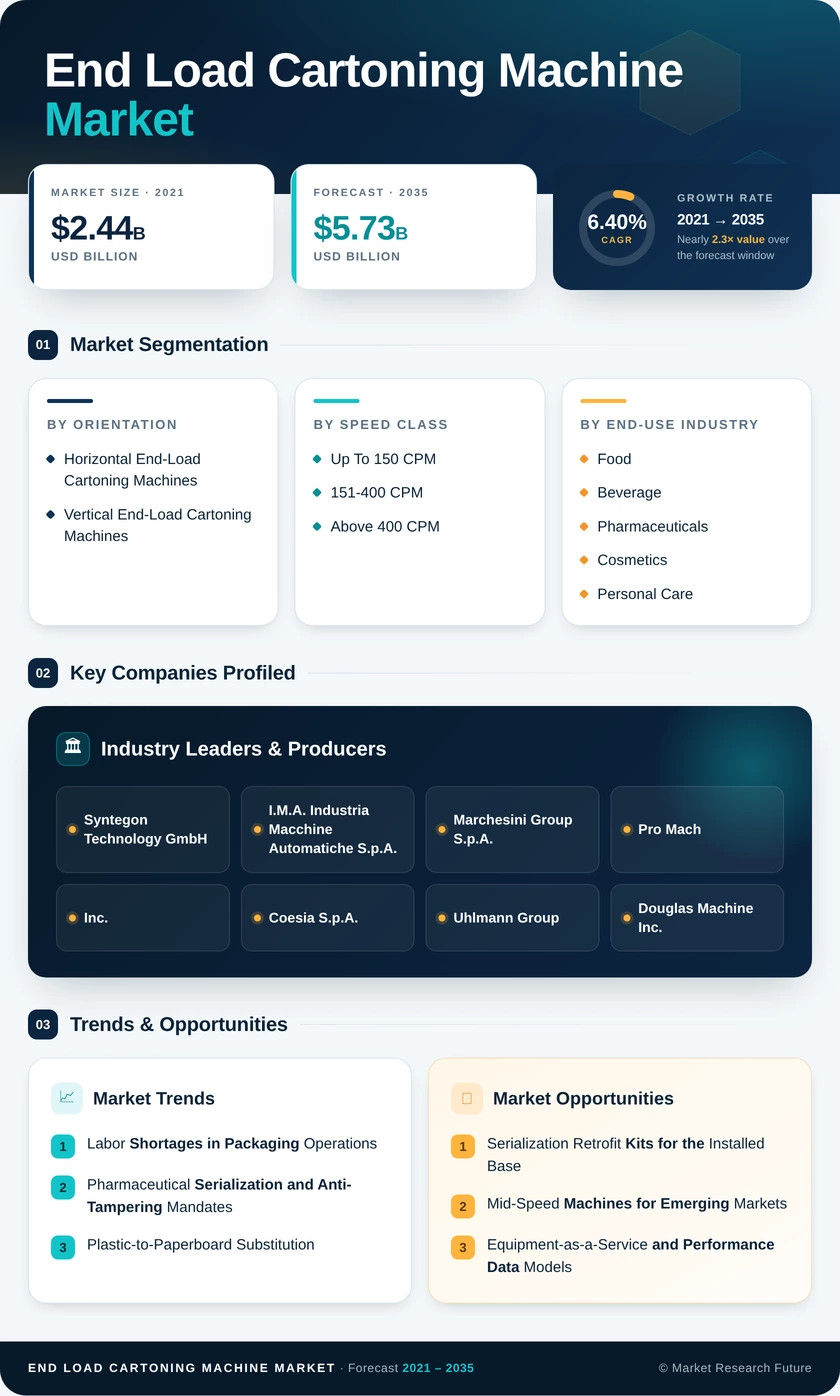
Segmentation Quick Reference
| Dimension | Sub-Segments | Dominant Segment | Fastest Growing Segment |
|---|---|---|---|
| By Orientation | Horizontal End-Load Cartoning Machines; Vertical End-Load Cartoning Machines | Horizontal End-Load Cartoning Machines (74.3% share) | Vertical End-Load Cartoning Machines (7.9% CAGR) |
| By Speed Class | Up To 150 CPM; 151-400 CPM; Above 400 CPM | 151-400 CPM (52.4% share) | 151-400 CPM (52.4% share) |
| By End-Use Industry | Food and Beverage; Pharmaceuticals; Cosmetics and Personal Care; Other End-Use Industries | Food and Beverage (50.6% share) | Pharmaceuticals (9.7% CAGR) |
| By Automation Level | Semi-Automatic Machines; Fully Automatic Machines; Robotic-Integrated Machines | Fully Automatic Machines (62.0% share) | Robotic-Integrated Machines (8.8% CAGR) |
| By Region | North America; Europe; Asia-Pacific; South America; Middle East & Africa | North America (40.8% share) | Asia-Pacific (10.5% CAGR) |
Market Segmentation Overview
By Orientation
| Sub-Segment | Key Trend |
|---|---|
| Horizontal End-Load Cartoning Machines | Continuous-motion pushers and multi-lane infeeds exceed 400 CPM without larger footprints |
| Vertical End-Load Cartoning Machines | Cobot-paired cells reduce drop height for fragile cosmetics and vials |
Horizontal End-Load Cartoning Machines lead with a 74.3% share because snack, cereal, and OTC medicine products slide easily into the carton end at high speed. Vertical End-Load Cartoning Machines grow fastest at a 7.9% CAGR, since gravity loading protects fragile items and compact frames suit crowded plants. Servo-adjusted lug chains on horizontal machines are narrowing the changeover advantage vertical units once held.
By Speed Class
| Sub-Segment | Key Trend |
|---|---|
| Up To 150 CPM | Specialty and regional brands favor low-cost, simple frames |
| 151-400 CPM | Servo motion and code verification migrate down from premium models |
| Above 400 CPM | Limited to low-variety commodity products such as gum and generic analgesics |
The 151-400 CPM class dominates with a 52.4% share and is also the fastest-growing speed band, because one frame can cover mixed SKU portfolios at a reasonable cost. Up To 150 CPM machines remain relevant for short specialty runs. Above 400 CPM platforms face frequent stoppages when SKU variety rises, pushing buyers toward modular mid-range cells.
By End-Use Industry
| Sub-Segment | Key Trend |
|---|---|
| Food and Beverage | Wash-down, stainless frames with IP65 options for multi-flavor lines |
| Pharmaceuticals | Serialization, anti-tampering, and 21 CFR Part 11 data integrity |
| Cosmetics and Personal Care | Window-cut cartons and vertical infeeds for shelf appeal |
| Other End-Use Industries | Household and hardware items in durable carton formats |
Food and Beverage leads with a 50.6% share as ready-meal, dairy, and confectionery plants run several flavors per shift. Pharmaceuticals grow fastest at a 9.7% CAGR because DSCSA and EU anti-tampering rules require validated cartoners with integrated print-and-verify stations. Cosmetics and Personal Care buyers prioritize presentation, which favors vertical loading and premium carton styles.
By Automation Level
| Sub-Segment | Key Trend |
|---|---|
| Semi-Automatic Machines | Retained by craft brands with limited capital budgets |
| Fully Automatic Machines | Lights-out operation with remote-service uptime contracts |
| Robotic-Integrated Machines | Cage-free cobots handle infeed and carton stacking |
Fully Automatic Machines dominate with a 62.0% share as plants seek consistent output with fewer operators. Robotic-Integrated Machines grow fastest at an 8.8% CAGR because cobots slot into existing halls without guarding and can be retaught quickly for new SKUs. Semi-Automatic Machines keep a foothold among small producers, though their relevance declines as financing and service models improve.


 Noah Malgeri
Co-Founder

 Peter Groot koerkamp
Account and Business Manager

 Younghwan Choi
Senior Retail Manager

 Mark Irwin
Management Consultant

 Akif Moroglu
Strategy & Business Development Director

 Guilherme Gomes Martins
Product Management Director

 Joseph Aguayo
Sales Operations & Pricing Manager

 La Terria Dodd
Program Support Specialist

 Rob Kooiker
Group Product Manager HVAC & Fire Protection GMA