×
Request Free Sample ×

Kindly complete the form below to receive a free sample of this Report

* Please use a valid business email

Leading companies partner with us for data-driven Insights

clients tt-cursor
Hero Background
English
Chinese
French
Japanese
Korean
German
Spanish

Embedded Technology Market Share

ID: MRFR/SEM/0535-HCR
110 Pages
Aarti Dhapte
October 2025

Embedded Technology Market Size, Share and Research Report By Platforms (Mobile, Web, Cloud, On-Premise), By Hardware (Processor IP, MCU/MPU, ASIC, FPGA), By Application (Automotive, Consumer Electronics, Aerospace), And By Region (North America, Europe, Asia-Pacific, And Rest Of The World) – Industry Forecast Till 2035

Share:
Download PDF ×

We do not share your information with anyone. However, we may send you emails based on your report interest from time to time. You may contact us at any time to opt-out.

Embedded Technology Market Infographic
Purchase Options

Market Share

Embedded Technology Market Share Analysis

In the competitive realm of the global market for embedded technology, market share placement approaches play a pivotal part in determining the success and endurance of businesses. One prevalent method is discrimination, where firms strive to recognize their embedded solutions from competitors by proposing superior performance, unique features, or advanced functionalities. By sourcing materials efficiently, enhancing production processes, and attaining economies of level, businesses can place themselves as cost-effective selections in the market, asking price-sensitive consumers and extending their market share.

Strategic alliances and partnerships are progressively becoming prevalent market placement strategies in the embedded technology background. Businesses often seek cooperation with technology providers, industry leaders, or complementary businesses to improve their access to new markets and product offerings and leverage each other's strengths.

Another remarkable market share placement policy is customer concentration. By understanding the specialized requirements and inclinations of their target audience, businesses can customize their embedded solutions to deal with these requirements effectively. A customer-focused method not only facilitates preserving existing customers but also interests new ones through positive word-of-mouth and reputation building.

Invention is a cornerstone policy in the global market for embedded technology. Businesses that consistently invest in research and development to generate cutting-edge technologies and solutions can place themselves as industry leaders. Being at the forefront of innovation not only appeals to tech-savvy consumers but also allows businesses to set trends and standards within the market.

Market merging through mergers and acquisitions is another tactical move in the embedded technology background. By acquiring or merging with other businesses, businesses can extend their product selections, gain access to new markets, and benefit from synergies that result in cost savings.

Implementing ability and flexibility are essential strategies for embedded technology in the vigorous global market. Businesses that can quickly implement changes in technology trends, market demands, and regulatory requirements place themselves for long-term success. Geographical expansion is a policy repeatedly employed by businesses seeking to broaden their market share. By inserting new regional markets, businesses can tap into unfamiliar opportunities and spread their customer base.

In the end, the global market for embedded technology is highly competitive, and successful market share-placement strategies require a multifaceted approach. Whether through differentiation, cost leadership, strategic partnerships, customer focus, innovation, market consolidation, flexibility, geographical expansion, or effective marketing, businesses must carefully craft their strategies to align with market conditions and stake out a strong and sustainable place in this emerging background.

Author
Aarti Dhapte
Team Lead - Research

She holds an experience of about 6+ years in Market Research and Business Consulting, working under the spectrum of Information Communication Technology, Telecommunications and Semiconductor domains. Aarti conceptualizes and implements a scalable business strategy and provides strategic leadership to the clients. Her expertise lies in market estimation, competitive intelligence, pipeline analysis, customer assessment, etc.

Leave a Comment

FAQs

How much is the Embedded Technology market?

The Embedded Technology Market size was valued at USD 96.78 billion in 2024.

What is the growth rate of the Embedded Technology market?

The global market is projected to grow at a CAGR of 7.00% during the forecast period, 2025 to 2035.

Which region held the largest market share in the Embedded Technology market?

Asia Pacific had the largest share in the Embedded Technology Market.

Who are the key players in the Embedded Technology market?

The key players in the market are Texas Instruments, Renesas Electronics Corporation, STMicroelectronics, Samsung, Microsoft Corporation, Infineon Technologies AG, Renesas Electronics Corporation, NXP Semiconductors, Atmel Corporation, and Infosys Ltd.

Which platform led the Embedded Technology market?

The cloud category dominated the market in 2022.

Which application had the largest market share in the market?

Consumer electronics had the largest share in the global market for Embedded Technology.

Market Summary

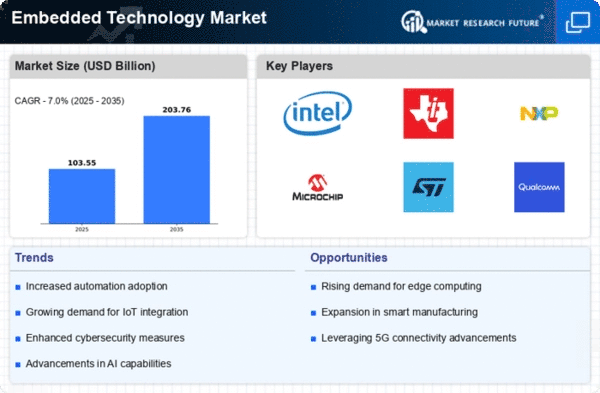
As per MRFR analysis, the Embedded Technology Market Size was estimated at 96.78 USD Billion in 2024. The Embedded Technology industry is projected to grow from 103.56 USD Billion in 2025 to 203.76 USD Billion by 2035, exhibiting a compound annual growth rate (CAGR) of 7.0 during the forecast period 2025 - 2035.

Key Market Trends & Highlights

The Embedded Technology Market is poised for substantial growth driven by innovation and increasing demand across various sectors.

  • The integration of Artificial Intelligence is transforming the capabilities of embedded systems, enhancing their functionality. North America remains the largest market for embedded technology, while Asia-Pacific is recognized as the fastest-growing region. Consumer Electronics continues to dominate the market, whereas Wearable Technology is emerging as the fastest-growing segment. The growing demand for smart devices and advancements in automotive technology are key drivers propelling market expansion.

Market Size & Forecast

2024 Market Size 96.78 (USD Billion)
2035 Market Size 203.76 (USD Billion)
CAGR (2025 - 2035) 7.0%
Largest Regional Market Share in 2024 North America

Major Players

Intel Corporation (US), Texas Instruments (US), NXP Semiconductors (NL), Microchip Technology (US), STMicroelectronics (CH), Qualcomm (US), Analog Devices (US), Infineon Technologies (DE), Renesas Electronics Corporation (JP)

Market Trends

The Embedded Technology Market is currently experiencing a dynamic evolution, driven by the increasing integration of smart devices across various sectors. This market encompasses a wide array of applications, including automotive, healthcare, consumer electronics, and industrial automation. As organizations strive for enhanced efficiency and connectivity, the demand for embedded systems continues to rise. These systems are pivotal in enabling real-time data processing and communication, which are essential for the development of the Internet of Things (IoT) and smart technologies. Furthermore, advancements in microcontroller technology and software development are facilitating the creation of more sophisticated embedded solutions, thereby expanding their applicability. In addition to technological advancements, the Embedded Technology Market is influenced by growing consumer expectations for seamless user experiences. As industries adopt automation and smart solutions, the need for reliable and efficient embedded systems becomes increasingly critical. Companies are investing in research and development to innovate and improve their offerings, which may lead to a more competitive landscape. The convergence of artificial intelligence with embedded technology is also noteworthy, as it appears to enhance the capabilities of devices, making them more intelligent and responsive. Overall, the Embedded Technology Market is poised for continued growth, driven by innovation and the relentless pursuit of efficiency across various sectors.

Integration of Artificial Intelligence

The integration of artificial intelligence into embedded systems is becoming increasingly prevalent. This trend suggests that devices are evolving to become more intelligent, enabling them to perform complex tasks autonomously. As AI algorithms are embedded within hardware, systems can analyze data in real-time, leading to improved decision-making and enhanced user experiences.

Rise of IoT Applications

The proliferation of Internet of Things applications is significantly impacting the Embedded Technology Market. This trend indicates a growing demand for interconnected devices that communicate seamlessly. As industries adopt IoT solutions, embedded systems are essential for facilitating data exchange and ensuring efficient operation across various platforms.

Focus on Energy Efficiency

There is a notable emphasis on energy efficiency within the Embedded Technology Market. This trend highlights the increasing need for sustainable solutions that minimize power consumption. Manufacturers are prioritizing the development of low-power embedded systems, which not only reduce operational costs but also align with global sustainability goals.

Embedded Technology Market Market Drivers

Rising Demand for IoT Devices

The increasing proliferation of Internet of Things (IoT) devices is a primary driver of the Global Embedded Technology Market Industry. As more devices become interconnected, the need for embedded systems that can efficiently manage data and connectivity grows. In 2024, the market is projected to reach 96.8 USD Billion, reflecting the heightened demand for smart home devices, wearables, and industrial IoT applications. This trend indicates a shift towards more automated and intelligent systems, which are expected to enhance operational efficiency across various sectors.

Market Segment Insights

By Application: Consumer Electronics (Largest) vs. Automotive (Fastest-Growing)

In the Embedded Technology Market, the application sectors exhibit varied market share distributions. Consumer Electronics holds the largest share, driven by the continuous advancements in smart devices and home automation. This segment encompasses a wide range of products, including smartphones, tablets, and <a href="https://www.marketresearchfuture.com/reports/smart-appliances-market-1049">smart appliances</a>, which consistently lead to increased demand for embedded solutions. In contrast, the Automotive sector, while smaller, is rapidly gaining traction, fueled by the rise in electric vehicles and advanced driver-assistance systems (ADAS).

Consumer Electronics: Dominant vs. Automotive: Emerging

The Consumer Electronics sector remains dominant in the Embedded Technology Market due to its extensive application in everyday devices that integrate sophisticated embedded systems for enhanced functionality. Innovations in artificial intelligence and connectivity significantly boost this sector's growth, making devices smarter and more user-friendly. Conversely, the Automotive sector, marked as emerging, focuses on integration within vehicles, particularly with the ongoing shift towards electric mobility and autonomous driving features. This sector's growth is driven by safety regulations and an increasing consumer demand for connected cars, positioning it as a critical area for future embedded technologies.

By End Use: Smart Home Devices (Largest) vs. Wearable Technology (Fastest-Growing)

The Embedded Technology Market exhibits a diverse landscape in its end-use segments. Among these, Smart Home Devices hold the largest market share, driven by increasing consumer demand for home automation and smart living solutions. This segment encompasses a variety of products, including smart thermostats, security systems, and voice-activated assistants, which are gaining traction in households across the globe. Wearable Technology, while not the largest, stands out as the fastest-growing segment. The proliferation of health-focused wearables, such as fitness trackers and smartwatches, signifies a shift towards personal health management and monitoring. This growth is propelled by advancements in sensor technologies and increasing health awareness among consumers, driving innovation and market expansion.

Wearable Technology (Dominant) vs. Medical Devices (Emerging)

Wearable Technology has solidified its position as a dominant force in the Embedded Technology Market, characterized by innovative products that integrate seamlessly into daily life. This segment leverages cutting-edge technologies to offer capabilities such as fitness tracking, health monitoring, and real-time data analysis, appealing to health-conscious consumers and tech enthusiasts alike. On the other hand, Medical Devices represent an emerging segment, poised for significant growth as the medical field embraces smart technologies for enhanced patient care. These devices utilize embedded technology to improve diagnostics, monitoring, and treatment outcomes, aligning with the increasing demand for telemetry, remote patient monitoring, and data-driven healthcare solutions.

By Technology: Microcontrollers (Largest) vs. Field Programmable Gate Arrays (Fastest-Growing)

In the Embedded Technology Market, Microcontrollers hold the largest market share, primarily due to their versatility and widespread application in consumer electronics and industrial automation. They serve as the backbone of numerous embedded systems, from simple household gadgets to complex machinery. In contrast, Field Programmable Gate Arrays (FPGAs) are gaining traction for their reconfigurable nature, making them ideal for specialized applications such as telecommunications and automotive systems. This shift demonstrates a diversified landscape within the market, with different technologies catering to varied industry needs.

Microcontrollers (Dominant) vs. FPGAs (Emerging)

Microcontrollers are recognized as the dominant force in the Embedded Technology Market, owing to their low cost, energy efficiency, and ease of programming. They are widely used in various applications, including smart home devices, automotive systems, and industrial controls. On the other hand, Field Programmable Gate Arrays represent an emerging technology segment characterized by their ability to be reconfigured post-manufacturing. This flexibility allows engineers to optimize hardware performance for specific tasks, thus driving their rapid adoption in evolving sectors like AI and IoT. The competition between these two technologies highlights the ongoing evolution and demand for tailored solutions in the embedded landscape.

By Component Type: Sensors (Largest) vs. Actuators (Fastest-Growing)

The Embedded Technology Market demonstrates a diverse distribution of market share among its component types. Sensors lead the way as the largest segment, primarily due to their critical role in data acquisition for various applications, including automotive, healthcare, and industrial automation. Following closely are Actuators, which are gaining traction due to their essential function in controlling systems and machinery, showcasing strong demand in smart home technologies and robotics.

Sensors (Dominant) vs. Actuators (Emerging)

Sensors are pivotal in the Embedded Technology Market as they facilitate the gathering of real-time data, which is increasingly essential for smart devices and IoT applications. Their dominance stems from widespread adoption across various sectors such as automotive, healthcare, and manufacturing. Meanwhile, Actuators represent an emerging force, essential for physical manipulation in devices, particularly in robotics and automation. The rise of smart home applications and <a href="https://www.marketresearchfuture.com/reports/industrial-automation-market-2212">industrial automation</a> is propelling the demand for actuators, as they provide key functionalities that enhance operational efficiencies and user experiences.

By Deployment Model: On-Premises (Largest) vs. Cloud-Based (Fastest-Growing)

The Embedded Technology Market is characterized by three primary deployment models: On-Premises, Cloud-Based, and Hybrid. On-Premises deployment holds the largest share, driven by businesses that prioritize data security and compliance. Conversely, Cloud-Based models are rapidly gaining traction, attributed to the growing inclination towards flexibility and scalability among organizations. The Hybrid model also plays a significant role, catering to entities seeking a balanced approach to deployment, however, its share remains less pronounced relative to On-Premises and Cloud-Based models.

Deployment Models: On-Premises (Dominant) vs. Cloud-Based (Emerging)

On-Premises deployment is distinguished by its robust security features and control over data, making it the go-to option for industries with stringent regulatory requirements. Its dominance in the Embedded Technology Market is fortified by its compatibility with legacy systems and the ability to customize solutions to specific organizational needs. In contrast, Cloud-Based deployment is emerging as a key contender, appealing to businesses that prioritize speed, remote access, and reduced IT overhead. This model supports rapid updates and easy scalability, making it ideal for companies looking to innovate and respond swiftly to market changes.

Get more detailed insights about Global Embedded Technology Market Research Report- Forecast 2035

Regional Insights

North America : Innovation and Market Leadership

North America continues to lead the Embedded Technology Market, holding a significant share of 48.39% in 2025. The region's growth is driven by rapid advancements in IoT, AI, and automotive technologies, alongside strong investments in R&D. Regulatory support for tech innovation and a robust infrastructure further catalyze demand, making it a hub for embedded solutions. The competitive landscape is characterized by major players such as Intel Corporation, Texas Instruments, and Qualcomm, which are at the forefront of technological advancements. The U.S. and Canada are the leading countries, with a strong focus on developing smart devices and systems. This region's emphasis on innovation and quality positions it as a critical player in the global market.

Europe : Regulatory Support and Growth

Europe's Embedded Technology Market is projected to reach a size of 28.14% by 2025, driven by stringent regulations promoting energy efficiency and sustainability. The European Union's Green Deal and Digital Strategy are pivotal in shaping market dynamics, encouraging the adoption of advanced embedded systems across various sectors, including automotive and healthcare. Leading countries like Germany, France, and the Netherlands are home to key players such as NXP Semiconductors and STMicroelectronics. The competitive landscape is marked by a strong emphasis on innovation and collaboration among tech firms and research institutions, fostering a vibrant ecosystem for embedded technologies. This synergy is crucial for maintaining Europe's competitive edge in the global market.

Asia-Pacific : Rapid Growth and Adoption

The Asia-Pacific region is witnessing rapid growth in the Embedded Technology Market, with a market share of 17.25% anticipated by 2025. This growth is fueled by increasing demand for consumer electronics, smart appliances, and automotive applications. Countries are investing heavily in digital transformation initiatives, supported by government policies that promote technology adoption and innovation. China, Japan, and South Korea are the leading countries in this region, hosting major players like Renesas Electronics and Infineon Technologies. The competitive landscape is evolving, with a focus on enhancing product capabilities and reducing costs. This region's dynamic market environment is essential for driving advancements in embedded technologies, positioning it as a key player in the global arena.

Middle East and Africa : Emerging Market Potential

The Middle East and Africa (MEA) region, while currently holding a smaller market share of 3.0%, presents significant growth opportunities in the Embedded Technology Market. The region is experiencing a surge in demand for smart technologies, driven by urbanization and government initiatives aimed at digital transformation. Investments in infrastructure and technology are expected to catalyze market growth in the coming years. Countries like South Africa and the UAE are leading the charge, with a growing presence of tech companies and startups focusing on embedded solutions. The competitive landscape is gradually evolving, with local and international players collaborating to enhance technological capabilities. This region's potential for growth makes it an attractive market for embedded technology investments.

Key Players and Competitive Insights

The Embedded Technology Market is characterized by a dynamic competitive landscape, driven by rapid advancements in technology and increasing demand for smart devices across various sectors. Key players such as Intel Corporation (US), Texas Instruments (US), and NXP Semiconductors (NL) are at the forefront, each adopting distinct strategies to enhance their market positioning. Intel Corporation (US) focuses on innovation in semiconductor technology, particularly in the realm of AI and IoT applications, while Texas Instruments (US) emphasizes localized manufacturing and supply chain optimization to meet the growing demand for embedded solutions. NXP Semiconductors (NL) is actively pursuing strategic partnerships to bolster its capabilities in automotive and industrial applications, thereby shaping a competitive environment that is increasingly collaborative.
The market structure appears moderately fragmented, with a mix of established players and emerging companies vying for market share. Key business tactics such as localizing manufacturing and optimizing supply chains are prevalent among major players, allowing them to respond swiftly to market demands and enhance operational efficiency. This collective influence of key players fosters a competitive atmosphere where innovation and responsiveness are paramount.
In November 2025, Intel Corporation (US) announced a significant investment in a new semiconductor fabrication facility in Arizona, aimed at increasing production capacity for embedded systems. This strategic move is likely to enhance Intel's ability to meet the surging demand for advanced embedded solutions, particularly in the automotive and industrial sectors, thereby reinforcing its competitive edge.
In October 2025, Texas Instruments (US) launched a new series of microcontrollers designed specifically for IoT applications, showcasing its commitment to innovation in embedded technology. This product line is expected to cater to the growing needs of developers seeking efficient and scalable solutions, further solidifying Texas Instruments' position in the market.
In September 2025, NXP Semiconductors (NL) entered into a partnership with a leading automotive manufacturer to develop next-generation vehicle control systems. This collaboration underscores NXP's strategic focus on the automotive sector, positioning it to capitalize on the increasing integration of embedded technology in smart vehicles.
As of December 2025, current competitive trends in the Embedded Technology Market are heavily influenced by digitalization, sustainability, and AI integration. Strategic alliances among key players are shaping the landscape, fostering innovation and enhancing product offerings. The shift from price-based competition to a focus on technological advancement and supply chain reliability is evident, suggesting that future competitive differentiation will hinge on the ability to innovate and adapt to evolving market demands.

Key Companies in the Embedded Technology Market include

Industry Developments

May 2022: Broadcom announced the acquisition of VMware in a cash-and-stock transaction that values at approximately $61 billion.

January 2022: Intel announced the introduction of mobile, the new EyeQ Ultra purpose-built SoC for autonomous vehicles.

Future Outlook

Embedded Technology Market Future Outlook

The Embedded Technology Market is projected to grow at a 7.0% CAGR from 2025 to 2035, driven by advancements in IoT, AI integration, and increased automation.

New opportunities lie in:

  • Development of AI-driven embedded systems for smart devices.
  • Expansion into automotive embedded solutions for electric vehicles.
  • Creation of cybersecurity frameworks for embedded technology applications.

By 2035, the Embedded Technology Market is expected to be robust, driven by innovation and diverse applications.

Market Segmentation

Embedded Technology Market End Use Outlook

  • Smart Home Devices
  • Wearable Technology
  • Robotics
  • Medical Devices
  • Networking Equipment

Embedded Technology Market Technology Outlook

  • Microcontrollers
  • Field Programmable Gate Arrays
  • Digital Signal Processors
  • System on Chip
  • Embedded Operating Systems

Embedded Technology Market Application Outlook

  • Consumer Electronics
  • Automotive
  • Industrial Automation
  • Healthcare
  • Telecommunications

Embedded Technology Market Component Type Outlook

  • Sensors
  • Actuators
  • Embedded Software
  • Power Management ICs
  • Connectivity Modules

Embedded Technology Market Deployment Model Outlook

  • On-Premises
  • Cloud-Based
  • Hybrid

Report Scope

MARKET SIZE 2024 96.78(USD Billion)
MARKET SIZE 2025 103.56(USD Billion)
MARKET SIZE 2035 203.76(USD Billion)
COMPOUND ANNUAL GROWTH RATE (CAGR) 7.0% (2025 - 2035)
REPORT COVERAGE Revenue Forecast, Competitive Landscape, Growth Factors, and Trends
BASE YEAR 2024
Market Forecast Period 2025 - 2035
Historical Data 2019 - 2024
Market Forecast Units USD Billion
Key Companies Profiled Intel Corporation (US), Texas Instruments (US), NXP Semiconductors (NL), Microchip Technology (US), STMicroelectronics (CH), Qualcomm (US), Analog Devices (US), Infineon Technologies (DE), Renesas Electronics Corporation (JP)
Segments Covered Application, End Use, Technology, Component Type, Deployment Model
Key Market Opportunities Integration of artificial intelligence in embedded systems enhances automation and efficiency across various industries.
Key Market Dynamics Rising demand for smart devices drives innovation and competition in the Embedded Technology Market.
Countries Covered North America, Europe, APAC, South America, MEA

FAQs

How much is the Embedded Technology market?

The Embedded Technology Market size was valued at USD 96.78 billion in 2024.

What is the growth rate of the Embedded Technology market?

The global market is projected to grow at a CAGR of 7.00% during the forecast period, 2025 to 2035.

Which region held the largest market share in the Embedded Technology market?

Asia Pacific had the largest share in the Embedded Technology Market.

Who are the key players in the Embedded Technology market?

The key players in the market are Texas Instruments, Renesas Electronics Corporation, STMicroelectronics, Samsung, Microsoft Corporation, Infineon Technologies AG, Renesas Electronics Corporation, NXP Semiconductors, Atmel Corporation, and Infosys Ltd.

Which platform led the Embedded Technology market?

The cloud category dominated the market in 2022.

Which application had the largest market share in the market?

Consumer electronics had the largest share in the global market for Embedded Technology.

  1. SECTION I: EXECUTIVE SUMMARY AND KEY HIGHLIGHTS
    1. | 1.1 EXECUTIVE SUMMARY
    2. | 1.1.1 Market Overview
    3. | 1.1.2 Key Findings
    4. | 1.1.3 Market Segmentation
    5. | 1.1.4 Competitive Landscape
    6. | 1.1.5 Challenges and Opportunities
    7. | 1.1.6 Future Outlook
  2. SECTION II: SCOPING, METHODOLOGY AND MARKET STRUCTURE
    1. | 2.1 MARKET INTRODUCTION
    2. | 2.1.1 Definition
    3. | 2.1.2 Scope of the study
    4. |-- 2.1.2.1 Research Objective
    5. |-- 2.1.2.2 Assumption
    6. |-- 2.1.2.3 Limitations
    7. | 2.2 RESEARCH METHODOLOGY
    8. | 2.2.1 Overview
    9. | 2.2.2 Data Mining
    10. | 2.2.3 Secondary Research
    11. | 2.2.4 Primary Research
    12. |-- 2.2.4.1 Primary Interviews and Information Gathering Process
    13. |-- 2.2.4.2 Breakdown of Primary Respondents
    14. | 2.2.5 Forecasting Model
    15. | 2.2.6 Market Size Estimation
    16. |-- 2.2.6.1 Bottom-Up Approach
    17. |-- 2.2.6.2 Top-Down Approach
    18. | 2.2.7 Data Triangulation
    19. | 2.2.8 Validation
  3. SECTION III: QUALITATIVE ANALYSIS
    1. | 3.1 MARKET DYNAMICS
    2. | 3.1.1 Overview
    3. | 3.1.2 Drivers
    4. | 3.1.3 Restraints
    5. | 3.1.4 Opportunities
    6. | 3.2 MARKET FACTOR ANALYSIS
    7. | 3.2.1 Value chain Analysis
    8. | 3.2.2 Porter's Five Forces Analysis
    9. |-- 3.2.2.1 Bargaining Power of Suppliers
    10. |-- 3.2.2.2 Bargaining Power of Buyers
    11. |-- 3.2.2.3 Threat of New Entrants
    12. |-- 3.2.2.4 Threat of Substitutes
    13. |-- 3.2.2.5 Intensity of Rivalry
    14. | 3.2.3 COVID-19 Impact Analysis
    15. |-- 3.2.3.1 Market Impact Analysis
    16. |-- 3.2.3.2 Regional Impact
    17. |-- 3.2.3.3 Opportunity and Threat Analysis
  4. SECTION IV: QUANTITATIVE ANALYSIS
    1. | 4.1 Semiconductor & Electronics, BY Application (USD Billion)
    2. | 4.1.1 Consumer Electronics
    3. | 4.1.2 Automotive
    4. | 4.1.3 Industrial Automation
    5. | 4.1.4 Healthcare
    6. | 4.1.5 Telecommunications
    7. | 4.2 Semiconductor & Electronics, BY End Use (USD Billion)
    8. | 4.2.1 Smart Home Devices
    9. | 4.2.2 Wearable Technology
    10. | 4.2.3 Robotics
    11. | 4.2.4 Medical Devices
    12. | 4.2.5 Networking Equipment
    13. | 4.3 Semiconductor & Electronics, BY Technology (USD Billion)
    14. | 4.3.1 Microcontrollers
    15. | 4.3.2 Field Programmable Gate Arrays
    16. | 4.3.3 Digital Signal Processors
    17. | 4.3.4 System on Chip
    18. | 4.3.5 Embedded Operating Systems
    19. | 4.4 Semiconductor & Electronics, BY Component Type (USD Billion)
    20. | 4.4.1 Sensors
    21. | 4.4.2 Actuators
    22. | 4.4.3 Embedded Software
    23. | 4.4.4 Power Management ICs
    24. | 4.4.5 Connectivity Modules
    25. | 4.5 Semiconductor & Electronics, BY Deployment Model (USD Billion)
    26. | 4.5.1 On-Premises
    27. | 4.5.2 Cloud-Based
    28. | 4.5.3 Hybrid
    29. | 4.6 Semiconductor & Electronics, BY Region (USD Billion)
    30. | 4.6.1 North America
    31. |-- 4.6.1.1 US
    32. |-- 4.6.1.2 Canada
    33. | 4.6.2 Europe
    34. |-- 4.6.2.1 Germany
    35. |-- 4.6.2.2 UK
    36. |-- 4.6.2.3 France
    37. |-- 4.6.2.4 Russia
    38. |-- 4.6.2.5 Italy
    39. |-- 4.6.2.6 Spain
    40. |-- 4.6.2.7 Rest of Europe
    41. | 4.6.3 APAC
    42. |-- 4.6.3.1 China
    43. |-- 4.6.3.2 India
    44. |-- 4.6.3.3 Japan
    45. |-- 4.6.3.4 South Korea
    46. |-- 4.6.3.5 Malaysia
    47. |-- 4.6.3.6 Thailand
    48. |-- 4.6.3.7 Indonesia
    49. |-- 4.6.3.8 Rest of APAC
    50. | 4.6.4 South America
    51. |-- 4.6.4.1 Brazil
    52. |-- 4.6.4.2 Mexico
    53. |-- 4.6.4.3 Argentina
    54. |-- 4.6.4.4 Rest of South America
    55. | 4.6.5 MEA
    56. |-- 4.6.5.1 GCC Countries
    57. |-- 4.6.5.2 South Africa
    58. |-- 4.6.5.3 Rest of MEA
  5. SECTION V: COMPETITIVE ANALYSIS
    1. | 5.1 Competitive Landscape
    2. | 5.1.1 Overview
    3. | 5.1.2 Competitive Analysis
    4. | 5.1.3 Market share Analysis
    5. | 5.1.4 Major Growth Strategy in the Semiconductor & Electronics
    6. | 5.1.5 Competitive Benchmarking
    7. | 5.1.6 Leading Players in Terms of Number of Developments in the Semiconductor & Electronics
    8. | 5.1.7 Key developments and growth strategies
    9. |-- 5.1.7.1 New Product Launch/Service Deployment
    10. |-- 5.1.7.2 Merger & Acquisitions
    11. |-- 5.1.7.3 Joint Ventures
    12. | 5.1.8 Major Players Financial Matrix
    13. |-- 5.1.8.1 Sales and Operating Income
    14. |-- 5.1.8.2 Major Players R&D Expenditure. 2023
    15. | 5.2 Company Profiles
    16. | 5.2.1 Intel Corporation (US)
    17. |-- 5.2.1.1 Financial Overview
    18. |-- 5.2.1.2 Products Offered
    19. |-- 5.2.1.3 Key Developments
    20. |-- 5.2.1.4 SWOT Analysis
    21. |-- 5.2.1.5 Key Strategies
    22. | 5.2.2 Texas Instruments (US)
    23. |-- 5.2.2.1 Financial Overview
    24. |-- 5.2.2.2 Products Offered
    25. |-- 5.2.2.3 Key Developments
    26. |-- 5.2.2.4 SWOT Analysis
    27. |-- 5.2.2.5 Key Strategies
    28. | 5.2.3 NXP Semiconductors (NL)
    29. |-- 5.2.3.1 Financial Overview
    30. |-- 5.2.3.2 Products Offered
    31. |-- 5.2.3.3 Key Developments
    32. |-- 5.2.3.4 SWOT Analysis
    33. |-- 5.2.3.5 Key Strategies
    34. | 5.2.4 Microchip Technology (US)
    35. |-- 5.2.4.1 Financial Overview
    36. |-- 5.2.4.2 Products Offered
    37. |-- 5.2.4.3 Key Developments
    38. |-- 5.2.4.4 SWOT Analysis
    39. |-- 5.2.4.5 Key Strategies
    40. | 5.2.5 STMicroelectronics (CH)
    41. |-- 5.2.5.1 Financial Overview
    42. |-- 5.2.5.2 Products Offered
    43. |-- 5.2.5.3 Key Developments
    44. |-- 5.2.5.4 SWOT Analysis
    45. |-- 5.2.5.5 Key Strategies
    46. | 5.2.6 Qualcomm (US)
    47. |-- 5.2.6.1 Financial Overview
    48. |-- 5.2.6.2 Products Offered
    49. |-- 5.2.6.3 Key Developments
    50. |-- 5.2.6.4 SWOT Analysis
    51. |-- 5.2.6.5 Key Strategies
    52. | 5.2.7 Analog Devices (US)
    53. |-- 5.2.7.1 Financial Overview
    54. |-- 5.2.7.2 Products Offered
    55. |-- 5.2.7.3 Key Developments
    56. |-- 5.2.7.4 SWOT Analysis
    57. |-- 5.2.7.5 Key Strategies
    58. | 5.2.8 Infineon Technologies (DE)
    59. |-- 5.2.8.1 Financial Overview
    60. |-- 5.2.8.2 Products Offered
    61. |-- 5.2.8.3 Key Developments
    62. |-- 5.2.8.4 SWOT Analysis
    63. |-- 5.2.8.5 Key Strategies
    64. | 5.2.9 Renesas Electronics Corporation (JP)
    65. |-- 5.2.9.1 Financial Overview
    66. |-- 5.2.9.2 Products Offered
    67. |-- 5.2.9.3 Key Developments
    68. |-- 5.2.9.4 SWOT Analysis
    69. |-- 5.2.9.5 Key Strategies
    70. | 5.3 Appendix
    71. | 5.3.1 References
    72. | 5.3.2 Related Reports

Semiconductor & Electronics Market Segmentation

Semiconductor & Electronics By Application (USD Billion, 2025-2035)

  • Consumer Electronics
  • Automotive
  • Industrial Automation
  • Healthcare
  • Telecommunications

Semiconductor & Electronics By End Use (USD Billion, 2025-2035)

  • Smart Home Devices
  • Wearable Technology
  • Robotics
  • Medical Devices
  • Networking Equipment

Semiconductor & Electronics By Technology (USD Billion, 2025-2035)

  • Microcontrollers
  • Field Programmable Gate Arrays
  • Digital Signal Processors
  • System on Chip
  • Embedded Operating Systems

Semiconductor & Electronics By Component Type (USD Billion, 2025-2035)

  • Sensors
  • Actuators
  • Embedded Software
  • Power Management ICs
  • Connectivity Modules

Semiconductor & Electronics By Deployment Model (USD Billion, 2025-2035)

  • On-Premises
  • Cloud-Based
  • Hybrid
Infographic

Free Sample Request

Kindly complete the form below to receive a free sample of this Report

Get Free Sample

Customer Strories

Compare Licence

×
Features License Type
Single User Multiuser License Enterprise User
Price $4,950 $5,950 $7,250
Maximum User Access Limit 1 User Upto 10 Users Unrestricted Access Throughout the Organization
Free Customization
Direct Access to Analyst
Deliverable Format
Platform Access
Discount on Next Purchase 10% 15% 15%
Printable Versions