
Request Free Sample ×

Kindly complete the form below to receive a free sample of this Report

* Please use a valid business email

Leading companies partner with us for data-driven Insights

clients tt-cursor
Hero Background
English
Chinese
French
Japanese
Korean
German
Spanish

Embedded System for Electric Vehicle Market Trends

ID: MRFR/AT/3971-HCR
188 Pages
Triveni Bhoyar
Last Updated: April 06, 2026

Embedded System for Electric Vehicle Market Research Report Information By Component (Sensors, MCU, Transceivers, and Memory Devices), By Application (Infotainment & Telematics, Body Electronics, and Safety & Security), and By Region (North America, Europe, Asia-Pacific, and Rest Of The World) – Market Forecast Till 2035

Share:
Download PDF ×

We do not share your information with anyone. However, we may send you emails based on your report interest from time to time. You may contact us at any time to opt-out.

Embedded System Electric Vehicle Market Infographic
Purchase Options

Market Trends

Key Emerging Trends in the Embedded System Electric Vehicle Market

Embedded Systems for Electric Vehicles (EVs) market share positioning strategies are crucial for organizations seeking to dominate. A common strategy is technical distinction. Companies provide embedded systems with advanced features like battery management, power distribution, and connection to distinguish out. Companies market themselves as pioneers by highlighting these technical advances, enticing consumers seeking cutting-edge electric car performance and efficiency solutions.

Cost leadership is another key EV embedded systems approach. Companies optimize manufacturing costs, negotiate beneficial supply chain arrangements, and use economies of scale to deliver cheap prices without compromising quality. These firms target customers and fleet operators seeking economical, dependable embedded systems for electric vehicles by promoting themselves as cost-effective alternatives.

Some firms in this sector use niche targeting. Instead of serving the whole electric vehicle sector, they focus on high-performance EVs, commercial electric cars, and electric buses and delivery trucks. Companies that specialize in a specialty can design their embedded systems to match the needs of that market, establishing themselves as specialists and gaining loyal customers.

Customer-centric tactics also matter. Customer service, customisation, and smooth integration of embedded technology into electric car models are companies' top priorities. These organizations generate brand loyalty and favorable word-of-mouth referrals by recognizing and meeting consumer demands, which may dramatically affect market share.

Strategy positioning in the EV embedded systems industry requires strategic relationships and collaborations. For integrated solutions that provide value, companies commonly partner with EV manufacturers, battery suppliers, and software developers. Working with an EV manufacturer to build embedded systems for their vehicles can provide you a competitive edge and improve market positioning through combined knowledge and resources.

Also important are continual innovation and technical improvement. Research and development, new features, and keeping up with trends make companies industry leaders. These organizations attract forward-thinking clients and consolidate their market dominance by delivering cutting-edge solutions to meet electric car industry demands.

Multifaceted market share tactics exist for the Embedded System for Electric Vehicle Market. Technological distinction, cost leadership, specialty targeting, customer-centric methods, partnerships, and innovation help organizations stand out in this competitive marketplace. Businesses aspire to grab market share and retain a sustainable and important position in this fast increasing market by analyzing market dynamics, exploiting unique assets, and meeting electric car industry demands.


Author
Author Profile
Triveni Bhoyar
Senior Research Analyst

Triveni Bhoyar has over 5 years of experience in the market research industry, specializing in the Automotive and Aerospace & Defense sectors. She has contributed to 200+ reports, including numerous custom projects for leading global companies, delivering solutions to complex business challenges. Renowned for her ability to generate valuable insights, Triveni excels in addressing unique market dynamics with precision and depth. Her expertise spans market sizing, competitive intelligence, and trend analysis, enabling clients to craft data-driven growth strategies. With strong analytical rigor and a client-centric approach, she plays a pivotal role in driving impactful, strategic decision-making.

Leave a Comment

FAQs

What is the projected market valuation for the Embedded System for Electric Vehicle Market in 2035?

<p>The projected market valuation for the Embedded System for Electric Vehicle Market in 2035 is 48.39 USD Billion.</p>

What was the market valuation for the Embedded System for Electric Vehicle Market in 2024?

<p>The market valuation for the Embedded System for Electric Vehicle Market in 2024 was 10.01 USD Billion.</p>

What is the expected CAGR for the Embedded System for Electric Vehicle Market from 2025 to 2035?

<p>The expected CAGR for the Embedded System for Electric Vehicle Market during the forecast period 2025 - 2035 is 15.4%.</p>

Which companies are considered key players in the Embedded System for Electric Vehicle Market?

<p>Key players in the market include NVIDIA, Texas Instruments, Infineon Technologies, Renesas Electronics, STMicroelectronics, Microchip Technology, Analog Devices, Bosch, Continental, and Denso.</p>

What are the main components contributing to the Embedded System for Electric Vehicle Market?

<p>Main components include Sensors, MCUs, Transceivers, and Memory Devices, with projected valuations reaching 11.5, 14.0, 9.0, and 13.89 USD Billion respectively by 2035.</p>

How do application segments like Safety & Security impact the market?

<p>The Safety & Security application segment is projected to grow to 21.89 USD Billion by 2035, indicating its critical role in the market.</p>

What is the projected growth for the Infotainment & Telematics segment by 2035?

The Infotainment &amp; Telematics segment is expected to reach 14.5 USD Billion by 2035, reflecting its increasing importance in electric vehicles.

How does the performance of Body Electronics compare to other segments?

Body Electronics is projected to grow to 12.0 USD Billion by 2035, which is substantial but lower than the Safety &amp; Security segment.

What role do companies like Bosch and Denso play in the market?

Companies like Bosch and Denso are pivotal in driving innovation and technology advancements within the Embedded System for Electric Vehicle Market.

What trends are influencing the growth of the Embedded System for Electric Vehicle Market?

Trends such as increased demand for advanced safety features and enhanced infotainment systems are likely to drive growth in the Embedded System for Electric Vehicle Market.

Market Summary

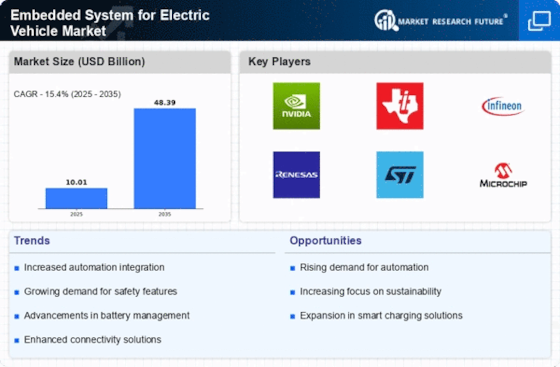
As per Market Research Future analysis, the Embedded System for Electric Vehicle Market was estimated at 10.01 USD Billion in 2024. The embedded system industry is projected to grow from 11.55 USD Billion in 2025 to 48.39 USD Billion by 2035, exhibiting a compound annual growth rate (CAGR) of 15.4% during the forecast period 2025 - 2035

Key Market Trends & Highlights

The Embedded System for Electric Vehicle Market is poised for substantial growth driven by technological advancements and increasing consumer demand.

  • North America remains the largest market for embedded systems in electric vehicles, reflecting a robust demand for advanced automotive technologies. The Asia-Pacific region is emerging as the fastest-growing market, propelled by rapid urbanization and increasing electric vehicle adoption. Sensors dominate the market as the largest segment, while memory devices are experiencing the fastest growth due to advancements in data processing capabilities. Rising demand for electric vehicles and government incentives are key drivers fueling the expansion of embedded systems in the automotive sector.

Market Size & Forecast

2024 Market Size 10.01 (USD Billion)
2035 Market Size 48.39 (USD Billion)
CAGR (2025 - 2035) 15.4%
Largest Regional Market Share in 2024 North America

Major Players

NVIDIA (US), <a href="https://www.ti.com/applications/automotive/hev-ev-powertrain/overview.html">Texas Instruments</a> (US), Infineon Technologies (DE), Renesas Electronics (JP), STMicroelectronics (CH), Microchip Technology (US), <a href="https://www.analog.com/en/solutions/automotive/electrification-and-powertrain/electric-powertrain-systems.html">Analog Devices</a> (US), Bosch (DE), Continental (DE), Denso (JP)

Market Trends

The Embedded System for Electric Vehicle Market is currently experiencing a transformative phase, driven by advancements in technology and increasing consumer demand for sustainable transportation solutions. As electric vehicles gain traction, the integration of sophisticated embedded systems becomes paramount. These systems enhance vehicle performance, improve energy efficiency, and facilitate advanced features such as autonomous driving and connectivity. The market appears to be evolving rapidly, with manufacturers focusing on developing innovative solutions that cater to the needs of modern consumers. This shift is likely to reshape the automotive landscape, as embedded systems play a crucial role in the overall functionality and appeal of electric vehicles. Moreover, the Embedded System for Electric Vehicle Market is influenced by regulatory frameworks and environmental considerations. Governments worldwide are implementing stringent emissions standards, which further propels the adoption of electric vehicles. Consequently, the demand for embedded systems that support these vehicles is expected to rise. The interplay between technological advancements and regulatory pressures suggests a dynamic market environment, where stakeholders must remain agile to adapt to changing conditions. As the industry progresses, the focus on enhancing user experience and ensuring safety will likely drive further innovations in embedded systems, solidifying their importance in the electric vehicle sector.

Increased Connectivity Features

The Embedded System for Electric Vehicle Market is witnessing a surge in demand for enhanced connectivity features. These systems enable vehicles to communicate with each other and with infrastructure, facilitating real-time data exchange. This trend not only improves navigation and traffic management but also enhances safety and user experience.

Focus on Energy Management

Energy management systems within embedded solutions are becoming increasingly critical. These systems optimize battery usage and charging processes, contributing to improved vehicle range and efficiency. As consumers seek longer-lasting electric vehicles, the emphasis on effective energy management is likely to grow.

Advancements in Autonomous Driving Technologies

The pursuit of autonomous driving capabilities is significantly influencing the Embedded System for Electric Vehicle Market. Innovations in sensor technology and artificial intelligence are driving the development of sophisticated embedded systems that support self-driving features. This trend indicates a shift towards greater automation in the automotive sector.

Embedded System Electric Vehicle Market Market Drivers

Rising Demand for Electric Vehicles

The increasing consumer preference for electric vehicles (EVs) is a primary driver for the Embedded System for Electric Vehicle Market. As environmental concerns gain prominence, more individuals are opting for EVs, which are perceived as a sustainable alternative to traditional vehicles. In 2025, the sales of electric vehicles are projected to reach approximately 10 million units, reflecting a substantial growth trajectory. This surge in demand necessitates advanced embedded systems that enhance vehicle performance, safety, and user experience. Consequently, manufacturers are investing heavily in the development of sophisticated embedded systems to meet the evolving needs of consumers, thereby propelling the Embedded System for Electric Vehicle Market forward.

Government Incentives and Regulations

Government policies and incentives aimed at promoting electric vehicle adoption significantly influence the Embedded System for Electric Vehicle Market. Various countries have implemented stringent emissions regulations and offer financial incentives for EV purchases, which encourage consumers to transition from internal combustion engines to electric alternatives. For instance, tax rebates and subsidies can lower the effective cost of EVs, making them more appealing. As a result, the demand for embedded systems that support compliance with these regulations is likely to increase. This regulatory landscape not only fosters innovation in embedded technologies but also ensures that manufacturers align their products with governmental standards, thus driving growth in the Embedded System for Electric Vehicle Market.

Consumer Demand for Enhanced Vehicle Features

The modern consumer's expectation for advanced features in vehicles is a significant driver for the Embedded System for Electric Vehicle Market. Features such as infotainment systems, connectivity options, and autonomous driving capabilities are becoming standard in new electric vehicles. As consumers seek vehicles that offer seamless integration with their digital lives, manufacturers are compelled to invest in advanced embedded systems that can support these features. The demand for high-quality user interfaces and real-time data processing is likely to escalate, pushing the boundaries of what embedded systems can achieve. This trend not only enhances the driving experience but also propels the Embedded System for Electric Vehicle Market to new heights.

Focus on Sustainability and Energy Efficiency

The growing emphasis on sustainability and energy efficiency is a crucial driver for the Embedded System for Electric Vehicle Market. As the world grapples with climate change, the automotive sector is under pressure to reduce its carbon footprint. Embedded systems play a vital role in optimizing energy consumption and improving the overall efficiency of electric vehicles. Technologies such as regenerative braking and energy management systems are integral to maximizing the range and performance of EVs. In 2025, the market for energy-efficient embedded systems is anticipated to expand significantly, reflecting the industry's commitment to sustainability. This focus not only aligns with consumer values but also drives innovation within the Embedded System for Electric Vehicle Market.

Technological Advancements in Embedded Systems

Rapid advancements in technology are reshaping the Embedded System for Electric Vehicle Market. Innovations in microcontrollers, sensors, and software development are enabling the creation of more efficient and reliable embedded systems. These systems are crucial for various functionalities, including battery management, vehicle-to-everything (V2X) communication, and advanced driver-assistance systems (ADAS). As of 2025, the market for embedded systems in EVs is expected to grow at a compound annual growth rate (CAGR) of over 15%. This growth is indicative of the increasing reliance on sophisticated embedded technologies to enhance vehicle performance and safety, thereby driving the Embedded System for Electric Vehicle Market.

Market Segment Insights

By Component: Sensors (Largest) vs. Memory Devices (Fastest-Growing)

The Embedded System for Electric Vehicle Market exhibits a diverse distribution of components that are essential for the functionality and efficacy of electric vehicles. Sensors are the largest segment, pivotal for monitoring and enhancing vehicle performance, safety, and user experience. On the other hand, memory devices are rapidly gaining traction, attributed to their critical role in data storage and processing for advanced functionalities. Alongside microcontrollers (MCUs) and transceivers, these components collectively shape the landscape of embedded systems in electric vehicles.

Memory Devices (Emerging) vs. MCUs (Dominant)

In the evolving landscape of embedded systems for electric vehicles, microcontrollers (MCUs) stand as a dominant component, coordinating multiple functions and integrating various systems within the vehicle. Conversely, memory devices represent an emerging segment, driven by the increasing demand for data handling and storage capabilities in electric vehicles. MCUs are essential for executing control operations and enhancing overall performance, while memory devices support advanced applications such as infotainment systems and autonomous driving features. This dynamic between dominant and emerging components reflects the industry's push towards more intelligent and efficient electric vehicles.

By Application: Infotainment & Telematics (Largest) vs. Safety & Security (Fastest-Growing)

In the Embedded System for Electric Vehicle Market, the application segment showcases a diverse distribution among its components, with Infotainment &amp; Telematics leading the sphere due to its pivotal role in enhancing on-board experience and connectivity. Body Electronics follows suit, contributing significantly to vehicle functionality, while Safety &amp; Security, although smaller in share, is gaining commendable traction in the market as consumers prioritize vehicle safety features. Recent trends illustrate a robust growth trajectory for Safety &amp; Security systems, attributed to increasing consumer awareness regarding safety and evolving regulatory frameworks mandating advanced safety features in vehicles. The demand for enhanced Infotainment &amp; Telematics systems remains strong, driven by technological advancements and the integration of connectivity features in electric vehicles, making it a crucial segment that influences consumer choice and vehicle design.

Safety &amp; Security: Infotainment &amp; Telematics (Dominant) vs. Body Electronics (Emerging)

Infotainment &amp; Telematics represents the dominant force within the application segment of the Embedded System for Electric Vehicle Market, characterized by its integrated functionalities that enhance user engagement and data connectivity. On the other hand, Body Electronics is emerging, focusing on improving comfort and convenience through automated systems such as power windows and automated climate control. These segments highlight a clear distinction in market maturity; while Infotainment &amp; Telematics enjoys extensive adoption owing to its user-centric focus, Body Electronics is progressively gaining traction with technological innovations that enhance vehicle interior experiences. The rapid integration of advanced electronic modules in Body Electronics marks a burgeoning interest, positioning this segment to contribute significantly in the coming years.

Get more detailed insights about Embedded System for Electric Vehicle Market Research Report- Forecast 2035

Regional Insights

By region, the study provides the market insights into North America, Europe, Asia-Pacific and Rest of the World. The North America Embedded System for Electric Vehicle Market dominated this market in 2022 (45.80%). The U.S. is predicted to benefit most financially as a result of the nation's automobile industry's rapid technical improvement. Demand for the software may rise as a result of the nation's stricter safety laws and regulations. Further, the U.S.

Embedded System for Electric Vehicle market held the largest market share, and the Canada Embedded System for Electric Vehicle market was the fastest growing market in the North America region.

Further, the major countries studied in the market report are The US, Canada, German, France, the UK, Italy, Spain, China, Japan, India, Australia, South Korea, and Brazil.

Figure 2 Embedded System for Electric Vehicle Market Share By Region 2024 (USD Billion)

Europe Embedded System for Electric Vehicle market accounted for the healthy market share in 2022. The market for electric vehicles is a market that the region's manufacturers are extremely interested in. Due to leading players' cutting-edge methods, the market for vehicle-embedded software will likely see a boost in consumer interest as the automotive and industrial industries in developed countries continue to grow rapidly. Further, the German Embedded System for Electric Vehicle market held the largest market share, and the U.K Embedded System for Electric Vehicle market was the fastest growing market in the European region.

The Asia Pacific Embedded System for Electric Vehicle market is expected to register significant growth from 2024 to 2032. due to rising income levels, a rise in vehicle manufacturing in developing countries like China, and a growth in the number of electric car owners in developed countries like Japan. China has the highest rate of vehicle production in the world, with a total of 29,015,434 manufactured cars, followed by Japan, India, South Korea, and then. The use of software will probably rise in Japan as electric vehicle use rises.

India's economy is expected to expand due to government backing for the car sector, much like China's. Moreover, China’s Embedded System for Electric Vehicle market held the largest market share, and the Indian Embedded System for Electric Vehicle market was the fastest growing market in the Asia-Pacific region.

Key Players and Competitive Insights

Leading market players are investing heavily in research and development in order to expand their product lines, which will help the Embedded System for Electric Vehicle market, grow even more. Market participants are also undertaking a variety of strategic activities to expand their global footprint, with important market developments including new product launches, contractual agreements, mergers and acquisitions, higher investments, and collaboration with other organizations. To expand and survive in a more competitive and rising market climate, Embedded System for Electric Vehicle industry must offer cost-effective items. Manufacturing locally to minimize operational costs is one of the key business tactics used by manufacturers in the Embedded System for Electric Vehicle industry to benefit clients and increase the market sector. In recent years, the Embedded System for Electric Vehicle industry has offered some of the most significant advantages to medicine. Major players in the Embedded System for Electric Vehicle market, including Robert Bosch, Continental AG, Panasonic, Texas Instruments, Mitsubishi Electric, and DENSO, are attempting to increase market demand by investing in research and development operations. A provider of technology and services, Robert Bosch GmbH (Bosch) is a division of Robert Bosch Stiftung GmbH. The business provides a broad range of goods and services, including automotive components and accessories, e-bike systems, automotive technology, home appliances, security systems, solar inverters, packaging technology, industry solutions, and business process management solutions. The company serves clients in the automotive, consumer electronics, and BPO sectors in the Americas, Europe, Asia Pacific, and Africa along with sales and service partners, subsidiaries, and local businesses. The headquarters of Bosch are in Stuttgart, Germany. In order to address a global scarcity of microchips, Robert Bosch has set aside more than $400 million in investments for manufacture as of October 2021. The company Realtime Robotics creates specialised software that runs on generic hardware and is intended to revolutionise how robots and autonomous vehicles move. The company's software enables clients to operate single or multiple robots safely and at full speed in unstructured and uncaged environments, reacting to a dynamic world and generating safe robotic motion plans in milliseconds as soon as changes are perceived. Real-time Robotics announced in June 2022 that it had partnered with Mitsubishi Electric Automation, Inc. to advance industrial robot programming and control using cutting-edge motion control and collision avoidance technology.

Key Companies in the Embedded System Electric Vehicle Market include

Industry Developments

  • Q2 2024: Renesas Electronics to Acquire Altium for $5.9 Billion to Boost Automotive Embedded Systems Renesas Electronics announced the acquisition of Altium, a leading provider of electronics design systems, to strengthen its embedded system offerings for electric vehicles and accelerate development of next-generation automotive platforms.
  • Q2 2024: Tesla Launches New In-House Embedded Vehicle Controller for Model Y Tesla unveiled a proprietary embedded system controller for its Model Y, designed to improve energy management and enable advanced driver-assistance features, marking a shift away from third-party suppliers.
  • Q3 2024: NXP Semiconductors Opens New R&D Center in Germany Focused on EV Embedded Systems NXP Semiconductors inaugurated a new research and development facility in Hamburg dedicated to the design and testing of embedded systems for electric vehicles, aiming to accelerate innovation in power management and connectivity.
  • Q2 2024: Infineon Technologies and Hyundai Motor Group Announce Strategic Partnership on EV Embedded Platforms Infineon Technologies and Hyundai Motor Group entered a multi-year partnership to co-develop embedded platforms for electric vehicles, focusing on safety, cybersecurity, and real-time data processing.
  • Q1 2025: BYD Secures Major Contract to Supply Embedded Battery Management Systems to Stellantis BYD signed a multi-year agreement to provide embedded battery management systems for Stellantis' upcoming line of electric vehicles, expanding its presence in the European automotive market.
  • Q2 2025: General Motors Appoints New CTO to Lead Embedded Systems Innovation for EVs General Motors named Dr. Lisa Chen as Chief Technology Officer, tasking her with spearheading the company's embedded systems strategy for its next generation of electric vehicles.
  • Q3 2024: Rivian Raises $1.2 Billion to Expand Embedded Software Development for Electric Trucks Rivian closed a $1.2 billion funding round to accelerate the development of proprietary embedded software and hardware for its electric truck lineup, with a focus on over-the-air updates and advanced diagnostics.
  • Q2 2024: Bosch Launches Next-Gen Embedded Control Unit for Electric Vehicles Bosch introduced a new embedded control unit designed for electric vehicles, featuring enhanced cybersecurity and real-time data processing to support autonomous driving and energy optimization.
  • Q1 2025: LG Innotek Opens New Manufacturing Facility for EV Embedded Modules in South Korea LG Innotek opened a state-of-the-art manufacturing plant in Gumi, South Korea, dedicated to producing embedded modules for electric vehicles, aiming to meet rising global demand.
  • Q2 2025: Panasonic and Toyota Announce Joint Venture to Develop Embedded Systems for Solid-State Battery EVs Panasonic and Toyota launched a joint venture focused on designing embedded systems for electric vehicles equipped with solid-state batteries, targeting mass production by 2027.
  • Q3 2024: Texas Instruments Unveils New Automotive-Grade Embedded Processors for Electric Vehicles Texas Instruments released a new line of automotive-grade embedded processors optimized for electric vehicle applications, offering improved energy efficiency and support for advanced driver-assistance systems.
  • Q1 2025: Volkswagen Group Acquires Embedded Software Startup to Bolster EV Platform Volkswagen Group acquired a Berlin-based embedded software startup to enhance its in-house capabilities for electric vehicle platforms, focusing on real-time operating systems and connectivity solutions.

Future Outlook

Embedded System Electric Vehicle Market Future Outlook

The Embedded System for Electric Vehicle Market is projected to grow at a 15.4% CAGR from 2025 to 2035, driven by advancements in battery technology, increased EV adoption, and regulatory support.

New opportunities lie in:

  • <p>Development of advanced vehicle-to-grid communication systems. Integration of AI-driven predictive maintenance solutions. Expansion of cybersecurity frameworks for embedded systems in EVs.</p>

By 2035, the market is expected to be robust, reflecting substantial growth and innovation.

Market Segmentation

Embedded System Electric Vehicle Market Component Outlook

  • Sensors
  • MCU
  • Transceivers
  • Memory Devices

Embedded System Electric Vehicle Market Application Outlook

  • Infotainment & Telematics
  • Body Electronics
  • Safety & Security

Report Scope

MARKET SIZE 2024 10.01(USD Billion)
MARKET SIZE 2025 11.55(USD Billion)
MARKET SIZE 2035 48.39(USD Billion)
COMPOUND ANNUAL GROWTH RATE (CAGR) 15.4% (2025 - 2035)
REPORT COVERAGE Revenue Forecast, Competitive Landscape, Growth Factors, and Trends
BASE YEAR 2024
Market Forecast Period 2025 - 2035
Historical Data 2019 - 2024
Market Forecast Units USD Billion
Key Companies Profiled NVIDIA (US), Texas Instruments (US), Infineon Technologies (DE), Renesas Electronics (JP), STMicroelectronics (CH), Microchip Technology (US), Analog Devices (US), Bosch (DE), Continental (DE), Denso (JP)
Segments Covered Component, Application, Region
Key Market Opportunities Integration of advanced artificial intelligence in embedded systems enhances electric vehicle performance and user experience.
Key Market Dynamics Rising demand for advanced driver-assistance systems drives innovation in embedded systems for electric vehicles.
Countries Covered North America, Europe, APAC, South America, MEA

FAQs

What is the projected market valuation for the Embedded System for Electric Vehicle Market in 2035?

<p>The projected market valuation for the Embedded System for Electric Vehicle Market in 2035 is 48.39 USD Billion.</p>

What was the market valuation for the Embedded System for Electric Vehicle Market in 2024?

<p>The market valuation for the Embedded System for Electric Vehicle Market in 2024 was 10.01 USD Billion.</p>

What is the expected CAGR for the Embedded System for Electric Vehicle Market from 2025 to 2035?

<p>The expected CAGR for the Embedded System for Electric Vehicle Market during the forecast period 2025 - 2035 is 15.4%.</p>

Which companies are considered key players in the Embedded System for Electric Vehicle Market?

<p>Key players in the market include NVIDIA, Texas Instruments, Infineon Technologies, Renesas Electronics, STMicroelectronics, Microchip Technology, Analog Devices, Bosch, Continental, and Denso.</p>

What are the main components contributing to the Embedded System for Electric Vehicle Market?

<p>Main components include Sensors, MCUs, Transceivers, and Memory Devices, with projected valuations reaching 11.5, 14.0, 9.0, and 13.89 USD Billion respectively by 2035.</p>

How do application segments like Safety & Security impact the market?

<p>The Safety & Security application segment is projected to grow to 21.89 USD Billion by 2035, indicating its critical role in the market.</p>

What is the projected growth for the Infotainment & Telematics segment by 2035?

The Infotainment &amp; Telematics segment is expected to reach 14.5 USD Billion by 2035, reflecting its increasing importance in electric vehicles.

How does the performance of Body Electronics compare to other segments?

Body Electronics is projected to grow to 12.0 USD Billion by 2035, which is substantial but lower than the Safety &amp; Security segment.

What role do companies like Bosch and Denso play in the market?

Companies like Bosch and Denso are pivotal in driving innovation and technology advancements within the Embedded System for Electric Vehicle Market.

What trends are influencing the growth of the Embedded System for Electric Vehicle Market?

Trends such as increased demand for advanced safety features and enhanced infotainment systems are likely to drive growth in the Embedded System for Electric Vehicle Market.

  1. SECTION I: EXECUTIVE SUMMARY AND KEY HIGHLIGHTS
    1. | 1.1 EXECUTIVE SUMMARY
    2. | | 1.1.1 Market Overview
    3. | | 1.1.2 Key Findings
    4. | | 1.1.3 Market Segmentation
    5. | | 1.1.4 Competitive Landscape
    6. | | 1.1.5 Challenges and Opportunities
    7. | | 1.1.6 Future Outlook
  2. SECTION II: SCOPING, METHODOLOGY AND MARKET STRUCTURE
    1. | 2.1 MARKET INTRODUCTION
    2. | | 2.1.1 Definition
    3. | | 2.1.2 Scope of the study
    4. | | | 2.1.2.1 Research Objective
    5. | | | 2.1.2.2 Assumption
    6. | | | 2.1.2.3 Limitations
    7. | 2.2 RESEARCH METHODOLOGY
    8. | | 2.2.1 Overview
    9. | | 2.2.2 Data Mining
    10. | | 2.2.3 Secondary Research
    11. | | 2.2.4 Primary Research
    12. | | | 2.2.4.1 Primary Interviews and Information Gathering Process
    13. | | | 2.2.4.2 Breakdown of Primary Respondents
    14. | | 2.2.5 Forecasting Model
    15. | | 2.2.6 Market Size Estimation
    16. | | | 2.2.6.1 Bottom-Up Approach
    17. | | | 2.2.6.2 Top-Down Approach
    18. | | 2.2.7 Data Triangulation
    19. | | 2.2.8 Validation
  3. SECTION III: QUALITATIVE ANALYSIS
    1. | 3.1 MARKET DYNAMICS
    2. | | 3.1.1 Overview
    3. | | 3.1.2 Drivers
    4. | | 3.1.3 Restraints
    5. | | 3.1.4 Opportunities
    6. | 3.2 MARKET FACTOR ANALYSIS
    7. | | 3.2.1 Value chain Analysis
    8. | | 3.2.2 Porter's Five Forces Analysis
    9. | | | 3.2.2.1 Bargaining Power of Suppliers
    10. | | | 3.2.2.2 Bargaining Power of Buyers
    11. | | | 3.2.2.3 Threat of New Entrants
    12. | | | 3.2.2.4 Threat of Substitutes
    13. | | | 3.2.2.5 Intensity of Rivalry
    14. | | 3.2.3 COVID-19 Impact Analysis
    15. | | | 3.2.3.1 Market Impact Analysis
    16. | | | 3.2.3.2 Regional Impact
    17. | | | 3.2.3.3 Opportunity and Threat Analysis
  4. SECTION IV: QUANTITATIVE ANALYSIS
    1. | 4.1 Automobile, BY Component (USD Billion)
    2. | | 4.1.1 Sensors
    3. | | 4.1.2 MCU
    4. | | 4.1.3 Transceivers
    5. | | 4.1.4 Memory Devices
    6. | 4.2 Automobile, BY Application (USD Billion)
    7. | | 4.2.1 Infotainment & Telematics
    8. | | 4.2.2 Body Electronics
    9. | | 4.2.3 Safety & Security
    10. | 4.3 Automobile, BY Region (USD Billion)
    11. | | 4.3.1 North America
    12. | | | 4.3.1.1 US
    13. | | | 4.3.1.2 Canada
    14. | | 4.3.2 Europe
    15. | | | 4.3.2.1 Germany
    16. | | | 4.3.2.2 UK
    17. | | | 4.3.2.3 France
    18. | | | 4.3.2.4 Russia
    19. | | | 4.3.2.5 Italy
    20. | | | 4.3.2.6 Spain
    21. | | | 4.3.2.7 Rest of Europe
    22. | | 4.3.3 APAC
    23. | | | 4.3.3.1 China
    24. | | | 4.3.3.2 India
    25. | | | 4.3.3.3 Japan
    26. | | | 4.3.3.4 South Korea
    27. | | | 4.3.3.5 Malaysia
    28. | | | 4.3.3.6 Thailand
    29. | | | 4.3.3.7 Indonesia
    30. | | | 4.3.3.8 Rest of APAC
    31. | | 4.3.4 South America
    32. | | | 4.3.4.1 Brazil
    33. | | | 4.3.4.2 Mexico
    34. | | | 4.3.4.3 Argentina
    35. | | | 4.3.4.4 Rest of South America
    36. | | 4.3.5 MEA
    37. | | | 4.3.5.1 GCC Countries
    38. | | | 4.3.5.2 South Africa
    39. | | | 4.3.5.3 Rest of MEA
  5. SECTION V: COMPETITIVE ANALYSIS
    1. | 5.1 Competitive Landscape
    2. | | 5.1.1 Overview
    3. | | 5.1.2 Competitive Analysis
    4. | | 5.1.3 Market share Analysis
    5. | | 5.1.4 Major Growth Strategy in the Automobile
    6. | | 5.1.5 Competitive Benchmarking
    7. | | 5.1.6 Leading Players in Terms of Number of Developments in the Automobile
    8. | | 5.1.7 Key developments and growth strategies
    9. | | | 5.1.7.1 New Product Launch/Service Deployment
    10. | | | 5.1.7.2 Merger & Acquisitions
    11. | | | 5.1.7.3 Joint Ventures
    12. | | 5.1.8 Major Players Financial Matrix
    13. | | | 5.1.8.1 Sales and Operating Income
    14. | | | 5.1.8.2 Major Players R&D Expenditure. 2023
    15. | 5.2 Company Profiles
    16. | | 5.2.1 NVIDIA (US)
    17. | | | 5.2.1.1 Financial Overview
    18. | | | 5.2.1.2 Products Offered
    19. | | | 5.2.1.3 Key Developments
    20. | | | 5.2.1.4 SWOT Analysis
    21. | | | 5.2.1.5 Key Strategies
    22. | | 5.2.2 Texas Instruments (US)
    23. | | | 5.2.2.1 Financial Overview
    24. | | | 5.2.2.2 Products Offered
    25. | | | 5.2.2.3 Key Developments
    26. | | | 5.2.2.4 SWOT Analysis
    27. | | | 5.2.2.5 Key Strategies
    28. | | 5.2.3 Infineon Technologies (DE)
    29. | | | 5.2.3.1 Financial Overview
    30. | | | 5.2.3.2 Products Offered
    31. | | | 5.2.3.3 Key Developments
    32. | | | 5.2.3.4 SWOT Analysis
    33. | | | 5.2.3.5 Key Strategies
    34. | | 5.2.4 Renesas Electronics (JP)
    35. | | | 5.2.4.1 Financial Overview
    36. | | | 5.2.4.2 Products Offered
    37. | | | 5.2.4.3 Key Developments
    38. | | | 5.2.4.4 SWOT Analysis
    39. | | | 5.2.4.5 Key Strategies
    40. | | 5.2.5 STMicroelectronics (CH)
    41. | | | 5.2.5.1 Financial Overview
    42. | | | 5.2.5.2 Products Offered
    43. | | | 5.2.5.3 Key Developments
    44. | | | 5.2.5.4 SWOT Analysis
    45. | | | 5.2.5.5 Key Strategies
    46. | | 5.2.6 Microchip Technology (US)
    47. | | | 5.2.6.1 Financial Overview
    48. | | | 5.2.6.2 Products Offered
    49. | | | 5.2.6.3 Key Developments
    50. | | | 5.2.6.4 SWOT Analysis
    51. | | | 5.2.6.5 Key Strategies
    52. | | 5.2.7 Analog Devices (US)
    53. | | | 5.2.7.1 Financial Overview
    54. | | | 5.2.7.2 Products Offered
    55. | | | 5.2.7.3 Key Developments
    56. | | | 5.2.7.4 SWOT Analysis
    57. | | | 5.2.7.5 Key Strategies
    58. | | 5.2.8 Bosch (DE)
    59. | | | 5.2.8.1 Financial Overview
    60. | | | 5.2.8.2 Products Offered
    61. | | | 5.2.8.3 Key Developments
    62. | | | 5.2.8.4 SWOT Analysis
    63. | | | 5.2.8.5 Key Strategies
    64. | | 5.2.9 Continental (DE)
    65. | | | 5.2.9.1 Financial Overview
    66. | | | 5.2.9.2 Products Offered
    67. | | | 5.2.9.3 Key Developments
    68. | | | 5.2.9.4 SWOT Analysis
    69. | | | 5.2.9.5 Key Strategies
    70. | | 5.2.10 Denso (JP)
    71. | | | 5.2.10.1 Financial Overview
    72. | | | 5.2.10.2 Products Offered
    73. | | | 5.2.10.3 Key Developments
    74. | | | 5.2.10.4 SWOT Analysis
    75. | | | 5.2.10.5 Key Strategies
    76. | 5.3 Appendix
    77. | | 5.3.1 References
    78. | | 5.3.2 Related Reports
  6. LIST OF FIGURES
    1. | 6.1 MARKET SYNOPSIS
    2. | 6.2 NORTH AMERICA MARKET ANALYSIS
    3. | 6.3 US MARKET ANALYSIS BY COMPONENT
    4. | 6.4 US MARKET ANALYSIS BY APPLICATION
    5. | 6.5 CANADA MARKET ANALYSIS BY COMPONENT
    6. | 6.6 CANADA MARKET ANALYSIS BY APPLICATION
    7. | 6.7 EUROPE MARKET ANALYSIS
    8. | 6.8 GERMANY MARKET ANALYSIS BY COMPONENT
    9. | 6.9 GERMANY MARKET ANALYSIS BY APPLICATION
    10. | 6.10 UK MARKET ANALYSIS BY COMPONENT
    11. | 6.11 UK MARKET ANALYSIS BY APPLICATION
    12. | 6.12 FRANCE MARKET ANALYSIS BY COMPONENT
    13. | 6.13 FRANCE MARKET ANALYSIS BY APPLICATION
    14. | 6.14 RUSSIA MARKET ANALYSIS BY COMPONENT
    15. | 6.15 RUSSIA MARKET ANALYSIS BY APPLICATION
    16. | 6.16 ITALY MARKET ANALYSIS BY COMPONENT
    17. | 6.17 ITALY MARKET ANALYSIS BY APPLICATION
    18. | 6.18 SPAIN MARKET ANALYSIS BY COMPONENT
    19. | 6.19 SPAIN MARKET ANALYSIS BY APPLICATION
    20. | 6.20 REST OF EUROPE MARKET ANALYSIS BY COMPONENT
    21. | 6.21 REST OF EUROPE MARKET ANALYSIS BY APPLICATION
    22. | 6.22 APAC MARKET ANALYSIS
    23. | 6.23 CHINA MARKET ANALYSIS BY COMPONENT
    24. | 6.24 CHINA MARKET ANALYSIS BY APPLICATION
    25. | 6.25 INDIA MARKET ANALYSIS BY COMPONENT
    26. | 6.26 INDIA MARKET ANALYSIS BY APPLICATION
    27. | 6.27 JAPAN MARKET ANALYSIS BY COMPONENT
    28. | 6.28 JAPAN MARKET ANALYSIS BY APPLICATION
    29. | 6.29 SOUTH KOREA MARKET ANALYSIS BY COMPONENT
    30. | 6.30 SOUTH KOREA MARKET ANALYSIS BY APPLICATION
    31. | 6.31 MALAYSIA MARKET ANALYSIS BY COMPONENT
    32. | 6.32 MALAYSIA MARKET ANALYSIS BY APPLICATION
    33. | 6.33 THAILAND MARKET ANALYSIS BY COMPONENT
    34. | 6.34 THAILAND MARKET ANALYSIS BY APPLICATION
    35. | 6.35 INDONESIA MARKET ANALYSIS BY COMPONENT
    36. | 6.36 INDONESIA MARKET ANALYSIS BY APPLICATION
    37. | 6.37 REST OF APAC MARKET ANALYSIS BY COMPONENT
    38. | 6.38 REST OF APAC MARKET ANALYSIS BY APPLICATION
    39. | 6.39 SOUTH AMERICA MARKET ANALYSIS
    40. | 6.40 BRAZIL MARKET ANALYSIS BY COMPONENT
    41. | 6.41 BRAZIL MARKET ANALYSIS BY APPLICATION
    42. | 6.42 MEXICO MARKET ANALYSIS BY COMPONENT
    43. | 6.43 MEXICO MARKET ANALYSIS BY APPLICATION
    44. | 6.44 ARGENTINA MARKET ANALYSIS BY COMPONENT
    45. | 6.45 ARGENTINA MARKET ANALYSIS BY APPLICATION
    46. | 6.46 REST OF SOUTH AMERICA MARKET ANALYSIS BY COMPONENT
    47. | 6.47 REST OF SOUTH AMERICA MARKET ANALYSIS BY APPLICATION
    48. | 6.48 MEA MARKET ANALYSIS
    49. | 6.49 GCC COUNTRIES MARKET ANALYSIS BY COMPONENT
    50. | 6.50 GCC COUNTRIES MARKET ANALYSIS BY APPLICATION
    51. | 6.51 SOUTH AFRICA MARKET ANALYSIS BY COMPONENT
    52. | 6.52 SOUTH AFRICA MARKET ANALYSIS BY APPLICATION
    53. | 6.53 REST OF MEA MARKET ANALYSIS BY COMPONENT
    54. | 6.54 REST OF MEA MARKET ANALYSIS BY APPLICATION
    55. | 6.55 KEY BUYING CRITERIA OF AUTOMOBILE
    56. | 6.56 RESEARCH PROCESS OF MRFR
    57. | 6.57 DRO ANALYSIS OF AUTOMOBILE
    58. | 6.58 DRIVERS IMPACT ANALYSIS: AUTOMOBILE
    59. | 6.59 RESTRAINTS IMPACT ANALYSIS: AUTOMOBILE
    60. | 6.60 SUPPLY / VALUE CHAIN: AUTOMOBILE
    61. | 6.61 AUTOMOBILE, BY COMPONENT, 2024 (% SHARE)
    62. | 6.62 AUTOMOBILE, BY COMPONENT, 2024 TO 2035 (USD Billion)
    63. | 6.63 AUTOMOBILE, BY APPLICATION, 2024 (% SHARE)
    64. | 6.64 AUTOMOBILE, BY APPLICATION, 2024 TO 2035 (USD Billion)
    65. | 6.65 BENCHMARKING OF MAJOR COMPETITORS
  7. LIST OF TABLES
    1. | 7.1 LIST OF ASSUMPTIONS
    2. | | 7.1.1
    3. | 7.2 North America MARKET SIZE ESTIMATES; FORECAST
    4. | | 7.2.1 BY COMPONENT, 2025-2035 (USD Billion)
    5. | | 7.2.2 BY APPLICATION, 2025-2035 (USD Billion)
    6. | 7.3 US MARKET SIZE ESTIMATES; FORECAST
    7. | | 7.3.1 BY COMPONENT, 2025-2035 (USD Billion)
    8. | | 7.3.2 BY APPLICATION, 2025-2035 (USD Billion)
    9. | 7.4 Canada MARKET SIZE ESTIMATES; FORECAST
    10. | | 7.4.1 BY COMPONENT, 2025-2035 (USD Billion)
    11. | | 7.4.2 BY APPLICATION, 2025-2035 (USD Billion)
    12. | 7.5 Europe MARKET SIZE ESTIMATES; FORECAST
    13. | | 7.5.1 BY COMPONENT, 2025-2035 (USD Billion)
    14. | | 7.5.2 BY APPLICATION, 2025-2035 (USD Billion)
    15. | 7.6 Germany MARKET SIZE ESTIMATES; FORECAST
    16. | | 7.6.1 BY COMPONENT, 2025-2035 (USD Billion)
    17. | | 7.6.2 BY APPLICATION, 2025-2035 (USD Billion)
    18. | 7.7 UK MARKET SIZE ESTIMATES; FORECAST
    19. | | 7.7.1 BY COMPONENT, 2025-2035 (USD Billion)
    20. | | 7.7.2 BY APPLICATION, 2025-2035 (USD Billion)
    21. | 7.8 France MARKET SIZE ESTIMATES; FORECAST
    22. | | 7.8.1 BY COMPONENT, 2025-2035 (USD Billion)
    23. | | 7.8.2 BY APPLICATION, 2025-2035 (USD Billion)
    24. | 7.9 Russia MARKET SIZE ESTIMATES; FORECAST
    25. | | 7.9.1 BY COMPONENT, 2025-2035 (USD Billion)
    26. | | 7.9.2 BY APPLICATION, 2025-2035 (USD Billion)
    27. | 7.10 Italy MARKET SIZE ESTIMATES; FORECAST
    28. | | 7.10.1 BY COMPONENT, 2025-2035 (USD Billion)
    29. | | 7.10.2 BY APPLICATION, 2025-2035 (USD Billion)
    30. | 7.11 Spain MARKET SIZE ESTIMATES; FORECAST
    31. | | 7.11.1 BY COMPONENT, 2025-2035 (USD Billion)
    32. | | 7.11.2 BY APPLICATION, 2025-2035 (USD Billion)
    33. | 7.12 Rest of Europe MARKET SIZE ESTIMATES; FORECAST
    34. | | 7.12.1 BY COMPONENT, 2025-2035 (USD Billion)
    35. | | 7.12.2 BY APPLICATION, 2025-2035 (USD Billion)
    36. | 7.13 APAC MARKET SIZE ESTIMATES; FORECAST
    37. | | 7.13.1 BY COMPONENT, 2025-2035 (USD Billion)
    38. | | 7.13.2 BY APPLICATION, 2025-2035 (USD Billion)
    39. | 7.14 China MARKET SIZE ESTIMATES; FORECAST
    40. | | 7.14.1 BY COMPONENT, 2025-2035 (USD Billion)
    41. | | 7.14.2 BY APPLICATION, 2025-2035 (USD Billion)
    42. | 7.15 India MARKET SIZE ESTIMATES; FORECAST
    43. | | 7.15.1 BY COMPONENT, 2025-2035 (USD Billion)
    44. | | 7.15.2 BY APPLICATION, 2025-2035 (USD Billion)
    45. | 7.16 Japan MARKET SIZE ESTIMATES; FORECAST
    46. | | 7.16.1 BY COMPONENT, 2025-2035 (USD Billion)
    47. | | 7.16.2 BY APPLICATION, 2025-2035 (USD Billion)
    48. | 7.17 South Korea MARKET SIZE ESTIMATES; FORECAST
    49. | | 7.17.1 BY COMPONENT, 2025-2035 (USD Billion)
    50. | | 7.17.2 BY APPLICATION, 2025-2035 (USD Billion)
    51. | 7.18 Malaysia MARKET SIZE ESTIMATES; FORECAST
    52. | | 7.18.1 BY COMPONENT, 2025-2035 (USD Billion)
    53. | | 7.18.2 BY APPLICATION, 2025-2035 (USD Billion)
    54. | 7.19 Thailand MARKET SIZE ESTIMATES; FORECAST
    55. | | 7.19.1 BY COMPONENT, 2025-2035 (USD Billion)
    56. | | 7.19.2 BY APPLICATION, 2025-2035 (USD Billion)
    57. | 7.20 Indonesia MARKET SIZE ESTIMATES; FORECAST
    58. | | 7.20.1 BY COMPONENT, 2025-2035 (USD Billion)
    59. | | 7.20.2 BY APPLICATION, 2025-2035 (USD Billion)
    60. | 7.21 Rest of APAC MARKET SIZE ESTIMATES; FORECAST
    61. | | 7.21.1 BY COMPONENT, 2025-2035 (USD Billion)
    62. | | 7.21.2 BY APPLICATION, 2025-2035 (USD Billion)
    63. | 7.22 South America MARKET SIZE ESTIMATES; FORECAST
    64. | | 7.22.1 BY COMPONENT, 2025-2035 (USD Billion)
    65. | | 7.22.2 BY APPLICATION, 2025-2035 (USD Billion)
    66. | 7.23 Brazil MARKET SIZE ESTIMATES; FORECAST
    67. | | 7.23.1 BY COMPONENT, 2025-2035 (USD Billion)
    68. | | 7.23.2 BY APPLICATION, 2025-2035 (USD Billion)
    69. | 7.24 Mexico MARKET SIZE ESTIMATES; FORECAST
    70. | | 7.24.1 BY COMPONENT, 2025-2035 (USD Billion)
    71. | | 7.24.2 BY APPLICATION, 2025-2035 (USD Billion)
    72. | 7.25 Argentina MARKET SIZE ESTIMATES; FORECAST
    73. | | 7.25.1 BY COMPONENT, 2025-2035 (USD Billion)
    74. | | 7.25.2 BY APPLICATION, 2025-2035 (USD Billion)
    75. | 7.26 Rest of South America MARKET SIZE ESTIMATES; FORECAST
    76. | | 7.26.1 BY COMPONENT, 2025-2035 (USD Billion)
    77. | | 7.26.2 BY APPLICATION, 2025-2035 (USD Billion)
    78. | 7.27 MEA MARKET SIZE ESTIMATES; FORECAST
    79. | | 7.27.1 BY COMPONENT, 2025-2035 (USD Billion)
    80. | | 7.27.2 BY APPLICATION, 2025-2035 (USD Billion)
    81. | 7.28 GCC Countries MARKET SIZE ESTIMATES; FORECAST
    82. | | 7.28.1 BY COMPONENT, 2025-2035 (USD Billion)
    83. | | 7.28.2 BY APPLICATION, 2025-2035 (USD Billion)
    84. | 7.29 South Africa MARKET SIZE ESTIMATES; FORECAST
    85. | | 7.29.1 BY COMPONENT, 2025-2035 (USD Billion)
    86. | | 7.29.2 BY APPLICATION, 2025-2035 (USD Billion)
    87. | 7.30 Rest of MEA MARKET SIZE ESTIMATES; FORECAST
    88. | | 7.30.1 BY COMPONENT, 2025-2035 (USD Billion)
    89. | | 7.30.2 BY APPLICATION, 2025-2035 (USD Billion)
    90. | 7.31 PRODUCT LAUNCH/PRODUCT DEVELOPMENT/APPROVAL
    91. | | 7.31.1
    92. | 7.32 ACQUISITION/PARTNERSHIP
    93. | | 7.32.1

Automobile Market Segmentation

Automobile By Component (USD Billion, 2025-2035)

  • Sensors
  • MCU
  • Transceivers
  • Memory Devices

Automobile By Application (USD Billion, 2025-2035)

  • Infotainment & Telematics
  • Body Electronics
  • Safety & Security
Infographic

Free Sample Request

Kindly complete the form below to receive a free sample of this Report

Get Free Sample

Customer Strories

Compare Licence

×
Features License Type
Single User Multiuser License Enterprise User
Price $4,950 $5,950 $7,250
Maximum User Access Limit 1 User Upto 10 Users Unrestricted Access Throughout the Organization
Free Customization
Direct Access to Analyst
Deliverable Format
Platform Access
Discount on Next Purchase 10% 15% 15%
Printable Versions