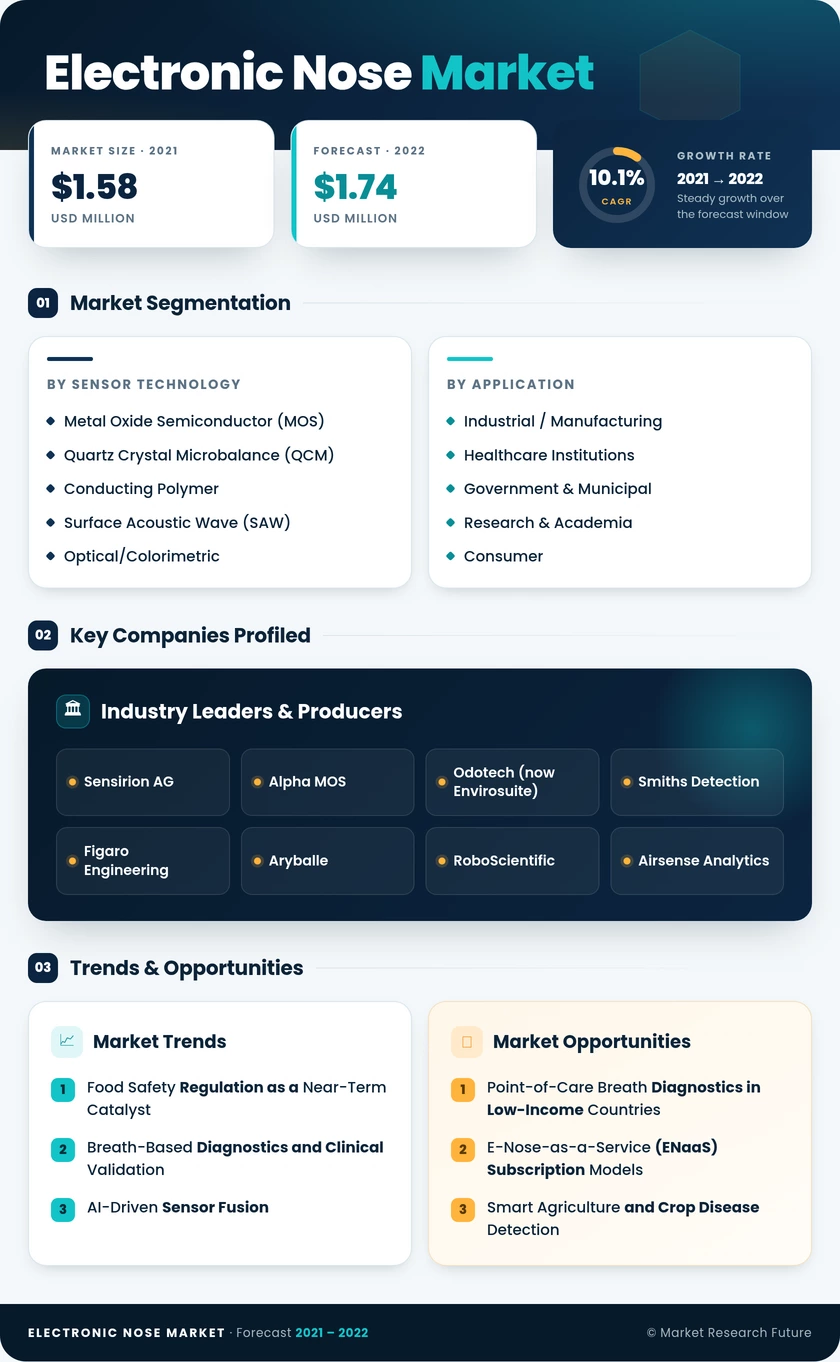
Electronic Nose Market

ID: MRFR/SEM/21038-HCR
128 Pages
Ankit Gupta
Last Updated: June 17, 2026
Electronic Nose Market Size, Share and Research Report By Sensor Technology (Metal Oxide Semiconductor (MOS), Quartz Crystal Microbalance (QCM), Conducting Polymer, Surface Acoustic Wave (SAW), Optical/Colorimetric), By Application (Food & Beverage Quality Control, Medical Diagnostics, Environmental Monitoring, Agriculture & Forestry, Defense & Security), By End User (Industrial / Manufacturing, Healthcare Institutions, Government & Municipal, Research & Academia, Consumer) - Industry Forecast to 2035
Download PDF ×

We do not share your information with anyone. However, we may send you emails based on your report interest from time to time. You may contact us at any time to opt-out.

  1. 1 Market Overview |
    1. 1.1 Study Assumptions & Market Definition |
    2. 1.2 Scope of the Study |
    3. 1.3 Research Methodology
  2. 2 Market Summary & Key Takeaways
  3. 3 Market Dynamics |
    1. 3.1 Market Drivers Analysis | |
      1. 3.1.1 Rising Food Safety Regulations | |
      2. 3.1.2 Clinical Breath Diagnostics Adoption | |
      3. 3.1.3 AI and Deep-Learning Sensor Fusion | |
      4. 3.1.4 Environmental Emission Monitoring Mandates | |
      5. 3.1.5 Miniaturization and Cost Reduction | |
      6. 3.1.6 Pharmaceutical Quality-Control Automation | |
      7. 3.1.7 Smart Agriculture and Precision Farming |
    2. 3.2 Market Restraints Analysis | |
      1. 3.2.1 Sensor Drift and Calibration Complexity | |
      2. 3.2.2 Lack of Standardized Testing Protocols | |
      3. 3.2.3 High Initial Integration Costs for SMEs | |
      4. 3.2.4 Limited Clinician Trust in AI-Based Diagnostics | |
      5. 3.2.5 Data Privacy Concerns in Medical E-Nose |
    3. 3.3 Market Opportunity Analysis | |
      1. 3.3.1 Point-of-Care Breath Diagnostics in Low-Income Countries | |
      2. 3.3.2 E-Nose-as-a-Service (ENaaS) Subscription Models | |
      3. 3.3.3 Smart Agriculture and Crop Disease Detection | |
      4. 3.3.4 Data Monetization Through Odor Signature Libraries | |
      5. 3.3.5 Integration with Smart-City Air-Quality Networks |
    4. 3.4 Industry Value Chain Analysis |
    5. 3.5 Porter's Five Forces Analysis
  4. 4 Global Electronic Nose Market Size & Forecast (2021–2035) |
    1. 4.1 Historical Market Size (2021–2025) |
    2. 4.2 Current & Forecast Market Size (2026–2035) |
    3. 4.3 Market Size by Revenue (USD Billion) |
    4. 4.4 Year-over-Year Growth Analysis
  5. 5 Segmentation Analysis |
    1. 5.1 By Sensor Technology | |
      1. 5.1.1 Metal Oxide Semiconductor (MOS) | |
      2. 5.1.2 Quartz Crystal Microbalance (QCM) | |
      3. 5.1.3 Conducting Polymer | |
      4. 5.1.4 Surface Acoustic Wave (SAW) | |
      5. 5.1.5 Optical/Colorimetric |
    2. 5.2 By Application | |
      1. 5.2.1 Food & Beverage Quality Control | |
      2. 5.2.2 Medical Diagnostics | |
      3. 5.2.3 Environmental Monitoring | |
      4. 5.2.4 Agriculture & Forestry | |
      5. 5.2.5 Defense & Security |
    3. 5.3 By End User | |
      1. 5.3.1 Industrial / Manufacturing | |
      2. 5.3.2 Healthcare Institutions | |
      3. 5.3.3 Government & Municipal | |
      4. 5.3.4 Research & Academia | |
      5. 5.3.5 Consumer
  6. 6 Regional Analysis |
    1. 6.1 North America | |
      1. 6.1.1 United States | |
      2. 6.1.2 Canada | |
      3. 6.1.3 Mexico |
    2. 6.2 Europe | |
      1. 6.2.1 Germany | |
      2. 6.2.2 United Kingdom | |
      3. 6.2.3 France | |
      4. 6.2.4 Rest of Europe |
    3. 6.3 Asia-Pacific | |
      1. 6.3.1 China | |
      2. 6.3.2 Japan | |
      3. 6.3.3 India | |
      4. 6.3.4 South Korea | |
      5. 6.3.5 Rest of Asia-Pacific |
    4. 6.4 South America | |
      1. 6.4.1 Brazil | |
      2. 6.4.2 Argentina | |
      3. 6.4.3 Rest of South America |
    5. 6.5 Middle East & Africa | |
      1. 6.5.1 UAE | |
      2. 6.5.2 Saudi Arabia | |
      3. 6.5.3 Rest of Middle East & Africa
  7. 7 Competitive Landscape |
    1. 7.1 Market Share Analysis (2025) |
    2. 7.2 Competitive Benchmarking Matrix |
    3. 7.3 Company Profiles | |
      1. 7.3.1 Sensirion AG | |
      2. 7.3.2 Alpha MOS | |
      3. 7.3.3 Envirosuite (Odotech) | |
      4. 7.3.4 Smiths Detection | |
      5. 7.3.5 Figaro Engineering | |
      6. 7.3.6 Aryballe | |
      7. 7.3.7 RoboScientific | |
      8. 7.3.8 Airsense Analytics | |
      9. 7.3.9 Syscor Controls & Automation | |
      10. 7.3.10 Scensive Technologies
  8. 8 Future Outlook & Strategic Recommendations (2026–2035) |
    1. 8.1 AI-Native Sensor Platforms |
    2. 8.2 Regulatory Convergence and Standardization |
    3. 8.3 Sustainability and Circular Economy Integration |
    4. 8.4 Consumer-Grade E-Nose Devices
  9. 9 Recent Developments & News
  10. 10 Frequently Asked Questions (FAQs)
  11. 11 Report Scope & Methodology |
    1. 11.1 Study Period & Base Year |
    2. 11.2 Data Sources & Citations |
    3. 11.3 Abbreviations ---
  12. 12 LIST OF TABLES ---
  13. 13 LIST OF FIGURES ---

Segmentation Quick Reference

DimensionSub-SegmentsDominant SegmentFastest Growing Segment
By Sensor TechnologyMOS, QCM, Conducting Polymer, SAW, Optical/ColorimetricMetal Oxide Semiconductor (MOS)Quartz Crystal Microbalance (QCM)
By ApplicationFood & Beverage QC, Medical Diagnostics, Environmental Monitoring, Agriculture & Forestry, Defense & SecurityFood & Beverage Quality ControlMedical Diagnostics
By End UserIndustrial/Manufacturing, Healthcare Institutions, Government & Municipal, Research & Academia, ConsumerIndustrial / ManufacturingConsumer


  • --

Market Segmentation Overview

By Sensor Technology

Sub-SegmentKey Trend
Metal Oxide Semiconductor (MOS)Mature, cost-optimized arrays dominate food and industrial deployments
Quartz Crystal Microbalance (QCM)Growing clinical and pharmaceutical adoption due to high sensitivity
Conducting PolymerLow-power, ambient-temperature operation driving portable device design
Surface Acoustic Wave (SAW)Robust performance in defense and hazardous-environment applications
Optical/ColorimetricEmerging lab-on-chip integration enabling point-of-care diagnostics


MOS sensors remain the backbone of commercial e-nose systems due to their sub-USD 3 per-sensor cost and proven performance in high-volume screening applications. QCM and optical platforms are gaining ground in precision-critical verticals where parts-per-trillion sensitivity justifies higher per-unit pricing.

By Application

Sub-SegmentKey Trend
Food & Beverage Quality ControlRegulatory mandates driving automated inline spoilage detection
Medical DiagnosticsBreath-analysis clinical trials expanding across oncology and respiratory care
Environmental MonitoringSmart-city and industrial-perimeter deployments are scaling globally.
Agriculture & ForestryGrain-storage and crop-disease detection pilots in India and Brazil
Defense & SecurityExplosive and chemical-agent detection for homeland security agencies


Food and beverage quality control generates the largest share of e-nose transactions globally, reflecting the sector's high testing frequency and regulatory pressure. Medical diagnostics is transitioning from research-stage to commercial-stage, with regulatory clearances expected to accelerate adoption through 2030.

By End User

Sub-SegmentKey Trend
Industrial / ManufacturingScale-driven procurement with predictable replacement cycles
Healthcare InstitutionsHospital procurement budgets are increasingly allocating for breath-diagnostic devices.
Government & MunicipalMulti-year service contracts for environmental and public-health monitoring
Research & AcademiaContinuous demand for flexible, configurable sensor platforms
ConsumerEmerging segment driven by miniaturized personal air-quality and food-freshness devices


Industrial end users provide the stable demand foundation for the electronic nose market, while healthcare and consumer segments represent the highest-growth opportunity tiers through 2035.

  • --