×
Hero Background
English
Chinese
French
Japanese
Korean
German
Spanish

Electroactive Polymers Market Size

ID: MRFR/CnM/4210-HCR
137 Pages
Chitranshi Jaiswal
October 2025

Electroactive Polymers (EAP) Market Research Information By Product Type (Conductive Polymers, Inherently Dissipative Polymers, Others), By The Application (Actuators, Sensors, Esd & Emi Protection, Others) – Forecast Till 2035

Share:
Download PDF ×

We do not share your information with anyone. However, we may send you emails based on your report interest from time to time. You may contact us at any time to opt-out.

Electroactive Polymers Market Infographic
Purchase Options

Electroactive Polymers Size

Electroactive Polymers Market Growth Projections and Opportunities

Many variables affect the Electroactive Polymers (EAP) market's dynamics and growth. The growing need for lightweight and flexible materials across sectors is a key market force. Electroactive polymers, which are lightweight and flexible, are used in robotics, healthcare, and electronics, boosting market expansion. The push toward shrinking in electronic devices is also driving EAP use because they can design tiny and finely structured components.

Technological advances shape the Electroactive Polymers market. Continuous research and development introduces new EAP formulations with improved characteristics and functions. This technological advancement is extending electroactive polymer applications and increasing market competition. Companies who invest in cutting-edge research and launch new goods get a competitive edge, influencing EAP industry growth and direction.

Global environmental concerns are driving industries like Electroactive Polymers to adopt eco-friendly solutions. EAPs lower carbon footprints by using eco-friendly materials. Demand for electroactive polymers is predicted to rise as industry adopt sustainable practices. Regulatory actions encouraging eco-friendly materials increase environmental considerations in the EAP market.

Economic conditions may affect the Electroactive Polymers market. Economic stability, disposable income, and consumer purchasing patterns affect EAP product demand. In periods of economic success, enterprises invest in new technology, driving the EAP market. In contrast, economic downturns may delay electroactive polymer adoption as industries slash costs.

Industry alliances are another important market element. Electroactive polymers are used in many industries, thus EAP manufacturers, end-users, and research institutes must collaborate to develop customized solutions and improve market reach. Partnerships may create new products, share research, and build a strong supply chain, which helps the Electroactive Polymers market grow and stabilize.

Geopolitical events and trade policy affect markets. International trade agreements, tariffs, and geopolitical concerns can affect EAP manufacturers' supply chains, production costs, and market access. Market operators must carefully handle geopolitical dynamics to avoid risks and capitalize on global possibilities."
Electroactive Polymers Market Size Graph
Author
Chitranshi Jaiswal
Research Analyst Level I

In her 3 years of experience in the market research field, she has handled critical cross-domain projects. She has an in-depth knowledge of market estimation & analysis, problem-solving, primary as well as secondary research, and team management.She holds an engineering degree and is an MBA professional from a well-known university, capable of evaluating the market and competitive conditions. An exceptional strategist with excellent communication skills and a passion for delivering cutting-edge & practical insights for the market. Proficient in multi-tasking, and can successfully deal with competing demands, while maintaining complete confidentiality. Generated business through active client and project development, networking, and high-quality responses. Her knowledge and skills have helped in making solid business decisions, securing funding from investors, and avoiding business failures.

Leave a Comment

FAQs

Who is going to top the list of the electroactive polymers (EAP) market?

Players making a strong impact on the electroactive polymers (EAP) market are Parker-Hannifin Corporation (U.S.) Solvay (Belgium), Merck Sharp & Dohme Corporation (Germany), Agfa-Gevaert Group (Belgium), 3M (U.S.), Premix (Finland), PolyOne Corporation (U.S.), NOVASENTIS, INC (U.S.), The Lubrizol Corporation (U.S.), and Kenner Material & System Co., Ltd (China).

Which region is going to rise with the fastest CAGR among the electroactive polymers (EAP) regional markets?

The Asia Pacific region would lead the electroactive polymers (EAP) market in terms of growth.

Which application-based segment is going to lead the electroactive polymers (EAP) market?

The electrostatic discharge segment would lead the application-based segmentation of the global electroactive polymers (EAP) market.

What strategies are the leading players implementing to take the global electroactive polymers (EAP) market forward?

Merger, acquisition, product launch, hike in R&D investment, better innovation, collaboration, brand positioning, and others are some of the effective measures that the market players are implementing.

What CAGR would the electroactive polymers (EAP) market achieve during the forecast period (2017-2024)?

The electroactive polymers (EAP) market has a possibility of getting ahead with 7% CAGR during the forecast period of 2025 to 2035.

Market Summary

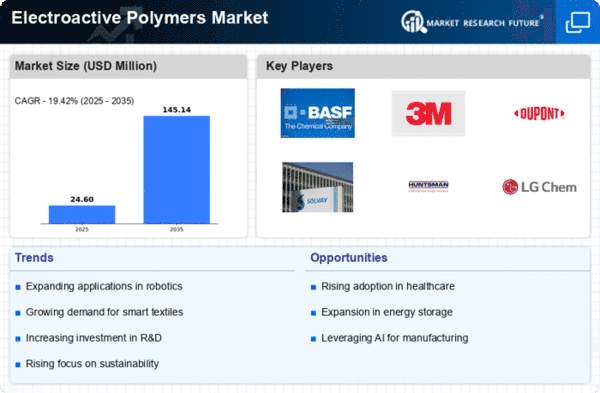
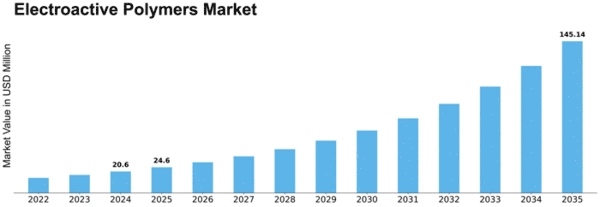
As per Market Research Future analysis, the Electroactive Polymers Market Size was estimated at 20.6 USD Million in 2024. The Electroactive Polymers industry is projected to grow from USD 24.61 Million in 2025 to USD 145.14 Million by 2035, exhibiting a compound annual growth rate (CAGR) of 19.42% during the forecast period 2025 - 2035

Key Market Trends & Highlights

The Electroactive Polymers Market is poised for substantial growth driven by technological advancements and sustainability initiatives.

  • North America remains the largest market for electroactive polymers, driven by robust demand across various industries.
  • The Asia-Pacific region is emerging as the fastest-growing market, fueled by increasing investments in smart materials and innovative technologies.
  • Sensors dominate the market as the largest segment, while actuators are recognized as the fastest-growing segment due to their expanding applications.
  • Key market drivers include the rising demand for smart materials and advancements in energy harvesting technologies, which are shaping the industry's future.

Market Size & Forecast

2024 Market Size 20.6 (USD Million)
2035 Market Size 145.14 (USD Million)
CAGR (2025 - 2035) 19.42%
Largest Regional Market Share in 2024 North America

Major Players

<p>BASF SE (DE), 3M Company (US), DuPont de Nemours, Inc. (US), Solvay S.A. (BE), Huntsman Corporation (US), LG Chem Ltd. (KR), Mitsubishi Chemical Corporation (JP), Covestro AG (DE), RTP Company (US)</p>

Market Trends

The Electroactive Polymers Market is currently experiencing a transformative phase, driven by advancements in material science and increasing applications across various industries. These polymers, which respond to electrical stimuli, are finding their way into sectors such as automotive, healthcare, and consumer electronics. The growing demand for smart materials that can adapt to their environment is propelling innovation and investment in this field. As industries seek to enhance functionality and efficiency, the Electroactive Polymers Market is poised for substantial growth, with new applications emerging regularly. In addition to technological advancements, environmental considerations are influencing the Electroactive Polymers Market. Manufacturers are increasingly focusing on sustainable practices, leading to the development of eco-friendly materials that do not compromise performance. This shift towards sustainability is not only appealing to consumers but also aligns with global efforts to reduce environmental impact. As the market evolves, it appears that the integration of electroactive polymers into everyday products will become more prevalent, potentially reshaping the landscape of multiple sectors.

Sustainability Initiatives

The Electroactive Polymers Market is witnessing a notable shift towards sustainable practices. Manufacturers are increasingly prioritizing eco-friendly materials and production methods, which align with global environmental goals. This trend reflects a growing consumer preference for products that minimize ecological impact, thereby influencing the development of new, sustainable electroactive polymers.

Technological Advancements

Continuous innovation in material science is driving the Electroactive Polymers Market forward. New formulations and processing techniques are enhancing the performance and versatility of these materials. As industries explore novel applications, the integration of advanced technologies is likely to expand the scope of electroactive polymers in various sectors.

Diverse Applications

The range of applications for electroactive polymers is broadening significantly. From automotive components to medical devices, these materials are being utilized in an increasing number of fields. This diversification suggests that the Electroactive Polymers Market may continue to grow as new use cases are discovered and developed.

Electroactive Polymers Market Market Drivers

Market Growth Projections

The Global Electroactive Polymers Market Industry is poised for substantial growth, with projections indicating a market size of 3.25 USD Billion in 2024 and an anticipated increase to 7.5 USD Billion by 2035. This growth trajectory suggests a compound annual growth rate of 7.9% from 2025 to 2035, reflecting the increasing adoption of electroactive polymers across various industries. Factors contributing to this growth include advancements in technology, rising demand for smart materials, and the integration of these polymers in renewable energy applications. The market's expansion indicates a robust interest in innovative materials that enhance functionality and efficiency.

Rising Demand for Smart Materials

The Global Electroactive Polymers Market Industry is experiencing a surge in demand for smart materials, which are increasingly utilized in various applications such as sensors, actuators, and artificial muscles. This trend is driven by advancements in technology and the growing need for innovative solutions in sectors like healthcare and robotics. The market is projected to reach 3.25 USD Billion in 2024, reflecting a robust interest in materials that can respond to external stimuli. As industries seek to enhance functionality and efficiency, the adoption of electroactive polymers is likely to expand, indicating a promising trajectory for the market.

Growing Demand in Automotive Sector

The Global Electroactive Polymers Market Industry is experiencing a notable increase in demand from the automotive sector. Electroactive polymers are being integrated into various automotive applications, including sensors, actuators, and smart materials for vehicle interiors. As the automotive industry moves towards electrification and automation, the need for lightweight and efficient materials is becoming paramount. This trend is expected to contribute significantly to the market's growth, with projections indicating a potential market size of 7.5 USD Billion by 2035. The automotive sector's focus on innovation and sustainability is likely to drive further adoption of electroactive polymers.

Advancements in Healthcare Technologies

The Global Electroactive Polymers Market Industry is significantly influenced by advancements in healthcare technologies. Electroactive polymers are increasingly utilized in medical devices, including drug delivery systems and implantable devices, due to their biocompatibility and ability to respond to physiological stimuli. The growing focus on personalized medicine and minimally invasive procedures is likely to drive the demand for these materials. As healthcare continues to evolve, the integration of electroactive polymers into innovative medical solutions may enhance patient outcomes and operational efficiencies, suggesting a strong growth potential for the market in the coming years.

Growth in Renewable Energy Applications

The Global Electroactive Polymers Market Industry is witnessing significant growth due to the increasing integration of electroactive polymers in renewable energy applications. These materials are essential in the development of energy-efficient devices such as solar panels and fuel cells. As the world shifts towards sustainable energy solutions, the demand for electroactive polymers is expected to rise. By 2035, the market could reach 7.5 USD Billion, driven by the need for innovative materials that enhance energy conversion and storage. This growth reflects a broader commitment to sustainability and the potential for electroactive polymers to play a crucial role in the energy transition.

Increased Investment in Research and Development

The Global Electroactive Polymers Market Industry benefits from increased investment in research and development across various sectors. Companies and research institutions are focusing on developing new formulations and applications for electroactive polymers, which could lead to enhanced performance and functionality. This trend is particularly evident in industries such as automotive and aerospace, where lightweight and efficient materials are in high demand. The anticipated compound annual growth rate of 7.9% from 2025 to 2035 indicates a robust commitment to innovation, suggesting that ongoing R&D efforts will play a pivotal role in shaping the future of the market.

Market Segment Insights

By Application: Sensors (Largest) vs. Actuators (Fastest-Growing)

<p>In the Electroactive Polymers Market, the application segment showcases a diverse distribution, with sensors taking the lead as the largest component, attributed to their extensive use in consumer electronics and industrial automation. Following closely are actuators, which are rapidly gaining traction due to advancements in robotics and automation technologies. Other segments like artificial muscles, energy harvesting, and smart textiles, while important, currently hold smaller market shares but are poised for future innovations. The growth trends in this segment are driven by the increasing demand for smart and efficient technologies across multiple industries. Particularly, the sensors segment is benefiting from the rise of the Internet of Things (IoT), whereas actuators are being propelled by the need for precision and automation. Emerging applications like artificial muscles and energy harvesting are increasingly attracting investments, indicating a future shift in market dynamics.</p>

<p>Sensors (Dominant) vs. Energy Harvesting (Emerging)</p>

<p>The Sensors segment in the Electroactive Polymers Market is characterized by its dominance, driven by the widespread integration of sensors in various applications ranging from healthcare to automotive. These sensors offer unique advantages such as flexibility and lightweight design, which are crucial for modern applications. In contrast, the Energy Harvesting segment is deemed emerging, focusing on capturing and converting ambient energy into usable power. This segment is gaining attention as industries seek sustainable energy solutions. The potential for innovation in energy harvesting technologies positions it as a key player for future growth, aligning with global trends towards sustainability and reduced carbon footprints. This contrast between a well-established dominant segment and an innovative emerging segment showcases the dynamic nature of the market.</p>

By Type: Conductive Polymers (Largest) vs. Shape Memory Polymers (Fastest-Growing)

<p>In the Electroactive Polymers Market, Conductive Polymers currently hold the largest share, making them a predominant choice across various applications, including automotive and electronics. Their versatility and excellent electrical properties have cemented their position, while other types like Dielectric Polymers and Ionic Polymers also play crucial roles, albeit with smaller market shares. Shape Memory Polymers, while not the largest, represent an exciting shift in the market due to their unique properties, catering to specialized applications in medical devices and soft robotics.</p>

<p>Conductive Polymers (Dominant) vs. Shape Memory Polymers (Emerging)</p>

<p>Conductive Polymers are well established in the market, prized for their ability to conduct electricity while maintaining flexibility, making them ideal for applications in flexible electronics, sensors, and energy storage. Their widespread usage ensures a consistent demand, supporting innovation in product development. In contrast, Shape Memory Polymers represent an emerging segment characterized by their adaptability and ability to return to a predefined shape when subjected to specific stimuli. This property enables innovative applications in sectors such as medical devices and consumer products, attracting investment and driving research into their commercial viability.</p>

By End Use Industry: Automotive (Largest) vs. Aerospace (Fastest-Growing)

<p>In the Electroactive Polymers Market, the end use industry segment showcases a diverse landscape with automotive applications leading in market share. This dominance is attributed to the rising demand for lightweight materials and advanced technologies aimed at enhancing vehicle performance and fuel efficiency. Following automotive, healthcare and consumer electronics also represent significant portions, contributing to the evolution of electroactive polymers in various specialized applications. Meanwhile, robotics is gradually establishing its niche, signaling increasing integration into diverse products.</p>

<p>Automotive: Dominant vs. Aerospace: Emerging</p>

<p>The automotive sector dominates the end use industry for electroactive polymers, driven by the need for innovation in electric vehicles and smart automotive technologies. As automotive manufacturers continue to enhance vehicle performance through the incorporation of advanced lightweight polymers, market demand remains robust. In contrast, the aerospace sector, though currently smaller in share, is emerging rapidly due to its focus on high-performance components that require materials with superior electroactive properties. The aerospace industry demands materials that can withstand extreme conditions while providing reliability and efficiency, thereby stimulating significant growth in the use of electroactive polymers in applications like flight control systems and next-generation aircraft designs.</p>

Get more detailed insights about Electroactive Polymers Market Research Report - Forecast to 2035

Regional Insights

North America : Market Leader in Innovation

North America is poised to maintain its leadership in the Electroactive Polymers market, holding a significant market share of 10.36 in 2024. The region's growth is driven by increasing demand in sectors such as automotive, healthcare, and consumer electronics. Regulatory support for advanced materials and sustainability initiatives further catalyze market expansion, making it a hub for innovation and investment in electroactive technologies. The competitive landscape is robust, with key players like BASF SE, 3M Company, and DuPont de Nemours, Inc. leading the charge. The U.S. is the primary market, supported by a strong manufacturing base and R&D capabilities. Companies are focusing on strategic partnerships and technological advancements to enhance product offerings and meet the growing demand for smart materials.

Europe : Emerging Market with Potential

Europe is witnessing a growing interest in the Electroactive Polymers market, with a market size of 5.18 in 2024. The region's growth is fueled by increasing investments in renewable energy and smart technologies, alongside stringent regulations promoting sustainable materials. The European Union's Green Deal and initiatives for circular economy practices are significant drivers, encouraging innovation in electroactive solutions. Leading countries such as Germany, France, and the UK are at the forefront of this market, with companies like Solvay S.A. and Covestro AG making substantial contributions. The competitive landscape is characterized by a mix of established players and innovative startups, all vying to capture market share in this evolving sector. The focus on sustainability and advanced applications is expected to propel further growth.

Asia-Pacific : Rapid Growth and Adoption

Asia-Pacific is emerging as a significant player in the Electroactive Polymers market, with a market size of 4.92 in 2024. The region's growth is driven by rapid industrialization, urbanization, and increasing demand for advanced materials in electronics and automotive sectors. Government initiatives promoting smart manufacturing and technological advancements are also key catalysts for market expansion. Countries like China, Japan, and South Korea are leading the charge, with major companies such as LG Chem Ltd. and Mitsubishi Chemical Corporation actively investing in R&D. The competitive landscape is dynamic, with a mix of local and international players striving to innovate and capture market share. The focus on high-performance materials is expected to drive further growth in this region.

Middle East and Africa : Niche Market with Opportunities

The Middle East and Africa represent a niche market for Electroactive Polymers, with a market size of 0.14 in 2024. The region is gradually recognizing the potential of these materials, driven by increasing investments in technology and infrastructure. The demand for electroactive solutions is expected to grow as industries such as oil and gas, and renewable energy seek innovative materials to enhance efficiency and sustainability. Countries like South Africa and the UAE are beginning to explore the applications of electroactive polymers, although the market is still in its infancy. The presence of key players is limited, but there is potential for growth as local industries evolve and seek advanced materials. Strategic partnerships and investments will be crucial for market development in this region.

Key Players and Competitive Insights

The Electroactive Polymers Market is currently characterized by a dynamic competitive landscape, driven by innovation, sustainability, and strategic partnerships. Key players such as BASF SE (DE), 3M Company (US), and DuPont de Nemours, Inc. (US) are actively shaping the market through their distinct operational focuses. BASF SE (DE) emphasizes innovation in material science, particularly in developing advanced electroactive materials for automotive and aerospace applications. Meanwhile, 3M Company (US) leverages its extensive research capabilities to enhance product performance and expand its portfolio in smart materials. DuPont de Nemours, Inc. (US) is strategically positioned towards sustainability, focusing on eco-friendly electroactive solutions that align with global environmental standards. Collectively, these strategies foster a competitive environment that prioritizes technological advancement and market responsiveness.

In terms of business tactics, companies are increasingly localizing manufacturing to reduce lead times and optimize supply chains. The market structure appears moderately fragmented, with several key players exerting influence while also allowing for niche entrants. This fragmentation encourages innovation and competition, as companies strive to differentiate their offerings in a crowded marketplace.

In November 2025, BASF SE (DE) announced a collaboration with a leading automotive manufacturer to develop next-generation electroactive polymers aimed at enhancing vehicle efficiency. This partnership is significant as it not only reinforces BASF's commitment to innovation but also positions it strategically within the rapidly evolving automotive sector, where lightweight and efficient materials are paramount.

In October 2025, 3M Company (US) launched a new line of electroactive polymers designed for use in wearable technology. This move is indicative of 3M's strategy to penetrate the growing market for smart textiles, which is expected to expand significantly in the coming years. By diversifying its product offerings, 3M is likely to capture a larger share of the market and respond to the increasing demand for integrated technology solutions.

In September 2025, DuPont de Nemours, Inc. (US) unveiled a new eco-friendly electroactive polymer that is fully recyclable. This development aligns with the company's sustainability goals and reflects a broader industry trend towards environmentally responsible materials. By prioritizing sustainability, DuPont is not only meeting regulatory demands but also appealing to a growing consumer base that values eco-conscious products.

As of December 2025, the Electroactive Polymers Market is witnessing trends such as digitalization, AI integration, and a heightened focus on sustainability. Strategic alliances are increasingly shaping the competitive landscape, enabling companies to pool resources and expertise. Looking ahead, competitive differentiation is likely to evolve from traditional price-based competition to a focus on innovation, technological advancements, and supply chain reliability. This shift underscores the importance of agility and responsiveness in a market that is rapidly changing.

Key Companies in the Electroactive Polymers Market market include

Industry Developments

Future Outlook

Electroactive Polymers Market Future Outlook

<p>The Electroactive Polymers Market is projected to grow at a 19.42% CAGR from 2024 to 2035, driven by advancements in smart materials, increasing demand in automotive applications, and innovations in healthcare technologies.</p>

New opportunities lie in:

  • <p>Development of biodegradable electroactive polymers for sustainable applications.</p>
  • <p>Integration of electroactive polymers in wearable health monitoring devices.</p>
  • <p>Expansion of electroactive polymer applications in robotics and automation systems.</p>

<p>By 2035, the Electroactive Polymers Market is expected to achieve substantial growth and innovation.</p>

Market Segmentation

Electroactive Polymers Market Type Outlook

  • Conductive Polymers
  • Dielectric Polymers
  • Shape Memory Polymers
  • Electrostrictive Polymers
  • Ionic Polymers

Electroactive Polymers Market Application Outlook

  • Sensors
  • Actuators
  • Artificial Muscles
  • Energy Harvesting
  • Smart Textiles

Electroactive Polymers Market End Use Industry Outlook

  • Automotive
  • Aerospace
  • Healthcare
  • Consumer Electronics
  • Robotics

Report Scope

MARKET SIZE 202420.6(USD Million)
MARKET SIZE 202524.61(USD Million)
MARKET SIZE 2035145.14(USD Million)
COMPOUND ANNUAL GROWTH RATE (CAGR)19.42% (2024 - 2035)
REPORT COVERAGERevenue Forecast, Competitive Landscape, Growth Factors, and Trends
BASE YEAR2024
Market Forecast Period2025 - 2035
Historical Data2019 - 2024
Market Forecast UnitsUSD Million
Key Companies ProfiledBASF SE (DE), 3M Company (US), DuPont de Nemours, Inc. (US), Solvay S.A. (BE), Huntsman Corporation (US), LG Chem Ltd. (KR), Mitsubishi Chemical Corporation (JP), Covestro AG (DE), RTP Company (US)
Segments CoveredApplication, Type, End Use Industry
Key Market OpportunitiesAdvancements in smart materials and wearable technology drive growth in the Electroactive Polymers Market.
Key Market DynamicsTechnological advancements drive demand for electroactive polymers in diverse applications, enhancing market competitiveness and innovation.
Countries CoveredNorth America, Europe, APAC, South America, MEA

FAQs

Who is going to top the list of the electroactive polymers (EAP) market?

Players making a strong impact on the electroactive polymers (EAP) market are Parker-Hannifin Corporation (U.S.) Solvay (Belgium), Merck Sharp &amp; Dohme Corporation (Germany), Agfa-Gevaert Group (Belgium), 3M (U.S.), Premix (Finland), PolyOne Corporation (U.S.), NOVASENTIS, INC (U.S.), The Lubrizol Corporation (U.S.), and Kenner Material &amp; System Co., Ltd (China).

Which region is going to rise with the fastest CAGR among the electroactive polymers (EAP) regional markets?

The Asia Pacific region would lead the electroactive polymers (EAP) market in terms of growth.

Which application-based segment is going to lead the electroactive polymers (EAP) market?

The electrostatic discharge segment would lead the application-based segmentation of the global electroactive polymers (EAP) market.

What strategies are the leading players implementing to take the global electroactive polymers (EAP) market forward?

Merger, acquisition, product launch, hike in R&amp;D investment, better innovation, collaboration, brand positioning, and others are some of the effective measures that the market players are implementing.

What CAGR would the electroactive polymers (EAP) market achieve during the forecast period (2017-2024)?

The electroactive polymers (EAP) market has a possibility of getting ahead with 7% CAGR during the forecast period of 2025 to 2035.

  1. Executive Summary
  2. Scope of the Report
    1. Market Definition
    2. Scope of the Study
      1. Research Objectives
      2. Assumptions & Limitations
    3. Markets Structure
  3. Market Research
    1. Methodology
    2. Research Process
    3. Secondary Research
    4. Primary
    5. Research
    6. Forecast Model
  4. Market Landscape
    1. Porter’s
      1. Threat of New Entrants
      2. Bargaining power
      3. Threat of substitutes
      4. Segment rivalry
    2. Five Forces Analysis
    3. of buyers
    4. Value
    5. Chain/Supply Chain of Global Electroactive Polymers Market
  5. Industry Overview
    1. of Global Electroactive Polymers Market
    2. Introduction
    3. Growth Drivers
    4. Impact analysis
    5. Market Challenges
  6. Market Trends
    1. Introduction
    2. Growth Trends
    3. Impact analysis
  7. Global Electroactive
    1. Polymers Market by Application
    2. Introduction
    3. Actuators
      1. Market Estimates & Forecast
    4. Market Estimates & Forecast, 2020-2027
    5. by Region, 2020-2027
    6. Sensors
      1. Market Estimates & Forecast,
      2. Market Estimates & Forecast by Region, 2020-2027
      3. Market Estimates & Forecast, 2020-2027
      4. Market Estimates & Forecast by Region, 2020-2027
    7. ESD & EMI Protection
    8. Antistatic
      1. Market Estimates & Forecast, 2020-2027
      2. Market
    9. Packaging
    10. Estimates & Forecast by Region, 2020-2027
    11. Others
      1. Market
      2. Market Estimates & Forecast by
    12. Estimates & Forecast, 2020-2027
    13. Region, 2020-2027
  8. Global Electroactive Polymers Market by Product Type
    1. Introduction
    2. Conductive Polymers
      1. Market Estimates &
      2. Market Estimates & Forecast by Region, 2020-2027
    3. Forecast, 2020-2027
    4. Inherently Dissipative Polymers
      1. Market Estimates & Forecast,
      2. Market Estimates & Forecast by Region, 2020-2027
      3. Market Estimates & Forecast, 2020-2027
      4. Market Estimates & Forecast by Region, 2020-2027
    5. Inherently Conductive Polymers
    6. Others
      1. Market Estimates & Forecast, 2020-2027
      2. Market Estimates &
    7. Forecast by Region, 2020-2027
  9. Global Electroactive Polymers Market by Region
    1. Introduction
    2. North America
      1. Market Estimates & Forecast,
      2. Market Estimates & Forecast by Application, 2020-2027
      3. Market Estimates & Forecast by Product Type, 2020-2027
      4. U.S.
      5. Mexico
      6. Canada
    3. & Forecast by Application, 2020-2027
    4. by Product Type, 2020-2027
    5. Forecast, 2020-2027
    6. Market Estimates & Forecast by Application, 2020-2027
    7. & Forecast by Product Type, 2020-2027
    8. Europe
      1. Market Estimates
      2. Market Estimates & Forecast by Application,
      3. Market Estimates & Forecast by Product Type, 2020-2027
      4. Germany
      5. France
      6. Italy
      7. Spain
      8. U.K
      9. Rest of Europe
    9. & Forecast, 2020-2027
    10. Market Estimates & Forecast by Application, 2020-2027
    11. & Forecast by Product Type, 2020-2027
    12. Estimates & Forecast, 2020-2027
    13. by Application, 2020-2027
    14. Type, 2020-2027
    15. Market Estimates & Forecast by Product Type, 2020-2027
    16. Market Estimates & Forecast, 2020-2027
    17. by Application, 2020-2027
    18. Type, 2020-2027
    19. Market Estimates & Forecast by Product Type, 2020-2027
    20. & Forecast by Application, 2020-2027
    21. by Product Type, 2020-2027
    22. Asia Pacific
      1. Market Estimates &
      2. Market Estimates & Forecast by Application, 2020-2027
      3. Market Estimates & Forecast by Product Type, 2020-2027
      4. China
      5. India
      6. Japan
      7. Australia
      8. New Zealand
    23. Forecast, 2020-2027
    24. & Forecast by Application, 2020-2027
    25. by Product Type, 2020-2027
    26. Forecast, 2020-2027
    27. Market Estimates & Forecast by Application, 2020-2027
    28. & Forecast by Product Type, 2020-2027
    29. Estimates & Forecast, 2020-2027
    30. by Application, 2020-2027
    31. Type, 2020-2027
    32. Rest of Asia Pacific
    33. Market Estimates & Forecast by Product Type, 2020-2027
    34. The Middle East
      1. Market Estimates & Forecast, 2020-2027
      2. Market
      3. Market Estimates &
      4. Turkey
      5. Israel
      6. North Africa
      7. GCC
      8. Rest of the
    35. & Africa
    36. Estimates & Forecast by Application, 2020-2027
    37. Forecast by Product Type, 2020-2027
    38. & Forecast, 2020-2027
    39. Market Estimates & Forecast by Application, 2020-2027
    40. & Forecast by Product Type, 2020-2027
    41. Market Estimates & Forecast, 2020-2027
    42. by Application, 2020-2027
    43. Type, 2020-2027
    44. Market Estimates & Forecast by Product Type, 2020-2027
    45. Middle East & Africa
    46. Market Estimates & Forecast by Product Type, 2020-2027
    47. Latin America
      1. Market Estimates & Forecast, 2020-2027
      2. Market Estimates &
      3. Market Estimates & Forecast by
      4. Brazil
      5. Rest of Latin America
    48. Forecast by Application, 2020-2027
    49. Product Type, 2020-2027
    50. Argentina
    51. Market Estimates & Forecast by Application, 2020-2027
    52. & Forecast by Product Type, 2020-2027
    53. Market Estimates & Forecast, 2020-2027
    54. by Application, 2020-2027
    55. Type, 2020-2027
  10. Company Landscape
  11. Company Profiles
    1. Solvay
      1. Company Overview
      2. Application/Business Segment Overview
      3. Key Developments
    2. Financial Updates
    3. Parker-Hannifin Corporation
      1. Company Overview
      2. Application/Business Segment Overview
      3. Key Developments
    4. Financial Updates
    5. Agfa-Gevaert Group
      1. Application/Business Segment Overview
      2. Financial
      3. Key Developments
    6. Company Overview
    7. Updates
    8. 3M
      1. Company Overview
      2. Application/Business Segment Overview
      3. Financial Updates
      4. Key Developments
    9. Merck Sharp & Dohme Corporation
      1. Application/Business Segment Overview
      2. Financial
      3. Key Developments
    10. Company Overview
    11. Updates
    12. The Lubrizol Corporation
      1. Application/Business Segment Overview
      2. Financial
      3. Key Developments
    13. Company Overview
    14. Updates
    15. NOVASENTIS, INC
      1. Company
      2. Application/Business Segment Overview
      3. Financial
      4. Key Developments
    16. Overview
    17. Updates
    18. Premix
      1. Company Overview
      2. Application/Business Segment Overview
      3. Financial Updates
      4. Key Developments
    19. PolyOne Corporation
      1. Company Overview
      2. Application/Business Segment Overview
      3. Financial Updates
      4. Key Developments
    20. Kenner Material & System Co., Ltd
      1. Application/Business Segment Overview
      2. Key Developments
    21. Company Overview
    22. Financial Updates
  12. Conclusion
  13. LIST OF TABLES
  14. World Population by Major Regions (2020 To 2030)
  15. Global Electroactive Polymers Market: By Region, 2020-2027
    1. Table
  16. North America Electroactive Polymers Market: By Country, 2020-2027
    1. Table
  17. Europe Electroactive Polymers Market: By Country, 2020-2027
  18. Asia
    1. Pacific Electroactive Polymers Market: By Country, 2020-2027
  19. The Middle
    1. East & Africa Electroactive Polymers Market: By Country, 2020-2027
    2. Table
  20. Latin America Electroactive Polymers Market: By Country, 2020-2027
    1. Table
  21. Global Electroactive Polymers by Application Market: By Regions, 2020-2027
  22. North America Electroactive Polymers by Application Market: By Country,
    1. Table10 Europe Electroactive Polymers by Application Market: By
    2. Country, 2020-2027
    3. Table11 Asia Pacific Electroactive Polymers by Application
    4. Market: By Country, 2020-2027
    5. Table12 The Middle East & Africa Electroactive
    6. Polymers by Application Market: By Country, 2020-2027
    7. Table13 Latin America
    8. Electroactive Polymers by Application Market: By Country, 2020-2027
    9. Table14
    10. Global Electroactive Polymers by Product Type Market: By Regions, 2020-2027
    11. Table15 North America Electroactive Polymers by Product Type Market: By Country,
    12. Table16 Europe Electroactive Polymers by Product Type Market: By
    13. Country, 2020-2027
    14. Table17 Asia Pacific Electroactive Polymers by Product
    15. Type Market: By Country, 2020-2027
    16. Table18 The Middle East & Africa Electroactive
    17. Polymers by Product Type Market: By Country, 2020-2027
    18. Table19 Latin America
    19. Electroactive Polymers by Product Type Market: By Country, 2020-2027
    20. Table20
    21. Global Electroactive Polymers by Product Type Market: By Regions, 2020-2027
    22. Table21 Global Application Market: By Region, 2020-2027
    23. Table22 Global Product
    24. Type Market: By Region, 2020-2027
    25. Table23 Global End-use Market: By Region,
  23. Table24 North America Electroactive Polymers Market, By Country
  24. Table25 North America Electroactive Polymers Market, By Application
    1. Table26
  25. North America Electroactive Polymers Market, By Product Type
    1. Table27 North
  26. America Electroactive Polymers Market, By End-use
    1. Table28 Europe: Electroactive
  27. Polymers Market, By Country
    1. Table29 Europe: Electroactive Polymers Market,
    2. By Application
  28. Table30 Europe: Electroactive Polymers Market, By Product Type
  29. Table31 Europe: Electroactive Polymers Market, By End-use
    1. Table32 Asia Pacific:
  30. Electroactive Polymers Market, By Country
    1. Table33 Asia Pacific: Electroactive
  31. Polymers Market, By Application
    1. Table34 Asia Pacific: Electroactive Polymers
  32. Market, By Product Type
    1. Table35 Asia Pacific: Electroactive Polymers Market,
    2. By End-use
    3. Table36 The Middle East & Africa: Electroactive Polymers Market,
    4. By Country
    5. Table37 The Middle East & Africa Electroactive Polymers Market,
    6. By Application
    7. Table38 The Middle East & Africa Electroactive Polymers
  33. Market, By Product Type
    1. Table39 The Middle East & Africa: Electroactive
  34. Polymers Market, By End-use
    1. Table41 Latin America: Electroactive Polymers Market,
    2. By Country
  35. Table42 Latin America Electroactive Polymers Market, By Application
  36. Table43 Latin America Electroactive Polymers Market, By Product Type
    1. Table44
  37. Latin America: Electroactive Polymers Market, By End-use
    1. LIST OF
    2. FIGURES
  38. Global Electroactive Polymers market segmentation
  39. Forecast Methodology
  40. Five Forces Analysis of Global Electroactive
    1. Polymers Market
  41. Value Chain of Global Electroactive Polymers Market
  42. Share of Global Electroactive Polymers Market in 2020, by country (in
    1. %)
  43. Global Electroactive Polymers Market, 2020-2027,
    1. FIGURE 7
    2. Sub segments of Application
  44. Global Electroactive Polymers Market size
    1. by Application, 2020
  45. Share of Global Electroactive Polymers Market
    1. by Application, 2020-2027
  46. Global Electroactive Polymers Market size
    1. by Product Type, 2020
  47. Share of Global Electroactive Polymers Market
    1. by Product Type, 2020-2027

Electroactive Polymers Market Segmentation

Market Segmentation Overview

  • Detailed segmentation data will be available in the full report
  • Comprehensive analysis by multiple parameters
  • Regional and country-level breakdowns
  • Market size forecasts by segment
Infographic

Free Sample Request

Kindly complete the form below to receive a free sample of this Report

Get Free Sample

Customer Strories

Compare Licence

×
Features License Type
Single User Multiuser License Enterprise User
Price $4,950 $5,950 $7,250
Maximum User Access Limit 1 User Upto 10 Users Unrestricted Access Throughout the Organization
Free Customization
Direct Access to Analyst
Deliverable Format
Platform Access
Discount on Next Purchase 10% 15% 15%
Printable Versions